Telecom Technical Skills : Essential Skills for Careers
Table of Contents
Technical Skills Every Telecom Professional Needs in India
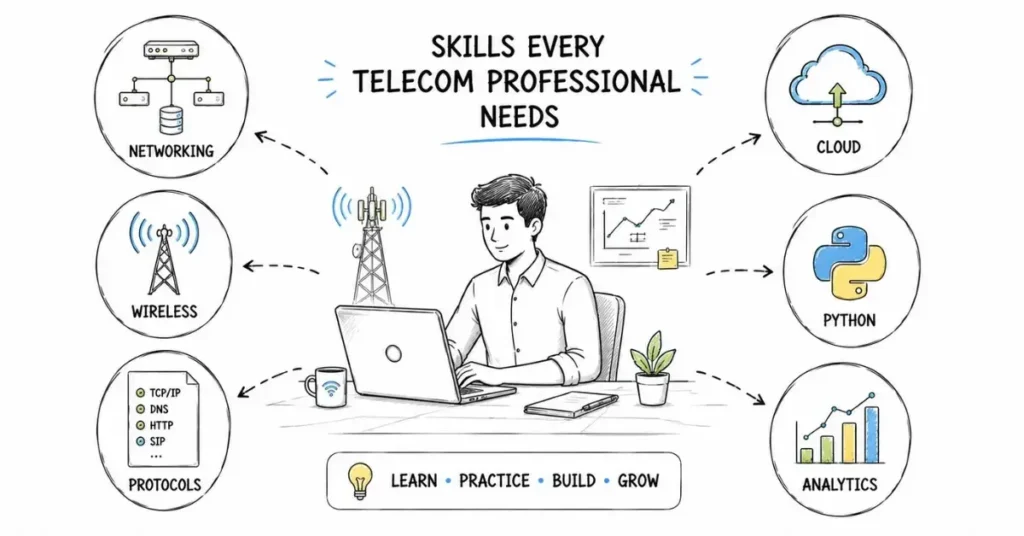
One of the most common mistakes students make when preparing for a telecom career is studying everything broadly and mastering nothing specifically.
They know what 5G is. They have heard of CCNA. They understand, vaguely, what a network engineer does. But when a recruiter at Ericsson or Tech Mahindra asks, “What have you actually worked with?” they do not have a concrete answer.
This post fixes that. It maps the technical skills Indian telecom employers look for by role type, tells you which ones are non-negotiable versus nice-to-have, and gives you a realistic study plan for building them.
Two Types of Skills in Telecom
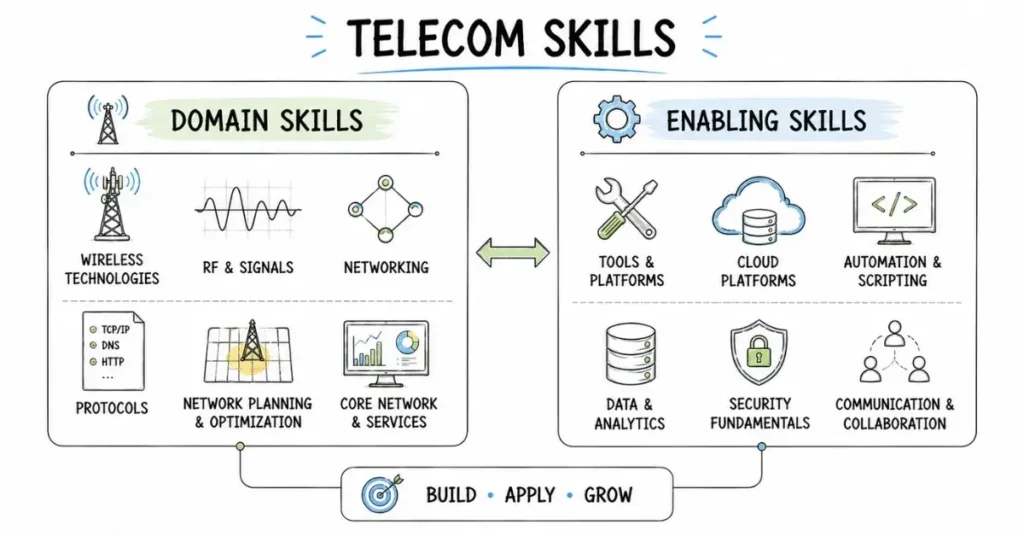
Before listing skills, understand the split that every telecom job description reflects:
Domain skills — knowledge specific to telecom technology: how networks are structured, how signals travel, how protocols work, how billing systems operate. These are the skills that make you a telecom professional rather than a generic IT person.
Enabling skills — tools and technologies that support telecom work: networking certifications, cloud platforms, programming languages, data tools. These exist in other industries too, but in telecom they are applied to specific problems.
You need both. Strong domain knowledge without enabling skills makes you a theorist. Strong enabling skills without domain knowledge makes you someone who has to be trained from scratch at every employer’s expense. The candidates who get hired fastest have both — even at an entry level.
Skill Group 1: Networking Fundamentals
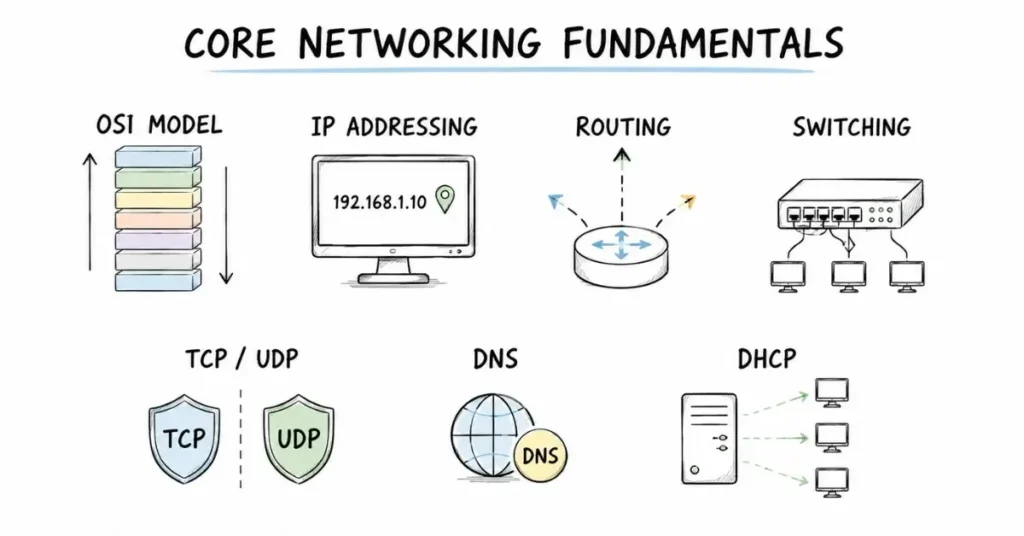
This is the bedrock. Whether you want to be a deployment engineer, a NOC analyst, a core network engineer, or a telecom analyst, you need to understand how data moves across networks.
What specifically you need to know:
- The OSI model — all seven layers, what happens at each one, and why it matters for troubleshooting
- IP addressing and subnetting — calculating subnets, understanding CIDR notation, knowing the difference between private and public IP ranges
- Routing protocols — OSPF and BGP at a functional level (how routers discover each other, how traffic paths are decided)
- Switching basics — VLANs, spanning tree protocol, how Layer 2 networks operate
- TCP/UDP — the difference between them, when each is used, how connection establishment works
- DNS and DHCP — how domain names resolve, how devices get IP addresses automatically
How to build this: Cisco Packet Tracer (free) lets you simulate all of these scenarios on your laptop. Spend 30–45 minutes per day for 8–10 weeks and you will have genuine hands-on experience with every concept above.
Certification that validates it: CCNA. It covers all of the above and is the most recognized networking certification in India’s telecom job market. Consider it your entry ticket.
Skill Group 2: Radio and Wireless Technology Basics
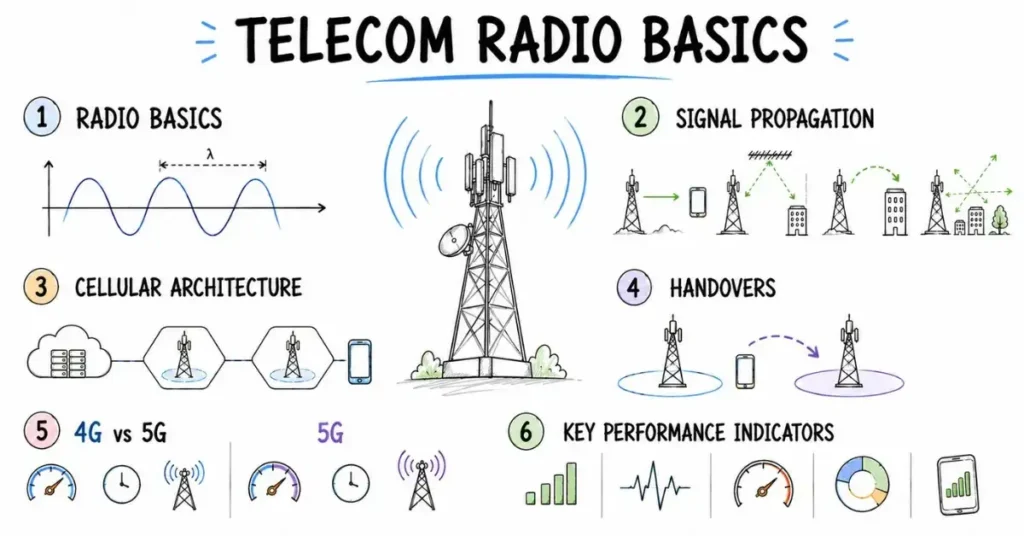
If you are targeting any role that touches the radio side of telecom RF engineer, 5G deployment engineer, drive test engineer, RAN optimization you need to understand how wireless signals work.
What specifically you need to know:
- Radio frequency basics — what frequency and wavelength mean, how different frequencies behave (higher frequency = shorter range but higher capacity)
- Signal propagation — how signals weaken with distance, what causes interference, how buildings and terrain affect coverage
- Cellular network architecture — how cells are structured, what handover is (when your phone switches from one cell to another as you move), what a sector is
- 4G LTE and 5G NR key concepts — OFDM (the modulation technique both use), MIMO (using multiple antennas to send more data), beamforming (focusing signal in a specific direction)
- Key performance indicators (KPIs) — RSRP (signal strength), SINR (signal quality), RSRQ (signal quality relative to interference), throughput, call drop rate
How to build this: The 3GPP website publishes free technical specifications. Start with the overview documents rather than the full specs — they are designed to be readable. Complement this with Nokia’s free online learning resources and YouTube channels like Techplayon, which explain 5G concepts in clear, visual formats.
Certification that validates it: Nokia 5G Associate certification covers RAN fundamentals well. For RF specifically, TELCOMA’s RF engineering courses are well-regarded in India.
Skill Group 3: Telecom-Specific Protocols and Standards
This is where telecom separates itself from general IT networking. Understanding these protocols is what makes a candidate look like they actually know the industry.
Key protocols and standards you should know:
- 3GPP standards — the international body that defines 4G and 5G. You do not need to memorize specifications, but knowing which 3GPP release introduced which feature (5G SA was Release 15, for example) shows awareness.
- Diameter and RADIUS — authentication and authorization protocols used in telecom core networks
- SIP (Session Initiation Protocol) — the protocol that sets up voice and video calls over IP; used in VoIP and IMS (IP Multimedia Subsystem)
- GTP (GPRS Tunnelling Protocol) — how user data is tunnelled through the core network in 4G and early 5G
- SCTP — the transport protocol used for signalling between network elements
- SNMP and YANG/NETCONF — how network equipment is managed and configured remotely; increasingly important as networks move toward automation
You do not need to implement these from scratch. But knowing what they are, what problem they solve, and where in the network they operate lets you hold a meaningful conversation in a technical interview and read a network diagram intelligently.
Skill Group 4: OSS/BSS Knowledge
For anyone targeting analyst, operations, or IT services roles in telecom, OSS and BSS knowledge is the domain skill equivalent of what RF knowledge is for engineers.
What specifically you need to know:
- What OSS covers — fault management, performance management, configuration management, network inventory
- What BSS covers — subscriber management, billing, rating, product catalogue, CRM
- How the two connect — a service provisioned in BSS needs to be reflected in network configuration managed by OSS; failures in that synchronization cause revenue leakage
- Common platforms — Ericsson ENM, Nokia NetAct (OSS side); Amdocs, Oracle BRM, Comverse BSCS (BSS side)
- Revenue assurance basics — understanding the concept of revenue leakage (services delivered but not billed) and how analysts detect it
How to build this: Amdocs and Oracle both publish documentation and training resources online. LinkedIn Learning has introductory courses on telecom BSS/OSS. Even reading the Wikipedia articles on these systems carefully — following every linked concept — gives you a working foundation.
Skill Group 5: Cloud and Virtualisation
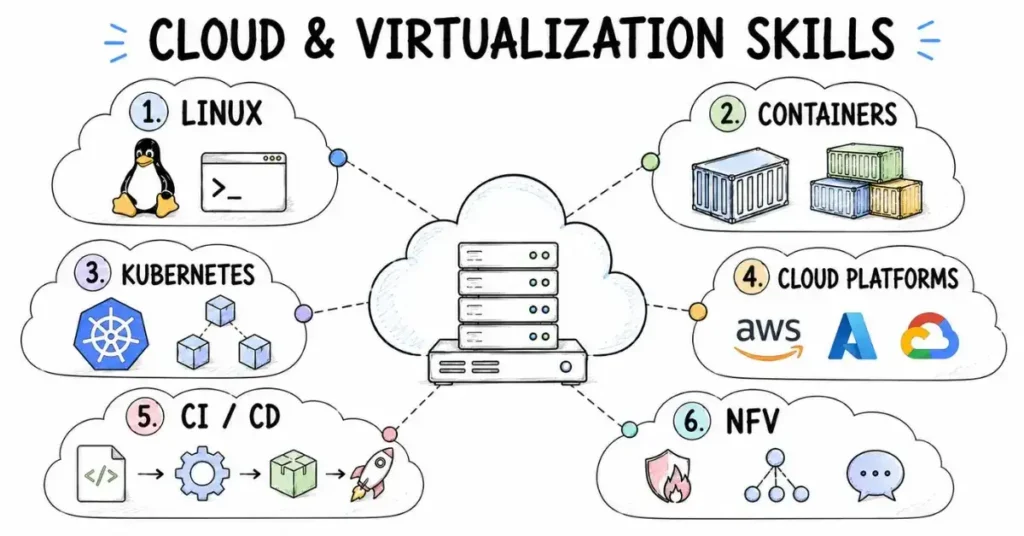
This skill group was optional in telecom three years ago. It is now close to mandatory for anyone targeting 5G core, network automation, or modern managed services roles.
5G core networks are cloud-native. They run as microservices on Kubernetes clusters — the same infrastructure used by software companies to run web applications. This means telecom engineers increasingly need to know:
- Linux command line — navigating the filesystem, reading logs, running processes, using grep and awk for log analysis
- Containers and Kubernetes basics — what Docker containers are, how Kubernetes orchestrates them, how to deploy and check the status of a containerised application
- Cloud platforms — at a minimum, AWS or Azure fundamentals. The specific services relevant to telecom are compute (EC2/VMs), storage, and managed Kubernetes (EKS/AKS).
- CI/CD concepts — how software is continuously built, tested, and deployed using pipelines; relevant for engineers working on cloud-native network functions (CNFs)
- NFV (Network Functions Virtualisation) — the concept of running network functions (like a firewall or a 5G core element) as software on standard servers instead of dedicated hardware
Certifications that validate this: AWS Cloud Practitioner or Azure Fundamentals (both have free study paths and cost ₹8,000–₹12,000 to attempt). For deeper specialisation, AWS Advanced Networking Specialty is the gold standard for cloud network engineers.
Skill Group 6: Python for Network Automation
Python has become the default scripting language across telecom, networking, and cloud. You do not need to become a software engineer. You need to be able to write scripts that make your work faster and more reliable.
What specifically you need to be able to do:
- Read and write files (log files, configuration files, CSV reports)
- Make API calls to retrieve data from network management systems
- Parse JSON and XML responses (most network APIs return data in these formats)
- Loop through lists of network devices and perform an action on each
- Write simple functions and use libraries like requests, paramiko (SSH connections), and pandas (data manipulation)
A realistic benchmark: 100 hours of deliberate Python practice not passive video watching, but actually writing code gets most engineering graduates to a functional level for network automation work.
Where to practice: Cisco DevNet (developer.cisco.com) has free learning paths specifically for network automation with Python. They include sandbox environments where you practice against real virtual network equipment without needing to buy anything.
Skill Group 7: Data and Analytics Skills
For anyone targeting analyst roles — or any engineer who wants to grow beyond pure technical work — data skills are the bridge between technical knowledge and business impact.
What specifically you need:
- SQL — write queries that join multiple tables, filter data, aggregate results, and handle nulls correctly. This single skill opens more telecom analyst roles than any certification.
- Excel (advanced) — pivot tables, dynamic charts, VLOOKUP/XLOOKUP, conditional formatting, and basic macros
- Power BI or Tableau — building interactive dashboards from telecom performance or business data
- Basic statistics — mean, median, standard deviation, trend analysis, and correlation. You do not need a statistics degree — just enough to interpret data correctly and not draw wrong conclusions.
How These Skills Map to Roles
Skill Group | NOC Analyst | Network Engineer | 5G Deployment | Telecom Analyst | Core/Cloud Engineer |
Networking Fundamentals | ✅ Essential | ✅ Essential | ✅ Essential | ⚡ Helpful | ✅ Essential |
RF and Wireless | ❌ Not needed | ⚡ Helpful | ✅ Essential | ❌ Not needed | ❌ Not needed |
Telecom Protocols | ⚡ Helpful | ✅ Essential | ⚡ Helpful | ⚡ Helpful | ✅ Essential |
OSS/BSS | ⚡ Helpful | ❌ Not needed | ❌ Not needed | ✅ Essential | ❌ Not needed |
Cloud/Virtualisation | ❌ Not needed | ⚡ Helpful | ❌ Not needed | ❌ Not needed | ✅ Essential |
Python Automation | ❌ Not needed | ⚡ Helpful | ⚡ Helpful | ⚡ Helpful | ✅ Essential |
Data/Analytics | ❌ Not needed | ❌ Not needed | ❌ Not needed | ✅ Essential | ❌ Not needed |
Use this table to focus your study time. Do not try to build all seven skill groups at once. Pick the two or three that match your target role and go deep on those first.
A 90-Day Skill-Building Plan for Freshers
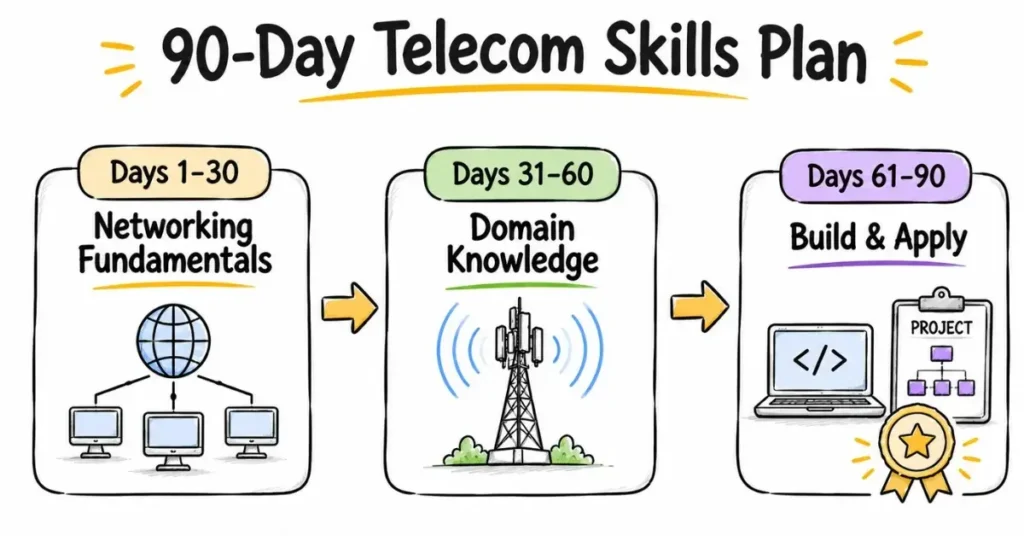
If you are starting from zero today, here is a realistic 90-day plan:
Days 1–30: Networking Fundamentals
- Download Cisco Packet Tracer
- Work through Cisco NetAcad’s CCNA Introduction course (free)
- Build three lab scenarios: basic LAN, inter-VLAN routing, and a simple WAN with OSPF
- Goal: complete all CCNA theory modules
Days 31–60: Domain Knowledge
- Choose your direction (RAN or Core/Analyst) and study accordingly
- RAN path: Nokia 5G Associate study materials + Techplayon YouTube (5G NR fundamentals playlist)
- Core/Analyst path: Introduction to OSS/BSS + SQL basics on Mode Analytics or SQLZoo (free)
- Goal: be able to explain your chosen area clearly in a 5-minute conversation
Days 61–90: Apply and Build
- Attempt your first certification exam (CCNA or Nokia 5G Associate)
- Build one project: a simulated network in Packet Tracer (RAN path) or a SQL analysis of a public telecom dataset from data.gov.in (Analyst path)
- Update LinkedIn with skills, project description, and certification status
- Apply to 10 targeted roles
Ninety days of consistent effort — not intensive cramming, just 1–1.5 hours daily — puts you in a meaningfully better position than the majority of candidates applying for the same entry-level roles.