
Telecommunications Career Guide : 5G & Network Engineering
Table of Contents
Telecommunications Career Guide: 5G & Network Engineering Jobs in India
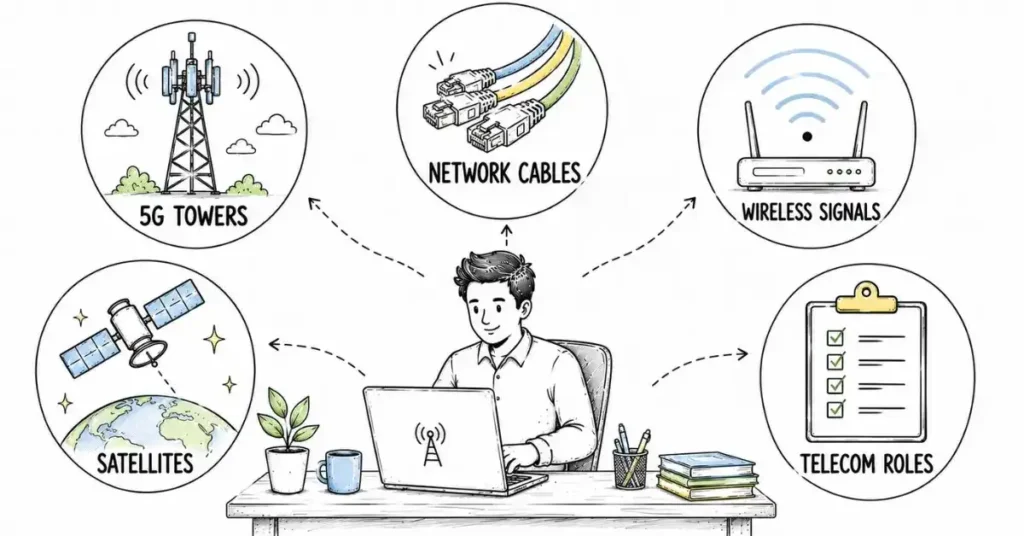
If you are a student or a working professional trying to figure out whether telecom is the right career for you landed on the right page.
Telecom is one of the few industries in India where the government, private companies, and foreign vendors are all spending money at the same time. India had 5.08 lakh 5G base stations deployed by the end of 2025. Ericsson projects India’s 5G subscriber base will cross 1 billion by 2031. And the Telecom Sector Skill Council (TSSC) estimated India needs 22 million skilled workers in 5G-focused industries.telecom.economictimes.
That is a massive opportunity but only for people who know which roles exist, which skills employers actually want, and how to get in.
This guide covers all of that. We will walk through job roles, salaries, certifications, top hiring companies, and a step-by-step plan whether you are a fresher or someone switching careers.
What Is the Telecom Industry, Really?
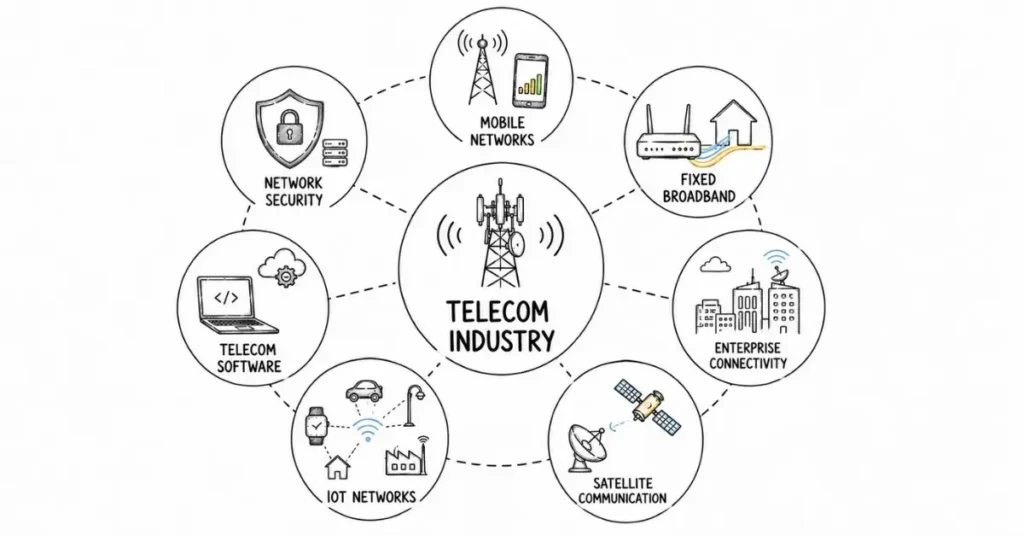
Most people think telecom = mobile calls and internet. That is a small part of it.
The telecom industry today covers:
- Mobile networks — 4G, 5G, and now early conversations about 6G
- Fixed broadband — fiber-to-the-home (FTTH), fixed wireless access (FWA)
- Enterprise connectivity — private 5G networks inside factories, airports, and warehouses
- Satellite communication — Low Earth Orbit (LEO) satellites providing internet to remote areas
- IoT networks — connecting machines, vehicles, sensors, and smart city infrastructure
- Telecom software — OSS (Operations Support Systems) and BSS (Business Support Systems) that run everything behind the scenes
- Network security — protecting telecom infrastructure from cyberattacks
The TSSC report counted 11.59 million total employed in Indian telecom — 2.95 million in corporate roles and 8.24 million in blue-collar (field and maintenance) positions. So this is not a niche sector. It employs more people than most industries you can think of.
Why 2025–2030 Is the Best Time to Enter Telecom in India

Here is the honest picture — and it is a good one.
The 5G rollout created new job categories that did not exist five years ago. Roles like 5G deployment engineer, O-RAN integration specialist, network automation engineer, and 5G core network engineer barely existed in India before 2022. Now they are live on job portals every week.
The demand-supply gap is real. India currently has a telecom skills gap of 2.41 million workers — and that number could grow 3.8 times by 2030 if hiring strategies do not change. A skills gap means less competition for good candidates.
Freshers are in demand. 45% of telecom companies in India said they plan to hire freshers in H1 2025. That is unusually high for a technical industry.
Tier-2 and Tier-3 cities are opening up. 5G infrastructure deployment is happening in smaller cities now, not just metros. Companies are actively looking for talent in Hyderabad, Pune, Ahmedabad, Jaipur, and beyond.
India’s job market overall is growing. India’s hiring across sectors was projected to grow 9% in 2025, led by IT, retail, and telecom.
The Main Job Roles in Telecom — Explained Simply
Telecom has roles for engineers, analysts, managers, and even business professionals. Here is a plain-language breakdown.
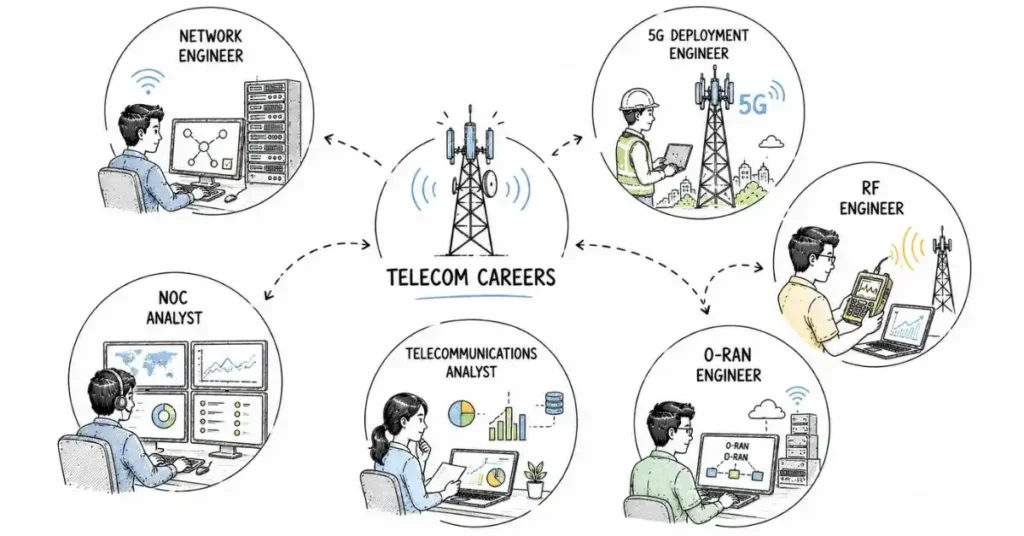
Network Engineer
A network engineer designs, builds, and maintains communication networks. Think of them as the architects of the pipes that carry your internet and calls.
They work with routers, switches, protocols like IP/MPLS, and increasingly with cloud-based network tools. In India, network engineers work at Jio, Airtel, TCS, Infosys, Wipro, Ericsson, Nokia, and dozens of smaller telecom vendors and system integrators.
Salary range in India: ₹1.4 lakh to ₹5 lakh (entry-level) — ₹12 lakh to ₹20 lakh (lead/managerial level). Verified salary data from 6figr shows an average of ₹19.1 lakh for experienced network
5G Deployment Engineer
This is one of the fastest-growing roles in Indian telecom right now. A 5G deployment engineer sets up the physical and software infrastructure needed to run 5G networks — installing base stations (gNodeBs), configuring radio parameters, running acceptance tests, and troubleshooting field issues.
Jio and Airtel’s aggressive 5G expansion, which reached 99.9% of Indian districts by end of 2025, created thousands of these positions.
RF (Radio Frequency) Engineer
RF engineers work on the wireless signal side — making sure 5G signals travel correctly, that coverage does not have gaps, and that users get good speeds. They use tools like drive testing, network planning software, and signal analysis tools.
Network Operations Center (NOC) Analyst
This is the entry point that most freshers overlook. A NOC analyst monitors live networks 24/7, raises alarms when something breaks, and coordinates with field engineers to fix issues. It is shift-based work, but it gives you unmatched exposure to real network behaviour — and most senior network engineers started here.
Telecommunications Analyst
A telecom analyst sits between the technical and business sides. They analyze network performance data, customer usage patterns, billing systems, and service quality metrics. They work with BSS/OSS tools and produce reports that help companies decide where to invest next.
If you are from a data or commerce background, this role gives you the cleanest entry into telecom without needing deep engineering skills.
5G Core Network Engineer
The “core” is the brain of a 5G network — it handles authentication, routing, policy management, and subscriber data. 5G core engineers work with cloud-native software (since 5G core runs on Kubernetes and microservices) and need skills in both networking and cloud computing.
This is one of the highest-paying specializations in telecom today.
OpenRAN / O-RAN Engineer
Open RAN (Radio Access Network) is a new approach where telecom operators use software from multiple vendors instead of being locked into one company. This is still emerging in India but is growing fast — both Jio and Airtel have run O-RAN trials.
O-RAN engineers need skills in protocol stacks (MAC, RLC, PDCP), 3GPP standards, Python scripting, and test automation.
Telecom Project Manager
As 5G projects grow in size — involving tower companies, government bodies, vendors, and operators — project managers who understand both telecom technology and project execution are in high demand. This role suits engineers with 5+ years of experience who want to move away from hands-on technical work.
Salaries in Indian Telecom — A Realistic Picture
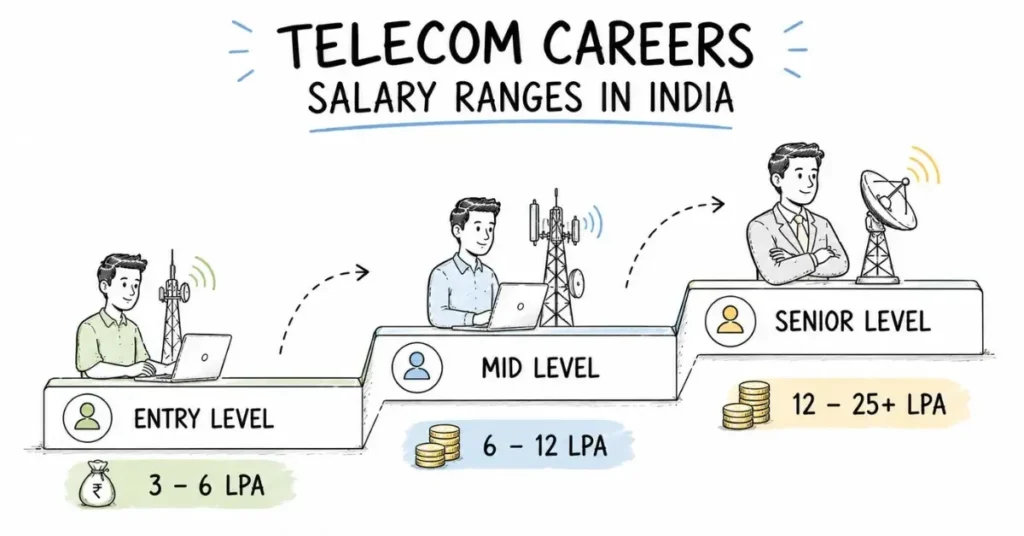
Here is a salary table based on current market data from multiple sources:
Role | Entry Level (0–2 yrs) | Mid Level (3–6 yrs) | Senior Level (7+ yrs) |
Network Engineer | ₹1.4L–₹5L | ₹5L–₹10L | ₹12L–₹20L |
5G Engineer (avg) | ₹8L–₹12L | ₹18L–₹28L | ₹30L–₹57L |
Telecom Analyst | ₹3L–₹6L | ₹6L–₹12L | ₹12L–₹20L |
NOC Analyst | ₹2.5L–₹4.5L | ₹4.5L–₹8L | ₹8L–₹14L |
Telecom Project Manager | ₹6L–₹10L | ₹10L–₹18L | ₹18L–₹35L |
5G Core/O-RAN Specialist | ₹10L–₹15L | ₹18L–₹30L | ₹35L–₹57L |
Important note: These are base salary ranges. Companies like Ericsson, Nokia, and Jio add annual bonuses, ESOPs, and benefits on top. Total compensation packages at senior levels in these companies can be 30–40% higher than the base figures above.
Top Companies Hiring in Indian Telecom
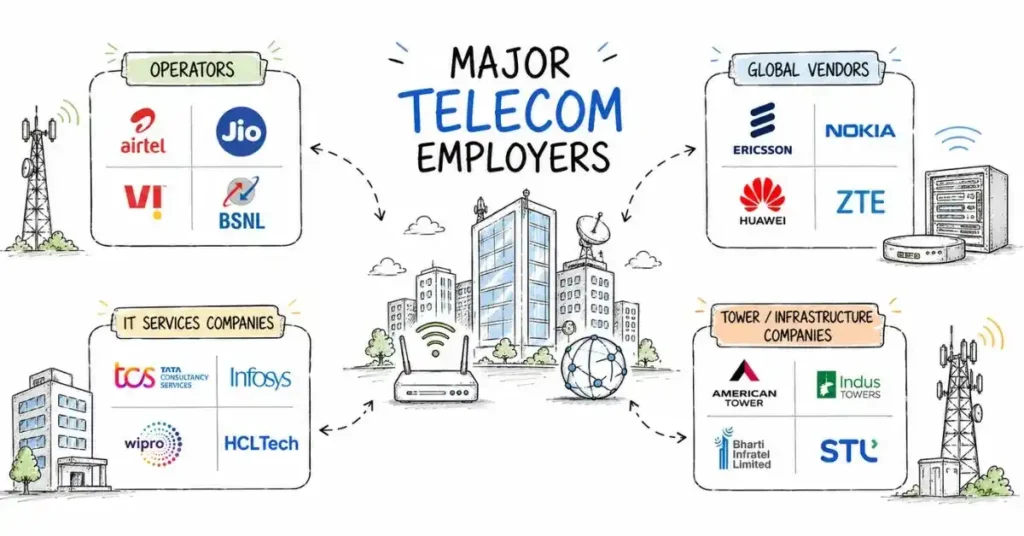
You will not have to go far to find telecom employers. Here are the key categories:
Telecom Operators (the ones who run the networks):
- Reliance Jio — India’s largest 5G network, aggressive on hiring engineers, data analysts, and product managers
- Bharti Airtel — Strong hiring in 5G, home broadband, and enterprise connectivity
- Vodafone Idea (Vi) — Currently restructuring but still active in network roles
- BSNL — Government-owned, relevant for those wanting stable public-sector roles
Global Vendors (the ones who build the equipment):
- Ericsson — Hires for 5G RAN, core network, and managed services; major India presence in Gurugram and Bengaluru
- Nokia — Strong in 5G RAN, IP routing, and optical networks; partners with NIIT for India-based training
- Huawei — Large project presence in India despite geopolitical tensions; hires engineers through Indian subsidiaries
- Samsung Networks — Growing presence in 5G radio
IT Services Companies (telecom domain):
- Tata Consultancy Services (TCS) — Telecom domain practice; hires analysts, test engineers, and project managers
- Infosys — OSS/BSS consulting and managed services
- Wipro — Network services and telecom IT
- Tech Mahindra — One of India’s largest telecom IT companies; deep in BSS/OSS, testing, and 5G software
Tower and Infrastructure Companies:
- Indus Towers — Field engineer and operations roles
- ATC India — American Tower Corporation; tower operations and maintenance jobs
What Degree Do You Need for Telecom?
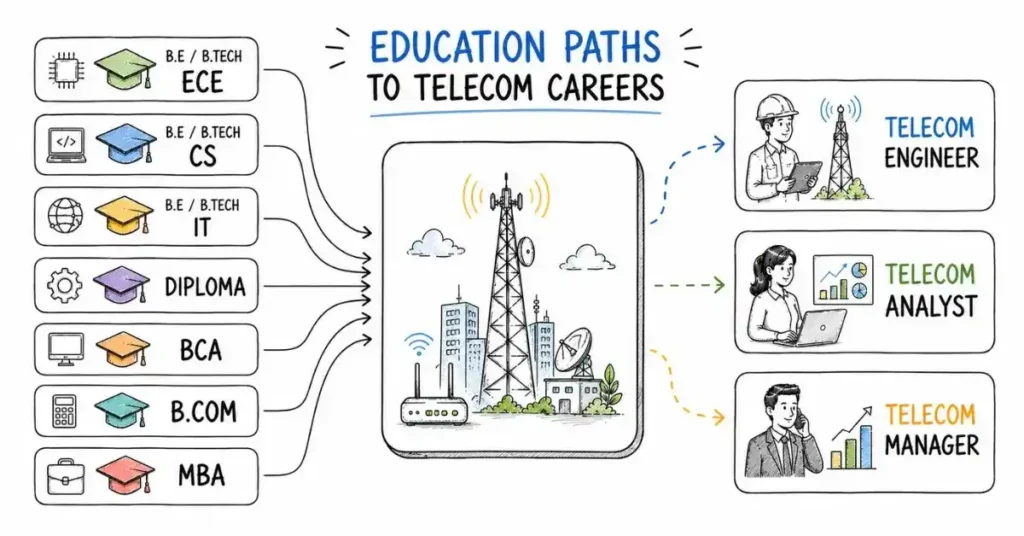
This is one of the most common questions — and the honest answer is: it depends on which role you want.
For engineering roles (network engineer, RF engineer, 5G deployment, O-RAN):
- B.E./B.Tech in Electronics and Communication Engineering (ECE) — the most direct path
- B.E./B.Tech in Computer Science (CS) or Information Technology (IT) — works well for core network, cloud telecom, and NOC roles
- Diploma in Electronics/Communication — entry into field/technician roles, with room to grow
For analyst and business roles (telecom analyst, product manager, business development):
- BCA, B.Sc. (IT), B.Com + certifications — works for OSS/BSS analyst roles
- MBA in Telecom Management — MBA graduates can enter at ₹3–5 lakh at entry level and grow to ₹15–30 lakh in 10 years
The honest truth about degrees: A relevant degree gives you the foundation. But in 2025 telecom hiring, certifications and hands-on skills matter just as much — sometimes more — than your college name. A fresher with a B.Tech ECE + CCNA + hands-on lab experience will outperform a B.Tech from a tier-1 college who has no telecom-specific skills.
Certifications That Actually Matter
The telecom certification landscape can be confusing. Here is a clean breakdown of what employers in India actually look for:
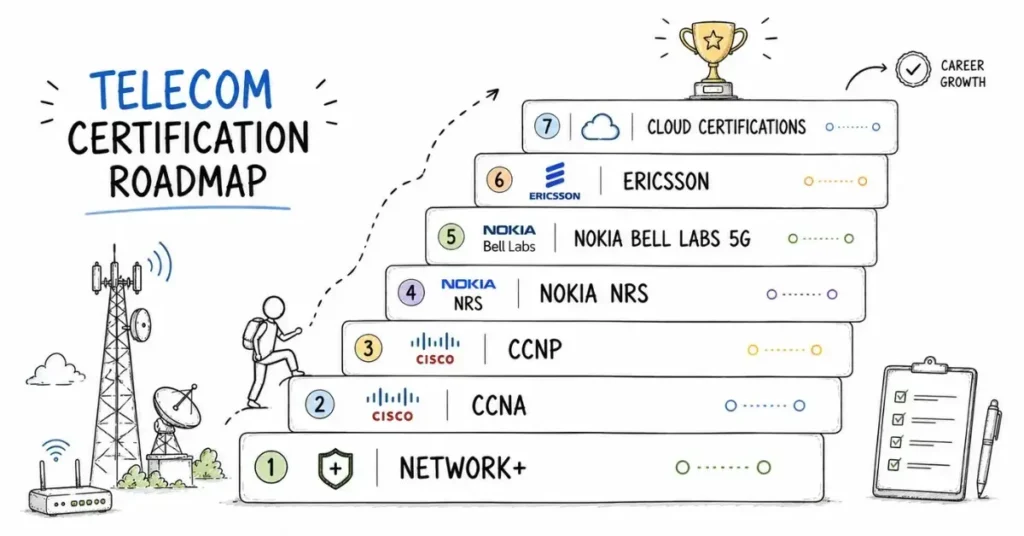
For Networking Fundamentals
- CompTIA Network+ — Good starting point for absolute beginners. Covers basic networking concepts, protocols, and troubleshooting. No prerequisites.
- Cisco CCNA (Cisco Certified Network Associate) — The single most recognized entry-level networking cert in India. Covers routing, switching, IP addressing, and basic security. Most IT/telecom companies treat CCNA as a baseline expectation for network roles.
For Advanced Networking
- Cisco CCNP (Cisco Certified Network Professional) — The next level after CCNA. Specializations available in enterprise networking, service provider (telecom-relevant), and security.
- Nokia NRS I (Network Routing Specialist I) — Nokia’s entry-level routing certification. Relevant for candidates targeting Airtel, Vi, or Nokia itself — all of whom use Nokia IP routing equipment.
- Nokia NRS II — Advanced routing. Recognized and valued by telecom operators and Nokia partners.
For 5G Specifically
- Nokia Bell Labs 5G Certification — Available at Associate and Professional levels. Nokia partnered with NIIT and COAI to offer this in India. Highly relevant for Jio, Airtel, and Nokia hiring.
- Nokia 5G RAN Certifications (Professional, Expert, Specialist) — Role-specific certs for RAN engineers. The Expert level requires passing the NRN-524 exam (5G RAN Optimisation Expert).
- Ericsson Certifications — Ericsson offers its own training and certification tracks for 5G RAN and core. Relevant if you are targeting Ericsson or Ericsson-managed services contracts.
- 5G World Pro / TELCOMA 5G Certs — Third-party certifications that cover 5G architecture, NR air interface, and core network. Good for building foundational 5G knowledge.
For Cloud/Automation (Increasingly Important in Telecom)
- AWS/Azure/GCP cloud certifications — 5G core runs on cloud infrastructure. Cloud knowledge is becoming a hiring advantage in telecom.
- Python programming — Not a formal certification, but verified Python skills are listed in a large share of 5G and O-RAN job descriptions.
The Honest Skills Gap Problem & What You Can Do About It
Here is something most career guides skip: only 40% of India’s computer science and IT graduates are considered employable in the tech/telecom sector. The reason is the gap between what colleges teach and what companies need on day one.
The specific skills that are missing:
- Hands-on lab experience with actual network equipment or simulators
- Protocol-level understanding — knowing not just that TCP/IP exists, but how packets actually move through a real network
- Scripting and automation — Python basics for network engineers is now a minimum, not a bonus
- Familiarity with real vendor tools — Wireshark, Spirent, JDSU drive test tools, Ericsson ENM, Nokia NetAct
The fix is not complicated — but it requires effort outside of your college curriculum:
- Set up a home lab using Cisco Packet Tracer or GNS3 (both free)
- Complete at least one vendor certification (CCNA as a starting point)
- Do a project — even a small one — involving network configuration, protocol analysis, or automation
- Document that project on LinkedIn and GitHub
Career Roadmap by Experience Level
Whether you are just out of college or have been in IT for 5 years and want to move into telecom here is the realistic path.
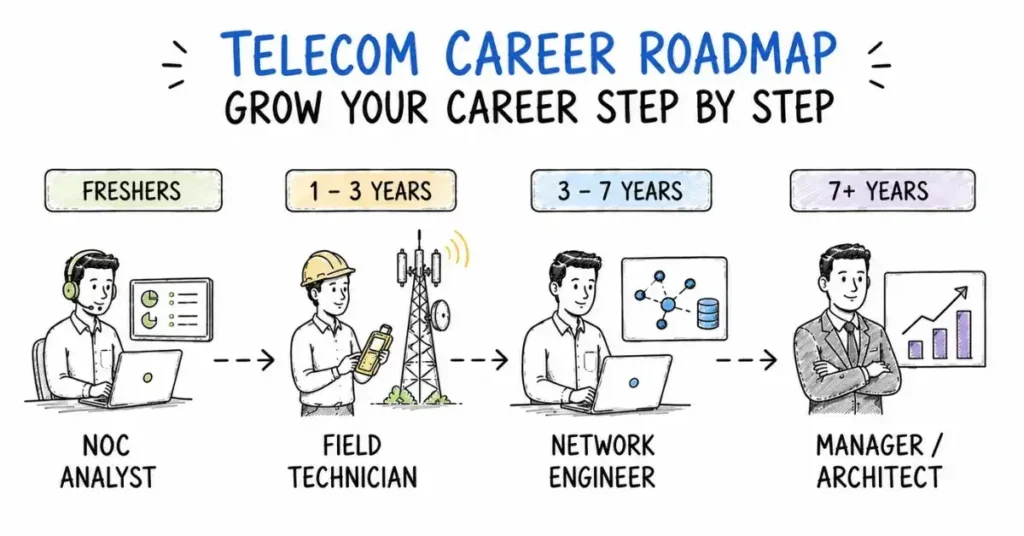
If You Are a Fresher (0–1 Year Experience)
Your first goal is to get inside a telecom company — any role. The most accessible entry points are:
- NOC Analyst — Monitoring networks, raising tickets, coordinating with field teams. No deep technical knowledge required to start, but you learn fast.
- Field Technician / Drive Test Engineer — On-ground work: testing signal quality, assisting with tower installations. Physical work, but excellent exposure to real networks.
- Telecom OSS/BSS Support Analyst — Entry-level at IT companies like TCS, Infosys, Tech Mahindra; involves managing telecom software systems.
- Graduate Trainee / Management Trainee — Jio, Airtel, and BSNL all run structured fresher programs.
What to have ready before applying:
- CCNA or CompTIA Network+ (at least started)
- One hands-on project (even a simulated network topology)
- A LinkedIn profile that mentions your telecom skills clearly
If You Have 1–3 Years of IT or Related Experience
You are not starting from zero. Map your current skills to telecom:
Your Current Skill | Telecom Entry Point |
IT helpdesk / desktop support | NOC Analyst → Network Engineer |
Software testing | Protocol testing / O-RAN test engineer |
Data analysis | Telecom Analyst / OSS analyst |
Cloud/DevOps | 5G Core engineer / Network automation |
Project coordination | Telecom project management |
Get one domain-specific certification (Nokia 5G Associate or CCNP Service Provider) and start applying to telecom domain roles at TCS, Tech Mahindra, or Wipro — they hire more lateral movers than operators do.
If You Have 3–7 Years of Telecom Experience
You should be specializing now. The biggest salary jumps in telecom happen when you move from generalist to specialist. High-demand specializations right now:
- 5G RAN optimization (Nokia or Ericsson tools)
- O-RAN / Open RAN integration
- 5G core (cloud-native, Kubernetes-based)
- Network automation (Python + Ansible + YANG/NETCONF)
- Telecom security
Also: start building vendor-specific expertise. An engineer who knows Nokia NetAct deeply is more valuable to Nokia’s managed services team than one who knows networking in general.
If You Have 7+ Years in Telecom
You are looking at three main paths:
- Senior specialist / architect — Deep technical expert, solving problems no one else can. Salaries ₹20L–₹57L.
- Management track — Team lead → manager → director. This requires adding soft skills (stakeholder management, budgeting, vendor negotiations) to your technical base.
- Consulting / freelance — Experienced telecom professionals are increasingly moving to contract-based consulting, especially for 5G deployment projects in the Middle East and Southeast Asia.
How to Job Search in Indian Telecom — Practically
Most candidates apply on job portals and get no response. Here is a smarter approach.
Step 1: Fix your resume for telecom
Telecom hiring managers look for specific keywords that match the equipment and technologies they use. Your resume must mention:
- Specific vendors and tools you have worked with (Nokia, Ericsson, Cisco, Huawei — whichever is true)
- Protocols by name (LTE, NR, IP/MPLS, BGP, OSPF, etc.)
- Specific certifications with the exact certification name, not just “networking certifications”
- Quantified achievements — “Reduced network downtime by 18% in Q2 2024” is infinitely better than “maintained network performance”
Step 2: Use the right platforms
- LinkedIn — Most telecom hiring happens here. Follow Ericsson India, Nokia India, Reliance Jio, Bharti Airtel, and Tech Mahindra on LinkedIn. Turn on job alerts for: “5G engineer India,” “network engineer Hyderabad,” “telecom analyst Bengaluru.”
- Naukri.com — Still the highest-volume platform for telecom roles in India, especially for mid-level positions
- Indeed India — Good for NOC analyst and fresher-level roles
- Company career pages directly — Ericsson, Nokia, Jio, and TCS all post roles on their own portals that do not always appear on job boards
Step 3: Build a telecom network (the human kind)
This sounds obvious, but most Indian job seekers skip it. Join telecom communities on LinkedIn. Comment on posts from telecom professionals. Connect with engineers at companies you want to join — not to ask for a job, but to ask one specific question about their work. People remember candidates who showed genuine interest.
Also: Apeksha Telecom (Telecom Gurukul) and similar India-based training institutes often have placement cells with direct connections to hiring managers at telecom companies.
Step 4: Prepare for two types of interviews
Technical rounds in telecom are not like IT interviews. You will be asked:
- To draw and explain network topologies
- About specific protocols (what happens during an LTE attach procedure, explain 5G NR handover)
- About your hands-on experience with tools
- Scenario-based questions (“your NOC dashboard shows a spike in packet loss on 3 cells in one area — walk me through your troubleshooting steps”)
HR rounds are standard — prepare for competency-based questions using the STAR method (Situation, Task, Action, Result).
The Future of Telecom Jobs in India: What Is Coming
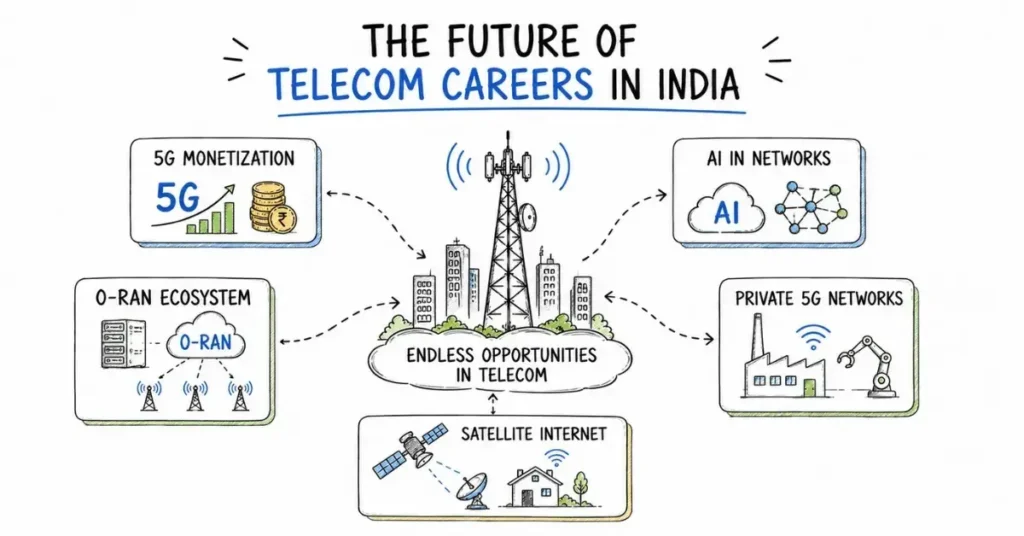
Understanding where the industry is heading helps you make smarter career choices today.
5G Monetization is the next wave. Jio, Airtel, Nokia, Ericsson, and COAI all identified 5G monetization as the defining theme for 2026. This means companies are shifting from building 5G to making money from it — through enterprise services, APIs, and new applications. This creates demand for roles that combine technical knowledge with business understanding: solutions architects, technical sales, and product managers.
AI is entering the network. Ericsson, Nokia, and Jio are all investing in AI-led network optimization — using machine learning to predict failures, automate traffic management, and reduce energy consumption. Engineers who understand both networking and AI/ML will have a significant edge by 2027.
O-RAN is coming to India at scale. The government’s push for indigenous telecom technology and the global O-RAN Alliance are accelerating Open RAN adoption in India. This creates demand for O-RAN test engineers, integration specialists, and software developers.
Private 5G networks for enterprises. Factories, airports, ports, and large campuses are building their own private 5G networks. This is a completely separate job market from public telcos — and it is growing fast. Companies like Sterlite Technologies, Tejas Networks, and C-DOT are active in this space.
Satellite internet (LEO) — India’s TRAI is regulating satellite spectrum allocation, and companies like OneWeb (now Eutelsat), SpaceX Starlink, and Amazon Kuiper are entering the Indian market. This will create new engineering and operations roles over the next 3–5 years.
Government Telecom Sector: A Separate Consideration
For those who want job security along with a good career in telecom, the government sector has specific opportunities:
- BSNL (Bharat Sanchar Nigam Limited) — Recruits through JTO (Junior Telecom Officer) exams. Salary is lower than private sector but job security is high.
- BBNL (Bharat Broadband Network Limited) — Manages the BharatNet project connecting rural India with fiber.
- C-DOT (Centre for Development of Telematics) — India’s government telecom R&D centre. Hires engineers for 5G, 6G, and satellite communications research. Competitive salaries for R&D roles.
- DoT (Department of Telecommunications) — Policy and regulatory roles, typically for candidates with engineering + management backgrounds.
- DRDO Telecom Division — Defense communication systems; requires security clearance.
Quick Comparison: Telecom vs. IT Career
Many engineering graduates are deciding between IT (software, web development) and telecom. Here is an honest side-by-side:
Factor | IT/Software | Telecom |
Entry salary | ₹3L–₹6L | ₹2.5L–₹5L |
Senior salary ceiling | ₹30L–₹1Cr+ | ₹20L–₹57L |
Job volume | Very high | Lower but growing fast |
Specialization required | Medium | High |
Work nature | Mostly office/remote | Mix of office + field |
Career switch difficulty | Easy (many paths) | Moderate (domain knowledge required) |
International demand | High | Very high (Middle East, Europe hungry for 5G engineers) |
AI impact on jobs | High disruption risk | Lower disruption — physical network needs humans |
This Guide's Full Subtopic Library
This master guide connects to 15 detailed posts. Use them to go deeper on any topic that matters to you right now:
Understanding the Industry:
- What Is a Career in Telecommunications? Roles, Scope & 2025 Outlook
- 5G Technology Explained for Job Seekers: What You Actually Need to Know
Job Roles in Detail:
- Network Engineer Career Path: From Entry Level to Senior Roles
- 5G Deployment Engineer: Job Role, Skills Required & Where to Find Work
- Telecommunications Analyst: What They Do, Salary & Career Growth
- Wireless Technology Jobs Beyond 5G: IoT, Satellite & Private Networks
Skills and Education:
- Technical Skills Every Telecom Professional Needs in 2025
- Best Degrees for a Telecommunications Career: What Actually Gets You Hired
Certifications:
- Top Telecom Certifications That Employers Actually Value
- CCNA vs. CCNP vs. Nokia NRS: Which Telecom Cert Should You Get First?
Salaries and Companies:
- Telecommunications Salary Guide: What Network Engineers Earn in 2025
- Top Companies Hiring for 5G and Telecom Jobs in 2025
Job Search and Career Entry:
Before You Move Forward
Three things to do this week:
- Identify your entry point — pick the one role above that matches your current background most closely
- Start one certification — even 30 minutes a day on CCNA Packet Tracer or Nokia 5G Associate prep changes your positioning in 60 days
- Update your LinkedIn — add “Telecommunications” and “5G” to your profile if you are pursuing this direction; recruiters filter by these terms
The demand is there. India’s telecom skill gap is real, and companies are hiring. The question is whether you are prepared when the opportunity arrives.