
Real Estate Career Guide : Property Management & Sales
Table of Contents
Introduction

India’s real estate sector stands at an exciting inflection point in 2026, offering unprecedented career opportunities across diverse specializations. With the industry expected to contribute 13% to the country’s GDP and institutional investments reaching US$ 10.4 billion in 2025, professionals entering this field today are positioning themselves in one of the nation’s most dynamic and rewarding industries. The market is projected to evolve into a trillion-dollar economy, creating thousands of new jobs annually across sales, management, valuation, facility operations, and specialized technical roles.
The transformation of India’s real estate sector goes beyond mere numbers. The Real Estate (Regulation and Development) Act (RERA) implemented in 2016 has professionalized the industry, establishing mandatory registration for agents and bringing transparency that protects both professionals and consumers. This regulatory framework has elevated real estate from an informal sector to a structured profession with clear entry requirements, ethical standards, and career pathways.
What makes real estate careers particularly compelling is their accessibility combined with substantial earning potential. Unlike many professions requiring extensive formal education or years of specialized training, several real estate paths welcome motivated individuals with basic qualifications. A high school education or bachelor’s degree, combined with RERA registration, can launch you into sales roles with unlimited income potential. Property management careers offer stable salaries starting from ₹3-5 lakh annually and growing to ₹7-20 lakh with experience and certifications. Facility management professionals earn an average of ₹19.5 lakh, with top performers exceeding ₹50 lakh annually.
The career diversity within real estate ensures there’s a path matching virtually any skill set, personality type, and professional preference. Extroverted individuals who thrive on relationships and persuasion excel in sales and brokerage roles. Analytical thinkers comfortable with numbers and data find fulfillment in appraisal, valuation, or investment analysis. Organizationally-minded professionals who enjoy operational excellence and problem-solving build rewarding property management careers. Technical specialists interested in building systems, sustainability, and workplace optimization pursue facility management. Creative professionals skilled in content, design, and digital strategy carve niches as real estate marketing specialists.
This comprehensive master guide explores everything you need to understand, evaluate, and launch your real estate career in India. You’ll discover the various specializations available, understand mandatory licensing and valuable certifications, learn realistic salary expectations across experience levels, and receive actionable guidance for entering and advancing in your chosen path. Whether you’re a recent graduate exploring career options, a mid-career professional seeking change, or an entrepreneur building a real estate business, this guide provides your roadmap for success in India’s booming property sector.
Understanding India's Real Estate Industry in 2026
Market Growth and Career Drivers
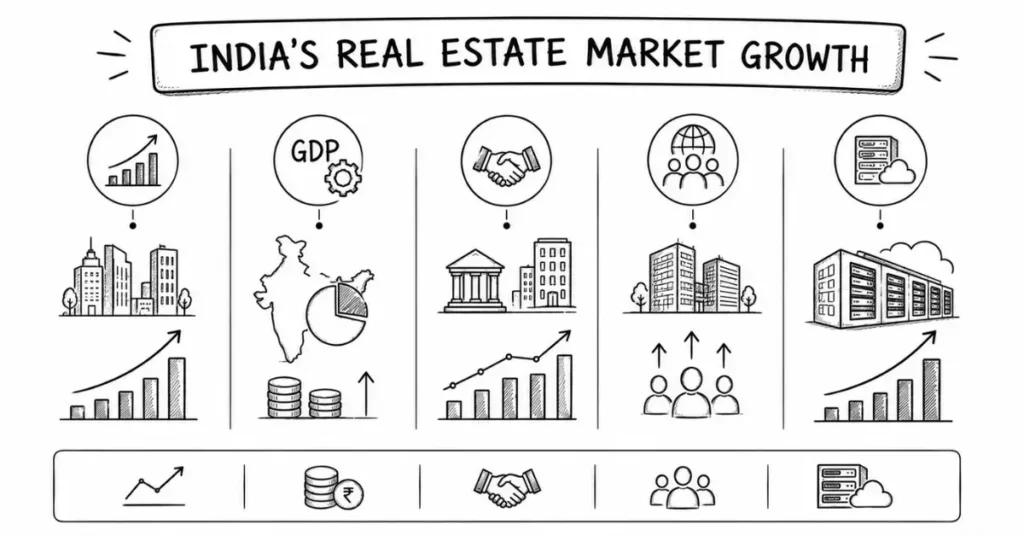
India’s real estate sector is experiencing robust growth driven by multiple converging factors. According to industry surveys, nearly 70% of developers anticipate home prices increasing by more than 5% in 2026, with about half expecting 5-10% price appreciation. This optimistic outlook translates directly into abundant career opportunities as developers expand operations, hire sales teams, and invest in property management infrastructure.
Several key factors are driving career growth across the industry. Huge housing requirements persist in Tier I cities while smaller towns show growing market potential, creating demand for real estate professionals across geographic tiers. Record institutional investments of US$ 10.4 billion in 2025 have created new analyst, asset management, and advisory roles supporting sophisticated investors.
The expansion of Global Capability Centres (GCCs) is revolutionizing commercial real estate career opportunities. GCCs now account for 35-40% of office space demand and are projected to lease 50-55 million square feet between 2025 and 2027. These centres have evolved from basic support operations to strategic innovation hubs, driving consistent demand for commercial real estate brokers, leasing professionals, and facility managers.
The data center boom represents one of the most explosive career opportunities. India’s data center capacity is projected to grow at 21% CAGR through 2030, requiring massive investments and creating specialized roles in site acquisition, development project management, and facility operations. Professionals developing expertise in this technical niche will find exceptional opportunities throughout the next decade.
Green building mandates and sustainability requirements are creating entirely new career categories. As environmental regulations tighten and corporate ESG (Environmental, Social, Governance) commitments increase, demand grows for sustainability consultants, green building certification specialists, and facility managers with energy management expertise. The PropTech (property technology) revolution demands tech-savvy professionals who understand both real estate fundamentals and digital transformation tools including AI, automation, data analytics, and virtual reality applications.
Why Choose Real Estate as a Career
Real estate careers offer compelling advantages that distinguish them from many other professional paths. The industry provides multiple entry points accommodating diverse educational backgrounds. While advanced degrees enhance opportunities and earnings, many successful careers launch with basic qualifications plus industry-specific training and certifications.
Performance-based earnings in sales roles create unlimited income potential. Your effort, skill development, and relationship-building directly determine your compensation without artificial ceilings imposed by salary structures. Top performers regularly earn several times more than entry-level professionals, and this differential reflects merit rather than tenure or political maneuvering.
Career flexibility appeals to individuals seeking work-life integration. Many real estate roles allow significant schedule control, remote work possibilities, and entrepreneurial independence. Property agents often work as independent contractors choosing their clients, focus areas, and work intensity. Property managers and facility professionals increasingly enjoy hybrid work arrangements combining site visits with remote administrative work.
The industry rewards continuous learning and adaptation. As markets evolve, technologies advance, and regulations change, professionals who invest in skill development and certifications consistently outperform those relying on outdated knowledge. This learning orientation keeps careers intellectually stimulating while creating advancement opportunities throughout your professional life.
Real estate naturally expands your professional network across industries and socioeconomic strata. Property transactions involve clients from diverse backgrounds including business owners, corporate executives, investors, and families. These relationships often lead to opportunities beyond real estate, including business partnerships, investment opportunities, and career transitions into related fields.
The sector’s essential nature provides career stability despite economic cycles. While transaction volumes fluctuate with market conditions, people always need housing, businesses require commercial space, and properties demand ongoing management and maintenance. This fundamental demand creates baseline career stability even during challenging economic periods.
Core Real Estate Career Paths
Real Estate Sales and Brokerage

Real estate sales represents the most accessible and visible career path in the industry. As a real estate agent, you serve as an intermediary connecting property buyers with sellers, guiding clients through one of their most significant financial decisions. The role demands strong interpersonal skills, market knowledge, persistence, and genuine client service orientation.
RERA registration is absolutely mandatory for all real estate agents in India. Section 9 of the RERA Act explicitly states that no agent can facilitate transactions without registration. This legal requirement protects consumers while establishing professional standards for agents. Your RERA registration number must be displayed in all property dealings and advertisements, allowing clients to verify your legitimate status.
The registration process is straightforward but requires several months. Eligibility requires minimum age of 18 years and educational qualifications of 10th or 12th grade completion depending on your state. You’ll create an account on your state’s RERA website, complete the online application form with personal and educational details, upload required documents including identity proof, address proof, educational certificates, and photographs, pay registration fees typically ranging from ₹5,000-₹25,000, and wait 4-6 months for verification and approval.
Real estate agents earn primarily through commissions on closed transactions. Commission rates typically range from 1-2% of the property’s sale value. For properties valued between ₹50 lakh and ₹1 crore, commissions range from 1-2% depending on deal specifics and local market dynamics. On a ₹1 crore property at 2% commission, the total commission is ₹2 lakh.
However, agents rarely retain full commissions. Most work under brokerages that share commissions according to negotiated splits. Common arrangements include 50-50 splits for new agents, 60-40 splits where agents receive 60%, and 70-30 or higher splits for experienced agents with proven track records. Using the ₹1 crore example, at a 50-50 split the agent receives ₹1 lakh; at 70-30 they receive ₹1.4 lakh.
Earnings vary dramatically by experience and performance. Entry-level agents in their first 1-2 years might earn ₹2-4 lakh annually while building skills and client networks. Mid-career agents with 3-5 years typically earn ₹5-10 lakh as deal flow becomes consistent. Experienced agents with 7-10 years and established reputations command ₹12-25 lakh or more. Top performers with 10+ years, extensive networks, and luxury or commercial specialization can exceed ₹50 lakh annually.
Career progression typically follows this path: real estate agent building foundational skills and client base, senior agent with established reputation and repeat business, team leader managing and mentoring other agents, and broker operating independently or leading an agency. Brokers earn significantly more by retaining portions of all their agents’ commissions plus their own production.
Property Management Professionals
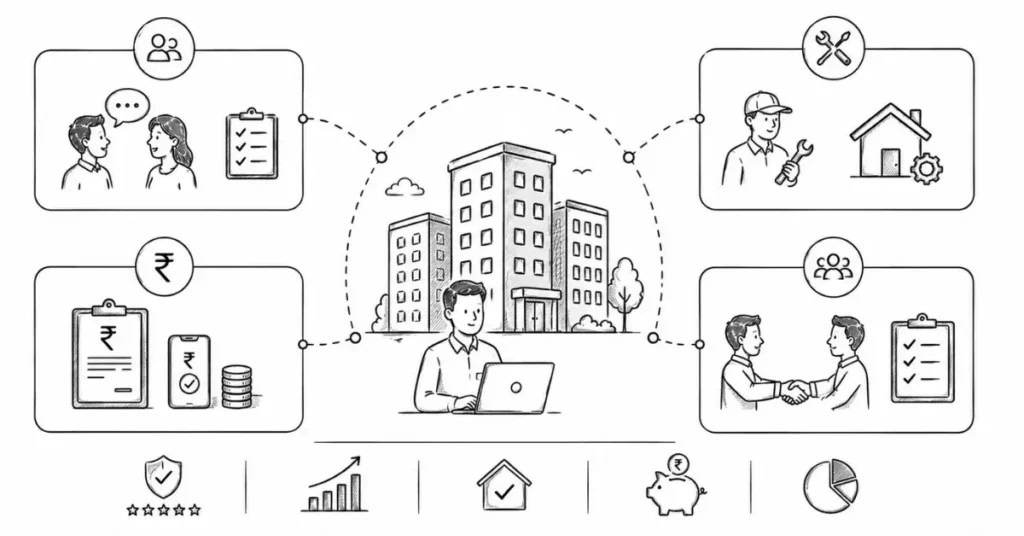
Property management represents a distinct career focusing on day-to-day property operations, maintenance, tenant relations, and financial performance on behalf of owners. Unlike commission-based sales, property managers enjoy salary-based compensation, regular work schedules, and predictable career progression.
Property managers oversee residential properties (apartments, housing societies, condominiums), commercial properties (office buildings, retail spaces, industrial facilities), or mixed-use developments. Your responsibilities span tenant acquisition and relations, maintenance coordination, financial management including rent collection and expense control, vendor and contractor management, legal and regulatory compliance, and performance reporting to owners.
The career offers stable earnings with clear experience-based progression. Entry-level property managers (0-2 years) earn approximately ₹3 lakh annually in assistant roles supporting senior managers. Early career professionals (2-5 years) earn around ₹3.9 lakh managing smaller properties independently. Mid-career managers (5-10 years) command approximately ₹4.7 lakh overseeing significant portfolios. Experienced professionals (10-15 years) earn around ₹5.8 lakh managing premium properties or leading teams. Senior-level managers (15-20 years) can reach ₹7.2 lakh or more in regional or director positions.
Educational qualifications significantly impact earnings and advancement. High school graduates can enter through assistant positions, but bachelor’s degree holders earn substantially more and advance faster. Master’s degree holders access senior management and executive tracks most readily. Professional certifications dramatically enhance careers. The Certified Property Manager (CPM) designation from the Institute of Real Estate Management (IREM) is the most prestigious credential, demonstrating advanced competency in operations, financial management, marketing, and leadership. CPM holders earn an average of $118,383 (approximately ₹98 lakh) in the United States, and while Indian salaries are lower, certified professionals command significant premiums over non-certified peers.
The Accredited Residential Manager (ARM) credential, also from IREM, focuses specifically on residential property management. ARM holders earn an average of $66,813 (approximately ₹55 lakh) in the US, with 82% reporting higher income after certification. These certifications require completing coursework, passing examinations, and documenting relevant experience, but deliver substantial return through career advancement and earning increases.
Facility Management Careers
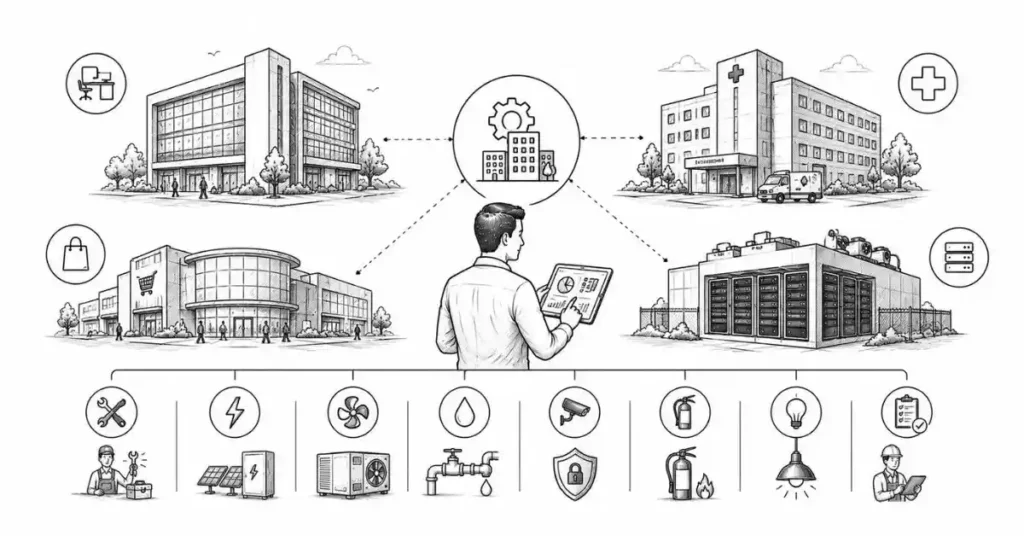
Facility management is a specialized profession ensuring the functionality, comfort, safety, and efficiency of built environments. Facility managers coordinate physical workplaces with people and operations, overseeing maintenance, space planning, energy management, security, sustainability, and occupant services.
The scope differs from property management. While property managers focus on rental properties with multiple tenant relationships and leasing activities, facility managers work for organizations managing their own occupied spaces, focusing on building systems, workplace services, and operational efficiency. Major employers include corporate offices, hospitals, educational institutions, manufacturing plants, shopping malls, hotels, government facilities, and data centers.
Facility management offers strong compensation in India. Professionals earn an average of ₹19.5 lakh annually, mostly ranging from ₹15 lakh to ₹45.5 lakh based on experience and portfolio. The top 10% earn more than ₹30 lakh annually, and the highest earners reach ₹50 lakh. Monthly salaries average ₹32,467 according to Indeed data, with significant variation by experience, employer size, and location. Entry-level facility managers with less than 1 year experience earn around ₹3.6 lakh, early career professionals (1-4 years) earn approximately ₹3.9 lakh, and experienced managers command ₹5.7 lakh or more.
The Certified Facility Manager (CFM) credential from the International Facility Management Association (IFMA) is the gold standard certification recognized globally. CFM validates competency across eleven areas including communication, emergency preparedness, sustainability, finance, human factors, leadership, operations and maintenance, project management, quality, real estate, and technology. Eligibility requires at least five years of facility management experience (or three years with a bachelor’s degree) plus passing a comprehensive examination.
CFM holders enjoy significant earning advantages. According to IFMA data, credentials and certifications lead to higher salaries and faster career growth. The investment in certification typically pays for itself within 1-2 years through salary increases and advancement opportunities.
Real Estate Appraisers and Valuers
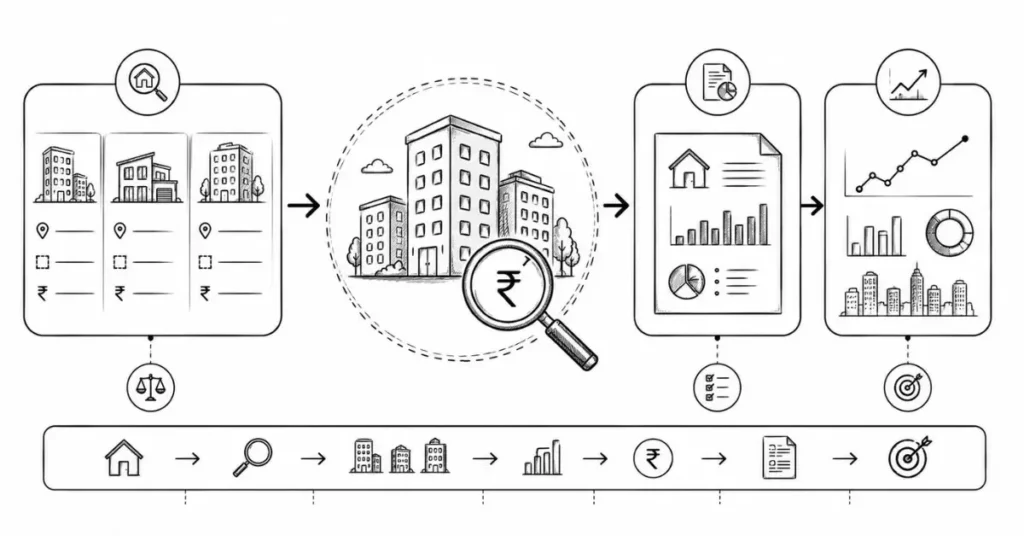
Real estate appraisers provide independent professional opinions on property values for sales, purchases, financing, taxation, insurance, legal proceedings, and investment analysis. This analytical career requires systematic thinking, attention to detail, market knowledge, and understanding of valuation methodologies.
India’s regulatory framework for registered valuers establishes specific qualification requirements. Acceptable educational backgrounds include graduate degrees in civil engineering, architecture, or post-graduate degrees in real estate valuation from recognized universities. Alternatively, you can qualify through experience: at least ten years working as a valuer, architect, town planner, or in building construction with monthly salaries exceeding ₹2,000, or ten years practicing independently as a consulting engineer, valuer, surveyor, or architect with gross receipts exceeding ₹50,000 in any three of five years preceding registration.
Beyond base qualifications, registered valuers must complete valuation education programs through recognized organizations, pass valuation examinations, complete practical training with registered valuers (typically 6-12 months), submit detailed registration applications, and pay registration fees ranging from ₹10,000-₹50,000. Registration requires periodic renewal through continuing professional education, typically 15-30 hours annually.
Appraiser income varies widely. Entry-level appraisers working for firms earn ₹3-5 lakh annually while building skills. Registered appraisers with 3-5 years experience earn ₹5-8 lakh through employment or independent practice. Experienced appraisers with 7-10 years command ₹8-15 lakh through higher fees, greater efficiency, and specialized expertise. Senior appraisers with 10+ years and strong reputations earn ₹15-30 lakh or more through premium assignments, expert witness work, consulting engagements, and leadership positions. Elite commercial property appraisers specializing in complex properties, REITs, or litigation can exceed ₹40-60 lakh annually.
Commercial Real Estate Specialists
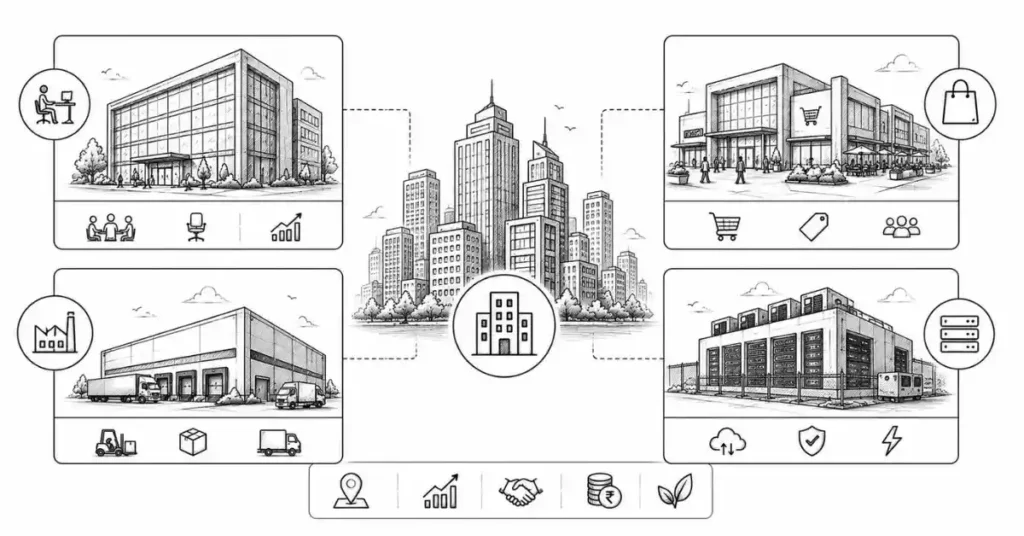
Commercial real estate focuses on properties used for business purposes including office buildings, retail spaces, industrial warehouses, hotels, healthcare facilities, and mixed-use developments. This specialization typically offers higher earning potential than residential roles due to larger transaction values and complex deal structures.
The commercial sector shows exceptional growth opportunities. GCCs drive 35-40% of office space demand with projections of 50-55 million square feet of leasing between 2025-2027. Data centers present explosive growth with capacity expected to reach 1,800 MW by 2026 and over 4,500 MW by 2030, requiring USD 20-25 billion in investments. These massive projects create consistent demand for commercial brokers, leasing professionals, project managers, and facility specialists.
The Certified Commercial Investment Member (CCIM) designation represents the most respected commercial real estate credential. CCIM designees are recognized experts in commercial and investment real estate, proficient in both theory and practice. This elite corps includes brokers, leasing professionals, investment counselors, asset managers, appraisers, corporate real estate executives, property managers, developers, institutional investors, commercial lenders, attorneys, and bankers.
LinkedIn data shows over 1,000 commercial real estate jobs currently available in India with leading employers including Lodha, Tata Communications, WeWork India, KPMG India, Emeritus, Goldman Sachs, CBRE India, Embassy REIT, Amazon Web Services, and Reliance Industries. Roles span property management, project management, transactions, valuation, leasing, development, portfolio management, and specialized functions.[
Real Estate Investment Analysts
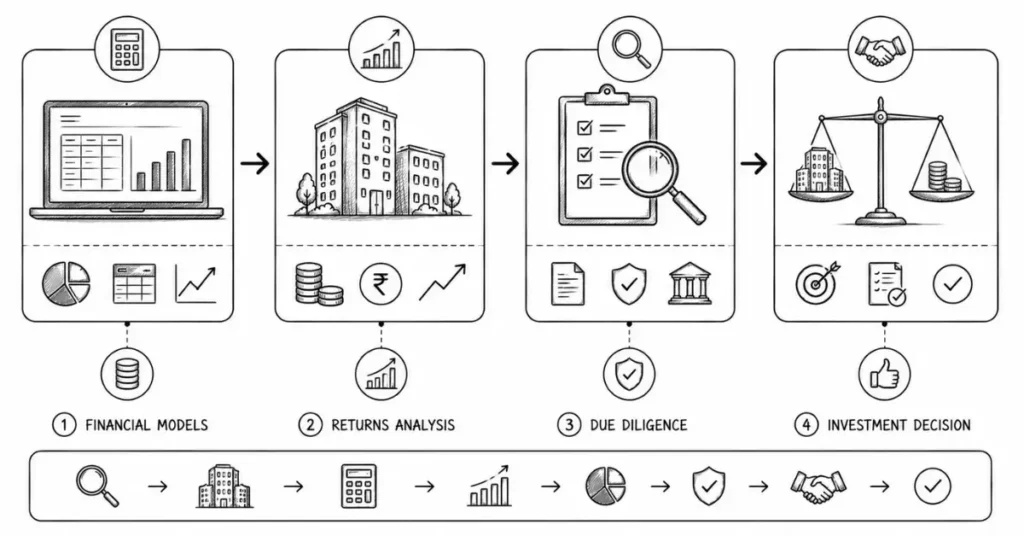
Investment analysis is a specialized career evaluating property investments for institutional investors, private equity firms, REITs, and high-net-worth individuals. Analysts conduct financial modeling, market research, due diligence, and risk assessment guiding investment decisions involving crores or billions of rupees.
The role requires strong quantitative abilities, financial acumen, and analytical thinking. You’ll develop complex financial models projecting cash flows, returns on investment, net present values, and internal rates of return. You’ll analyze market trends, demographics, economics, and property-specific factors assessing investment viability. You’ll perform due diligence reviewing legal documents, financial statements, operating data, and physical property conditions.
Educational backgrounds typically include degrees in finance, economics, business administration, or real estate. The Chartered Financial Analyst (CFA) designation is highly valued in investment roles despite not being real estate-specific. CFA eligibility in India requires a bachelor’s degree or equivalent, with final-year undergraduate students also eligible. While work experience isn’t required for Level I and II exams, candidates need four years of professional work experience in investment decision-making to earn the CFA charter after passing all three levels.
Job opportunities exist at firms like Welspun Group, Morgan Stanley, CBRE, Colliers, KPMG, Crisil, Cerberus Capital Management, and various real estate private equity funds. Entry-level analysts typically earn ₹6-10 lakh annually, mid-level analysts earn ₹12-20 lakh, and senior analysts and associates at leading firms command ₹25-50 lakh or more. Performance bonuses based on fund returns significantly increase total compensation.
Real Estate Marketing Specialists
Digital transformation has created strong demand for marketing specialists who understand both real estate fundamentals and digital strategies. These professionals develop and execute campaigns promoting properties, generating leads, building brand awareness, and supporting sales teams.
Roles combine traditional real estate knowledge with modern digital marketing skills including search engine optimization (SEO), social media marketing, content marketing, email marketing, paid advertising (Google Ads, Meta Ads), website management, graphic design, video production, and analytics. Creating compelling property listings, virtual tours, and promotional content across digital platforms is essential.
Digital marketing salaries in India vary significantly by experience and industry. Entry-level professionals earn ₹18,000-₹32,000 monthly (approximately ₹2.5-4 lakh annually). Mid-level marketers with 2-5 years earn ₹50,000-₹90,000 monthly (₹6-11 lakh annually). Senior specialists with 5-8 years command ₹1,00,000-₹2,20,000 monthly (₹12-26 lakh annually), and experts with 8+ years earn ₹2,50,000-₹6,00,000 monthly (₹30-72 lakh annually).
Real estate industry marketers earn on the higher end of these ranges due to high-budget campaign management, typically earning ₹50,000-₹2,20,000 monthly (₹6-26 lakh annually). Skills increasing compensation include Google Ads and Meta Ads expertise, SEO proficiency, funnel building, marketing automation, and AI tool proficiency.
Professionals with strong command over SEO and SEM tools earn ₹4-10 lakh annually, while those experienced with AI marketing platforms like ChatGPT, Jasper, or Midjourney earn ₹8-20 lakh as these technologies integrate deeply into campaign strategies.
Real Estate Development and Project Management

Real estate development involves creating new properties through land acquisition, design, construction, and eventual sale or lease. Project managers coordinate architects, engineers, contractors, regulatory authorities, financiers, and marketing teams delivering projects on time and within budget.
India’s streamlined approval processes have reduced development timelines significantly, with single-window clearance systems and digitized land records cutting approval cycles. Projects once requiring 24-36 months now move faster, making project management roles more rewarding and less frustrating.
LinkedIn shows over 500 real estate project manager jobs currently available in India. Employers include Amazon, Curefit, ITC, CBRE, Cushman & Wakefield, and major developers. Roles span civil project management, interior fitout coordination, retail outlet development, MEP (mechanical, electrical, plumbing) management, and comprehensive development oversight.
Key skills include construction management knowledge, understanding of zoning laws and building codes, financial management for budgeting and cost control, contract negotiation and vendor management, risk assessment and mitigation, stakeholder communication and coordination, and timeline planning using project management methodologies. Many successful project managers hold civil engineering or architecture degrees providing technical foundations. Project Management Professional (PMP) certification enhances credibility demonstrating mastery of project management principles.
Entry-level project coordinators earn ₹4-6 lakh annually, project managers earn ₹8-15 lakh, senior project managers command ₹15-25 lakh, and development directors or VPs managing portfolios earn ₹30-60 lakh or more depending on company size and project scale.
RERA Registration: Mandatory Foundation
Understanding RERA's Importance
The Real Estate (Regulation and Development) Act, 2016 (RERA) represents a watershed moment for India’s real estate sector, bringing transparency, accountability, and professional standards. For aspiring agents, understanding RERA is essential because operating without registration is illegal and can result in penalties of up to ₹10,000 per day and imprisonment.
RERA registration is compulsory for all real estate agents involved in selling, purchasing, advertising, marketing, booking, or inviting individuals to purchase plots, apartments, or buildings within RERA-registered projects. This covers virtually all real estate transaction activities, making registration essential for agent careers.
Registration builds trust by allowing clients to verify your RERA number online, adding credibility to your services. It provides legal authorization to practice, as only registered agents can sell RERA-approved projects legally. It prevents penalties and legal exposure from non-compliance. And it establishes professional identity in an industry increasingly valuing credentials and transparency.
Eligibility and Application Process
RERA registration eligibility is intentionally accessible. Requirements include minimum age of 18 years and educational qualifications of 10th or 12th grade completion depending on your state. Some states may have additional requirements, so verify your specific state’s RERA website for precise criteria.
The registration process is conducted entirely online through state RERA portals. Step 1: Visit your state’s official RERA website and create an account. Step 2: Click “New Registration” and enter required information including personal details, educational qualifications, contact information, and business details. Step 3: Verify your email address to enable login. Step 4: Upload required documents including PAN card, permanent address proof, business address proof, recent photographs, educational certificates, and declarations regarding no pending criminal or civil cases.
Step 5: Accept the declaration and pay the registration fee online, typically ₹5,000-₹25,000 depending on your state. Step 6: After payment, receive an application number for tracking your application status. Step 7: Wait for verification by RERA authorities, typically 4-6 months, during which they review documents and may request additional information. Step 8: Upon approval, receive your certificate of registration and registration number. Step 9: Download your certificate by logging into your account.
Registration Validity and Compliance
RERA registration is valid for five years in most states, after which renewal is required. Initiate renewal at least 60 days before expiration to prevent gaps in authorization. The renewal process involves submitting online applications, providing updated documents if required, paying renewal fees, and receiving renewed certificates upon approval.
Your RERA registration number must be quoted in all property dealings and advertisements. This transparency allows consumers to verify they’re working with legitimate registered agents, protecting them from fraud and building your credibility as a professional compliant with legal requirements
Essential Skills Across Real Estate Careers
Interpersonal and Communication Skills
Real estate fundamentally involves people and relationships regardless of your specific role. Excellent interpersonal skills aren’t optional—they’re foundational to career success. Active listening helps you understand client needs, concerns, and motivations, enabling better service and solutions. Clear communication allows you to explain complex processes, terms, and documents in accessible language without condescension. Emotional intelligence enables reading unstated concerns, managing anxieties, navigating conflicts, and maintaining composure during stressful situations.
Negotiation abilities impact results across sales, leasing, vendor management, and deal-making. Preparation, win-win orientation, emotional detachment, and creative problem-solving characterize effective negotiators. Relationship building transforms one-time clients into repeat customers and referral sources, creating sustainable long-term success through trust, reliability, and genuine care.
Market Knowledge and Research
Comprehensive market knowledge establishes credibility and enables quality advice. You need to understand neighborhood characteristics, current pricing trends, inventory levels, buyer demand patterns, and regulatory environments. Develop systematic approaches maintaining current knowledge through weekly data reviews, property tours, local news monitoring, and networking with industry professionals.
Research skills enable efficient property identification, comparable analysis, market trend interpretation, and data-driven recommendations. Learn to use multiple listing services, property databases, public records, and analytics platforms effectively.
Financial and Analytical Abilities
Financial literacy is critical across most real estate roles. Understanding mortgage calculations, return metrics, cash flow analysis, taxation, and basic accounting principles enables competent client guidance and sound decision-making. For specialized roles like investment analysis or development, advanced financial modeling becomes essential.
Analytical thinking helps evaluate data reliability, identify appropriate comparables, make sound adjustments for differences, recognize trends and patterns, and detect inconsistencies requiring investigation. Systematic analysis supports defensible conclusions and confident recommendations.
Technology Proficiency
Modern real estate demands technology competency. CRM systems track leads, manage communications, and organize pipelines. Property listing platforms require familiarity for effective marketing. Virtual tour technology, digital document management, online transaction platforms, and increasingly AI tools for content generation, predictive analytics, and automated workflows are standard tools you’ll use regularly.
Embrace technology as an enabler rather than viewing it as a threat. Professionals leveraging technology for efficiency while maintaining human judgment and relationship elements will thrive. Those resisting digital transformation will struggle competitively.
Salary Expectations and Earning Potential
Sales and Brokerage Earnings
Real estate agent income varies dramatically based on performance, experience, location, and market conditions. Entry-level agents (0-2 years) might earn ₹2-4 lakh annually while building skills and networks. Mid-career agents (3-5 years) typically earn ₹5-10 lakh as deal flow becomes consistent. Experienced agents (7-10 years) command ₹12-25 lakh or more. Top performers (10+ years) with luxury or commercial specialization exceed ₹50 lakh annually.
Commission structures typically range 1-2% of property sale values. On a ₹1 crore property at 2% commission, total commission is ₹2 lakh. However, agents working under brokerages split commissions 50-50 to 70-30 depending on experience and negotiation. Geographic location significantly affects earnings, with metropolitan markets offering higher property values and transaction volumes than smaller cities.
Property Management Compensation
Property managers enjoy salary-based compensation with clear progression. Entry-level (0-2 years): ₹3 lakh annually. Early career (2-5 years): ₹3.9 lakh. Mid-career (5-10 years): ₹4.7 lakh. Experienced (10-15 years): ₹5.8 lakh. Senior level (15-20 years): ₹7.2 lakh or more.
Professional certifications create significant premiums. CPM holders earn substantially more than non-certified peers, with US data showing averages of $118,383 (approximately ₹98 lakh), though Indian salaries are proportionally lower. ARM certification holders earn an average of $66,813 (approximately ₹55 lakh) in the US, with 82% reporting higher incomes post-certification
Facility Management Income
Facility managers average ₹19.5 lakh annually, ranging from ₹15-45.5 lakh based on experience and portfolio. The top 10% earn more than ₹30 lakh, with the highest earners reaching ₹50 lakh. Entry-level professionals earn around ₹3.6 lakh, early career (1-4 years) earn approximately ₹3.9 lakh, and experienced managers command ₹5.7 lakh or more. CFM certification significantly boosts earning potential through demonstrated expertise and global credential recognition.
Appraiser and Analyst Earnings
Appraisers see wide income variation. Entry-level: ₹3-5 lakh. Mid-career (3-5 years): ₹5-8 lakh. Experienced (7-10 years): ₹8-15 lakh. Senior (10+ years): ₹15-30 lakh+. Elite commercial specialists: ₹40-60 lakh+.
Investment analysts earn ₹6-10 lakh entry-level, ₹12-20 lakh mid-level, and ₹25-50 lakh+ senior-level, with performance bonuses significantly increasing total compensation.
Marketing and Development Compensation
Digital marketing specialists in real estate earn ₹6-26 lakh annually depending on experience. Entry-level: ₹2.5-4 lakh. Mid-level (2-5 years): ₹6-11 lakh. Senior (5-8 years): ₹12-26 lakh. Experts (8+ years): ₹30-72 lakh.
Project managers earn ₹4-6 lakh entry-level, ₹8-15 lakh mid-level, ₹15-25 lakh senior-level, and ₹30-60 lakh+ at director/VP levels depending on company size and project scale.
Choosing Your Real Estate Career Path
Self-Assessment Questions
Consider these questions when evaluating which real estate path suits you best:
Personality and Skills: Are you naturally outgoing and energized by social interaction (sales/brokerage) or more introverted preferring analytical work (appraisal/analysis)? Do you enjoy persuasion and relationship-building (sales) or operational excellence and systems (property/facility management)? Are you comfortable with income variability (sales) or do you prefer salary stability (management)?
Work Preferences: Do you want flexible schedules with entrepreneurial independence (sales) or structured work with clear responsibilities (management)? Are you willing to work evenings/weekends when clients need you (sales) or prefer regular business hours (corporate facility management)? Do you enjoy variety with different clients and properties (sales) or depth managing specific properties long-term (management)?
Financial Situation: Do you have 6-12 months savings to weather initial income inconsistency (sales), or do you need immediate steady income (salaried roles)? Are you comfortable with performance-based compensation (sales), or do you prefer predictable paychecks (management)? Can you invest in certifications that pay off over 2-5 years (CPM, CFM, CCIM), or do you need to minimize upfront costs?
Career Goals: Do you want unlimited earning potential (sales/brokerage) or steady advancement with clear progression (management)? Are you building toward independent practice/business ownership (brokerage) or corporate advancement (facility management, investment analysis)? Do you want location flexibility (sales) or are you tied to specific geographic areas?
Career Path Matching
Choose Sales/Brokerage if you: Are extroverted and relationship-focused, enjoy persuasion and negotiation, thrive with variable income and performance rewards, want entrepreneurial independence, and have financial cushion for initial period.
Choose Property Management if you: Prefer operational focus over sales, enjoy problem-solving and coordination, want steady salary-based compensation, value work-life balance, and like managing ongoing relationships.
Choose Appraisal/Valuation if you: Are analytically minded and detail-oriented, enjoy research and systematic analysis, prefer independent work, want professional independence, and can invest time in registration process.
Choose Facility Management if you: Are technically inclined, enjoy operational coordination, want corporate employment stability, appreciate working with building systems and sustainability, and are comfortable with certification requirements.
Choose Investment Analysis if you: Have strong quantitative abilities, enjoy financial modeling, hold relevant degree (finance, economics, business), want corporate or institutional employment, and are willing to pursue CFA or similar credentials.
Choose Marketing if you: Are creative and digitally savvy, enjoy content creation, understand both real estate and digital tools, want diverse project work, and can develop multiple technical skills.
Choose Development/Project Management if you: Have engineering or construction background, enjoy coordination of complex projects, want to see tangible results, can handle high responsibility, and have strong organizational skills.
Launching Your Real Estate Career: Action Plan
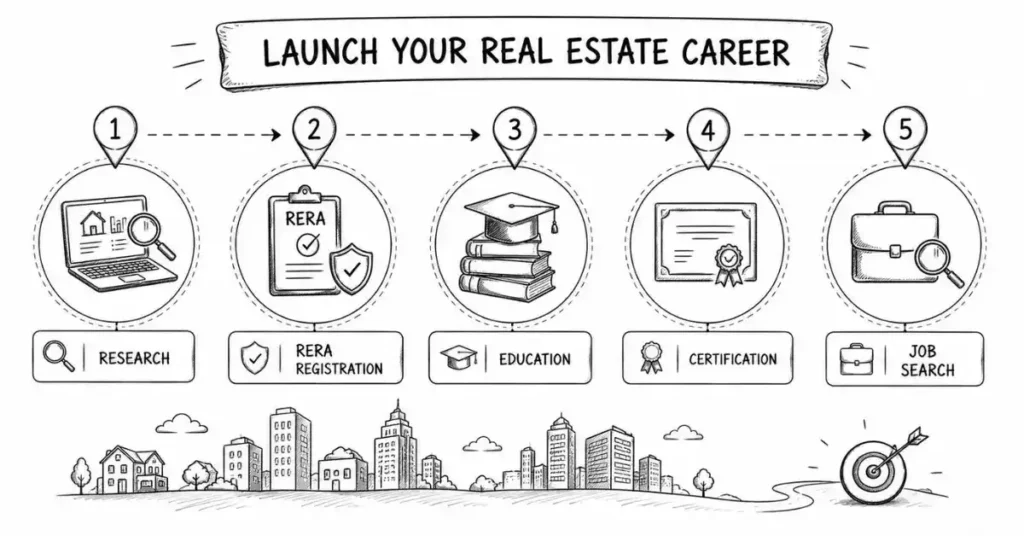
Phase 1: Research and Preparation (Months 1-2)
Deepen your industry understanding by reading real estate news, following market trends, joining online communities, attending open houses, and interviewing practicing professionals. Assess financial readiness by calculating monthly expenses, evaluating savings runway, planning for income gaps, and creating realistic transition budgets.
Visit your state’s RERA website to understand specific requirements. Research educational programs if formal credentials would benefit your goals, evaluating costs versus salary benefits and exploring flexible learning options.
Phase 2: RERA Registration and Education (Months 2-8)
For agent careers, gather required documents and submit RERA registration applications. Use the 4-6 month waiting period productively through online real estate courses, market research, networking at industry events, and building digital presence on LinkedIn and professional platforms.
For other careers, pursue relevant education or certifications. Property management candidates should explore CPM or ARM pathways. Facility management aspirants should investigate CFM requirements. Appraisers should complete registered valuer education programs and practical training.
Phase 3: Gaining Experience (Months 6-12)
For sales careers, join established brokerages providing training, mentorship, leads, and systems. Choose agencies carefully based on reputation, commission structures, support quality, and culture fit.
For property/facility management, seek assistant or coordinator positions at property management companies, facility management firms, or corporate facilities departments. These entry roles provide essential operational experience while earning stable income.
For specialized roles (appraisal, investment analysis), pursue internships or junior positions at valuation firms, real estate investment companies, REITs, or development firms.
Phase 4: Building Your Network and Reputation
Join professional associations (IREM, IFMA, RICS India, local realtor associations) for networking, education, and credibility. Attend industry conferences and events regularly. Build complementary professional relationships with mortgage brokers, lawyers, contractors, and other real estate service providers.
Leverage digital networking through comprehensive LinkedIn profiles, regular content sharing, meaningful engagement with others’ posts, and joining real estate professional groups. For sales agents, cultivate your sphere of influence by informing your personal network about your career, offering real estate help without immediate sales pressure, and requesting referrals explicitly.
Phase 5: Continuous Development
Commit to ongoing learning through continuing education courses, professional development workshops, market research routines, technology skill building, and mentor relationships with experienced professionals. Plan certification timelines strategically, pursuing CPM, CFM, CCIM, or other credentials when eligible and able to invest time and money.
Develop specializations distinguishing you from competitors. Consider focusing on specific neighborhoods, property types, client segments, or services where you can build recognized expertise commanding premium compensation.
Overcoming Common Career Challenges
Financial Uncertainty in Sales Roles
Commission-based income creates stress, especially initially. Address this through adequate savings (6-12 months living expenses) before transitioning, part-time starts while maintaining other income, diversified income streams combining sales with rentals or consulting, disciplined budgeting based on lowest earning months, and separate savings accounts smoothing income fluctuations.
Dealing with Rejection
Real estate sales involves frequent rejection as prospects decline, deals fall apart, and negotiations fail. Develop resilience by reframing rejection as information rather than personal failure, maintaining consistent activity regardless of recent outcomes, celebrating small wins and process metrics beyond closed deals, building support systems through mentors and peer groups, and viewing challenges as learning opportunities rather than defeats.
Work-Life Balance
Real estate can consume unlimited time if you allow it. Establish boundaries through defined work hours communicated to clients, strategic technology use enabling responsiveness without 24/7 availability, scheduling personal time as non-negotiable appointments, and recognizing that sustainable success requires rest and renewal, not constant hustle.
Keeping Current with Regulations
India’s real estate regulatory environment continues evolving. Stay current by subscribing to RERA updates from your state authority, joining professional associations providing regulatory guidance, attending continuing education focused on legal compliance, and consulting attorneys for complex questions rather than guessing.
Future Trends Shaping Real Estate Careers
Technology Integration
Virtual reality property tours, AI-powered property recommendations, automated valuation models, blockchain for transactions, and PropTech tools are reshaping how professionals work. Embrace technology as an efficiency enabler while maintaining human judgment and relationships that technology cannot replace.
Sustainability Focus
Green building mandates, ESG requirements, energy efficiency standards, and climate considerations create demand for professionals with sustainability expertise. Facility managers, developers, and appraisers understanding environmental factors will command premium compensation.
Data Center Boom
India’s explosive data center growth requires specialized real estate professionals understanding power infrastructure, cooling requirements, connectivity needs, and data sovereignty regulations. This technical niche offers exceptional opportunities through 2030.
Hybrid Workplace Evolution
Corporate office strategies balancing remote work with collaboration spaces affect both leasing patterns and facility requirements. Understanding workplace trends enables better service to corporate clients navigating these changes.
Frequently Asked Questions
Is RERA registration mandatory for all real estate agents? Yes, absolutely mandatory for anyone involved in selling, purchasing, advertising, or marketing properties within RERA-registered projects. Operating without registration is illegal and can result in penalties up to ₹10,000 per day and imprisonment.
How long does RERA registration take? The process typically takes 4-6 months from application submission to certificate receipt. Timeline varies by state depending on application volumes and administrative efficiency.
Do I need a college degree for real estate careers? Not for agent careers—RERA requires only 10th or 12th grade education. However, degrees significantly enhance earning potential and advancement opportunities in property management, facility management, and specialized roles. Property managers with bachelor’s degrees earn substantially more than those with only certificates or diplomas.
What’s the best real estate career for stable income? Property management and facility management offer salary-based compensation with regular work schedules, providing more stability than commission-based sales. Corporate facility management and investment analyst roles at established firms also provide steady employment.
Can I work part-time in real estate initially? Yes, many successful agents began part-time while maintaining other employment, gradually transitioning as real estate income grew. Part-time entry reduces financial risk and allows testing whether real estate suits you before fully committing.
What certifications are most valuable? CPM (Certified Property Manager) for property management, CFM (Certified Facility Manager) for facility roles, CCIM for commercial real estate, and CFA for investment analysis are the most respected credentials creating significant earning premiums and career advancement.
How much can I realistically earn in real estate? Highly variable by role and performance. Sales agents: ₹2-50+ lakh. Property managers: ₹3-20 lakh. Facility managers: ₹15-50 lakh. Appraisers: ₹3-60 lakh. Investment analysts: ₹6-50+ lakh. Geographic location, experience, specialization, and individual effort dramatically impact earnings.
Conclusion: Your Real Estate Career Starts Today
India’s real estate sector offers exceptional career opportunities across diverse specializations, each with unique advantages, challenges, and rewards. The industry’s strong growth trajectory driven by urbanization, infrastructure development, technology expansion, and regulatory improvements creates sustained demand for qualified professionals.
Success requires combining mandatory requirements like RERA registration with ongoing skill development, strategic networking, financial discipline, and persistent effort. The professionals who thrive view their careers as long-term ventures requiring patience, continuous learning, and genuine service rather than quick-money schemes.
Your first step is clarifying which path aligns with your strengths, interests, financial situation, and lifestyle preferences. Then take concrete action: visit your state RERA website, research educational programs, connect with practicing professionals, join industry associations, or apply for entry-level positions.
Real estate careers reward those who commit to excellence, maintain professional integrity, build genuine relationships, and continuously adapt to market evolution. Whether you choose sales, management, appraisal, facility operations, marketing, investment analysis, or development, the comprehensive guidance in this master guide provides your foundation for launching and developing a rewarding career in India’s dynamic, growing real estate market.
The real estate professionals who build lasting success approach their work with professionalism, ethics, client-focus, and dedication to continuous improvement. They understand that reputation built through years of excellent service cannot be replicated by shortcuts or unethical practices.
Your real estate career journey begins today with the decision to pursue this exciting field and take that first concrete action step. Whether you’re fresh out of college, transitioning mid-career, or building entrepreneurial ventures, India’s real estate sector offers opportunities matching your ambitions and abilities. Commit to the journey, invest in your development, serve your clients excellently, and build the rewarding career you envision.