
Property Management Career India: Salary & Certifications
Table of Contents
Introduction
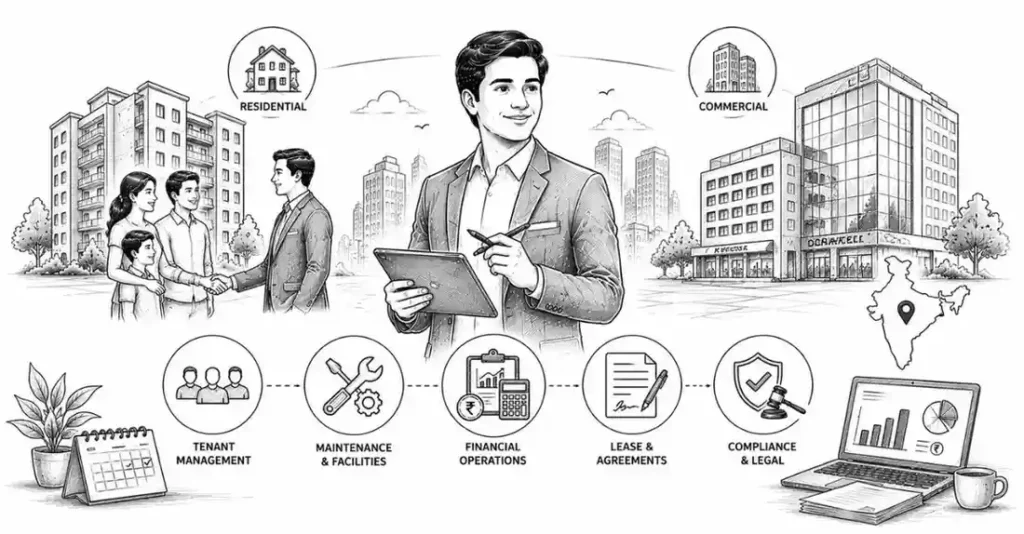
Property management represents one of the most stable and professionally rewarding career paths within India’s expanding real estate sector. Unlike commission-based sales roles with unpredictable income, property managers enjoy salary-based compensation, regular work schedules, and steady career progression. As India’s commercial and residential real estate sectors grow more sophisticated, demand for qualified property management professionals continues rising across all major cities.
Property managers serve as the operational backbone ensuring buildings function smoothly, tenants remain satisfied, owners maximize returns, and properties maintain their value. Your responsibilities span tenant relations and lease management to maintenance coordination, financial oversight, vendor management, and regulatory compliance. The role combines interpersonal skills with operational excellence, financial acumen with problem-solving abilities, and strategic thinking with meticulous attention to detail.
What makes property management particularly appealing is the career’s stability and clear growth trajectory. While India doesn’t enforce a uniform property management license, educational qualifications and professional certifications create distinct career advantages. Entry-level positions start around ₹3-4 lakh annually, mid-career professionals earn ₹5-8 lakh, and experienced managers with certifications like CPM (Certified Property Manager) command ₹10-20 lakh or more in senior positions.
This comprehensive guide explores everything you need to build a successful property management career in India, from understanding different specializations and required qualifications through certification pathways, realistic salary expectations, essential skills development, and proven strategies for career advancement in this growing profession.
Understanding the Property Manager Role
Core Responsibilities
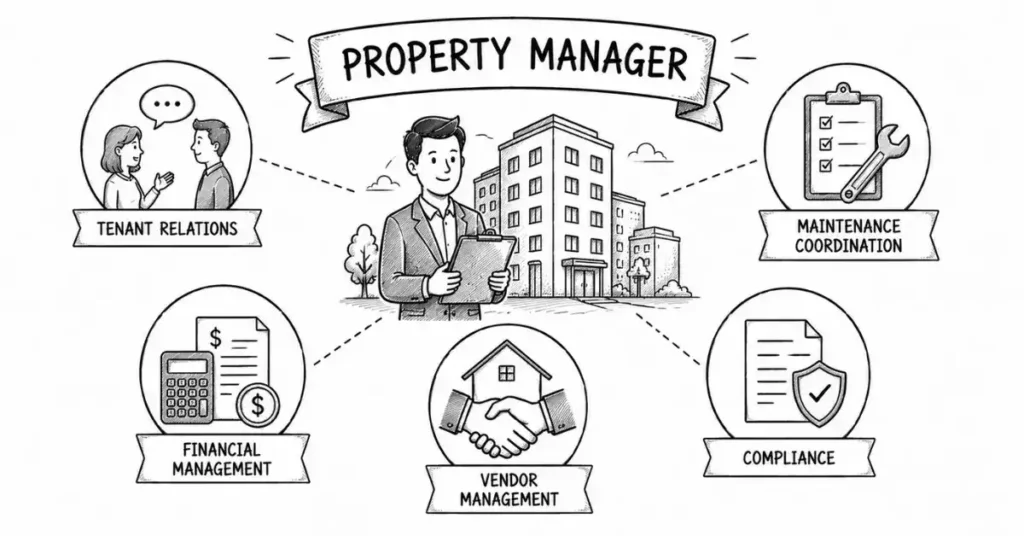
Property managers oversee the day-to-day operations of residential, commercial, or mixed-use properties on behalf of owners who lack time, expertise, or geographic proximity to manage properties themselves. Your primary objective is maximizing property value and owner returns while ensuring tenant satisfaction and regulatory compliance.
Tenant relationship management forms a central pillar of property management. You market vacant units through online listings, property portals, and signage to minimize vacancy periods. You screen prospective tenants by verifying income and employment, checking references, reviewing credit histories, and assessing rental payment capacity. You draft, sign, and renew lease agreements ensuring legal compliance and protecting owner interests. Throughout tenancies, you serve as the primary contact for tenant concerns, coordinate move-ins and move-outs, enforce lease terms and community rules, and handle lease renewals or terminations according to legal requirements.
Maintenance coordination ensures properties remain functional, safe, and attractive. You conduct regular property inspections identifying maintenance needs, safety hazards, or lease violations. You schedule repairs and regular maintenance including cleaning, landscaping, pest control, and equipment servicing. When repairs are needed, you receive tenant requests, evaluate urgency and legitimacy, coordinate contractors and service providers, oversee work quality and completion, and manage costs within budget parameters. For larger properties, you may supervise on-site maintenance staff responsible for minor repairs and daily upkeep.
Financial management directly impacts owner satisfaction and your performance evaluations. You set rental rates based on market analysis ensuring competitive positioning while maximizing income. You collect rent payments, follow up on late payments, and implement collection procedures for delinquencies. You pay property expenses including utilities, maintenance, vendor invoices, insurance, and property taxes. You create and manage annual budgets forecasting income and expenses. Monthly or quarterly, you generate financial reports showing income, expenses, occupancy rates, and net operating income, providing owners with transparent performance visibility and handling tax and financial reporting requirements.
Vendor and contractor management requires negotiation skills and quality oversight. You solicit bids for maintenance and improvement projects, negotiate contracts balancing cost and quality, monitor contractor performance ensuring timely, quality work, and maintain relationships with reliable service providers for various building systems and needs. Efficient coordination and vendor management is crucial for ensuring timely repairs and maintaining asset value.
Legal and regulatory compliance protects both owners and tenants while avoiding penalties. You ensure lease agreements comply with state and local rental laws. You understand and follow fair housing regulations prohibiting discrimination. You maintain properties according to health and safety codes and local building regulations. You execute eviction procedures legally when necessary, following proper notice requirements and court processes. You maintain required documentation for tax and legal purposes, ensuring legal compliance with landlord-tenant laws.
Residential vs. Commercial Property Management
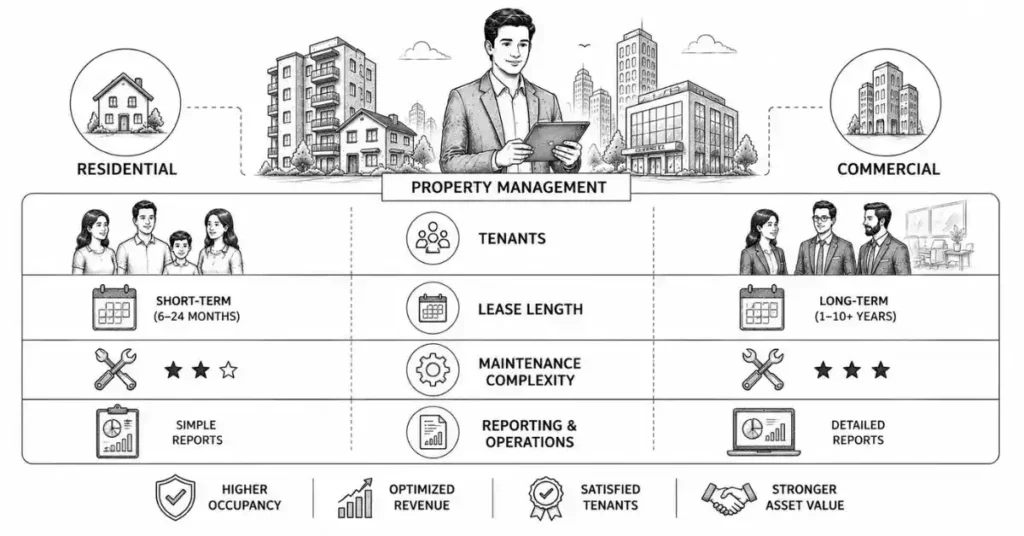
Property management specializations differ significantly in responsibilities, challenges, and skill requirements.
Residential property management focuses on apartments, housing societies, independent houses for rent, gated communities, and residential condominiums. Residential property managers typically deal with individual or family tenants making emotional decisions about their homes. Lease terms are usually 11 months to 1 year in India. Maintenance issues tend to be relatively routine (plumbing, electrical, appliances). Tenant turnover can be frequent requiring regular marketing and leasing activities. Rent collection involves numerous smaller transactions. Communication is frequent with tenants expecting responsive service.
Commercial property management oversees office buildings, retail spaces, industrial warehouses, shopping malls, and mixed-use developments. Commercial property managers work with business tenants making financial decisions based on location, foot traffic, and operational suitability. Lease terms are much longer (typically 3-9 years), providing revenue stability. Maintenance involves sophisticated building systems (HVAC, security, elevators) requiring specialized vendors. Tenant improvements and space modifications are common. Rent collection involves fewer, much larger transactions with more complex payment structures. Financial analysis and reporting requirements are more sophisticated.
Commercial property management duties span day-to-day operations handling building maintenance, repairs, cleanliness, and security; financial management collecting rent, managing budgets, and overseeing financial reporting; tenant relations screening tenants, negotiating lease agreements, and addressing concerns to maintain occupancy; and compliance ensuring property adherence to local regulations and building codes.
Work Environment and Schedule
Property managers split time between office work, property site visits, and tenant or vendor meetings. In office, you handle administrative tasks, respond to emails and calls, review financial reports, process invoices and payments, and coordinate with owners and senior management. At property sites, you conduct inspections, meet with tenants, oversee maintenance and repairs, show vacant units, and address on-site issues. You also attend meetings with owners reporting performance, discussing budgets and capital improvements, and presenting recommendations.
Most property managers work standard business hours, though emergencies occasionally require evening or weekend responses. Residential managers may show properties on weekends to accommodate working renters’ schedules. The work provides more predictability than sales roles while still offering variety through different properties, diverse challenges, and various stakeholders.
Education and Qualification Requirements
Minimum Educational Requirements
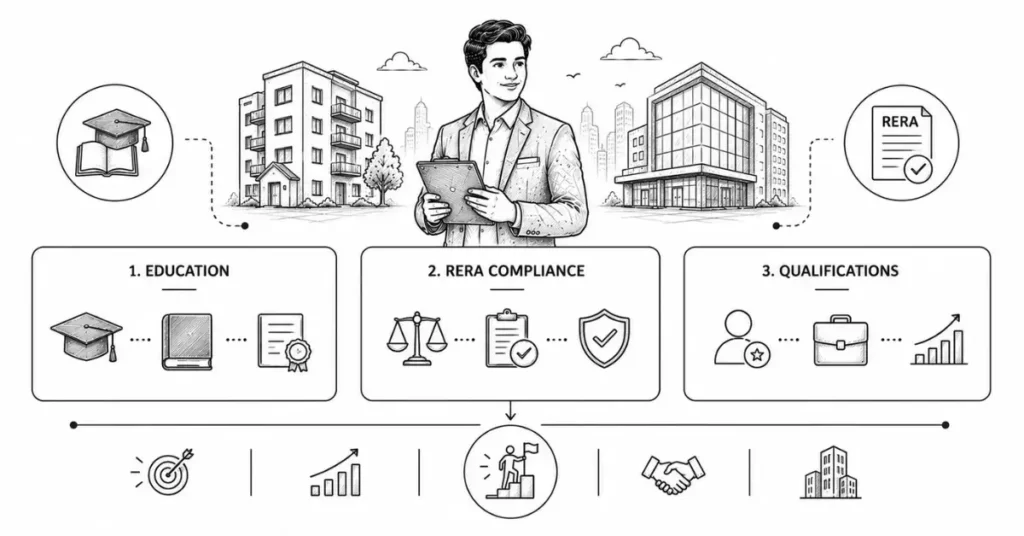
While India does not enforce a uniform property management license, certain educational and professional thresholds are necessary to build a credible career.
Basic qualifications: A Bachelor’s degree in any stream is the minimum educational requirement recognized by most major employers and property management companies in India. This provides the theoretical foundation required for financial reporting and legal understanding.
Useful degrees and courses: Degrees in Business Management, Real Estate Management, Finance, or Property Law are highly advantageous. Specialized certifications in areas like facility management or real estate valuation provide a strong competitive edge. These educational programs should cover property operations and maintenance, landlord-tenant law and lease agreements, financial management and accounting, marketing and leasing strategies, customer service and relationship management, and building systems and maintenance fundamentals.
However, bachelor’s degrees dramatically increase both hiring competitiveness and long-term earnings. Property managers with bachelor’s degrees earn substantially more than those with only certificates or diplomas, and master’s degree holders command even higher salaries representing significant premiums over lower qualifications.
RERA Registration for Property Managers
In India, anyone who facilitates leasing or selling property must be registered with RERA (Real Estate Regulatory Authority). While RERA registration is primarily mandatory for real estate sales agents, property managers whose roles include marketing and leasing properties should obtain this registration to ensure legal compliance.
The RERA registration process involves obtaining a degree in a relevant field, completing mandatory RERA training and passing the Certificate of Competency exam, and applying through your state’s RERA portal with required documents and fees. Registration validity is typically five years, requiring periodic renewal.
Professional Certifications
While not legally mandatory, professional certifications significantly enhance property management careers through increased knowledge, professional credibility, higher earning potential, and expanded career opportunities.
Certified Property Manager (CPM) from the Institute of Real Estate Management (IREM) stands as the most prestigious property management credential internationally recognized. CPMs are recognized as experts in real estate management and are at the top of the profession.
CPM certification demonstrates advanced competency in property operations, financial management, human resources, marketing, and leadership. The financial payoff is substantial: CPMs earn an average of $118,383 annually compared to the industry average of $48,340 in the United States. While Indian salaries are proportionally lower, certified professionals command significant premiums over non-certified peers.
CPM Requirements include completing required IREM courses covering management skills, investment real estate, financial management, and asset management. You must pass the comprehensive CPM examination testing knowledge across all competency areas. Experience requirements include a total of three years (36 months) of experience in real estate management positions, managing a minimum portfolio, and performing a minimum number of functions. After earning CPM, you must complete continuing education maintaining current knowledge.
Over half of CPMs hold senior-level management positions, demonstrating the credential’s value for career advancement. The CPM designation is recognized as the standard of excellence in property management, and the certification process can take up to two years to complete.
Accredited Residential Manager (ARM) also from IREM focuses specifically on residential property management. ARM certification suits professionals managing apartment communities, condominiums, housing societies, and residential portfolios who want to demonstrate competency without pursuing the more extensive CPM designation.
ARM requirements include completing ARM coursework covering practical skills for residential management like maintenance, leasing, financial operations, human resources, and legal compliance. You must pass ARM examinations testing course material comprehension. Continuing education maintains credential currency. ARM typically serves as either an entry-level credential before pursuing CPM or as a terminal credential for those focused exclusively on residential management.
Master Property Manager (MPM) represents one of the peak points in the field. It typically requires 5 years of experience and the same requirements as the certified property manager, along with additional advanced qualifications. This is recognized as a top-tier industry credential.
The certification process you decide to undertake is determined by the type of role you are going for and may require membership of the certifying organization.
Property Management Salary and Earnings
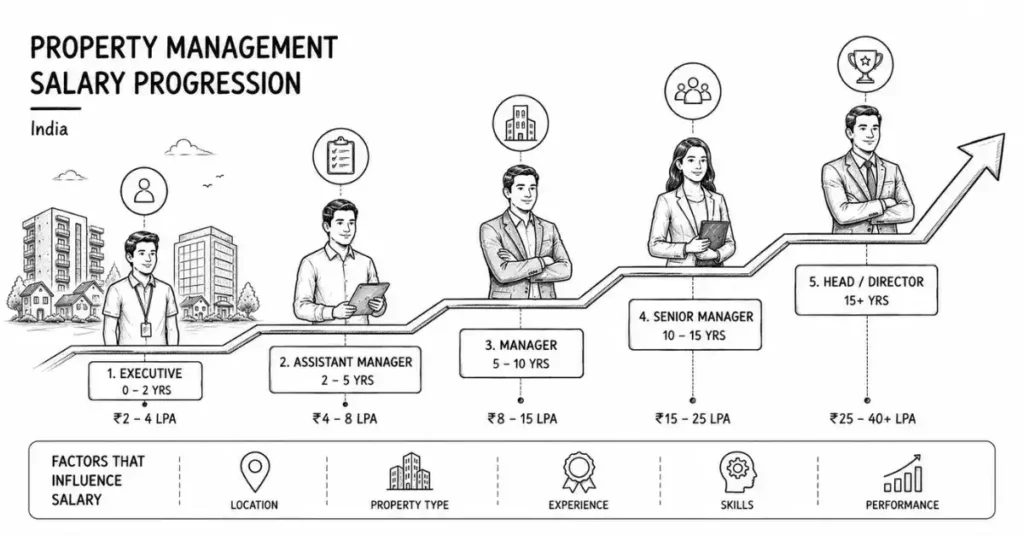
Salary by Experience Level
Property manager compensation in India reflects experience, education, property types, portfolio size, and geographic location. Understanding realistic salary expectations helps with career planning and negotiation.
Entry-Level (0-2 years): Property managers with less than two years of experience earn approximately ₹3-4 lakh annually. Entry-level roles typically involve assistant property manager positions, supporting senior managers with administrative tasks, tenant communications, maintenance coordination, and property inspections. These positions provide essential learning opportunities while earning modest but stable income from career start.
Early Career (2-5 years): Property managers with 2-5 years of experience earn around ₹4-6 lakh annually. At this career stage, you typically manage smaller properties independently or assist with larger portfolios. You’ve developed solid operational skills, tenant relationship capabilities, vendor management abilities, and problem-solving experience. This represents significant earnings growth rewarding developed competency and proven reliability.
Mid-Career (5-10 years): Property managers with 5-10 years of experience command approximately ₹6-10 lakh annually. Mid-career professionals often manage significant portfolios or large commercial properties, supervise junior property managers or administrative staff, handle complex tenant issues and negotiations, and participate in strategic planning with ownership. This stage shows substantial growth reflecting increased responsibilities and autonomy.
Experienced (10-15 years): Property managers with 10-15 years of experience earn around ₹10-15 lakh annually. Experienced professionals typically manage premium or complex portfolios, lead property management teams, develop and implement operational standards and systems, and advise ownership on strategic property decisions.
Senior Level (15-20 years): The most experienced property managers with 15-20 years command ₹15-20 lakh or more annually. Senior professionals often hold titles like Regional Property Manager, Director of Property Management, or Vice President of Operations overseeing multiple properties or entire portfolios, setting company-wide standards and procedures, mentoring and developing property management teams, and participating in executive strategic planning.
Certification Impact on Earnings
Professional certifications create substantial salary premiums. The CPM designation has a significant financial payoff, with CPM holders earning an average of $118,383 annually compared to the industry average of $48,340 in the United States. This represents approximately 2.5 times higher earnings for certified professionals.
In India, while absolute salary figures are lower, the proportional premium remains substantial. CPM holders can expect to earn 40-60% more than non-certified peers at similar experience levels. The average salary for a CPM certified property manager in the United States is $60,000 per year, with the right skills and experience potentially earning much more.
Property management certifications are a great way to stand out in the competitive field of property management and can lead to higher job satisfaction and better pay. The certification investment typically pays for itself within 1-2 years through salary increases and advancement opportunities.
Geographic and Property Type Variations
Location significantly affects property management salaries. Metropolitan markets like Mumbai, Delhi-NCR, Bengaluru, Pune, and Hyderabad offer higher salaries reflecting higher living costs, larger and more valuable properties, more sophisticated property types, and greater competition for talent. However, net income after accounting for living costs may not differ as dramatically as gross salaries suggest.
Tier-2 cities offer lower gross salaries but also lower living costs, less competition for positions, growing real estate markets creating opportunities, and potential for faster advancement in smaller markets with less established talent.
Property type also influences compensation. Commercial property managers typically earn more than residential managers due to larger property values, more complex operations, sophisticated financial analysis requirements, and longer lease terms reducing leasing workload. Luxury residential property managers earn premium salaries managing high-end properties with sophisticated residents, premium amenities requiring specialized management, higher owner expectations, and larger property values.
Essential Skills for Property Management Success
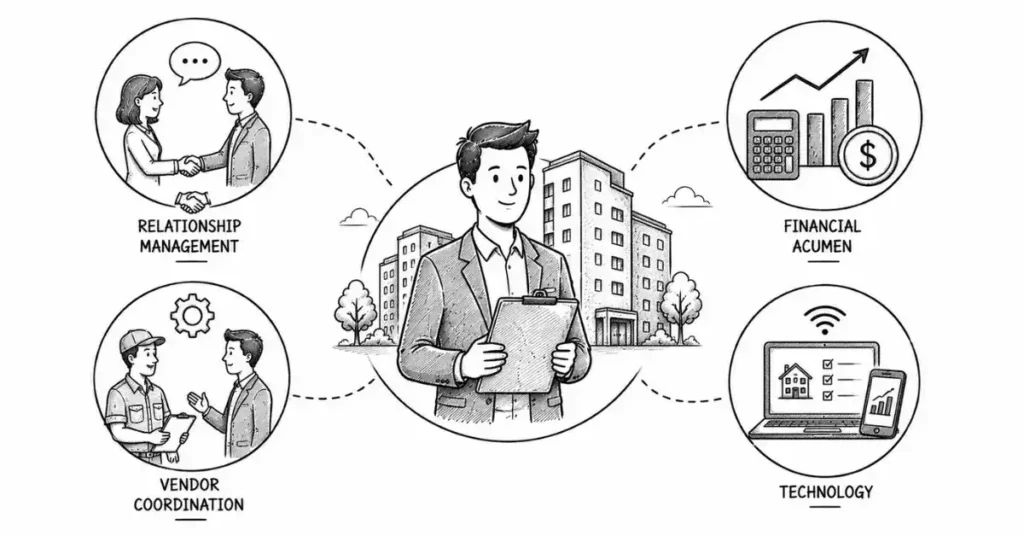
Customer Handling and Relationship Management
The property manager acts as the primary buffer between the owner and the tenant. Excellent conflict resolution and communication skills are required to handle complaints and retain tenants. Customer service orientation means treating tenants as valued customers, practicing active listening to understand concerns and needs, problem-solving to address issues quickly and fairly, conflict resolution mediating disputes between tenants or with management, and maintaining professional boundaries while being approachable.
Vendor management involves clear communication of expectations, scope, and timelines, negotiation securing quality services at fair prices, relationship building with reliable contractors for ongoing needs, performance monitoring ensuring work quality and timeliness, and conflict resolution addressing problems professionally while protecting property interests.
Financial Management and Accounting
Proficiency in creating and managing budgets, tracking cash flow, processing invoices, and generating accurate financial reports (like profit and loss statements) is mandatory. Develop competency in budget development projecting annual income and expenses, rent setting based on market analysis and property positioning, expense management controlling costs without sacrificing quality, financial reporting clearly communicating performance to owners, and variance analysis understanding why actual results differ from budgets and taking corrective action.
Analytical abilities help you evaluate market rental rates and competitive positioning, assess maintenance spending patterns identifying inefficiencies, analyze occupancy trends spotting seasonal patterns or problems, interpret financial metrics like net operating income, capitalization rates, and expense ratios, and make data-driven recommendations supporting strategic decisions with solid analysis.
Coordination and Vendor Management
The ability to efficiently coordinate with contractors, repair vendors, and maintenance staff is crucial for ensuring timely repairs and maintaining asset value. This requires building reliable vendor networks, negotiating favorable service agreements, scheduling preventive maintenance, responding promptly to emergency repairs, and maintaining detailed maintenance records.
Technology Proficiency
The professional must demonstrate a strong theoretical and practical understanding of property management, typically gained through internships or formal apprenticeship programs. Modern property management requires facility with property management software systems tracking tenants, leases, maintenance, and finances, accounting platforms for financial tracking and reporting, communication tools including email, messaging apps, and tenant portals, document management systems organizing leases, contracts, and records, and increasingly smart building technologies monitoring systems and automating controls.
Gain proficiency in modern PropTech, utilizing specialized software and mobile applications for efficient management. Property managers embracing technology improve efficiency and service quality while reducing operational costs.
Career Path and Advancement Opportunities
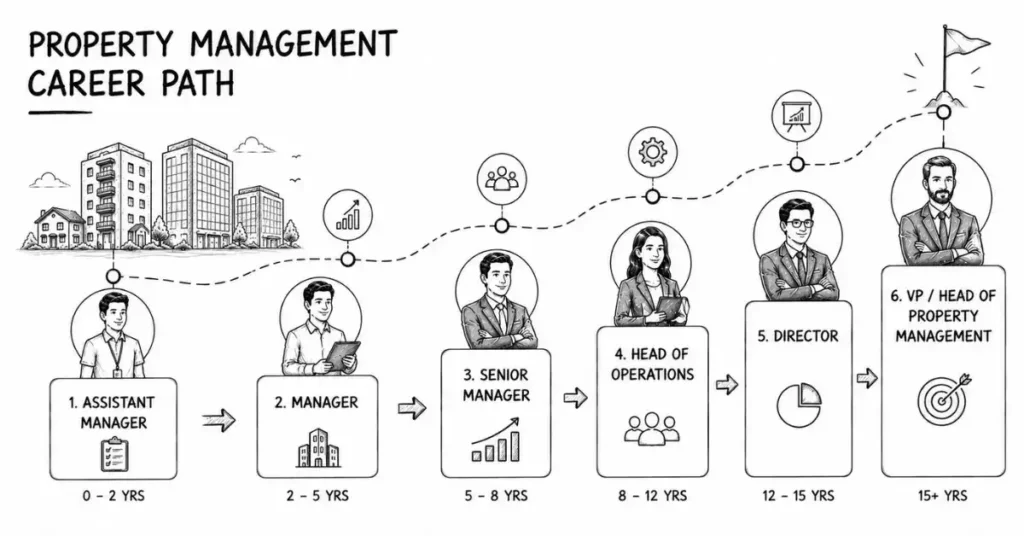
Typical Career Progression
Property management offers clear advancement pathways for professionals demonstrating competence, reliability, and leadership potential.
Step 1: Start with entry-level roles in a property management firm or gain experience as a licensed real estate agent, learning the practicalities of client and tenant negotiation. Assistant property manager roles provide foundations while earning ₹3-4 lakh annually.
Step 2: Property Manager managing individual properties or small portfolios independently, with full responsibility for day-to-day operations, tenant relations, direct vendor and contractor management, budget preparation and financial reporting, lease negotiations and enforcement, and handling complex tenant issues. Property managers typically earn ₹4-8 lakh annually depending on property size and complexity.
Step 3: Senior Property Manager overseeing multiple properties or large complex portfolios, managing property management teams, developing and implementing operational standards, strategic planning for property performance and improvements, owner relationship management and advisory, and mentoring junior property managers. Senior property managers earn ₹8-15 lakh or more.
Step 4: Regional Property Manager or Portfolio Manager responsible for all properties in a geographic region or specific portfolio, setting performance standards and ensuring consistency, strategic resource allocation across properties, senior leadership team participation, high-level owner relationship management, and contributing to company growth strategies. These positions command ₹12-20 lakh or higher.
Step 5: Director of Property Management or Vice President representing executive-level positions overseeing entire property management divisions, setting company-wide policies and procedures, strategic planning and business development, senior team leadership and development, and contributing to overall company direction. Executive roles can exceed ₹20 lakh with bonuses.
Specialization Opportunities
Step 4: Choose a niche (e.g., commercial leasing or residential build-to-rent) and pursue professional certification (like NAR-India’s programs or CPM/ARM) to boost credibility.
As you gain experience, consider specializing in specific property types or management aspects to differentiate yourself. Residential specialization focuses on apartment communities, condominiums, affordable housing, or student housing. Commercial specialization includes office buildings, retail centers and malls, industrial warehouses, or mixed-use developments. Functional specialization centers on financial management and analysis, leasing and marketing, maintenance and operations, or asset management strategy.
How to Launch Your Property Management Career
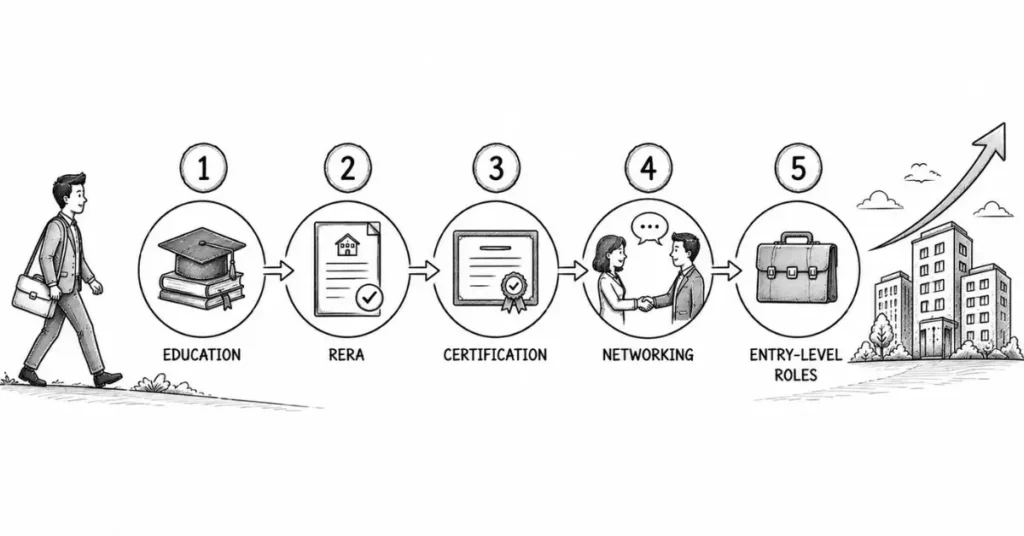
Step-by-Step Entry Plan
Step 1: Obtain a degree in a relevant field (Business/Finance/Real Estate). This provides the theoretical foundation required for financial reporting and legal understanding. If you already hold bachelor’s degrees in unrelated fields, consider shorter property management certificate programs adding specialized knowledge.
Step 2: In India, anyone who facilitates leasing or selling property must be registered with RERA. Obtain this mandatory registration if your role will involve property marketing and leasing to ensure legal compliance.
Step 3: Start with entry-level roles in a property management firm or gain experience as a licensed real estate agent, learning the practicalities of client and tenant negotiation. Property management hiring prioritizes demonstrated reliability, responsibility, and interpersonal skills, often valuing these character traits over specific credentials for entry positions.
Entry strategies include applying for assistant property manager positions at property management companies, apartment communities, or commercial properties; seeking junior facility coordinator roles in corporate environments managing their own properties; exploring administrative positions at real estate management firms providing exposure to operations; considering internships while completing degrees; or offering property oversight services for small-time landlords managing a few units.
Step 4: Choose a niche and pursue professional certification. Consider ARM certification after 1-2 years of property management experience once you’ve gained practical operational knowledge. Budget approximately ₹50,000-₹1,00,000 for ARM coursework, materials, and examination fees. Consider CPM after 3-5 years when you’ve accumulated required experience. Budget ₹1,50,000-₹2,50,000 for CPM courses, materials, and examination.
Step 5: Gain proficiency in modern PropTech. Utilize specialized software and mobile applications for efficient management, becoming expert in property management platforms used by your employer.
Building Your Professional Network
Join professional associations (IREM, RICS India, local property management associations) for networking, education, and career advancement opportunities. Attend meetings, volunteer for committees, and participate actively. Build vendor relationships with reliable contractors, maintenance professionals, and service providers becoming invaluable assets. Connect with other property managers through associations, LinkedIn, and industry events building genuine relationships focused on mutual benefit.
Frequently Asked Questions
Do I need RERA registration to work as a property manager? RERA registration is mandatory for real estate agents but not typically required for property managers who only oversee operations for owners. However, if your role includes marketing and leasing properties as part of property management responsibilities, RERA registration is advisable.
What’s the difference between property management and facility management? Property management focuses on operating rental properties for owners, emphasizing tenant relations, lease management, and rent collection. Facility management focuses on maintaining physical environments for organizations that own and occupy properties, emphasizing building systems, maintenance operations, and workplace services.
Can I work as a property manager remotely? Property management requires significant on-site presence for inspections, tenant meetings, vendor coordination, and emergency response. However, administrative tasks like financial reporting and vendor scheduling can be done remotely. Some property managers achieve hybrid arrangements with strategic site visits.
How stable is property management employment? Property management offers significantly more employment stability than commission-based sales. Property managers receive regular salaries rather than commission-only compensation, work predictable schedules, and experience steadier demand less affected by market cycles.
What certifications are most valuable? CPM (Certified Property Manager) is the most prestigious and financially rewarding credential, with holders earning substantially more than non-certified peers. ARM (Accredited Residential Manager) is valuable for residential property focus. Both are offered by IREM and recognized internationally.
Conclusion
Property management careers offer stability, clear advancement pathways, growing demand, and the satisfaction of maintaining well-functioning communities and properties. The profession rewards operational excellence, relationship management, financial discipline, and problem-solving abilities while providing more predictable schedules and income than sales-based real estate roles.
Your journey begins with education and entry-level positions building foundational skills, progresses through professional certification demonstrating expertise, and advances through increasingly responsible roles managing larger or more complex portfolios. Property managers who continuously develop skills, build strong vendor and peer networks, pursue professional certifications like CPM or ARM, and consistently deliver results create sustainable, rewarding careers in India’s growing real estate sector.
Take your first action today—research property management programs, apply for assistant positions, join professional associations, or connect with property managers for informational interviews. Your property management career begins with that first deliberate step toward this stable, professionally satisfying field.