
Practice and Self-Assessment
Table of Contents
Blog Content
Knowledge alone doesn’t make you a great interviewer. Practice does. The difference between candidates who get offers and those who don’t often comes down to how much they’ve practiced with real feedback. This final section provides you with the tools to practice strategically, assess yourself honestly, and track your improvement over time.

SECTION 1: Mock Interview Framework
Before you go to your real interview, you need to practice in realistic conditions. This framework gives you structured mock interview scenarios.
Setting Up Your Mock Interviews
Three Types of Mock Interviews (Do All Three):
Type 1: Solo Practice (Week 1)
- Interview yourself on video
- Record your answers to 10 common questions
- Review the recording objectively
- Identify weak areas
Type 2: Friend/Peer Practice (Week 2)
- Have someone interview you using prepared questions
- Feedback from another person is invaluable
- They catch things you don’t see in yourself
- Simulates real pressure better than solo practice
Type 3: Mentor/Professional Practice (Week 3)
- If possible, practice with someone from your field
- They understand industry context
- They can give professional-level feedback
Most realistic simulation of actual interview
Mock Interview Scenario 1: The Standard Interview (60 Minutes)
Structure:
- Greeting and small talk (3 minutes)
- Company/role questions (7 minutes)
- Background questions (10 minutes)
- Behavioral questions (20 minutes)
- Your questions (5 minutes)
- Closing (3 minutes)
- Buffer time (12 minutes)
Questions to Include:
Opening (Warm-Up)
- “Tell me about yourself”
- “Why are you interested in this company?”
Company/Role Understanding
3. “What do you know about our company?”
4. “How does this role fit into your career?”
Background and Experience
5. “Walk me through your resume”
6. “What’s your greatest professional achievement?”
Behavioral (STAR Method)
7. “Tell me about a time you failed”
8. “Tell me about a time you handled pressure”
9. “Describe a conflict you resolved”
10. “Tell me about a project you led”
Closing
11. “Do you have questions for us?”
12. “Is there anything else you’d like to add?”
Time Yourself: Aim for 45-55 minutes total (realistic interview length)

Mock Interview Scenario 2: The Stress Interview (45 Minutes)
Some interviewers ask tough questions to see how you handle pressure. This simulates that.
Challenging Questions to Include:
- “I see here you job-hopped. Can you explain that?”
- “You don’t seem to have direct experience in X. How would you handle that?”
- “Tell me about something you’re really not good at”
- “If we check your references, what will they say about your weaknesses?”
- “What’s a decision you made that you regret?”
- “Tell me about a time you lied or bent the truth”
- “Why are you overqualified/underqualified for this role?”
- “Tell me about a time you didn’t get promoted when you expected to”
- “What would your previous manager criticize about you?”
- “Would you be willing to take a pay cut for this role?”
Purpose: Prepares you for uncomfortable questions. Most interviewers won’t ask these, but if they do, you’ll be ready.
Your Mindset: Remember, even stress interviews are testing your judgment and resilience, not trying to be mean. Stay calm and authentic.
Mock Interview Scenario 3: The Industry-Specific Interview (50 Minutes)
Practice with questions specific to your industry (see Subtopic 3 for industry examples).
For IT/Tech:
- “Tell me about a technical challenge you solved”
- “How do you stay updated with technologies?”
- “Describe your experience with Agile”
For Finance/Banking:
- “How do you ensure accuracy in your work?”
- “Tell me about a compliance challenge”
- “Why is risk management important?”
For Sales/Marketing:
- “Tell me about your biggest sales win”
- “How do you handle rejection?”
- “Describe your approach to lead generation”
For Operations/Logistics:
- “Tell me about a process you improved”
- “How do you handle disruptions?”
- “Describe your approach to efficiency”
For Healthcare/Education:
- “Tell me about balancing policy with care”
- “How do you prevent burnout?”
- “Describe your continuing education”

SECTION 2: Self-Assessment Rubric
Use this rubric to evaluate your interview performance objectively.
Scoring System: 1-5 Scale
- 1 = Needs Significant Development
- 2 = Needs Development
- 3 = Adequate
- 4 = Good
5 = Excellent
Content Quality Assessment


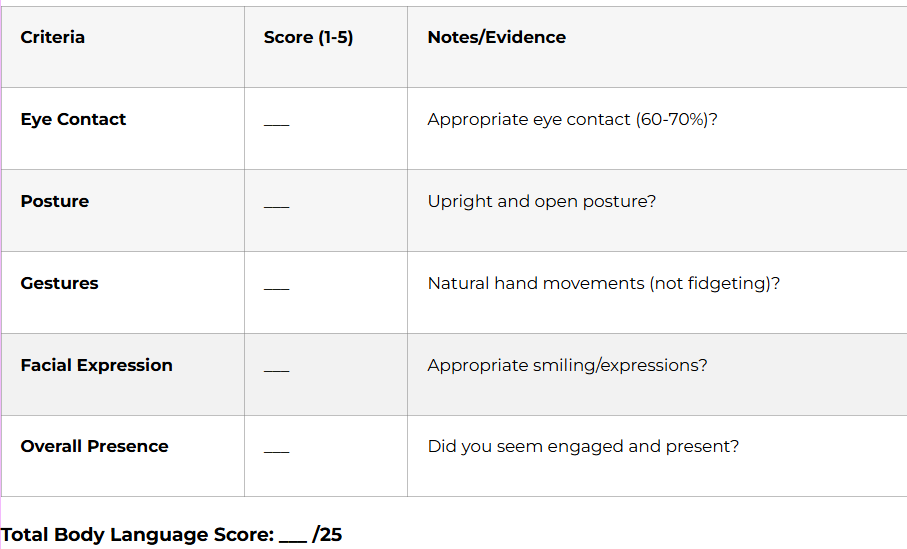
Delivery Quality Assessment
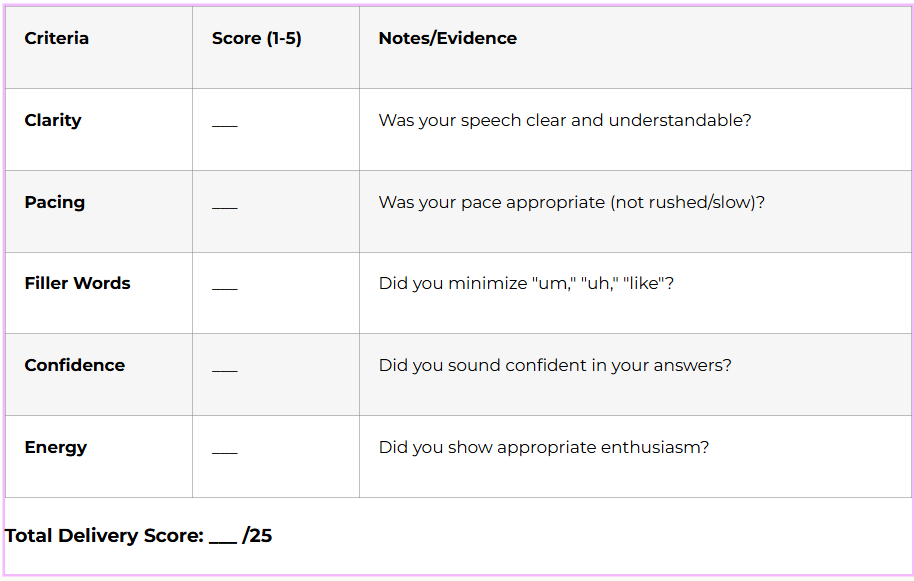
Body Language Assessment (In-Person/Video)
Communication & Listening Assessment
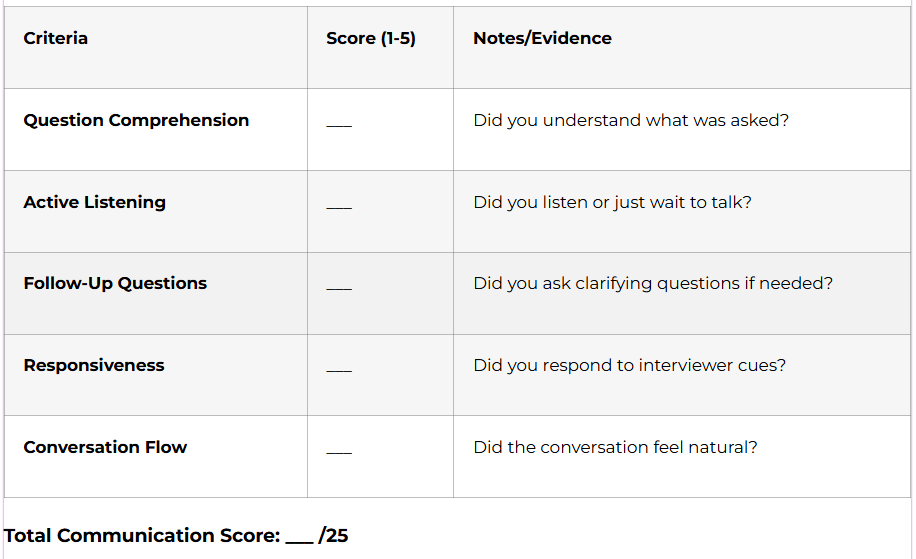
Overall Interview Assessment

GRAND TOTAL SCORE
Content: ___ /25
Delivery: ___ /25
Body Language: ___ /25
Communication: ___ /25
TOTAL: ___ /100
Interpretation:
- 85-100: Excellent. You’re ready for your real interview.
- 75-84: Good. Minor improvements needed. Practice one more round.
- 65-74: Adequate. Significant practice needed. Focus on weak areas.
- Below 65: Needs work. Practice more before real interview.
SECTION 3: Detailed Feedback Template
After each mock interview, use this template to document feedback.
Mock Interview Evaluation Form
Interview Details:
- Date: ___________
- Type: (Solo / Peer / Professional)
- Duration: ___________
- Interviewer Name: ___________
Overall Score: ___ /100
Three Things That Went Well:
Evidence: _____________
Evidence: _____________
Evidence: _____________
Three Areas to Improve:
Why: _____________
Improvement Strategy: _____________
Why: _____________
Improvement Strategy: _____________
Why: _____________
Improvement Strategy: _____________
Most Powerful Moment in Interview:
What happened: _____________
Why it worked: _____________
Can you replicate this in real interview: Yes / No
Most Uncomfortable Moment:
What was asked: _____________
How you answered: _____________
How you’d answer differently: _____________
Questions You Struggled With:
Your answer was weak because: _____________
Better answer: _____________
Your answer was weak because: _____________
Better answer: _____________
Action Items Before Next Practice:
- Practice story #___ more
- Reduce filler words in___
- Improve body language in___
- Develop answer for question___
- Research more about___
- Practice with friend on___
Next Mock Interview Scheduled: ___________

SECTION 4: Progress Tracking
Track your improvement across multiple mock interviews.
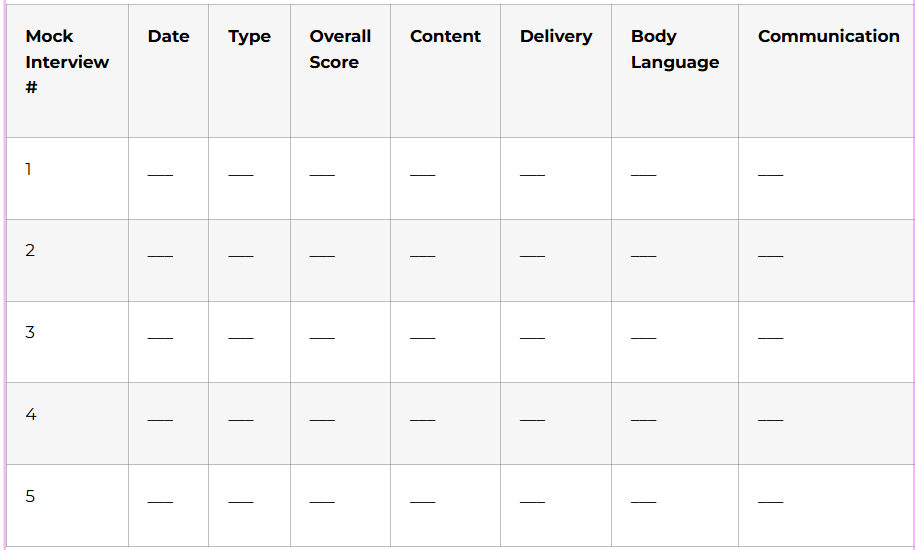
- Interview 1 Score: ___
- Interview 3 Score: ___
- Interview 5 Score: ___
- Goal: Reach 85+ by real interview
Improvement Areas Tracking:
Track where you’ve made the most progress.
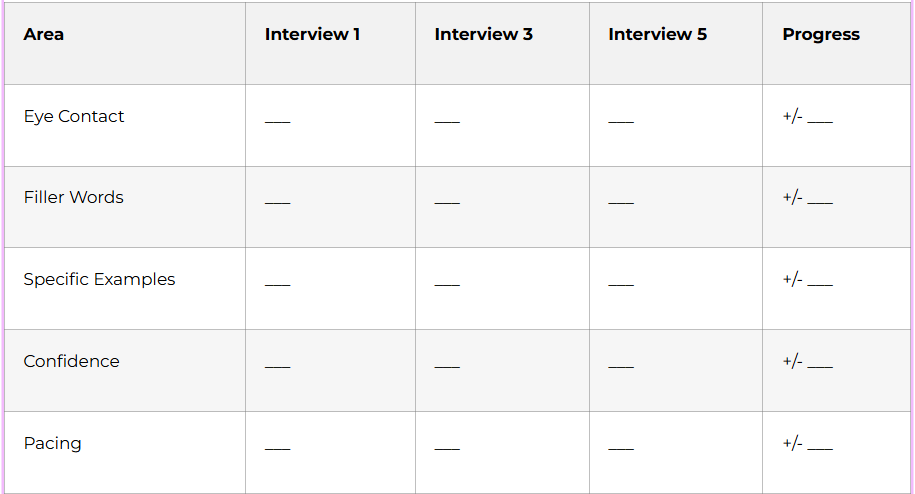
Positive Trend: Where are you improving most? ___________
Plateau Areas: Where isn’t progress happening? What needs to change? ___________
SECTION 5: Specific Practice Scenarios
Practice with these realistic scenarios.

Scenario 1: You Have a Gap in Experience
Setup: You’re applying for a Senior Content Manager role. You’ve never managed a team before.
Question Likely to Come Up:
“You haven’t had direct team management experience. How would you handle managing your first team?”
Practice Your Answer:
Your task: Write your answer to this question using everything you’ve learned.
Response Framework:
- Acknowledge the gap honestly (don’t pretend you have experience you don’t)
- Show you’ve thought about it (mentoring, leadership training, etc.)
- Show how your relevant experience transfers (coordination, influence, etc.)
- Express willingness to learn and ask for support
- Show you take responsibility seriously
Example Answer to Work From:
“You’re right that I haven’t managed a team formally yet. I recognize this is an important skill to develop. Here’s what I’ve done to prepare: I recently led a project coordinating with 3 other departments, which gave me insight into how to organize people and timelines. I also mentored a junior writer informally for 6 months. More importantly, I’m not approaching this naively—I know my first 90 days will be about learning how to lead effectively. I’d want to work closely with you or my director to understand your team dynamics and expectations. I’m committed to developing this skill and becoming a strong manager.”
Scenario 2: You Have Multiple Job Changes
Setup: You’ve changed jobs every 1.5-2 years. Now you’re interviewing somewhere.
Question Likely to Come Up:
“I see you’ve moved around quite a bit. Why? And why should we believe you’ll stay here?”
Practice Your Answer:
Response Framework:
- Briefly explain the reasons (without bad-mouthing previous companies)
- Show the pattern (growth, learning, career building—not running away)
- Explain what’s different about this opportunity
- Express commitment
Example Answer:
“You’re noticing my career movement. Here’s the honest story: My first role taught me execution fundamentals. After 18 months, I was ready for more responsibility, so I moved to a role where I could learn strategy. After 2 years, I’d learned what I wanted to learn there. This third role has taught me leadership. Now, 2 years in, I’m ready to go deeper in an organization—not just move every time I learn something new. What’s different about your company is that you’re asking me to think long-term. I’m genuinely interested in staying and growing here because I can see 5-year growth potential in this role. I’m not looking for my next step after this—I’m looking to build something meaningful here.”
Scenario 3: You Made a Career Mistake
Setup: In a previous role, you took on something you weren’t qualified for and it didn’t go well.
Question Likely to Come Up:
“Tell me about a situation where you were in over your head?”
Practice Your Answer:
Response Framework Using STAR:
- Situation: Describe the situation honestly
- Task: What was your responsibility?
- Action: What did you do? (Include the struggle AND the recovery)
- Result: How did it turn out? What did you learn?
Example Answer:
“In my first marketing role, I was asked to lead a rebranding project for a major client. I was excited but honestly unprepared—I’d never done something that complex. About 4 weeks in, I realized I was struggling. I could have tried to hide it, but I did the right thing: I told my manager I was in over my head and asked for help.
My manager didn’t take the project away—she coached me. She helped me break down the project into smaller pieces and showed me frameworks for thinking about brand strategy. Simultaneously, she paired me with a senior team member who mentored me through the process.
The project succeeded. The client was happy. Most importantly, I learned a crucial lesson: Asking for help earlier is better than struggling silently. That experience taught me humility and how to seek support. Now, when I’m challenged, I don’t assume I should figure everything out alone—I ask good questions and get the right people involved.”
Scenario 4: You're Overqualified
Setup: You’re applying for a role that seems below your qualifications.
Question Likely to Come Up:
“Your background suggests you could do this role easily. Why are you interested in stepping back?”
Practice Your Answer:
Response Framework:
- Acknowledge the observation (they’re right)
- Reframe it positively (it’s not stepping back, it’s strategic)
- Explain your motivation honestly
- Show you’re looking for fit, not just a step up
Example Answer:
“You’re observing that my background could lead to more senior roles. That’s true. But I’m making an intentional choice with this one. I’ve been in fast-paced, high-pressure environments for 8 years. I’ve reached a point where I want quality of life and meaningful impact over just climbing a ladder. Your company appeals to me because it’s stable, mission-driven, and smaller enough that I’ll actually see the impact of my work. I’m genuinely interested in the role itself, not using it as a stepping stone. I’d rather be deeply engaged in work I care about than stressed and burned out in a senior position. I think your company will get someone who’s experienced enough to handle complexity but grounded enough to stay and build something sustainable.”
Scenario 5: You're Asked Something Completely Unexpected
Setup: You’ve prepped well, but the interviewer asks something random.
Question That Comes Up:
“If you were a vegetable, what vegetable would you be?”
This Actually Happens. How do you handle it?
Practice Your Approach (Don’t Memorize an Answer):
Your Mindset: Stay calm. This is usually testing how you think under pressure, not looking for a specific answer.
Your Process:
- Pause for 3 seconds (shows you’re thinking)
- Give an honest, thoughtful answer (not a joke unless the interviewer is clearly joking)
- Connect it back to work if possible
Example Response:
“That’s a creative question. Let me think… I’d say I’m a carrot. Here’s why: Carrots are versatile—you can have them raw, cooked, in almost any preparation. They’re reliable—they grow consistently. They’re nutritious—they contribute real value. But mostly, I like that carrots work best as part of a larger dish. They support and enhance, rather than dominate. In work, I feel the same way—I’m most effective when I’m part of a team with a shared vision, supporting the overall mission.”
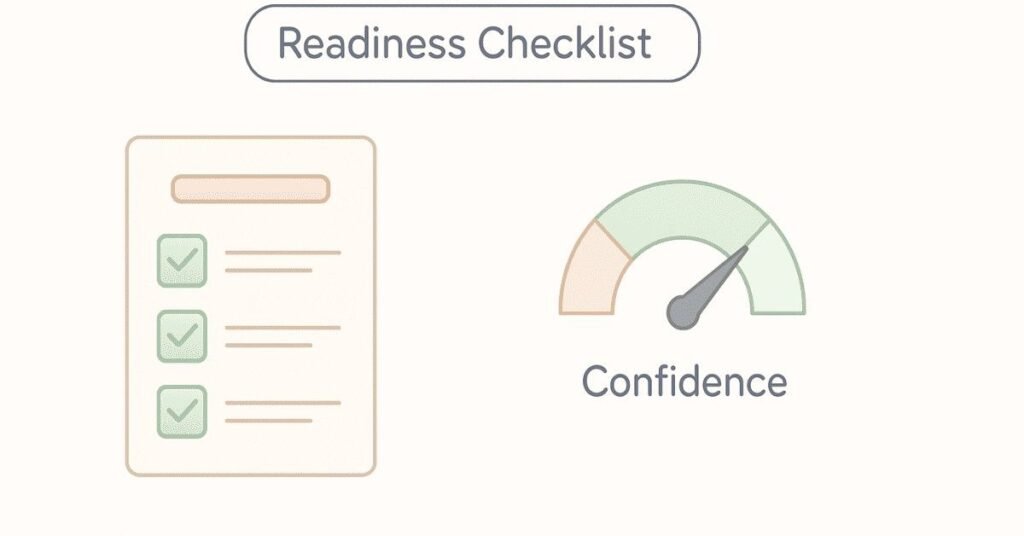
SECTION 6: Final Readiness Assessment
Complete this 48 hours before your real interview.
Pre-Interview Final Checklist
Knowledge Readiness (Rate 1-5)
- Company knowledge: ___ (Do you know their mission, products, recent news?)
- Role understanding: ___ (Do you understand the key responsibilities?)
- Industry knowledge: ___ (Do you understand industry trends?)
- Competitor knowledge: ___ (Do you know 2-3 main competitors?)
Story Readiness (Rate 1-5)
- Story 1 (Achievement): Can tell in 2-3 minutes naturally: ___
- Story 2 (Challenge): Can tell in 2-3 minutes naturally: ___
- Story 3 (Failure): Can tell in 2-3 minutes naturally: ___
- Story 4 (Leadership): Can tell in 2-3 minutes naturally: ___
- Story 5 (Teamwork): Can tell in 2-3 minutes naturally: ___
Question Readiness (Rate 1-5)
- “Tell me about yourself”: ___
- “Why our company?”: ___
- “Your strengths?”: ___
- “Your weakness?”: ___
- “Behavioral questions?”: ___
Mental Readiness (Rate 1-5)
- Confidence level: ___
- Excitement about role: ___
- Nervousness (lower is better): ___
- Sense of preparation: ___
Physical Readiness (Rate 1-5)
- Sleep quality: ___
- Attire prepared: ___
- Logistics planned: ___
- Materials organized: ___
Overall Readiness Score: ___ /50
- 45-50: Ready. You’re prepared and confident.
- 40-44: Mostly ready. Do a final review of weak areas.
- 35-39: Somewhat ready. Do one more practice session.
Below 35: Not quite ready. Spend more time preparing.
SECTION 7: Post-Interview Reflection
After your real interview, complete this reflection to learn.
Post-Interview Debrief Form
Interview Details:
- Company: ___________
- Position: ___________
- Date: ___________
- Duration: ___ minutes
- Interviewer(s): ___________
Initial Gut Feeling:
How do you think it went (1-10)? ___
Why: ___________
What Went Well:
What Could Have Gone Better:
- What would you do differently: ___________
- What would you do differently: ___________
- What would you do differently: ___________
Surprising Moments:
Something unexpected that happened: ___________
How you handled it: ___________
What you learned: ___________
Stories You Told:
Which story resonated most: ___________
Evidence: ___________
Questions They Asked That You Weren’t Prepared For:
Question: ___________
How you answered: ___________
Better answer: ___________
Your Questions:
Which question got the best response: ___________
Why did it resonate: ___________
Red Flags or Concerns:
Did you notice anything concerning about the role/company: ___________
Things to Follow Up On:
Anything you forgot to mention: ___________
Points to include in follow-up email: ___________
Next Steps:
When will you hear back: ___________
Who should you follow up with: ___________
When to send follow-up email: ___________
SECTION 8: Follow-Up Email Templates
Send Within 24 Hours
Template 1: Standard Thank You
Subject: Thank You for the [Position] Interview
“Dear [Interviewer Name],
Thank you for taking time to speak with me about the [Position] role at [Company]. I genuinely enjoyed learning about your team and the exciting work you’re doing in [specific area they discussed].
Our conversation about [specific topic] particularly resonated with me because [your relevant perspective]. It reinforced why I’m excited about this opportunity.
I’m very interested in moving forward with your team. Please let me know if you need any additional information from me.
Best regards,
[Your Name]
[Phone Number]”
Template 2: Addressing a Weak Answer
Subject: Follow-Up from [Position] Interview
“Dear [Interviewer Name],
Thank you again for the excellent interview yesterday. I was reflecting on our conversation, and I realized I could have given a stronger answer to your question about [specific question].
To provide better clarity: [Your improved answer]. I think this better demonstrates [relevant skill].
I remain very interested in this opportunity and would welcome any follow-up conversations.
Best regards,
[Your Name]
[Phone Number]”
Template 3: If You Haven’t Heard Back (After One Week)
Subject: Checking In – [Position] Application
“Dear [Interviewer Name],
I hope this message finds you well. I wanted to check in regarding the [Position] role I interviewed for on [date]. I remain very interested in this opportunity and would appreciate any updates on the timeline for next steps.
Thank you again for considering my candidacy.
Best regards,
[Your Name]
[Phone Number]”
Template 4: If Rejected
Subject: Thank You for Considering My Application
“Dear [Interviewer Name],
Thank you for letting me know about the decision regarding the [Position] role. While I’m disappointed not to move forward, I genuinely appreciated learning about your company and meeting your team.
If possible, I’d welcome any feedback on my interview to help me grow professionally. I remain interested in future opportunities with [Company] and would welcome staying in touch.
Best regards,
[Your Name]
[Phone Number]”
SECTION 9: 90-Day Post-Interview Development Plan
If You Got Rejected
Week 1: Reflection
- Request feedback (where possible)
- Complete post-interview debrief
- Identify main improvement areas
- Feel your emotions (it’s OK to be disappointed)
Week 2-3: Analysis
- Review interview performance
- Compare yourself to what they were looking for
- Identify skill/knowledge gaps
- Plan how to close those gaps
Week 4+: Development
- Take courses in weak areas
- Build stories in areas where you were weak
- Practice interviews monthly
- Stay in touch with company (politely)
- Apply to similar roles elsewhere
Mindset:
This isn’t failure—it’s feedback. Every interview teaches you something. The best candidates fail multiple times before they succeed.
If You Got the Job
First Week: Preparation
- Accept offer in writing
- Give notice at current job (if applicable)
- Begin onboarding materials
- Research company/team deeper
- Prepare for first day
Before Starting
- Connect with future teammates on LinkedIn
- Review employee handbook
- Prepare questions for manager
- Set personal goals for first 90 days
- Plan what success looks like in your first month
Your 90-Day Success Plan:
- Month 1: Learn (listen more than talk, observe culture)
- Month 2: Contribute (make small improvements, prove competence)
Month 3: Lead (take on bigger initiatives, show strategic thinking)
Final Wisdom
The secret to interview success isn’t luck. It’s systematic preparation combined with authentic confidence.
You’ve now had access to:
- 8 comprehensive subtopics covering every aspect of HR interviews
- Real examples from multiple industries
- Practical frameworks and templates
- Assessment tools and progress tracking
- Practice scenarios and feedback mechanisms
What separates people who get offers from those who don’t isn’t necessarily intelligence—it’s consistency in preparation.
Your Interview Success Formula:
- Learn the common questions and formats (Subtopics 1-5)
- Understand advanced strategies (Subtopic 6)
- Organize your preparation (Subtopic 7)
- Practice consistently with feedback (Subtopic 8)
- Reflect and improve after each attempt
Before Your Interview, Remember:
The interviewer wants you to be great. They’re hoping you’re the perfect candidate. They’re not trying to trick you or make you fail. You start from a position of advantage.
Go in prepared but relaxed. Authentic but professional. Confident but humble. That combination wins jobs.
Positive Trend: Where are you improving most? ___________
Plateau Areas: Where isn’t progress happening? What needs to change? ___________