
Question Format Breakdowns
Table of Contents
Blog Content
One of the biggest mistakes candidates make is treating similar questions as identical. In reality, subtle wording changes completely alter what an interviewer is asking and how you should answer.
For example:
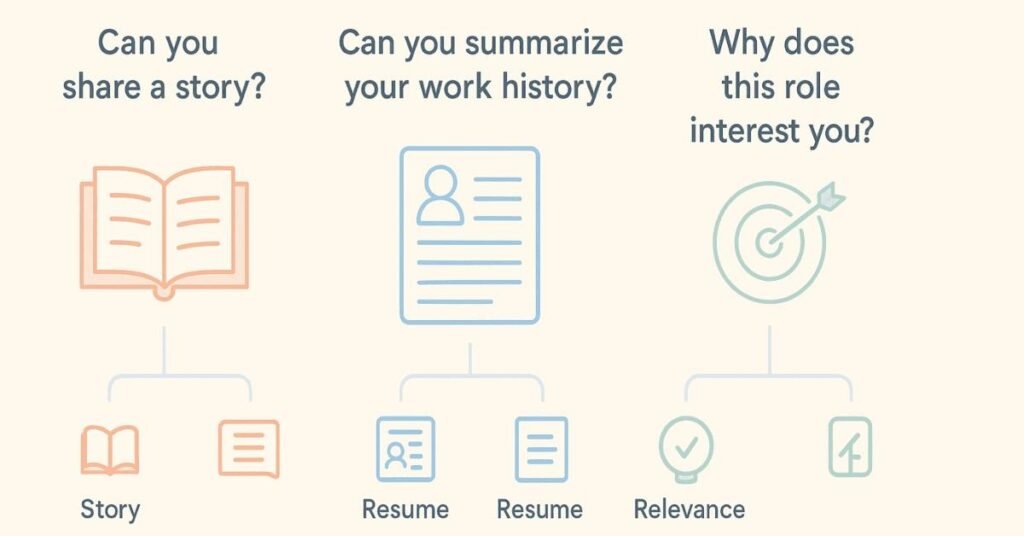
- “Tell me about yourself” (open-ended, wants your story)
- “Can you walk me through your resume?” (structured, wants chronological overview)
- “How has your experience prepared you for this role?” (targeted, wants relevance to THIS job)
All three seem similar, but they demand different answers. Get the format wrong, and even a good answer falls flat.
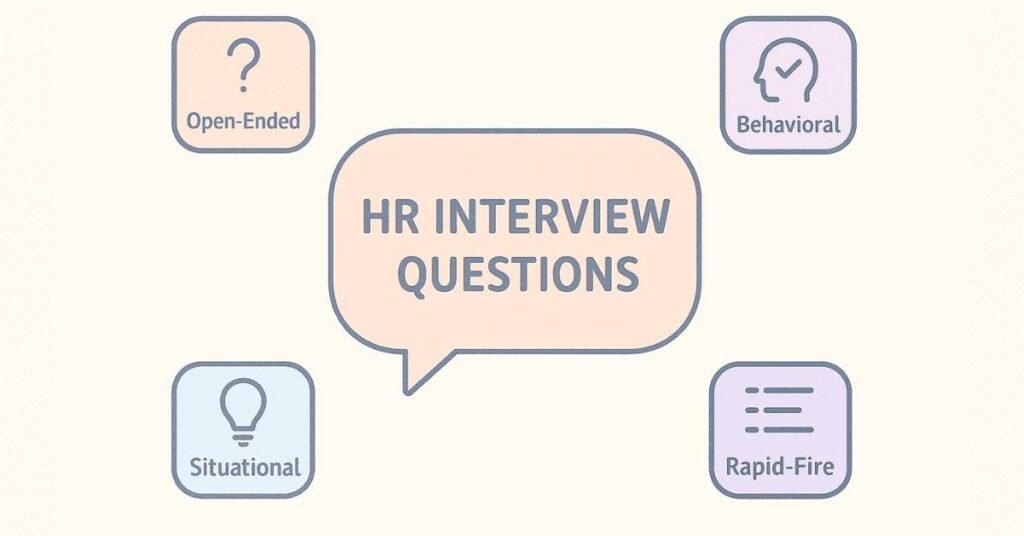
In this section, we’ll break down the most common HR interview questions by format—showing you exactly what each format requires, what HR is really asking, and how to answer each variation strategically.
Format 1: Open-Ended Story Questions ("Tell Me About...")
These questions ask you to tell a story with minimal structure. HR wants to see how you organize information and what you naturally emphasize.
Question Format 1.1: "Tell me about yourself"
What This Format Asks:
Open-ended with no parameters. HR is essentially saying: “You have the floor. Tell me what you think I should know about you.”
What HR Is Really Asking:
- How do you see yourself?
- What’s important to you professionally?
- Can you communicate clearly and concisely?
- Are you relevant to this role?
The Challenge:
Without structure, candidates often:
- Tell their entire life story (not relevant)
- Focus on personal interests instead of professional relevance
- Ramble without a clear point
- Waste time on irrelevant information
The Winning Format (Revisited with New Depth):
You have 2.5-3 minutes. Here’s the structure that works:
Opening (20 seconds) – Your Professional Foundation:
“I’m a Digital Marketing Specialist with 4 years of experience in content strategy and SEO. I’ve worked with EdTech companies and B2B SaaS businesses, helping them grow organic traffic and generate qualified leads.”
Why This Works: You immediately establish:
- Your role (what yo
- How long you’ve been doing it (credibility)
- Industries you know (relevant to the job)
The Bridge (40 seconds) – Your Key Achievements:
“In my current role, I’ve managed content strategy for 8 different clients simultaneously. My biggest achievement was creating a content framework that increased one client’s organic traffic by 180% in 18 months. I also led a team of 3 writers and implemented processes that improved content quality consistently.”
Why This Works:
- You’re showing impact (180%, not just “increased traffic”)
- You’re proving you can handle complexity (8 clients, team management)
- You’re mentioning relevant skills for the new role
The Connection (40 seconds) – Why This Role Matters:
“I’m genuinely excited about your company because I’ve followed your work in education technology. Your commitment to making quality education accessible aligns with my values. I’m particularly interested in how you’re expanding into new markets, and I believe my experience scaling EdTech platforms could directly contribute to your growth strategy.”
Why This Works:
- You’ve done research (not generic)
- You’ve connected your experience to their needs
- You’re explaining motivation beyond paycheck
The Close (20 seconds) – Forward Looking:
“I’m looking for a role where I can combine strategic expertise with hands-on execution, and ideally mentor junior team members as my responsibilities grow. Your company seems like the right place to do that.”
Why This Works:
- You’re expressing ambition appropriately
- You’re showing you want growth
- You’re indicating you’ll be loyal
Complete Answer Timed (2.5-3 minutes):
“I’m a Digital Marketing Specialist with 4 years of experience in content strategy and SEO. I’ve worked with EdTech companies and B2B SaaS businesses, helping them grow organic traffic and generate qualified leads.
In my current role, I’ve managed content strategy for 8 different clients simultaneously. My biggest achievement was creating a content framework that increased one client’s organic traffic by 180% in 18 months. I also led a team of 3 writers and implemented processes that improved content quality consistently.
I’m genuinely excited about your company because I’ve followed your work in education technology. Your commitment to making quality education accessible aligns with my values. I’m particularly interested in how you’re expanding into new markets, and I believe my experience scaling EdTech platforms could directly contribute to your growth strategy.
I’m looking for a role where I can combine strategic expertise with hands-on execution and mentor junior team members as my responsibilities grow. Your company seems like the right place to do that.”
Delivery Tips:
- Speak naturally (don’t memorize word-for-word)
- Pause between sections to breathe
- Show enthusiasm when discussing the company
- Make eye contact (if video or in-person)
Avoid filler words like “um,” “uh,” “like,” “basically”
Question Format 1.2: "Walk me through your resume"
What This Format Asks:
More structured than “tell me about yourself.” HR wants a chronological journey through your career.
What HR Is Really Asking:
- Do you understand your own career progression?
- Can you explain why you changed roles?
- Does your experience connect logically or seem scattered?
The Winning Format:
Instead of reading your resume line-by-line, tell the STORY of your career progression.
Opening – Career Direction (30 seconds):
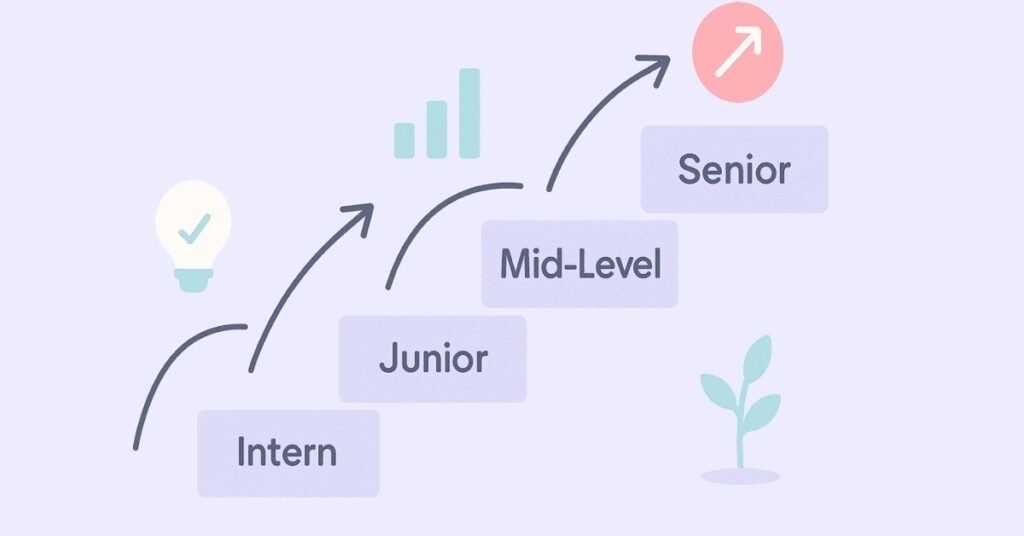
“Looking at my career, there’s a clear progression in one direction: I started in individual execution, moved into team coordination, and now I’m doing strategic leadership. Each step built on the previous one.”
Why This Works: You’re immediately showing intentional growth, not random job-hopping.
Development – Chronological Progression (2 minutes):
Role 1 (Your Starting Point):
“I started as a Junior Content Writer at Content Agency XYZ (2019-2020). In this role, I learned the fundamentals—how to write for different audiences, understand SEO basics, and work with clients. This was my foundation.”
Role 2 (The Growth):
“In 2020, I moved to Content Coordinator at Digital Wave Agency. The key difference: I wasn’t just writing anymore; I was planning. I built content calendars, coordinated with designers and developers, and started analyzing which content performed best. This role taught me that strategy matters as much as execution.”
Role 3 (The Leadership):
“By 2022, I became Content Manager at a SaaS company. This role involved leading a team of 2 writers, setting content strategy for multiple products, and directly reporting to the Marketing Director. I learned what leadership looks like—accountability, delegation, vision-setting.”
Role 4 (Current/Why You’re Here):
“Now, in my current role as Content Marketing Manager at Frontlines Edutech (2023-present), I manage strategy for the entire content department. I oversee 5 team members, set content direction across our EdTech platform, and directly contribute to revenue goals. This experience has given me the strategic and leadership foundation I’m looking for.”
Why This Progression Works:
- You’re showing learning at each stage
- You’re explaining why you moved (growth, not running away)
- You’re showing increasing responsibility
- You’re demonstrating you didn’t jump randomly
Closing – Connection to New Role (30 seconds):
“Each role has prepared me for this opportunity. I’ve grown from someone who executes tasks to someone who sets strategy and leads teams. I’m ready for a role where I can scale what I’ve built and contribute to your company’s strategic marketing goals.”
Why This Works:
- You’re tying your journey to the new role
- You’re expressing readiness without arrogance
- You’re showing vision
What NOT to Do:
Don’t say: “2019-2020: I wrote content. 2020-2022: I coordinated content. 2022-2023: I managed content.”
(This is boring and doesn’t show growth)
Do say: “I progressively took on more responsibility, learning first how to execute well, then how to coordinate teams, and finally how to set strategy.”
(This shows intentional career building)
Question Format 1.3: "How has your experience prepared you for this role?"
What This Format Asks:
More targeted than the previous two. HR wants you to connect YOUR specific experience to THIS specific job.
What HR Is Really Asking:
- Have you read the job description?
- Can you articulate the connection between your background and this role?
- Will you be able to do this job effectively?
The Winning Format:
Identify 3 key requirements from the job description, then show how you’ve done each.
Job Description Analysis (Do This Before the Interview):
If the job posting says: “We’re looking for a Content Marketing Manager who can:
- Lead content strategy for 3 different product lines
- Manage a team of writers and designers
- Drive lead generation through SEO and paid content”
Your Answer Format:
“I’ve reviewed the job description carefully, and three things stand out as critical to success here. Let me show how I’m prepared for each:
Requirement 1 – Leading Content Strategy for Multiple Product Lines:
In my current role, I manage content strategy for 8 different EdTech courses simultaneously. Each course has different target audiences (students vs. corporate trainers), different messaging, and different success metrics. I’ve developed a framework that allows me to maintain consistency while tailoring strategy to each audience. I can absolutely replicate this approach for your 3 product lines.
Requirement 2 – Managing a Team:
I currently lead a team of 5 people—3 writers and 2 designers. I’ve built systems for planning, feedback, and professional development. Two of my team members have been promoted because of the growth they experienced under my leadership. Team management is one of my core strengths.
Requirement 3 – Driving Lead Generation Through Content:
This is where I’ve seen my biggest impact. By implementing an SEO-driven content strategy combined with targeted paid promotion, I increased qualified lead generation by 280% for one client. I understand both organic and paid content and how to measure which drives actual business results.
All three of these requirements align directly with skills I’ve developed and proven in my current role. I’m confident I can deliver immediately.”
Why This Works:
- Shows you did your research
- Directly matches your experience to their needs
- Uses specific metrics and examples
- Demonstrates confidence without arrogance
- Indicates you’ve thought deeply about the fit
Format 2: Behavioral Questions ("Tell Me About a Time When...")
These questions ask about specific situations from your past. HR wants to see how you actually behave in real scenarios.
Question Format 2.1: "Tell me about a time when you failed"
What This Format Asks:
The interviewer wants a real failure story—not a weakness disguised as a strength, but an actual failure.
What HR Is Really Asking:
- Are you self-aware enough to admit mistakes?
- Can you learn from failure?
- How do you respond to setbacks?
- Will you blame others or take responsibility?
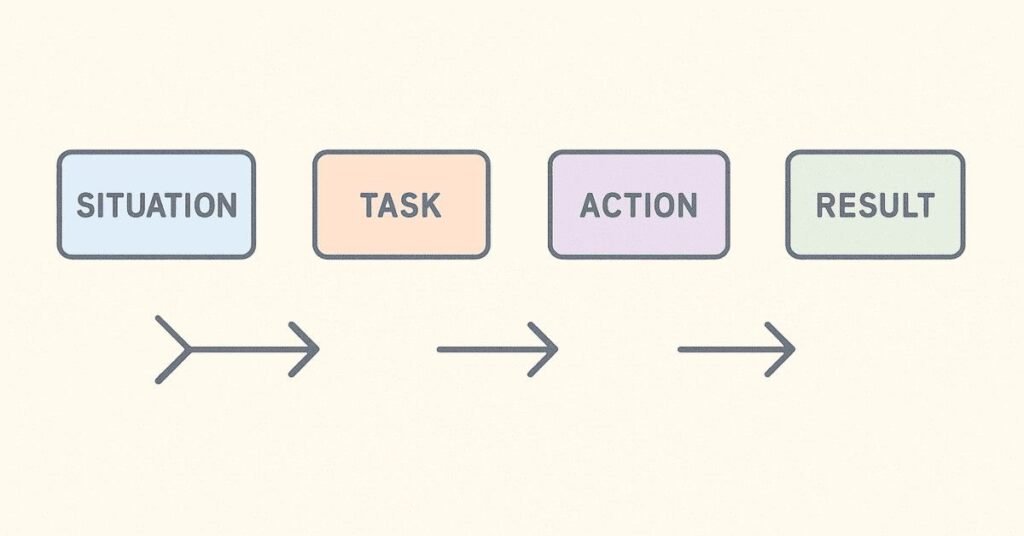
The Winning STAR Format (Detailed):
Situation (20-30 seconds):
Set the scene so the interviewer understands the context.
“In my second year as a content coordinator, I was managing our blog publication schedule. We committed to publishing 2 posts per week. Three months into my role, I felt confident in my abilities. I decided I didn’t need my detailed content calendar anymore and started managing posts through email and chat.”
Why This Works: You’re being specific (time, role, context) and you’re setting up why the failure happened naturally.
Task (10-15 seconds):
What was your responsibility?
“I was solely responsible for ensuring all blog posts met our quality standards and published on schedule.”
Why This Works: You’re taking ownership immediately.
Action (30-40 seconds):
Here’s the key—don’t skip the mistake part. Show the failure clearly.
“For about 6 weeks, things seemed fine. But then I completely missed a Tuesday publication deadline. We didn’t publish our post that week, and it wasn’t until my manager asked about it that I realized my mistake. I had no system to catch gaps in the schedule.”
Why This Works: You’re not minimizing the failure. You’re showing the actual consequences.
Result (45-60 seconds):
This is where you show learning and recovery.
“I immediately told my manager what happened instead of making excuses. I realized I’d let overconfidence override the systems that worked. I went back to my content calendar—but this time with improvements. I added:
- An automated flagging system for posts due in 48 hours
- A backup reviewer from the team to catch any gaps
- A weekly audit process to ensure nothing fell through the cracks
The new system worked so well that my manager recommended it to other teams. Six months later, we hadn’t missed a single deadline. More importantly, I learned that systems and discipline don’t disappear as you grow—they become more important.”
Why This Works:
- You showed real failure (not minimized)
- You demonstrated responsibility (no blaming)
- You proved learning (concrete changes)
- You showed lasting improvement (6 months without mistakes)
- You extended learning to others (recommended to teams)
Timing Check: This should take 2-2.5 minutes total.
Mistake to Avoid:
Don’t say: “I’ve never really failed” (no one believes this)
Don’t say: “I forgot to send one email, but it was fine” (too minor)
Don’t say: “My team messed up the project, but I was fine” (not taking responsibility)

Question Format 2.2: "Tell me about a time when you had to deliver quality work under tight deadlines"
What This Format Asks:
The interviewer wants to understand your prioritization and work ethic under pressure.
What HR Is Really Asking:
- Can you handle pressure without quality suffering?
- Do you panic or stay calm?
- Can you make tough decisions about what matters most?
The Winning STAR Format:
Situation (20-30 seconds):
“Last quarter, our CEO had a meeting scheduled with a potential major corporate partner. This partnership could bring ₹50 lakhs in annual revenue. The CEO wanted a comprehensive report showing our platform’s performance, student outcomes, and ROI. The meeting was 72 hours away.”
Task (10-15 seconds):
“I was assigned to create this report. Normally, this type of analysis takes 2-3 weeks because it involves pulling data from multiple systems and creating visualizations.”
Action (50-60 seconds):
This is where you show your process, not just hustle.
“I could have panicked, but instead I got strategic. First, I identified what the CEO actually needed—not every metric, just the ones that would impress a corporate decision-maker. Second, I reached out to our data team and clearly communicated exactly what I needed and the timeline.
While waiting for data, I didn’t sit idle. I started building the report structure and designing the visuals. When data arrived, it was just a matter of plugging it in.
On the second day, I realized I needed someone’s input on data interpretation. Instead of struggling alone, I asked a colleague. She helped me refine my analysis in 2 hours—something would have taken me 8 hours alone.
I completed everything 6 hours before the meeting.”
Why This Works:
- Shows strategic thinking (not just working harder)
- Demonstrates communication (clarity with data team)
- Shows efficiency (worked on visuals while waiting)
- Indicates collaboration (asked for help)
- Proves time management (finished early)
Result (40-50 seconds):
“The report was comprehensive and professional. The CEO used it in the pitch, and it impressed the corporate partner. We signed a contract that year worth ₹50 lakhs annually. That partnership is still active and has been incredibly valuable.
More importantly, I learned that under pressure, strategy beats hustle. Breaking big problems into smaller pieces, communicating clearly, and knowing when to ask for help got me to a better result faster than if I’d just worked 72 hours straight.”
Why This Works:
- Shows concrete business impact
- Highlights learning beyond just completing the task
Demonstrates professionalism (not just stress)
Question Format 2.3: "Tell me about a time when you had to influence someone"
What This Format Asks:
The interviewer wants to understand your communication and persuasion skills.
What HR Is Really Asking:
- Can you get buy-in from others?
- Do you communicate clearly?
- Can you find common ground?
- Are you manipulative or collaborative?
The Winning STAR Format:
Situation (20-30 seconds):
“Our company was planning to maintain our blog publication frequency at 2 posts per week. Based on my analytics, I believed we should increase to 4 posts per week. The marketing director disagreed—she thought more content would dilute quality.”
Task (10-15 seconds):
“My challenge was to get her to see that volume and quality weren’t mutually exclusive.”
Action (50-60 seconds):
“Instead of just arguing my position, I prepared data:
- I showed our top-performing content (they averaged 12,000 views)
- I showed our low-performing content (they averaged 2,000 views)
- The insight: The difference wasn’t caused by publishing frequency—it was caused by topic selection and SEO optimization.
I proposed a test: ‘Let’s increase to 4 posts per week for 6 weeks, but only on topics we’ve validated as high-performing. I’ll measure quality metrics (engagement, leads, conversions) to prove quality doesn’t suffer.’
I also addressed her concern directly: ‘I understand your worry that more content means lower quality. That’s reasonable. Let’s measure it. If quality suffers, we go back to 2 posts. If it doesn’t, we keep the new pace.’
She agreed to the test.”
Result (40-50 seconds):
“After 6 weeks, the results were clear:
- Average engagement increased 35%
- Lead generation increased 28%
- Average post quality remained the same (actually improved slightly)
She not only agreed to the increased frequency—she asked me to present the framework to other teams. This approach has now become standard across our company.
What I learned: Influence isn’t about being the loudest voice. It’s about understanding the other person’s concerns, backing your position with data, and being willing to test your ideas. She trusted me because I acknowledged her perspective and proved my point with evidence.”
Why This Works:
- Shows you understand the other person’s perspective
- Demonstrates data-driven thinking
- Proves you’re willing to test ideas (not just push agendas)
- Shows respect for their authority
- Displays clear communication
Has a strong outcome with learning
Format 3: Hypothetical Questions ("What Would You Do If...")
These questions present scenarios without past experience to draw from. HR wants to see your thinking process and judgment.

Question Format 3.1: "What would you do if you had conflicting instructions from two managers?"
What This Format Asks:
The interviewer wants to understand how you make decisions and navigate hierarchy when there’s ambiguity.
What HR Is Really Asking:
- Do you panic or think strategically?
- Do you respect hierarchy?
- Can you handle conflict diplomatically?
- Do you communicate clearly?
The Winning Answer Format:
Acknowledge the Real Situation (20-30 seconds):
“This is a realistic scenario that happens, and I appreciate the question because it shows you’re thinking about real workplace dynamics.”
Show Your Thinking Process (2-3 minutes):
“Here’s how I’d approach it:
Step 1 – Get Clear on the Instructions (30-45 seconds):
First, I’d make sure I actually understand what each manager is asking. Sometimes what seems like conflicting instructions is actually a miscommunication. I’d ask clarifying questions:
- ‘So you’re asking me to prioritize X, correct?’
- ‘By when do you need this?’
- ‘What’s the business impact if this doesn’t get done?’
Step 2 – Assess Urgency and Importance (30-45 seconds):
Not all priorities are equally urgent. I’d ask myself:
- Which has the earlier deadline?
- Which impacts the most important business goal?
- Are these actually conflicting, or can they be sequenced?
Step 3 – Gather Information (30-45 seconds):
Before choosing, I’d understand the context:
- Have both managers agreed on priorities recently?
- Is one instruction from an urgent situation that just came up?
- Is there a hierarchy of authority I should defer to?
Step 4 – Propose and Get Agreement (1-1.5 minutes):
Instead of just choosing one manager to disappoint, I’d propose a solution and get agreement:
‘I’ve received priority requests from both Manager A and Manager B. I want to respect both priorities. Here’s what I propose: I’ll complete Task A first (needs completion by tomorrow) and Task B immediately after (completes by end of week). Does this work for everyone?’
If they still disagree, I’d say: ‘I need clarity on priority. Both are important, and I want to deliver both well. Which one should take precedence?’
Step 5 – If Still Unclear, Escalate:
If I truly can’t get clarity from the managers, I’d go up one level: ‘I have conflicting priorities from Manager A and Manager B. I’ve attempted to sequence them, but both believe their task should come first. Can you help me understand the priority?’
This shows respect for hierarchy—I’m not making the choice arbitrarily; I’m asking for guidance from someone with broader perspective.”
Real Example (1-2 minutes):
“This actually happened to me. My direct manager wanted me to focus on client communication during a project. Simultaneously, the project manager wanted me to focus on detailed documentation. I approached it exactly as I described:
I asked each what was truly critical. The client manager said communication was essential for client satisfaction. The project manager said documentation was critical for project hand-off.
I proposed: ‘I’ll allocate 70% of my time to client communication (the immediate priority) and 30% to documentation. Once the client communication peak passes, I’ll shift to documentation.’
Both agreed, and everything was completed successfully. The key was communicating clearly about trade-offs rather than just choosing one person to disappoint.”
Why This Works:
- Shows you don’t panic
- Demonstrates respect for hierarchy
- Proves you communicate clearly
- Indicates you think systematically
- Shows you involve people in decisions
- Displays business acumen (understanding priorities)
Includes a real example for credibility
Question Format 3.2: "How would you handle it if a senior colleague was giving you incorrect information that was affecting your work?"
What This Format Asks:
The interviewer wants to see if you can navigate difficult interpersonal situations with hierarchy.
What HR Is Really Asking:
- Do you speak up or stay silent?
- Are you respectful of seniority while maintaining integrity?
- Can you communicate difficult messages diplomatically?
- Do you solve problems or create conflict?
The Winning Answer Format:
Acknowledge the Difficulty (15-20 seconds):
“This is tricky because it involves both respecting seniority and maintaining accuracy. Here’s how I’d handle it:”
Show Your Approach (2-2.5 minutes):
“Step 1 – Verify You’re Correct (30-45 seconds):
First, I’d verify that I’m actually right. I wouldn’t immediately assume a senior person is wrong. I’d:
- Double-check my sources
- Look at the information from multiple angles
- Ask others quietly if they see the same issue
- Make sure I’m not misunderstanding
Step 2 – Approach With Humility (30-45 seconds):
Once I’m confident there’s an issue, I’d approach the senior colleague privately (never in a group setting where they’d feel embarrassed):
‘I’ve noticed something in the information I received, and I want to make sure I’m understanding correctly. [Describe the issue]. Am I misunderstanding something, or should we verify this?’
Notice I’m asking if I’m misunderstanding—not telling them they’re wrong. This is critical. I’m giving them an out while addressing the issue.
Step 3 – Be Prepared for Different Responses (45-60 seconds):
They might respond with:
- ‘Oh, I see the confusion. Actually, [clarification].’ (They realize the issue and clarify)
- ‘That’s interesting. Let me check.’ (They’ll verify)
- ‘No, I’m confident in this.’ (They maintain their position)
If they maintain their position but I’m still concerned, I’d ask: ‘Would you be comfortable if I verified this with [another source]? I want to make sure we’re working with accurate information.’
Step 4 – If There’s Still a Discrepancy:
If there’s a real issue and they won’t address it, I’d escalate:
- I’d document the discrepancy
- I’d bring it to my direct manager: ‘I’ve noticed a discrepancy between the information I received and what I’m verifying independently. This is affecting my work. Can you help me understand how to proceed?’
This frames it as a problem-solving issue, not as the senior person being wrong.”
Real Example (1-1.5 minutes):
“This happened in my previous role. A senior team member provided guidelines for a client project that didn’t align with the client’s written requirements. Instead of ignoring the guidelines or challenging the senior person publicly, I did exactly this:
I verified: I re-read the client’s email and our contract. I was right—the guidelines didn’t match.
I approached privately: ‘I’ve been reviewing the guidelines you shared and comparing them to the client’s written requirements. I noticed they seem to differ on [specific point]. Am I misunderstanding something?’
They said: ‘Oh, those guidelines were from an older version of the project. I forgot to update them. Thanks for catching that.’
Problem solved. They weren’t defensive because I’d approached respectfully.”
Why This Works:
- Shows you can maintain integrity without creating conflict
- Demonstrates respect for hierarchy
- Proves you communicate diplomatically
- Indicates you verify before accusing
- Shows you solve problems, not create them
Displays maturity and judgment
Format 4: Direct Preference Questions ("What Do You Like About...")
These questions ask about your preferences and values. HR wants to understand what motivates you.
Question Format 4.1: "What do you like most about your current role?"
What This Format Asks:
What aspects of your job are you actually engaged with?
What HR Is Really Asking:
- What will keep you motivated here?
- Are you someone who can find meaning in the work?
- What do you value (strategy, creativity, people, impact)?
- Will you be satisfied with this new role?
The Winning Answer Format:
Don’t Say: “I like the paycheck” or “I like leaving at 5 PM”
(These don’t inspire confidence you’ll be engaged)
Instead, Identify What Genuinely Engages You:
“What I love most about my current role is the combination of strategic thinking and measurable impact. Here’s what I mean:
I spend significant time developing content strategy—thinking about what our audience needs, where the market is going, how we position ourselves. That strategic thinking engages the part of my brain that loves solving puzzles.
But I’m not just strategizing in a vacuum. I see the direct results. When I develop a content strategy and our organic traffic increases 180%, I can see that my thinking translated into business value. That tangible impact is incredibly motivating.
I also deeply value the team I work with. I’ve had opportunities to mentor junior writers and see them grow into confident, skilled professionals. Helping others develop keeps me engaged beyond just my individual work.
If your role offers these three elements—strategic thinking, measurable impact, and opportunity to develop people—I’d be very engaged. And based on our conversation about your marketing strategy and team structure, it sounds like it does.”
Why This Works:
- You’re specific (not generic like “I like helping people”)
- You’ve identified what actually motivates you
- You’re connecting your motivation to their role
- You’re showing you think about impact
- You’re indicating you’ll stay engaged
The Contrast:
If they ask “What do you like LEAST about your current role?” you can answer similarly:
“What I like least is when I’m pulled into execution-only work without strategic input. For example, when I’m asked to write blog posts without understanding the strategy behind them, I feel less engaged. I’m most satisfied when I understand the ‘why’ behind my work.
This is actually why this opportunity excites me—it seems like the role has more strategic ownership than my current one, which is exactly where I want to grow.”
Why This Works:
- You’re being honest about what doesn’t motivate you
- You’re framing it constructively
You’re connecting it to why the new role is appealing

Format 5: Rapid-Fire Questions (Multiple Short Questions)
Sometimes interviewers ask 3-5 quick questions in succession to see how you think under pressure.
Examples of Rapid-Fire Formats:
“In three words, how would you describe yourself?”
Don’t say: “Hard-working, friendly, smart” (generic)
Say: “Strategically driven, detail-oriented, collaborative”
(More specific and professional)
“What’s your biggest strength and weakness?”
Strengths: Pick something relevant to the job with proof.
“Strategic thinking. I consistently develop approaches that generate measurable business impact.”
Weakness: Pick something you’ve actively worked on.
“Early in my career, I got caught up in tactical execution and lost sight of strategy. I’ve deliberately shifted to thinking more strategically, and now strategy is actually my strength.”
“Where do you see yourself in 5 years?”
“I see myself as a senior leader in [your field] contributing to strategic decisions, not just execution. I’ll have deepened expertise in [specific area], taken on more leadership responsibility, and potentially mentored several junior professionals into stronger roles.”
“Why should we hire you?”
“Because I combine strategic thinking with hands-on execution. I deliver measurable business impact. I develop people around me. And I’m genuinely interested in this company and role—not just taking any job.”
“What’s your greatest accomplishment?”
Pick one that’s:
- Measurable
- Relevant to this role
- Shows your thinking process
“Leading a content transformation that increased organic revenue by 180% in 18 months. What I’m proud of isn’t just the result—it’s the approach. Instead of just working harder, I completely rethought our strategy. That systematic thinking is what I bring to every challenge.”
Master Framework: Adapting Answers to Question Variations
The same underlying story can be adapted to answer similar but slightly different questions. Here’s how:
Your Core Story: “I developed a content strategy that increased organic traffic 180% in 18 months”
If asked: “Tell me about a project you led”
→ Focus on the leadership aspect: “I led a team of 3 writers through a complete content transformation…”
If asked: “Describe a time when you solved a complex problem”
→ Focus on the problem-solving: “I analyzed why our content wasn’t performing and discovered the root cause was [specific issue]…”
If asked: “Tell me about your greatest achievement”
→ Focus on the impact: “I transformed our content function, resulting in a 180% increase in organic traffic and approximately ₹50 lakhs in revenue impact…”
If asked: “How does your experience prepare you for this role?”
→ Focus on relevance: “This role requires someone who can scale content operations. I’ve done exactly that by [specific approach], and I can apply this framework to your situation…”
Master Key: Every strong story you have can be adapted to answer 4-5 different questions. You only need 3-5 really solid stories.
Universal Answer Delivery Tips for All Formats
Regardless of question format, these tips apply universally:
The 3-Second Pause
Before answering, pause for 3 seconds to collect your thoughts. This looks thoughtful, not reactive.
Structured Answers
Every answer should have a beginning, middle, and end. This helps people follow your thinking.
Specific Numbers
Instead of “increased significantly,” say “increased 45%.” Numbers stick in people’s minds.
Real Examples
Better to have one detailed example than five vague ones.
The Relevance Bridge
End answers by connecting back to the role: “This experience directly prepared me for [aspect of this role].”
Avoid These Mistakes:
- Rambling (stay on topic)
- Criticizing previous employers (always frame positively)
- Exaggerating (be honest)
- Using filler words (um, uh, like, basically)
- Appearing desperate (you’re interviewing them too)
- One-word answers (engage in the conversation)

Your Pre-Interview Preparation Checklist
One Week Before:
- ✓ Identify 3-5 strong stories from your experience
- ✓ Write out full answers to common questions
- ✓ Identify the 3-5 most likely questions for your industry/role
- ✓ Practice saying answers aloud (not in your head)
Three Days Before:
- ✓ Time yourself answering questions (2-3 minutes is standard)
- ✓ Practice with a friend or record yourself
- ✓ Identify weak points in your delivery
- ✓ Research the company and role
Day Before:
- ✓ Review your answers once more (don’t cram)
- ✓ Get good sleep
- ✓ Prepare your interview space (if video)
- ✓ Charge your devices
Morning Of:
- ✓ Review your self-introduction once
- ✓ Eat a good breakfast
- ✓ Arrive 5-10 minutes early
✓ Take deep breaths to calm nerves