
Telecom Jobs for Freshers : How to Start Your Career in India
Table of Contents
How to Break Into Telecom With No Prior Experience
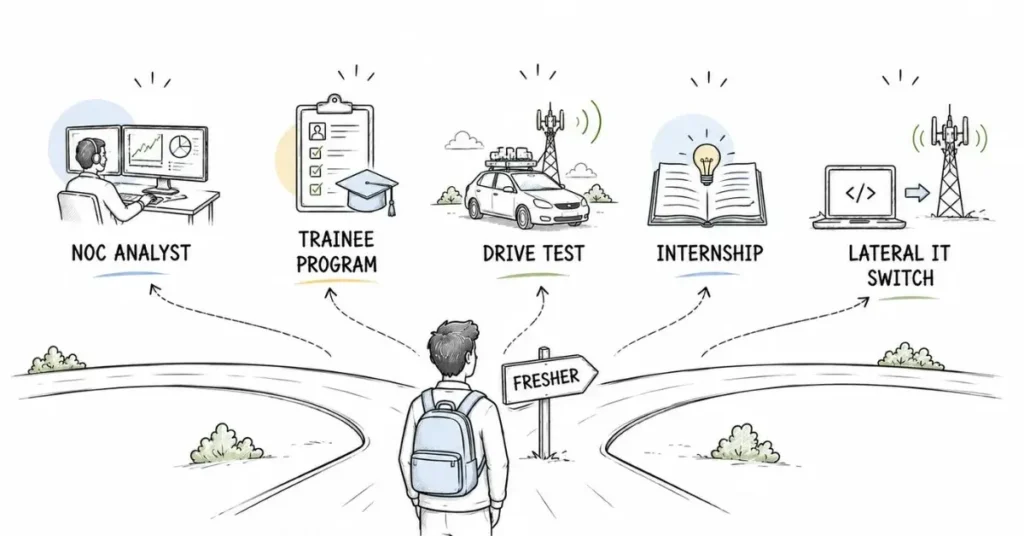
Getting a first job in any technical sector feels like a circular problem: you need experience to get a job, but you need a job to get experience.
Telecom is no different but it has more legitimate entry doors than most technical fields. The industry actively hires freshers, runs structured trainee programs, and has roles specifically designed for candidates who know the basics but have never worked in a professional telecom environment.
This post maps every realistic entry path, tells you what each one looks like in practice, and gives you a step-by-step action plan you can start this week.
Why Telecom Is More Fresher-Friendly Than You Think
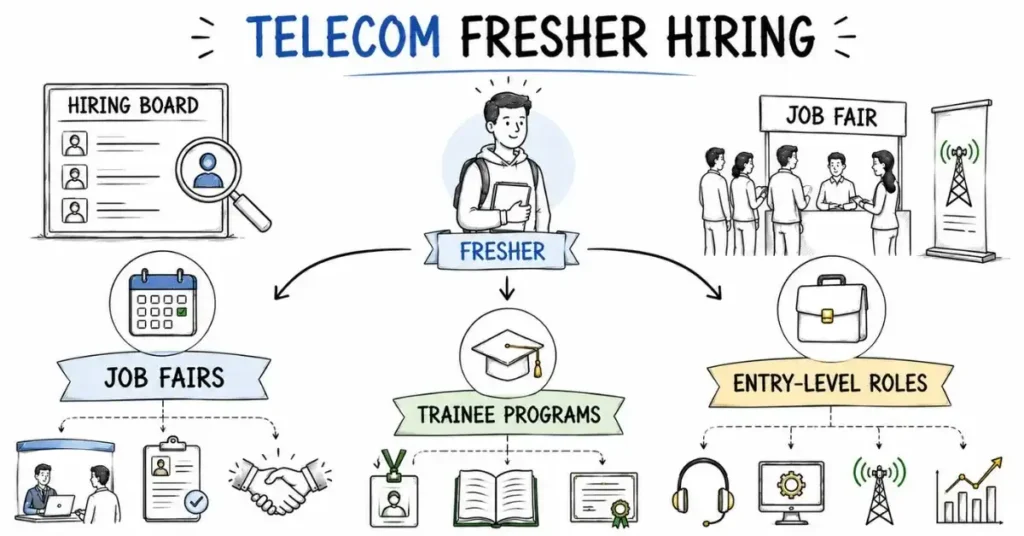
Getting a first job in any technical sector feels like a circular problem: you need experience to get a job, but you need a job to get experience.
Telecom is no different — but it has more legitimate entry doors than most technical fields. The industry actively hires freshers, runs structured trainee programs, and has roles specifically designed for candidates who know the basics but have never worked in a professional telecom environment.
This post maps every realistic entry path, tells you what each one looks like in practice, and gives you a step-by-step action plan you can start this week.
Entry Point 1: NOC Analyst (The Most Accessible Door)
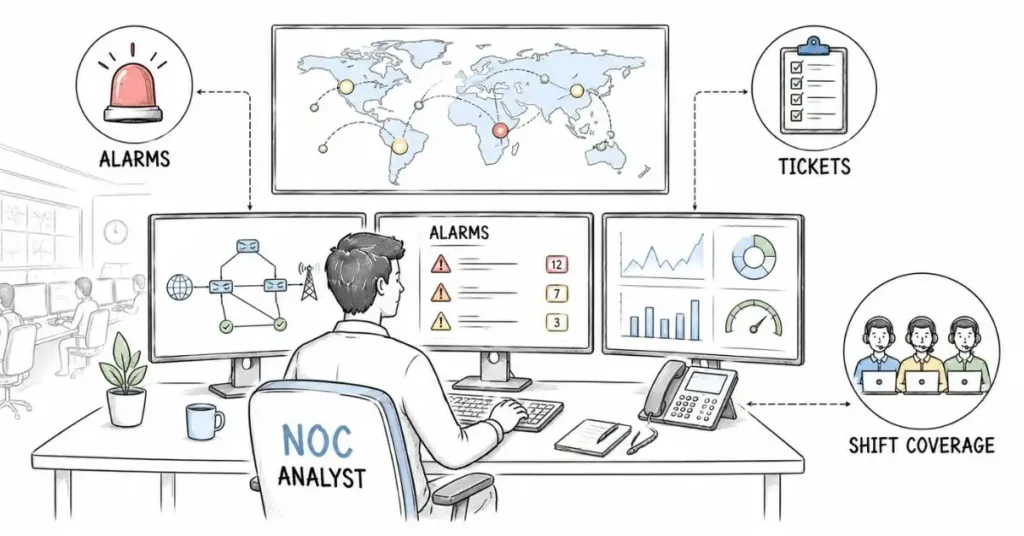
If you have a basic networking foundation — CCNA or CompTIA Network+, or even strong conceptual knowledge — NOC analyst is the most widely available entry-level telecom role in India.
LinkedIn currently lists 72 entry-level telecommunications positions in India, with NOC Engineer roles consistently among the top listings. Indeed shows fresher NOC Engineer (VoIP) roles actively being filled by companies like Neom Communications, with comprehensive training provided on the job.
What a NOC analyst fresher role looks like:
- You monitor live networks using dashboards — watching for alarms, performance drops, or outages
- When something goes wrong, you raise a ticket and follow a defined escalation procedure
- You work in shifts — typically 3 shifts covering 24 hours, 7 days a week
- Training is provided on the specific tools and platforms used (Ericsson ENM, Nokia NetAct, IBM Netcool, or similar)
What you need to apply:
- B.E./B.Tech (ECE, CS, IT) or Diploma in Electronics/Communication
- Basic networking knowledge (TCP/IP, OSI model)
- CCNA or CompTIA Network+ is preferred but not always mandatory
- Willingness to work in shifts and, for some companies, willingness to relocate
Companies actively posting NOC fresher roles:
- Neom Communications (Delhi NCR)
- Plume (Hyderabad) — NOC Analyst for global Wi-Fi and smart home network operations
- Uniinfo Telecom Services — entry-level trainee engineer roles with 30-day classroom + 60-day field training, ₹10,000/month stipend during training
- Tech Mahindra, TCS, Wipro — all hire NOC L1 analysts for managed services
Salary at entry: ₹2.4L–₹3.5L per year. Modest — but the exposure you get in 12–18 months of NOC work is worth more than the salary number suggests.
Entry Point 2: Telecom Trainee / Graduate Engineer Trainee Programs
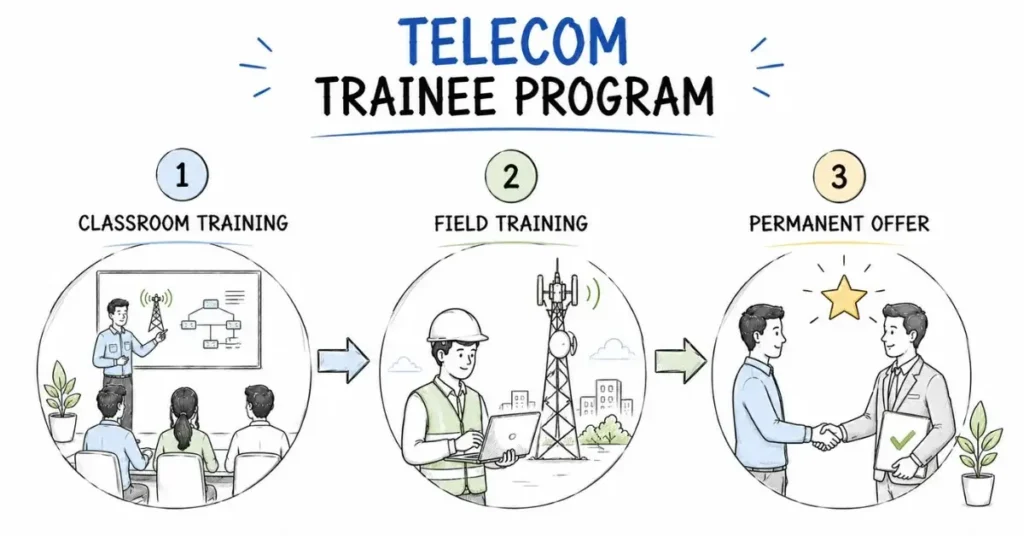
Several companies run structured programs specifically for engineering freshers — providing training before placing you in a live role. These are the best entry points if you have no hands-on experience and want a supported learning environment.
Uniinfo Telecom Services runs one of the most specific trainee programs for freshers: 30 days of classroom training on wireless communications and antenna systems, followed by 60 days of field training on actual projects. Stipend of ₹10,000/month during training, then a permanent offer from the fourth month onward. They accept Diploma and B.E./B.Tech (ECE/EIE/EEE).
Reliance Jio — Graduate Management Trainee and Graduate Engineer Trainee programs. Jio hires freshers from engineering campuses and through off-campus drives for structured one-year programs covering network, product, and operations functions.
TCS — The TCS National Qualifier Test (NQT) is the primary fresher route into TCS, including their telecom domain practice. TCS hires engineering graduates across disciplines and places them in telecom projects based on aptitude and training performance.
Tech Mahindra — Fresh talent program for engineering graduates. Their telecom vertical specifically looks for ECE and CS freshers for OSS/BSS testing, NOC, and network support roles.
Entry Point 3: Drive Test Engineer / Field Technician

This is a hands-on field role that requires less upfront technical knowledge than NOC or network engineering positions — making it one of the most accessible entry points for freshers.
A drive test engineer travels around a coverage area in a vehicle with testing equipment, measuring 4G/5G signal strength, call quality, and data speeds. The data collected is used by RF engineers to improve network performance.
Why this works as an entry point:
- Lower barrier to entry — some companies hire diploma holders
- You develop genuine hands-on understanding of how mobile networks behave in the real world
- The field experience is valued by RF engineering teams when you want to move to an office-based role later
- You learn drive test tools (TEMS, NEMO) that are listed in RF engineer job descriptions
Salary: ₹2.5L–₹4L at entry level for field roles
Companies that hire drive test freshers: Ericsson managed services partners, Nokia delivery partners, smaller telecom project companies working on Jio and Airtel optimization contracts.
Entry Point 4: Telecom Internships
Internships in telecom are less abundant than in IT software, but they exist — and a government-sector telecom internship on your resume carries meaningful weight.
Government internship programs:
Telecommunication Engineering Centre (TEC), Department of Telecommunications — TEC runs a formal internship scheme for final-year and postgraduate students in Electronics, Communications, IT, and related disciplines. Applications are through tec.gov.in. The work involves telecom standards, testing, and policy — exposure that most private-sector interns never get.
National Centre for Communications Security (NCCS), Department of Telecommunications, Bengaluru — Runs a quarterly internship scheme for 3rd/4th year engineering students in ECE, IT, CS, and related streams with minimum 60% marks. Applications involve submitting a prescribed form with CV to NCCS’s Bengaluru office.
Department of Telecommunications (DoT) — Posts occasional vacancies and internship opportunities at dot.gov.in/all-vacancies. Worth bookmarking and checking quarterly.
Private-sector internships:
Ericsson, Nokia, and Airtel all offer summer internship programs for penultimate-year students — but competition is high and most positions are filled through campus recruitment at engineering colleges. If your college has a placement cell, push them to reach out to these companies specifically for telecom internships rather than waiting for them to come to campus.
Smaller telecom companies and managed services firms are more accessible for internship applications sent directly to HR via LinkedIn or email.
Entry Point 5: Lateral Entry From IT
If you already have 1–2 years of IT experience — helpdesk, desktop support, software testing, data analysis — you are not a fresher in the strict sense, and that works in your favour.
Companies actively want to hire people with IT foundations for telecom roles because the learning curve is shorter. The key is mapping your existing skills to a telecom role correctly.
Current IT Role | Best Telecom Entry Point | What to Add |
IT Helpdesk / Desktop Support | NOC Analyst → Network Engineer | CCNA, basic networking labs |
Software Tester / QA | Protocol Testing Engineer, OSS/BSS Test | Telecom domain basics, TTCN-3 |
Data Analyst / BI | Telecom Analyst, Network Performance Analyst | SQL (if not already), OSS/BSS knowledge |
Cloud/DevOps Engineer | 5G Core Engineer, Network Automation | CCNA + Nokia 5G Associate |
Project Coordinator | Telecom Project Support | PRINCE2 or PMP basics, telecom terminology |
The channel to use for lateral entry: IT services companies (Tech Mahindra, TCS, Wipro) are most open to lateral movers from non-telecom IT backgrounds. They hire for telecom domain training programs that bring IT professionals into telecom project work.
Building Your Profile Before You Apply
Here is the reality: the candidates who get shortlisted for entry-level telecom roles are not the ones who applied the most. They are the ones whose profiles showed the most evidence of preparation.
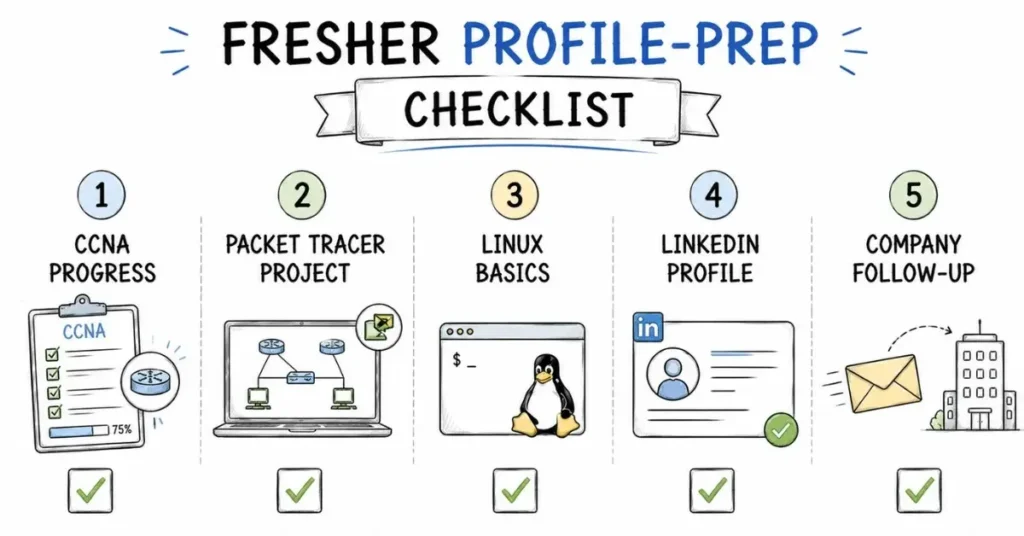
These five things, done before you apply, change your shortlisting rate significantly:
1. Get CCNA (or at least start it visibly)
Even being mid-way through CCNA preparation is better than nothing on a resume. On your LinkedIn profile, add “Currently pursuing CCNA — expected completion [month]” under certifications. Recruiters see this as initiative. Candidates with active certification pursuit get shortlisted at higher rates than those with no certification activity.
2. Build one lab project in Cisco Packet Tracer
Download Cisco Packet Tracer (free). Build a network with three routers, configure OSPF, and simulate a link failure to watch traffic reroute. Take a screenshot of your topology. Document what you configured in a short paragraph.
Put this on LinkedIn: “Built a multi-router OSPF network in Packet Tracer — configured routing, tested failover.” That one line, on a profile that otherwise has no professional experience, is a differentiator.
3. Learn basic Linux command line
Most telecom network equipment runs on Linux. Knowing how to navigate directories, read log files, use grep and awk, and run basic scripts is a genuine skill that freshers applying to NOC and network roles almost never have. FreeCodeCamp and Linux Journey (linuxjourney.com) both have free, beginner-friendly Linux courses.
4. Set up a clean, targeted LinkedIn profile
Your LinkedIn headline should not say “B.Tech ECE Graduate seeking opportunities.” It should say “Aspiring Network Engineer | CCNA In Progress | Cisco Packet Tracer | 5G Enthusiast.” The difference in how recruiters read these two headlines is enormous.
Add every technical skill you have studied — even if you have not used it professionally. Recruiters search by skill keywords. If you do not have the keyword on your profile, you do not appear in their search.
5. Follow and engage with telecom companies
Follow Ericsson India, Nokia India, Reliance Jio, and Tech Mahindra on LinkedIn. Comment thoughtfully on their posts about 5G, network launches, or industry trends. This is not networking in a transactional sense — it is building visibility in a small community. Recruiters at these companies notice active, informed candidates in their comment sections.
The Trainee Program Application Strategy
Many students apply to one or two companies and wait. The candidates who get hired apply strategically across multiple channels simultaneously.
Here is a practical application strategy for freshers:
Week 1:
- Apply to TCS NQT (if not already done) — this is always open and gives you access to TCS’s entire talent pool
- Apply to 3–5 NOC analyst roles on Indeed.in and Naukri using keywords “NOC fresher,” “network support fresher,” “telecom trainee”
- Apply to Uniinfo Telecom Services trainee program directly
Week 2:
- Check TelcoJobs (telcojobs.in) for TSSC-linked placement drives
- Apply to 3–5 roles on LinkedIn using “entry level telecommunications India” filter
- Send one direct LinkedIn message to an HR professional at Tech Mahindra or Wipro — not asking for a job, but asking about their fresher intake process for telecom roles
Week 3 onward:
- Keep applying in batches of 5–8 per week
- Track every application in a simple spreadsheet — company, role, date applied, status
- Follow up on applications that received no response after 2 weeks with a polite one-line LinkedIn message
The telecom job market rewards persistence. Most freshers give up after 10–15 applications. The ones who get hired typically apply 40–80 times before landing their first role — not because rejection is inevitable, but because volume and targeting both matter.
One Mindset Shift That Changes Everything
Most freshers approach their first job search with the question: “Which company will hire me?”
The better question is: “Which companies am I the right fit for, and what can I do in the next 30 days to be a stronger candidate for them?”
The first question is passive. The second one is actionable. It leads to studying the right things, building the right skills, and applying to the right roles — rather than spraying applications everywhere and hoping something sticks.
Telecom has real entry points for freshers. The door is open. What you bring to the threshold determines whether you walk through it.