
Top Telecom Certifications in India for Career Growth
Table of Contents
Telecom Certifications in India
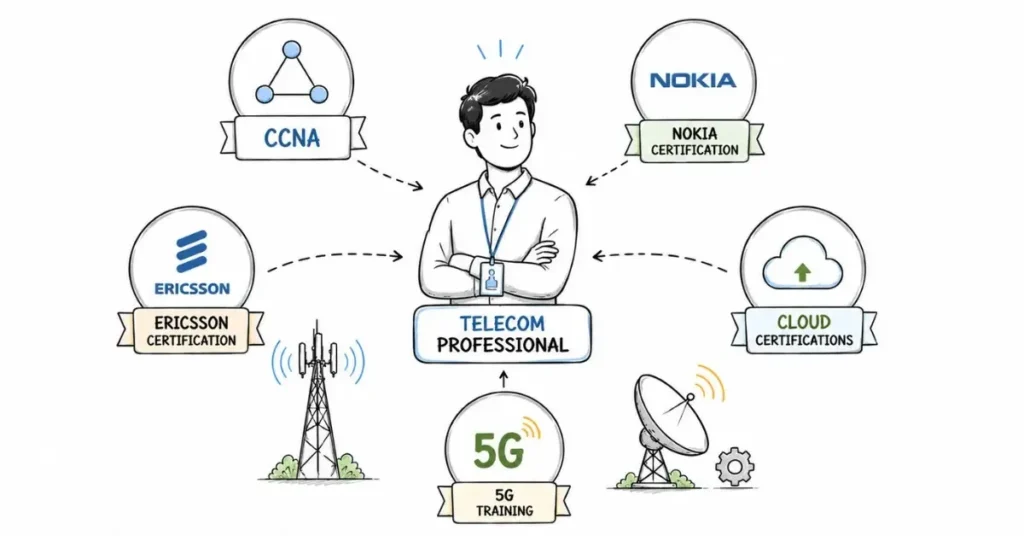
The telecom certification market is full of noise. Dozens of providers, hundreds of courses, and every single one claims to be “industry-recognised” and “career-transforming.”
Most are not.
This post cuts through that noise. It covers only the certifications that show up consistently in Indian telecom job descriptions, that hiring managers at companies like Ericsson, Nokia, TCS, and Airtel genuinely recognize, and that deliver a measurable return on your time and money. Every certification here is evaluated on four criteria: hiring signal (how often it appears in job descriptions), cost, difficulty, and realistic salary impact.
Why Certifications Matter More in Telecom Than in Most Industries
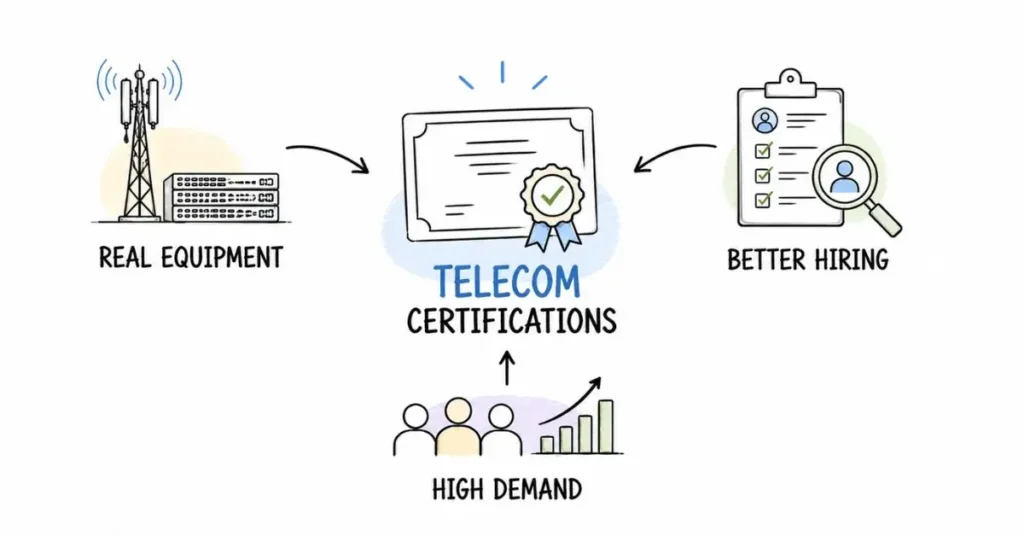
In software development, a strong GitHub portfolio sometimes matters more than certifications. In telecom, certifications carry more weight — for two reasons.
First, telecom technology is vendor-specific. Knowing how Nokia’s routing equipment works is different from knowing how Cisco’s routing equipment works. Vendors have built certification programs that validate precisely that vendor-specific knowledge, and employers who use Nokia equipment specifically look for Nokia certifications.
Second, the skills gap in Indian telecom is severe enough that employers use certifications as the primary filter for shortlisting candidates. With a demand-supply gap of 2.41 million skilled workers, companies do not have the luxury of only hiring people from premium colleges. A CCNA from a tier-3 college graduate carries real weight.
CCNA alone is requested in 78% of network engineer job postings in India. That number tells you everything about the certification’s value in this market.
Tier 1: The Non-Negotiables
These are the certifications that appear most frequently in Indian telecom job descriptions. If you are serious about a telecom career, one of these should be on your roadmap.
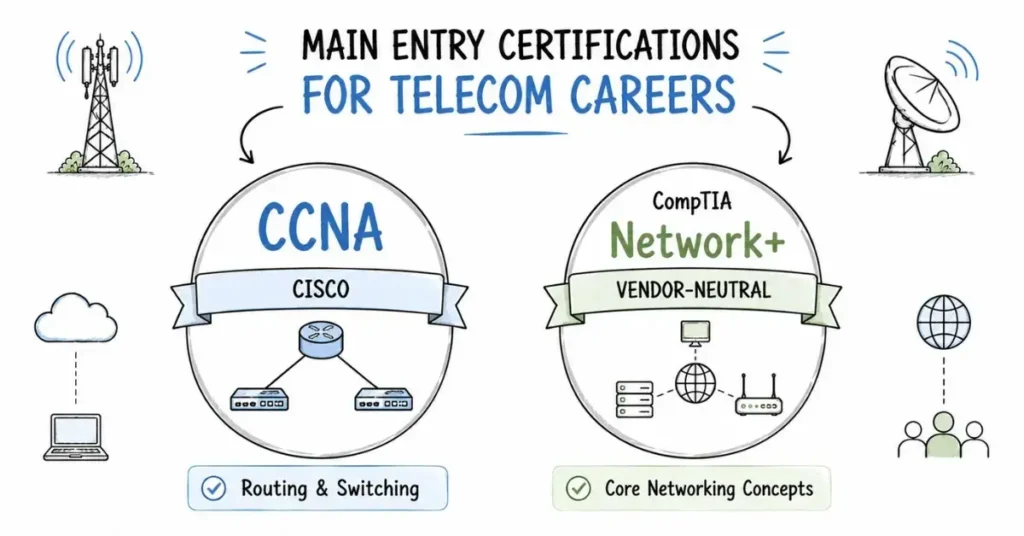
Cisco Certified Network Associate (CCNA)
What it covers: Routing and switching fundamentals, IP addressing, VLANs, OSPF, WAN technologies, network security basics, and automation introduction.
Why it matters: CCNA is the baseline networking credential recognized across every segment of Indian telecom — operators, vendors, IT services companies, and managed services providers. 94% of hiring managers surveyed globally say they prefer CCNA-certified candidates for networking roles. In India specifically, it is the most requested certification in network engineer job postings. Professionals with CCNA report an average 20% salary increase over non-certified peers.
Who should get it: Anyone targeting network engineer, NOC analyst, 5G deployment, or core network roles. Also strongly recommended as a foundational add-on for ECE graduates whose degree had limited networking coverage.
Cost: Exam fee approximately ₹27,000–₹30,000 (USD 200–220 at current exchange rates). Study material: free via Cisco NetAcad, or paid Udemy courses at ₹500–₹2,000 during sales.
Difficulty: Moderate. Most self-study candidates take 3–5 months preparing 1–1.5 hours per day. The exam tests both conceptual understanding and practical troubleshooting.
Time to complete: 3–5 months self-study. 2–3 months intensive.
Validity: 3 years, after which recertification is required.
CompTIA Network+
What it covers: Networking fundamentals — similar ground to CCNA but vendor-neutral and slightly less deep on Cisco-specific content. Covers troubleshooting, infrastructure, network operations, network security, and tools.
Why it matters: Network+ is widely recognized as a vendor-neutral entry-level credential. For candidates from non-engineering backgrounds (BCA, B.Sc. IT) who want to demonstrate networking awareness without attempting the full CCNA, Network+ is a credible starting point. It also satisfies baseline requirements for government and defence-adjacent telecom roles.
Who should get it: Non-engineering graduates entering telecom analyst or NOC roles. Also useful for IT professionals switching to telecom who want a quick credential before pursuing CCNA.
Cost: Exam fee approximately ₹18,000–₹20,000. Study materials from CompTIA’s official resources or free via Professor Messer’s website (widely used by Indian candidates).
Difficulty: Lower than CCNA. Most candidates complete it in 6–8 weeks with focused study.
Validity: 3 years.
Tier 2: Vendor-Specific Powerhouses
These certifications are more specialized than CCNA but deliver stronger signals for specific roles — particularly at companies that use Nokia or Ericsson equipment, which covers most of India’s major operators.
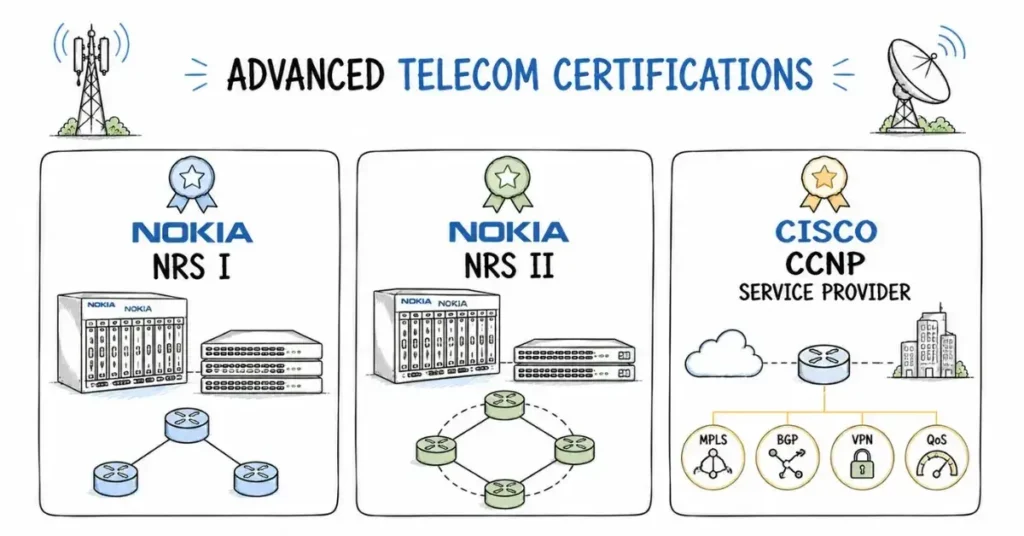
Nokia NRS I — Network Routing Specialist I
What it covers: Nokia IP networking fundamentals — IP/MPLS, OSPF and IS-IS routing protocols, VPNs, Quality of Service (QoS), and Nokia’s SR OS (the operating system on Nokia routing equipment).
Why it matters: Nokia is a major equipment vendor for Airtel, Vi, and several large ISPs in India. Engineers working on these networks use Nokia equipment daily. NRS I signals to these employers that you understand their infrastructure specifically. Unlike CCNA, which tests generic Cisco knowledge, NRS I tests Nokia-specific implementation — and that is exactly what hiring managers at Airtel’s IP team or Nokia’s managed services arm want to see.
Who should get it: Network engineers targeting Nokia-centric environments. Also valuable as a second certification after CCNA for candidates who want to specialize in service provider networking.
Cost: Exam fee $125 USD (approximately ₹10,500). No prerequisites required — you can attempt it directly without any prior certification.
Difficulty: Moderate. The Nokia-specific content (SR OS commands, Nokia-specific routing configurations) requires hands-on practice. Nokia offers MySRLab — a remote lab environment for practising on actual Nokia virtual equipment.
Time to complete: 2–3 months focused study after CCNA-level foundation.
Nokia NRS II — Network Routing Specialist II
What it covers: Advanced Nokia IP/MPLS networking — deeper routing protocol implementation, advanced VPN services, multicast, and Nokia-specific architecture. Requires both a written exam and a practical lab exam.
Why it matters: NRS II is a serious qualification. The lab component (a 3.5-hour practical exam costing €650) means you cannot fake it — you have to actually configure Nokia equipment under exam conditions. This makes it one of the most credible signals of genuine Nokia expertise in the market.
Who should get it: Working network engineers with 2–4 years of experience, particularly those already working with Nokia equipment or targeting senior roles at Nokia-centric operators.
Cost: The full NRS II bundle (self-study materials + exam vouchers + lab exam) costs approximately $2,695 USD. The written composite exam alone is $375 USD. This is a meaningful investment — but at the senior levels where NRS II matters, the salary premium justifies it.
Difficulty: High. One of the more rigorous routing certifications in the market.
Cisco CCNP Service Provider
What it covers: Advanced networking for service provider (telecom) environments — MPLS, segment routing, BGP scaling, VPN services, quality of service, and network automation.
Why it matters: The Service Provider track is the CCNP specialization directly relevant to telecom. Engineers who clear CCNP SP signal that they can handle the scale and complexity of carrier-grade networks, not just enterprise networks. For roles at Cisco-based operators or IT services companies managing telecom infrastructure, CCNP SP carries significant weight.
Who should get it: Network engineers with 3–5 years of experience who are ready to specialize and target senior roles.
Cost: CCNP requires passing two exams — a core exam ($400 USD) and a concentration exam ($300 USD). Total approximately ₹60,000.
Difficulty: High. Requires solid practical experience on top of theoretical knowledge.
Tier 3: 5G-Specific Certifications
These certifications are more recent and specifically validate 5G knowledge. They carry strong signal for deployment, RAN, and core network roles.
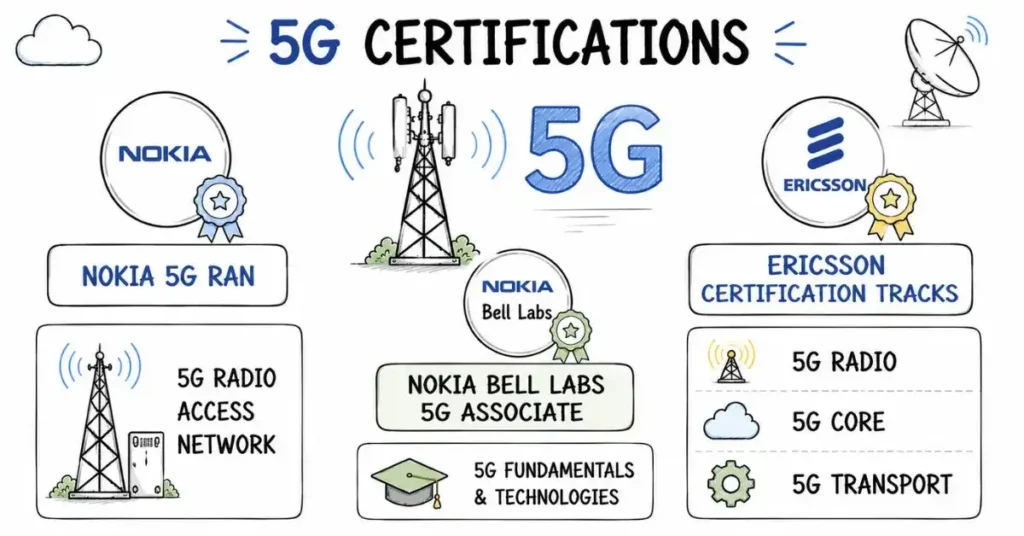
Nokia 5G RAN Certifications (Professional, Expert, Specialist)
What it covers: Nokia’s 5G RAN product knowledge — gNodeB configuration, 5G NR radio fundamentals, RAN optimization, and Nokia-specific tools like Nokia NetAct and Nokia Network Operations.
Why it matters: Nokia is a primary 5G RAN vendor for Airtel and other operators globally. Nokia’s own professional services team — which manages and optimizes live networks for operators — requires these certifications for its engineers. Candidates with Nokia 5G RAN Professional or Expert certifications are directly hireable for Nokia-managed network roles.
Who should get it: 5G deployment engineers, RAN optimization engineers, and anyone targeting Nokia’s professional services or delivery teams.
Cost: Course + exam packages vary. Contact Nokia’s authorized training partners (including TELCOMA and Apeksha Telecom in India) for current India pricing.
Nokia Bell Labs 5G Associate Certification
What it covers: 5G architecture fundamentals, NR air interface, 5G core concepts, use cases, and deployment scenarios. Vendor-neutral in approach despite being Nokia-branded.
Why it matters: Nokia partnered with NIIT and COAI to make this available in India specifically. It is one of the few structured 5G certifications designed to be accessible to freshers and early-career professionals — not just experienced engineers. Jio and Airtel both recognize it in their hiring.[niit]
Who should get it: Freshers and early-career candidates who want a 5G credential before entering the job market. A good companion to CCNA for candidates targeting 5G roles.
Cost: India pricing available through NIIT and COAI-affiliated centers. Typically ₹15,000–₹25,000 for the full course and exam.
Ericsson Certified Associate / Expert Programs
What it covers: Ericsson offers role-specific certification tracks for 5G RAN, 5G core, IP networking, and managed services. The Expert level requires demonstrating deep product knowledge through both written and practical components.
Why it matters: Ericsson is India’s largest 5G RAN vendor in terms of deployment scale. Their managed services teams — which run network operations for multiple operators simultaneously — specifically look for Ericsson-certified engineers for their India delivery centres in Gurugram and Bengaluru.
Who should get it: Engineers targeting Ericsson or Ericsson-managed network roles. Note that Ericsson certifications are most valuable when targeting Ericsson specifically — their market recognition outside Ericsson’s ecosystem is lower than Nokia NRS or Cisco certs.
Tier 4: Supporting Certifications That Strengthen Any Telecom Profile
These are not telecom-specific but add measurable value to a telecom resume.
AWS Cloud Practitioner / Azure Fundamentals
5G core networks run on cloud infrastructure. Engineers and analysts who understand cloud platforms — even at a foundational level — have a meaningful edge for core network, automation, and OSS/BSS roles. Both AWS and Azure offer free study paths, with exam fees in the ₹8,000–₹12,000 range.
Cisco DevNet Associate
Covers network automation — writing Python scripts for network management, using APIs to interact with network devices, and understanding software-defined networking concepts. As automation enters every layer of telecom operations, this certification is growing in relevance fast for network engineers who want to stay ahead.
PMP (Project Management Professional)
For engineers with 5+ years of experience moving toward project management in telecom, PMP is the recognized standard. Telecom project managers with PMP earn noticeably more than those without it, particularly at global vendors managing large 5G deployment contracts.
The Realistic Certification Roadmap by Career Stage
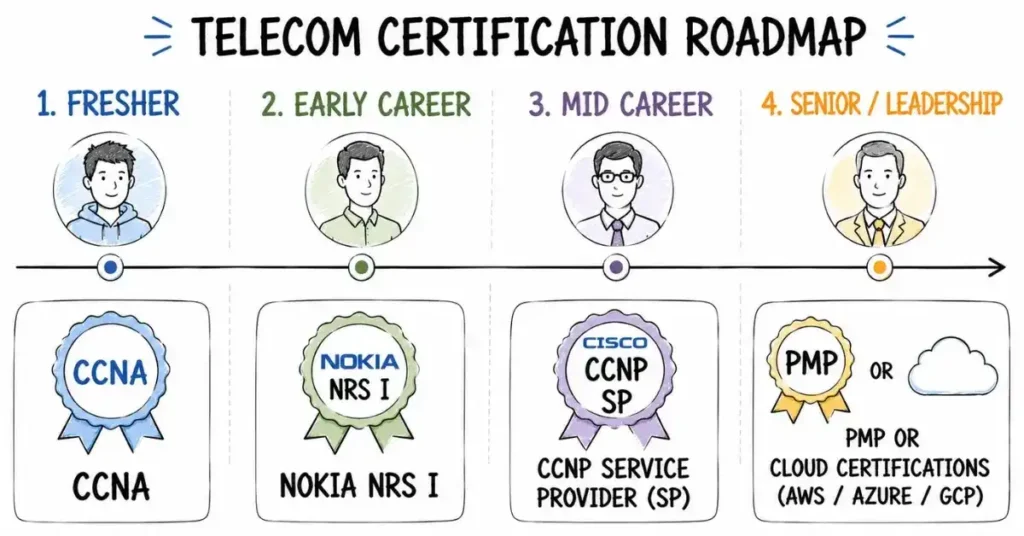
Stage | Primary Cert | Secondary Cert | Timeline |
Fresher (0 experience) | CCNA | CompTIA Network+ OR Nokia 5G Associate | 4–6 months |
Early Career (1–3 yrs) | CCNP SP or Nokia NRS I | AWS Cloud Practitioner | 6–12 months |
Mid Career (3–7 yrs) | Nokia NRS II or CCNP SP | Cisco DevNet or PMP | 12–18 months |
Senior (7+ yrs) | Nokia SRA or CCIE | Domain-specific (Ericsson Expert, etc.) | 18–24 months |
Do not attempt to collect all of these at once. Each certification takes real time and real money. One well-prepared certification beats three half-studied ones — every time.
How to Study Without Expensive Classroom Courses
The most expensive part of telecom certifications in India is classroom training — which most students do not need.
Here is what self-study actually looks like for the top certifications:
For CCNA:
- Cisco NetAcad (free theory + Packet Tracer labs)
- Jeremy’s IT Lab on YouTube (the most comprehensive free CCNA course available)
- Boson ExSim practice exams (paid, approximately ₹4,000 — worth every rupee for exam simulation)
For Nokia NRS I:
- IPCisco.com (structured NRS I lessons aligned to the exam)
- Nokia’s MySRLab for hands-on practice on virtual Nokia equipment
- Nokia’s official study guide (available on Nokia’s learning portal)
For Nokia 5G Associate:
- NIIT’s Nokia-partnered course (India-specific, includes exam prep)
- Nokia’s own online learning portal has foundational 5G modules
For 5G fundamentals (general):
- Techplayon YouTube channel — explains 5G NR concepts clearly without requiring prior expertise
- 5GWorldPro.com — structured 5G training with certification tracks
- Apeksha Telecom (Telecom Gurukul) — India-based training with placement support
One Thing Candidates Get Wrong About Certifications
They stop after passing the exam.
A certification on your resume gets you shortlisted. What gets you hired is being able to talk about what the certification taught you in specific, practical terms.
In an interview, the difference between two CCNA-certified candidates is not the certificate — it is that one of them can say: “After CCNA, I built a multi-site OSPF network in Packet Tracer with three routers and simulated a link failure to watch traffic reroute. I documented the whole topology and configuration.” The other candidate says: “Yes, I have CCNA.”
Get the certification. Then build something with what it taught you. The combination is what employers actually hire.