
5G Technology Explained : Career Guide for Job Seekers
Table of Contents
5G Technology Explained for Job Seekers: What You Actually Need to Know

You keep hearing about 5G. Jio is advertising it. Airtel is advertising it. The government is talking about it. And every second telecom job posting mentions it.
But what actually is 5G? And more importantly what does it mean for your career?
This post is not a technical deep-dive for engineers. It is a plain-language explanation for students and career changers who want to understand 5G well enough to talk about it in interviews, choose the right certifications, and pick the roles that match where the industry is actually going.
Start Here: What 4G Did, and What 5G Does Differently
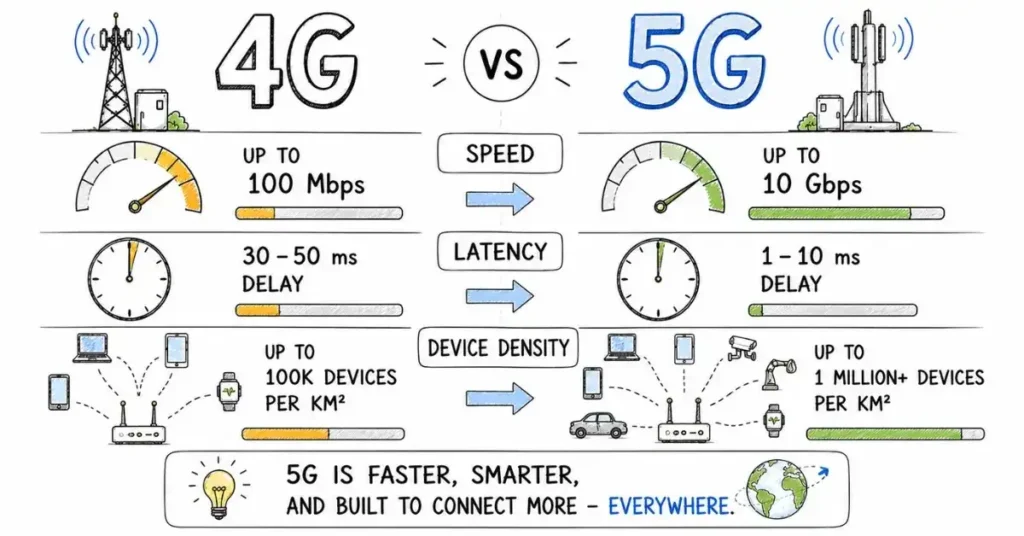
To understand 5G, you need to understand what came before it.
1G (1980s) — made wireless voice calls possible for the first time.
2G (1990s) — digitized calls and added SMS messaging.
3G (early 2000s) — brought mobile internet, though slow by today’s standards.
4G/LTE (2010s) — made mobile internet fast enough for video streaming, apps, and smartphones as we know them today.
Each generation was not just a speed upgrade. Each one changed what people could do with mobile technology — and changed which industries were disrupted.
5G is the fifth generation. It does three things that 4G could not do well:
- Much faster speeds. Peak 5G speeds in lab conditions reach 20 Gbps — roughly 100 times faster than 4G. In real-world Indian deployments, users see 150–500 Mbps on a good 5G connection, which is still 5–10 times faster than typical 4G speeds.
- Ultra-low latency. Latency is the delay between sending a signal and receiving a response. 4G latency is around 30–50 milliseconds. 5G brings this down to 1–10 milliseconds. That sounds small, but it is the difference between a robotic surgery arm responding in real time versus with a noticeable lag. It enables things like autonomous vehicles, remote industrial control, and real-time gaming at a level 4G simply cannot support.
- Massive connectivity. 5G can connect up to 1 million devices per square kilometer. 4G handles about 4,000. This is what makes IoT (Internet of Things) at scale possible smart factories with thousands of sensors, smart cities, connected agriculture, logistics tracking.
These three improvements speed, latency, and device density are why 5G is not just “faster 4G.” It enables entirely new categories of applications. And those new applications need new engineers, analysts, and managers to build and run them.
The Three Types of 5G You Will Hear About
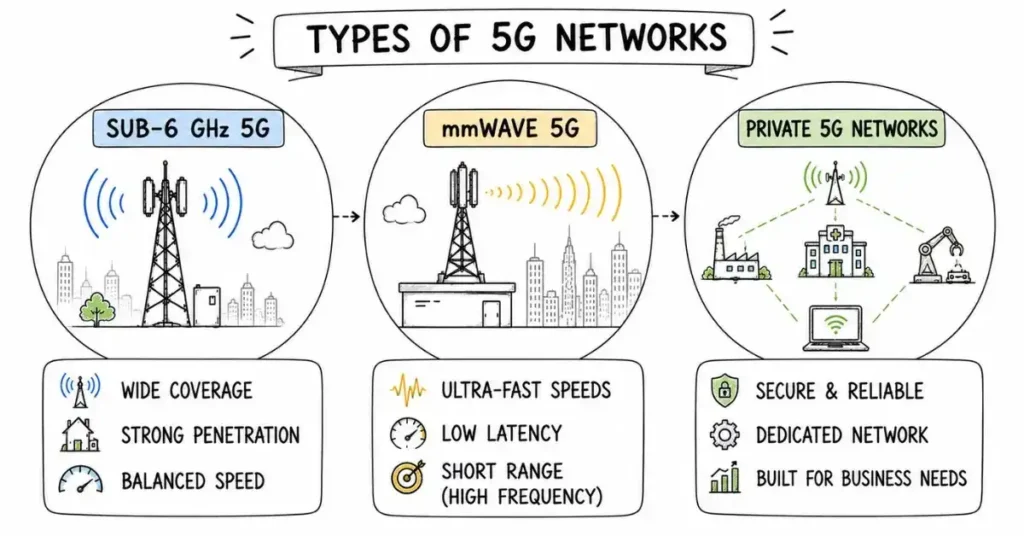
When employers talk about 5G in job descriptions, they often mention specific frequency bands. Here is what those mean — in plain language.
Sub-6 GHz 5G (also called FR1)
This is the most common type deployed in India. It uses radio frequencies below 6 GHz — similar to 4G but with upgraded technology. It covers wide areas, penetrates buildings reasonably well, and delivers speeds of 100–500 Mbps. Jio and Airtel’s nationwide 5G coverage largely uses this band. Most 5G deployment engineer roles in India today work with Sub-6 GHz infrastructure.
mmWave 5G (also called FR2 — millimetre wave)
This uses very high frequencies (24 GHz and above). It delivers extremely high speeds (up to 4–5 Gbps in ideal conditions) but has very short range and cannot penetrate walls easily. It is used in specific high-density locations — stadiums, airports, conference centres. India has limited mmWave deployment right now, but it is growing. RF engineers who specialize in mmWave planning are well-compensated because the skill is rare.
Private 5G Networks
This is not a frequency type — it is a deployment model. Instead of connecting to a public operator’s network, a factory, hospital, or airport builds its own dedicated 5G network. This gives them more control, lower latency, and better security. Private 5G is one of the fastest-growing job markets in telecom right now, separate from the mainstream operator hiring you typically see on job portals.
How a 5G Network Is Actually Structured
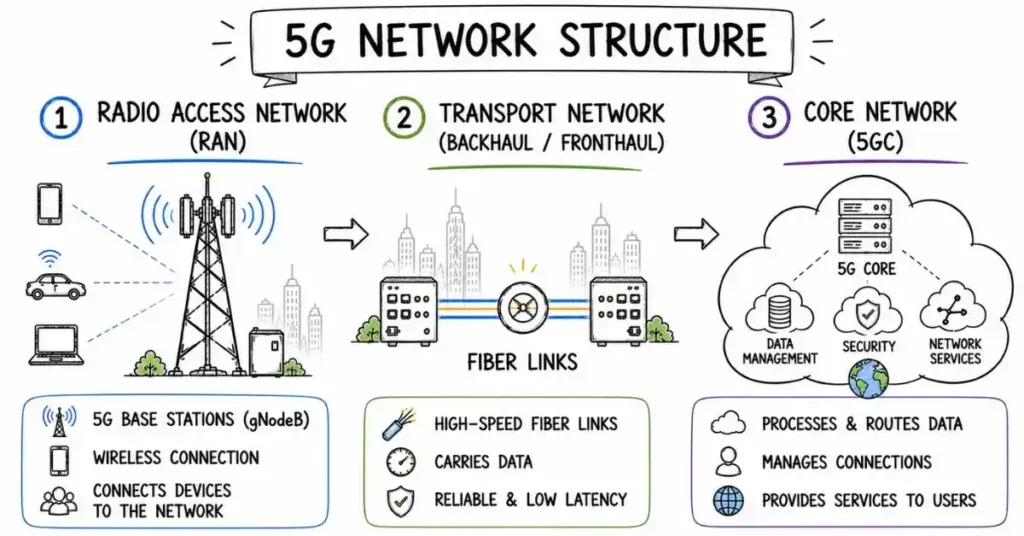
You do not need to be an engineer to understand this. Think of a 5G network in three parts:
Part 1 — The Radio Access Network (RAN)
This is what you can see: the towers and antennas. In 5G, the base station is called a gNodeB (gNB). The RAN is responsible for connecting your phone to the network wirelessly.
This is where RF engineers, 5G deployment engineers, and drive test engineers work.
Part 2 — The Transport Network
Think of this as the highway connecting towers to the brain of the network. Data from your phone travels from the tower through fiber cables or microwave links to a central facility. Transport network engineers design and maintain this middle layer.
Part 3 — The Core Network
The core is the brain. It handles authentication (checking that you are allowed on the network), routing (deciding where your data goes), billing, and subscriber data. In 5G, the core is cloud-native — meaning it runs on software, not dedicated hardware boxes. This is why 5G core engineers need both networking skills and cloud computing knowledge.
Understanding this three-part structure helps you immediately when you read job descriptions. A role mentioning “gNB configuration” or “RAN optimization” is in Part 1. “IP/MPLS transport” is Part 2. “5GC, AMF, SMF, UPF” are Part 3 — the core functions. You do not need to know what all those abbreviations mean today, but knowing they belong to different parts of the network helps you study in the right direction.
What New Jobs Did 5G Create in India?
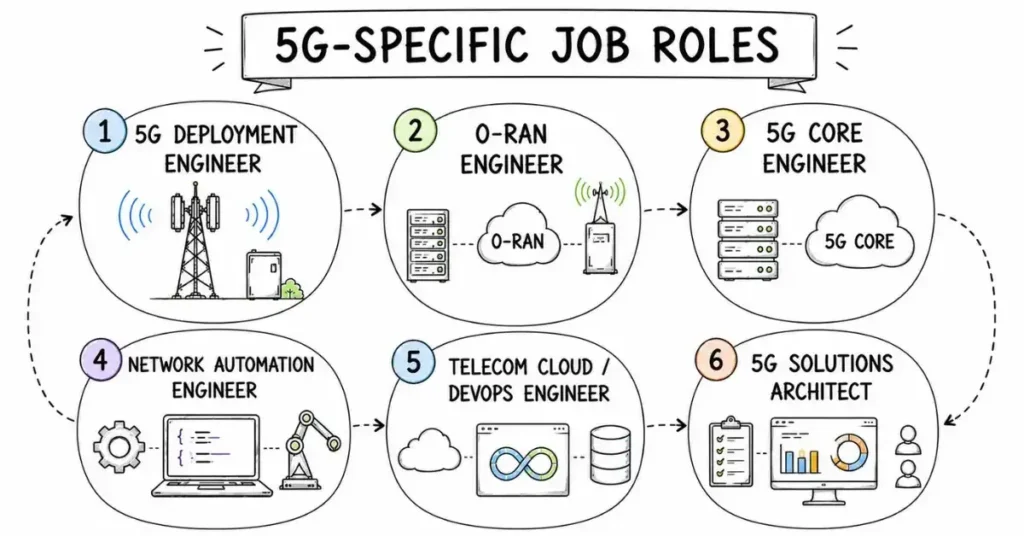
This is the most important section for your career planning. 5G did not just create more of the same jobs. It created categories that did not exist five years ago.
5G Deployment Engineer
Before 5G, deploying a base station was largely a hardware job. You bolted things together, connected cables, and ran basic tests. 5G deployment is more complex — it involves configuring software parameters, integrating with cloud management systems, and running acceptance tests against 3GPP standards. This is a specialized role with strong demand and decent starting salaries.
O-RAN / Open RAN Engineer
Traditional telecom was “closed” — if your RAN equipment came from Ericsson, your software had to come from Ericsson too. Open RAN breaks this lock. It allows operators to mix hardware and software from different vendors using open standards. O-RAN engineers need to understand protocol stacks, open interfaces (like F1, E1, Xn), and often need scripting skills in Python. Jio and Airtel have both run O-RAN trials, and this role is moving from experimental to mainstream.
5G Core Network Engineer
Because 5G core runs on cloud infrastructure, this role sits at the intersection of networking and cloud computing. Engineers in this space work with Kubernetes, Docker, and cloud platforms (AWS, Azure, or private cloud) — alongside telecom protocols. Starting salaries for 5G core engineers in India are noticeably higher than other entry-level telecom roles because the skill combination is genuinely rare.
Network Automation Engineer
5G networks are too large and complex to manage manually. Automation engineers write scripts (mostly Python) that automatically detect problems, push configuration changes, and generate reports. This is one of the most future-proof roles in telecom — demand for it grew 68% between 2020 and 2023.
Telecom Cloud / DevOps Engineer
Cloud-native telecom needs people who understand both software deployment and network behaviour. Engineers who can deploy and manage telecom network functions (VNFs/CNFs) using CI/CD pipelines, Kubernetes, and Helm charts are in short supply. Companies like Ericsson, Nokia, and Mavenir are specifically hunting for this profile.
5G Solutions Architect / Technical Sales
As 5G moves from deployment to monetization — selling 5G services to enterprises, building use cases for smart factories, connected logistics, and healthcare — companies need people who can translate technical capability into business value. These roles pay well and suit engineers who are also good communicators.
5G-Specific Roles vs. General Telecom Roles
Not every telecom job requires 5G knowledge. Here is a clear split to help you focus your preparation:
Role | 5G-Specific? | What You Need |
NOC Analyst | No | General networking, alarm management tools |
RF Engineer | Partially | 5G NR air interface knowledge helps |
5G Deployment Engineer | Yes | gNB configuration, 3GPP NR standards |
O-RAN Engineer | Yes | Open interfaces, Python, protocol stacks |
5G Core Engineer | Yes | Cloud-native, Kubernetes, 5GC architecture |
Network Automation Engineer | Yes | Python, YANG/NETCONF, CI/CD basics |
Telecom OSS/BSS Analyst | No | BSS/OSS tools, SQL, telecom domain basics |
Transport Network Engineer | Partially | IP/MPLS stays relevant across generations |
Telecom Project Manager | No | PMP/Prince2, vendor management |
Network Automation Engineer | Yes | Python, Ansible, YANG |
If you are a fresher, this table helps you figure out where to start. If you want a 5G-specific role, you need to invest in understanding at least one part of the 5G architecture — RAN, transport, or core — and get a relevant certification to back it up.
What Does 5G Mean for India Specifically?
The scale of India’s 5G rollout matters for your career because it means the work is happening here — not just in the US or Europe.
India launched 5G in October 2022. By the end of 2025, Jio and Airtel together covered 99.9% of Indian districts with 5G. The rollout speed was faster than almost any other country in the world.
But coverage is just Phase 1. Phase 2 — which is happening right now through 2026 and beyond — is about using that coverage to build services. Enterprise 5G, private networks, smart manufacturing, connected agriculture, digital healthcare — all of these are on the roadmap for Indian operators and the Indian government.
The jobs that come with Phase 2 are different from the deployment engineer roles of Phase 1. They require people who can combine technical 5G knowledge with domain understanding of specific industries. An engineer who understands 5G and also understands factory automation or healthcare is worth significantly more than one who knows only the network side.
This is why building domain awareness — not just technical skills — is a smart career move right now.
Common 5G Terms You Will See in Job Descriptions
You do not need to memorize all of these today. But recognising them helps you read job postings intelligently and study in the right direction.
- gNB / gNodeB — The 5G base station (the tower equipment)
- NR (New Radio) — The 5G air interface standard; the “language” 5G devices and towers use to communicate
- 5GC (5G Core) — The software-based brain of the network
- AMF — Access and Mobility Management Function; handles device authentication and mobility
- SMF — Session Management Function; manages data sessions
- UPF — User Plane Function; the part of the core that actually forwards your data
- RAN — Radio Access Network; the tower/antenna side of the network
- O-RAN — Open RAN; the open-standards version of RAN that allows multi-vendor deployments
- NSA (Non-Standalone) — An early 5G mode that uses 4G core alongside 5G radio
- SA (Standalone) — Full 5G with its own core network; required for the most advanced 5G features
- Network Slicing — Splitting one physical 5G network into multiple virtual networks for different use cases
- MEC (Multi-access Edge Computing) — Running computing power at the edge of the network (near the tower) rather than in a distant data centre; reduces latency significantly
When a job description mentions “SA 5G deployment experience” or “O-RAN integration,” you now know what those terms mean at a conceptual level — which is exactly what you need to decide whether the role fits your trajectory.
Where to Start Learning 5G
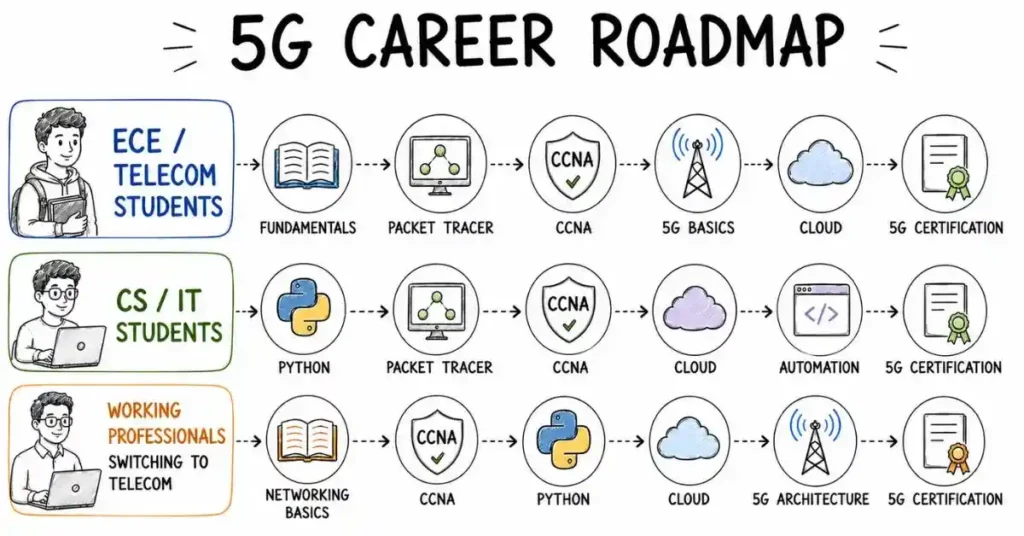
Here is a realistic study path depending on your background:
If you are an ECE/telecom engineering student:
- Start with Cisco Packet Tracer to get networking fundamentals solid
- Complete CCNA (3–4 months of self-study)
- Move to Nokia 5G Associate certification or a 5G World Pro course for 5G-specific knowledge
- Do a 5G-focused final year project — simulate a 5G RAN scenario, build a small network automation script
If you are from a CS/IT background:
- Cover networking basics (OSI model, TCP/IP, routing) using free resources on Cisco’s NetAcad
- Take CCNA or CompTIA Network+
- Add a cloud certification (AWS Cloud Practitioner or Azure Fundamentals) because 5G core is cloud-based
- Learn Python basics — 100 hours of Python is enough to write simple network automation scripts
If you are a working professional switching into telecom:
- Identify which layer of the network (RAN, transport, or core) maps most closely to your current skills
- Get the domain-specific certification for that layer (Nokia NRS for transport/routing; Nokia/Ericsson RAN cert for radio; cloud certs + CCNP SP for core)
- Apply for roles at IT services companies first (TCS, Tech Mahindra) — they are more open to lateral movers than operators
5G is not going away. If anything, the skills being built today around 5G will directly translate into 6G preparation by the early 2030s. The engineers who understand 5G deeply are the ones who will define what comes next.