
Work Experience Section Mastery
Table of Contents
Most LinkedIn work experience sections sound like job descriptions:
“Responsible for managing social media accounts, creating content, and tracking analytics. Collaborated with team members on campaigns.”
Recruiters read this in 2 seconds and move on. Here’s why: it lists tasks, not impact. It doesn’t tell them what you accomplished or what value you brought.
The difference between a forgotten profile and a recruiter’s callback comes down to how you frame your experience.
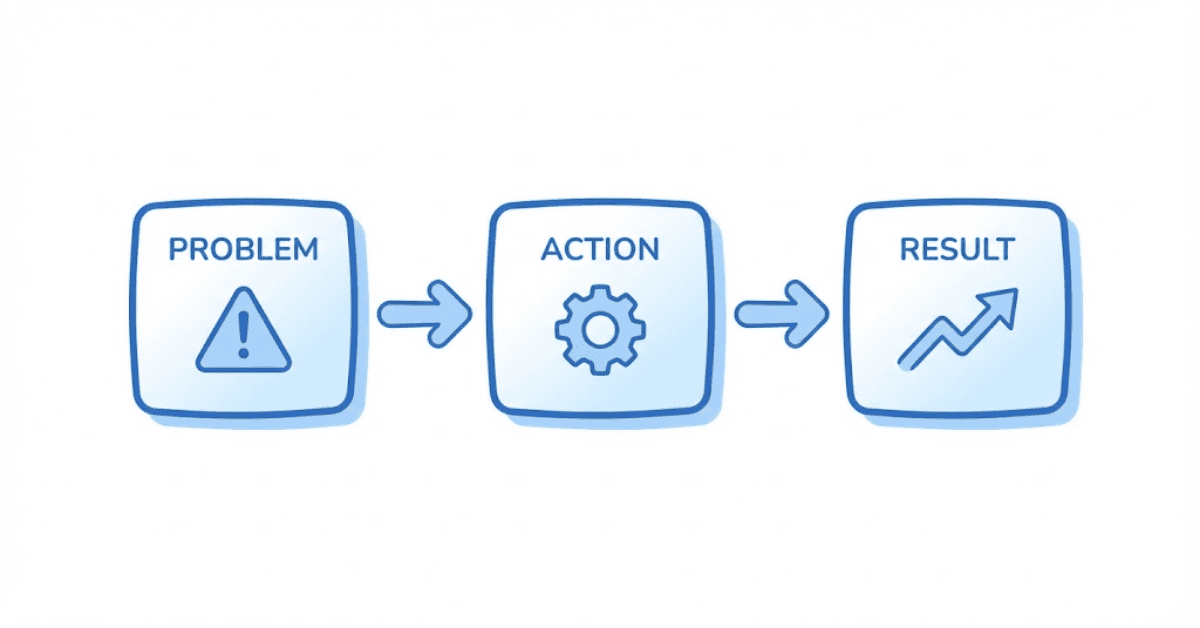
The PAR Framework: The Master Formula
Every achievement should follow this structure:
P – Problem (What challenge or opportunity existed?)
A – Action (What specific steps did you take?)
R – Result (What quantifiable outcome occurred?)
This framework works because it tells a complete story. It shows you didn’t just do a job—you solved a problem.
PAR Framework Example
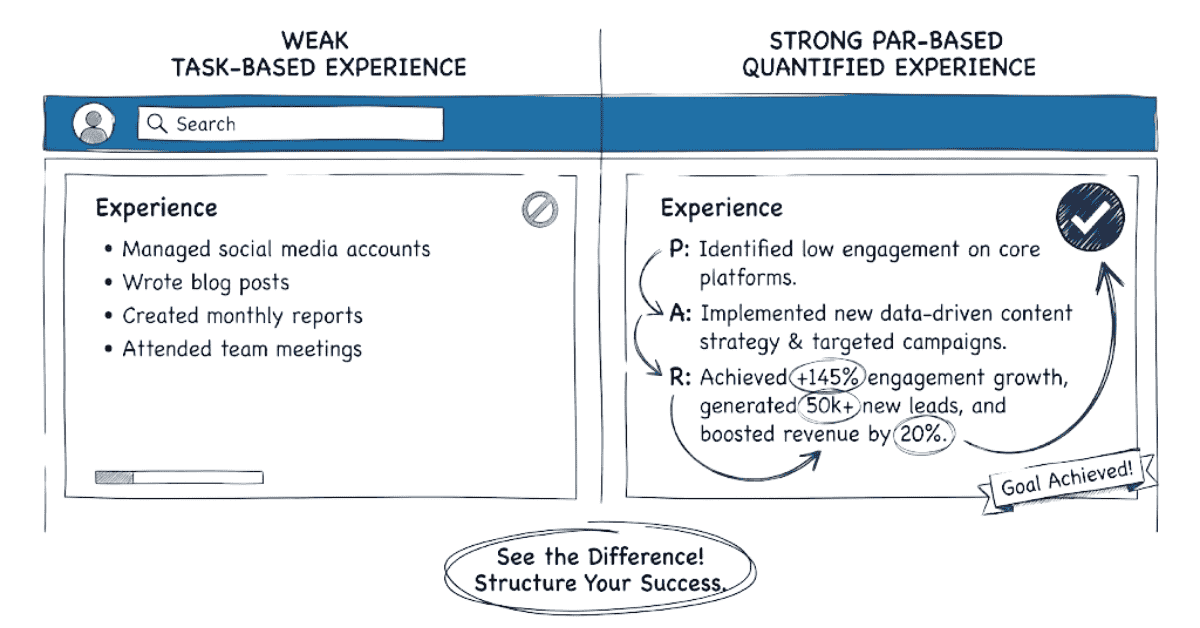
❌ Weak Version (Just tasks):
“Created social media content for 5 accounts. Posted daily. Managed comments and messages.”
✅ PAR Version (Story with impact):
“Noticed that daily posts weren’t increasing engagement. Implemented a content calendar strategy with specific posting times and audience-focused topics. Increased average engagement by 145% (from 2% to 4.9%) and follower growth from 100/month to 500/month within 3 months.”
See the difference? The second version shows problem-solving, strategy, and quantified results.
Want to Improve Your Entire Resume ?
Explore expert career resources, job updates, and guidance at Frontlines Media.
The 3-Part Template for Work Experience
LinkedIn allows you to tell a deeper story than traditional resumes. Use this structure:
Part 1: Role Context (1-2 sentences)
Set the stage. What was the company? What was your scope?
Example: “Managed social media strategy for a B2B SaaS company with 50K followers across 3 platforms. Responsible for content creation, community engagement, and campaign execution.”
Part 2: Key Achievements (3-4 bullet points using PAR)
Your most impressive wins using the Problem-Action-Result formula.
Example:
- Increased post engagement by 145% – Noticed the company’s posting schedule didn’t align with audience activity. Analyzed 6 months of data to identify peak engagement times, restructured content calendar, and piloted new content formats. Within 3 months, engagement rate grew from 2% to 4.9%, driving 3x more clicks to product pages.
- Grew follower base by 220% in 1 year – Evaluated competitor social strategies and identified messaging gaps in our industry. Launched weekly “Industry Insights” series and partnered with 5 industry influencers for guest posts. Grew followers from 50K to 161K while maintaining engagement rates.
- Reduced response time by 80% – Customers were waiting 24+ hours for inquiries to be answered on social. Implemented a shared Slack channel for customer messages and created templated responses for common questions. Average response time dropped from 18 hours to 2 hours.
Part 3: Skills & Tools Used
What did you learn or master?
Example: “Tools & Skills: Buffer, Hootsuite, Canva, Data Analysis, Community Management, Content Strategy, Google Analytics”
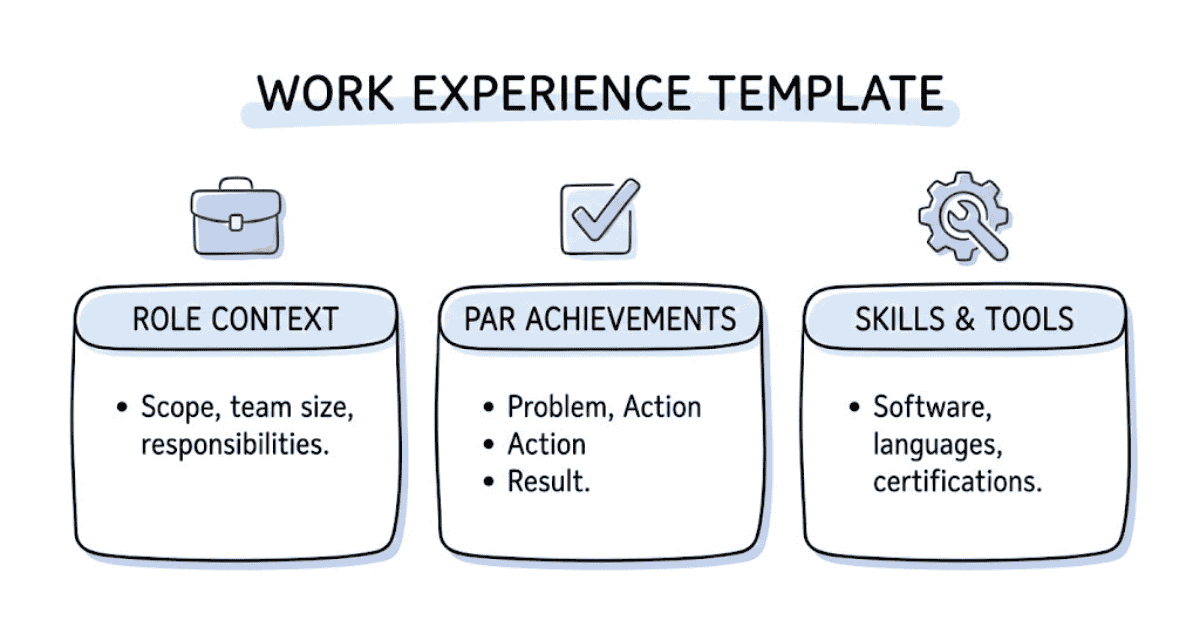
The Three-Part Template in Action
Let me show you real examples for different career stages:
For a Marketing Fresher:
Role Context:
“Completed 3-month internship at XYZ Digital Marketing Agency, supporting a team of 4 in managing campaigns for 10+ SME clients across e-commerce, fintech, and SaaS industries.”
Key Achievements:
- Launched first independent campaign that generated $15K in attributed sales – Started with zero marketing experience. Created a targeted Google Ads campaign for an e-commerce client (small budget, high competition). Used keyword research, competitor analysis, and A/B testing to optimize. Campaign achieved 3.2% conversion rate (vs. 1.2% industry average) in first month.
- Wrote 20+ blog articles that attracted 50K organic views – Learned SEO from scratch by completing courses. Applied keyword research to write 20 original blog posts for client websites. Within 6 months, articles accumulated 50K+ organic views and generated 200+ leads for clients.
- Reduced campaign cost-per-click by 35% – Analyzed underperforming keywords in Google Ads. Identified irrelevant keywords draining budget. Removed wasteful keywords and added negative keywords. CPR dropped from $2.50 to $1.63 while maintaining quality score.
Skills & Tools:
Google Ads, Google Analytics, Keyword Research (SEMrush), Content Writing, A/B Testing, Canva, WordPress
For an Experienced Professional (SEO Manager):
Role Context:
“Led SEO function for a fintech B2B SaaS platform with 5M+ monthly visitors. Managed team of 3 SEO specialists and oversaw strategy for corporate website, blog, and product documentation.”
Key Achievements:
- Scaled organic traffic from 500K to 5M monthly visitors (10x growth) in 2 years – Inherited a website with poor technical foundation and scattered content strategy. Built comprehensive technical SEO roadmap addressing crawl issues, Core Web Vitals, and site speed. Restructured 10K+ pages into coherent topic clusters. Result: ranked 500+ keywords on page 1; organic traffic became 60% of total traffic.
- Generated $8M+ in attributed revenue through organic search – Implemented proper conversion tracking and attribution modeling. Created content roadmap targeting high-intent keywords. Optimized landing pages with CRO best practices. Organic channel grew from 5% to 25% of company revenue.
- Built and scaled SEO team from 1 to 3 people – Identified bottleneck: single person managing 5M+ page estate. Hired and trained 2 SEO specialists on company’s proprietary frameworks. Delegated technical SEO and content optimization while I focused on strategy. Team productivity increased by 250%.
Skills & Tools:
Technical SEO, Content Strategy, Keyword Research, Link Building, Google Analytics 4, Google Search Console, Screaming Frog, Python/SQL (data analysis), Team Leadership
For a Career Switcher (Finance to Marketing):
Role Context:
“Transitioned from 4 years of financial analysis to digital marketing. First marketing role managing growth experiments for an early-stage fintech startup (Series A, 20 people).”
Key Achievements:
- Reduced customer acquisition cost by 45% while improving sign-up quality – Applied analytical skills from finance background to analyze CAC by channel. Discovered paid search was attracting low-quality leads. Shifted 60% of budget to content marketing and partnerships. CAC dropped from $45 to $25; quality score improved (lower churn).
- Designed measurement framework that revealed $200K in wasted ad spend – Noticed marketing team wasn’t tracking channel attribution properly. Built Excel model to track customer journey across touchpoints (finance background advantage). Discovered 30% of ad spend went to channels with negative ROI. Redirected budget to high-performers.
- Launched company’s first content marketing program from zero – Recognized content marketing could leverage my analytical background to prove ROI. Created content roadmap tied to revenue goals (unlike traditional “content for content’s sake” approach). Produced 15 pillar articles. Content attracted 2K qualified leads in first quarter.
Skills & Tools:
Content Strategy, Google Analytics, Excel/Data Analysis, Financial Modeling, Paid Advertising (Google Ads, LinkedIn), Marketing Attribution, Project Management
Want Stronger Work Experience Bullets ?
Build job-ready skills achievement-driven experience sections. Explore Job-Ready Courses

Common Mistakes in Work Experience Sections
Mistake 1: Using Vague Metrics
❌ “Increased sales by a lot”
❌ “Improved team performance significantly”
✅ “Increased sales by 45% ($200K) in Q3”
✅ “Improved team productivity by 120% (reduced project cycle time from 8 weeks to 4 weeks)”
Vague metrics tell recruiters nothing. Specific numbers prove credibility.
Mistake 2: Listing Tasks Instead of Achievements
❌ “Responsible for managing social media accounts, posting content daily, responding to comments”
✅ “Grew social following by 220% through strategic content calendar and engagement initiatives”
Tasks describe any job. Achievements describe your contribution.
Mistake 3: Not Showing Career Growth
❌ Listing same responsibilities across 3 jobs with no progression
✅ Show how responsibilities evolved (junior → independent execution → leadership) and how skills deepened
Recruiters want to see growth. If you look the same person across 5 years, why should they promote you?
Mistake 4: Ignoring Keywords
❌ Work experience contains zero overlap with job descriptions you’re targeting
Recruiters search LinkedIn using filters for skills and keywords. If you don’t mention “Google Analytics,” they won’t find you when they search for it.
Mistake 5: Making Achievements Sound Unrealistic
❌ “Single-handedly built the entire marketing department that generated $50M in revenue”
Most recruiter cynics will think either: (a) you’re exaggerating, or (b) you were lucky, not skilled.
✅ “Led marketing team expansion from 3 to 8 people, establishing processes that contributed to 35% YoY revenue growth”
This is credible and shows leadership without exaggeration.
Formatting Tips for Scanability
LinkedIn doesn’t support bold or italic formatting in work experience, but you can improve readability:
Use bullet points (- , →, ✦) – Don’t write paragraphs. Use symbols to separate achievements.
Lead with the metric – Put the result first, then explain. Recruiters scan, so grab attention immediately.
Example: “✦ Increased engagement by 145% – Created content calendar focused on audience insights, piloted new formats, and optimized posting schedule.”
Keep bullets to 2-3 lines – Anything longer and you lose readers on mobile.
Group by function, not by task – Don’t list 10 random things you did. Group related achievements.
❌ Bad:
- Managed social media
- Posted daily
- Responded to comments
- Tracked analytics
- Made graphics
- Attended meetings
- Coordinated with sales
✅ Good:
Content & Community:
- Increased post engagement by 145% through strategic content planning
Analytics & Optimization:
- Reduced customer response time by 80% through process improvements
Team & Cross-function:
Coordinated quarterly social campaigns with Sales and Product teams
Adding Media to Work Experience
This is underused and powerful. Profiles with media attachments get 11x more views. You can attach:
- Case studies (PDF with campaign results)
- Portfolio links (live website examples)
- Short videos (30-60 seconds demo)
- Analytics screenshots (showing impact)
- Before-and-after comparisons
Example: If you mention “Redesigned website increasing conversion rate by 32%,” attach a screenshot showing before/after or a short video walk-through.
Action Steps: Rewrite Your Work Experience This Week
Day 1:
- Pick one current or past job
- Write down 5 things you accomplished (not tasks—outcomes)
- Add numbers/metrics where possible
Day 2:
- Apply the PAR framework to each achievement
- Write 3-4 achievement bullets for this role
- Research keywords from 3 job descriptions for your target role
Day 3:
- Add relevant keywords to your bullets naturally
- Format with bullet points and symbols
- Proofread for typos
Day 4:
- Update this role on LinkedIn
- Monitor profile views (should increase within 48 hours)
This Week:
- Repeat for remaining roles
- Consider adding media (case study, video, or portfolio link)
Work Experience Done ?
Now perfect your resume with our most-read resume writing guide. Read Resume Guide