
Why Manufacturing Matters—Economic Impact & Job Security
Table of Contents
The Hidden Truth About Manufacturing: It Will Never Disappear
Here’s something critical that most career guides won’t tell you: manufacturing is fundamental to human civilization.
Think about it. Every device, vehicle, medicine, food product, and piece of infrastructure must be manufactured somewhere by someone. Unlike some industries that might fade away or become obsolete, manufacturing is permanent. Governments won’t let it disappear because their economies depend on it. People will always need products.
This creates a career advantage: exceptional job security. India’s manufacturing sector is projected to grow at a CAGR (Compound Annual Growth Rate) of 4.8% from 2025-2030, with 500,000 new job openings expected. Manufacturing output expanded by 4.8% in September 2025 alone, signaling consistent, steady growth.
Let’s understand why this matters and what it means for your career.
Manufacturing's Role in India's Economy
India isn’t known globally for being the world’s manufacturing superpower—not yet. But that’s changing, and it’s changing fast.
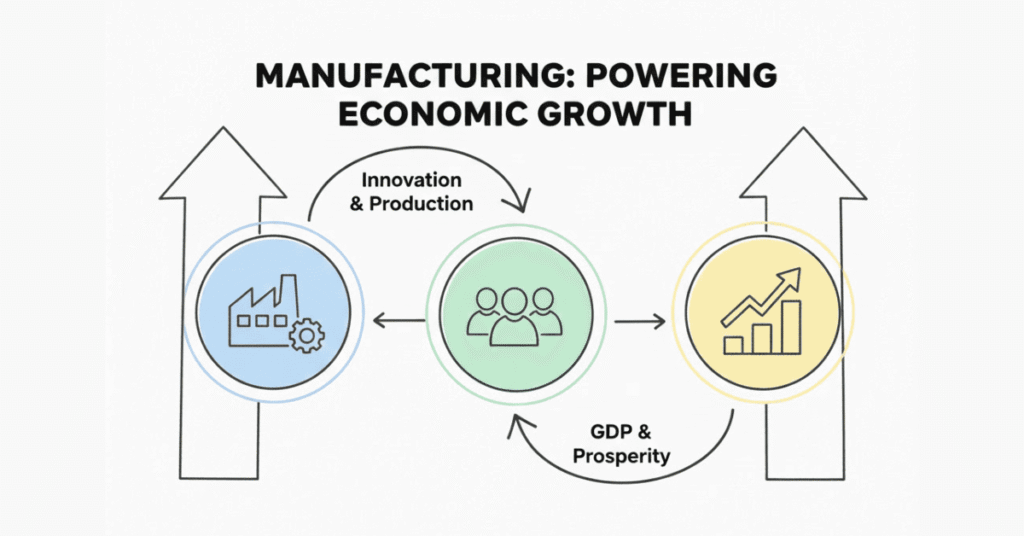
The Government’s Vision: India’s government has set a specific goal—increase manufacturing’s contribution to GDP from the current level to 25% by 2030. This is called “Make in India,” and it’s a top priority. To achieve this, India needs skilled manufacturing professionals at every level.
Telangana’s manufacturing sector has grown at an average rate of 8.4% annually (2014-15 to 2019-20), higher than India’s national average of 6.5%. This data shows your state isn’t just growing; it’s outpacing the nation. Even more recent data from September 2025 shows manufacturing output expanding at 4.8%, maintaining momentum.
Why This Matters for You:
When a government prioritizes an industry, it supports it through:
- Tax incentives for companies investing in manufacturing
- Government contracts for manufactured goods
- Investments in infrastructure and training
- Policy support and regulatory ease
- International trade agreements favoring manufacturing sectors
This government backing creates a stable, growth-oriented environment. Manufacturing isn’t a shrinking sector you’re backing the wrong horse on. It’s a sector the nation is betting on.
Job Security: Why Manufacturing Differs from Other Industries
Specialization 1: Robotic Arm Technician
Comparison with Other Growing Sectors:

Comparison with Other Growing Sectors:Notice the pattern? Manufacturing has built-in stability because factories must be physically located, require permanent infrastructure, and employ diverse skill levels. You can’t outsource a factory to another country as easily as you can outsource software codin
The Numbers: Manufacturing Growth in India
Let’s look at concrete data to understand the scale of opportunity:
Current Growth Rate (2025):
The manufacturing sector is expected to create 500,000 new job openings across leading sectors, with a 15% increase in opportunities within the sector itself.
Sector Performance:
Industrial production grew by 3% in the first half of FY2026 (April-September 2025). Manufacturing specifically expanded by 4.8% in September 2025, demonstrating consistent expansion.
Technology Spending:
Digital technologies will account for 40% of all manufacturing technology spending by 2025, up from 20% in 2021. This creates new, higher-paying roles in automation, data analysis, and system management.
Capital Goods Segment:
Capital goods—machinery and equipment manufacturing—grew 4.7% in September 2025, indicating businesses are investing in production capacity expansion. More factories being built = more jobs.
What This Means:
The sector isn’t just growing—it’s diversifying. Traditional manufacturing roles remain stable while new technology-focused roles are exploding. A fresher entering manufacturing today has options: traditional production engineering OR modern automation engineering OR data-driven quality management. Pick your path based on interest, not necessity.
Regional Opportunity: Telangana & Andhra Pradesh—Manufacturing Hubs of India
Here’s insider knowledge most freshers don’t have: You’re lucky to be in Telangana.
Your state isn’t just a manufacturing destination; it’s becoming a preferred global manufacturing location. Telangana’s GSDP (Gross State Domestic Product) growth has averaged 8.7% annually, higher than India’s national average of 6.8%.
Within Telangana, the manufacturing sector has expanded at 8.4% annually—that’s nearly 30% above the national manufacturing growth rate.
What Companies Are Building Here:
- Automotive & Components: Hyderabad hosts manufacturing facilities for cars, two-wheelers, and auto components for global brands
- Pharmaceuticals: Telangana is a pharma hub, with manufacturing facilities for medicines and pharmaceutical compounds
- Electronics & Semiconductors: Companies are investing in semiconductor fabrication and electronics assembly
- Engineering Components: Precision manufacturing for industrial equipment
- Food Processing: Value-added food manufacturing
Major companies establishing or expanding in Telangana include L&T, Bosch, Mahindra, TCS Manufacturing, and numerous smaller precision manufacturers.
Career Implication:
You don’t need to leave your state to find excellent manufacturing opportunities. Local job markets in Hyderabad, Warangal, and other industrial areas offer competitive salaries, shorter commute times, and growing opportunities.
Job Security During Economic Downturns
One of manufacturing’s greatest strengths: it’s recession-resistant.
During economic recessions, what happens?
- IT companies freeze hiring; manufacturing continues recruiting
- Financial services companies reduce staff; manufacturing maintains production
- Retail sectors contract; manufacturing supports essential supply chains
- Real estate stalls; manufacturing facilities are built
Why? Because manufacturing produces the essentials. During COVID-19, while many sectors shut down, pharmaceutical manufacturing and food processing actually increased production. This shows the fundamental stability.
Historical Pattern:
Every recession in the past 20 years, manufacturing recovered faster than other sectors. The 2008 financial crisis, the 2020 pandemic—manufacturing has proven resilient.
Career Growth Stability & Advancement Opportunity
Manufacturing offers something rare: clear career progression with stability at each level.
Unlike some industries where advancement is uncertain, manufacturing has defined steps:
- Entry: Assembly Operator, QC Trainee, Production Trainee
- Mid: Production Engineer, Quality Executive, Supervisor
- Senior: Manager, Director, Plant Head
Each step pays more, requires more skills, but offers reasonable advancement timelines. You know where you’re going. You can plan your career with confidence.
The Bottom Line: Why Manufacturing is Your Safe Career Bet

Manufacturing offers what every fresher seeks:
- Job Security: Fundamental to human needs, government-backed growth
- Stable Advancement: Clear pathways with measurable milestones
- Geographic Advantage: Hubs in your state (Telangana) with expanding opportunities
- Recession Resistance: Stable during economic downturns
- Growth Potential: Expected 500,000 new jobs in coming years
The Reality: While IT might pay more initially and finance might seem glamorous, manufacturing offers something more valuable—stability combined with growth. You can build a genuine, long-term career here with less uncertainty.
Choose manufacturing not as a fallback, but as a deliberate strategy. You’re backing a sector that’s essential, growing, and here to stay.