
Understanding JAM (Just A Minute)
Table of Contents

Blog Content:
Introduction: Your One-Minute Window of Opportunity
Imagine stepping into an interview room, and the interviewer says: “You have exactly one minute to speak about entrepreneurship. Go!” Your mind freezes. Your palms sweat. You either ramble nervously or go completely blank.
This scenario happens to thousands of students every year during campus placements. It’s called JAM—and it’s becoming one of the most critical selection tools for companies.
But here’s the good news: JAM is not about being naturally eloquent or having extraordinary knowledge. It’s a learnable skill that you can master with proper understanding and practice.
What Exactly is JAM?
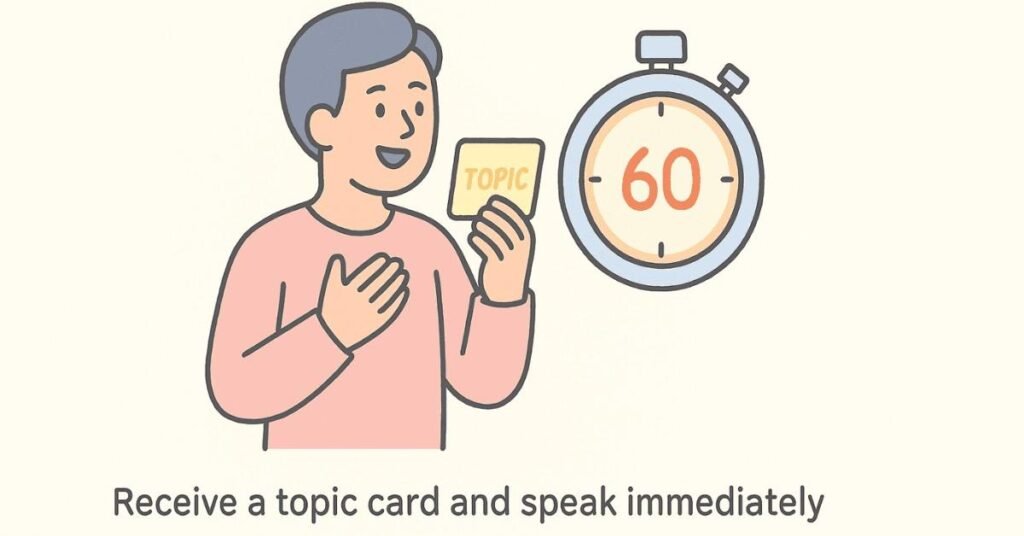
JAM stands for Just A Minute—a public speaking exercise where you’re given a topic (usually something you’ve never heard of before) and asked to speak continuously for 60 seconds without stopping, repeating yourself, or straying from the topic.
Think of it as thinking on your feet while the clock ticks. You can’t prepare in advance. You can’t look at your notes. You simply receive a topic and start speaking immediately.
Common JAM topics in campus placements include:
- Abstract concepts (e.g., “Happiness,” “Success,” “Change”)
- Current affairs (e.g., “Climate change,” “Social media impact”)
- Everyday situations (e.g., “Why people procrastinate,” “Benefits of reading”)
- Industry-related topics (e.g., “Digital transformation,” “AI ethics”)

🔍 Explore structured learning resources to strengthen communication clarity →
Why Do Companies Love JAM Rounds?
You might wonder: “Why don’t they just ask regular interview questions?”
The reason is simple—JAM reveals who you really are.
During a prepared interview answer, you can rehearse, memorize, and deliver perfectly scripted responses. But in JAM, there’s nowhere to hide. Companies use JAM to assess:
- Your Thinking Speed
Can you process a new topic within seconds and create a logical flow? This shows your mental agility and real-time problem-solving ability. - Your Communication Clarity
Do you speak clearly, use proper grammar, and explain your thoughts effectively? Companies want employees who can communicate without confusing colleagues or clients. - Your Confidence Level
Can you speak publicly without excessive hesitation or nervousness? Confidence matters in presentations, client meetings, and team interactions. - Your Knowledge Depth
Do you have general awareness about current affairs, your field, and the world around you? This shows curiosity and engagement. - Your Composure Under Pressure
When faced with an unknown topic, do you panic or do you handle it calmly? This trait is valuable in unexpected work situations. - Your Creativity and Originality
Can you offer fresh perspectives rather than textbook answers? This demonstrates critical thinking.
📘 Discover more preparation content designed to enhance performance across multiple areas →
How JAM is Different from Other Selection Methods
Let’s clarify how JAM stands apart:

JAM is specifically designed to catch you off-guard—and that’s exactly why it’s so revealing of your true capabilities.
Understanding JAM Formats in Campus Placements
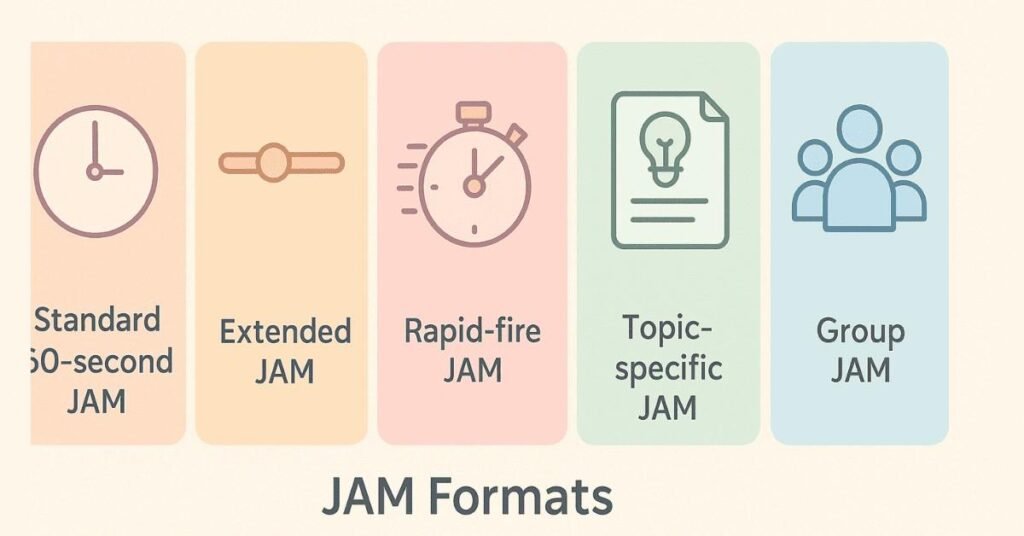
Different companies conduct JAM rounds differently. Let’s understand the variations you might encounter:
Standard JAM (1-Minute Format)
You receive a topic, get 10-15 seconds to think (if lucky), and then speak for exactly 60 seconds. The moment the timer hits 60 seconds, you must stop.
Extended JAM (2-3 Minute Format)
Some companies give you longer duration. This is slightly less common but appears in some organizations. More time means higher expectations for depth.
Rapid-Fire JAM
You get 3-5 topics back-to-back in quick succession. This tests your stamina and consistency.
Topic-Specific JAM
The company gives you topics related to their industry or your role. For example, an IT company might ask about emerging technologies.
Group JAM
You speak alongside other candidates. While not exactly “group discussion,” it combines elements of JAM with observation of how you listen to others.
The Four Rules of JAM: The Three Ds and One I
Here’s what evaluators specifically watch for:
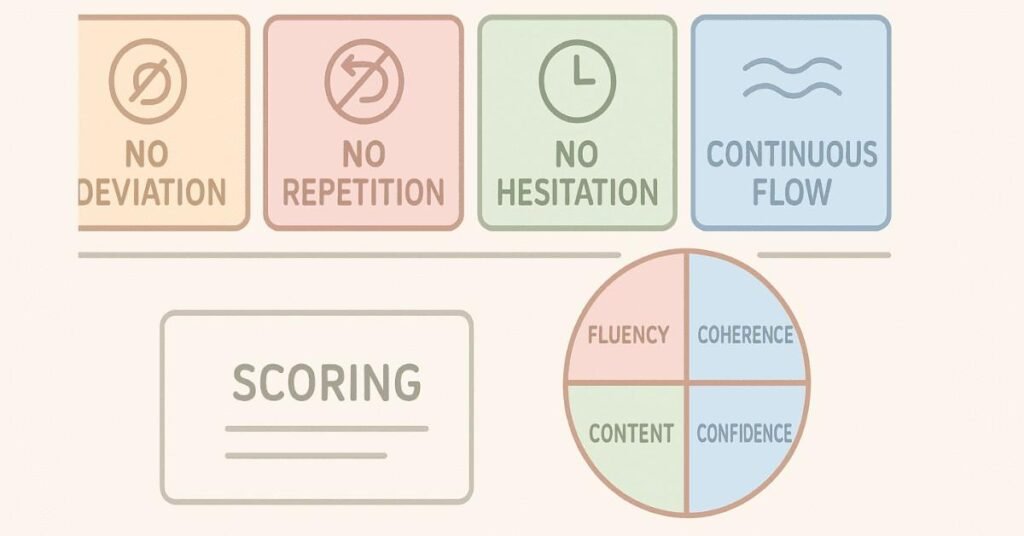
- No Deviation
Your speech should stay relevant to the topic throughout. If you’re speaking about “Online education,” don’t suddenly jump to “Benefits of travelling.” Every sentence should connect to the main topic. - No Deviation (Repetition)
Don’t repeat the same points or words. If you say “Digital learning is important” in your first sentence, avoid saying similar variations repeatedly. Use synonyms and introduce new ideas instead. - No Deviation (Hesitation)
Minimize pauses, fillers (like “uh,” “um,” “you know”), and long silences. These break your flow and make you seem unprepared or nervous. - Continuity (No Stopping)
Keep speaking for the full 60 seconds without stopping. Brief pauses are acceptable, but long silences suggest you’ve run out of ideas—which is a red flag for evaluators.
How JAM is Evaluated: The Scoring System
Different organizations use different rubrics, but most evaluate JAM on these dimensions:
Fluency (40% weight typically)
- Do you speak smoothly without constant pauses?
- Is your speech natural and conversational?
- Can you maintain a steady pace?
Coherence (30% weight typically)
- Is your speech logical and easy to follow?
- Do your ideas connect well?
- Is there a clear beginning, middle, and end?
Content Knowledge (20% weight typically)
- Is your information accurate?
- Do you provide relevant examples?
- Do you show understanding of the topic?
Confidence (10% weight typically)
- Do you maintain steady eye contact with the evaluator?
- Is your body language open and relaxed?
- Does your voice sound assured?
Note: Different companies adjust these weights. Some prioritize fluency more heavily, while others focus on content.
📂 Access complete learning materials focused on improving fluency, reasoning, and delivery →
Why Understanding JAM Matters for Your Placement
Here’s the reality: JAM often determines whether you proceed to the next round or get eliminated. Some companies have a 70-80% elimination rate at the JAM stage alone.
But understanding JAM fundamentally—what it tests, why companies use it, and how it’s evaluated—gives you a psychological edge. You stop seeing it as a random speaking test and start seeing it as a measurable skill you can develop systematically.
Key Takeaways for You
- JAM assesses your real-time thinking, communication clarity, and composure
- It’s different from interviews and group discussions because of zero preparation time
- Four key rules: No deviation, no repetition, no hesitation, continuous flow
- It’s evaluated on fluency, coherence, content, and confidence
- Understanding JAM is your first step toward mastering it