
The 60-Second Hack to Ace "Tell Me About Yourself" and Clear the HR Round
Table of Contents
Introduction
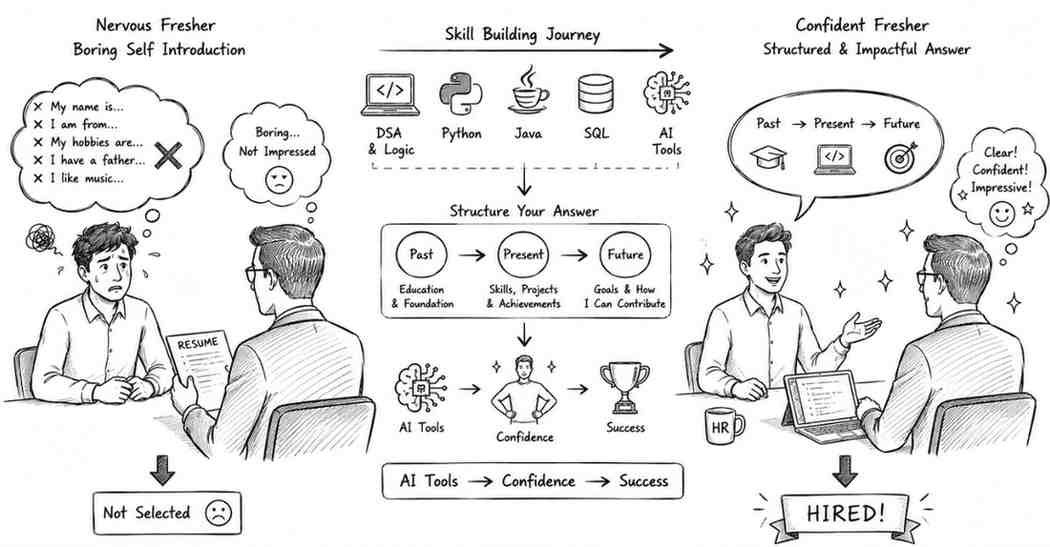
You made it. You survived the resume screening. You cleared the aptitude test. You even battled through the technical coding round and proved your skills.
Now, you are sitting in the final HR round. The HR Manager looks at you, smiles, and asks the most common, predictable, and seemingly innocent question in the history of corporate interviews:
“So, tell me a little bit about yourself.”
And suddenly, a highly capable software developer, data analyst, or cloud engineer completely falls apart.
What do 99% of freshers say in this exact moment?
“My name is [Name]. I am from [Hometown]. I did my B.Tech from XYZ College with an 8.0 CGPA. I have a father, a mother, and a younger brother. My hobbies are listening to music, watching movies, and playing cricket. I am a hardworking and passionate student.”
If this is your answer, I need you to listen to me very carefully: You have just lost the job offer in the first 60 seconds.
The HR round is not a formality; it is the ultimate culture fit test. When you answer the very first question by reading out your family tree and your weekend hobbies, you immediately position yourself as an immature college student, not a corporate professional.
In this comprehensive guide, I am going to show you exactly how HR managers think, why they ask this question, and the psychological Past-Present-Future Framework you must use to answer it. I will also give you word-for-word scripts whether you are an IT fresher, a Non-IT professional switching to IT, or a student with a career gap.
Let’s hack the HR round.
Chapter 1: The Psychology Behind the Question
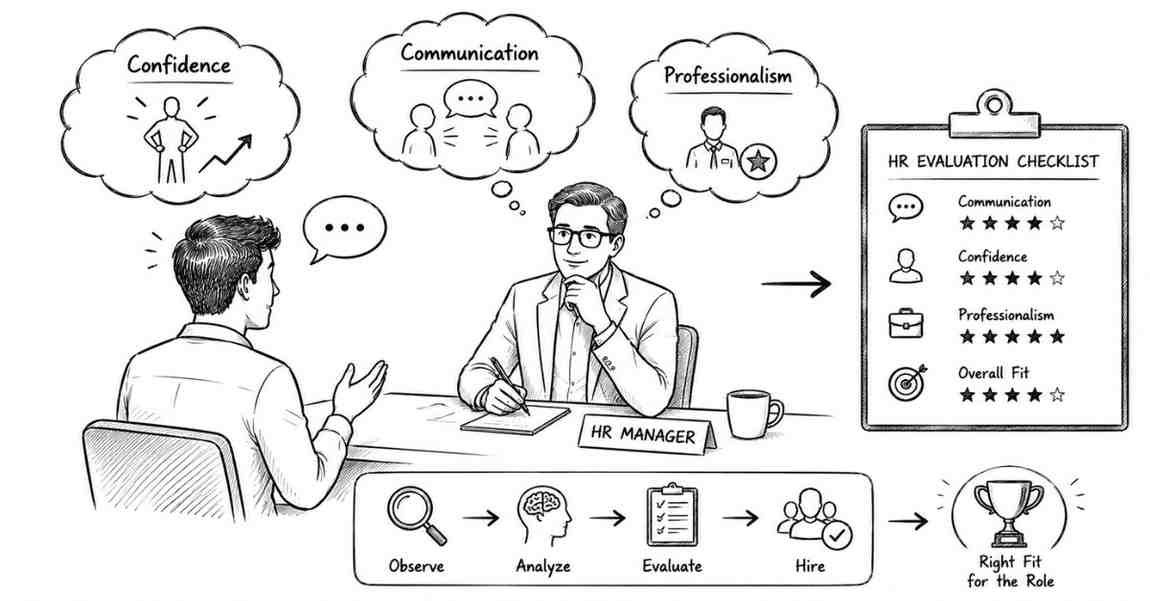
To answer the question correctly, you must first understand why it is being asked.
When an HR manager says, “Tell me about yourself,” they are not asking for your autobiography. They already have your resume sitting right in front of them. They know your name, they know your college, and they know your city. Repeating what is already printed on the paper is a massive waste of their time.
So, what are they actually testing?
- Confidence and Communication: Can you articulate your thoughts clearly under pressure? If they put you in front of a client tomorrow, will you embarrass the company, or will you speak like a professional?
- Self-Awareness: Do you know what your core strengths are? Can you summarize your professional identity?
- The “Elevator Pitch”: Can you sell yourself in 60 seconds?
The HR manager is using this question to set the tone for the rest of the interview. If your introduction is weak, boring, and robotic, the interviewer subconsciously zones out. But if your introduction is sharp, value-driven, and confident, the interviewer leans in. They start treating you as a future colleague rather than a desperate applicant.
Chapter 2: The Three Fatal Mistakes (Never Do This)
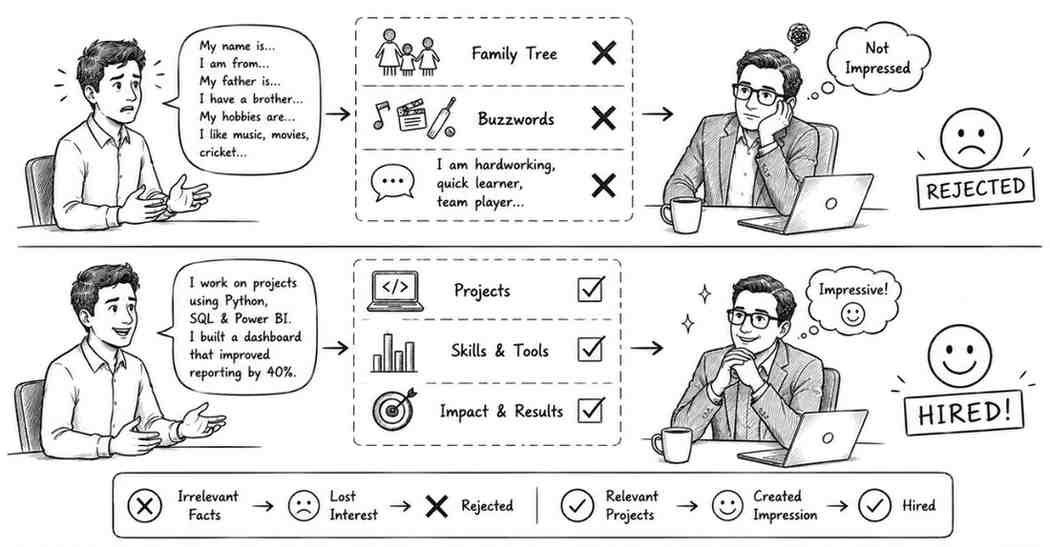
Before I give you the winning formula, we need to eliminate the toxic habits that colleges accidentally teach students. Never include these three things in your introduction:
1. The Family Tree
Unless you are applying for a job at a family counseling center, the HR does not care what your father does for a living or how many siblings you have. It is completely irrelevant to your ability to write code or analyze data. Do not mention your family in a professional introduction.
2. The Hobby Dump
“My hobbies are browsing the internet and listening to music.” This adds zero value to your profile. Every human being on earth listens to music. If your hobby is directly related to the job (e.g., “I spend my weekends competing in open-source hackathons” or “I write a tech blog on Medium”), then mention it. Otherwise, keep your hobbies to yourself until asked.
3. The “Buzzword” Salad
Do not say, “I am a dedicated, hardworking, punctual, quick-learning team player.” These are empty buzzwords. Anyone can claim to be hardworking. In the corporate world, you do not tell people you are hardworking; you prove it by talking about the complex projects you have successfully built.
Chapter 3: The "Past-Present-Future" Framework
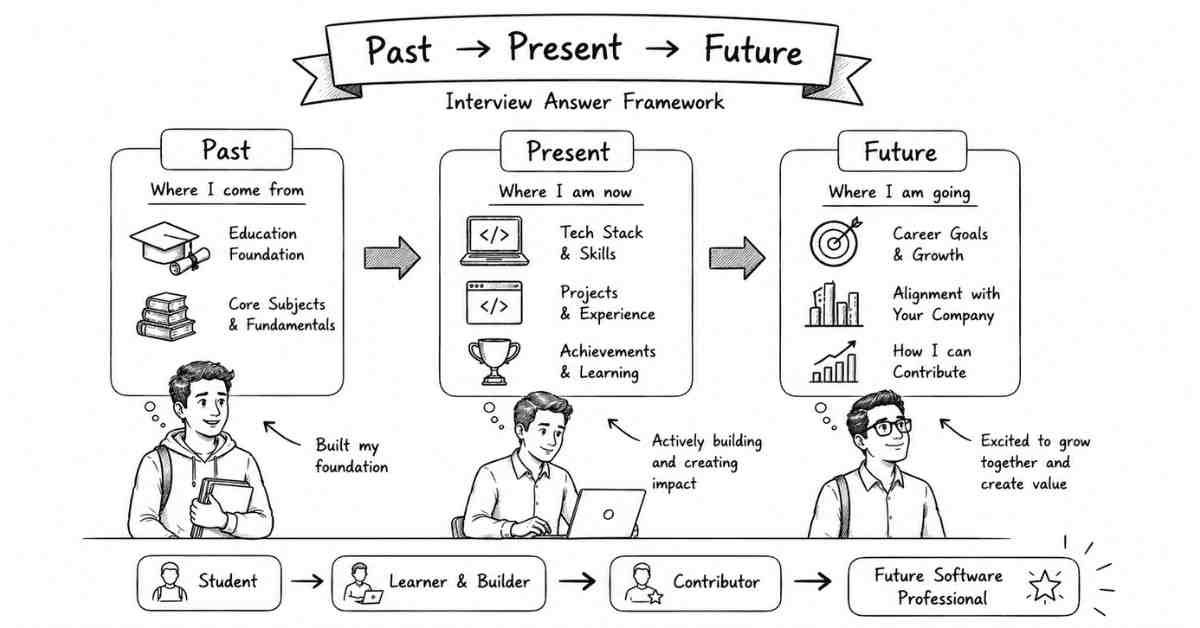
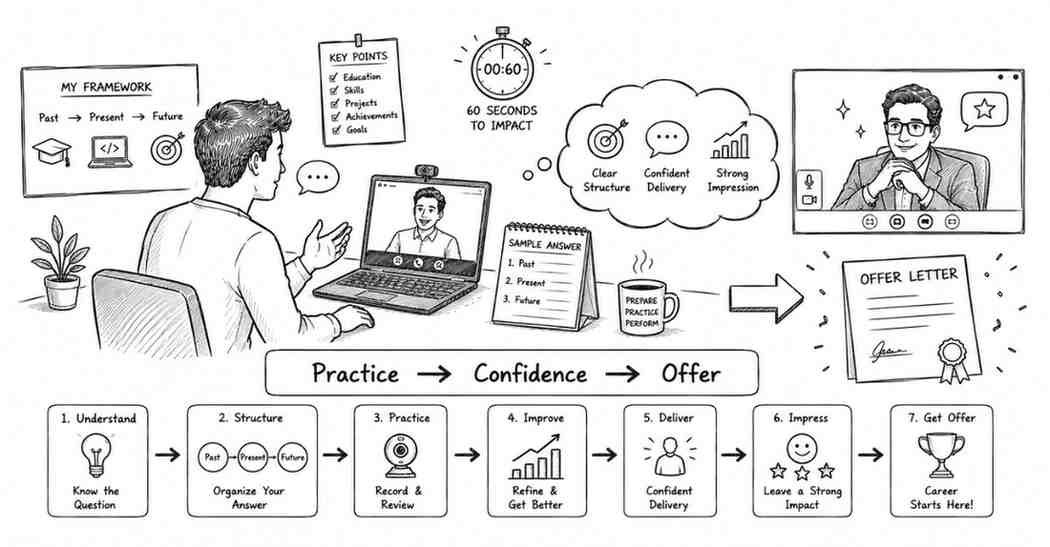
The perfect answer to “Tell me about yourself” is a 60-second professional story. It should sound like a movie trailer for your career. To build this trailer, we use the Past-Present-Future (PPF) Framework.
This structure organizes your thoughts, prevents you from rambling, and hits every psychological trigger the HR is looking for.
Phase 1: The PAST (15 Seconds)
What to say: Briefly mention your educational foundation and the root of your technical skills.
The Goal: Establish your baseline qualifications without reading your entire marks memo.
- Example: “I recently graduated with a degree in Computer Science, where I built a strong foundation in Object-Oriented Programming and database management.”
Phase 2: The PRESENT (30 Seconds)
What to say: This is the most important part. What are you doing right now? Talk about your current tech stack, your active projects, and your “Proof of Work” (which we discussed in Episode 4).
The Goal: Prove that you are a builder, not just a theoretical student. Show them you have hands-on skills.
- Example: “Currently, I am specializing in the MERN stack. I recently engineered a fully functional E-commerce web application with secure payment integration, which is live on my GitHub. I’ve been heavily focused on writing clean, scalable code and optimizing frontend performance.”
Phase 3: The FUTURE (15 Seconds)
What to say: Why are you sitting in this chair, talking to this specific company? How do your skills align with the role they are offering?
The Goal: Show that you did your research and that you are culturally aligned with their team.
- Example: “I am now looking to bring my hands-on frontend skills to a dynamic team. I have been following [Company Name]’s recent shift toward building AI-driven user interfaces, and I am highly eager to contribute to and grow within that environment.”
When you combine these three phases, you get a flawless, 60-second professional pitch.
Chapter 4: The 60-Second Master Scripts (Copy & Paste)
Every candidate’s background is different. The script that works for a B.Tech IT fresher will not work for someone switching from a BPO job to the IT sector.
Here are three highly customized, word-for-word scripts based on your specific situation. Read them, adapt them to your skills, and practice them in front of a mirror.
Script 1: The Standard Tech Fresher (B.Tech/BSc)
(Use this if you are a recent graduate looking for a developer, data, or cloud role).
“Sure, I’d love to.
[PAST] I recently graduated with a degree in [Your Degree], where I developed a very strong foundation in [Mention 2 core subjects, e.g., Data Structures and Web Technologies]. During my academics, I realized my true passion lies in building things from scratch, which led me to dive deep into [Your Domain, e.g., Full Stack Development].
[PRESENT] Currently, I spend my time building highly responsive applications using [Your Tech Stack, e.g., React.js, Node.js, and MongoDB]. To move beyond theory, I recently built and deployed a [Mention your best project, e.g., a real-time Chat Application], where I tackled complex challenges like state management and API integration.
[FUTURE] I am now looking to transition my hands-on project experience into a full-time role. I applied to [Company Name] because I deeply admire your team’s work in [Mention a company product or industry, e.g., scalable cloud solutions], and I am excited about the opportunity to bring my coding skills to your fast-paced environment.”
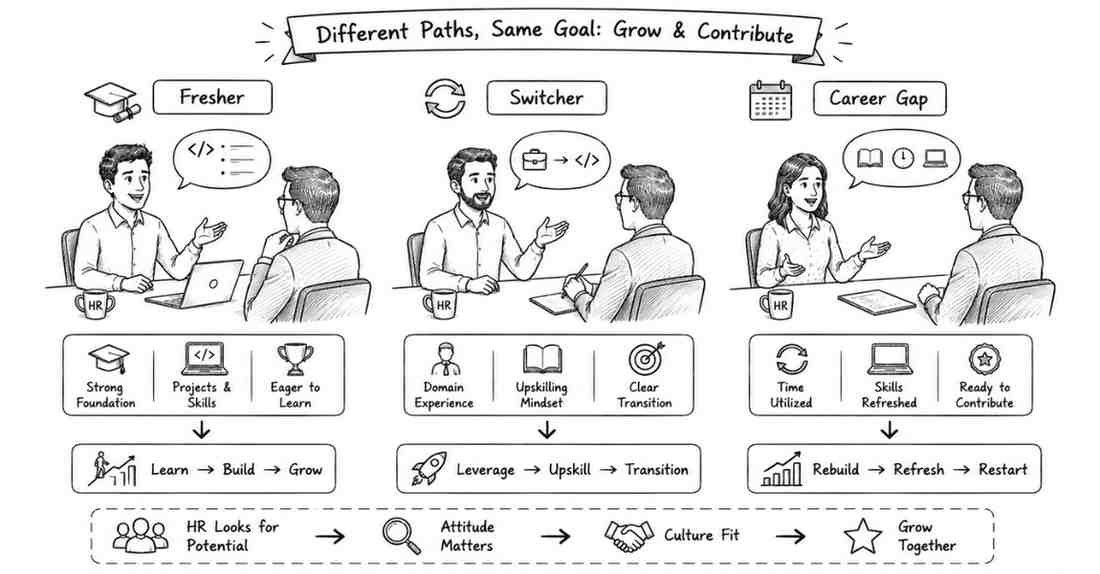
Script 2: The Non-IT to IT Switcher
(Use this if you have experience in Sales, HR, BPO, or Admin, and have recently upskilled to enter IT roles like Data Analytics, Business Analysis, or Workday).
“Absolutely.
[PAST] My background is actually quite unique. I spent the last [Number] years working in [Your Non-IT field, e.g., Operations/Customer Success]. During that time, I developed exceptionally strong skills in client communication, problem-solving, and managing high-pressure targets.
[PRESENT] However, I realized that the core of solving business problems lies in technology. So, I proactively upskilled myself in [Your New IT Skill, e.g., Data Analytics]. Over the last 6 months, I have mastered [List Tools, e.g., Python, SQL, and PowerBI]. I recently combined my past domain knowledge with my new tech skills to build a [Mention Project, e.g., a live Sales Forecasting Dashboard] using real-world datasets.
[FUTURE] I am now looking to pivot entirely into the tech space. Because I understand both the business-client side and the technical-data side, I believe I can bring immediate value to the [Role Name, e.g., Data Analyst] position here at [Company Name].”
(Why this works: It turns your “Non-IT” background into a superpower by calling it “Business/Client Domain Knowledge” and bridges it perfectly with your new IT skills).
Script 3: The Career Gap Candidate
(Use this if you have a 1, 2, or 3-year gap due to UPSC preparation, health, or personal reasons. Do not hide the gap; own it confidently).
“I’d be happy to.
[PAST] I graduated in [Year] with a degree in [Your Degree]. Following my graduation, I took some intentional time to [Mention the gap briefly but confidently, e.g., prepare for civil services / manage a family medical situation]. This period taught me immense discipline, analytical thinking, and resilience.
[PRESENT] While navigating that, I realized my long-term career ambition was firmly in the tech industry. I recently completed an intensive, project-based certification in [Your Tech Domain, e.g., Cloud Computing with AWS]. I have spent the last few months aggressively building my portfolio, including [Mention your best project, e.g., migrating a 3-tier web architecture to the cloud and automating it using Terraform].
[FUTURE] I am now fully ready to re-enter the corporate workforce. I am looking for a company that values hands-on skill and a growth mindset. I am highly drawn to [Company Name] because of your innovative work in [Mention their industry], and I am ready to hit the ground running on day one.”
(Why this works: You address the elephant in the room immediately, frame the gap as a period of building discipline, and quickly pivot the conversation to the complex tech projects you are building right now).
Chapter 5: Delivery, Tone, and Body Language
You can have the greatest script in the world, but if you deliver it like a robot reading from a teleprompter, you will fail.
How you say it is just as important as what you say. Here are the golden rules for delivering your 60-second pitch:
1. The “Virtual” Eye Contact Rule
In 2026, 80% of HR rounds happen over Zoom, Microsoft Teams, or Google Meet. When you are speaking, do not look at the HR manager’s face on your screen. If you look at the screen, it appears to the interviewer that you are looking down. You must look directly into the webcam lens. Looking into the lens simulates perfect, confident eye contact.
2. The Power of the Pause
When you finish your pitch, stop talking.
Many candidates get nervous when there is silence, so they start rambling: “Uh… yeah, so that’s me… and um, I also like playing chess… yeah.” Finish your “Future” statement with a confident smile, look at the camera, and stay silent. Let the HR absorb your powerful introduction.
3. Do Not Memorize Word-for-Word
If you try to memorize the script exactly, you will panic if you forget one word. Instead, memorize the structure (Past, Present, Future) and the key bullet points. Speak conversationally, like you are explaining your career to a respected senior.
4. Audio Quality Matters
If you sound like you are underwater, your confidence won’t translate. Invest in a decent pair of earphones with a good microphone. Ensure you are in a quiet room with a clean, neutral background.
Conclusion: Your Action Plan for Today
The “Tell me about yourself” question is not a trap; it is the greatest gift an interviewer can give you. It is a blank canvas. It is your opportunity to take control of the interview and tell the HR manager exactly what you want them to know about you.
Let’s review your action plan to hack the HR round:
- Ditch the Bio-Dump: Stop talking about your family, your hometown, and your generic hobbies.
- Adopt the PPF Framework: Restructure your introduction into Past (Foundation), Present (Projects/Skills), and Future (Company Alignment).
- Pick Your Script: Choose the template above that matches your reality (Fresher, Switcher, or Career Gap).
- Customize and Practice: Fill in your specific tech stack and project names. Stand in front of a mirror or record yourself on your phone camera. Do it 10 times until it flows naturally.
When you deliver a crisp, 60-second, project-driven introduction, the HR manager will physically sit up straighter. You are no longer just another resume in the pile; you are a professional ready to be hired.
What’s Next in the “Job Ready 2026” Series?
You nailed the introduction. The HR is impressed. But then, they look at your resume, point to the “Spotify Clone” or the “Sales Dashboard” you built, and ask:
“This project looks interesting. Can you walk me through how you built it and what challenges you faced?”
If you start listing the tools you used without explaining the business logic, you will lose them. You need to know how to tell a technical story.
In Episode 11: Explaining Projects using the STAR Method, I am going to teach you the elite framework used by candidates at Google and Amazon. I will show you exactly how to explain any project—whether it’s UI/UX, Full Stack, or Data Analytics—so that the interviewer is completely blown away by your problem-solving skills.
👉 Action Item for Today: Open a Word document right now. Type out your Past-Present-Future script. Practice reading it out loud with a timer. Keep it under 60 seconds.
If you are struggling to fill the “Present” part of your script because you do not have any impressive projects, it is time to upskill. At Frontlines Edutech, we specialize in project-based training. We don’t just teach you the syntax; we help you build the robust, real-world portfolio projects that make answering HR questions incredibly easy. See you in the next post!