
Telecommunications Analyst in India : Career & Salary Guide
Table of Contents
Telecommunications Analyst : What They Do, Salary & Career Growth

Most telecom career guides focus entirely on engineers network engineers, RF engineers, deployment engineers. But there is a whole category of telecom professionals who are not engineers, do not configure routers, and still build strong, well-paying careers in the sector.
Telecommunications analysts are that category.
If you come from a commerce, statistics, BCA, B.Sc. IT, or MBA background or if you are an engineer who prefers working with data over working with hardware the telecom analyst path is worth understanding properly. This post covers what the role involves, how it differs from similar-sounding titles, what tools you need, and what you can realistically earn.
What a Telecommunications Analyst Does In Plain Language
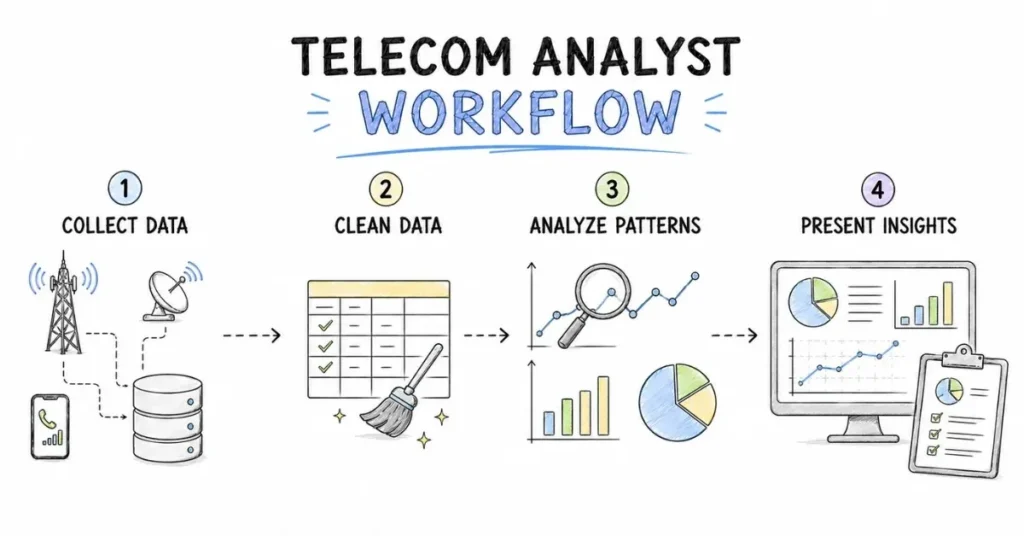
The simplest way to describe it: a telecom analyst uses data to help a telecom company make better decisions.
Those decisions could be about network performance (“why is this region showing higher call drop rates this week?”), customer behaviour (“which customer segments are most likely to switch to a competitor?”), revenue (“are we billing correctly for all the services we provisioned?”), or operations (“where is the biggest inefficiency in our support workflow?”).
The analyst sits between the raw data and the people who need to act on it. They collect data from multiple systems, clean and organize it, analyse it for patterns, and present findings in a format that non-technical stakeholders can understand.
In a large telecom company like Jio or Airtel, analysts work across multiple departments:
- Network Performance — analysing KPIs (Key Performance Indicators) like call success rate, data throughput, latency, and uptime
- Customer Experience (CX) — tracking how customers interact with the service, where they complain, and what drives churn (customers leaving)
- Revenue Assurance — making sure that every service delivered is being billed, and that no revenue is leaking through system gaps
- Business Intelligence (BI) — building dashboards and reports for senior management
- OSS/BSS Operations — supporting the software systems that run the network and the billing
The Difference Between a Telecom Analyst and a Network Analyst
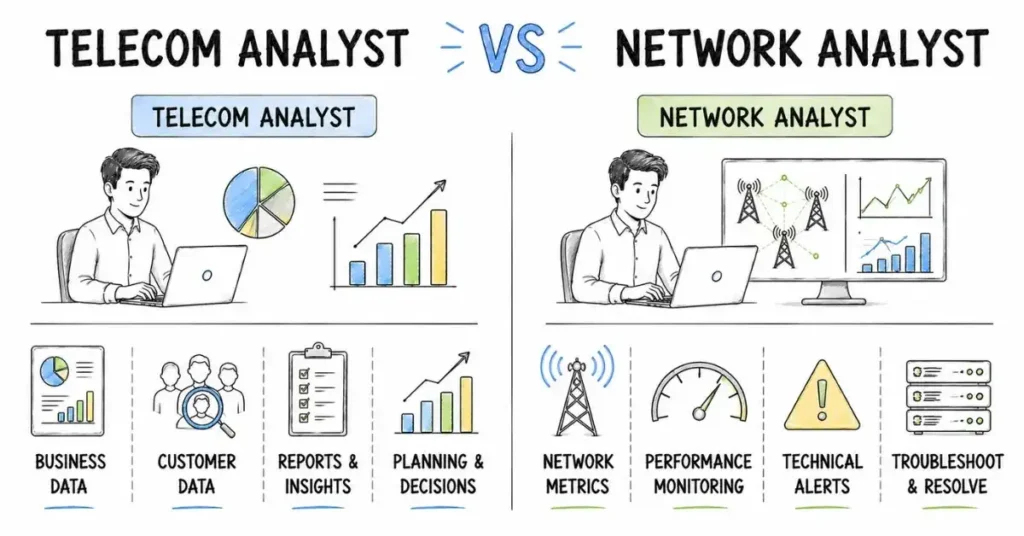
These two titles are used interchangeably sometimes, but they are different in practice.
A network analyst is closer to the engineering side. They analyse network performance data specifically — traffic patterns, link utilisation, fault trends — and their recommendations are mostly technical (“this sector needs capacity expansion,” “this node has recurring hardware faults”).
A telecommunications analyst is broader. They work across network data, business data, and customer data. Their recommendations span technical and commercial decisions.
In practice, the distinction matters when you read job descriptions. A network analyst role at a vendor like Ericsson or Nokia will expect you to understand network KPIs and protocols. A telecom analyst role at an operator’s business intelligence or customer experience team requires stronger data skills and less networking depth.
Both are valid career paths. Which one fits you depends on whether your strength is closer to the technical or the analytical side.
The Systems a Telecom Analyst Works With
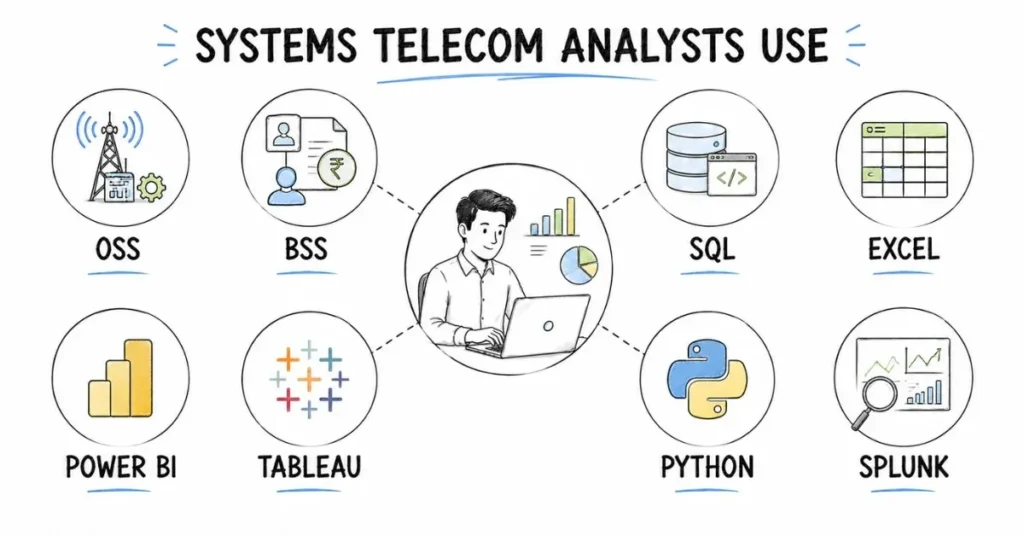
This section is important because knowing these systems makes you immediately more hireable — they appear directly in job descriptions.
OSS — Operations Support Systems
OSS is the software that manages the technical side of a telecom network. It handles network inventory (what equipment is where), fault management (tracking alarms and outages), performance management (monitoring KPIs), and configuration management (keeping records of how everything is configured).
Common OSS platforms in India:
- Ericsson ENM (Ericsson Network Manager)
- Nokia NetAct
- Huawei U2000/MAE
- IBM Tivoli NetCool (used by many operators for unified fault management)
An OSS analyst supports these systems, generates performance reports from them, and helps operations teams use the data effectively.
BSS — Business Support Systems
BSS handles the commercial side: subscriber management, billing, customer orders, product catalogues, and revenue management. If OSS is the engine room, BSS is the front office.
Common BSS platforms:
- Amdocs (used by Airtel and many global operators)
- Oracle Communications Billing and Revenue Management (BRM)
- Comverse BSCS
- SAP for Utilities/Telecom
BSS analyst roles require understanding how telecom billing works — rating (how much to charge for a call or data session), mediation (collecting raw usage data from the network), and invoicing.
BI and Analytics Tools
Beyond OSS and BSS, telecom analysts work with general data and BI tools:
A Day in the Life — What This Actually Looks Like
To make this concrete, here is what a mid-level telecom analyst at an Indian operator might do on a typical day:
Morning: Pull the daily network performance report from the OSS. Flag any KPIs that fell below threshold overnight — perhaps three cells in a specific area showed high packet loss rates. Write a summary and send it to the network operations team with the relevant data extracted.
Late morning: A product manager asks for data on how many postpaid subscribers in Tier-2 cities upgraded their plan in the last quarter. Pull this from the BSS data warehouse using SQL, build a simple breakdown table, and share it.
Afternoon: Work on a monthly churn analysis — identifying customers who downgraded or left in the past 30 days, grouping them by segment, and trying to find patterns that explain why. Use Python or Excel to merge data from three different sources (billing, CRM, network usage).
Late afternoon: Attend a weekly review meeting with the network team. Present the previous week’s performance trend — which regions improved, which degraded, what the likely causes are. Answer questions and take action items.
This is not glamorous work. It is methodical, detail-oriented, and sometimes repetitive. But it is also genuinely useful — the decisions that come out of this analysis affect millions of subscribers and crores of rupees in revenue.
What Qualifications Do You Actually Need
This is where the telecom analyst path opens up for non-engineers.
Degrees that work:
- B.Tech / B.E. (any stream, but ECE and CS are most directly relevant)
- BCA or B.Sc. (IT / Computer Science)
- B.Com or BBA — works for BSS and revenue assurance roles specifically
- MBA — especially for roles that blend analytics with business decision-making
The skills that matter more than your degree:
- SQL — non-negotiable. If you cannot write SQL queries to extract and manipulate data, you cannot do this job. The good news: SQL is learnable in 4–6 weeks with consistent practice.
- Excel — advanced Excel (pivot tables, VLOOKUP/XLOOKUP, dynamic charts) is used daily
- Understanding of telecom concepts — you do not need to configure a router, but you need to know what a cell site is, what KPIs like RSRP, SINR, and throughput mean, and how billing systems work at a basic level
- Communication — translating data into clear, actionable summaries for non-technical managers is a core part of the job
Realistic Salary Ranges in India
Telecom analyst salaries in India depend heavily on which company you work for and which type of analysis you specialize in.
Role Type | Entry Level (0–2 yrs) | Mid Level (3–6 yrs) | Senior Level (7+ yrs) |
OSS/BSS Support Analyst | ₹2.5L–₹5L | ₹5L–₹10L | ₹10L–₹18L |
Network Performance Analyst | ₹3L–₹6L | ₹6L–₹12L | ₹12L–₹20L |
Revenue Assurance Analyst | ₹3L–₹6L | ₹7L–₹14L | ₹14L–₹22L |
BI / Data Analyst (Telecom) | ₹4L–₹8L | ₹8L–₹16L | ₹16L–₹28L |
Telecom Consultant (IT firms) | ₹5L–₹9L | ₹10L–₹18L | ₹18L–₹35L |
The highest-paying analyst roles in telecom sit at the intersection of data skills and business impact — revenue assurance, customer analytics, and BI consulting. Analysts who can directly connect their work to revenue outcomes earn significantly more than those in pure reporting roles.
Career Growth Path From Analyst to Senior Roles

Telecom analytics is not a dead end. Here is how the progression typically works:
Years 0–2: Analyst / Junior Analyst
Learning the systems, writing standard reports, building SQL skills, understanding telecom KPIs and business metrics.
Years 2–5: Senior Analyst / Specialist
Owning specific analytical domains (churn, revenue assurance, network performance). Building dashboards. Starting to drive recommendations, not just reports.
Years 5–8: Lead Analyst / Analytics Manager
Managing a small team. Owning the analytics roadmap for a business function. Presenting to senior leadership. At this level, strong performers at operators like Jio or Airtel earn ₹15–22 lakh.
Years 8+: Head of Analytics / Director
Running the analytics function for a department or business unit. Some professionals at this level move into product management or strategy roles — using their data background to drive business decisions rather than just support them.
There is also a consulting path. Analysts who develop deep expertise in Amdocs, Oracle BRM, or Ericsson OSS platforms become highly sought-after consultants — both at IT services companies and independently. Senior BSS/OSS consultants with 8–10 years of experience command ₹20–40 lakh at companies like TCS, Wipro, and Accenture’s telecom practice.
One Skill That Changes Your Career Trajectory Faster Than Anything Else
If you are an analyst in telecom and you want to grow faster, learn to tell a story with data — not just present it.
There is a meaningful difference between an analyst who sends a table of numbers and one who sends a three-paragraph summary that says: “Call drop rates in Hyderabad South rose 12% last week. The pattern matches the three cells upgraded on Tuesday — likely a parameter misconfiguration. If unaddressed, we estimate 4,200 subscribers in that area are experiencing degraded service. Recommend rolling back the Tuesday change and re-testing.”
That second analyst gets called into more meetings, trusted with more decisions, and promoted faster. The data is the same. The ability to interpret it and frame it for action is the differentiator.
You build this skill by practising it — every time you produce a report, ask yourself: “What does this data actually mean? What should someone do differently because of it?” Write that down, even if no one asked you to. Over time, that habit becomes your professional identity.
Where to Find Telecom Analyst Jobs in India
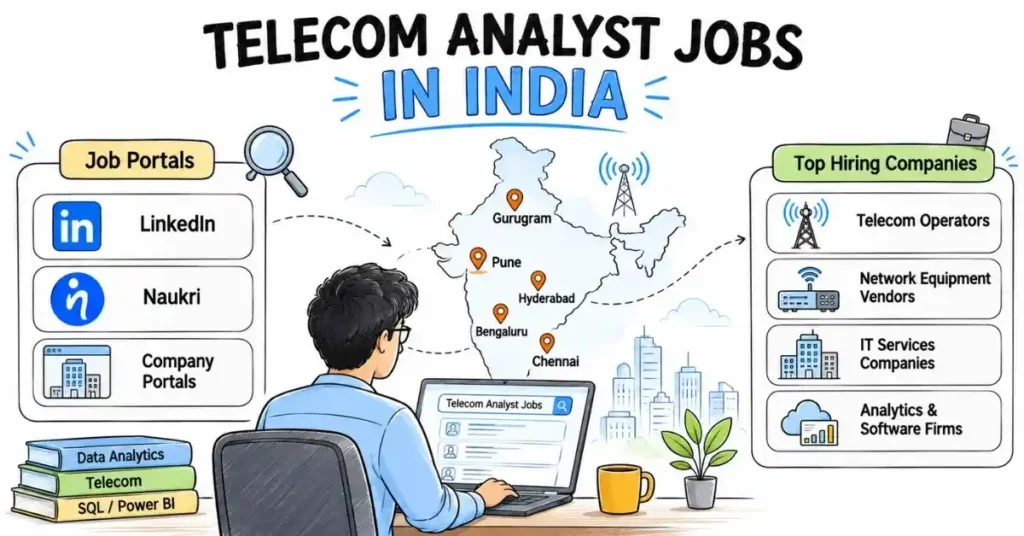
- Naukri.com — search “telecom analyst,” “OSS analyst,” “BSS analyst,” “network performance analyst”
- LinkedIn — follow Jio, Airtel, TCS iON, Tech Mahindra, Amdocs India, Comviva (a Tech Mahindra company)
- Company career portals — Amdocs India hires BSS/OSS analysts regularly and is a strong brand name for this career path
- Comviva — specializes in telecom software and hires analytics professionals consistently
The cities with the highest concentration of telecom analyst roles in India are Bengaluru, Hyderabad, Pune, Chennai, and Gurugram — all driven by the IT services and vendor presence in those cities.