
Teaching Career Guide: Teacher Salary Scale India ₹3-40 Lakhs
Table of Contents
Part 1: Understanding Teaching Salaries in India
Introduction
Is teaching financially viable? Can you earn ₹50 lakhs+ annually? Can you comfortably raise a family? These questions matter when choosing teaching as career.
The answer is nuanced: teaching salary varies dramatically by position, experience, sector, location, and specialization. A government school teacher in small town might earn ₹4-6 lakhs annually. A senior educator in premium international school might earn ₹40+ lakhs. A professor at prestigious university with research grants can exceed ₹80 lakhs.
This guide provides complete salary transparency—not the rosy picture schools advertise, but real numbers based on 2025 market data. You’ll understand what’s realistic at each career stage, how to accelerate earnings, and which paths maximize income.
Reality Check: Why Teacher Salaries Matter
Many choose teaching despite lower starting salaries, attracted to mission, job security, summers off. But salary matters:
- Can you afford rent in metro cities?
- Can you support family dependents?
- Can you save for retirement?
- Can you pursue further education?
- Does salary match your expertise and effort?
A teacher earning ₹4 lakhs yearly in metro city struggles. Same salary in Tier-3 city is comfortable. This guide helps you understand your market value and negotiate accordingly.
Part 2: School Teacher Salary Breakdown (By Sector & Experience)
Government School Teachers (Grades 1-12)
Pay structure:
- Base salary + Dearness Allowance (DA) + other allowances
- Salary determined by state education board
- Largely uniform across country (minor variations by state)
Salary Scale 2025 (All-India Average):

Real scenario: Priya, government primary teacher in Delhi
- Monthly salary: ₹24,000 (base + DA)
- Annual: ₹2.88 lakhs
- Benefits value: ₹80,000 (health insurance, PF contribution, job security)
- Total compensation value: ₹3.68 lakhs
- Job security: Permanent, pension guarantee
State variations 2025:
- Maharashtra, Delhi, Karnataka (higher): ₹3-5 lakhs entry
- Uttar Pradesh, Bihar (lower): ₹2-3 lakhs entry
- Difference: ₹1-2 lakhs between highest and lowest states
Advantages of government sector:
✅ Job security (permanent after probation)
✅ Pension (₹50% salary lifelong after retirement)
✅ Healthcare for self + family
✅ Summers off (2 months mandatory)
✅ Predictable salary progression
✅ No performance pressure (salary doesn’t depend on results)
Disadvantages:
❌ Lower salary than private sector
❌ Limited growth after 20 years
❌ Slower salary progression
❌ Bureaucratic constraints
❌ Limited flexibility in teaching methods
❌ Cannot add income sources easily (government rules restrict)
Salary growth timeline:
text
Year 1-5: ₹2.2-3.4 lakhs (annual increments ~3%)
Year 5-10: ₹3.4-5 lakhs (annual increments ~3%)
Year 10-20: ₹5-6.7 lakhs (plateaus, minimal growth)
Year 20+: ₹6.7-9 lakhs (possible promotion to principal/coordinator)
Private School Teachers (Grades 1-12)
Pay structure:
- Base salary (school decides)
- Performance-based increments
- Bonus structure (variable)
- No government protection
Salary Scale 2025 (Metropolitan cities):

Real scenario: Rajesh, private school English teacher, Mumbai (5 years experience)
- Monthly salary: ₹45,000
- Annual: ₹5.4 lakhs
- Performance bonus: ₹40,000 (if student exam scores meet targets)
- Total potential: ₹5.8 lakhs
- Job security: Contract-based (renewable annually)
Tier-3 city variation:
Same teacher in smaller city might earn ₹3-4 lakhs (30-40% lower than metro)
Advantages of private sector:
✅ Higher starting salary (20-30% above government)
✅ Merit-based growth (strong teachers earn more)
✅ Faster progression to senior roles
✅ Performance incentives (can earn ₹1-3 lakhs bonus)
✅ Flexibility in teaching approaches
✅ Can add income through tutoring/online teaching
Disadvantages:
❌ No job security (can be terminated)
❌ No pension (need personal retirement planning)
❌ Higher stress (performance-dependent)
❌ Limited healthcare
❌ Can get replaced by cheaper teacher
❌ Pressure to maintain student numbers for school income
Salary growth timeline:
text
Year 0-2: ₹2.6-4.2 lakhs (rapid learning phase)
Year 2-5: ₹4.2-6.2 lakhs (proven capability, faster growth)
Year 5-10: ₹6.2-8.4 lakhs (leadership roles available)
Year 10+: ₹8.4-15 lakhs (head of department, senior leadership)
International Schools (CBSE, ICSE, IB, Cambridge)
Pay structure:
- Significantly higher than Indian schools
- Mix of Indian and foreign teachers
- Performance-based progression
Salary Scale 2025 (Metro cities—Delhi, Mumbai, Bangalore):
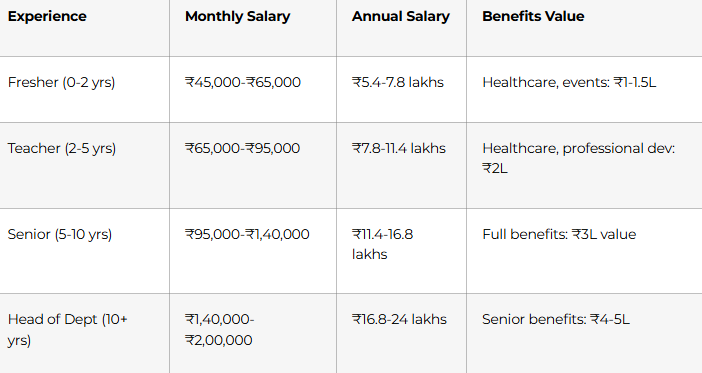
Real scenario: Priya, IB Mathematics teacher, Delhi International Academy (6 years experience)
- Monthly salary: ₹85,000
- Annual: ₹10.2 lakhs
- Housing allowance: ₹3 lakhs/year
- Bonus: ₹50,000 (performance-based)
- Healthcare: ₹1 lakh value (self + family)
- Professional development: ₹80,000 (conferences, training)
- Total compensation: ₹15.3 lakhs
Advantages:
✅ 50-100% higher salary than private schools
✅ Comprehensive benefits (housing, healthcare)
✅ Professional development funded
✅ Global curriculum exposure
✅ Better student discipline (fees filter student selection)
✅ Career progression to leadership
Disadvantages:
❌ Requires certifications (IB, Cambridge, etc.)
❌ High expectations and accountability
❌ More competitive hiring process
❌ Fewer positions available
❌ Still contract-based (not permanent)
Part 3: Beyond Classroom Teaching - Higher Earning Paths
University Professors (Lecturer to Professor)
Pay structure:
- Government universities: UGC pay scales (defined)
- Private universities: Variable, negotiated
Government University Faculty Scale 2025 (UGC):

Real scenario: Dr. Amit, Associate Professor, Delhi University (10 years)
- Monthly salary: ₹1,15,000
- Annual: ₹13.8 lakhs
- Research grant managing: ₹30 lakhs (10% overhead to researcher)
- Consulting projects: ₹3 lakhs
- Total annual income: ₹16.8 + 3 + 3 = ₹22.8 lakhs
Advantages:
✅ Higher salary than school teaching
✅ Prestige and academic freedom
✅ Research grants (additional income)
✅ Consulting opportunities
✅ Job security (permanent after probation)
✅ Sabbatical leaves (extended research periods)
✅ Published work increases earning potential
Path to university:
- Bachelor’s → Master’s → PhD (5-7 years)
- Research Associate role (2-3 years)
- Assistant Professor position
- Promotion through publication and research
Timeline to ₹20+ lakhs:
- Year 0 (PhD student): ₹0-3 lakhs (fellowship)
- Year 5 (Assistant Prof): ₹10-14 lakhs
- Year 15 (Associate Prof): ₹16-22 lakhs
- Year 25 (Professor): ₹24-35 lakhs+
EdTech & Corporate L&D Roles
Teaching skills + tech = premium salaries
Salary Range 2025:
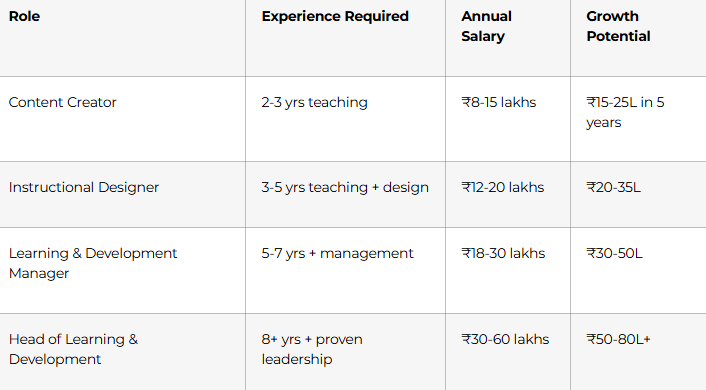
Real scenario: Neha, Learning Experience Designer, EdTech startup (4 years teaching + 2 years EdTech)
- Annual salary: ₹16 lakhs
- Performance bonus: ₹2 lakhs
- Stock options: ₹3 lakhs value/year
- Total: ₹21 lakhs
- Growth: Year 3: ₹25L, Year 5: ₹35L (senior role)
Advantages:
✅ Significantly higher than school teaching
✅ Rapid salary growth (especially in startups)
✅ Equity/stock options
✅ Professional development funding
✅ Flexible work arrangements
✅ Remote work options
Path to EdTech:
- 2-3 years classroom teaching (credibility)
- Take EdTech courses (Coursera, LinkedIn Learning)
- Content creation samples (blog posts, videos, courses)
- Apply to EdTech companies
- Entry: ₹10-15 lakhs
- Growth: ₹3-5 lakhs/year increase possible
Online Tutoring & Content Creation
High earning potential, self-employed model
Income Range 2025:

Real scenario: Priya, independent online English tutor (full-time)
- 15 students × ₹1,500/month each: ₹22,500
- Monthly average: ₹22,500
- Annual: ₹2.7 lakhs
- Plus: Course sales ₹3 lakhs/year, ad revenue ₹1 lakh/year
- Total: ₹6.7 lakhs annually
More realistic scenario (after 1-2 years building):
- 30 students × ₹1,500: ₹45,000
- Courses: ₹6 lakhs/year
- Ad revenue: ₹2 lakhs/year
- Total: ₹13.4 lakhs annually
Advantages:
✅ High earning potential (if you build properly)
✅ Complete flexibility
✅ Passive income from courses/content
✅ Scalable (1 video reaches millions)
✅ No fixed employer
Disadvantages:
❌ Highly variable income
❌ Build time required (6-12 months before substantial income)
❌ Competition is intense
❌ No benefits, no job security
❌ Requires self-discipline and marketing
Part 4: Comprehensive Salary Comparison by Path
5-Year Earnings Comparison

Insight: EdTech and international schools offer highest growth. Government offers security but lowest earnings. Self-employed has highest ceiling but riskiest path.
10-Year Earnings Projection

Big picture: Over 10 years, EdTech and international school paths generate 2-3x more cumulative income than government sector. But government offers security government paths don’t.
Location Impact on Salary
Same position, different city = vastly different salary and lifestyle.
Example: Senior School Teacher (10 years experience, Private School)

Insight: Tier-3 cities offer better lifestyle for given salary! ₹5 lakhs in small city = comfortable living with savings. ₹10 lakhs in Delhi = tight living with minimal savings.
Part 5: Strategies to Maximize Teaching Income
Strategy 1: Skill Certifications (+₹2-5 lakhs)
- IB certification: +₹2-3 lakhs annually
- CELTA/TESOL: +₹2-4 lakhs annually
- Google Cloud certification: +₹1-2 lakhs annually
- Microsoft certifications: +₹1-1.5 lakhs annually
Timeline: 2-6 weeks to get certified, salary increases within 2-6 months
Strategy 2: Additional Income Streams
Option A: Freelance Content Writing
- Time commitment: 5-10 hours/week
- Monthly income: ₹15,000-₹40,000
- Annual additional: ₹1.8-4.8 lakhs
- Total contribution to annual: ₹20-25% increase
Option B: Online Tutoring (Part-time)
- Time: 10-15 hours/week (evenings/weekends)
- Income: ₹20,000-₹50,000/month
- Annual: ₹2.4-6 lakhs
- Total annual increase: 30-40%
Option C: Summer Programs
- Teaching summer camps, crash courses
- Income: ₹50,000-₹2,00,000 for 4-week summer
- One-time annual boost
Realistic total: School salary ₹10 lakhs + tutoring ₹3 lakhs + content writing ₹1.5 lakhs = ₹14.5 lakhs annually
Strategy 3: Leadership Roles (+₹2-8 lakhs)
- Department head: +₹2-3 lakhs
- Curriculum coordinator: +₹2-4 lakhs
- Academic coordinator: +₹3-5 lakhs
- Vice principal: +₹5-8 lakhs
Timeline: 3-7 years of experience + demonstrated capability
Strategy 4: International Teaching (2-3x salary)
- Middle East (UAE, Saudi): ₹15-25 lakhs + housing
- Southeast Asia (Thailand, Vietnam): ₹10-15 lakhs + housing
- Developed countries (UK, Canada, USA): ₹25-50 lakhs depending on visa access
Timeline: 2-6 months preparation + visa process
Strategy 5: EdTech Transition (3-5x growth)
- School teacher: ₹8 lakhs
- Content role in EdTech: ₹12-15 lakhs (transition)
- 5 years later: ₹25-40 lakhs (leadership)
Timeline: 2-3 months preparation for transition
Part 6: Real Salary Stories (Case Studies)
Case Study 1: Rahul - Government School Teacher Staying Stable
text
Background: B.Ed graduate, 12 years government school teaching
YEAR 1: ₹2.2 lakhs
– Monthly salary: ₹18,000
– Pension value: Not yet vested
– Job satisfaction: High (mission-driven)
YEAR 5: ₹3 lakhs
– Monthly salary: ₹24,000
– Benefits: Full healthcare, job security
– Savings: ₹30,000/year
YEAR 12 (Current): ₹4.8 lakhs
– Monthly salary: ₹38,000
– Pension value (after 20 years): ₹9.6 lakhs/year lifelong
– Additional income: ₹50,000/year (Sunday tuition)
– Total annual: ₹5.3 lakhs
– Cumulative 12 years: ₹40 lakhs + pension security
FUTURE (Age 58, after 30 years):
– Pension: ₹4.8 lakhs × 50% = ₹2.4 lakhs/year lifelong
– Quality of life: Secure, comfortable
Lesson: Government sector offers modest salary but extraordinary security. Over lifetime, pension makes total value substantial.
Case Study 2: Priya - International School Climber
text
Background: B.Ed, IB certification, 8 years teaching
YEAR 1 (Private school): ₹3.8 lakhs
– Position: English teacher, entry-level
YEAR 2 (International school): ₹7.2 lakhs
– Position: International school English teacher
– Benefits: Healthcare, housing allowance, conferences
– Salary jump: 90% increase!
YEAR 5 (Leadership): ₹14 lakhs
– Position: Head of English Department
– Benefits: Full package ₹17 lakhs value
– Leadership experience: Building curriculum, training teachers
YEAR 8 (Current—Vice Principal Academic): ₹22 lakhs
– Position: Vice Principal Academic
– Bonus: ₹2 lakhs performance
– Total: ₹24 lakhs
– Cumulative 8 years: ₹85 lakhs
PROJECTED (Year 15, Principal role): ₹40-50 lakhs
Lesson: Certifications + moving to international schools = exponential growth. Strategy: gain experience → get certified → international schools → leadership roles.
Case Study 3: Neha - EdTech Transition Rocket
text
Background: Classroom teacher 4 years, now in EdTech
YEAR 0-4 (School): ₹5 lakhs average
– Position: Private school English teacher
– Realizes: Limited growth, capped salary
YEAR 5 (Transition): ₹10 lakhs
– Position: Content Creator, EdTech startup
– Challenge: Starting fresh, but higher ceiling
– Benefit: Rapid learning, equity options
YEAR 6: ₹15 lakhs
– Position: Senior Content Creator
– Equity: Options vesting, value ₹2 lakhs
YEAR 8 (Current): ₹25 lakhs
– Position: Head of Content
– Base: ₹20 lakhs
– Bonus: ₹3 lakhs
– Equity: ₹2 lakhs value
– Total: ₹25 lakhs
– Cumulative (8 years including teaching): ₹1.15 crores
PROJECTED (Year 12): ₹45-60 lakhs (Director role)
Lesson: EdTech offers highest growth for aggressive earners. Requires risk (leaving security) but payoff is substantial.
Case Study 4: Amit - Independent Online Tutor
text
Background: Teacher 6 years, wanted freedom
YEAR 0 (Left school): ₹6 lakhs (last school salary)
– Decision: Start independent online tutoring
MONTH 1-3: ₹0 income
– Building: Website, YouTube channel, landing page
– Cost: ₹50,000 (website, ads)
MONTH 4-6: ₹20,000/month
– 15 students × ₹1,000/month
– YouTube: Starting (no income yet)
MONTH 7-12: ₹40,000/month
– 40 students × ₹1,000
– Udemy course: ₹20,000/month
YEAR 2 (Current): ₹60,000/month
– Online tuition: ₹45,000
– Courses: ₹15,000
– YouTube: ₹2,000
– Annual: ₹7.2 lakhs
YEAR 3: ₹85,000/month = ₹10.2 lakhs annually
GROWTH TRAJECTORY:
Year 1: ₹2 lakhs (slow start)
Year 2: ₹7.2 lakhs
Year 3: ₹10.2 lakhs
Year 5: ₹15-18 lakhs (mature business)
ADVANTAGES REALIZED:
– Freedom to teach how I want
– Flexible schedule
– No office politics
– Multiple income streams
RISKS FACED:
– Income variability
– No benefits or security
– High initial financial stress
– Always hustling for growth
Lesson: Self-employment highest ceiling but requires patience, marketing savvy, and risk tolerance. Not for everyone, but high rewards for those who persist.
Part 7: Negotiating Your Salary
Know Your Market Value
Before accepting any offer, know what you should earn:
Research sources:
- Ask peers in similar roles (increasingly normalized)
- Check Glassdoor, PayScale, LinkedIn Salary
- Ask HR: “What’s typical range for this position?”
- Understand: Location, experience level, certifications all matter
Example calculation:
- Base salary: ₹8 lakhs (market for 5-year teacher, metro private school)
- Certifications (IB): +₹1 lakh (15% premium)
- Leadership responsibility: +₹1.5 lakhs (20% premium)
- Target negotiation range: ₹10-11 lakhs
Negotiation Talking Points
If offered ₹8 lakhs but research shows ₹10 lakhs typical:
✅ “I appreciate the offer. Based on my research, comparable positions range ₹10-12 lakhs. I bring [specific value: IB certification, student outcomes improvements]. Would you consider ₹10.5 lakhs?”
Notice: Cite research + demonstrate value + propose specific number (not vague).
If school resists salary increase:
✅ Alternative: “I understand salary constraints. Could we discuss: professional development allowance ₹1 lakh, performance bonus structure, or curriculum coordination responsibility?”
Often schools have flexibility on other components even if base is fixed.
Part 8: Complete Salary FAQ
Q1: What’s realistic starting salary in India 2025?
- Government: ₹2.2-2.8 lakhs
- Private school: ₹3.5-4.5 lakhs
- International school: ₹5.5-7.5 lakhs
- EdTech: ₹8-12 lakhs
Q2: How much can you earn as experienced teacher (10+ years)?
- Government: ₹5-6.5 lakhs
- Private school: ₹10-14 lakhs
- International school: ₹15-22 lakhs
- International school (leadership): ₹25-40 lakhs
- EdTech/corporate: ₹25-60 lakhs
Q3: Is ₹10 lakhs annually achievable?
Yes, multiple paths:
- Private school senior teacher (metro, 5+ years)
- International school teacher (any experience level)
- EdTech content role
- Online tutoring (full-time, mature)
- University professor (early career)
Q4: Can teachers earn ₹50 lakhs+?
Yes, but requires:
- International school principal/senior leadership role
- EdTech director/VP role
- Consulting/consulting role
- University professor with major research grants
- Successful online business at scale
Q5: What’s the highest paying teaching-related role?
- EdTech director/VP: ₹50-100 lakhs+ (with equity)
- University dean/director: ₹40-80 lakhs
- International school principal: ₹40-60 lakhs
- Educational consultant: ₹50-200 lakhs (if successful)
Q6: Should salary be only consideration when choosing teaching path?
No. Consider:
- Job security (government > private > EdTech)
- Work-life balance (government/school > EdTech)
- Growth opportunity (EdTech/international > government)
- Mission alignment (personal satisfaction)
- Location/lifestyle preference
- Family obligations
Sweet spot: Balance decent salary (₹10-15 lakhs) with security + growth + meaning.
Part 9: Your Salary Planning Roadmap
5-Year Salary Growth Plan
If Starting in Government School (₹2.5L):
text
Year 1-2: ₹2.5-2.8 lakhs (gain experience)
Year 3: ₹3 lakhs + ₹0.5L side tutoring = ₹3.5 lakhs
Year 4: ₹3.3 lakhs + ₹1L side income = ₹4.3 lakhs
Year 5: ₹3.5 lakhs + ₹1.5L side income + department coordinator role = ₹5 lakhs
GOAL: ₹5 lakhs total income by year 5 (double starting salary)
If Starting in Private School (₹4L):
text
Year 1: ₹4 lakhs
Year 2: ₹5 lakhs (merit + increments)
Year 3: ₹6.5 lakhs (promotion or move to better school)
Year 4: ₹8 lakhs + ₹1L bonus = ₹9 lakhs
Year 5: ₹10 lakhs (senior role or international school move)
GOAL: ₹10 lakhs by year 5 (2.5x starting salary)
If Transitioning to EdTech (₹10L at entry):
text
Year 1: ₹10 lakhs
Year 2: ₹14 lakhs (promotion + performance)
Year 3: ₹18 lakhs (leadership + equity vesting)
Year 4: ₹23 lakhs
Year 5: ₹28 lakhs
GOAL: ₹25-30 lakhs by year 5 (growth of ₹4-5L annually)
Your Negotiation Checklist
Before accepting any offer:
✅ Research market rates for role/location/experience
✅ Calculate total compensation (salary + benefits + bonus)
✅ Know your walkaway point (minimum acceptable)
✅ Identify your leverage (certifications, experience, outcomes)
✅ Prepare three negotiation talking points
✅ Get offer in writing before confirming
✅ Understand benefits fully (healthcare scope, bonus structure)
✅ Ask about salary review timeline
✅ Understand growth path and timeline to next level
Final Summary: Teaching Salary Reality Check
The honest truth:
- Government teaching: Secure, modest, pension-backed. Realistic: ₹4-5 lakhs annually.
- Private school teaching: Growth-possible, performance-dependent. Realistic: ₹8-12 lakhs annually with experience.
- International schools: Premium salaries, high bar. Realistic: ₹15-25 lakhs annually.
- EdTech: Highest growth ceiling, highest risk. Realistic: ₹12-50 lakhs depending on progression.
- Self-employed online: Variable, highest ceiling, highest effort. Realistic: ₹5-15 lakhs annually mature business.
Best financial path:
- Start in established school (government/private/international) – 3 years
- Gain credentials (IB, CELTA, management)
- Move to international school or EdTech (salary jump)
- Build passive income (courses, tutoring, content)
- Year 10: ₹15-25 lakhs achievable for motivated educators
Most secure path:
Government school teaching + pension. Modest salary (₹4-5L) but unmatched security. Over 30-year career: ₹50%+ pension = ₹2.5+ lakhs/year for life.