
Structure and Organization Techniques
Table of Contents
Blog Content:
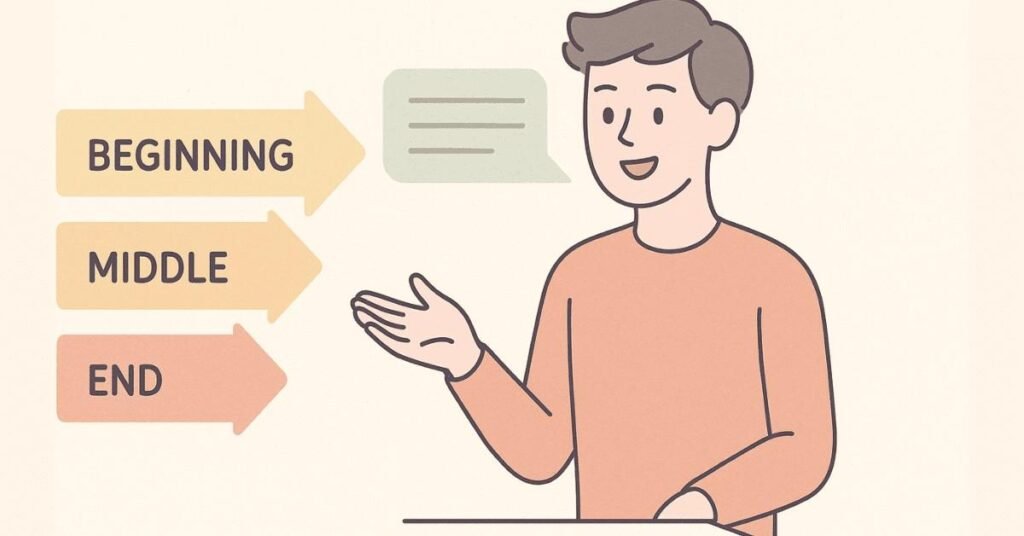
The Power of Structure in 60 Seconds
Two students receive the same JAM topic: “Impact of Social Media.”
Student A starts speaking: “Social media is very popular. Everyone uses it. It has good things and bad things. Like, we can connect with people. But sometimes it’s addictive. My cousin uses Instagram a lot. I also use WhatsApp. Facebook is also there. So yeah, social media is important but also has problems…”
Student B starts speaking: “Social media has fundamentally transformed human connection. On the positive side, it enables instant global communication and democratizes information access. However, research shows excessive use correlates with anxiety and reduced productivity. The key lies not in avoiding social media, but in conscious, purposeful usage that enhances rather than replaces real-world relationships.”
Notice the difference? Both students spoke about the same topic, but Student B sounds organized, logical, and professional. Student A sounds scattered and unprepared.
The difference is structure.
Structure is what transforms random thoughts into compelling speeches. It’s the invisible architecture that makes your content easy to follow and remember.
Why Structure Matters More Than Content
Here’s a counterintuitive truth: A well-structured speech with average content will always outperform a poorly structured speech with brilliant content.
Why? Because evaluators can’t appreciate your ideas if they can’t follow your logic. Structure does three critical things:
- Creates Clarity
Your evaluator knows where you’re going and can follow your reasoning. - Demonstrates Thinking Ability
Organized speech signals organized thinking—exactly what companies want. - Maximizes Time Efficiency
Structure ensures you cover all important points within 60 seconds without running out of content or time.
The STAR Method: Your Universal JAM Framework
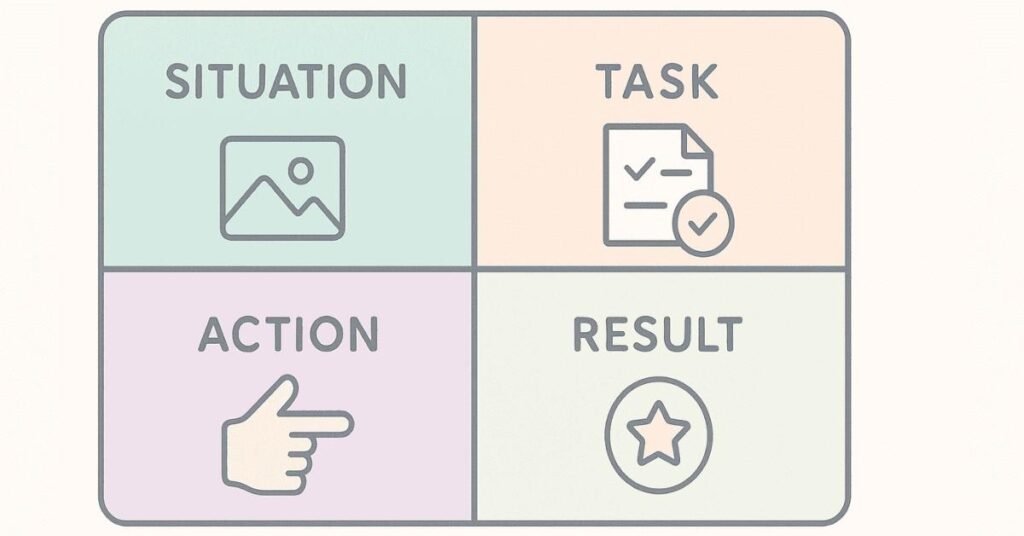
The STAR method is borrowed from professional interview techniques, but it works brilliantly for JAM. It stands for:
S – Situation/Statement
T – Task/Topic Analysis
A – Action/Approach
R – Result/Reflection
Let’s break down each component:
S – Situation/Statement (First 10-15 seconds)
Start by establishing context or making a clear opening statement about the topic.
What to include:
- A definition or explanation of the topic
- A relevant observation about the topic
- A thought-provoking question or statistic
- Personal connection or universal relevance
Example for topic “Time Management”:
“Time management has become one of the most critical skills in today’s fast-paced world. Despite having 24 hours each day, most people struggle to accomplish what truly matters.”
T – Topic Analysis (Next 15-20 seconds)
Analyze the topic by exploring its key dimensions, causes, or components.
What to include:
- Why the topic matters
- Different perspectives or aspects
- Underlying causes or factors
- Current scenario or trends
Example continuing “Time Management”:
“This challenge exists because we often confuse being busy with being productive. We fill our schedules without prioritizing what’s truly important. Additionally, constant digital distractions fragment our attention, making deep work nearly impossible.”
A – Action/Approach (Next 20-25 seconds)
Discuss solutions, methods, approaches, or your perspective on how to address the topic.
What to include:
- Practical solutions or strategies
- Real-world applications
- Personal experiences or observations
- Expert recommendations or proven methods
Example continuing “Time Management”:
“Effective time management requires three key practices. First, prioritize tasks using the Eisenhower Matrix—distinguishing between urgent and important. Second, implement time-blocking to dedicate focused hours to high-value activities. Third, eliminate or delegate low-impact tasks that consume energy without meaningful returns.”
R – Result/Reflection (Final 10 seconds)
Conclude with the outcome, impact, or forward-looking perspective.
What to include:
- Expected results or benefits
- Future implications
- Call to action or final thought
- Personal reflection or broader significance
Example completing “Time Management”:
“Mastering time management transforms not just productivity, but quality of life. When we manage time intentionally, we create space for what truly matters—growth, relationships, and meaningful achievement.”
Complete STAR Speech (approximately 60 seconds):
“Time management has become one of the most critical skills in today’s fast-paced world. Despite having 24 hours each day, most people struggle to accomplish what truly matters. This challenge exists because we often confuse being busy with being productive. We fill our schedules without prioritizing what’s truly important. Additionally, constant digital distractions fragment our attention, making deep work nearly impossible. Effective time management requires three key practices. First, prioritize tasks using the Eisenhower Matrix—distinguishing between urgent and important. Second, implement time-blocking to dedicate focused hours to high-value activities. Third, eliminate or delegate low-impact tasks that consume energy without meaningful returns. Mastering time management transforms not just productivity, but quality of life. When we manage time intentionally, we create space for what truly matters—growth, relationships, and meaningful achievement.”
That’s approximately 125 words—perfectly timed for 60 seconds.
🔍 Explore structured learning resources designed to strengthen communication clarity →
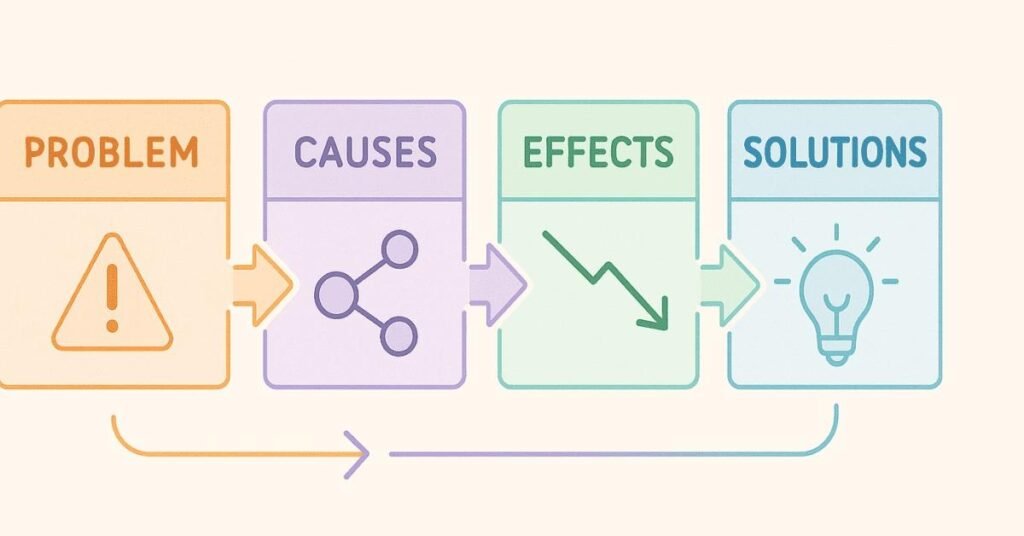
Alternative Structure: The Problem-Solution Framework
When your JAM topic involves a challenge or issue, use this structure:
Opening (10 seconds): Identify the problem clearly
Development (30 seconds): Explain causes and consequences
Solution (15 seconds): Propose actionable solutions
Closing (5 seconds): Future outlook or call to action
Example for topic “Plastic Pollution”:
Opening: “Plastic pollution has emerged as one of the greatest environmental crises of our time.”
Development: “Every year, 8 million tons of plastic enter our oceans, harming marine life and entering our food chain. The problem stems from our single-use culture and inadequate waste management systems. The consequences are devastating—ecosystem destruction, health risks, and irreversible environmental damage.”
Solution: “Solutions require collective action. Individuals can reduce plastic consumption by choosing reusable alternatives. Governments must enforce strict regulations on plastic production and improve recycling infrastructure. Businesses should innovate biodegradable packaging.”
Closing: “The time to act is now. Our choices today determine whether future generations inherit a healthy planet or a plastic wasteland.”
Introduction Frameworks That Hook Your Evaluator
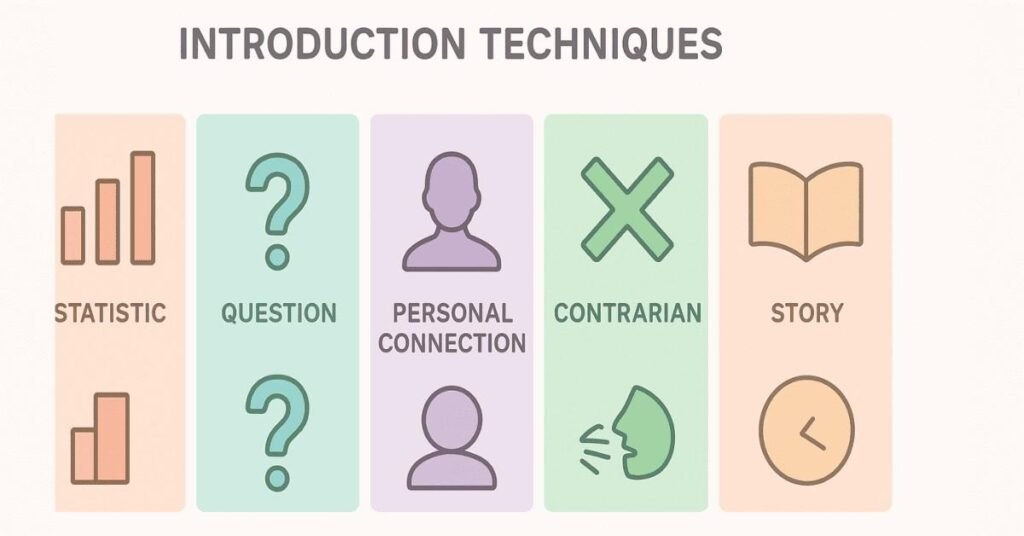
Your first 5-10 seconds are critical. A strong opening captures attention and sets the tone. Here are five proven introduction techniques:
- The Surprising Statistic Opening
Start with a compelling number or fact.
Example: “Did you know that 90% of people check their phones within 5 minutes of waking up? This dependency on technology has fundamentally altered how we start our days.”
- The Question Opening
Pose a thought-provoking question.
Example: “Have you ever wondered why some people achieve success effortlessly while others struggle despite working hard? The answer lies in mindset and strategic thinking.”
- The Personal Connection Opening
Make it relatable by connecting to common experiences.
Example: “We’ve all experienced that moment of panic before an exam when we realize we’ve procrastinated too long. This common scenario reveals important truths about human psychology and motivation.”
- The Contrarian Opening
Challenge conventional thinking.
Example: “Most people believe failure is something to avoid. However, failure is actually our most powerful teacher and the foundation of lasting success.”
- The Story/Scenario Opening
Begin with a brief narrative or hypothetical situation.
Example: “Imagine waking up tomorrow with no access to the internet. No emails, no social media, no instant information. This scenario helps us understand just how dependent we’ve become on digital connectivity.”
Choose the opening style that feels most natural to you and matches the topic.
Transitional Phrases: The Glue That Holds Your Speech Together
Transitions are the connective tissue between your ideas. They signal to the evaluator that you’re moving from one point to another, making your speech easy to follow.
For Adding Information:
- “Additionally…”
- “Furthermore…”
- “Another important aspect is…”
- “Building on that point…”
- “Equally important…”
For Showing Contrast:
- “However…”
- “On the other hand…”
- “Conversely…”
- “In contrast…”
- “Despite this…”
For Providing Examples:
- “For instance…”
- “To illustrate this point…”
- “Consider the case of…”
- “A practical example is…”
- “This is evident in…”
For Showing Cause and Effect:
- “As a result…”
- “Consequently…”
- “This leads to…”
- “Therefore…”
- “Due to this…”
For Concluding:
- “Ultimately…”
- “In conclusion…”
- “To summarize…”
- “The key takeaway is…”
- “Moving forward…”
Example showing transitions in action:
“Artificial Intelligence is reshaping industries worldwide. For instance, healthcare now uses AI for diagnostic accuracy and treatment recommendations. Additionally, financial institutions employ AI for fraud detection and risk assessment. However, these advancements come with challenges. Therefore, we must balance innovation with ethical considerations. Ultimately, AI’s success depends on responsible development and thoughtful implementation.”
Notice how each transition guides you smoothly from one idea to the next? That’s the power of deliberate transitional language.
The Three-Point Rule for Maximum Impact
Human brains naturally remember things in groups of three. When organizing your JAM content, structure your main body around three key points.
Why three?
- Two points feel incomplete
- Four or more points are hard to remember in 60 seconds
- Three creates a satisfying, complete feeling
Example for topic “Qualities of a Good Leader”:
“Leadership extends beyond authority—it’s about inspiration and impact. First, effective leaders demonstrate emotional intelligence, understanding and responding to team emotions. Second, they communicate vision clearly, ensuring everyone understands organizational goals and their role in achieving them. Third, great leaders empower others, building capabilities rather than creating dependency. These three qualities distinguish true leaders from mere managers.”
The formula:
- Opening (establish topic)
- First point (with brief elaboration)
- Second point (with brief elaboration)
- Third point (with brief elaboration)
- Closing (tie it together)
This structure is clean, memorable, and perfectly suited for 60 seconds.
📘 Discover more preparation-focused content created to support your skill-building journey →
The Sandwich Technique: Strong Start, Strong Finish
Research shows people remember the beginning and ending of speeches most vividly. This is called the “primacy and recency effect.”
Your middle content can be good, but your opening and closing must be exceptional.
Think of it like a sandwich:
- Top bread (Opening): Captures attention, establishes credibility
- Filling (Middle): Delivers information, examples, analysis
- Bottom bread (Closing): Leaves lasting impression, provides closure
Example for topic “Importance of Reading”:
Strong Opening (Top Bread):
“In an age of 30-second videos and 280-character tweets, books remain our most powerful tool for deep understanding and intellectual growth.”
Middle Content (Filling):
“Reading expands vocabulary, enhances concentration, and exposes us to diverse perspectives. Studies show regular readers develop superior critical thinking skills and demonstrate higher empathy levels. Furthermore, reading reduces stress and improves memory retention.”
Strong Closing (Bottom Bread):
“Every book is a conversation with great minds across time and space. The question isn’t whether we have time to read—it’s whether we can afford not to.”
Notice how the opening and closing are memorable and impactful, while the middle delivers solid content?
Organizing Different Types of JAM Topics
Not all topics fit the same structure. Here’s how to organize based on topic type:
For Abstract Concepts (e.g., “Success,” “Happiness,” “Courage”)
Structure: Definition → Personal Meaning → Universal Application → Significance
Example: “Success”
- Define what success means
- Share what it means to you personally
- Discuss how different people measure success
- Conclude with broader significance
For Current Events (e.g., “Climate Change,” “Digital Economy”)
Structure: Current Situation → Key Factors → Multiple Perspectives → Future Outlook
Example: “Remote Work Trend”
- Describe the current remote work landscape
- Explain why it’s growing (technology, pandemic impact)
- Present employer and employee perspectives
- Discuss future of work implications
For Skill/Process Topics (e.g., “Time Management,” “Communication Skills”)
Structure: Importance → Challenges → Methods/Techniques → Benefits
Example: “Effective Communication”
- Why communication matters in professional life
- Common communication barriers
- Techniques for improvement (active listening, clarity, feedback)
- Impact of strong communication skills
For Comparative Topics (e.g., “Online vs. Offline Learning”)
Structure: Introduction → Perspective 1 → Perspective 2 → Balanced Conclusion
Example: “Traditional vs. Digital Marketing”
- Define both approaches
- Traditional marketing strengths and limitations
- Digital marketing advantages and challenges
- Integrated approach for optimal results
The Pyramid Principle: Top-Down Communication
Professional consultants use the “Pyramid Principle”—starting with the conclusion and then providing supporting evidence.
This works exceptionally well for JAM because you deliver your main message immediately, then support it.
Traditional Structure (Bottom-Up):
Evidence → Evidence → Evidence → Conclusion
Pyramid Structure (Top-Down):
Conclusion → Supporting Evidence → Reinforcement
Example for topic “Why Exercise Matters”:
Traditional approach:
“Exercise improves cardiovascular health. It also strengthens muscles and bones. Additionally, it enhances mental well-being. Therefore, regular exercise is essential for overall health.”
Pyramid approach:
“Regular exercise is essential for comprehensive health and well-being. It strengthens our cardiovascular system, reducing heart disease risk. It builds muscle and bone density, preventing age-related deterioration. Perhaps most importantly, exercise releases endorphins that combat stress and depression, making it equally valuable for mental health.”
The pyramid approach feels more authoritative and confident—you state your position clearly and then defend it.
📂 Access complete learning materials that improve organization, reasoning, and delivery →
Time Management Within Your Speech
Even with great content, poor time management can destroy your JAM performance. Here’s how to allocate your 60 seconds:
Ideal Time Breakdown:
Opening (10-15 seconds / ~20 words)
- Hook your audience
- Establish topic clearly
- Create interest
Body/Development (35-40 seconds / ~75 words)
- Present 2-3 main points
- Provide examples or evidence
- Develop your argument
Closing (10 seconds / ~20 words)
- Summarize key message
- Provide final thought
- Leave strong impression
Total: Approximately 115-125 words for 60 seconds
Practice Tip: Write out your JAM responses and count words. After practicing 20-30 topics, you’ll naturally develop a sense of appropriate length without counting.
The Flow Test: Does Your Speech Make Sense?
After structuring your JAM response, apply the “Flow Test”:
- Can someone follow your logic without confusion?
If your evaluator gets lost, your structure needs work. - Does each point connect to the next naturally?
Abrupt topic jumps indicate missing transitions. - Does your conclusion relate to your opening?
Your speech should feel complete, not random. - Can you remove any sentence without losing meaning?
Every sentence should add value—no filler. - Would this make sense if written as a paragraph?
Good speeches have the same logical coherence as good writing.
If you answer “no” to any question, revise your structure.
Common Structure Mistakes to Avoid
Mistake 1: The Random Ramble
Jumping between unrelated points without logical connection.
Fix: Use transitions and follow a framework (STAR, Problem-Solution, Three-Point).
Mistake 2: The Definition Trap
Spending 30 seconds defining the topic instead of discussing it.
Fix: Quick definition (5-10 seconds max), then move to analysis.
Mistake 3: The Repetition Loop
Saying the same thing multiple ways without adding new information.
Fix: Each sentence should introduce new information or perspective.
Mistake 4: The Abrupt Ending
Running out of ideas and stopping suddenly without proper closure.
Fix: Always plan your closing sentence. Know where you’re heading.
Mistake 5: The Over-Complexity
Trying to cover too many angles in 60 seconds.
Fix: Focus on 2-3 key points. Depth beats breadth in JAM.
Your 7-Day Structure Mastery Practice Plan
Day 1-2: STAR Method
- Practice 5 topics using STAR framework
- Time each response
- Record and evaluate logical flow
Day 3-4: Three-Point Structure
- Practice 5 topics with three main points
- Focus on smooth transitions
- Ensure balanced time for each point
Day 5: Opening Mastery
- Practice 10 different openings for the same topic
- Identify which styles feel most natural
- Perfect your hook
Day 6: Closing Mastery
- Practice 10 different closings for the same topic
- Make each memorable
- Practice delivering with confidence
Day 7: Full Integration
- Combine all elements
- Practice 5 complete topics
- Focus on seamless flow from opening to closing
Repeat this cycle with different topics for 3-4 weeks.
🧭 Continue your learning journey with more structured guidance and performance-focused content →
Key Takeaways for Structure and Organization
- Structure transforms random thoughts into compelling speeches
- STAR method provides a universal framework: Situation, Task, Action, Result.
- Alternative frameworks work for different topics: Problem-Solution, Three-Point, Pyramid Principle
- Strong openings capture attention using statistics, questions, or relatable scenarios.
- Transitions create smooth flow between ideas and signal logical progression.
- The three-point rule ensures memorability and manageable content
- Time allocation matters: 10-15s opening, 35-40s body, 10s closing
- Every sentence should add value—no filler or repetition
- Practice with frameworks until structure becomes automatic