
Speaking Fundamentals for JAM
Table of Contents

Blog Content:
Why Great Content Isn’t Enough
You’ve prepared well. You know what to say. Your ideas are solid. You start speaking during your JAM round, and then… you sound nervous. Your voice shakes. You speak too fast. Words get jumbled. Your evaluator struggles to understand you.
Here’s the harsh truth: Even the best content can fail if your delivery is poor.
Think of it this way—you could have a delicious recipe, but if you burn the food while cooking, nobody will enjoy it. Similarly, great ideas delivered poorly will not impress anyone.
The good news? Speaking fundamentals are completely trainable. You don’t need to be a naturally gifted speaker. You just need to understand the mechanics and practice consistently.
The Four Pillars of JAM Speaking
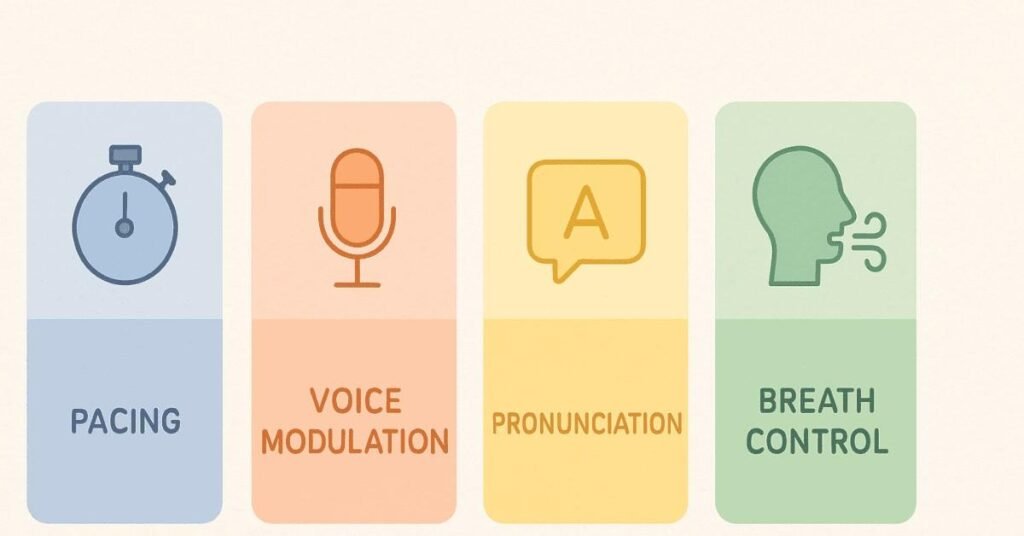
Outstanding JAM delivery rests on four foundational elements:
- Pacing — How fast or slow you speak
- Voice Modulation — How you vary pitch, tone, and volume
- Pronunciation — How clearly you articulate words
- Breath Control — How you manage breathing during continuous speech
Master these four, and your JAM performance will transform—even if your content remains the same.
Let’s break down each pillar systematically.
Pillar 1: Pacing — Finding Your Rhythm
What is Pacing?
Pacing refers to the speed at which you speak. In JAM, pacing is critical because you have exactly 60 seconds—not a second more or less.
Many students make one of two mistakes:
- Speaking too fast (trying to cram everything in, sounding rushed and unclear)
- Speaking too slow (running out of things to say, creating awkward silences)
The ideal JAM pace is approximately 120-150 words per minute—which translates to about 2-2.5 words per second.
Why does this matter?
When you speak too fast:
- Words blur together
- The evaluator can’t process your ideas
- You sound nervous and out of control
- You’re more likely to make pronunciation mistakes
When you speak too slow:
- You struggle to fill 60 seconds
- You sound unsure or unprepared
- You might repeat yourself unnecessarily
- The evaluator loses interest
How to Find Your Natural Pace
Here’s a simple test:
- Record yourself reading this sentence naturally: “The quick brown fox jumps over the lazy dog while the sun sets behind the mountains.”
- Count how many seconds it took.
- Evaluate:
- Under 4 seconds = Too fast (slow down)
- 4-6 seconds = Perfect range (maintain this)
- Over 6 seconds = Too slow (speed up)
Now you have a baseline for your natural speaking rhythm.
The Variable Pacing Technique
Professional speakers don’t maintain the same pace throughout. They vary their speed strategically:
Slow down when:
- Introducing your topic (first 5-10 seconds)
- Emphasizing important points
- Explaining complex ideas
- Concluding your speech (last 10 seconds)
Speed up when:
- Listing examples or supporting details
- Transitioning between ideas
- Building momentum and energy
- Covering familiar or simple concepts
Example in action:
[SLOW] “Social media has fundamentally transformed how we communicate.” [Pause] [FASTER] “We connect instantly, share experiences globally, and build communities online.” [SLOW] “But this convenience comes with hidden costs that we’re only beginning to understand.”
Notice how the pace creates a rhythm? That’s what makes speech engaging rather than monotonous.
Practice Exercise: The Metronome Method
Use your phone’s metronome app or an online tool:
- Set it to 120 beats per minute
- Speak one syllable per beat
- Practice saying: “To-day I will prac-tice speak-ing with per-fect pac-ing”
- Once comfortable, remove the metronome and maintain that rhythm naturally
Do this for 3-5 minutes daily for two weeks. Your brain will internalize the optimal pacing.

🔍 Explore structured learning resources designed to strengthen communication clarity →
Pillar 2: Voice Modulation — Making Your Words Come Alive
What is Voice Modulation?
Voice modulation means intentionally varying your vocal pitch, tone, volume, and energy to create interest and convey emotion.
Think about how boring it would be if someone spoke like a robot—same tone, same pitch, same volume for 60 seconds straight. That’s what happens when you don’t modulate your voice.
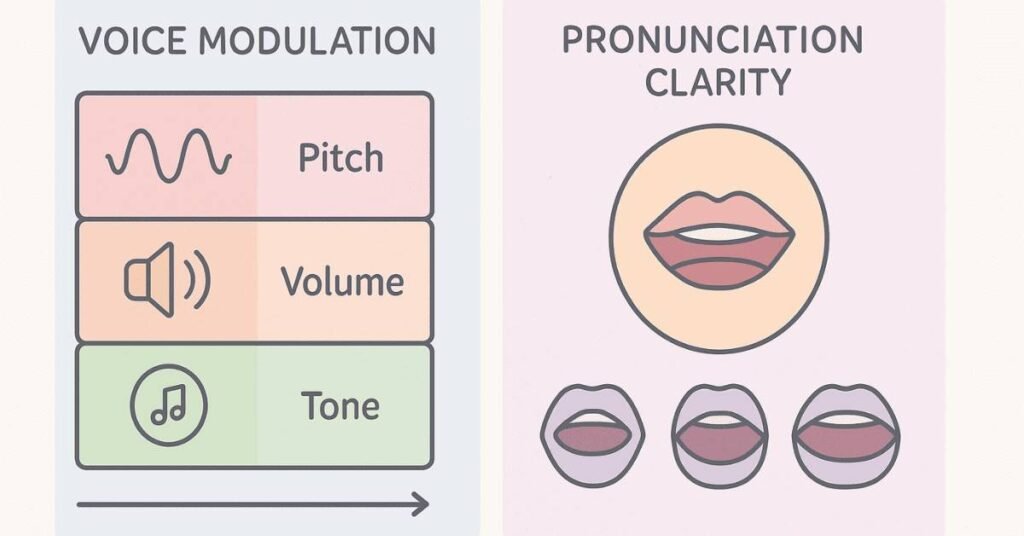
The Three Dimensions of Voice Modulation
Dimension 1: Pitch (High and Low)
Pitch is how high or low your voice sounds.
- Higher pitch = Excitement, questions, enthusiasm
- Lower pitch = Authority, seriousness, emphasis
- Mid-range pitch = Normal conversation, explanations
Example:
“Is climate change really that serious?” [Higher pitch for the question]
“Absolutely.” [Lower pitch for emphasis]
“Scientists have been warning us for decades.” [Mid-range for explanation]
Practice Exercise: The Vocal Scale
- Say “Hello” at your lowest comfortable pitch
- Gradually raise your pitch saying “Hello” five times
- Reach your highest comfortable pitch
- Come back down gradually
Do this daily to develop pitch flexibility.
Dimension 2: Volume (Loud and Soft)
Volume isn’t just about being heard—it’s about creating emphasis and emotion.Louder volume = Passion, importance, calls to action.
- Softer volume = Intimacy, reflection, caution
- Normal volume = Standard delivery
Critical Rule for JAM: Never speak too softly. Your evaluator needs to hear every word clearly. However, you can use strategic volume variation for impact.
Example:
“We all face challenges.” [Normal volume]
“But here’s what matters—” [Slightly louder, building emphasis]
“How we respond to them.” [Normal volume, steady]
Practice Exercise: The Room Projection
- Stand in an empty room
- Imagine someone at the far corner
- Speak loud enough for them to hear WITHOUT shouting
- Maintain that projection level
This builds your diaphragm strength and projection ability.
Dimension 3: Tone (Emotional Color)
Tone is the emotional quality of your voice—friendly, serious, enthusiastic, concerned, confident.
Your tone should match your content:
- Discussing problems → Serious, concerned tone
- Sharing solutions → Optimistic, confident tone
- Giving examples → Conversational, friendly tone
- Making conclusions → Firm, authoritative tone
Example:
“Unemployment is a serious challenge.” [Serious tone]
“However, new industries are creating opportunities.” [Optimistic tone]
“For instance, the tech sector added 200,000 jobs last year.” [Conversational tone]
“This shows adaptation is key to success.” [Confident, authoritative tone]
The Modulation Warning: Don’t Overdo It
Some students, after learning modulation, sound theatrical or artificial. The goal is natural variation, not drama. Your voice should sound like an engaged, passionate conversation—not a movie performance.
📘 Discover more preparation-focused content designed for performance improvement →
Pillar 3: Pronunciation and Clarity — Being Understood
Why Pronunciation Matters in JAM
If your evaluator can’t understand your words, your content becomes irrelevant. Poor pronunciation is one of the top reasons students fail JAM rounds, even with good ideas.
The Three Common Pronunciation Problems
Problem 1: Unclear Consonant Sounds
Many Indian students struggle with specific consonant pairs:
- V vs. W → “Very” sounds like “Wery”
- S vs. Sh → “See” sounds like “Shee”
- T vs. D → “Tree” sounds like “Dree”
- P vs. B → “Park” sounds like “Bark”
Quick Fix Exercise:
Practice these word pairs slowly in front of a mirror:
- Van / Wan
- Sip / Ship
- Tie / Die
- Pack / Back
Watch your mouth movements. Your lips, tongue, and teeth positioning matters.scribd
Problem 2: Weak Ending Sounds
Many speakers drop the last sound of words:
- “Good morning” becomes “Goo mornin”
- “I think that” becomes “I thin tha”
- “World economy” becomes “Worl econom”
Quick Fix: Exaggerate ending sounds during practice. Say “Good-DUH” instead of “Good.” Over time, you’ll naturally pronounce endings clearly without exaggeration.
Problem 3: Incorrect Word Stress
English is a stress-timed language. Stressing the wrong syllable changes meaning or sounds awkward:
- ❌ “con-TENT” (should be “CON-tent”)
- ❌ “IN-crease” (as verb, should be “in-CREASE”)
- ❌ “ad-DRESS” (as noun, should be “AD-dress”)
Quick Fix: When learning new words, check pronunciation in Google or dictionaries that show stress patterns.
The Clear Speech Formula
Follow this formula for maximum clarity:
SLOW (slightly slower than normal)
- LOUD (projected but not shouting)
- OPEN MOUTH (don’t mumble with closed lips)
= CRYSTAL CLEAR SPEECH
Daily Practice Routine (5 minutes):
- Tongue Twisters (1 minute)
- “She sells seashells by the seashore”
- “Red lorry, yellow lorry”
- “Unique New York”
- Reading Aloud (2 minutes)
- Read a news article slowly and clearly
- Record yourself
- Listen and identify unclear words
- Mirror Practice (2 minutes)
- Watch your mouth while speaking
- Ensure proper lip and tongue movement
- Check facial expressions

Pillar 4: Breathing Techniques — Sustaining Your Speech
The Breathing Problem Most Students Face
You start speaking confidently. Ten seconds in, you realize you’re running out of breath. Your voice becomes shaky. You rush to finish your sentence. You gasp for air mid-speech.
Sound familiar?
The reason? Most people use shallow chest breathing instead of proper diaphragmatic breathing.youtube
Understanding Diaphragmatic Breathing
Your diaphragm is a muscle below your lungs. When you breathe deeply from your diaphragm (not your chest), you get:
- More air capacity
- Better voice control
- Reduced nervousness
- Sustained speech without gasping youtube
Test Yourself:
Place one hand on your chest and one on your stomach. Breathe normally.
- If your chest rises → You’re chest breathing (shallow, inefficient)
- If your stomach expands → You’re diaphragm breathing (deep, efficient)
The 4-7-8 Breathing Technique (Pre-JAM Preparation)
Before your JAM round, calm your nerves and oxygenate your brain.
- Breathe in through your nose for 4 counts
- Hold your breath for 7 counts
- Exhale through your mouth for 8 counts
- Repeat 3-4 times
This activates your parasympathetic nervous system, reducing anxiety and steadying your voice.youtube
The Strategic Pause Breathing Technique (During JAM)
You can’t stop mid-sentence to take obvious breaths during JAM—that breaks flow. Instead, use strategic pauses as natural breathing points:
Example:
“Technology is changing education. [BREATHE THROUGH PAUSE] Students now learn through interactive platforms. [BREATHE] This creates personalized learning experiences. [BREATHE] The future of education is digital.”
Those pauses sound natural to listeners, but they’re your breathing moments.
Breath Support Exercise (Daily Practice):
- Stand straight with good posture
- Take a deep diaphragm breath
- Count out loud as far as you can on one breath: “1, 2, 3, 4…”
- Track your number daily
Goal: Reach 30-40 counts comfortably. This builds breath capacity for sustained speaking.
📂 Access complete learning materials to improve confidence, delivery, and consistency →
Managing Nervousness: The Mind-Body Connection
Even with perfect technique, nervousness can sabotage your delivery. Your voice shakes. Your throat tightens. Your breathing becomes shallow.
Why This Happens:
When you’re nervous, your body enters “fight or flight” mode. Your muscles tense, including your vocal cords and diaphragm. This physically affects your.
The Three-Step Nervousness Management Protocol
Step 1: Physical Relaxation (Before JAM)
- Roll your shoulders backward 5 times
- Shake out your hands and arms
- Do gentle neck rotations
- Stretch your jaw by opening wide and yawning
This releases muscle tension.youtube
Step 2: Mental Reframing (Mindset Shift)
Instead of thinking: “I might mess up”
Think: “This is a chance to showcase my skills”
Instead of thinking: “Everyone is judging me”
Think: “The evaluator wants me to succeed”
Your internal dialogue directly impacts your external delivery.
Step 3: Power Posture (2 Minutes Before)
Stand in a “power pose” (feet shoulder-width apart, hands on hips, chest open) for 2 minutes before your turn. Research shows this increases confidence hormones and reduces stress hormones.
Putting It All Together: The Complete JAM Delivery Framework
Here’s how all four pillars work together in a real JAM response:
Topic: “Why reading books matters”
[Opening – Slow pace, mid-low pitch, clear pronunciation]
“Reading books has become a lost art in our digital age.”
[Pause for breath]
[Middle – Variable pace, modulated tone, projected volume]
“When we read, we develop concentration, expand vocabulary, and exercise our imagination. [Slight emphasis] Books transport us to different worlds and perspectives.”
[Pause for breath]
[Supporting detail – Slightly faster pace, conversational tone]
“Studies show that people who read regularly have better cognitive abilities and reduced stress levels.”
[Pause for breath]
[Closing – Slower pace, confident tone, lower pitch]
“In an age of short-form content, books remain our most powerful tool for deep learning and personal growth.”
Notice:
✅ Variable pacing
✅ Voice modulation
✅ Clear pronunciation
✅ Strategic breathing pauses
✅ Natural flow
Your 7-Day Speaking Fundamentals Practice Plan
Day 1-2: Focus on Pacing
- Practice with metronome
- Record and time yourself
- Identify your natural pace
Day 3-4: Focus on Voice Modulation
- Vocal scale exercises
- Practice pitch variation
- Work on volume projection
Day 5-6: Focus on Pronunciation
- Tongue twisters daily
- Mirror practice
- Record and correct unclear sounds
Day 7: Focus on Breathing
- Diaphragmatic breathing exercises
- Strategic pause practice
- Full JAM simulation with all techniques
Repeat this cycle for 3-4 weeks and you’ll see dramatic improvement.
🧭 Continue your learning journey with more structured guidance and skill-building support →
Key Takeaways for Speaking Fundamentals
- Pacing: Aim for 120-150 words/minute; vary speed strategically
- Voice Modulation: Use pitch, volume, and tone variation naturally
- Pronunciation: Focus on consonants, ending sounds, and word stress
- Breathing: Use diaphragmatic breathing and strategic pauses youtube
- Nervousness: Manage through physical relaxation and mental reframing
- Practice daily: 5-10 minutes of focused practice yields significant results