
Space Technology Courses & Certifications in India
Table of Contents
Introduction:
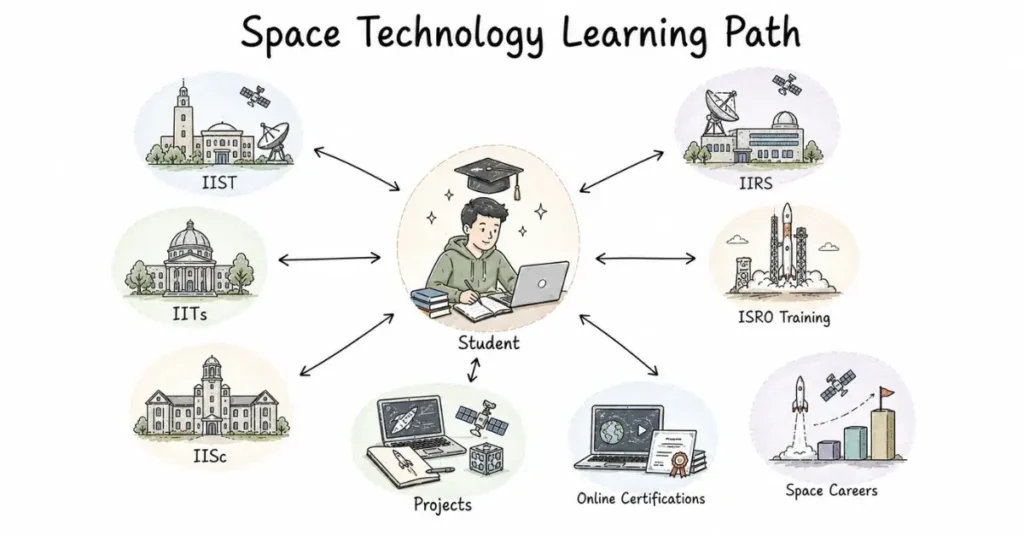
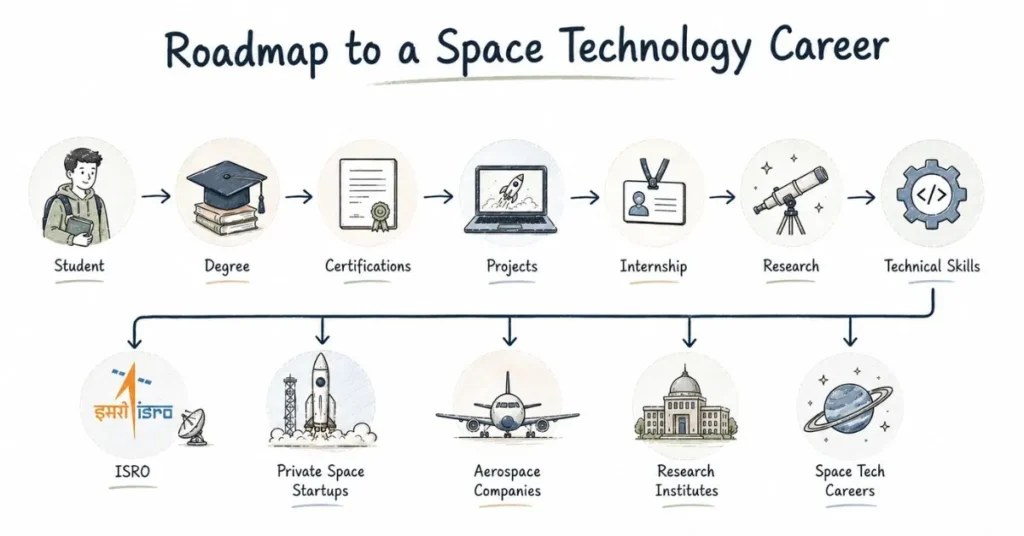
Every career guide in this series has pointed to one common truth: the right education opens the right doors. But with so many colleges, certifications, and short courses available in India today each claiming to prepare you for a space career figuring out which ones actually matter is genuinely confusing.
This guide cuts through that confusion. It covers every major formal education and certification pathway for space technology careers in India degree programs, postgraduate courses, short-term certifications, and online options with honest information about fees, eligibility, duration, and which career paths each one supports.
Category 1 : Undergraduate Degree Programs
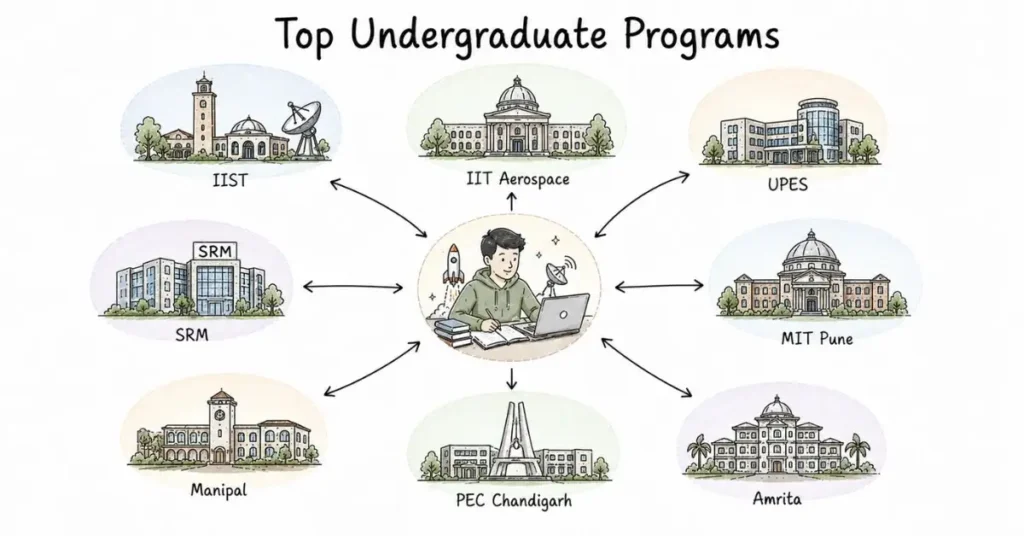
IIST B.Tech Programs (The Gold Standard)
The Indian Institute of Space Science and Technology (IIST) in Thiruvananthapuram remains India’s most direct undergraduate path into space careers. It is the only university in India dedicated exclusively to space science and technology, established by the Department of Space, Government of India.
Programs offered:
- B.Tech in Aerospace Engineering
- B.Tech in Avionics
- B.Tech in Physical Sciences (with space applications focus)
Entry: JEE Advanced rank. IIST maintains a separate merit list from JEE Advanced scores. Admission is through JOSAA counselling.
Fees: Approximately ₹6.3 lakh total for the full 4-year program significantly subsidised by the government.
Key advantage: B.Tech graduates are directly absorbed into ISRO on completing their degree no ICRB exam required. This is the most reliable single path into ISRO for any Indian student.
Who should target IIST: Students with JEE Advanced ranks who are certain they want a space career particularly at ISRO.
IIT Aerospace Engineering B.Tech Programs
IIT Bombay, IIT Madras, IIT Kharagpur, and IIT Kanpur all offer B.Tech in Aerospace Engineering. These programs are rigorous, research-oriented, and place graduates across ISRO, HAL, Boeing India, Airbus India, DRDO, and top international aerospace programs.
Entry: JEE Advanced highly competitive.
Fees: Standard IIT fees (approximately ₹2–2.5 lakh per year with scholarship options).
Key advantage: Maximum flexibility IIT graduates can go into space, defence, aviation, research, or even transition to other engineering sectors if needed.
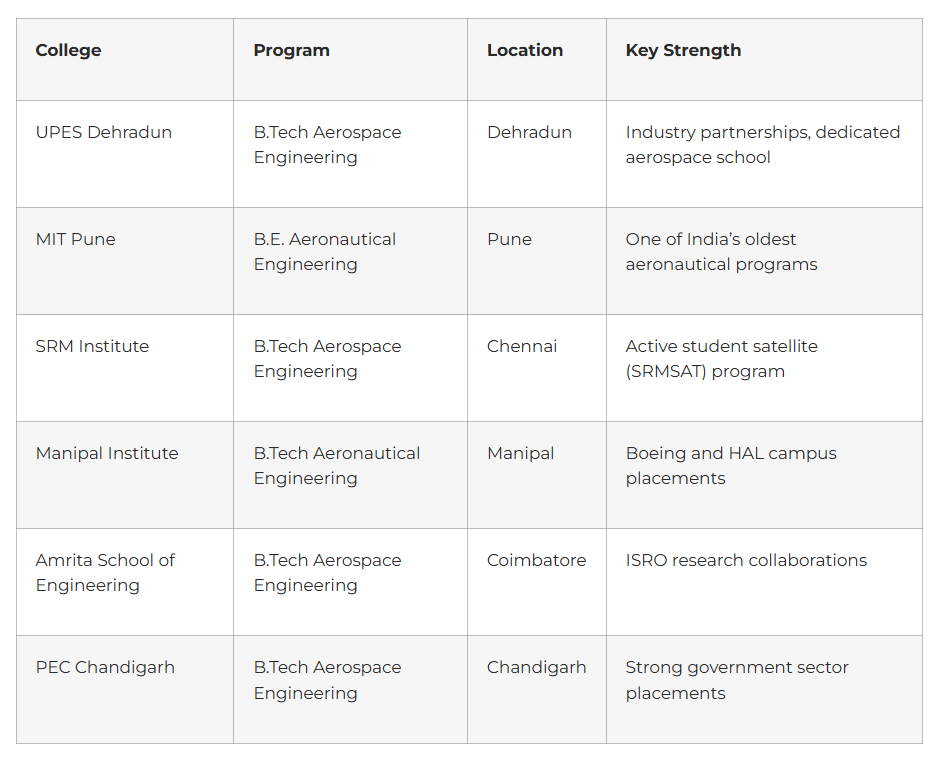
Other Strong B.Tech Options
Category 2 : Postgraduate Degree Programs
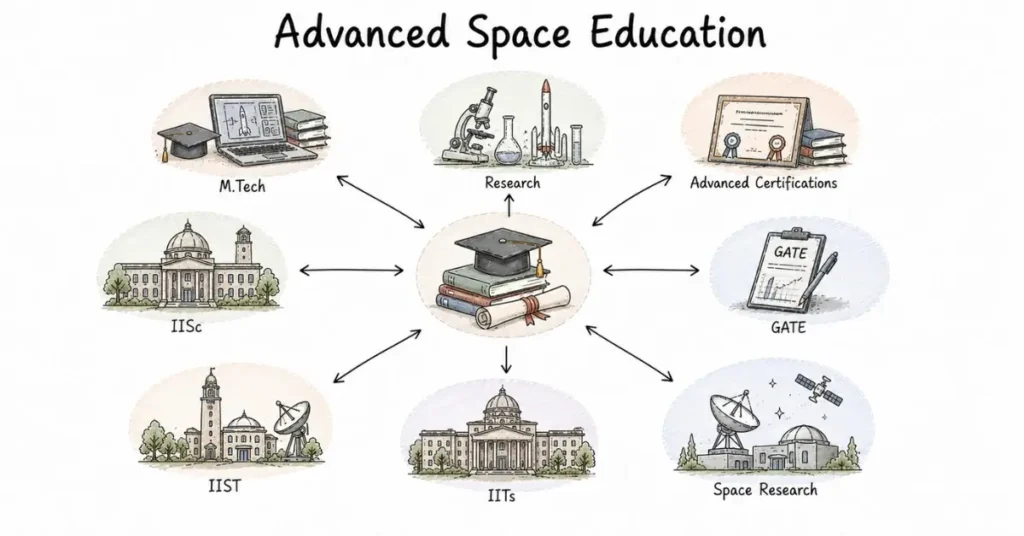
M.Tech Programs: Where to Target
An M.Tech from a reputed institution serves two purposes: deeper technical specialisation and faster access to senior roles at ISRO and aerospace companies.
IIST M.Tech Programs:
- M.Tech in Aerospace Engineering
- M.Tech in Earth System Science
- M.Tech in Solid State Physics (space applications)
- Entry: GATE (Aerospace Engineering paper code AE or relevant branch)
- IIST M.Tech graduates are similarly absorbed into ISRO, making this a second reliable path for those who missed IIST at the B.Tech level
IIT M.Tech Programs (relevant specialisations):
- IIT Bombay: M.Tech Aerospace Engineering
- IIT Madras: M.Tech Aerospace Engineering
- IIT Kharagpur: M.Tech Aerospace Engineering
- IIT Delhi: M.Tech RF and Microwave Engineering (for SATCOM roles)
- IISc Bengaluru: M.Tech Aerospace Engineering (Division of Mechanical Engineering)
- Entry: GATE: a strong GATE score in the relevant branch is the primary selection criterion
M.Tech in Remote Sensing and GIS:
- Anna University, Chennai
- Andhra University, Visakhapatnam
- Osmania University, Hyderabad
- Symbiosis Institute of Geoinformation Technology, Pune
- These are accessible to geography, environmental science, and engineering graduates
IISc Advanced Certification in Space Technologies
The Indian Institute of Science (IISc), Bengaluru in collaboration with TalentSprint offers an Advanced Certification Program in Space Technologies. This is a structured 6-month program designed specifically for working professionals and recent graduates who want to build applied space technology skills.
Duration: 6 months (part-time, weekend format)
Mode: Online with in-person immersions at IISc campus
Eligibility: B.E./B.Tech or M.Sc. in engineering or science
Topics covered: Space systems, satellite design, remote sensing, launch vehicle technology, emerging SpaceTech applications, Indian space policy
Fees: Approximately ₹1.5–2 lakh (check current fees on TalentSprint website)
Key advantage: IISc brand, faculty who are active researchers and ISRO collaborators, and a structured curriculum that covers both hardware and software sides of space technology
This program is particularly valuable for working engineers in mechanical, ECE, or CS roles who want to formally pivot into space technology without leaving their jobs.
Category 3 : ISRO's Own Training Programs
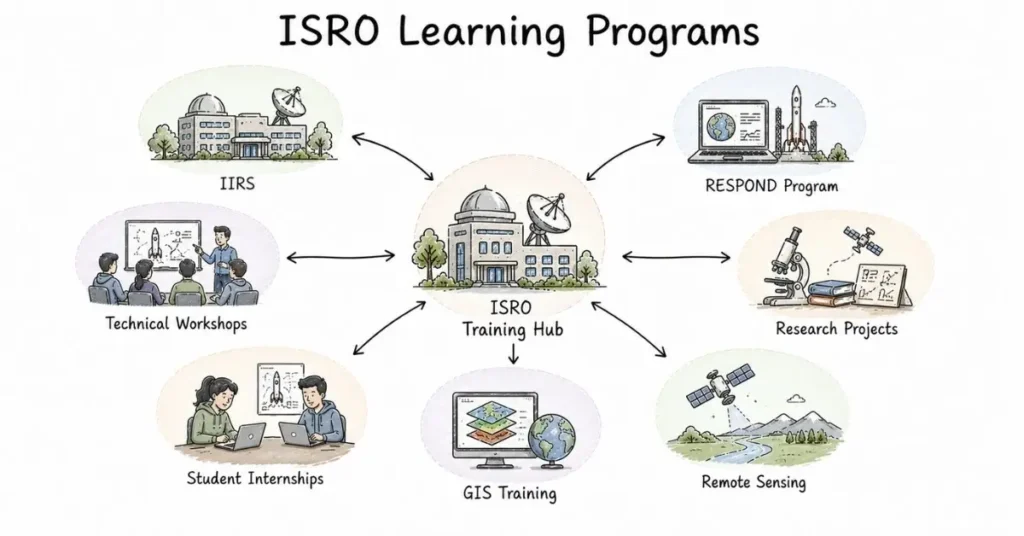
IIRS Programs (Indian Institute of Remote Sensing, Dehradun)
IIRS is ISRO’s own training and research institute for remote sensing, GIS, and geoinformatics. It is one of the most directly career-relevant training options available to anyone targeting remote sensing roles at ISRO or in the private sector.
PG Diploma in Remote Sensing and GIS:
- Duration: 1 year (full-time, residential)
- Eligibility: B.Sc./B.Tech/M.Sc. in science, engineering, or geography with minimum 55%
- Selection: Written test and interview conducted by IIRS
- Fees: Relatively modest subsidised as an ISRO institution
- Location: Dehradun, Uttarakhand
- Key advantage: Taught by ISRO scientists; direct exposure to real ISRO data and tools; strong alumni network in ISRO NRSC and state GIS departments
M.Sc. in Geoinformatics (in collaboration with Andhra University):
- 2-year full-time program
- Covers remote sensing, GIS, GPS, digital image processing, and applications
- Entry through IIRS selection process
Short-term and Online Courses:
IIRS runs a robust calendar of short-term training courses (2 days to 4 weeks) covering specific topics: microwave remote sensing, agricultural applications, urban mapping, disaster management using satellite data. Many of these are offered online and are free or nominally priced. An IIRS certificate on your resume is recognised across India’s remote sensing community.
Find the current course calendar at: iirs.gov.in
ISRO RESPOND Program (For M.Tech and Ph.D. Students)
ISRO’s RESPOND (Research Sponsorship) program funds M.Tech and Ph.D. research at Indian universities on space-related topics. If you are pursuing a postgraduate degree and your research has a space application, applying for RESPOND sponsorship gives you:
- A research stipend
- Access to ISRO data and sometimes ISRO facilities
- A direct connection to ISRO scientists as co-supervisors
- Visibility for future ISRO recruitment
Apply through your university’s research office with a proposal aligned to ISRO’s current research priorities. Details at isro.gov.in/Research.html
India Space Academy (ISA) Winter and Summer Training
The India Space Academy runs structured training programs for students at undergraduate and postgraduate levels. Programs cover satellite technology, rocket propulsion, space mission design, and remote sensing. Duration ranges from 1 week to 1 month.
These are paid programs, but they are practically oriented and give direct exposure to working space engineers as instructors. An ISA training certificate demonstrates initiative to employers it shows you pursued space knowledge beyond your coursework.
Category 4 : Online Certifications Worth Your Time
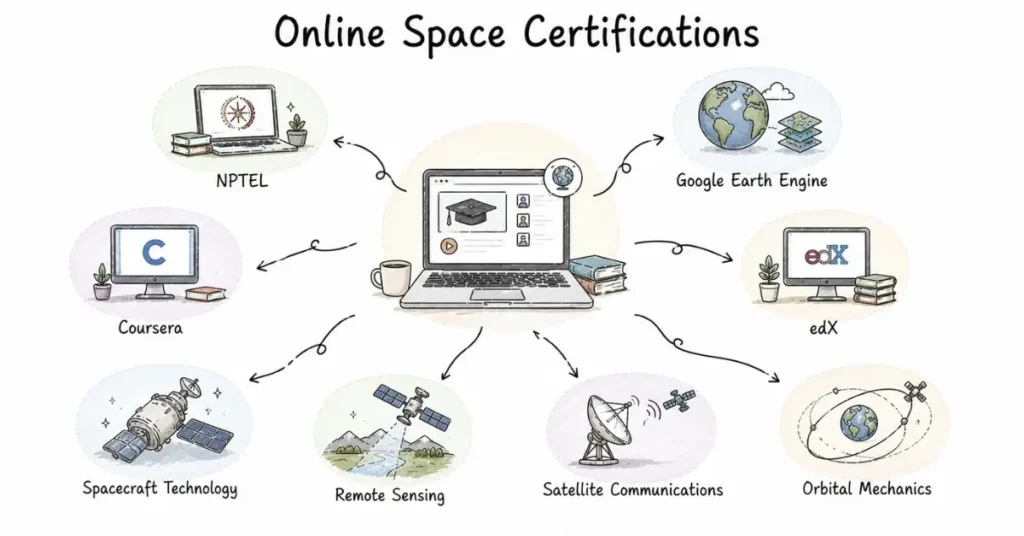
For students at colleges without strong aerospace programs, or working professionals building toward a space career transition, online certifications fill real gaps. These are the ones with genuine credibility:
NPTEL Courses (Free, IIT-taught, Certificate Available)
NPTEL (National Programme on Technology Enhanced Learning) is India’s largest online engineering education platform, run by IITs and IISc. Several courses are directly relevant:
- Spacecraft Technology: covers satellite design, orbital mechanics, propulsion fundamentals
- Rocket Propulsion: by IIT Madras; thermodynamics of propulsion systems
- Introduction to Remote Sensing: covers sensors, image processing, applications
- Antenna Theory: relevant for RF and SATCOM roles
- Digital Signal Processing: relevant for communication and sensor roles
NPTEL courses are free to audit. Certificates are available for ₹1,000–₹2,000 after a proctored exam. The IIT faculty quality is high and the certificates are recognised by Indian aerospace employers including ISRO.
Find them at: nptel.ac.in
Coursera and edX : International Certifications
Several international universities offer space technology courses that are accessible to Indian students:
- Space Mission Design and Operations: TU Delft, edX (free to audit, paid certificate)
- Spacecraft Dynamics and Control: University of Colorado Boulder, Coursera
- Satellite Communications Systems: TU Delft, edX
- Robotics and Space Exploration: University of Toronto, Coursera (relevant for Gaganyaan-era career aspirants)
- Introduction to Orbital Mechanics: Multiple providers on Coursera
These international certificates carry weight when applying to MNCs like Boeing India or Airbus, and to well-funded startups with internationally experienced founding teams.
Google Earth Engine Developer Certificate
For anyone targeting remote sensing and GIS roles, completing Google’s own GEE Developer pathway and documenting your projects publicly is the most valuable free certification available. It demonstrates practical, deployable skills rather than just theoretical knowledge.
Sign up at: earthengine.google.com
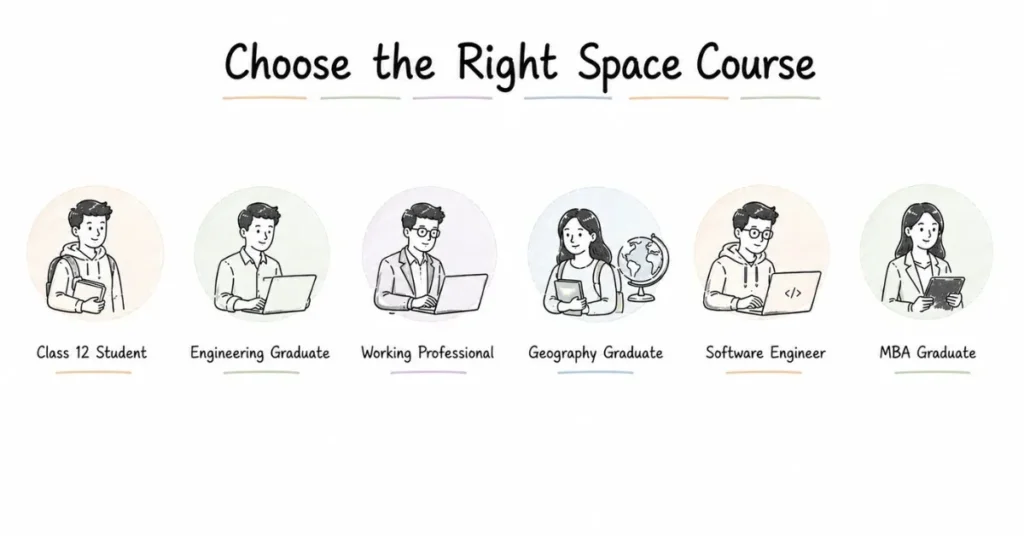
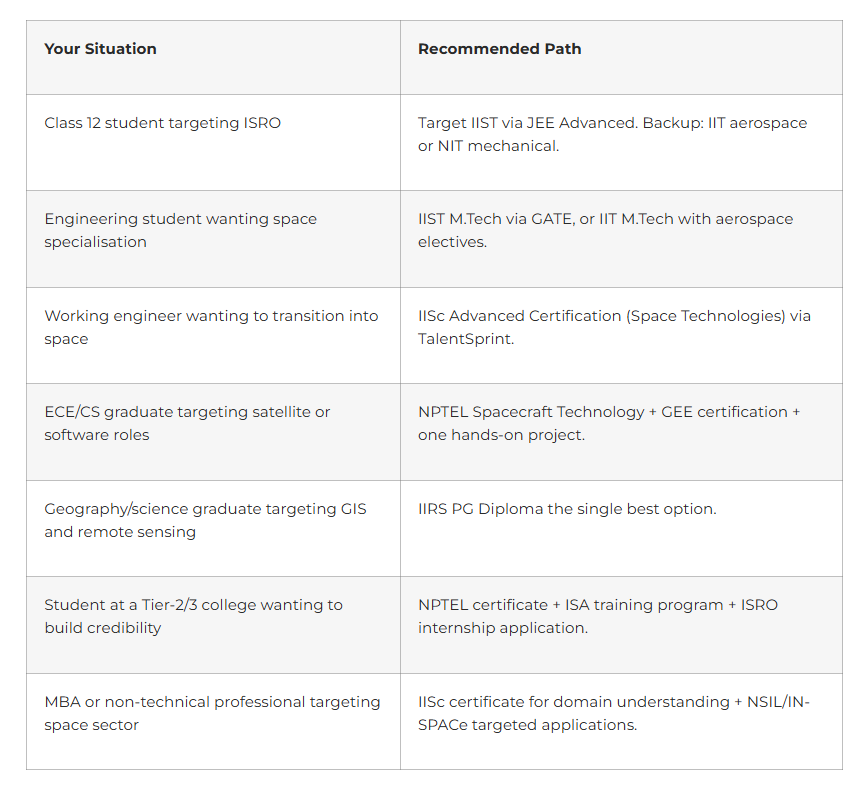
Choosing the Right Program : A Decision Guide
One Honest Note About Certifications
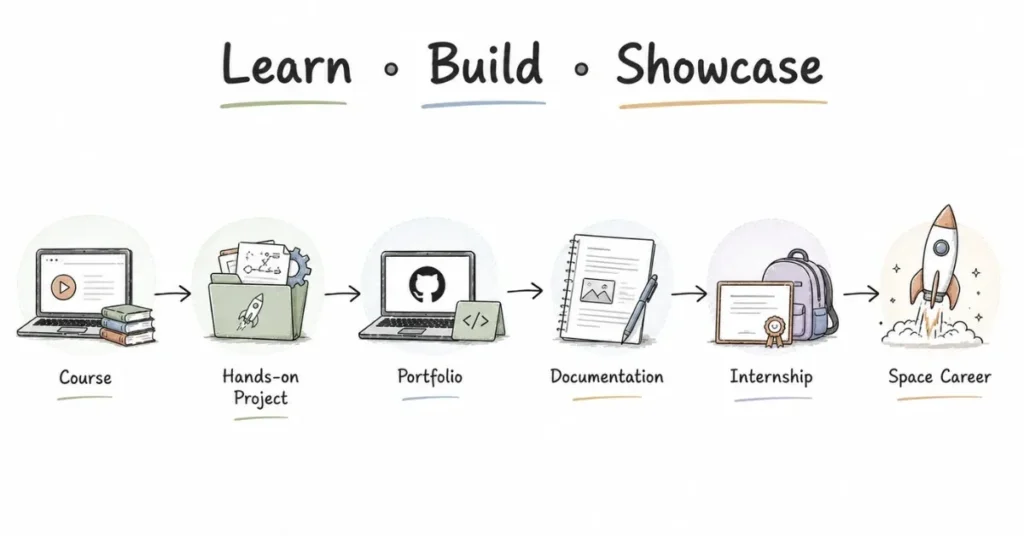
A certification without a project to back it up is wallpaper on a resume.
Every employer in India’s space sector whether ISRO, Skyroot, or Pixxel will ask you what you built, not just what course you completed. The purpose of a certification is to give you the knowledge to build something. If you complete an NPTEL course on spacecraft technology but cannot describe one thing you applied from it, the certificate does not carry weight.
The formula that works is simple: course + project + documentation. Learn something, build something with it, write about what you built. That combination consistently opens doors that credentials alone cannot.
FAQs: Space Technology Courses in India
Q: Is the IISc Advanced Certification worth the fee for a fresh graduate?
If you have a B.Tech and are genuinely targeting a space career, yes the IISc brand, the faculty quality, and the structured curriculum make it one of the highest-ROI space certifications in India. If you are still in college, focus on NPTEL and hands-on projects first and save this for post-graduation.
Q: Can I get into ISRO with only online certifications and no formal aerospace degree?
ISRO ICRB requires a B.E./B.Tech in a relevant branch online certifications alone do not substitute for this. However, certifications significantly strengthen your written exam preparation and your interview performance. They also open doors at private startups and remote sensing companies that do not have the same formal degree requirements.
Q: Are IIRS courses available for students outside Dehradun?
Yes. IIRS offers many of its short courses online accessible from anywhere in India. The PG Diploma and M.Sc. programs are residential (in Dehradun), but the growing catalogue of online courses means students in Hyderabad, Chennai, or anywhere else can access ISRO-quality remote sensing training without relocating.
Q: What is the GATE Aerospace Engineering paper, and should I take it?
GATE AE (Aerospace Engineering) covers flight mechanics, space dynamics, structures, propulsion, and aerodynamics. It is the gateway to M.Tech admissions in aerospace at IITs and IIST. It is also used for shortlisting by some PSUs. If your goal is an M.Tech in aerospace from a top institution, GATE AE is the path. If your goal is direct ISRO recruitment, GATE is not required ICRB has its own exam.