
Space Systems Engineer Career in India
Table of Contents
Introduction:
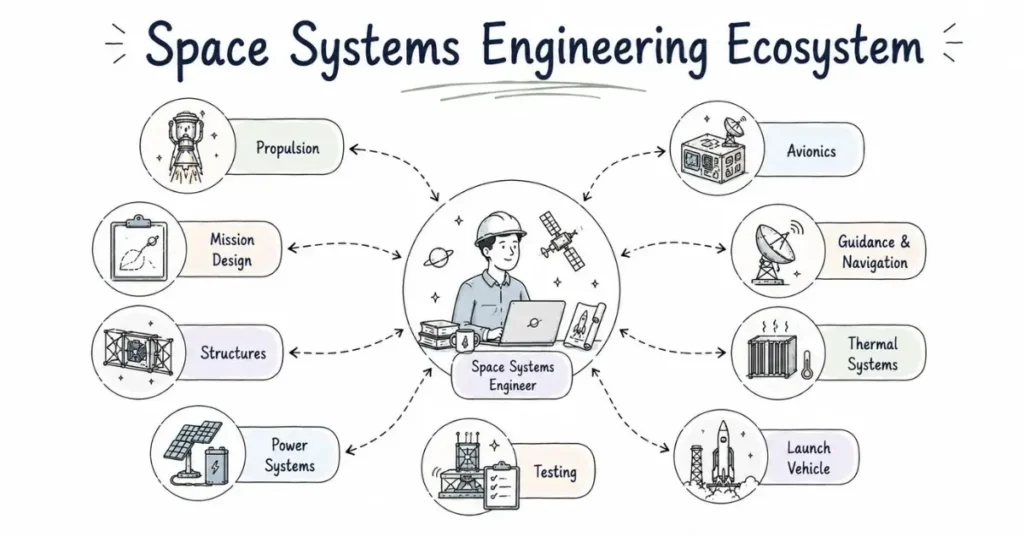
There is a role in the space sector that does not always get its own job posting but it is the one that holds everything together.
When a rocket lifts off, hundreds of individual systems have to work simultaneously: propulsion ignites and sustains thrust, avionics guides the vehicle along the correct trajectory, the structure survives the vibration and aerodynamic loads, the power system keeps every sensor alive, and the mission sequence executes at precisely the right moments. Someone has to make sure all of these systems talk to each other, do not interfere with each other, and collectively achieve the mission objective.
That person is a space systems engineer.
This guide covers what space systems engineering actually means in India, what the specific sub-roles look like (propulsion, avionics, mission design), who is hiring, what they pay, and how you build the skills to get there.
What Is Space Systems Engineering?
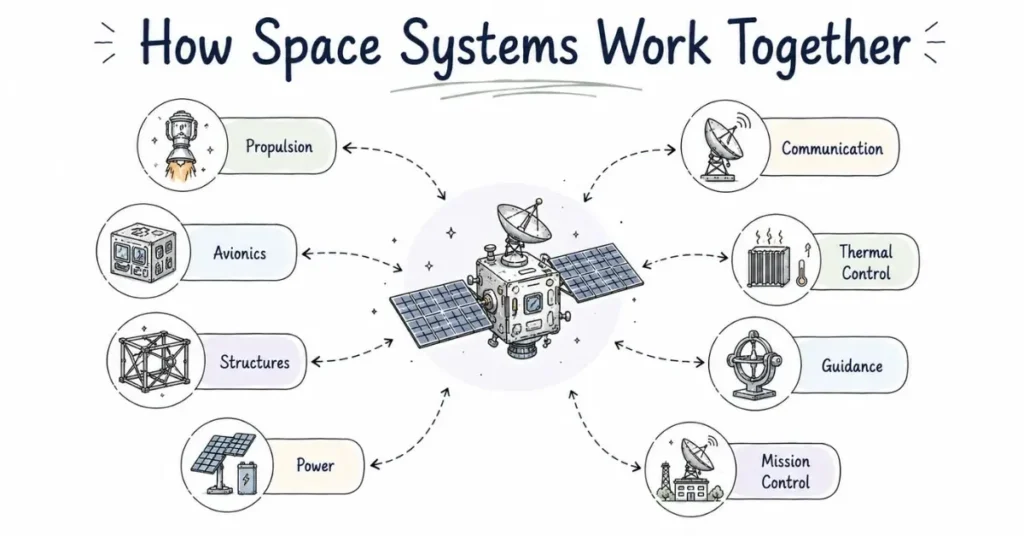
Systems engineering is the discipline of designing and managing complex systems over their entire lifecycle. In the space context, a systems engineer does not typically design a single component. Instead, they:
- Define the overall architecture of a spacecraft or launch vehicle
- Break the mission requirements down into subsystem requirements
- Ensure every subsystem interfaces correctly with every other subsystem
- Identify and manage risks across the entire system
- Verify and validate that the final product meets the original mission requirements
Think of a systems engineer as the translator between mission goals and engineering reality. The mission team says “we need a satellite that can image any point on Earth within 6 hours with 1-metre resolution.” The systems engineer figures out what orbit, what payload, what power system, what data downlink architecture, and what launch vehicle makes that possible and at what cost and weight.
Within space systems engineering, three specialisations are particularly important and widely hired in India:
Specialisation 1 : Propulsion Engineering
What Propulsion Engineers Do
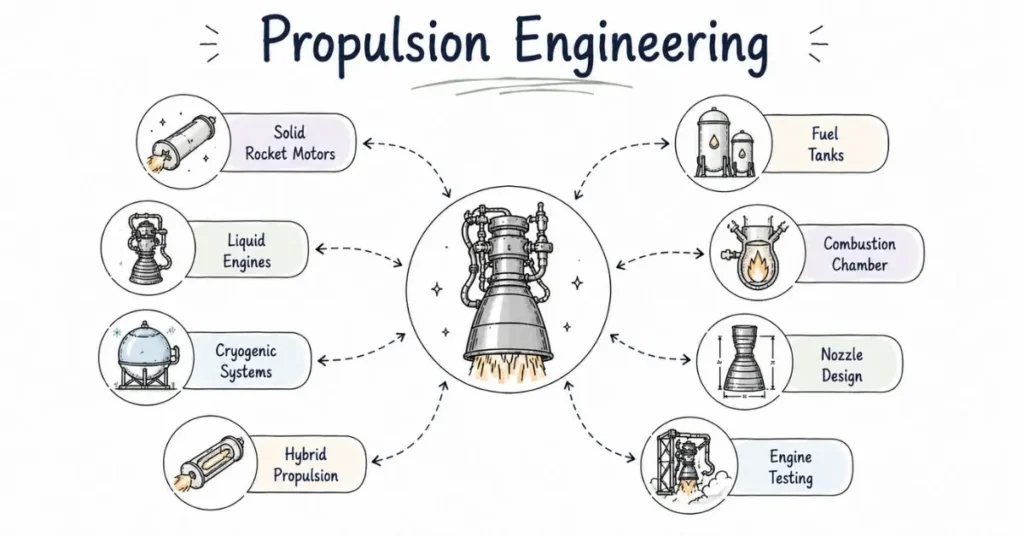
Propulsion engineers design, develop, and test the systems that generate thrust the force that pushes rockets into space and keeps satellites in their correct orbits.
In India, propulsion work spans two main areas:
Launch vehicle propulsion: The engines and motor systems that power rockets like PSLV, GSLV, and LVM3 and the private vehicles from Skyroot and Agnikul. This includes solid propellant motors, liquid propellant engines (cryogenic and semi-cryogenic), and hybrid systems.
Spacecraft propulsion: The smaller thruster systems on satellites that maintain their orbit, adjust their attitude, and de-orbit them at end of life. This is Bellatrix Aerospace’s core business and a major focus at ISRO’s LPSC.
Key Technical Skills for Propulsion Roles
- Thermodynamics and combustion theory
- Rocket propulsion fundamentals (specific impulse, thrust coefficient, nozzle design)
- Fluid mechanics particularly for liquid propellant flow systems
- CAD tools (CATIA, SolidWorks) for engine geometry design
- CFD tools (ANSYS Fluent, OpenFOAM) for combustion and flow simulation
- Materials knowledge high-temperature alloys, ceramic composites, ablative materials
- Test infrastructure knowledge propulsion testing requires specialised test stands and safety protocols
Top Employers for Propulsion Engineers
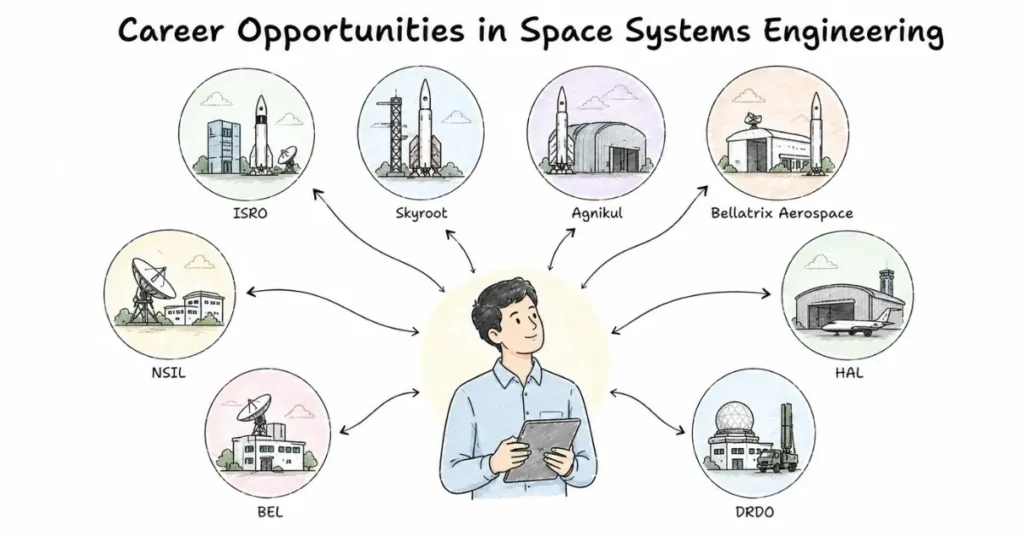
- ISRO VSSC (Vikram Sarabhai Space Centre) : designs and tests all ISRO launch vehicle propulsion systems
- ISRO LPSC (Liquid Propulsion Systems Centre) : focused specifically on liquid and cryogenic propulsion
- Skyroot Aerospace : Vikram rocket propulsion development
- Agnikul Cosmos : 3D-printed semi-cryogenic engine development
- Bellatrix Aerospace : electric and green propellant spacecraft propulsion
- DRDO (solid propellant work for defence missiles with space overlap)
Propulsion Engineer Salary in India
- Fresher: ₹6–9 LPA (startups); ₹56,100/month base (ISRO)
- Mid-level (3–7 years): ₹15–28 LPA
- Senior (7+ years): ₹30–50 LPA: propulsion is one of the highest-paid specialisations due to genuine rarity of deep expertise
Specialisation 2: Avionics Engineering
What Avionics Engineers Do
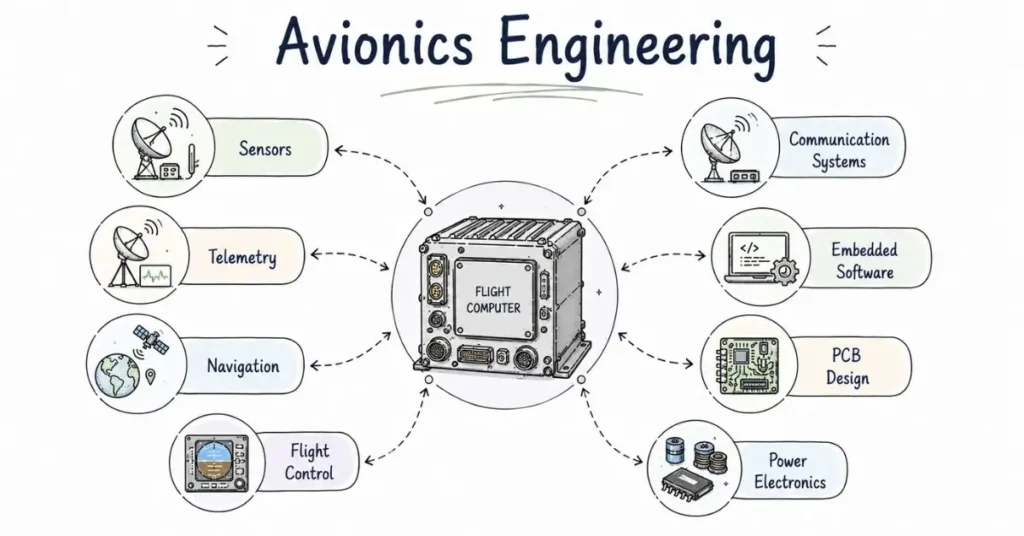
Avionics is the electronics of flying vehicles the systems that handle guidance, navigation, control, communication, and data management for rockets and spacecraft.
An avionics engineer works on:
- Flight computers: the on-board processors that execute mission logic, process sensor data, and send commands to actuators
- Inertial Navigation Systems (INS): accelerometers and gyroscopes that track the vehicle’s position and orientation
- Telemetry systems: transmit real-time vehicle data to ground stations during flight
- Command and data handling: receive commands from ground and distribute them to subsystems
- Power electronics: voltage regulation and power distribution for all avionics components
- Pyrotechnic firing circuits: the controlled electrical triggers that separate rocket stages, deploy fairings, and fire engine igniters
Avionics engineering sits between electrical engineering and software you need to understand both hardware design and the embedded software that runs on it.
Key Technical Skills for Avionics Roles
- Embedded systems programming: C and C++ on real-time processors
- RTOS (Real-Time Operating Systems): FreeRTOS, VxWorks, RTEMS
- PCB (Printed Circuit Board) design: Altium Designer, KiCad
- Digital and analog circuit design
- FPGA programming: VHDL or Verilog for hardware logic
- Communication interfaces: CAN bus, SpaceWire, MIL-STD-1553 (aerospace standard data buses)
- EMC (Electromagnetic Compatibility): ensuring electronics do not interfere with each other in the confined space of a rocket or satellite
Top Employers for Avionics Engineers
- ISRO VSSC and ISAC: avionics for launch vehicles and satellites respectively
- BEL (Bharat Electronics Limited): builds avionics systems for ISRO under work-share agreements
- HAL: avionics for aircraft and helicopters (aeronautical overlap)
- Skyroot Aerospace: full avionics stack for Vikram rocket family
- Agnikul Cosmos: avionics for Agnibaan
- Dhruva Space: satellite avionics and on-board computer systems
Avionics Engineer Salary in India
- Fresher: ₹5–9 LPA (private); ₹56,100/month base (ISRO/BEL)
- Mid-level: ₹14–25 LPA
- Senior: ₹28–45 LPA
Specialisation 3 : Mission Design and Analysis
What Mission Designers Do
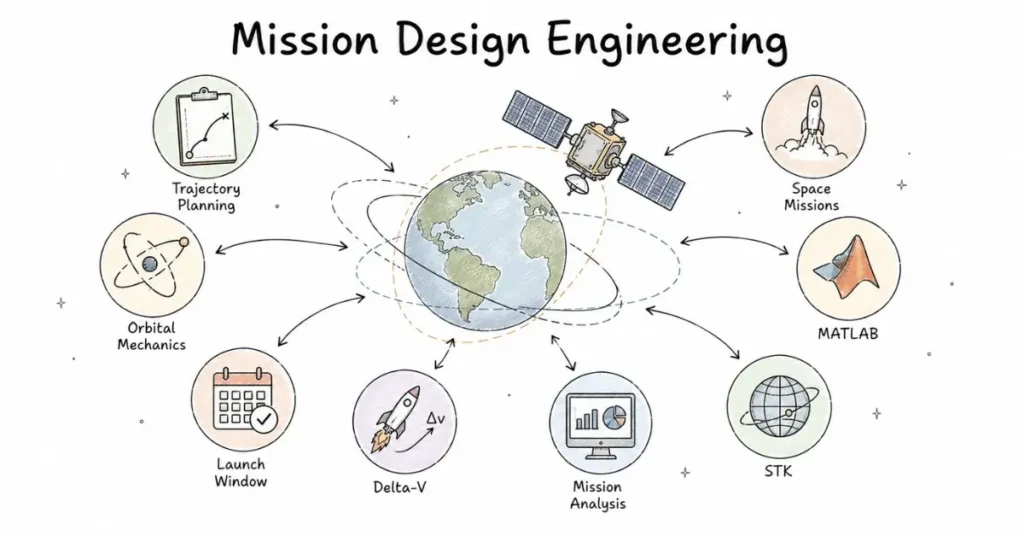
Mission design is the discipline of figuring out how to achieve a space mission objective within real-world constraints of physics, budget, and technology.
A mission designer or mission analysis engineer works on:
- Trajectory design: calculating the path a rocket or spacecraft must follow to reach its target orbit, planet, or point in space. Chandrayaan-3’s lunar transfer trajectory, Aditya-L1’s journey to the L1 Lagrange point these were designed by mission analysts.
- Orbital mechanics: understanding how orbits evolve over time, how atmospheric drag affects LEO satellites, how gravitational influences of multiple bodies affect deep space missions
- Delta-V budgeting: calculating the total velocity change a spacecraft needs to complete its mission, which directly determines how much propellant it must carry
- Launch window analysis: identifying the specific dates and times when launch is geometrically possible for the target orbit
- Re-entry and de-orbit analysis: for crewed missions (Gaganyaan) and end-of-life satellite disposal
Key Technical Skills for Mission Design
- Orbital mechanics: Kepler’s laws, two-body and n-body dynamics, perturbation theory
- STK (Systems Tool Kit): the industry-standard software for mission analysis and visualisation
- MATLAB and Python: for custom trajectory calculation and simulation
- GMAT (General Mission Analysis Tool): NASA’s open-source mission design tool, widely used
- Numerical methods: mission analysis involves solving complex differential equations numerically
- Physics fundamentals: classical mechanics, gravitational physics
Top Employers for Mission Designers
- ISRO: across VSSC (launch vehicle trajectories), ISAC (satellite orbit design), and mission planning teams for all major programs
- NSIL: mission planning for commercial launch and satellite services
- Skyroot and Agnikul: mission analysis for their launch vehicles
- Bellatrix Aerospace: orbital transfer mission design
Mission Design Engineer Salary in India
- Fresher: ₹6–10 LPA (startups); government scales at ISRO
- Mid-level: ₹16–28 LPA
- Senior: ₹30–50 LPA; senior mission designers with deep space experience are extremely rare and highly valued
The Systems Integration Role Holding It All Together
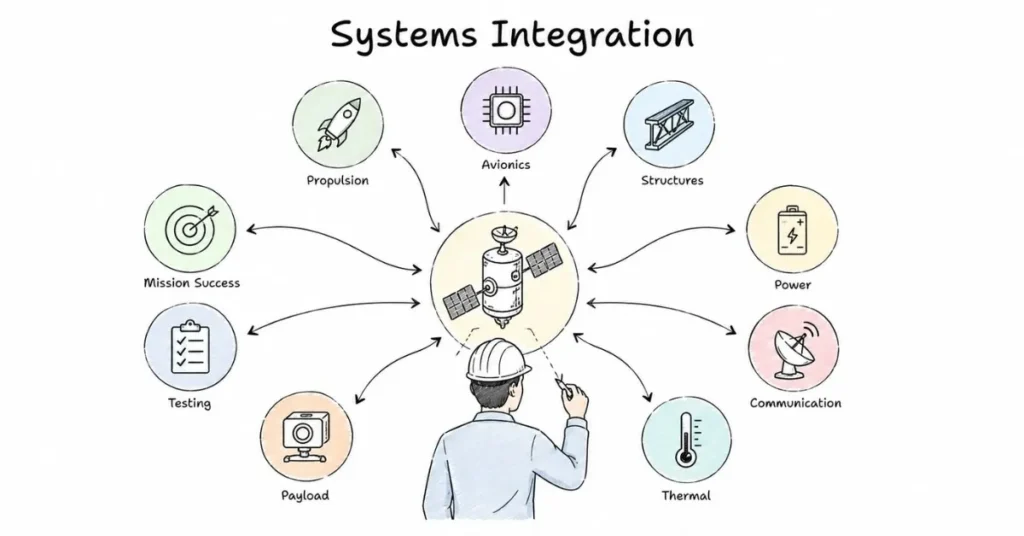
Above these three specialisations sits the pure systems engineering role the person responsible for the overall system architecture and integration.
At ISRO, this role is often called a Mission Director or Project Director at senior levels. At startups, it is typically titled Systems Engineer or Lead Systems Engineer.
The skills required at this level go beyond any single technical domain:
- Requirements management breaking high-level mission goals into traceable subsystem requirements
- Interface management documenting and controlling every physical, electrical, and data interface between subsystems
- Risk management identifying failure modes, assessing probability and impact, tracking mitigations
- Verification and validation planning and overseeing tests that prove the system does what it was designed to do
- MBSE (Model-Based Systems Engineering) using tools like SysML and Cameo Systems Modeler to create digital models of the entire system architecture
This is a role that generally requires 5–8 years of subsystem experience before someone transitions into it. You almost never start as a systems engineer you start as a propulsion, avionics, or structures engineer and grow into the systems role over time.
How to Build Toward a Space Systems Engineering Career
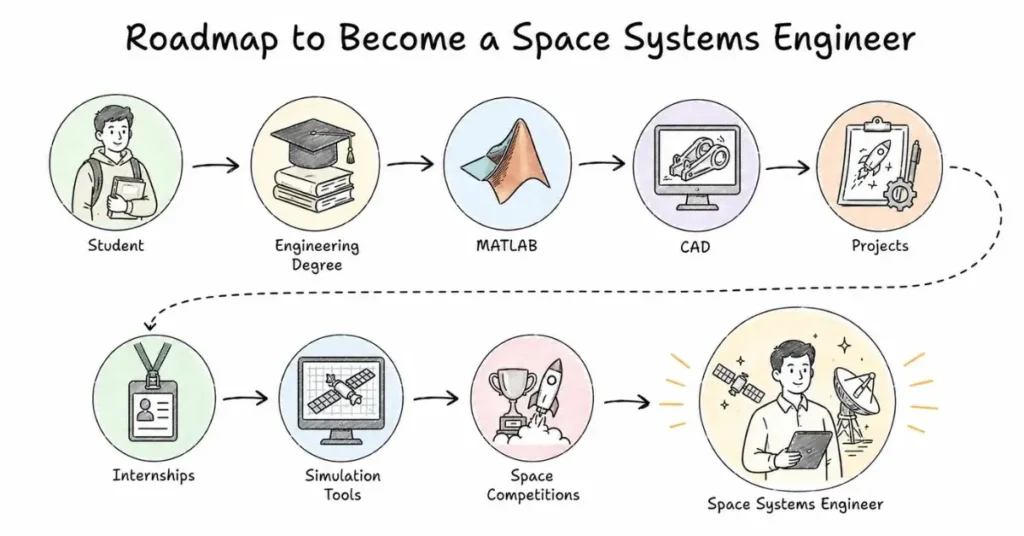
Start with one subsystem and go deep.
Pick propulsion, avionics, or mission design based on your undergraduate branch mechanical for propulsion, ECE for avionics, physics or aerospace for mission design. Spend your first 3–5 years becoming genuinely expert in that subsystem.
Use competition projects to get hands-on early.
Student rocketry competitions (Student Rocketry Challenge India, Spaceport America Cup) give you direct propulsion and avionics experience. CubeSat competitions give you systems integration experience. These are the most effective ways to build a portfolio before your first job.
Learn STK and MATLAB seriously.
Both tools are used across all three specialisations described in this guide. A strong MATLAB project demonstrating orbital mechanics or propulsion simulation is a powerful resume item. STK has a free academic licence use it.
Target ISRO VSSC or LPSC for propulsion; ISAC for avionics and systems.
These are the richest learning environments for these specialisations in India. Even an internship of 4–6 weeks gives you exposure to real hardware and processes that no coursework replicates.
Read ISRO technical publications.
ISRO publishes technical papers, annual reports, and mission descriptions that describe actual engineering decisions. Reading these builds the vocabulary and awareness that impresses interviewers. Find them at isro.gov.in and through Google Scholar searches for ISRO + your specialisation.
FAQs : Space Systems Engineer Career India
Q: Do I need an aerospace degree specifically for systems engineering?
No. Mechanical, ECE, and computer science engineers all move into space systems roles. The key is deep expertise in one subsystem area plus the ability to think across the entire system which comes with experience and deliberate effort, not a specific degree.
Q: Is mission design taught in Indian universities?
Not widely at the undergraduate level. IIT Bombay, IIT Madras, and IIST touch on orbital mechanics in their aerospace programs. Most deep mission design knowledge is learned on the job at ISRO or through self-study using tools like GMAT and MATLAB with resources from NASA and ESA.
Q: What is the difference between a systems engineer and a project manager in space?
Systems engineers are technical they own the architecture and integration of the vehicle or spacecraft. Project managers own the schedule, budget, and stakeholder communication. At ISRO, senior scientists often carry both responsibilities. At startups, the roles are usually separate.
Q: How important is simulation experience for these roles?
Extremely important. Almost every hiring manager for propulsion, avionics, and mission design roles will ask about your simulation work. MATLAB, STK, ANSYS, and CFD tools are not optional extras they are core job requirements.