
The Overlooked Resume Section That Changes Everything

Table of Contents
Your skills section is the second most important part of your resume after your professional summary. But most people treat it like an afterthought.
Here’s why your skills section deserves strategic attention: An ATS system scans your skills section first (after the header). Recruiter browsing your resume in 6 seconds glances at skills section second. Both parties are looking for a quick answer to the same question: “Do you have what we need?”
If your skills section is disorganized or missing crucial keywords, you fail both tests. You get filtered by the robot AND overlooked by the human.
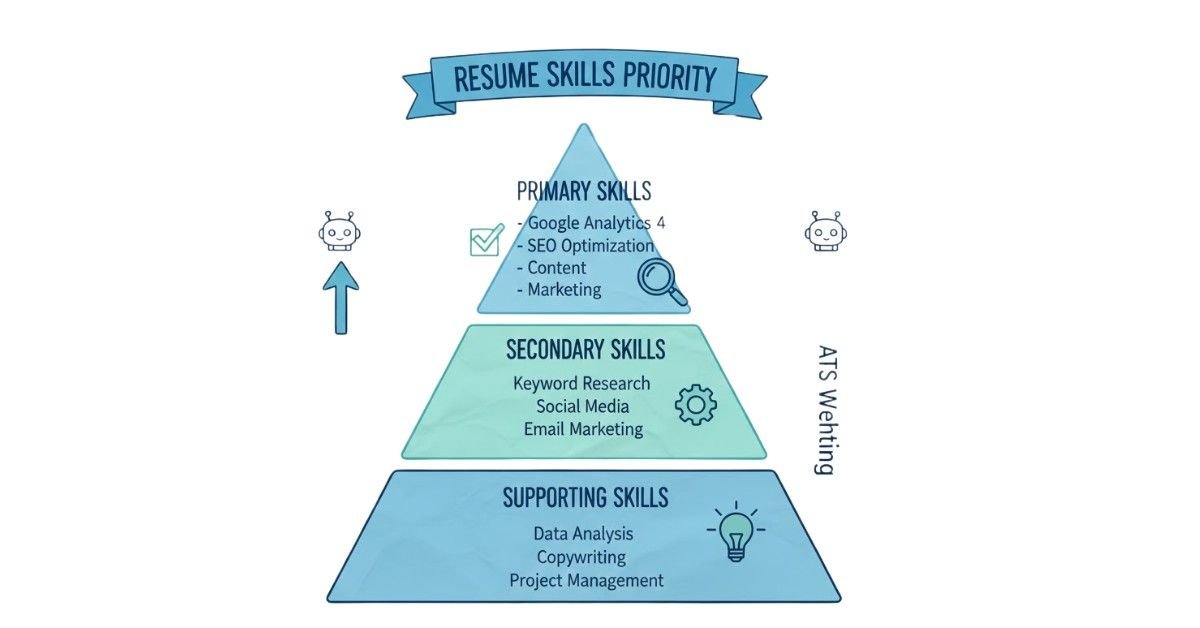
The Science Behind Skills Organization
There’s a specific structure that works best for both ATS systems and human readers. It’s not random or optional—it’s strategic.
The three-tier organization method:
- Primary Skills (Most Important) — Listed first, highest relevance
- Secondary Skills (Important) — Listed second, good-to-have skills
- Supporting Skills (Nice-to-have) — Listed third, supplementary skills
This structure matters because:
- ATS ranks matches based on position — Skills listed first are weighted more heavily
- Recruiters scan top-to-bottom — They notice tier 1 immediately
- Relevance is clear — You signal what matters most for this role

Category-Based Organization: The Winning Format
Instead of a random bullet list, organize skills into meaningful categories. This serves multiple purposes:
- ATS Parsing: System can extract skills more accurately when they’re labeled
- Recruiter Scanning: Clear categories make it easy to find specific skills
- Keyword Density: Labeled categories sometimes contain keywords (e.g., “SEO & Content” contains both terms)
Here’s the optimal format:
text
SKILLS
[Category Name]: [Skill 1], [Skill 2], [Skill 3], [Skill 4], [Skill 5]
[Category Name]: [Skill 1], [Skill 2], [Skill 3], [Skill 4]
[Category Name]: [Skill 1], [Skill 2], [Skill 3]
Real Example for Digital Marketer:
text
SKILLS
SEO & Content Marketing: Search Engine Optimization (SEO), Keyword Research, On-Page Optimization, Technical SEO, Content Strategy, Content Marketing, Blog Management, Copy Writing
Digital Marketing: Digital Marketing Strategy, Social Media Management, Campaign Management, Email Marketing, Social Media Marketing, A/B Testing, Conversion Rate Optimization
Analytics & Tools: Google Analytics 4 (GA4), Google Ads, Google Search Console, Facebook Ads Manager, LinkedIn Marketing, HubSpot, Semrush, Ahrefs
Web & Design: WordPress, Elementor Pro, Figma, Canva, HTML, CSS, WooCommerce
Leadership & Soft Skills: Team Leadership, Project Management, Cross-Functional Collaboration, Strategic Planning, Communication, Problem-Solving, Agile Methodology
Why This Works:
- 5-6 skills per category — Enough to capture keywords without overwhelming
- Related skills grouped — Easier for ATS to understand skill clusters
- Tool names included — Specific tools are often searched for
- Both long-form and acronyms — “Google Analytics 4 (GA4)” captures both search variations
Categories mirror job description — If job lists “Digital Marketing,” that category appears in your resume
“Want More Career & Resume Skill Tips? Explore Frontlines Media’s Expert Guides ”
Prioritization: What Goes First?
The position of skills matters significantly. Skills listed first in your Primary section are weighted higher by ATS algorithms.
Priority Hierarchy:
Tier 1 – Primary Category (Most Important):
- Skills directly mentioned in job description
- Skills with 3+ mentions across job posting
- Skills most critical to the role
Tier 2 – Secondary Category:
- Skills mentioned once or twice in job posting
- Highly relevant supporting skills
- Common across your industry
Tier 3 – Tertiary Category:
- Nice-to-have skills
- General professional skills
- Soft skills and tools you know but aren’t central to this role
Example for a Data Analytics role:
Correct Priority Order:
- Data Analytics & Tools (most mentioned in job = primary)
- Data Visualization & BI Tools (important but secondary)
- Programming & SQL (supporting tools)
- Business & Analysis (soft skills)
Incorrect Priority Order:
- Microsoft Office (generic, not role-specific)
- Leadership (less critical for analytics role)
- Data Visualization (should be higher)
- Data Analytics (should be first!)
The Long-Form vs. Acronym Strategy
Many skills have both versions. The smart approach is including both:
Marketing Skills Example:
Instead of: “SEO” (only acronym)
Or: “Search Engine Optimization” (only full form)
Write: “Search Engine Optimization (SEO)” (both versions)
Why? Different recruiters search differently:
- Some search for “SEO”
- Some search for “Search Engine Optimization”
- You want to appear in both results
Other Common Examples:
- “Google Analytics 4 (GA4)” not just “GA4”
- “Conversion Rate Optimization (CRO)” not just “CRO”
- “Customer Relationship Management (CRM)” not just “CRM”
- “Application Programming Interface (API)” not just “API”
- “Master of Business Administration (MBA)” in education section
Rule of Thumb: If it has a widely-used acronym, include both.

“Build High-Demand Skills That Recruiters Search For — Explore Job-Ready Courses
Skills Section by Role Type
Different roles require different skill emphasis. Here’s how to structure skills for various positions:
For Entry-Level/Fresher Positions:
text
TECHNICAL SKILLS
Web Development: HTML, CSS, JavaScript, React, Node.js, WordPress, Git, REST APIs
Tools & Platforms: VS Code, GitHub, Figma, Chrome DevTools
ACADEMIC SKILLS
Relevant Coursework: Full-Stack Web Development, Database Management, Software Engineering Principles, Data Structures
SOFT SKILLS
Communication, Problem-Solving, Team Collaboration, Quick Learner, Adaptability
Why this works: Emphasizes academic background and tools since experience is limited. Shows relevant coursework signals capability even without work history.
For Mid-Level Professionals (3-7 years):
text
CORE COMPETENCIES
Project Management: Agile/Scrum, Project Planning, Resource Allocation, Stakeholder Management, Risk Management, Timeline Management
Leadership: Team Management, Performance Management, Cross-Functional Leadership, Training & Development, Mentoring, Delegation
TECHNICAL SKILLS
Tools & Platforms: Jira, Asana, Microsoft Project, Slack, Confluence, Azure DevOps
SOFT SKILLS
Strategic Planning, Decision-Making, Communication, Negotiation, Change Management, Problem-Solving
Why this works: Emphasizes management and strategic capabilities. Includes specific tools you’ve mastered. Balance of technical and soft skills.
For Senior/Experienced Professionals (7+ years):
text
EXECUTIVE COMPETENCIES
Strategic Leadership: Business Strategy, P&L Management, Market Analysis, Competitive Positioning, Growth Strategy, Organizational Development
Team & Department Leadership: C-Suite Collaboration, Board Presentations, Department Management (teams of 10+), Talent Acquisition & Development, Culture Building, Change Management
DOMAIN EXPERTISE
[Your Industry/Field Specific]: [Specific methodologies and frameworks you’ve mastered]
BUSINESS TOOLS
Data & Analytics: Tableau, Power BI, Advanced Excel, SQL, Salesforce Analytics
Project Management: SAP, Oracle, Enterprise Resource Planning (ERP), Workday
Why this works: Emphasizes strategic impact and leadership. Shows ability to manage large teams and drive business results. Includes enterprise-level tools.
Technical Skills: Be Specific, Not Generic
Generic Skills (Low ATS Score):
- “Good at computers”
- “Tech-savvy”
- “Experienced with software”
- “Know Microsoft products”
Specific Skills (High ATS Score):
- “Excel: VLOOKUP, Pivot Tables, Macros, Data Visualization”
- “Microsoft Project: Gantt Charts, Resource Planning, Risk Management”
- “Salesforce: CRM Configuration, Custom Reports, Sales Cloud Administration”
- “Python: Data Analysis, Automation, Web Scraping, Pandas, NumPy”
The difference? Specific skills are searchable and prove competency. Generic skills could mean anything.
Soft Skills: Include But Don't Overdo
Soft skills are important but easily overlooked if you overdo them. The rule:
Do Include Soft Skills If:
- They’re explicitly mentioned in job description
- They’re relevant to the specific role
- You have examples to back them up in your experience section
Don’t Include If:
- They’re generic (“communication,” “teamwork,” “responsible”)
- They’re not mentioned anywhere in job description
- You haven’t demonstrated them in previous roles
Good Soft Skills Choices:
- Leadership (if you managed people)
- Project Management (if you led projects)
- Strategic Planning (if you created strategies)
- Cross-Functional Collaboration (if you worked across departments)
- Problem-Solving (if you solved specific problems)
- Negotiation (if you negotiated contracts/deals)
- Presentation Skills (if you presented to audiences)
Skills to Avoid (Too Generic):
- “Hardworking”
- “Motivated”
- “Team player”
- “Proactive”
- “Excellent communication” (prove it through your bullets instead)
- “Good listener”
Certifications & Credentials Section
This deserves its own mini-section within skills:
text
CERTIFICATIONS & CREDENTIALS
– Google Analytics Certification (Issued: March 2024)
– HubSpot Inbound Marketing Certification (Issued: August 2023)
– Certified Project Manager (CPM) – PMI (Issued: January 2022)
– AWS Certified Solutions Architect (Issued: June 2023)
Why separate? Certifications are credentials that prove competency. They’re often searched for specifically and deserve prominence.
Format correctly:
- Certification name
- Issuing organization (optional but helpful)
- Date issued (shows recency)
- Skip expiration dates (unless specifically relevant)
Languages Section (Especially Important for India)
If you speak multiple languages, this is valuable:
text
LANGUAGES
– English (Fluent / Native)
– Hindi (Native / Fluent)
– Telugu (Fluent / Conversational)
– Marathi (Basic)
Proficiency Levels (Use One):
- Native: Your first language
- Fluent: Can have complex conversations, read/write professionally
- Intermediate: Can manage most daily conversations
- Conversational: Can handle basic interactions
- Basic: Limited vocabulary, learning stage
For Indian companies targeting multiple regions (Telangana, Andhra Pradesh, Maharashtra), language skills are a significant advantage.
Real-World Skills Section Examples
EXAMPLE 1: Digital Marketing Manager
text
SKILLS
Digital Marketing & SEO: Digital Marketing Strategy, Search Engine Optimization (SEO), Keyword Research, Technical SEO, Content Strategy, Content Marketing, Blog Optimization, Copy Writing, SEM
Marketing Tools & Platforms: Google Analytics 4 (GA4), Google Ads, Google Search Console (GSC), Facebook Ads Manager, LinkedIn Marketing, Semrush, Ahrefs, HubSpot, Mailchimp
Web & Design: WordPress, Elementor Pro, Figma, Canva, Basic HTML/CSS, WooCommerce, Page Builder
Social Media & Content: Social Media Management, Social Media Marketing, Community Management, Instagram, LinkedIn, Facebook, Content Calendar Management
Leadership & Soft Skills: Team Leadership, Project Management, Cross-Functional Collaboration, Strategic Planning, Communication, Problem-Solving, Agile/Scrum
LANGUAGES
– English (Fluent)
– Hindi (Native)
– Telugu (Fluent)
CERTIFICATIONS
– Google Analytics Certification (March 2024)
– HubSpot Inbound Marketing Certification (August 2023)
EXAMPLE 2: Data Analyst
text
SKILLS
Data Analytics & Business Intelligence: Data Analysis, SQL, Python, Data Visualization, Business Intelligence, Statistical Analysis, Dashboard Development, KPI Tracking, Predictive Analytics
BI Tools & Platforms: Tableau, Power BI, Excel (Advanced), Google Analytics 4, Looker, Microsoft SQL Server
Programming Languages: Python (Pandas, NumPy, Matplotlib), SQL (Complex Queries, Stored Procedures), R (Basic), VBA
Databases: MySQL, PostgreSQL, Microsoft SQL Server, MongoDB
Soft Skills: Analytical Thinking, Problem-Solving, Attention to Detail, Data-Driven Decision Making, Stakeholder Communication, Documentation
TECHNICAL PROFICIENCY
– Advanced: Excel, SQL, Tableau
– Intermediate: Python, Power BI
– Basic: R, MongoDB
LANGUAGES
– English (Fluent)
– Hindi (Native)
CERTIFICATIONS
– Google Analytics Certification (Issued: 2024)
– Tableau Desktop Specialist (Issued: 2023)
EXAMPLE 3: Project Manager
text
SKILLS
Project Management & Leadership: Project Planning & Execution, Agile/Scrum Methodology, Waterfall Methodology, Risk Management, Stakeholder Management, Resource Allocation, Budget Management, Team Leadership, Performance Management
Project Management Tools: Jira, Asana, Monday.com, Microsoft Project, Confluence, GitHub, Slack
Communication & Strategy: Strategic Planning, Executive Communication, Presentation Skills, Cross-Functional Collaboration, Conflict Resolution, Change Management
Domain-Specific: Software Development Lifecycle (SDLC), Product Management, Process Improvement, Quality Assurance (QA), IT Service Management (ITSM)
CERTIFICATIONS
– Certified Scrum Master (CSM) – Scrum Alliance (Issued: 2023)
– Project Management Professional (PMP) – PMI (Issued: 2022)
– Agile Certified Practitioner (ACP) – PMI (Issued: 2023)
LANGUAGES
– English (Fluent)
– Hindi (Native)
– Marathi (Conversational)
Skills Section Optimization Checklist
Before finalizing:
- ✓ Are primary skills (most relevant to job) listed first?
- ✓ Are skills organized into meaningful categories?
- ✓ Do you include both long-form and acronym for important terms?
- ✓ Are skills directly mentioned in job description included?
- ✓ Is there a separate Certifications section with dates?
- ✓ Are soft skills limited to 5-7 most relevant?
- ✓ Did you remove generic/overused terms?
- ✓ Are skills specific (not “good communication” but actual skills)?
- ✓ Are tool names and platforms explicitly listed?
- ✓ Does skills section align with experience bullets?
- ✓ For Indian roles, are relevant languages included?