
India's Private Space Startups Careers at Skyroot, Agnikul, Pixxel & More
Table of Contents
Introduction
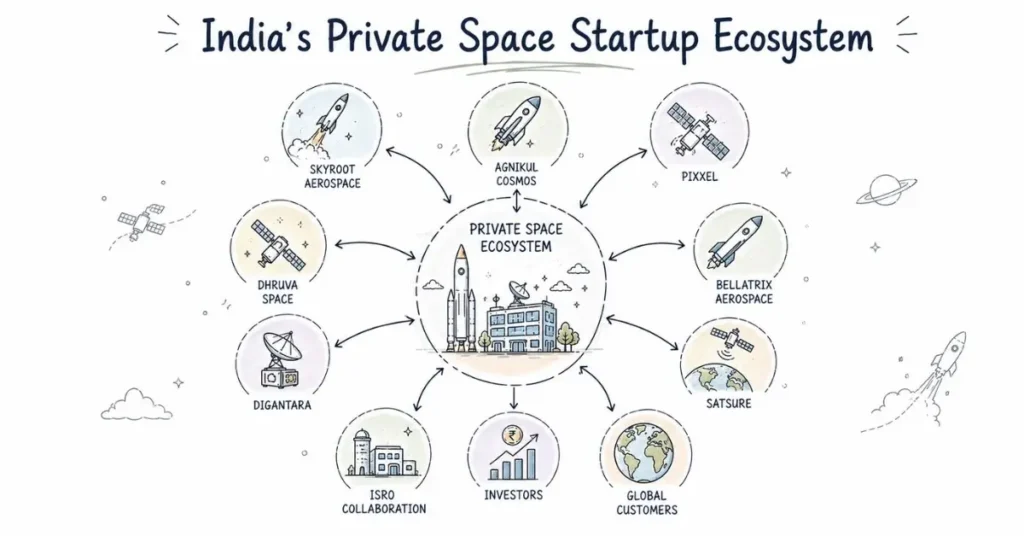
In 2022, a small team from Hyderabad rolled a rocket called Vikram-S onto a launch pad at Sriharikota. It was not ISRO’s rocket. It was built by Skyroot Aerospace a company founded by two former ISRO engineers who left their government jobs to build India’s first private launch vehicle.
Vikram-S flew successfully. And in doing so, it did not just prove a technology. It proved that a career in India’s space sector no longer means waiting for an ISRO vacancy notification.
India’s private space ecosystem has matured faster than almost anyone predicted. As of 2025, over 300 space startups are active in India, collectively raising hundreds of millions in funding and building hardware that is actually flying. These companies are hiring and they offer something ISRO genuinely cannot: the chance to own significant work from day one, see it fly within months rather than years, and be part of a team small enough that your individual contribution is impossible to miss.
This guide covers the most important private space startups in India, what they do, what roles they hire for, and how you break in.
Why Private Space Startups Are a Serious Career Option Now
Five years ago, telling your parents you were joining a space startup instead of ISRO would have been a difficult conversation. Today, the calculus has changed.
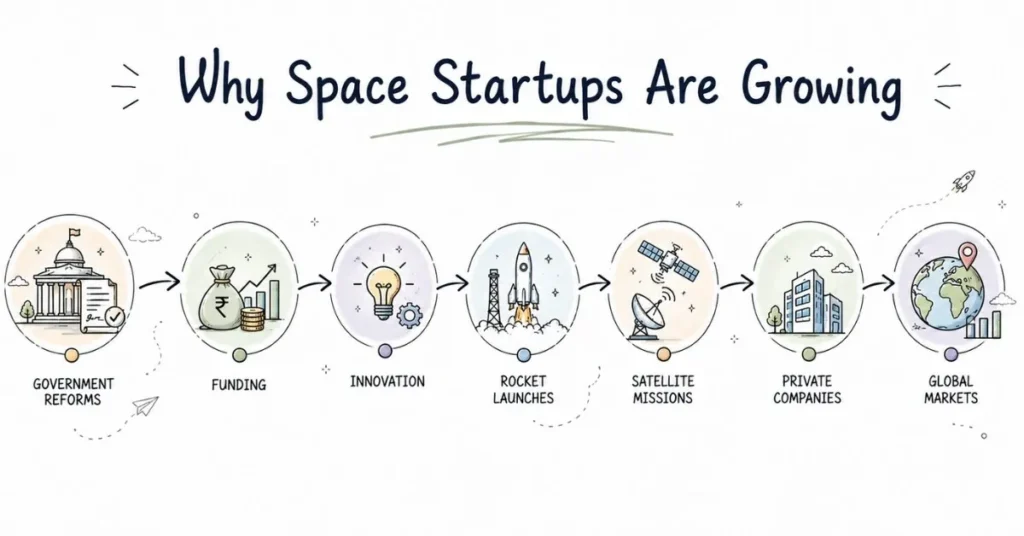
India’s top space startups are not garage experiments. They are well-funded, technically credible companies with real hardware in orbit or on launch pads, active government contracts, and international clients. Here is what makes them worth considering seriously:
Funding is real and substantial. India’s private space sector raised approximately $617 million in cumulative funding by end of 2024, with FY25 alone seeing nearly ₹1,250 crore invested. The government added a ₹1,000 crore IN-SPACe Venture Capital Fund and ₹500 crore Technology Adoption Fund on top of private investment.
Hardware is flying. Skyroot launched Vikram-S. Agnikul flew the world’s first rocket with a fully 3D-printed engine Agnibaan SOrTeD in May 2024. Pixxel has multiple hyperspectral satellites in orbit. Dhruva Space has deployed satellites through ISRO launches. These are not promises. They are track records.
The career progression is faster. An engineer at a space startup with 3 years of experience often carries responsibilities that would take 8–10 years to reach at ISRO. The title may be less prestigious but the depth of ownership is significantly higher.
The Major Players India's Top Private Space Companies
Skyroot Aerospace (Hyderabad)
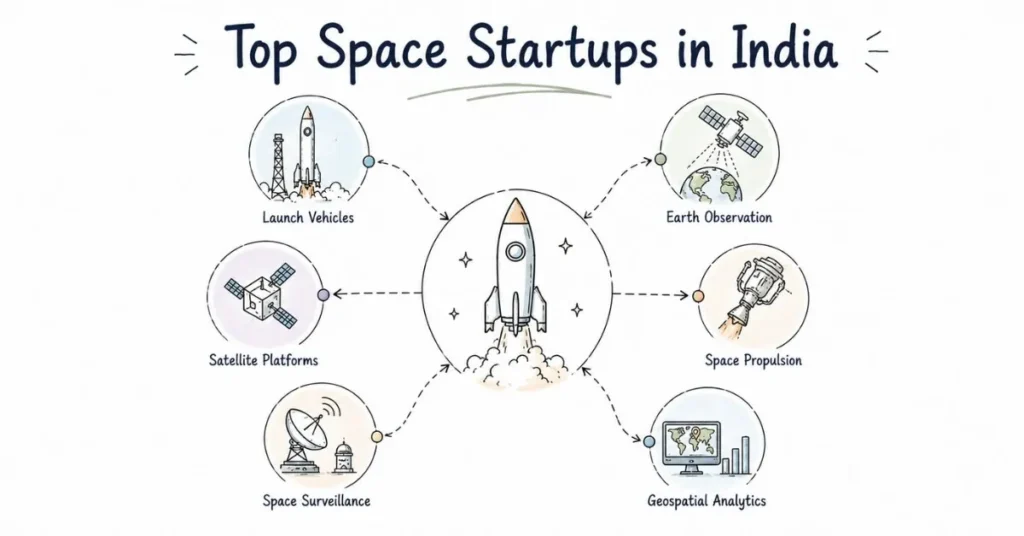
What they do: Build launch vehicles. Their Vikram rocket family ranges from Vikram-S (a single-stage solid rocket) to Vikram-1 and Vikram-2 (orbital launch vehicles). Founded in 2018 by Pawan Kumar Chandana and Bharath Daka, both ex-ISRO engineers.
Why they matter: First Indian private company to successfully launch a rocket. Well-funded (raised over $68 million). Active ISRO launch site access. Targeting commercial small satellite launch market.
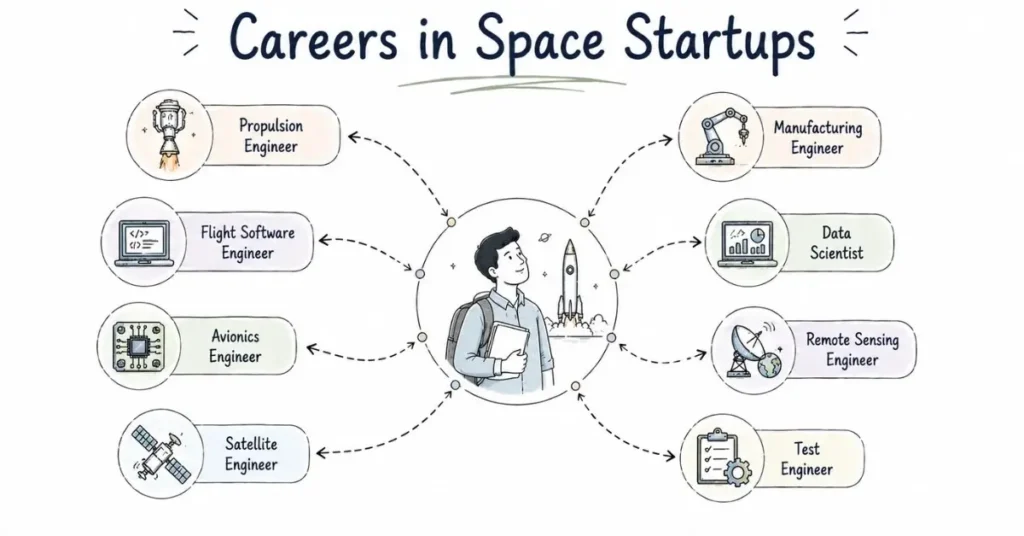
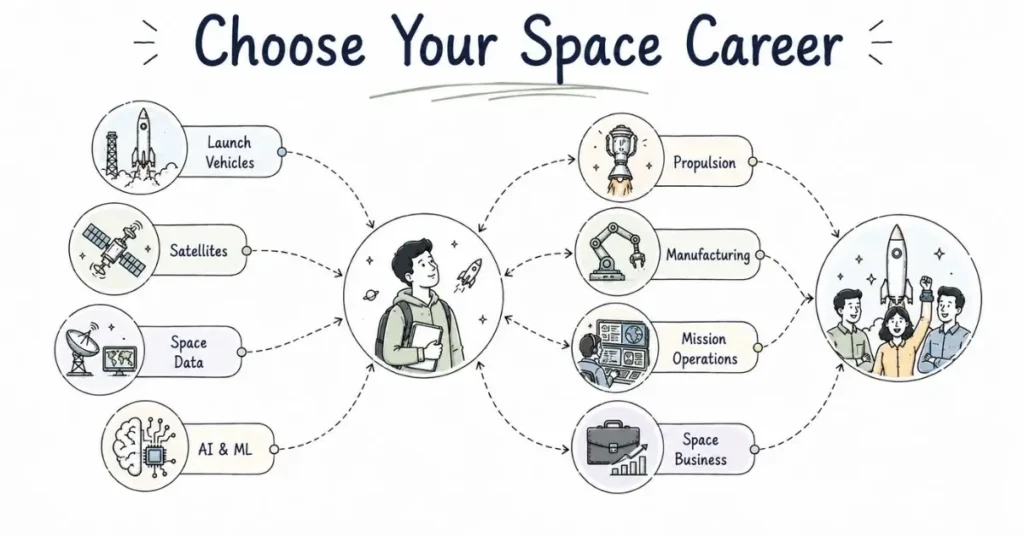
Who they hire: Propulsion engineers, structures engineers, avionics engineers, systems engineers, manufacturing engineers, GNC (Guidance Navigation and Control) engineers, flight software developers, and test engineers.
Culture: Fast-paced, high ownership, small teams. Engineers wear multiple hats. Work is hands-on you are not running simulations all day; you are building and testing hardware.
How to apply: skyroot.in/careers direct applications. Also actively recruits on LinkedIn.
Agnikul Cosmos (Chennai)
What they do: Build semi-cryogenic launch vehicles. Their rocket Agnibaan uses a revolutionary fully 3D-printed engine called AgniletTM the world’s first of its kind. Founded in 2017 out of IIT Madras by Srinath Ravichandran and Moin SPM.
Why they matter: Agnibaan SOrTeD’s successful flight in May 2024 was one of the most significant milestones in Indian private space history. Their 3D-printing approach dramatically reduces manufacturing time and cost a genuine technological edge.
Who they hire: Propulsion engineers (cryogenic and semi-cryogenic), manufacturing engineers (additive manufacturing expertise is a plus), avionics engineers, structures engineers, flight software engineers, and test engineers.
Culture: Deep technology focus. Strong IIT Madras academic connection. Research-driven engineering culture. Smaller team than Skyroot, which means even higher individual ownership.
How to apply: agnikul.in/careers direct applications and LinkedIn.
Pixxel (Bengaluru)
What they do: Build and operate a constellation of hyperspectral Earth observation satellites. Hyperspectral imaging captures hundreds of wavelength bands simultaneously far more than standard cameras enabling detection of crop disease, mineral deposits, pollution, and dozens of other applications invisible to normal cameras. Founded in 2019 by Awais Ahmed and Kshitij Khandelwal.
Why they matter: Pixxel has already launched multiple satellites and is building a full constellation. Their data platform serves agriculture, mining, environmental monitoring, and defence sectors globally. Well-funded with international clients.
Who they hire: Satellite systems engineers, payload engineers (optical and hyperspectral), AOCS engineers, flight software engineers, data scientists, remote sensing engineers, and machine learning engineers for their data analytics platform.
Culture: Strong blend of hardware and software. Data and analytics teams work alongside satellite engineers. International in outlook Pixxel has global clients and a globally-oriented team.
How to apply: pixxel.space/careers direct applications.
Dhruva Space (Hyderabad)
What they do: Build satellite platforms and provide satellite deployment and in-orbit operations services. Think of Dhruva Space as a company that builds the standardised “bus” that other organisations can plug their payloads into dramatically reducing the cost and complexity of building a satellite. Founded in 2012 one of India’s oldest active space startups.
Why they matter: Dhruva Space has deployed satellites successfully and has active contracts with government and commercial clients. Their satellite platform approach is directly aligned with India’s growing need for affordable satellite access.
Who they hire: Satellite systems engineers, AOCS engineers, power systems engineers, structures engineers, ground systems engineers, thermal engineers, and operations staff.
Culture: More structured than early-stage startups Dhruva is one of the more established companies in the ecosystem. Methodical engineering culture with a mix of experienced ISRO alumni and young engineers.
How to apply: dhruvaspace.com/careers and LinkedIn.
Bellatrix Aerospace (Bengaluru)
What they do: Develop in-space propulsion systems the thrusters and engines that satellites and spacecraft use once they are already in orbit. Their electric propulsion and green propellant thruster systems are used by satellites needing to change orbit, maintain station, or de-orbit at end of life. Founded in 2015 by Rohan Ganapathy and Yashas Karanam (both IISc alumni).
Why they matter: In-space propulsion is a critical bottleneck as satellite constellations scale. Every satellite in a LEO constellation needs propulsion to maintain its orbit and avoid collisions. Bellatrix has active orders from domestic and international clients.
Who they hire: Propulsion engineers (electric and chemical), mechanical engineers, embedded systems engineers, and test engineers.
Culture: Deep technology, research-driven. Strong IISc alumni culture. Relatively small and specialised.
Digantara (Bengaluru)
What they do: Space situational awareness tracking objects in Earth orbit to prevent satellite collisions. As the number of satellites grows exponentially, knowing where every object in orbit is becomes critical. Digantara builds sensors and data platforms for this. Founded in 2018.
Why they matter: Space debris and collision avoidance is one of the fastest-growing concerns in the global space industry. Digantara has government and commercial clients across India and internationally.
Who they hire: Sensors engineers, data scientists, software engineers, orbital mechanics analysts, and business development professionals.
SatSure (Bengaluru)
What they do: Satellite data analytics using data from Earth observation satellites to solve problems in agriculture, infrastructure, banking, and insurance. SatSure does not build satellites; it uses satellite data to build decision-making tools.
Why they matter: The downstream applications of satellite data are enormous and largely untapped in India. SatSure serves agricultural lenders, infrastructure monitoring companies, and government agencies. Their work sits at the intersection of satellite technology and data science.
Who they hire: Remote sensing engineers, GIS analysts, data scientists, machine learning engineers, and business analysts. Strong option for non-traditional space backgrounds.
Salary at India's Private Space Startups
This is where startup careers differ most noticeably from government roles:
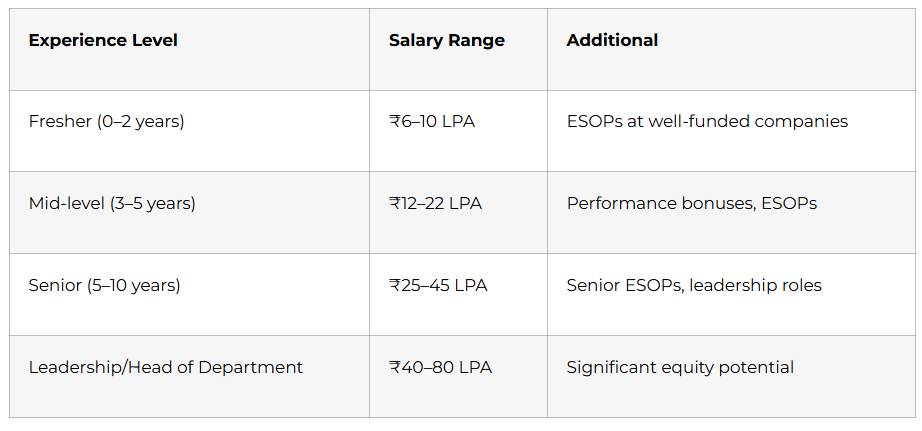
The ESOP (Employee Stock Ownership Plan) component is important and often underestimated. Early employees at Skyroot, Agnikul, and Pixxel who received ESOPs when these companies were pre-revenue now hold stakes that could be worth crores if these companies reach IPO or acquisition stages. This is not guaranteed startup equity always carries risk but it is a real potential upside that ISRO and HAL simply cannot offer.
How Startup Hiring Works - What They Actually Look For
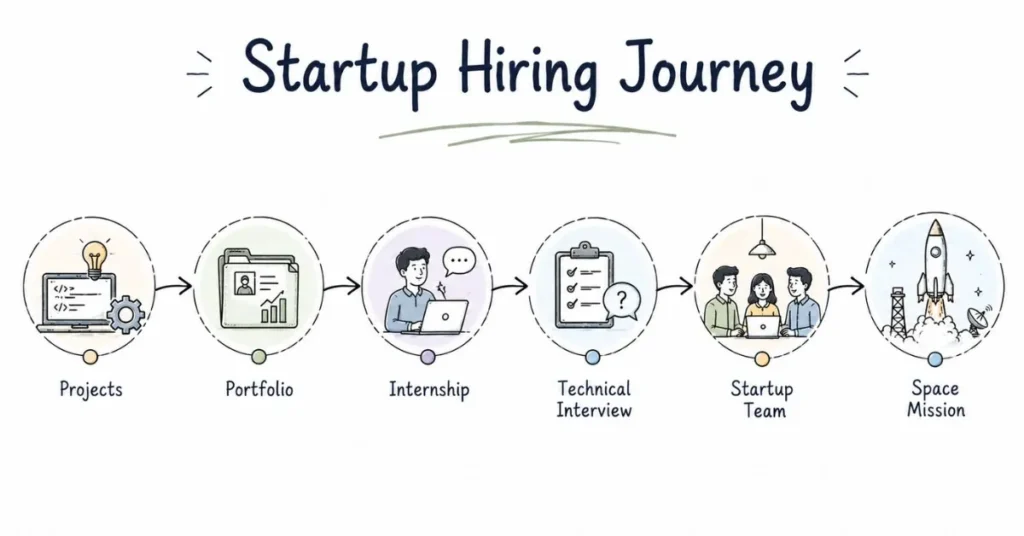
Government organisations like ISRO hire for credentials: degree, percentage, exam score. Startups hire for evidence of capability.
When Skyroot or Agnikul reviews a resume, they are looking for:
Demonstrated hands-on work. Have you built something? A rocket motor test rig, a CubeSat, a propulsion simulation, a satellite attitude control algorithm? Show them. Projects, GitHub repositories, competition results, and internship work all count more than your CGPA.
Genuine technical depth in one area. Startups do not want generalists who know a little about everything. They want someone who knows propulsion, or AOCS, or flight software really well and is intellectually curious enough to pick up adjacent knowledge quickly.
Problem-solving under constraints. Startup interviews often include practical problem-solving questions: “How would you design a thermal control system for a 3U CubeSat with a ₹5 lakh budget?” They want to see how you think, not just what you have memorised.
Cultural fit for ambiguity. Startups change direction, face unexpected technical problems, and ask engineers to take on responsibilities outside their job description regularly. Candidates who need extremely defined roles and processes struggle. Candidates who thrive in uncertainty do well.
How to Break Into a Private Space Startup
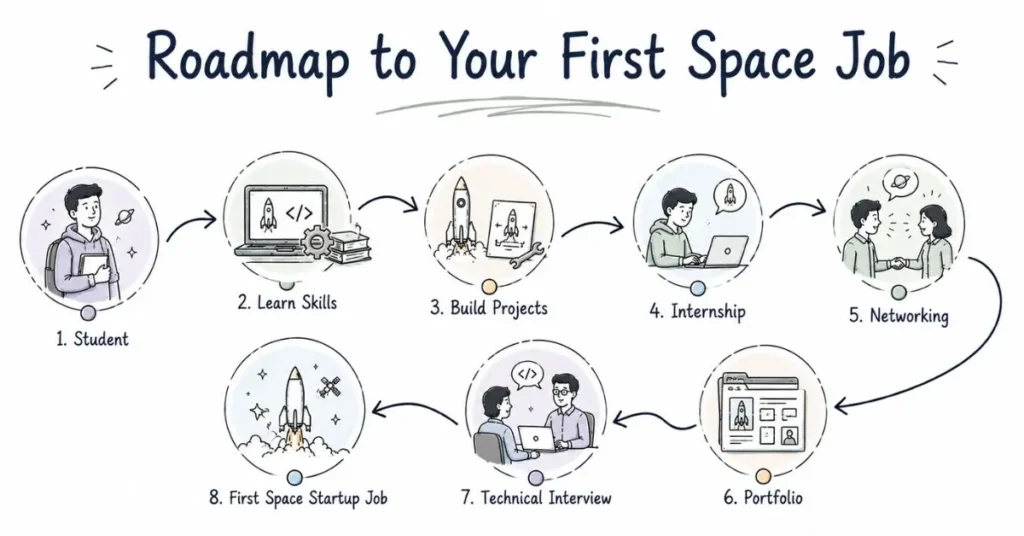
Step 1: Build something real
The single most effective thing you can do is complete a hands-on project preferably aerospace-relevant. A CubeSat project, a propulsion test, a MATLAB simulation of a satellite subsystem, a rocket that actually flies at a student competition. Put it on GitHub. Write about it on LinkedIn.
Step 2: Apply directly and specifically
Do not send a generic resume to a startup. Read their website. Understand what they are building. Reference their specific projects in your application. Tell them exactly which role you want and why your background fits it.
Step 3: Follow their technical content
Most Indian space startups publish technical blogs, LinkedIn posts, and YouTube content about their work. Engaging genuinely with this content thoughtful comments, questions, sharing insights puts your name in front of hiring teams in a way that a cold application cannot.
Step 4: Use LinkedIn actively
Most startup hiring in India’s space sector happens through LinkedIn. Follow the founders and engineering leads at your target companies. Connect with them not with a generic “I want a job” message, but with a specific, relevant observation or question about their work.
Step 5: Target internships first
A startup internship is often the fastest path to a full-time offer. Agnikul, Pixxel, Skyroot, and Dhruva Space all take interns. A strong internship performance almost always converts to a job offer at small companies because they invested time training you and do not want that to walk out the door.
FAQs : Private Space Startup Careers in India
Q: Are startup jobs in space risky compared to ISRO?
All startup jobs carry more risk than government employment that is honest. But India’s top-funded space startups (Skyroot, Agnikul, Pixxel) have real revenue, active government contracts, and international clients. They are significantly more stable than an early-stage app startup. The risk is real but manageable.
Q: Do I need an IIT degree to get into Skyroot or Agnikul?
No. Both companies hire from NITs, BITS Pilani, UPES, and other strong engineering colleges. What matters is demonstrated technical ability, project work, and genuine enthusiasm for the specific technical problem the company is solving.
Q: Can a final year student apply to space startups?
Yes. Most startups welcome final year applications for both internships and full-time roles (with joining contingent on graduation). Apply 3–4 months before your expected graduation date.
Q: What is the work culture like at Indian space startups compared to IT companies?
Very different. The pace is faster, the problems are harder, and the work is more physical you may be in a lab testing hardware, not sitting in front of a laptop all day. Hierarchies are flat. Access to leadership is direct. The trade-off is that work hours can be irregular, especially around launch campaigns or critical test milestones.
Q: Which Indian space startup has the best long-term career prospects?
All of the major ones mentioned in this guide have strong fundamentals. Skyroot has the most launch hardware track record. Agnikul has the most differentiated technology (3D-printed engines). Pixxel has the most developed commercial data business. If forced to choose based purely on career development breadth Pixxel offers the widest range of roles spanning hardware, software, and data analytics.