
Practice Framework and Improvement
Table of Contents
Blog Content:

Why Most Students Don’t Improve
Students practice JAM randomly. They speak on topics when they remember to, without structure, without feedback, without progression.
Six months later, their fluency hasn’t improved much.
Why? Because random practice doesn’t create improvement. Structured practice does.
Think of it like learning to drive. You don’t improve by occasionally driving. You improve through:
- Structured lessons with progressively harder skills
- Targeted feedback
- Repetition of specific techniques
- Clear milestones
JAM requires the same approach.
The Three-Phase Progression Framework
Phase 1: Foundation Building (Weeks 1-2)
Objective: Understand mechanics and build basic confidence
Weekly time commitment: 3-4 hours
Focus areas:
- Understanding JAM rules (no deviation, repetition, hesitation)
- Learning the STAR framework
- Practicing pacing and breathing
- Recording yourself and identifying weaknesses
Daily practice (30 minutes):
- 5 JAM topics (6-7 minutes each)
- Choose topics from foundation category (easier, familiar topics)
- Don’t worry about perfection—focus on completing the full 60 seconds
- Record every session
Weekly review (30 minutes):
- Listen to 2-3 recordings from the week
- Identify: filler words, hesitations, clarity issues
- Note 2-3 improvement areas
Phase 1 Success Criteria:
✓ Can speak for full 60 seconds without long pauses
✓ Understand STAR framework and can apply it
✓ Identifying your own mistakes through recordings
Phase 2: Skill Development (Weeks 3-6)
Objective: Develop specific skills and handle variety
Weekly time commitment: 4-5 hours
Focus areas:
- Voice modulation and pacing control
- Pronunciation and clarity
- Content generation in multiple frameworks
- Handling diverse topic types
Daily practice (40 minutes):
- 8-10 JAM topics (4 minutes each, compressed to force faster thinking)
- Mix topic types: abstract, current affairs, technical, personal
- Practice one specific skill daily (Monday: voice modulation, Tuesday: pronunciation, etc.)
- Continue recording sessions
Weekly challenge (1 hour):
- 15-minute rapid-fire: 5 topics back-to-back with only 30 seconds prep each
- Practice with interruptions: Friend stops you mid-speech and changes topic
- Evaluate your recovery ability
Phase 2 Success Criteria:
✓ Noticeably reduced filler words (fewer than 2 per minute)
✓ Clear voice modulation in recordings
✓ Can handle diverse topic types
✓ Recover from interruptions without panic
Phase 3: Advanced Mastery (Weeks 7-12)
Objective: Achieve fluency, confidence, and excellence
Weekly time commitment: 4-5 hours
Focus areas:
- Nuanced content with sophisticated examples
- Handling challenges and unexpected scenarios
- Building evaluator presence and confidence
- Consistency under pressure
Daily practice (40 minutes):
- 6-8 JAM topics (focus on quality, not quantity)
- Topics from your 50+ database (covering all categories)
- Simulate real interview scenario (formal setting, mock evaluator)
- Continue recording and self-assessment
Weekly advanced practice (1 hour):
- Mock interviews with multiple topics and surprises
- Have evaluators interrupt, ask questions, change topics
- Practice in front of different audiences (classmates, teachers, family)
- Get specific feedback from each
Phase 3 Success Criteria:
✓ Speak with natural fluency and confidence
✓ Generate rich content with specific examples
✓ Handle any interruption calmly
✓ Receive positive feedback from mock evaluators
✓ Yourself feel genuinely prepared
🔍 Explore structured learning resources designed to strengthen clarity, delivery, and consistency →
The Daily Practice Structure
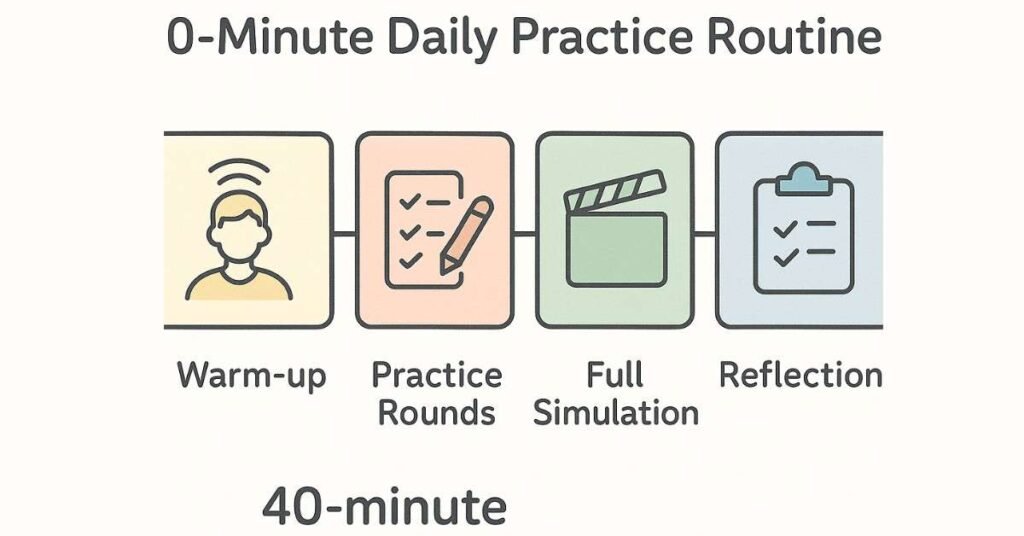
Optimal 40-Minute Daily Session:
Warm-up (5 minutes)
- Vocal scale exercises (high to low pitch)
- Breathing exercises (4-7-8 breathing)
- Tongue twisters
- Purpose: Prepare your voice and calm nervous system
Practice Round 1 (10 minutes)
- 2 topics, 5 minutes each
- Focus: Apply specific skill (voice modulation, pacing, pronunciation)
- Record and note one area for improvement
Practice Round 2 (10 minutes)
- 2 topics, 5 minutes each
- Focus: Apply different skill
- Increase difficulty (less familiar topics)
Practice Round 3 (10 minutes)
- 1 topic, 10 minutes
- Focus: Full simulation—present to an imaginary audience
- Slow paced, focus on quality over speed
Cool-down and Reflection (5 minutes)
- Listen to one recording from the session
- Note: One thing you did well, one area to improve
- Plan tomorrow’s focus area
Weekly Deep Review (1 hour)
Pick one day weekly for comprehensive analysis:
- Listen to all 5 recordings from the week
- Tally: How many filler words? How many clear enunciations? Pacing issues?
- Compare to previous week: Are you improving?
- Create specific targets for next week
Example weekly targets:
- Week 1: Reduce “um” usage from 8 per minute to 5 per minute
- Week 2: Perfect pronunciation of 10 difficult words
- Week 3: Add specific data/statistics to 80% of speeches
Week 4: Achieve 70-80% eye contact with mock evaluator

📘 Discover more preparation-focused content created to support continuous improvement →
The Topics Progression Strategy
Don’t just practice random topics. Progress from easy to hard:
Week 1-2: Foundation Topics (Familiar, Simple)
- “My hobby”
- “Why I chose my course”
- “Benefits of exercise”
- “Importance of friendship”
- “My favorite technology”
Week 3-4: Intermediate Topics (Some unfamiliarity)
- Abstract: “Success,” “Courage,” “Change”
- Current affairs: “COVID-19 impact,” “Climate change”
- Technical: “Artificial Intelligence,” “Digital marketing”
Week 5-6: Advanced Topics (Challenging, unfamiliar)
- “Ethical considerations in genetic engineering”
- “Future of work in a post-pandemic world”
- “Blockchain and decentralized systems”
- “Neuromarketing and consumer behavior”
Week 7+: Expert Topics (Difficult, comprehensive)
- “Impact of quantum computing on cybersecurity”
- “Regulatory challenges in cryptocurrency adoption”
- “Intersection of philosophy and modern psychology”
Why this progression works? Your brain adapts to increasing difficulty. By the time you face real JAM, even “expert” topics feel manageable.

The Feedback Loop: Getting Better from Practice
Random practice doesn’t improve you. Deliberate feedback does.
Self-Feedback System:
After each 60-second speech, evaluate:
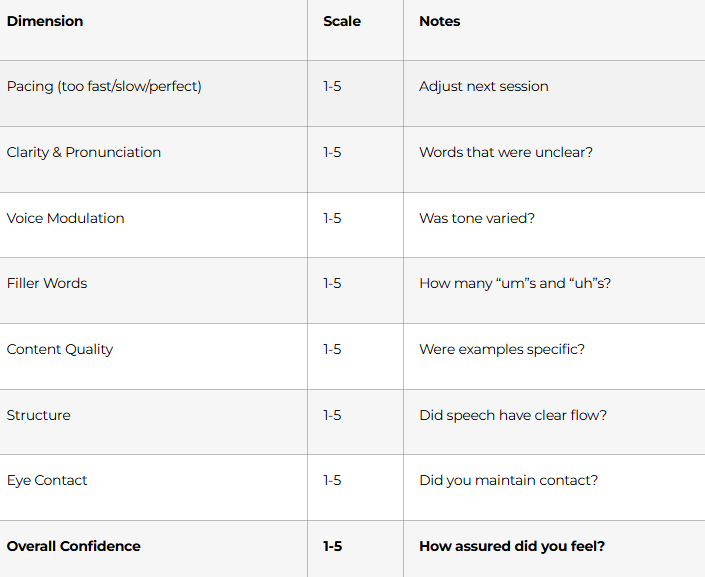
Your goal: Each dimension should reach 4+ by week 12.
External Feedback System:
Weekly, have someone (teacher, friend, mentor) watch your recording and provide:
- One specific thing you did well
- One specific thing to improve
- One question about your content (tests clarity)
This targeted feedback accelerates improvement exponentially.
📂 Access complete learning materials that enhance confidence, adaptability, and long-term performance →
Tracking Progress Visually
Create a simple progress sheet:

Seeing numerical improvement is motivating and demonstrates progress.
The Mock Interview Protocol
By week 6+, practice in realistic scenarios:
Monthly Mock Interview (2-3 hours)
- Setup: Formal room, mock evaluator (preferably someone you don’t know), timer
- Process:
- 3-4 JAM topics, back-to-back
- 1-2 with interruptions
- Q&A after speeches
- Evaluator provides feedback
- 3-4 JAM topics, back-to-back
- Recording: Record the entire mock
- Post-Analysis: Review and compare to actual interviews (if you’ve done any)
This realistic practice builds genuine confidence and identifies remaining weaknesses.
Handling Plateaus
Around week 8-10, many students hit a plateau—improvement slows or stalls.
Why this happens: You’ve mastered basics but haven’t yet internalized advanced skills.
How to break through:
- Increase difficulty: Move to your hardest topic categories
- Add constraints: Practice with distractions (background noise, time pressure)
- Variety: Change your practice location and evaluators
- Deliberate practice: Focus intensely on your weakest area for one week
- Teaching others: Explain JAM techniques to a friend—this deepens your mastery
Plateaus are normal and usually precede significant breakthroughs.
The 90-Day JAM Transformation Timeline
Days 1-14 (Foundation)
- Understand rules and frameworks
- Build basic confidence
- Reduce initial nervousness
Days 15-42 (Competence)
- Develop specific skills
- Handle diverse topics
- Noticeably reduce errors
Days 43-70 (Proficiency)
- Achieve consistent fluency
- Generate sophisticated content
- Handle surprises calmly
Days 71-90 (Mastery)
- Speak with natural confidence
- Engage sophisticated content
- Ready for high-stakes interviews
By day 90, you’ve transformed from “nervous about JAM” to “confident in JAM”.
🧭 Continue your learning journey with more guidance, frameworks, and improvement-focused insights →
Key Takeaways for Practice Framework
- Structured practice > Random practice
- Three-phase progression: Foundation, Skill Development, Advanced Mastery
- Daily 40-minute sessions with warm-up, practice rounds, reflection
- Weekly deep reviews with specific metrics
- Progress from easy to hard topics to build gradually
- Self-feedback and external feedback both essential
- Track progress visually to stay motivated
- Mock interviews in realistic scenarios build genuine readiness
- Plateaus are normal—persist through them
90 days of consistent practice creates genuine transformation