
Practice and Performance Framework
Table of Contents

Blog Content:
Here’s a hard truth: You can’t get better at GDs by reading about them. You can only get better by doing them.
Think of it like swimming. You can read a thousand articles on swimming technique, but until you get in the water, you won’t improve. GD is the same.
But not all practice is equal. Structured practice beats random practice by a huge margin.
Let me walk you through a proven framework.
1. The Mock GD Setup: Creating a Real Environment

You can’t practice alone. You need a group. But you also need the right environment.
What you need:
- 8-12 people (at least 6, ideally 10-12)
- A moderator (someone who’s not participating)
- A timer
- A quiet room
- A topic
How to organize this:
If you’re in college, ask your seniors or friends to form a practice group. If you’re preparing for placements, check if your college’s career services offers mock GDs. If not, create a group yourself.
Minimum practice schedule:
- Mock GD every week for 4 weeks before your actual placement GDs
- Each mock should be 25-30 minutes (like a real one)
- Different topics each time
Why environment matters:
Practicing in a real group, in front of others, with time pressure—this mimics the actual GD. Your nervousness is real. Your choices are real. This is where learning happens.
Practicing alone or with just one friend? Much less effective.
🔍 Explore structured learning resources designed to support consistent skill-building →
2. Topic Selection: Practicing the Right Diversity
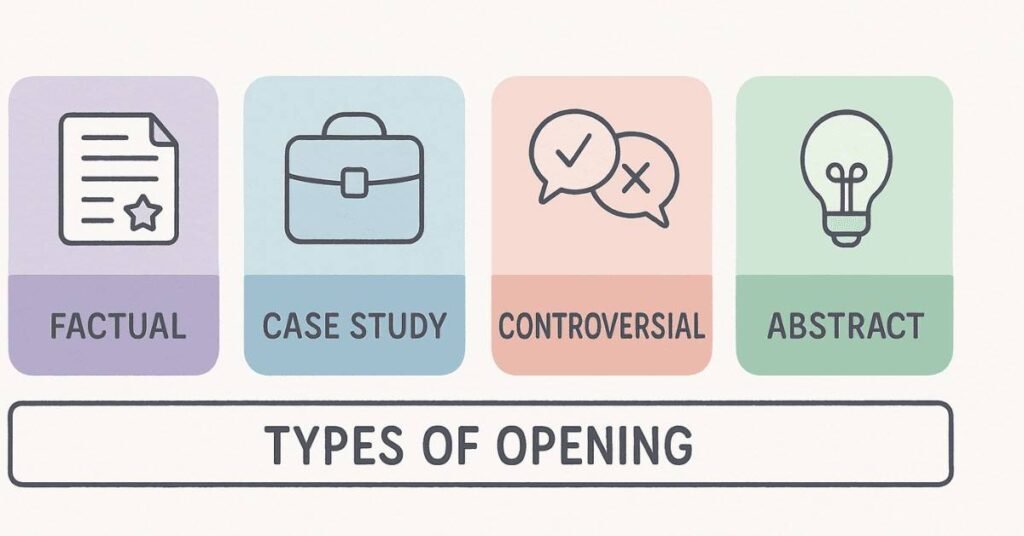
You can’t prepare for every possible topic. But you can prepare for categories of topics.
Week 1 – Factual Topics:
- “Should India prioritize manufacturing or technology?”
- “Is cryptocurrency the future of finance?”
Week 2 – Case Study Topics:
- “A company’s algorithm is discriminating against minorities. What should the CEO do?”
- “A factory is polluting a river. Residents are protesting. How do you resolve this?”
Week 3 – Controversial Topics:
- “Social media is good/bad”
- “Remote work vs. office work”
Week 4 – Abstract Topics:
- “Haste makes waste”
- “Success is a journey, not a destination”
By practicing across different categories, you prepare for any topic that comes your way.
3. Recording and Self-Assessment: Watching Yourself
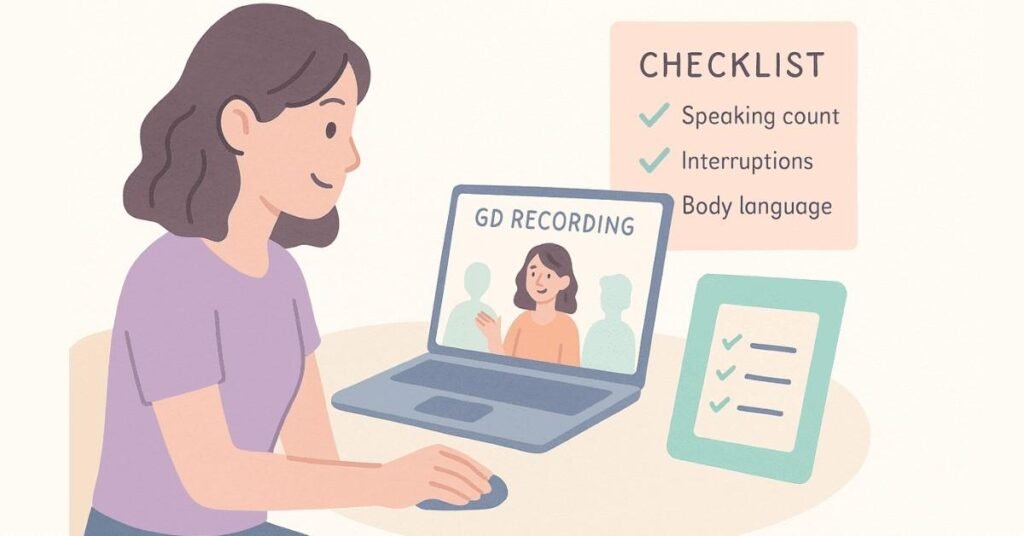
This is uncomfortable, but it’s the best way to improve.
After each mock GD:
Step 1: Record the entire GD (Ask the moderator to record on their phone)
Step 2: Watch the recording (Watch it alone, not with friends. It’s embarrassing but necessary.)
Step 3: Fill out your self-assessment form:
- How many times did I speak? (Ideal: 3-5 times)
- How long did I speak each time? (Ideal: 1.5-2 minutes per turn)
- Was I listening actively or planning my next point?
- Did I interrupt anyone? If yes, was it polite?
- Did I dominate or was I too quiet?
- What’s my body language like? (Posture, eye contact, gestures)
- Did I use PREP structure?
- Did I have relevant examples?
- Did I make any emotional outbursts?
- What’s my strongest point from this GD?
- What’s my weakest point from this GD?
Step 4: Identify one thing to improve next time.
Don’t try to fix everything. Pick ONE thing. If you dominated, focus on listening next time. If you were quiet, focus on speaking up next time.
The power of recording:
Most students don’t realize how they actually come across. When you watch yourself, you see things you never noticed:
- You say “um” 20 times per minute
- Your voice gets quieter when you’re nervous
- You slouch when listening to disagreements
- You interrupt more than you think
Seeing is believing. This awareness changes everything.
📘 Discover more preparation content to strengthen performance and learning clarity →
4. Feedback Loop: Learning from Others' Observations
After watching yourself, get feedback from others in the group.
Ask specific questions:
- “What was my strongest contribution?”
- “At what point did you feel I was dominating or being too quiet?”
- “Did any of my body language turn you off?”
- “What’s one thing I should keep doing? One thing I should change?”
Don’t ask vague questions like: “How was I?”
Vague questions get vague answers. Specific questions get actionable feedback.
The feedback framework:
Write down at least 2 pieces of feedback per mock:
- What I did well: (Keep doing this)
- What I need to improve: (Work on this)
Over 4 weeks, you’ll accumulate 8 insights on what you do well and 8 on what needs improvement.
5. The Confidence Pyramid: Building Through Progressive Difficulty
Confidence builds through small wins, not giant leaps.
Week 1 (Comfort Level):
- Discuss topics you already know about
- Speak in front of friends
- Focus on getting comfortable speaking
Week 2 (Challenge Level):
- Topics you’re less familiar with
- Larger group
- Focus on listening and asking questions
Week 3 (Push Level):
- New topics with less prep time
- Stranger or near-stranger group
- Focus on leadership and guiding discussion
Week 4 (Real Test):
- Mock in formal setting (college campus, career center)
- Topics you haven’t seen before
- Full pressure environment
Each level builds on the previous one. By week 4, your actual GD feels easier because you’ve already done harder things.
6. Specific Practice Drills
Beyond full mocks, practice specific skills:
Drill 1: Opening Practice (10 minutes)
- Get 5 different topics
- Take 2 minutes to prepare for each
- Deliver a 1-minute opening for each
This builds your opening muscle memory.
Drill 2: Listening Practice (15 minutes)
- Watch a YouTube GD video (multiple sources available)
- Don’t write notes
- After, summarize what each person said
This builds your listening discipline.
Drill 3: Recovery Practice (10 minutes)
- Your friend gives you a made-up fact: “The unemployment rate in India is 40%”
- You have to gracefully correct it or acknowledge the error
- Your friend pushes back
- You handle the disagreement professionally
This builds your ability to handle mistakes.
Drill 4: Body Language Practice (5 minutes)
- Speak for 2 minutes on a topic in front of a mirror
- Focus only on posture, eye contact, and gestures
- Do it again with corrections
This builds body language awareness.
Each drill takes 10-15 minutes. Do one drill per day.
📂 Access complete learning materials to improve confidence, reasoning, and delivery →
7. Progress Tracking: Measuring Improvement


Use a simple scorecard to track your progress:
When you see this progression, your confidence grows naturally because it’s based on actual improvement.
🧭 Continue your learning journey with more structured guidance and improvement-focused content →
8. The Week Before Your Real GD
Monday-Wednesday:
- Do 1-2 more mocks
- Light review of trending topics
- Practice opening statements
Thursday:
- No heavy practice (rest your mind)
- Light reading on 2-3 topics
- Positive self-talk
Friday:
- No practice at all
- Relax, sleep well
- Be confident—you’ve prepared
Day of GD:
- Eat breakfast
- Take 5 deep breaths before entering
- Remind yourself: “I’ve done this 10+ times in mocks. This is just one more.”
The Final Principle:
Confidence isn’t something you’re born with. Confidence comes from preparation and practice. When you’ve done 10 mocks, your real GD doesn’t feel scary anymore. It feels familiar. And in that familiarity, confidence blooms naturally.