
PPC & GOOGLE ADS SPECIALIST CAREER GUIDE
Table of Contents
What is a PPC Specialist and Why Are They in High Demand?
PPC (Pay-Per-Click) specialists manage online advertising campaigns where advertisers pay only when someone clicks their ad. They’re the professionals behind those sponsored results you see on Google search, YouTube ads, Facebook promoted posts, and LinkedIn sponsored content.
Here’s what makes PPC specialists uniquely valuable: every rupee they spend must generate measurable returns. Unlike organic marketing where results take months, PPC campaigns drive immediate traffic and sales—but only when managed expertly. A skilled PPC specialist can turn a ₹1 lakh monthly ad budget into ₹10 lakhs in revenue. An inexperienced one can waste that entire budget in days with nothing to show.
In 2026, Indian businesses are investing heavily in paid advertising, with digital ad spending projected to cross ₹50,000 crores. Companies need PPC specialists who understand auction dynamics, bidding strategies, audience targeting, and conversion optimization. Whether it’s an e-commerce store promoting Diwali sales, an edutech platform advertising courses, or a B2B SaaS company generating enterprise leads, PPC specialists make it happen profitably.
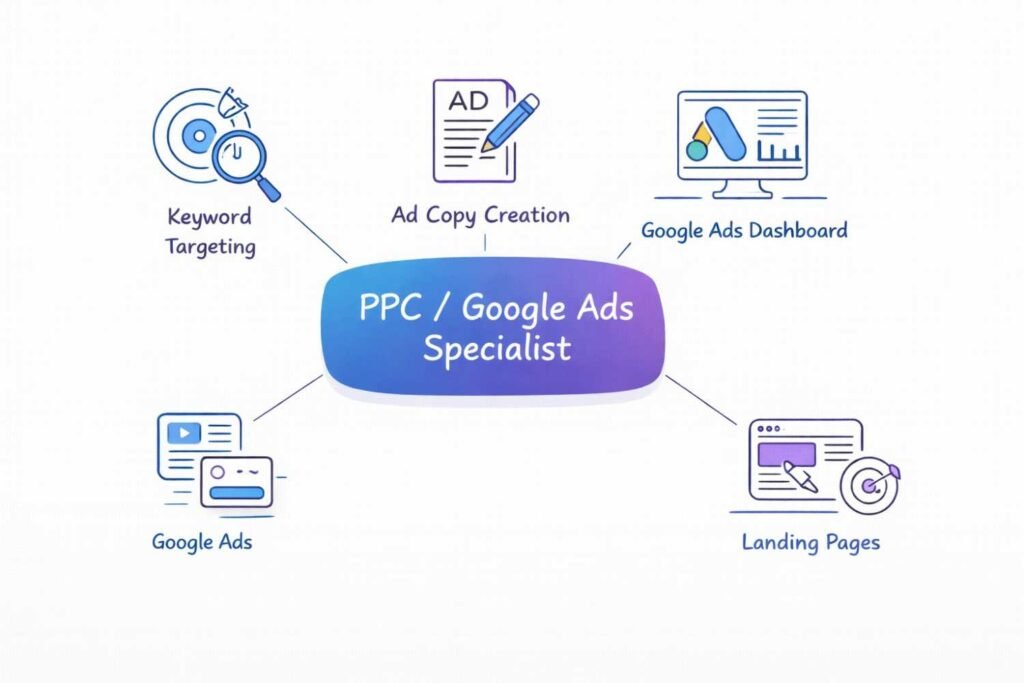
Day in the Life: What PPC Specialists Actually Do
Let’s explore a typical workday for a PPC specialist managing multiple campaigns
Morning (9:00 AM – 11:00 AM)
- Check campaign performance from previous day—impressions, clicks, cost-per-click, conversions
- Identify any campaigns that overspent or underperformed overnight
- Pause ads or keywords burning budget without conversions
- Review search term reports to find new negative keywords
- Respond to client requests or internal stakeholder questions about campaign performance
- Monitor competitor ad activity using SEMrush or SpyFu
Mid-Morning (11:00 AM – 1:00 PM)
- Conduct keyword research for new campaigns using Google Keyword Planner
- Build new ad campaigns with proper structure (campaigns → ad groups → keywords → ads)
- Write compelling ad copy with strong headlines and clear calls-to-action
- Set up conversion tracking to measure campaign success
- Create or optimize landing pages for better conversion rates
- Adjust bids based on keyword performance and budget allocation
Afternoon (2:00 PM – 4:00 PM)
- Analyze campaign data to identify optimization opportunities
- Run A/B tests on ad copy, headlines, or landing pages
- Adjust audience targeting based on demographic performance
- Review Quality Scores and improve ad relevance for lower costs
- Set up or refine automated bidding strategies (Target CPA, Target ROAS)
- Coordinate with creative team on display ad designs or video ad scripts
Late Afternoon (4:00 PM – 6:00 PM)
- Build comprehensive performance reports for clients or management
- Calculate ROI and present recommendations for budget reallocation
- Plan next month’s campaign strategy based on current performance
- Stay updated on Google Ads platform changes and new features
- Research industry best practices and competitor strategies
- Schedule budget pacing checks to ensure campaigns run throughout the month
PPC work is highly analytical and data-driven. You’ll spend significant time in spreadsheets, analyzing numbers, and making optimization decisions based on performance data.
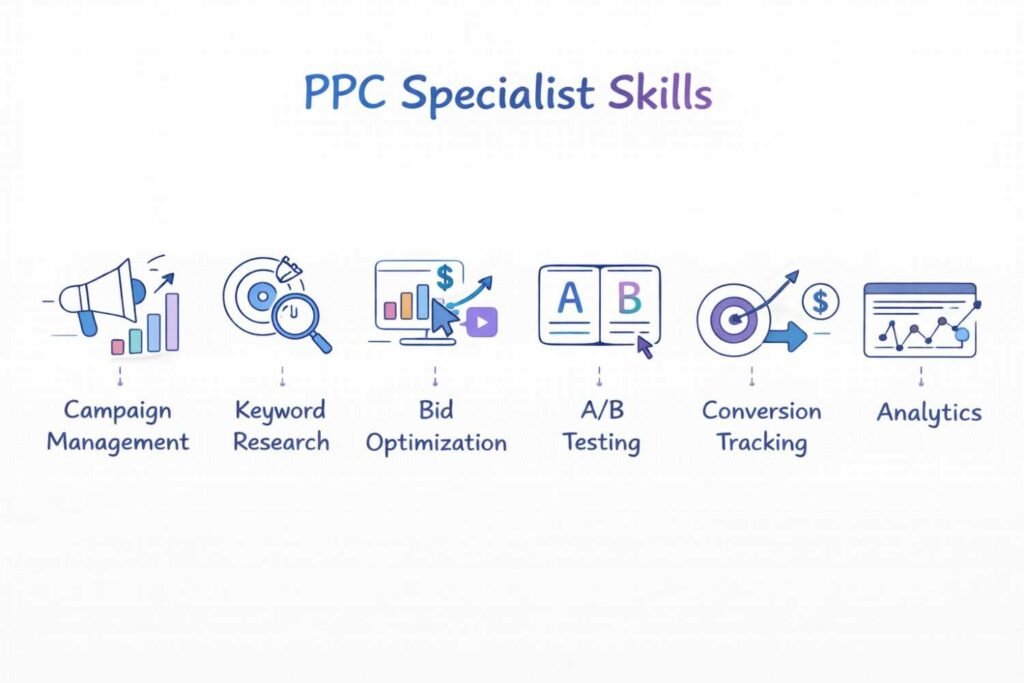
Essential Skills for PPC Specialists
Platform Expertise
Google Ads Mastery: Understanding Search campaigns, Display campaigns, Shopping campaigns, Video campaigns (YouTube), and App campaigns. This includes keyword match types, bidding strategies, ad formats, extensions, and Quality Score optimization.
Meta Ads (Facebook & Instagram): Managing campaigns across Facebook and Instagram with advanced targeting including interests, behaviors, demographics, and the new income-based targeting available for India in 2026. Understanding campaign objectives (awareness, consideration, conversion) and ad formats (single image, carousel, video, collection).
LinkedIn Ads: Running B2B campaigns using professional targeting (job titles, company size, industry, seniority). LinkedIn offers higher-quality leads but at premium costs requiring skilled budget management.
Microsoft Advertising: Bing Ads often overlooked but provides cheaper clicks with quality audiences, especially for B2B.
Analytical Skills
Data Analysis: Interpreting metrics like CTR (click-through rate), conversion rate, CPC (cost-per-click), CPA (cost-per-acquisition), and ROAS (return on ad spend).
Excel/Google Sheets Proficiency: Creating pivot tables, using formulas for calculations, building dashboards for quick analysis.
Statistical Understanding: Running valid A/B tests, understanding statistical significance, interpreting data trends accurately.
Google Analytics: Tracking user behavior after they click ads, understanding conversion paths, setting up goals and e-commerce tracking.
Strategic Skills
Campaign Structure: Organizing campaigns logically by business goals, products, or funnel stages with focused ad groups containing 10-20 thematically related keywords.
Audience Targeting: Identifying ideal customers through demographics, interests, behaviors, and intent signals.
Funnel Thinking: Creating different campaigns for awareness, consideration, and conversion stages with appropriate messaging and bidding.
Budget Management: Allocating spend across campaigns based on performance, ensuring campaigns run consistently without exhausting budgets early.
Creative Skills
Ad Copywriting: Writing compelling headlines and descriptions that drive clicks while maintaining relevance for Quality Score.
Landing Page Optimization: Understanding what makes landing pages convert—clear headlines, trust signals, streamlined forms, strong CTAs.
A/B Testing: Systematically testing different ad variations, audiences, and landing pages to improve performance.
Google Ads Campaign Structure Best Practices
Proper campaign structure is foundational to PPC success
Account Hierarchy
Your Google Ads account structure follows this hierarchy:
- Account (your business)
- Campaigns (organized by goals, products, or geographic targets)
- Ad Groups (themed keyword sets)
- Keywords (search terms you bid on)
- Ads (what users see)
Campaign Organization Strategies
By Product/Service Type: Separate campaigns for each major product category.
- Campaign 1: Digital Marketing Courses
- Campaign 2: Data Science Courses
- Campaign 3: Web Development Courses
By Funnel Stage:
- Campaign 1: Brand Awareness (broad keywords, lower bids)
- Campaign 2: Consideration (problem-aware keywords)
- Campaign 3: Conversion (high-intent keywords, higher bids)
By Geographic Target:
- Campaign 1: India
- Campaign 2: Tier 1 Cities (higher budgets)
- Campaign 3: Tier 2/3 Cities
Critical Best Practices
Separate Brand and Non-Brand Campaigns: Brand searches (people searching your company name) perform differently and require different strategies than generic searches.
Focused Ad Groups: Each ad group should contain 10-20 closely related keywords sharing the same intent. Don’t mix “buy digital marketing course” with “what is digital marketing”—they require different ad copy.
Multiple Ad Variations: Create 3-4 different ad variations per ad group for A/B testing.
Comprehensive Negative Keywords: Regularly add negative keywords to prevent wasting budget on irrelevant searches.
Consistent Naming Conventions: Use clear campaign names that anyone on the team can understand.
Smart Bidding Strategies for 2026
Google Ads bidding has evolved dramatically with AI and machine learning
AI-Driven Smart Bidding Options
Target CPA (Cost Per Acquisition): Tell Google your target cost per conversion, and Smart Bidding automatically adjusts bids in real-time to hit that target. Best for lead generation campaigns with consistent conversion values.
Target ROAS (Return on Ad Spend): Set target return on ad spend (e.g., 400% meaning ₹4 revenue for every ₹1 spent), and Google optimizes bids accordingly. Ideal for e-commerce with varying product values.
Maximize Conversions: Spend your entire daily budget while getting maximum conversions, regardless of cost. Good when you have budget to spend and want volume.
Maximize Conversion Value: Similar to above but prioritizes high-value conversions over conversion volume.
Enhanced CPC: Manually set bids but allow Google to adjust up or down by up to 30% for auctions more likely to convert.
2026 Smart Bidding Trends:
- Deep Learning Real-Time Optimization: AI instantly adjusts bids based on browsing history, location, device type, time of day, and keyword match
- Multi-Signal Audience Targeting: Instead of just targeting keywords, Smart Bidding targets user intent, interests, and behaviors to reach the right person at the right time
- Broad Match + Smart Bidding: Using broad match keywords with Smart Bidding allows Google to identify search intent beyond exact phrases, extending coverage while maintaining profitability
- Value-Based Bidding: Optimizing for customer lifetime value rather than just initial conversion
- Portfolio Bid Strategies: Running multiple campaigns under one AI-driven bid strategy for simplified management and improved performance
Best Practices for Smart Bidding:
- Requires at least 30-50 conversions monthly for effective learning
- Give new strategies 2-3 weeks to learn before evaluating performance
- Still monitor search terms and add negatives regularly
- Combine with audience signals for faster learning
PPC Campaign Management Workflow
Successful PPC management follows a systematic process
Phase 1: Research and Planning (Week 1)
- Define Campaign Goals: Clear objectives like “generate 100 qualified leads at ₹500 CPA” or “achieve ₹5 lakh revenue with 400% ROAS”
- Identify Target Audience: Demographics, interests, pain points, where they search
- Conduct Keyword Research: Find 50-100 relevant keywords with search volume and reasonable competition
- Competitive Analysis: Study competitor ads, keywords, landing pages, and offers
- Budget Determination: Calculate required budget based on estimated CPCs and conversion rates
- Landing Page Planning: Ensure landing pages exist and are optimized for conversions
Phase 2: Campaign Build (Week 1-2)
- Structure Campaigns and Ad Groups: Organize logically following best practices
- Add Keywords: Include keywords with appropriate match types (exact, phrase, broad)
- Write Ad Copy: Create 3-4 variations per ad group with compelling headlines and CTAs
- Set Up Conversion Tracking: Implement Google Ads conversion tags or import from Google Analytics
- Configure Settings: Set locations, languages, schedules, bidding strategies, budgets
- Add Ad Extensions: Sitelinks, callouts, structured snippets to improve ad visibility
Phase 3: Launch and Monitor (Week 2-3)
- Soft Launch: Start with 50-70% of budget to test performance
- Daily Monitoring: Check campaigns 1-2 times daily for any issues
- Quick Optimizations: Pause underperforming keywords, adjust bids on high performers
- Quality Score Checks: Ensure ads are relevant to keywords and landing pages
Phase 4: Optimization (Ongoing)
Daily Tasks:
- Review performance metrics
- Check budget pacing
- Add negative keywords from search term reports
- Adjust bids on high-performing keywords
Weekly Tasks:
- Analyze A/B test results
- Review Quality Scores and improve low-scoring keywords
- Adjust audience targeting based on demographic performance
- Update ad copy based on engagement data
Monthly Tasks:
- Comprehensive performance analysis
- Client/stakeholder reporting with insights and recommendations
- Strategic planning for next month based on learnings
- Budget reallocation across campaigns
Phase 5: Testing and Scaling (Month 2+)
- A/B Testing: Continuously test ad copy, landing pages, audiences, bidding strategies
- Scale Winners: Increase budgets on campaigns with positive ROI
- Pause Losers: Stop campaigns consistently failing to meet KPIs
- Expand Keywords: Add new keyword variations based on search term reports
- Try New Platforms: Test LinkedIn, Microsoft Ads, or display advertising once search is optimized
PPC Specialist Salary in India
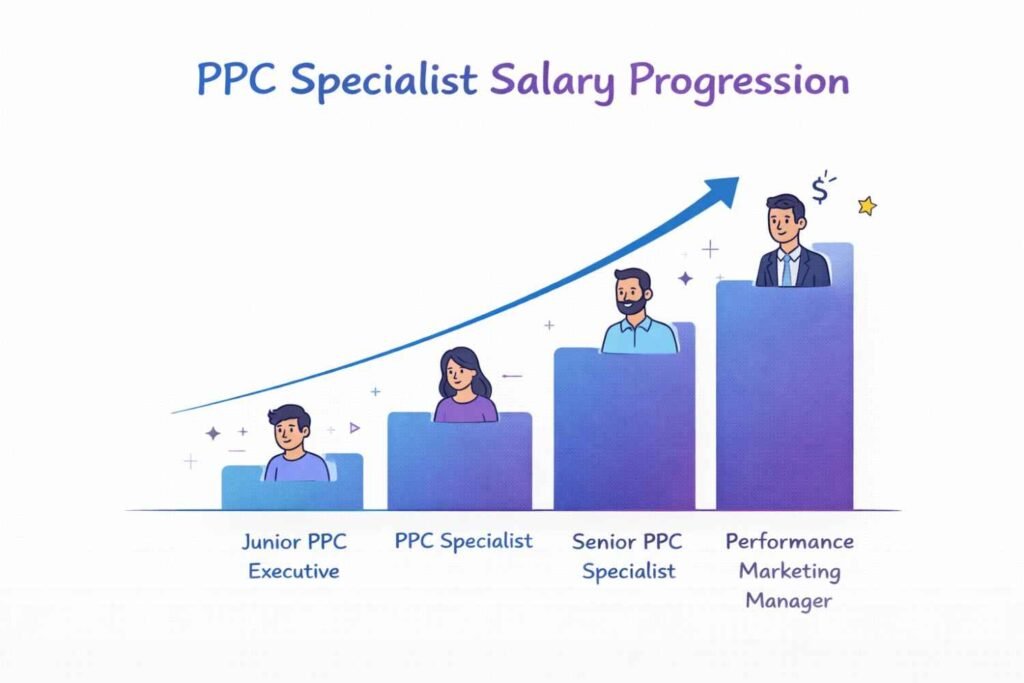
PPC specialists command strong salaries due to their direct revenue impact:
Experience-Based Salary Ranges
- Junior PPC Specialist (0-2 years): ₹3-5 lakhs per year
- PPC Specialist (2-4 years): ₹5-9 lakhs per year
- Senior PPC Specialist (4-6 years): ₹9-15 lakhs per year
- PPC Manager (6-8 years): ₹12-18 lakhs per year
- Lead/Head of Paid Media (8+ years): ₹18-25 lakhs per year
Average salary for mid-level PPC specialists is ₹5.9 lakhs, with senior specialists earning ₹11.3+ lakhs annually.
City and Industry Variations
Metro Cities:
- Bangalore and Mumbai offer 15-20% higher salaries than other cities
- Remote positions now offer metro-level salaries to talent in smaller cities
High-Paying Industries:
- E-commerce: ₹6-18 lakhs (managing large budgets, direct revenue impact)
- Fintech: ₹7-20 lakhs (complex products, high customer value)
- Real Estate: ₹5-15 lakhs (high-ticket transactions, premium commissions)
- B2B SaaS: ₹7-19 lakhs (long sales cycles, enterprise lead generation)
- Edutech: ₹5-14 lakhs (seasonal campaigns, course launches)
Certification Premium
Google Ads certified specialists earn 10-15% more than non-certified peers. Multiple certifications (Search, Display, Video, Shopping) command additional premiums.
Freelance and Consulting
Freelance PPC specialists charge:
- ₹1,500-3,000 per hour for mid-level specialists
- ₹3,000-6,000 per hour for senior consultants
- 10-20% of monthly ad spend as management fee (e.g., ₹20,000 to manage ₹1 lakh monthly budget)
- Project-based: ₹30,000-1,50,000 per campaign setup and management
Managing 4-6 clients with combined ₹10-15 lakh monthly budgets generates ₹1.5-3 lakhs monthly income for established freelancers.
How to Become a PPC Specialist: Detailed Roadmap
Month 1: Master Google Ads Fundamentals
Week 1-2: Learn Core Concepts
- Understand how Google Ads auction works
- Study keyword match types (exact, phrase, broad)
- Learn about Quality Score and Ad Rank
- Understand campaign types (Search, Display, Shopping, Video)
- Watch Google Ads official tutorials on YouTube
Week 3-4: Get Certified
- Complete Google Ads Search Certification (free, 3-4 hours)
- Take Google Ads Display Certification (free, 2-3 hours)
- Study for certifications using official Google Skillshop materials
Practice During Month 1:
- Set up personal Google Ads account (even without running campaigns)
- Explore the interface—campaigns, ad groups, keywords, ads
- Use Keyword Planner to research keywords for hypothetical campaigns
- Watch competitor ads by searching relevant keywords
Month 2: Get Hands-On Practice
Option A: Manage Small Personal Campaign
- Invest ₹2,000-5,000 in a micro-campaign promoting your blog, freelance services, or testing product
- Set up conversion tracking
- Run for 2-3 weeks monitoring daily
- Document everything—screenshots, learnings, optimizations
- Calculate final ROI and create case study
Option B: Offer Free/Cheap Services
- Find 1-2 small businesses willing to let you manage their ads
- Charge minimal fees (₹5,000-10,000/month) or work free for testimonials
- Manage campaigns with their budget while learning
- Document results as portfolio pieces
Month 2 Certifications:
- Google Ads Video Certification
- Google Analytics Individual Qualification (GAIQ)
- Optional: Meta Blueprint Advertising Fundamentals
Month 3: Expand Platform Knowledge
Learn Meta Ads (Facebook & Instagram):
- Complete Meta Blueprint certifications (free)
- Understand Meta’s campaign objectives and ad formats
- Learn about custom audiences, lookalike audiences, and retargeting
- Study income-based targeting now available for India
Explore Other Platforms:
- LinkedIn Campaign Manager (especially for B2B)
- Microsoft Advertising (Bing Ads)
- Basics of programmatic display advertising
Month 3 Practice:
- Run small Meta Ads campaign (₹1,000-3,000 budget)
- Compare performance with Google Ads
- Document cross-platform insights
Month 4-5: Build Comprehensive Portfolio
Portfolio Project 1: Google Ads Campaign Case Study
- Document complete campaign from planning to results
- Include: keyword research process, campaign structure, ad copy, landing page, optimization steps, final metrics (clicks, conversions, CPA, ROI)
- Present professionally with charts and screenshots
Portfolio Project 2: Meta Ads Campaign Analysis
- Similar to above but for Facebook/Instagram campaigns
- Highlight audience targeting, creative testing, conversion tracking
Portfolio Project 3: Competitive PPC Analysis
- Choose an industry (e.g., online education)
- Analyze 3-5 competitors’ PPC strategies
- Document their keywords, ad copy, offers, landing pages
- Provide recommendations for how to compete effectively
Portfolio Project 4: Campaign Optimization Report
- Take underperforming campaign (your own or simulated)
- Identify issues (high CPA, low CTR, poor Quality Score)
- Implement fixes
- Show before/after improvements
Create portfolio website showcasing these 4 projects with detailed explanations.
Month 6: Apply for PPC Jobs
Job Titles to Target:
- PPC Executive
- Google Ads Specialist
- Paid Media Executive
- Performance Marketing Executive (Junior)
- Digital Advertising Specialist
Resume Optimization:
- Lead with Google Ads certifications prominently
- Quantify portfolio results (“Achieved 350% ROAS on ₹5,000 campaign”)
- List platforms you’re proficient in
- Include both technical skills (bid management, conversion tracking) and soft skills (analytical thinking, data interpretation)
- Link to portfolio website
Where to Apply:
- Digital marketing agencies (highest hiring volume for PPC roles)
- E-commerce companies
- Performance marketing agencies
- Startups (AngelList, LinkedIn)
- Naukri, Indeed, LinkedIn Jobs, Internshala
Interview Preparation:
- Be ready to explain how Google Ads auction works
- Discuss how you’d structure a campaign for specific business type
- Explain Quality Score and how to improve it
- Walk through how you’d optimize underperforming campaign
- Demonstrate your analytical thinking with examples
Advanced PPC Optimization Checklist for 2026
Once you’re managing campaigns, use this checklist systematically:
Campaign Level Optimization:
- Review campaign settings ensuring correct targeting, scheduling, and networks
- Check budget pacing—spending too fast or too slow?
- Analyze geographic performance and adjust location targeting
- Review device performance (mobile vs. desktop) and adjust bids accordingly
- Ensure conversion tracking is working correctly
Ad Group Level:
- Ensure ad groups are tightly themed with related keywords
- Check that each ad group has 3-4 active ad variations
- Review ad strength indicators and improve to “Excellent” when possible
- Add all relevant ad extensions
Keyword Level:
- Review search term reports daily, adding negative keywords
- Adjust bids on high-performing keywords
- Pause keywords with zero conversions after significant spend
- Add new keyword variations based on search term discoveries
- Check keyword Quality Scores and improve low-scoring keywords
Ad Level:
- Run continuous A/B tests on headlines and descriptions
- Incorporate keywords into ad copy for relevance
- Test different calls-to-action
- Use countdown customizers for limited-time offers
- Ensure ads match landing page content
Conversion Level:
- Analyze conversion funnel to identify drop-off points
- Test landing page variations for better conversion rates
- Ensure page load speed is under 3 seconds
- Check mobile experience separately from desktop
- Add trust signals (testimonials, guarantees, security badges)
Common PPC Mistakes to Avoid
- Poor Campaign Structure: Mixing unrelated keywords in same ad groups leads to irrelevant ads and low Quality Scores.
- Ignoring Negative Keywords: Wasting budget on irrelevant clicks because you’re not regularly adding negatives.
- Sending Traffic to Homepage: Sending clicks to generic homepage instead of dedicated, relevant landing pages hurts conversion rates.
- Not Tracking Conversions Properly: Can’t optimize what you can’t measure—ensure conversion tracking is accurate.
- Setting and Forgetting: PPC requires ongoing monitoring and optimization; campaigns left alone for weeks underperform.
- Obsessing Over CTR: High click-through rate means nothing if those clicks don’t convert profitably.
- Using Only Exact Match: While exact match is safe, you miss opportunities; combine with phrase and broad match properly.
- Ignoring Mobile Experience: Over 70% of searches in India happen on mobile; if your landing page isn’t mobile-optimised, you’re wasting money.
- Making Too Many Changes At Once: Can’t identify what worked when you change 10 things simultaneously; test systematically.
- Not Giving Smart Bidding Time to Learn: Switching bidding strategies every few days prevents AI from optimizing effectively.
FAQs: PPC Specialist Career
Q: Is PPC harder to learn than SEO or social media?
PPC has a steeper learning curve initially due to technical complexity and direct budget responsibility. However, results are faster and more measurable, providing clearer learning feedback.
Q: Do I need a big budget to practice PPC?
No. You can learn fundamentals with ₹2,000-5,000 test campaigns. Many employers care more about your systematic approach and analysis than budget size managed.
Q: What’s more valuable: Google Ads or Facebook Ads skills?
Google Ads is higher in demand for Indian market, but knowing both significantly increases your value. Start with Google Ads, add Meta Ads within 3-4 months.
Q: Can PPC specialists work remotely?
Absolutely. PPC is one of the most remote-friendly digital marketing roles since everything is managed online. Many companies hire PPC talent from anywhere in India.
Q: Is PPC a stable long-term career?
Very stable. Paid advertising is here to stay, and businesses consistently need experts who can profitably manage ad budgets. The platforms evolve, but the core skills remain valuable.
Your Next Steps: Start Your PPC Career
PPC specialists are among the highest-paid digital marketers because they directly impact revenue. Every campaign you manage either makes or loses money, making your skills immediately valuable and measurable. Unlike roles where impact is fuzzy, PPC specialists point to clear numbers: “I turned ₹2 lakhs into ₹10 lakhs—here’s proof.”
This accountability can feel intimidating, but it’s also empowering. Your growth is directly tied to results you can demonstrate. Six months of focused learning and practice can make you hireable. One year of experience managing real budgets makes you valuable. Three years of proven campaign success makes you highly sought-after.
Start today by creating your Google Ads account and earning your first certification. Next week, invest ₹2,000 in a test campaign and learn by doing. Three months from now, you’ll have portfolio pieces and practical knowledge setting you apart from theoretical learners.
The PPC specialists earning ₹12-18 lakhs today started with their first ₹1,000 campaign wondering if they’d waste the money. They learned, optimized, and proved their value one campaign at a time. Your journey starts with the same first step: begin learning.