
Placement exam strategy
Table of Contents
Blog Content:
Introduction: Why Strategy Beats Knowledge in High-Pressure Exams
You now know quantitative concepts, logical reasoning, and data interpretation. But here’s the uncomfortable reality: knowledge alone doesn’t guarantee success in placement exams. Why? Because placement exams aren’t just tests of knowledge—they’re tests of execution under pressure.
Consider two candidates:
Candidate A: Knows every concept perfectly but spends 8 minutes on a single permutation question, then runs out of time.
Candidate B: Might not be as strong on certain topics but strategically skips difficult questions, completes 80% of the paper accurately, and scores higher.
Candidate B wins because strategy matters more than perfection when time is limited.
Companies use strict time limits deliberately. They’re not just testing “can you solve this?” They’re testing “can you solve this efficiently while managing pressure?” This mirrors real work: you’ll never have unlimited time for decisions.
This module teaches you the strategic framework that separates top scorers from average performers.
Section 1: Understanding the Exam Architecture
Know Your Enemy: Exam Structure Analysis
Before developing strategy, understand the exam structure completely.
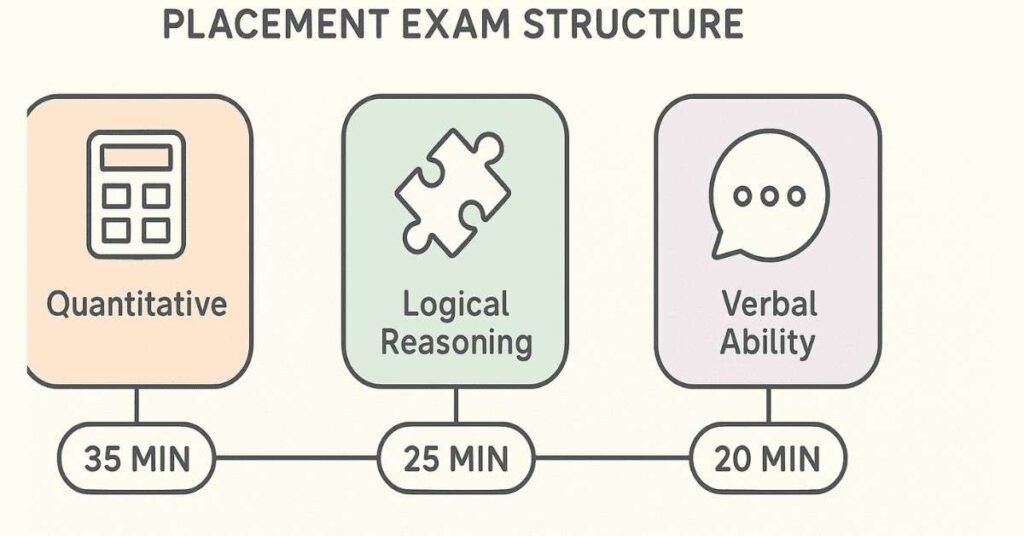
Typical Campus Placement Aptitude Exam Structure:
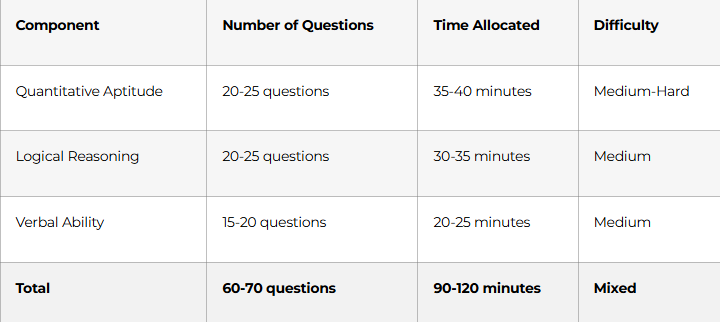
Critical Insight: You have approximately 1.5 to 2 minutes per question on average. This is the baseline.
But here’s the strategic advantage: not all questions take equal time. A simple arithmetic problem takes 30 seconds. A complex data interpretation set takes 4 minutes. A vocabulary question takes 20 seconds.
Your strategy must account for this variation.
Sectional Analysis: Where Your Strengths Matter Most
Quantitative Aptitude (35-40 minutes for 20-25 questions = 1.5-2 min/question)
This section heavily rewards speed because:
- Concepts are complex (permutations, probability, DI)
- Calculations are time-consuming
- One mistake cascades (especially in dependent problems)
Logical Reasoning (30-35 minutes for 20-25 questions = 1.2-1.7 min/question)
This section requires less calculation but more thinking:
- Syllogisms require careful logic (not quick math)
- Series problems need pattern recognition
- Classification needs conceptual clarity
Verbal Ability (20-25 minutes for 15-20 questions = 1.3-1.7 min/question)
This section is fastest for strong English speakers:
- Reading comprehension involves skimming
- Vocabulary relies on recognition
- Grammar rules are memorizable
The Strategic Implication: Your weakest section needs the most practice because it’s your bottleneck.
🔍 Explore structured learning paths designed to strengthen analytical speed and accuracy →
Section 2: Time Management Techniques
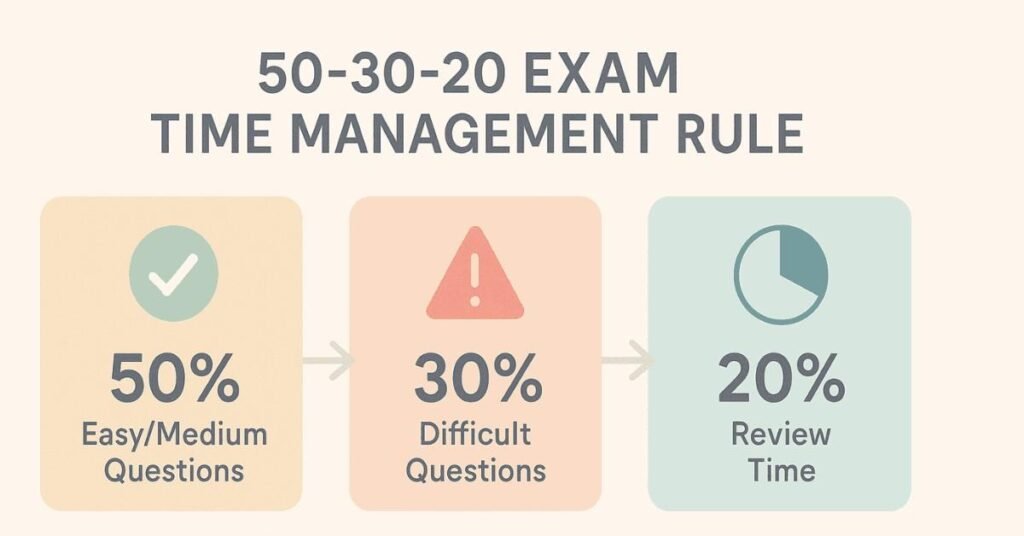
The 50-30-20 Rule for Placement Exams
Divide your exam time strategically:
- 50% = Easy and medium questions (your scoring zone)
- 30% = Difficult questions (attempt if time permits)
- 20% = Reserve time (for review and rechecking)
Example: 120-minute exam
- 60 minutes: Focus on easy/medium questions (aim for 90%+ accuracy)
- 36 minutes: Attempt difficult questions (aim for 50-60% accuracy)
- 24 minutes: Review answers, recalculate, verify
Why This Works: Most students spend 80% of time on questions worth 20% of marks, then rush the remaining questions. This rule inverts that logic.
Speed Calculation Framework
For Quantitative Section (40 minutes, 25 questions):
- Simple questions (15% of section): 30 seconds each = 3 questions in 1.5 min
- Medium questions (60% of section): 1.5 minutes each = 15 questions in 22.5 min
- Difficult questions (25% of section): 2-3 minutes each = 5-7 questions in 12-16 min
Allocation: 25 minutes on easy/medium, 15 minutes on difficult, leaving buffer.
For Logical Reasoning Section (35 minutes, 25 questions):
- Coding-decoding, Series: 1 minute each (15 questions = 15 min)
- Syllogisms, Blood relations: 1.5 minutes each (8 questions = 12 min)
- Classification, Analogies: 1 minute each (2 questions = 2 min)
- Buffer: 6 minutes
For Verbal Ability Section (25 minutes, 20 questions):
- Vocabulary (40%): 30 seconds each = 8 questions in 4 min
- Grammar (30%): 45 seconds each = 6 questions in 4.5 min
- Reading comprehension (30%): 1-1.5 min per question = 6 questions in 9 min
- Buffer: 7.5 minutes

📘 Discover more preparation-focused content to enhance performance under time pressure →
Section 3: Question Prioritization Strategy
The Question Triage Approach
Not all questions are created equal. Develop a rapid assessment system:
Tier 1: Immediate Attempts (Scoring Zone)
These are questions where:
- You recognize the concept instantly
- Solution path is clear
- Calculation is straightforward
- Estimated time: < 1 minute
Example Tier 1 Questions:
- “Find 25% of 400” (immediate: 100)
- “All A are B; B are C. Are all A, C?” (immediate: yes)
- “Synonym of ‘Intelligent'” (immediate: smart)
Tier 2: Conditional Attempts (Potential Zone)
These are questions where:
- Concept is familiar but requires thought
- Solution involves multiple steps
- Calculation is moderately complex
- Estimated time: 1.5-2 minutes
Decision Rule for Tier 2: Attempt if you have already completed 70% of Tier 1 questions with 15+ minutes remaining.
Example Tier 2 Questions:
- “A train travels at 60 km/h and B at 40 km/h. Meeting time?”
- “3 syllogism premises requiring logic deduction”
- “Reading comprehension with inference questions”
Tier 3: Skip First (Review Zone)
These are questions where:
- Concept is unfamiliar
- Solution path is unclear
- You might waste 3-4 minutes
- Estimated time: 2+ minutes (risky)
Decision Rule for Tier 3: Mark and skip immediately. Return only if 5+ minutes remain after Tier 1 and Tier 2.
Example Tier 3 Questions:
- Complex data interpretation with multiple calculations
- Difficult coding-decoding patterns
- Obscure vocabulary in context
Section 4: The Exam Day Execution Plan
Pre-Exam Phase: 30 Minutes Before Start
- Arrive 15 minutes early (avoid last-minute stress)
- Organize your space (pen, paper, ID, admit card)
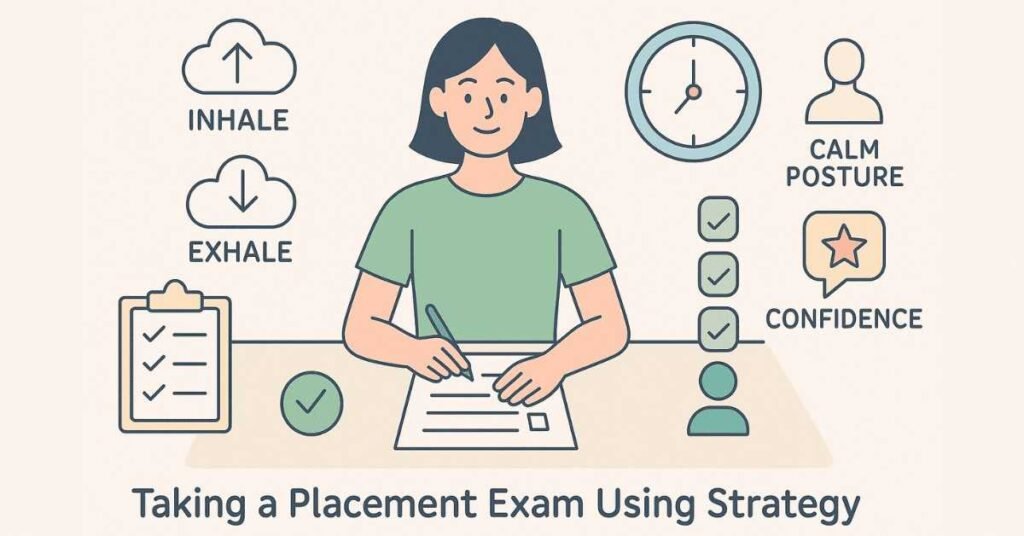
- Do 5 minutes of breathing exercises (calm your nervous system)
- Review your strategy one last time (time allocation, prioritization)
- Avoid discussing exams with other candidates (creates doubt)
Opening Phase: First 5 Minutes (Critical)
When you receive the exam paper, resist the urge to start immediately.
What You Should Do:
- Read all questions briefly (2-3 minutes)
- Mark Tier 1, 2, 3 questions (2 minutes)
- Take one deep breath
- Start with Tier 1
Why This Works: Reading all questions mentally sorts them by difficulty. You’ll unconsciously identify patterns and easy opportunities before starting.
Active Solving Phase: Main Time
For Quantitative Section (suggested approach):
Minute 0-15: Solve all Tier 1 questions in Quantitative
- Simple arithmetic and percentage problems
- Direct formula applications
- One-step logic problems
Minute 15-30: Tier 1 questions in Logical Reasoning
- Coding-decoding (recognizable patterns)
- Simple series
- Straightforward analogies
Minute 30-40: Tier 1 questions in Verbal
- Direct vocabulary matches
- Simple grammar rules
- Clear reading comprehension answers
Minute 40-60: Tier 2 questions across all sections
- Medium difficulty quantitative
- Complex syllogisms
- Context-based vocabulary
Minute 60-80: Return to Tier 3, attempt if confidence exists
Minute 80-100: Recalculate and verify answers
Minute 100-120: Final review and last-minute changes
Rechecking Phase: Last 10-15 Minutes
What NOT to do: Panic and change random answers. This reduces accuracy.
What TO do:
- Recalculate quantitative answers (especially those involving multiple steps)
- Re-read logical reasoning answers (especially syllogisms—verify logic once more)
- Check for silly mistakes (calculation errors, option selection errors)
- Mark all unattempted questions (prevents submission of blank answers)
Rule of thumb: Only change an answer if you’re 90% sure it was wrong on first attempt. Most changes worsen scores.
📂 Access complete learning resources to improve strategy, consistency, and test-day readiness →
Section 5: Common Mistakes and How to Avoid Them
Mistake 1: Attempting Questions in Order
The Problem: Question 1 might be a complex data interpretation set. Students waste 10 minutes here, then rush through easy questions later.
The Solution: Use the triage system. Jump to easier questions.
Mistake 2: Over-Confidence Leading to Careless Errors
The Problem: You know the concept, rush through, make silly calculation errors (2+2=5 type mistakes).
The Solution: For every quantitative answer, verify once before moving to the next question. Takes 10 seconds, saves 5 marks.
Mistake 3: Getting Stuck on One Question
The Problem: “I know I can solve this if I just try harder.” You spend 5 minutes on one question and waste time.
The Solution: Set a hard 2-minute limit per question. If stuck, mark and skip. You can return later if time permits.
Mistake 4: Misreading Negative Questions
The Problem: Question: “Which is NOT a synonym?” You identify synonyms but forget the “not” and select wrong answers.
The Solution: Circle negatives (“NOT”, “EXCEPT”, “WRONG”) immediately when reading.
Mistake 5: Skipping Simple Questions to “Save Time”
The Problem: Wanting to look smart, you skip easy 10-mark questions to attempt hard 5-mark questions.
The Solution: Easy points first, always. Confidence builds, time is saved.
Mistake 6: Wrong Option Selection
The Problem: You solve correctly but mark the wrong option (A instead of B).
The Solution: Read the option letter out loud in your mind. Takes 1 second, prevents careless mistakes.
Mistake 7: Ignoring the Negative Space
The Problem: You spend time on sections where you score poorly instead of maximizing strength sections.
The Solution: If you’re weak in verbal, don’t spend 30 minutes there. Spend 15 minutes, get what you can, move to quantitative where you’re strong.
Section 6: Stress Management During the Exam
Understanding Exam Anxiety
Exam anxiety isn’t weakness—it’s normal physiology. Your body releases cortisol, adrenaline surges, and your thinking becomes fuzzy. Knowing this helps you manage it.
Managing Peak Stress Moments
When 15 minutes remain and you’ve only completed 50% of questions:
Wrong response: Panic, rush, make mistakes
Right response:
- Take 30 seconds to breathe
- Acknowledge you can’t attempt everything
- Focus on completing Tier 1 questions in remaining time
- Accept partial scores rather than catastrophic failure
When you encounter a completely unfamiliar question:
Wrong response: “I’m doomed. I don’t know this concept.”
Right response:
- Mark as Tier 3 immediately
- Move forward
- Return only if time permits
- Remember: 1 skipped question = ~1% impact, not exam-ending
When an earlier answer looks suddenly wrong:
Wrong response: Panic and change it immediately
Right response:
- Mark to reconsider during review phase
- Don’t interrupt flow
- During review, recalculate thoroughly
- Only change if you’re 90% sure original was wrong
Physical Stress Management Techniques
During the exam:
- Progressive muscle relaxation (2 min, 3 times during exam): Tense each muscle group for 2 seconds, release. Repeats calming signals to brain.
- Box breathing (1 min, whenever overwhelmed): Breathe in 4 counts, hold 4, out 4, hold 4. Activates parasympathetic nervous system.
- Power posture (30 sec): Sit upright, shoulders back. Confident posture reduces anxiety hormones.
Between sections:
- Roll your neck and shoulders (30 seconds)
- Stretch arms and fingers
- Sip water (dehydration increases anxiety)
Section 7: Pre-Exam Checklist (72 Hours Before)
72 Hours Before
- Complete all practice tests in realistic conditions (don’t skip, don’t interrupt)
- Identify your weak question types from practice tests
- Spend 2-3 hours reinforcing those specific types
- Review your time allocation strategy
- Get 8 hours of sleep
48 Hours Before
- Do ONE light practice test (don’t exhaust yourself)
- Identify any remaining doubts
- Clarify those doubts with study materials or mentors
Prepare physical materials (admit card, ID, pen, rough paper)
24 Hours Before
- NO new topic learning (you’ll confuse yourself)
- Light review of formulas only (5-10 minutes)
- Relax, watch your favorite show, exercise lightly
- Prepare the route to exam center, check travel time
Day of Exam
- Wake up 2 hours before exam start
- Light breakfast (not heavy, not empty stomach)
- Review strategy one last time (10 minutes)
- Leave for exam center 30 minutes early
- Avoid discussing exams before start
- Go to toilet just before entering exam hall
Ensure phone is switched off completely
Section 8: Post-Exam Analysis for Future Improvement
Even if this exam is your last, analyzing performance helps future interviews.
Immediately After Exam:
- Write down question types you faced (while memory is fresh)
- Note which sections felt hardest
Identify if time management was your bottleneck
Within 24 Hours:
- Compare your score projection with actual score
- Analyze mistakes:
- Conceptual (didn’t know the concept)
- Careless (knew but made silly error)
- Conceptual (didn’t know the concept)
Time-related (didn’t attempt due to time)
- For conceptual mistakes: Return to that module and strengthen
- For careless mistakes: Identify if rushed; next time slow down
For time-related mistakes: Your prioritization strategy needs adjustment
Feedback Questions to Ask Yourself:
- If I had 5 more minutes, would I have scored 10% more? (Time management issue)
- Did I skip easy questions to attempt hard ones? (Prioritization issue)
- Did I change answers during review? Did changes help or hurt? (Confidence issue)
- Which section consumed the most time relative to attempts? (Strategy adjustment needed)