
Online Merchandising & Product Management
Table of Contents
Introduction: The Art and Science of Making Products Irresistible Online
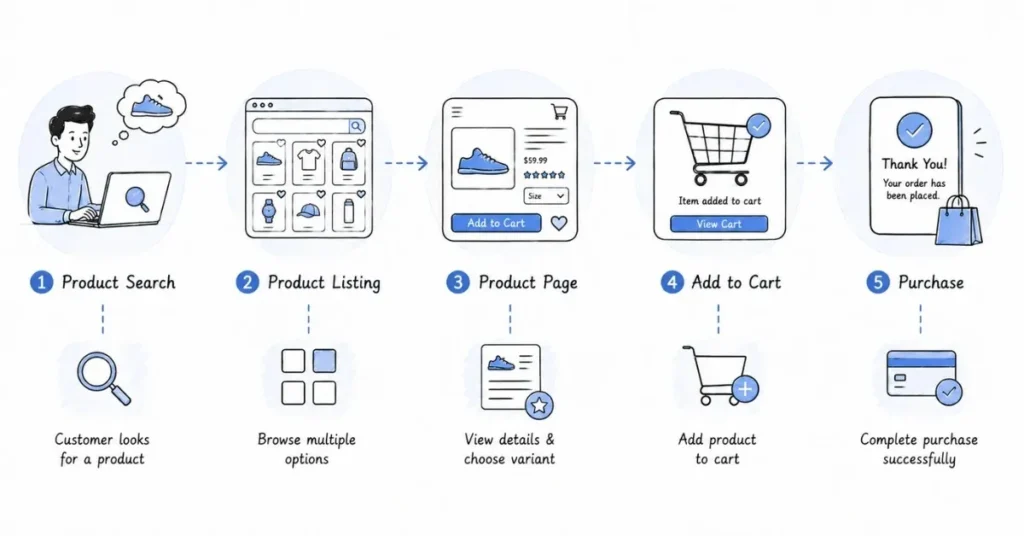
Walk into any successful physical store say, a premium fashion boutique. Notice how products are displayed?
- Mannequins wearing complete outfits (showing how to style)
- Best sellers at eye level (prime visibility)
- Complementary products placed together (shirt next to matching trousers)
- Lighting highlighting textures and colors
- Strategic pricing labels (₹4,999 instead of ₹5,000)
- New arrivals get prime window space
All of this is merchandising making products appealing and easy to buy.
Now translate this to online. That’s online merchandising and product management.
You don’t have physical space, lighting, or mannequins. You have pixels, product pages, search algorithms, and customer data. Your job is making products irresistible in this digital environment.
Let me show you what this looks like in reality.
Online Merchandising Specialist: The Digital Store Curator
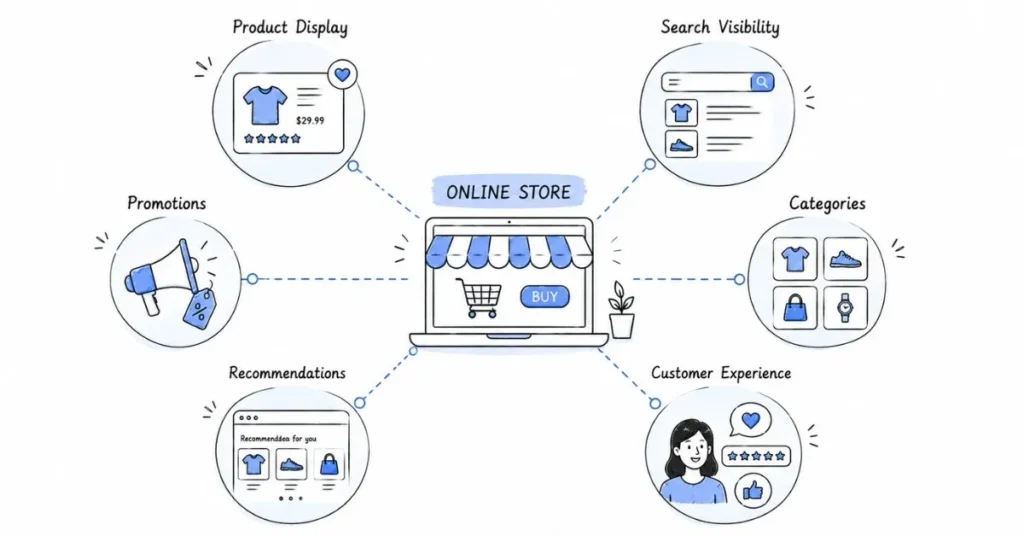
What you actually do:
You’re responsible for how products are presented, organized, and promoted on e-commerce platforms.
Key responsibilities:
1. Product Catalog Management
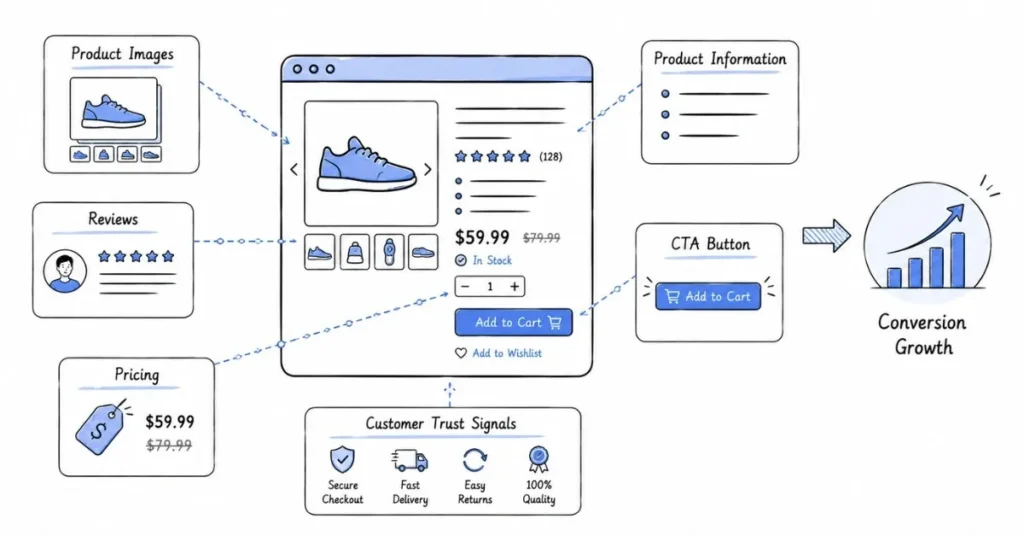
Creating compelling product listings:
Every product needs:
- Title: SEO optimized, clear, informative
- Images: High quality, multiple angles, lifestyle shots, zoom functionality
- Description: Benefits, features, specifications, answering all possible questions
- Pricing: Competitive, psychological pricing strategies
- Variants: Size, color, material options clearly displayed
- Stock status: Clear availability indication
Bad product listing example:
- Title: “Shirt”
- Image: One low quality photo
- Description: “Nice shirt, good quality”
- Price: ₹1,250
Good product listing example:
- Title: “Men’s Cotton Formal Shirt Slim Fit, Full Sleeve, Blue Checks Office Wear”
- Images: 6 high quality photos (front, back, side, detail shots, model wearing it, size chart)
- Description: “Premium 100% cotton formal shirt perfect for office and business meetings. Slim fit design flatters your physique. Breathable fabric keeps you comfortable through long workdays. Easy care, wrinkle resistant. Available in 5 sizes (S-XXL).”
- Price: ₹1,249 (psychological pricing)
- Customer reviews: Prominent display with photos
- Size guide: Interactive size finder
Second listing converts 3-4x better than first.
2. Category Management & Navigation
Organizing products logically:
Customer looking for “running shoes” shouldn’t have to scroll through 5,000 shoes. They need:
- Clear categories (Men’s Running Shoes → Trail Running, Road Running, All Terrain)
- Filters (Size, Brand, Price Range, Color, Customer Rating)
- Sorting options (Price low high, Newest, Best Selling, Customer Rating)
Your job: Creating this taxonomy and constantly optimizing it based on how customers actually search and browse.
Real example:
Initial category structure at a fashion site I worked with:
- Women’s Clothing → Tops → Casual Tops
Problem: Customers also searched “women’s kurtas,” “women’s ethnic wear,” “traditional tops” all different mental models.
Solution: Created multiple navigation paths to same products:
- Women → Ethnic Wear → Kurtas
- Women → Traditional → Kurtas
- Women → Tops → Ethnic Tops
Result: 25% improvement in category page engagement.
3. Visual Merchandising
Homepage curation:
Your homepage is like a store window. What do you feature?
Strategic decisions:
- Hero banner: What’s the main message? (New collection? Sale? USP?)
- Featured categories: Which 6-8 categories to highlight?
- Best-sellers: Which products?
- Social proof: Customer testimonials, media mentions
- Urgency: “Sale ends in 2 days,” “Only 5 left in stock”
Product page optimization:
Cross-selling: “Frequently bought together” if customer buying phone, show compatible cases and screen protectors
Upselling: “Customers also viewed” showing higher priced alternatives with better features
Bundle creation: “Complete the look” shirt, trouser, shoes styled together
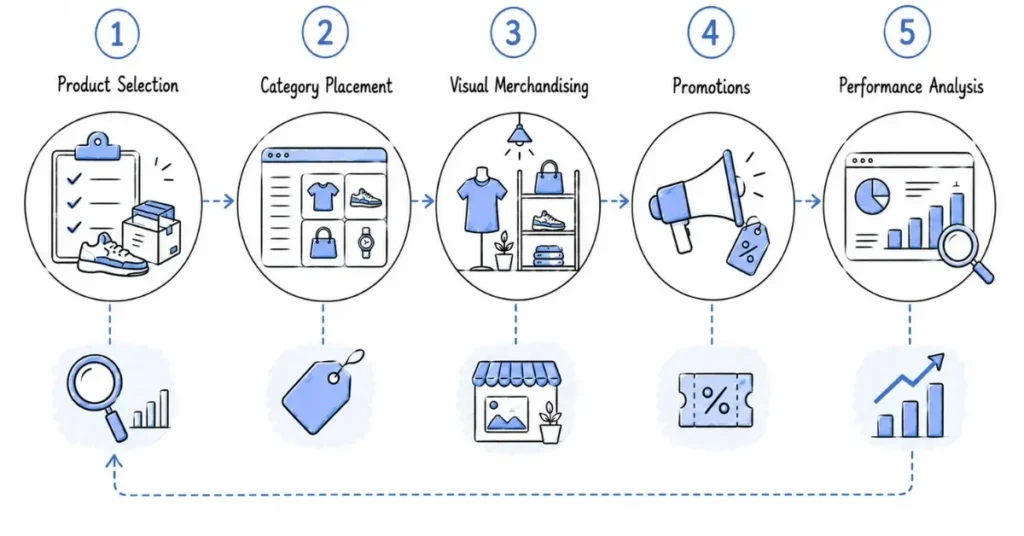
4. Pricing Strategy
Competitive pricing:
- Monitoring competitor prices
- Price matching where needed
- Identifying opportunities to differentiate (better product, better service justifies higher price)
Dynamic pricing:
- Adjusting prices based on demand, inventory levels, time of day
- Higher prices when demand high, lower when need to clear stock
- Personalized pricing (showing different prices to different customer segments ethically controversial but widely practiced)
Promotional pricing:
- Deciding discount percentages
- Flash sales, limited time offers
- Tiered discounts (buy 2 get 10% off, buy 3 get 20% off)
Psychological pricing:
- ₹999 vs ₹1,000 (charm pricing left digit effect)
- ₹1,299 vs ₹1,300
- Showing original price crossed out (₹2,000 ₹2,500) creates perception of deal
5. Search & Discoverability
Internal search optimization:
- Ensuring search understands Hindi and regional languages (“jeans” = “जींस”)
- Synonym mapping (formal shirt = dress shirt = office shirt)
- Autocomplete suggestions
- Handling misspellings
Faceted search:
- Allowing customers to filter by multiple attributes simultaneously
- “Show me: Men’s running shoes, Size 10, Under ₹3,000, Nike or Adidas brand, Blue color”
6. Seasonal & Campaign Planning
Festival merchandising:
Diwali example:
- Homepage banner: Diwali theme (diyas, lights, festive colors)
- Featured categories: Ethnic wear, gifting, home décor
- Product bundling: “Diwali Gift Hampers”
- Pricing: Festive discounts
- Content: “Diwali Shopping Guide,” “Gift Ideas by Budget”
A week in life of Priya, Merchandising Specialist at home décor e-commerce, Bangalore:
Monday:
- Analysis of weekend sales: Wall art category performed 40% above target, Furniture underperformed
- Hypothesis: Homepage featured wall art prominently
- Action: Adjust homepage to also feature furniture
Tuesday:
- Competitor analysis: 3 competitors launched monsoon collections
- We’re behind. Create urgency: Pull together our monsoon appropriate products (indoor plants, cozy furnishings), create “Monsoon Collection” landing page
Wednesday:
- Product content review: 50 new products added by vendor
- Reviewing photos (quality okay?), descriptions (compelling enough?), categorization (correct categories?)
- Rejecting 8 products for poor image quality, requesting reshoot
Thursday:
- Planning homepage for next week
- Data shows: Customers browsing “minimalist décor” trending up 30%
- Decision: Feature minimalist collection on homepage, create content piece “Minimalist Home Styling Guide”
Friday:
- Monthly merchandising report preparation
- Metrics: Category wise performance, conversion rates, AOV, return rates by category
- Insights: Lighting category has high return rate (15%) investigating, seems products look different in photos vs. reality
- Recommendation: Improve product photography to set accurate expectations
Product Manager (E-commerce): The Product Champion
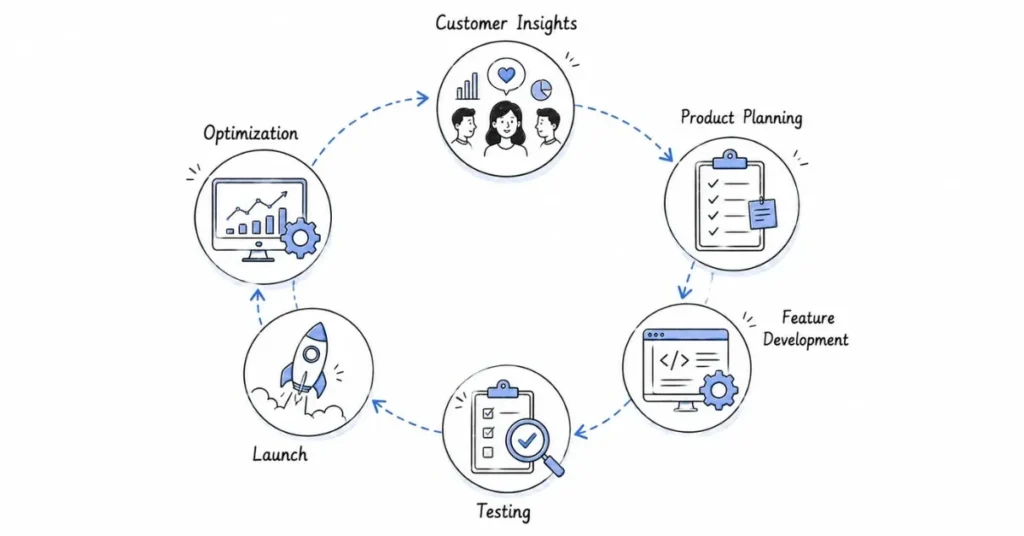
What you actually do:
You’re responsible for end-to-end product lifecycle – from deciding what products to stock, to their success or failure.
How Product Manager differs from Merchandising Specialist:
Merchandising: How to present and sell existing products (display, pricing, promotion)
Product Management: Which products to stock, product strategy, lifecycle management
Key responsibilities:
1. Product Assortment Strategy
Deciding product mix:
You manage “Men’s Footwear” category with ₹50 lakhs monthly revenue target.
Questions you answer:
- How many SKUs to stock? (Too few = limited choice, too many = inventory costs)
- Which price segments? (Budget ₹500-1500, Mid-range ₹1500-3500, Premium ₹3500+)
- Which subcategories? (Formal, Casual, Sports, Ethnic)
- Which brands? (Own brand vs. third-party brands, exclusive vs. shared)
Deciding based on:
- Customer demand data (what are people searching for?)
- Sales data (what sells well?)
- Margin analysis (what’s profitable?)
- Competition (what gaps can we fill?)
- Trends (what’s becoming popular?)
2. Vendor & Brand Management
Sourcing products:
For inventory model (you buy and stock):
- Finding suppliers/manufacturers
- Negotiating prices, minimum order quantities, payment terms
- Quality assurance
- Managing relationships
For marketplace model (brands sell on your platform):
- Onboarding brands
- Negotiating commission rates
- Ensuring quality and service standards
- Managing exclusive partnerships
Real negotiation scenario:
Brand X (premium footwear) wants to sell on our platform:
- They want 10% commission (we usually charge 15-20%)
- They want exclusivity (not selling on competitor platforms)
- They offer high-quality products, good brand reputation
Negotiation:
- Agree to 12% commission (compromise)
- Exclusivity for 6 months, then review
- They provide marketing support (co-branded campaigns)
- Minimum catalog of 50 SKUs
Win-win negotiation creates sustainable partnerships.
3. Product Lifecycle Management
Introduction: Launching new products
- Creating launch strategy
- Initial inventory planning
- Marketing coordination
- Performance monitoring
Growth: Scaling successful products
- Increasing inventory
- Expanding to more variants (colors, sizes)
- Featured placements
Maturity: Maintaining steady sellers
- Consistent stock availability
- Refresh marketing periodically
- Optimize costs
Decline: Managing slow movers
- Clearance strategies
- Bundle with faster moving products
- Eventually discontinue
4. Data Driven Decision Making
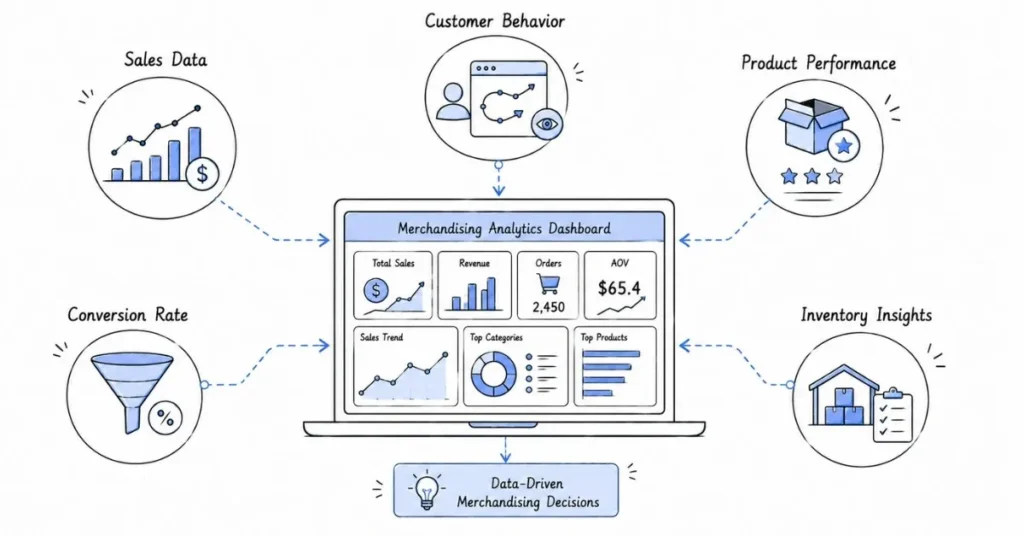
Metrics you track:
Product performance:
- Sales volume and revenue
- Conversion rate (what % of people viewing product actually buy?)
- Return rate (high returns indicate product issues)
- Customer ratings and review sentiment
Inventory metrics:
- Stock turnover ratio (how quickly inventory sells)
- Days of inventory (how many days will current stock last?)
- Stockout rate (how often we run out of stock)
Profitability:
- Gross margin by product
- Contribution margin (after all variable costs)
- Overall category profitability
Customer insights:
- What do customers say in reviews?
- What questions do they ask before buying?
- Why do they return products?
Example of data-driven decision:
Product: Premium leather wallet, ₹2,500
Data after 3 months:
- Sales: 250 units (₹6.25 lakhs revenue)
- Return rate: 25% (very high, normal is 8-10%)
- Customer complaints: “Quality not as expected,” “Leather feels cheap”
- Rating: 3.2 stars (poor)
Decision: Product has quality issues. Options:
- Work with vendor to improve quality
- Discontinue product
- Reduce price to ₹1,500 (matching quality perception)
Chose option 1: Worked with vendor, improved quality, relaunched.
New results after 3 months:
- Return rate: 8%
- Rating: 4.3 stars
- Sales: 320 units/month
5. Competitive Intelligence
Monitoring competition:
- What products are they launching?
- What prices are they offering?
- What’s their unique positioning?
- What’s working for them?
Finding opportunities:
- Products they don’t have (gaps in market)
- Products where we can offer better value
- Emerging trends they’re missing
Skills Needed for Success
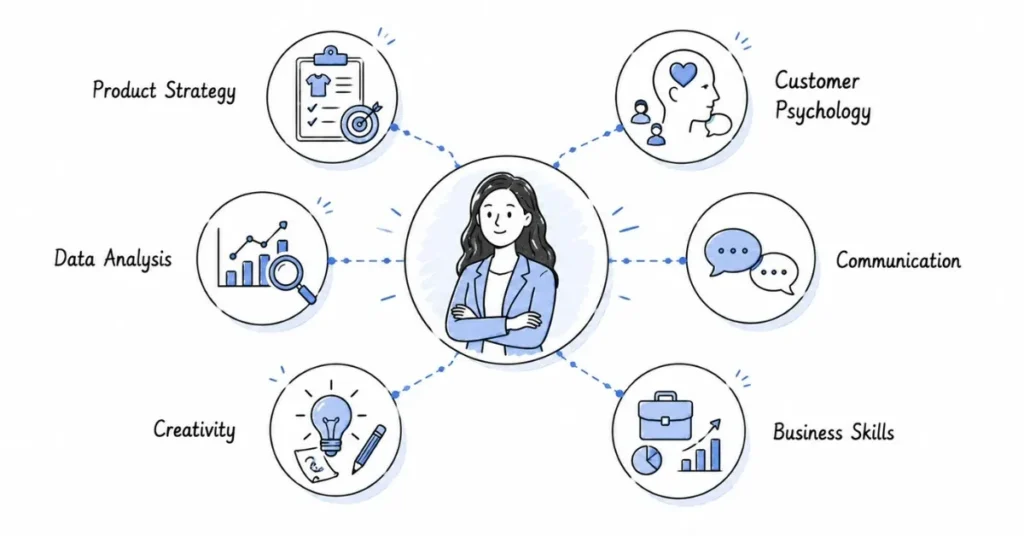
For Merchandising Specialist:
Creative eye: Understanding what’s visually appealing, how to present products attractively
Customer psychology: Understanding what makes people buy (social proof, scarcity, visual appeal)
Data literacy: Analyzing what’s working, optimization based on metrics
Tools proficiency:
- E-commerce platforms (Shopify, Magento, WooCommerce)
- Product management tools
- Analytics (Google Analytics, heatmaps)
- Basic image editing (Photoshop/Canva for creating promotional graphics)
For Product Manager:
Business acumen: Understanding profitability, margins, ROI
Analytical skills: Deep data analysis, identifying patterns and insights
Negotiation: Working with vendors and brands
Strategic thinking: Long-term product roadmap, not just day-to-day execution
Tools proficiency:
- Excel (advanced – pivot tables, complex formulas)
- Product management software
- Inventory management systems
- BI tools (Power BI, Tableau)
Salary Expectations
Merchandising Specialist:
- Entry level (1-3 years): ₹4-7 LPA
- Mid level (4-6 years): ₹8-14 LPA
- Senior (7+ years): ₹15-25 LPA
Product Manager:
- Entry level (2-4 years): ₹8-14 LPA
- Mid level (5-7 years): ₹15-26 LPA
- Senior (8+ years): ₹28-45 LPA
Product management typically pays 20-30% more than merchandising due to strategic nature and P&L responsibility.
Career Paths
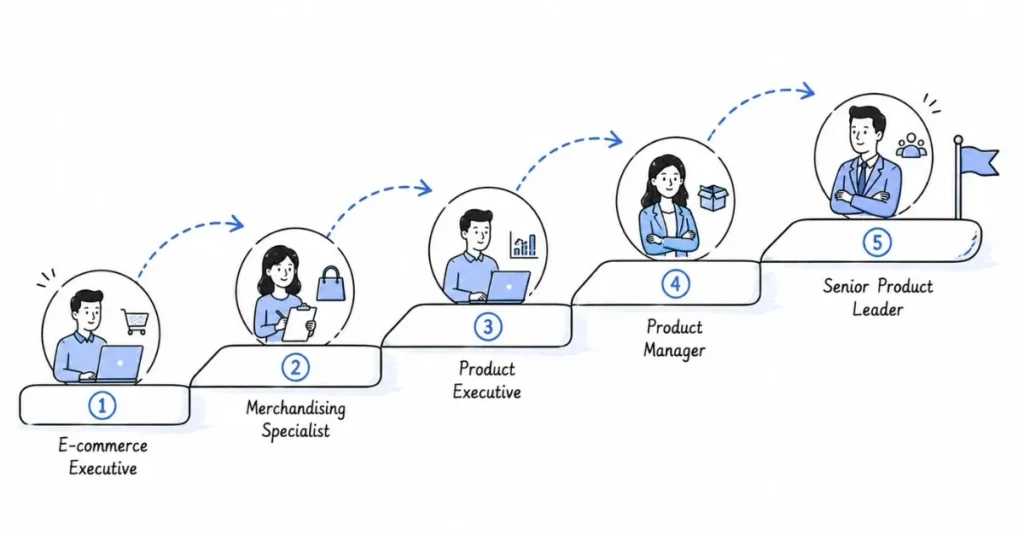
Path to Merchandising:
- Start as Merchandising Executive/Coordinator
- Learn product presentation, basic analytics
- Grow to Merchandising Specialist
- Advance to Senior Specialist or Category Merchandising Manager
Path to Product Management:
- Often requires 2-3 years experience first (in merchandising, category management, buying, or analytics)
- Enter as Associate Product Manager or Product Manager
- Grow to Senior PM
- Advance to Group PM or Head of Product
Lateral moves:
- Merchandising to Product Management (common)
- Product Management to E-commerce Manager or Category Head (common)
- Either role to entrepreneurship (understanding products deeply helps in starting own brand)
Indian E-commerce Specifics
Regional diversity:
- Product preferences vary by region
- South India might prefer different styles than North
- Your product assortment should reflect this
Price sensitivity:
- Indian consumers highly price-conscious
- Constant competitor price monitoring essential
- Value-for-money positioning crucial
Festival-driven sales:
- 40-50% of annual sales happen in Oct-Dec (Diwali, Durga Puja, Christmas)
- Product planning must account for this
Quality perception:
- Trust deficit in online shopping (especially for non-branded products)
- Heavy reliance on customer reviews and ratings
- Product presentation must build trust (detailed images, specifications, genuine reviews)
Challenges of the Role
Challenge 1: Inventory balance
Too much = Cash tied up, warehouse costs, risk of unsold stock
Too little = Lost sales, customer frustration
Finding perfect balance is constant struggle
Challenge 2: Trend prediction
Fashion and consumer preferences change fast. Bet on wrong trend = stuck with unsold inventory
Challenge 3: Competition
Competitors can copy your successful strategies within days. Constant innovation needed
Challenge 4: Data overload
Drowning in data from multiple sources. Finding meaningful signals in noise is challenging
Challenge 5: Cross-functional dependencies
You depend on designers for content, tech team for platform features, operations for execution. Coordination challenging
Why People Love These Roles
Reason 1: Tangible impact
You feature product on homepage, sales jump 3x. Direct, visible impact
Reason 2: Creative + analytical
Perfect blend – creative product presentation + data-driven decisions
Reason 3: Understanding consumer behavior
Fascinating to understand what makes people buy, how presentation influences decisions
Reason 4: Ownership
Your category, your products, your P&L (for PM roles). Entrepreneurial feeling within larger organization
Reason 5: Always learning
Consumer trends, technology, competition – constant learning keeps it interesting
Is This Right for You?
You’ll love merchandising if:
- You have aesthetic sense and creative eye
- You enjoy optimizing and testing
- You like seeing visual impact of your work
- You enjoy consumer psychology
You’ll love product management if:
- You enjoy strategic thinking
- You like P&L ownership
- You’re comfortable with ambiguity
- You enjoy data analysis and business metrics
- You want entrepreneurial experience
You might struggle if:
- You prefer deep technical work over business strategy
- You dislike juggling multiple priorities
- You need complete control (lots of dependencies in these roles)
- You prefer slow-paced environments (e-commerce moves fast)
Your Starting Point
For merchandising:
- Build aesthetic sense (study successful e-commerce sites, understand what works)
- Learn basic image editing
- Understand customer psychology
- Start as Merchandising Coordinator/Executive
For product management:
- Build strong Excel and analytical skills
- Understand e-commerce metrics deeply
- Learn about supply chain and vendor management
- Consider starting in buying, category management, or merchandising, then transition to PM
Final Thoughts
Merchandising and Product Management are where commerce meets psychology meets data science. You’re constantly answering: “How do I make customers want this product?”
It’s challenging, requires both left brain (analytics) and right brain (creativity) thinking, but incredibly rewarding.
Every time a customer discovers perfect product, completes purchase happily, and becomes loyal customer that’s your work materializing.
Your career in online merchandising or product management could start with one observation: “This product page could be better.” And then making it better.