
Non-Engineering Space Careers in India
Table of Contents
Introduction:
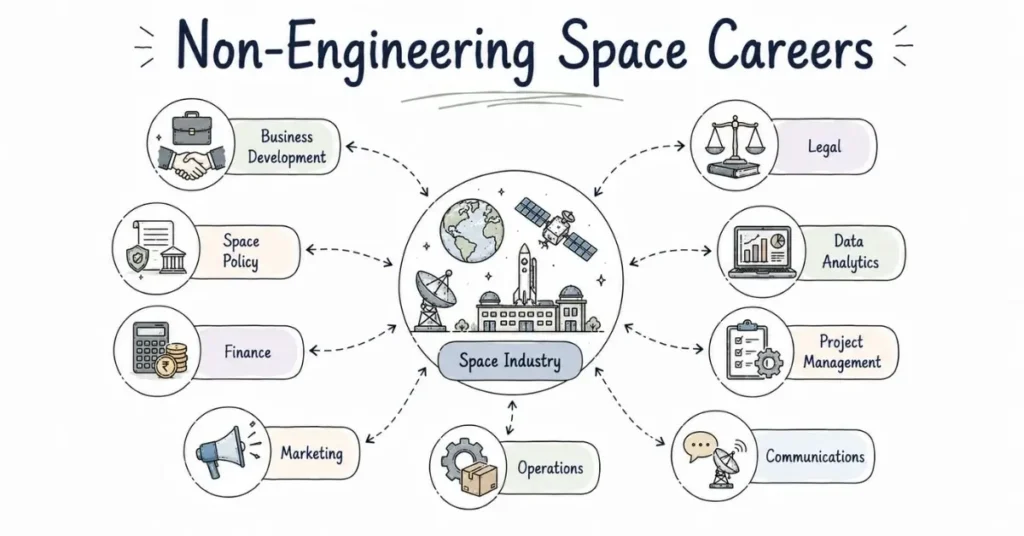
Every rocket launch you have ever watched had hundreds of engineers behind it. What the camera never shows is the equally large group of professionals who made that launch possible without writing a single line of code or designing a single component.
Someone negotiated the commercial contract that funded the mission. Someone built the regulatory case that got the launch approval. Someone ran the public affairs strategy that explained the mission to the nation. Someone managed the project timeline that kept 400 engineers working toward the same deadline. Someone analysed the market data that justified building the satellite in the first place.
India’s space sector needs all of these people and in 2025, it is actively hiring them. If you do not have an engineering background but feel genuinely drawn to the space industry, this guide is specifically for you.
Why Non-Engineering Roles Matter More Than Ever
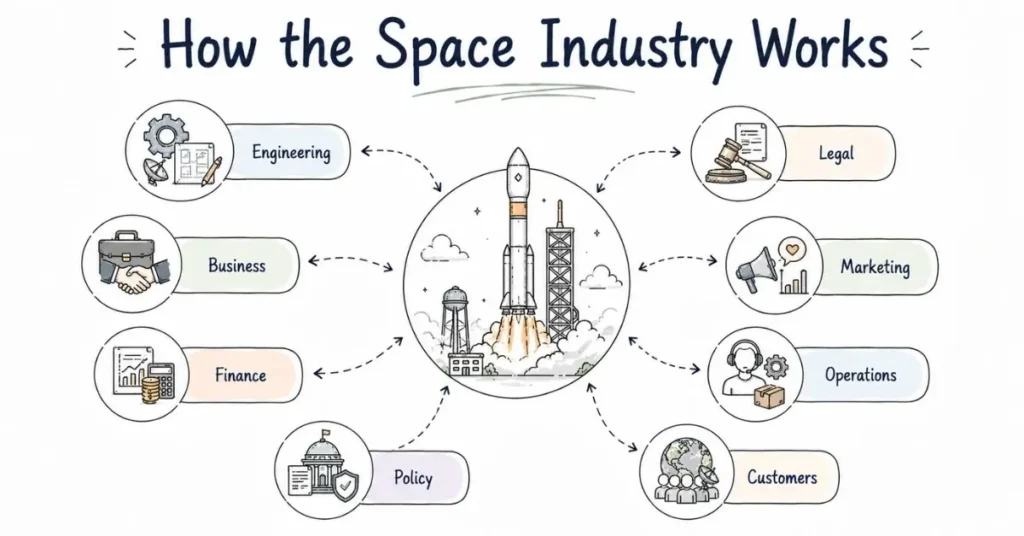
Five years ago, India’s space sector was almost entirely government-run and engineering-dominated. The jobs were technical, the organisations were hierarchical, and non-engineers had limited ways in.
That has changed fundamentally. The reason is commercialisation.
When space was purely a government activity, technical competence was the only currency. Now that private companies are building rockets, selling satellite services, seeking investors, navigating regulators, and competing for international contracts the sector needs exactly the same mix of skills that any growing industry needs: business development, legal expertise, policy understanding, financial analysis, marketing, operations management, and strategic communication.
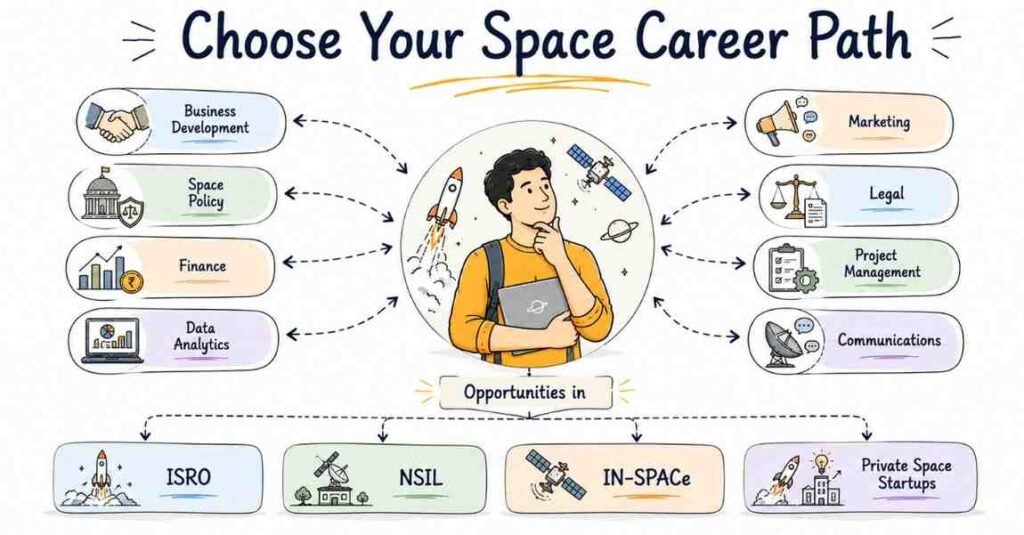
NSIL needs commercial managers to sell transponder capacity to broadcasters. IN-SPACe needs policy specialists to draft regulatory frameworks. Pixxel needs data product managers to build its analytics platform into a sellable product. SatSure needs agricultural domain experts who understand both satellite data and how farmers make decisions. Skyroot needs legal professionals to manage launch service contracts.
These roles exist today. They are paid well. And the competition for them is lower than for engineering roles because most people still do not know they exist.
Key Non-Engineering Career Tracks in India's Space Sector
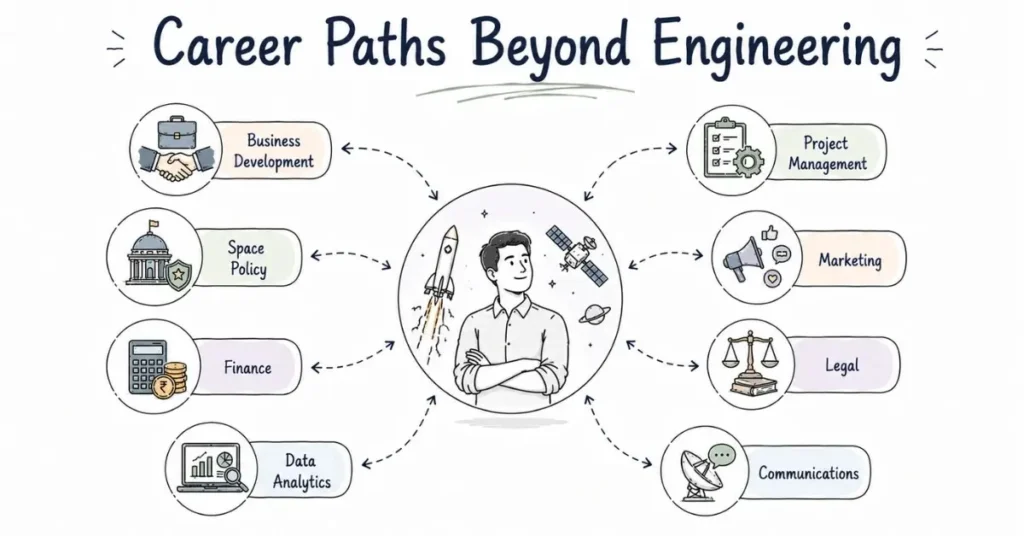
Business Development and Commercial Management
What this involves: Identifying potential customers for space products and services, building relationships, negotiating contracts, and converting opportunities into revenue.
In India’s space sector, business development roles exist primarily at NSIL, commercial satellite operators (SES India, Hughes India, Airtel’s satellite division), and private startups. The work involves selling transponder capacity to broadcasters, launch services to satellite operators, Earth observation data to agriculture or infrastructure companies, or satellite communication services to enterprise clients.
What employers look for:
- MBA from a reputed institution (preferred but not always mandatory)
- Understanding of the space sector you do not need to be an engineer, but you need to know what a transponder is, what LEO vs GEO satellites mean commercially, and what India’s satellite policy landscape looks like
- Sales and relationship-building experience
- Comfort working in a technical environment
Where this role exists: NSIL, Hughes India, SES India, Pixxel, SatSure, Astrome Technologies, Airtel OneWeb
Salary: ₹8–15 LPA at entry/mid level; ₹20–40 LPA at senior and leadership levels
Space Policy and Regulatory Affairs
What this involves: Developing, analysing, and implementing policies that govern space activities. In India, this means working with IN-SPACe, the Department of Space, TRAI, and DoT on questions like: How should India regulate private satellite launches? How should spectrum be allocated for satellite broadband? What international obligations does India have under the Outer Space Treaty?
This is genuinely specialist work. The intersection of international space law, domestic telecommunications regulation, national security considerations, and commercial space growth is complex and there are very few people in India who understand all of it well.
What employers look for:
- Degree in law (LLB/LLM), public policy, international relations, or economics
- Understanding of space law basics UN space treaties, ITU regulations, national space legislation
- Research and analytical writing skills
- Comfort working in government or quasi-government environments
Where this role exists: IN-SPACe (primary employer), Department of Space, TRAI, Ministry of External Affairs (space diplomacy roles), think tanks (Observer Research Foundation, IDSA), academic institutions
Salary: Government roles follow 7th Pay Commission scales (₹56,100/month base at entry level); think tank and consultancy roles ₹6–15 LPA
Finance and Investment in Space
What this involves: Managing financial operations, analysing investment opportunities, or raising capital for space companies and projects.
As India’s private space sector grows, a specialist financial community is forming around it. Venture capital funds are making space investments. NSIL manages commercial revenues. Private startups need CFOs and financial controllers. The IN-SPACe VC Fund needs investment managers who understand both space technology and venture investing.
What employers look for:
- CA, MBA Finance, or CFA qualification
- Understanding of aerospace or deep-tech sector dynamics
- For VC roles: ability to evaluate technical feasibility of space projects commercially
- For corporate finance roles: standard financial management, budgeting, and reporting skills
Where this role exists: NSIL finance team, space-focused VC funds (Speciale Invest, Kalaari Capital have made space investments), startup CFO roles, ISRO’s finance and administration departments
Salary: ₹8–18 LPA at mid-level; ₹25–50 LPA for senior finance leadership and VC roles
Data Analytics and Space Domain Expertise
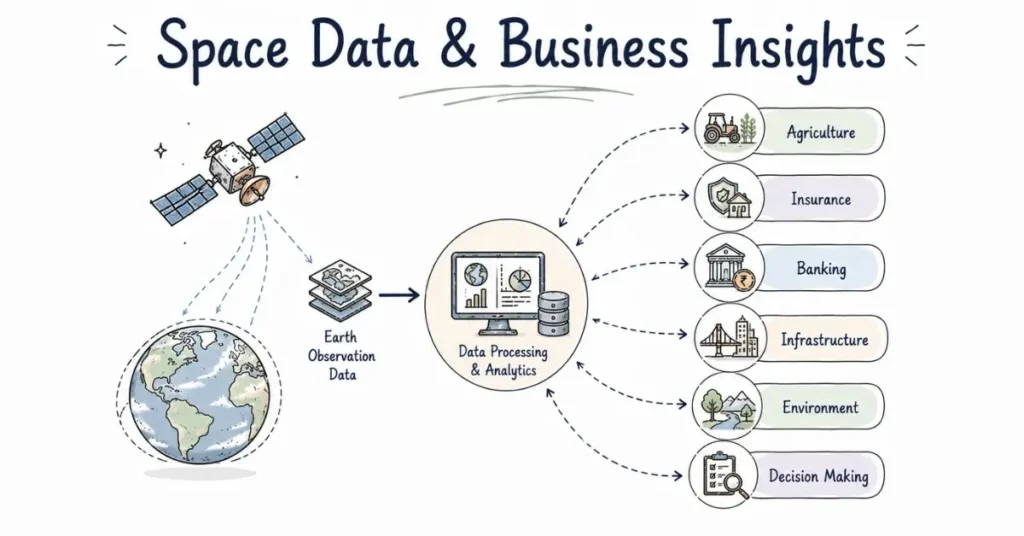
What this involves: Using satellite data to solve real-world problems without necessarily building the satellites or writing the processing algorithms yourself. This role is about understanding what satellite data means in a specific domain: agriculture, insurance, infrastructure, banking, environment, or defence.
A good example: SatSure’s agricultural analytics platform serves banks and insurance companies assessing farmer loan risk and crop damage. The engineers build the data pipeline. But someone with agricultural domain knowledge and analytical skills interprets the output, validates it against ground reality, and communicates it to banking clients who know nothing about satellites.
This is a genuine career track domain expert + satellite data literacy and it is accessible to people from agriculture, economics, environmental science, urban planning, or social science backgrounds.
What employers look for:
- Domain expertise in agriculture, environment, finance, or infrastructure
- Basic data literacy ability to interpret datasets, work with Excel/Python at a basic level
- Understanding of how satellite data relates to the domain problem
- Communication skills translating technical output into client-friendly insights
Where this role exists: SatSure, Cropin, Fasal, ISRO NRSC (applied research roles), state agriculture departments, insurance companies building satellite assessment teams
Salary: ₹5–12 LPA entry; ₹15–25 LPA senior domain specialist
Project and Operations Management
What this involves: Managing the delivery of complex space projects keeping timelines, budgets, and teams on track across engineering, commercial, and regulatory workstreams.
At ISRO, senior project directors are typically engineers who moved into management. But at private startups and commercial space companies, dedicated project managers with PMP or equivalent qualifications are increasingly hired from outside the engineering community.
What employers look for:
- PMP certification (Project Management Professional) or equivalent
- Experience managing complex, multi-stakeholder technical projects
- Ability to communicate between technical and non-technical teams
- Risk management skills
Where this role exists: NSIL, private startups (Skyroot, Agnikul, Dhruva Space), aerospace service companies (LTTS, TASL)
Salary: ₹8–18 LPA mid-level; ₹20–35 LPA senior
Marketing, Communications, and Content
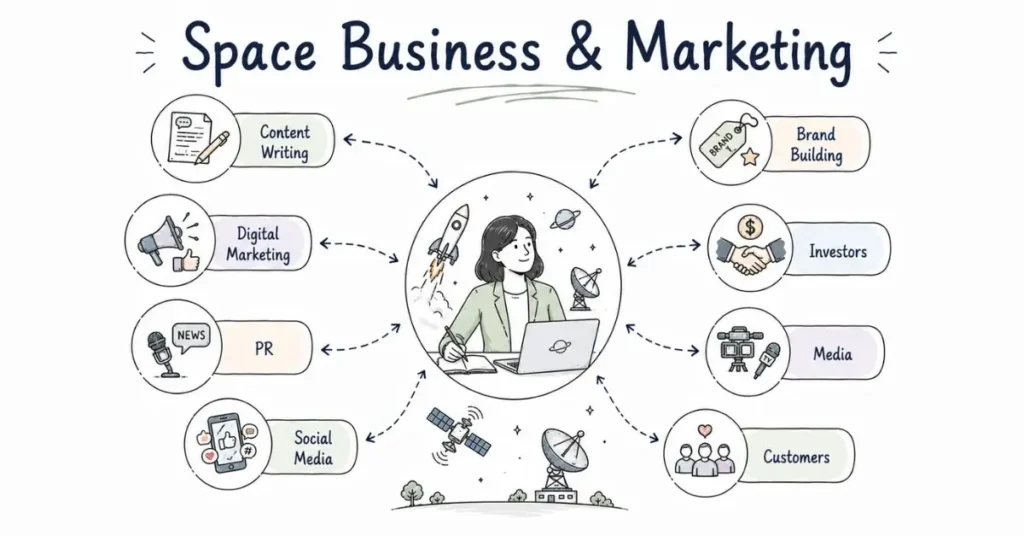
What this involves: Building awareness, credibility, and commercial pipeline for space companies through content, media relations, social media, and marketing campaigns.
This is perhaps the most accessible non-engineering entry point into India’s space sector. Private space startups Pixxel, Skyroot, Agnikul, SatSure all need marketing professionals who can communicate complex technical work clearly to investors, customers, media, and the public.
The work spans content writing about space technology in accessible language, managing LinkedIn and social media presence, writing press releases for launches and funding announcements, creating investor pitch materials, and building data-driven marketing campaigns for satellite data products.
What employers look for:
- Marketing, journalism, communications, or English literature background
- Ability to understand technical content well enough to explain it simply
- Content writing skills blogs, social media, PR copy
- For digital marketing roles: SEO, paid advertising, email marketing experience
Where this role exists: All private space startups with commercial ambitions; NSIL’s communications team; IN-SPACe’s public outreach team
Salary: ₹4–10 LPA entry; ₹12–25 LPA senior marketing leadership
Legal and Contracts
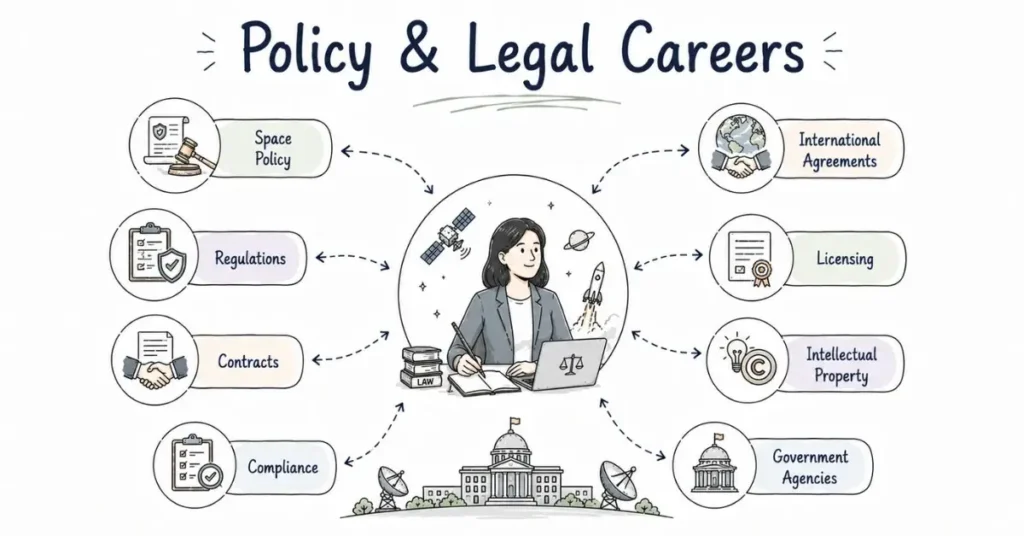
What this involves: Managing legal aspects of space activities launch service agreements, satellite operator licences, spectrum rights, intellectual property, investment agreements, and compliance with India’s evolving space regulatory framework.
Space law is genuinely specialised it combines elements of international law (the Outer Space Treaty, Registration Convention, Liability Convention), telecommunications law, contract law, and national space legislation. Very few lawyers in India currently specialise in it, which means those who develop this expertise have significant career leverage.
What employers look for:
- LLB/LLM with interest in space, technology, or international law
- Understanding of space law basics (UN treaties, ITU regulations, India’s space policy)
- Contract drafting and review experience
- For senior roles: experience in commercial negotiations
Where this role exists: IN-SPACe legal team, NSIL contracts team, law firms advising space startups (Shardul Amarchand Mangaldas, AZB & Partners both have aerospace clients), space startup in-house legal
Salary: ₹6–15 LPA early career; ₹20–45 LPA experienced space law specialists
How to Enter the Space Sector Without an Engineering Degree
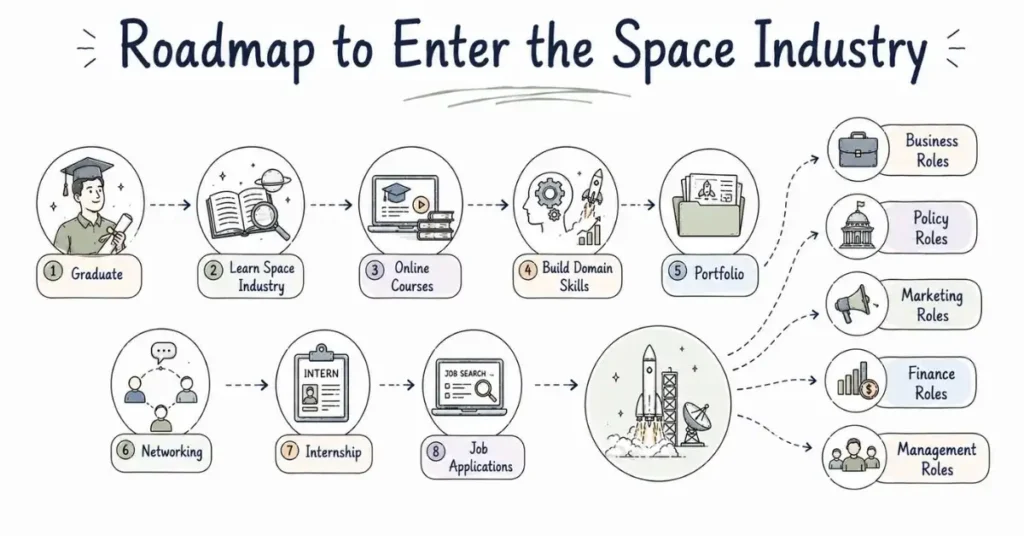
Step 1: Build genuine space sector literacy
You do not need to understand orbital mechanics. But you do need to understand India’s space ecosystem who the players are, what they do, how the regulatory framework works, and what the commercial opportunities are. Read this entire career guide series. Follow ISRO, NSIL, IN-SPACe, Skyroot, and Pixxel on LinkedIn. Read the annual Department of Space reports.
Step 2: Take one relevant online course
The IISc Advanced Certification in Space Technologies is open to non-engineers with science backgrounds. IIRS online courses are accessible to geography and environmental science graduates. NPTEL’s Introduction to Remote Sensing requires no engineering background. Even completing one structured program gives you a vocabulary and credential that signals genuine commitment.
Step 3: Connect your existing skills directly to space applications
Do not present yourself as “wanting to get into space.” Present yourself as a marketing professional who specialises in deep-tech communication, or a lawyer developing expertise in emerging technology regulation, or a finance professional building space sector knowledge. Specificity matters more than enthusiasm.
Step 4: Apply to startups first
Private space startups are far more open to non-traditional backgrounds than ISRO or government organisations. Pixxel, SatSure, and Skyroot have all hired marketing, business development, and operations professionals from outside aerospace. Apply directly, personalise your application to their specific business context, and demonstrate that you understand what they are building.
Step 5: Target NSIL and IN-SPACe for government non-engineering roles
Both organisations have specific roles for legal, finance, business development, and policy professionals. Watch their careers pages regularly. These roles are less publicised than ISRO engineering vacancies but are real and recurring.
FAQs : Non-Engineering Space Careers in India
Q: Do I need to know engineering to work in space policy?
You need enough technical literacy to understand what you are regulating or advising on but not engineering depth. Reading ISRO‘s mission descriptions, understanding basic satellite and launch vehicle concepts, and following India’s space policy developments gives you sufficient technical context for policy and regulatory roles.
Q: Can an MBA graduate build a career in India's space sector?
Yes, and increasingly so. NSIL, private startups, and commercial satellite operators all need MBA graduates for business development, strategy, and operations roles. An MBA with a genuine interest in space, supplemented by self-built sector knowledge, is a strong profile for the commercial side of India’s growing space economy.
Q: Is space marketing a real job in India?
It is becoming one. Three years ago, most Indian space startups were purely engineering-focused with minimal marketing. As they mature, raise larger funding rounds, and target enterprise customers, marketing becomes a business-critical function. Pixxel, SatSure, and Skyroot all have marketing teams. This will only grow.
Q: What is the best way for a law student to specialise in space law in India?
Start by reading the four UN space treaties (freely available online). Follow IN-SPACe’s regulatory outputs and India’s space policy documents. Take an online course in space law the International Space University (ISU) offers summer programs; some Indian law schools are beginning to offer space law modules. Connect with India’s small but growing community of space law professionals through LinkedIn.
Q: Are there roles for social scientists and economists in the space sector?
Yes, particularly at IN-SPACe (policy and impact assessment), ISRO’s applications divisions (socioeconomic impact studies of space applications), and think tanks researching India’s space economy. The space sector’s socioeconomic impact on agriculture, disaster management, and rural connectivity is an active research area that needs economists and social scientists.