
Medical Lab Technician (BMLT) – Diagnosis is Your Responsibility

Table of Contents
Introduction: The Invisible Healthcare Heroes Behind Every Diagnosis
Imagine this: A patient walks into a hospital with fever and body aches. The doctor suspects typhoid. He orders a blood test. Within an hour, a Medical lab technician draws blood, processes it, runs cultures, and delivers results. The doctor sees “Positive for Salmonella typhi” and prescribes antibiotics. The patient recovers.
Without that lab technician, the diagnosis never happens. Treatment never starts. The patient’s condition worsens.
That’s the reality of medical lab technicians—you’re not on the front lines with patients, but you’re absolutely essential to diagnosis, treatment, and patient outcomes
Here’s what makes medical lab technician careers special:
No Patient Pressure (If You Prefer). Unlike nurses dealing with anxious patients, or doctors making life-death decisions, lab technicians work in quieter laboratory environments. You’re focused on accuracy, not bedside manner.
Quick Entry. 2-year diploma gets you working. Compare that to nursing (2-4 years) or medicine (5.5 years).
Decent Starting Income. Fresh BMLT graduates earn ₹2-2.5 LPA, comparable to nursing.
Clear Specialization Paths. Blood bank, microbiology, biochemistry, immunology—each with its own specialization potential and salary progression.
Job Security. Every hospital needs lab technicians. These jobs aren’t going anywhere.
Growth Potential. Senior lab technicians, lab supervisors, and lab managers earn ₹10-12 LPA+ with experience.
If you’re detail-oriented, love science, enjoy precision work, and want stable healthcare employment without the emotional demands of direct patient care—medical lab technology could be your perfect fit.

What Do Medical Lab Technicians Actually Do? The Reality
Most people think lab technicians just “run tests.” But the actual work is far more complex and interesting.
The Typical Day of a Medical Lab Technician
Early Morning (7 AM – 10 AM):
Samples start arriving from wards and outpatient departments. Blood samples, urine samples, stool samples, sputum samples. Your job begins immediately.
You receive blood samples and must:
- Verify the label: Is it the right patient? Is the sample code correct?
- Check the sample quality: Is blood properly collected? Is it clotted (if it shouldn’t be)? Is there hemolysis (blood cells broken)?
- Sort samples: Separate them by test type (complete blood count, biochemistry, serology, microbiology, etc.)
- Create sample logs: Record receipt time, condition, and test type
This seems simple but is absolutely critical. A mislabeled sample could mean the wrong patient gets treated for the wrong condition. Lab technicians are the quality control checkpoint.
Mid-Morning (10 AM – 1 PM):
Now the actual testing begins. You operate sophisticated machines:
Hematology Analyzer: Counts blood cells (white cells, red cells, platelets). Takes 30 seconds per sample but requires proper sample preparation and machine maintenance.
Biochemistry Analyzer: Tests blood chemistry (glucose, proteins, enzymes, kidney function, liver function). Can process 100+ samples per hour.
Blood Culture Incubator: For microbiology samples, you inoculate cultures and place them in controlled temperature environments to grow bacteria.
Microscope Work: You examine blood smears, identify parasites, count cell differentials (different types of white blood cells). This requires training and experience—you’re literally making microscopic diagnoses.
Serological Testing: Running blood typing, infectious disease serology (HIV, hepatitis, syphilis testing), and immunological tests.
Each test has protocols. You follow them precisely. Accuracy is everything.
Afternoon (1 PM – 4 PM):
Results start coming in. You:
- Validate results: Do they make sense? Is a potassium level 10x higher than normal? That’s probably a hemolyzed sample—retest needed.
- Report results: Enter data into hospital information systems
- Quality assurance: Run quality control checks on machines
- Equipment maintenance: Clean, calibrate, and maintain analyzers
- Sample disposal: Biohazardous waste disposal following strict protocols
Evening (4 PM – 6 PM):
- Prepare for next day
- Document issues encountered
- Restock supplies
- Final equipment checks
This is the real work. Not just “running tests” but entire responsibility for diagnostic accuracy.
Why Lab Accuracy Matters So Much
Consider real consequences of lab errors:
Wrong Blood Type: Patient gets transfusion of incompatible blood → Severe transfusion reaction → Patient death
Glucose Test Error: Normal glucose reported as critical low → Doctor gives insulin → Patient becomes hypoglycemic → Brain damage
Bacterial Culture Contamination: False positive for sepsis → Patient given antibiotics unnecessarily → C. difficile infection develops from antibiotic side effect
Lab technicians literally hold life-and-death responsibility. That’s why accuracy obsession is non-negotiable.

Understanding BMLT: The Education That Qualifies You
BMLT stands for Bachelor of Medical Laboratory Technology. But “bachelor’s” might be misleading—let’s clarify.
BMLT vs DMLT: What’s the Difference?
DMLT (Diploma in Medical Lab Technology):
- Duration: 2 years
- After: 12th grade
- Cost: ₹1-3 lakhs
- Jobs available: Yes, many positions available
- Salary starting: ₹2-2.5 LPA
BMLT (Bachelor of Medical Lab Technology):
- Duration: 3 years
- Prerequisites: 12th with Science (PCB)
- Cost: ₹2-5 lakhs (government), ₹5-10 lakhs (private)
- Jobs available: More positions, better advancement
- Salary starting: ₹2.5-3.5 LPA
Practical difference: DMLT is sufficient for entry-level lab technician roles. BMLT positions you for senior roles, lab supervision, and specialization faster.
BMLT Curriculum: What You’ll Learn
Year 1:
- Anatomy & Physiology: How the body works (why you need this for labs)
- Biochemistry: Chemical processes in body and labs
- Microbiology: Bacteria, viruses, fungi (essential for microbiology lab section)
- Hematology: Blood and blood cells
- General Pathology: Disease processes
- Lab Management Basics: Organization and safety
Year 2:
- Clinical Biochemistry: Chemical analysis of patient samples
- Hematology (Advanced): Advanced blood testing techniques
- Microbiology (Advanced): Culturing, identifying, and sensitivity testing
- Immunohematology (Blood Banking): Blood typing, transfusion practices
- Serological Techniques: Antibody-antigen reactions, disease serology
- Lab Equipment & Techniques: Specific machine training
Year 3:
- Histopathology & Cytology: Tissue and cell examination
- Clinical Microbiology Advanced: Complex organism identification
- Advanced Immunology: Immune system testing
- Research Methods: Lab research fundamentals
- Clinical Internship: 6-12 months in actual hospital labs
By the end, you’re not just theoretically trained—you’ve worked in actual labs, handled real patient samples, and learned practical skills.upes
Where to Study BMLT
Government Colleges:
- Better quality education
- Lower fees (₹1-3 lakhs total)
- Competitive admission
- Rigorous curriculum
- Better placements
Private Colleges:
- Easier admission
- Higher fees (₹5-10 lakhs)
- Variable quality
- More flexibility
Entrance Exams:
- Some states use NEET for BMLT admission
- Others have state-level entrance exams
- Some colleges admit via merit basis
Pro tip: Aim for government colleges if possible. Quality is better, you save money, and employers prefer government-trained technicians.
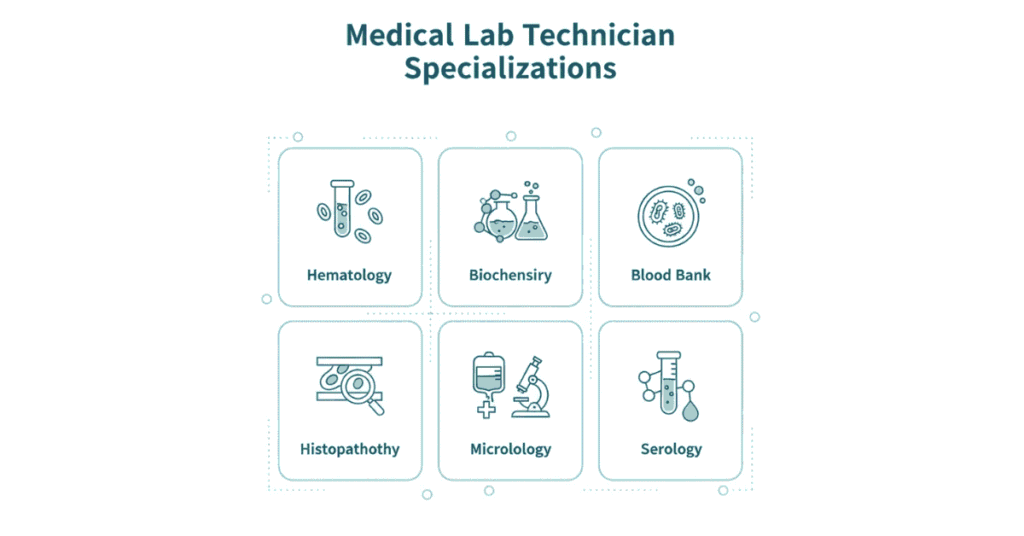
Types of Lab Technician Specializations: Your Paths
Specialization 1: Hematology Lab Technician
What They Do:
- Blood cell counting and analysis
- Coagulation studies (blood clotting tests)
- Blood smear preparation and examination
- Working with hematology analyzers
- Identifying blood disorders
Work Environment:
- Dedicated hematology lab section
- Regular 9-5 hours typically
- High-volume sample processing
- Mix of machine work and microscopy
Salary:
- Entry-level: ₹2-2.5 LPAcollegesearch
- Experienced (5+ years): ₹4-6 LPA
- Senior hematology specialist: ₹6-8 LPA
Best For: Those liking systematic work, blood analysis, comfortable with routine
Specialization 2: Biochemistry Lab Technician
What They Do:
- Chemical analysis of blood, urine, CSF
- Testing kidney function, liver function, glucose
- Enzyme assays and protein analysis
- Hormonal testing
- Working with biochemistry analyzers
Work Environment:
- Dedicated biochemistry section
- High sample volume
- Machine-heavy work
- Regular hours
Salary:
- Entry-level: ₹2-2.5 LPA
- Experienced (5+ years): ₹4-6 LPA
- Senior positions: ₹7-9 LPA
Best For: Those liking chemical analysis, machine operation, high precision
Specialization 3: Blood Bank Technician (Immunohematology)
What They Do:
- Blood typing (ABO, Rh typing)
- Compatibility testing before transfusions
- Blood component separation (plasma, platelets, RBCs)
- Cross-matching blood
- Managing blood inventory
- Ensuring transfusion safety
Work Environment:
- Blood bank department
- Critical work (wrong blood type = death)
- High responsibility
- Sometimes on-call for emergency transfusions
Salary:
- Entry-level: ₹2.5-3 LPA
- Experienced (5+ years): ₹5-7 LPA
- Blood bank supervisor: ₹7-10 LPA
Why Higher Salary: Blood banking is critical and demanding. Wrong blood type = patient death. Hospitals pay premium for reliable blood bank technicians.
Best For: Detail-obsessed professionals, those comfortable with high responsibility, those liking structured work
Specialization 4: Microbiology Lab Technician
What They Do:
- Culturing bacteria, viruses, fungi
- Identifying microorganisms from samples
- Sensitivity testing (which antibiotics work)
- Staining and microscopy
- Processing respiratory, urinary, and blood cultures
- Quality control
Work Environment:
- Microbiology lab with biosafety cabinets
- Handling infectious materials safely
- Shift work possible (cultures need monitoring)
- Can be high-pressure (sepsis cultures need fast results)
Salary:
- Entry-level: ₹2-2.5 LPA
- Experienced (5+ years): ₹4-6 LPA
- Senior microbiology: ₹6-9 LPA
Best For: Science enthusiasts, those interested in pathogens, people comfortable with biosafety protocols
Specialization 5: Serological/Immunology Technician
What They Do:
- Disease serology (HIV, hepatitis, syphilis testing)
- Immunological tests
- Antibody-antigen reactions
- Running serology analyzers
- Quality assurance on serological tests
Work Environment:
- Dedicated serology section
- Regular hours typically
- Biosafety considerations
- High sample volume
Salary:
- Entry-level: ₹2-2.5 LPA
- Experienced (5+ years): ₹4-6 LPA
- Senior positions: ₹6-8 LPA
Best For: Those interested in infectious diseases, immunology, disease prevention
Specialization 6: Histopathology Technician
What They Do:
- Tissue sample processing
- Slide preparation from biopsies
- Microscopic examination of tissues
- Cancer diagnosis support
- Surgical pathology support
Work Environment:
- Pathology lab with microscopes
- Regular hours
- Intellectually engaging work
- Lower sample volume but higher complexity
Salary:
- Entry-level: ₹2.5-3 LPA
- Experienced (5+ years): ₹4.5-6 LPA
- Senior histopathologist technician: ₹7-10 LPA
Best For: Detail-oriented professionals, those interested in pathology, cancer diagnosis
Essential Certifications That Boost Your Career
Phlebotomy Certification: The Quick Win
What It Is:
Specialized certification in blood collection techniques. Phlebotomists are experts in drawing blood from patients safely and correctly.
Why It Matters:
- Separate credential from BMLT
- Can command higher salary (₹500K – ₹1 LPA annually)
- Opens positions in diagnostic centers, blood banks, clinics
- Remote work possibilities (collection camps)
Duration: 4-8 weeks intensive
Cost: ₹5,000-20,000
Salary Impact:
- Lab technician without phlebotomy: ₹2-2.5 LPA
- With phlebotomy certification: ₹2.5-3.5 LPA
- Experienced phlebotomist: ₹3-5 LPA
Best For: Lab technicians wanting to expand skills, those interested in direct patient contact, earning additional income
Blood Bank Certification (Specialized)
Duration: 6-12 months advanced training
Salary boost: 25-40% increase
Value: Blood banking is critical, specialized, and well-paid
Quality Assurance Certification
Focus: Lab quality control, ISO standards, accreditation maintenance
Duration: 3-6 months
Salary boost: 20-30%
Best For: Those moving toward supervisory roles
Lab Management Certification
Focus: Lab supervision, staff management, budgeting, quality assurance
Salary impact: Can move from ₹4-5 LPA (technician) to ₹7-10 LPA (manager)
Best For: Those with leadership aspirations

Medical Lab Technician Salary & Career Progression: Real Numbers
Entry-Level (0-1 Year): Lab Technician Trainee
Salary: ₹1.8-2.5 LPA (₹15,000-20,000/month)upes+1
Typical Responsibilities:
- Learning lab procedures under supervision
- Basic sample processing
- Assisting experienced technicians
- Operating simple equipment
- Lab housekeeping and maintenance
What to Focus On:
- Master fundamental skills
- Get phlebotomy certification
- Build accuracy track record
- Learn lab protocols thoroughly
- Build relationships with seniors
Timeline: Usually 6-12 months in this phase
Junior Technician (1-2 Years)
Salary: ₹2.5-3.5 LPA (₹20,000-28,000/month)
Responsibilities:
- Independent sample processing
- Operating lab equipment
- Quality assurance checks
- Some mentoring of new technicians
- Specialization selection
Critical Decision:
Choose your specialization (hematology, biochemistry, blood bank, microbiology, etc.)
Best For: Specializing, getting certifications, establishing yourself
Mid-Career (2-5 Years): Senior Technician
Salary: ₹4-6 LPA (₹33,000-50,000/month)upes+1
Responsibilities:
- Leading lab operations
- Training new technicians
- Quality assurance oversight
- Equipment troubleshooting
- Sample validation authority
With Specialization: ₹5-7 LPA range
Advancement Path:
Move toward supervisory roles or specialization mastery
Senior-Level (5-8 Years): Lab Supervisor/Senior Specialist
Salary: ₹7-10 LPA (₹58,000-83,000/month)
Responsibilities:
- Supervising lab operations
- Staff performance management
- Quality assurance programs
- Equipment maintenance oversight
- Ensuring accreditation standards
With Advanced Certification: ₹8-12 LPA possible
Expert Level (8+ Years): Lab Manager/Director
Salary: ₹10-15 LPA (₹83,000-1,25,000+/month)
Responsibilities:
- Lab department management
- Budget and staffing decisions
- Quality and accreditation oversight
- Strategic planning
- Staff training and development
Best For: Leadership-oriented professionals, strategic thinkers
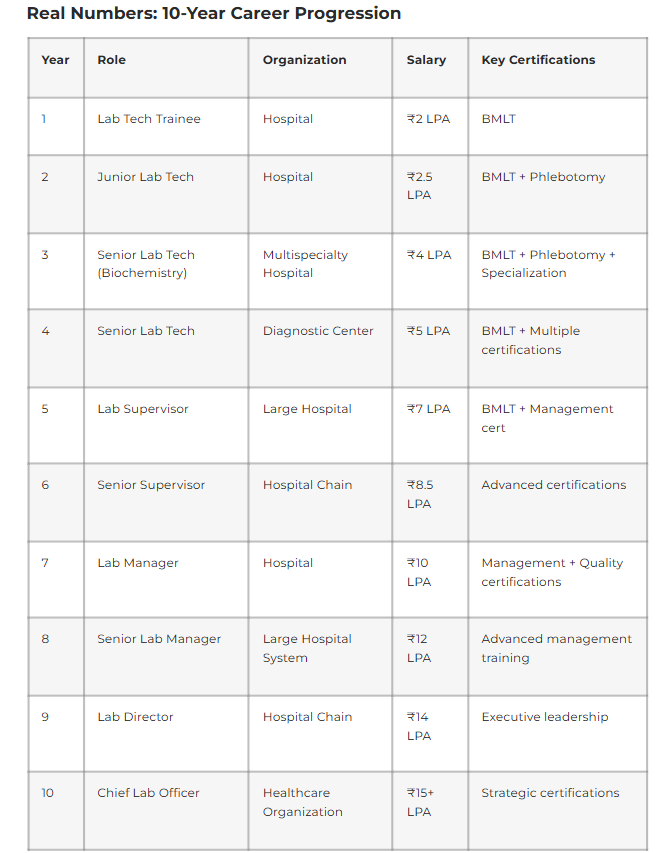
10-Year Result: ₹2 LPA → ₹15+ LPA (7.5x increase)
This is realistic progression with:
- Consistent performance
- Specialization selection
- Certification pursuit
Strategic career moves
Where to Work as Lab Technician: Your Options
Hospital Laboratories
What: Complete hospital lab handling all test types
Advantages:
- Diverse experience (all specializations)
- Career advancement opportunities
- Regular hours typically
- Benefits and stability
Disadvantages:
- High volume, sometimes hectic
- Limited patient contact
- Bureaucratic
- Shift work possible
Salary: ₹2.5-4 LPA entry, ₹6-10+ LPA senior
Best For: Those wanting complete lab experience, career advancement focus
Diagnostic Centers/Labs
What: Standalone labs serving outpatients (Metropolis, Apollo Diagnostics, Dr. Lal PathLabs)
Advantages:
- More relaxed pace
- Regular hours
- Customer service focus
- Newer equipment often
Disadvantages:
- More repetitive work
- Limited specialization options
- Less career growth typically
Salary: ₹2-3.5 LPA entry, ₹5-7 LPA senior
Best For: Those preferring stability, regular hours, less complexity
Pathology/Research Labs
What: Research-focused labs at universities, research institutions, pharma companies
Advantages:
- Intellectually stimulating
- Research opportunities
- Learning culture
- Innovation focus
Disadvantages:
- Variable hours (research doesn’t stop at 5 PM)
- Results uncertain
- Funding-dependent job security
Salary: ₹2.5-3.5 LPA entry, ₹5-8 LPA senior
Best For: Science enthusiasts, research-oriented professionals, PhD aspirants
Blood Banks/Blood Centers
What: Specialized blood banking (collection, processing, testing, distribution)
Advantages:
- Critical, meaningful work
- Specialized expertise
- Good salary for specialization
- Clear responsibility
Disadvantages:
- On-call requirements sometimes
- Repetitive if not specialized
- High responsibility stress
Salary: ₹2.5-3 LPA entry, ₹6-10 LPA senior
Best For: Detail-obsessed professionals, those wanting specialization, responsibility-seekers
Pharmaceutical/Manufacturing Labs
What: Quality control labs in pharmaceutical manufacturing
Advantages:
- Regular 9-5 hours
- Stable employment
- Good benefits
- Quality focus rewarded
Disadvantages:
- Repetitive work sometimes
- Less patient care connection
- Manufacturing pace pressures
Salary: ₹2.5-3.5 LPA entry, ₹5-8 LPA senior
Best For: Those preferring manufacturing, regular hours, stability
Landing Your First Lab Technician Job: Complete Strategy
Lab Technician Resume Template
text
[YOUR NAME]
City, State | Phone: +91-XXXXX-XXXXX | Email: yourname@email.com | LinkedIn: linkedin.com/in/yourprofile
PROFESSIONAL SUMMARY
Meticulous medical laboratory technician with [X months/years] of clinical laboratory experience. Proficient in hematology, biochemistry, and microbiology testing with 99%+ accuracy record. Dedicated to delivering precise diagnostic results and maintaining highest laboratory standards. BMLT qualified with phlebotomy certification.
LICENSES & CERTIFICATIONS
- BMLT (Bachelor of Medical Lab Technology) – [College Name] – [Year]
- Lab Technician License – [Registration Number]
- Phlebotomy Certification – [Issuing Organization] – [Year]
- Quality Control Certification – [If applicable]
PROFESSIONAL EXPERIENCE
Laboratory Technician Intern | [Hospital Name] | [City] | [Dates]
- Processed 200-300 blood samples daily using hematology and biochemistry analyzers with 99.2% accuracy
- Performed manual microscopy for blood smear analysis, identifying abnormalities with high precision
- Prepared cultures for microbiology testing, correctly identifying 98%+ of organism samples
- Maintained laboratory equipment, conducting daily quality assurance checks
- Documented all results accurately in hospital information system
- Assisted in blood banking operations, ensuring correct blood typing and cross-matching
- Mentored new interns on proper lab techniques and safety protocols
TECHNICAL SKILLS
Equipment Operation: Hematology Analyzers, Biochemistry Analyzers, Microbiology incubators, Blood culture systems, Microscopes (compound and digital)
Laboratory Techniques: Blood collection/phlebotomy, Sample processing, Microscopy, Culture preparation, Quality control, Sterilization procedures
Specializations: Hematology, Biochemistry, Basic microbiology, Blood banking basics
Lab Software: Hospital Lab Information System (LIS), [Specific software if used]
Safety: Biohazard waste disposal, Bloodborne pathogen protocols, HIPAA compliance
EDUCATION
Bachelor of Medical Lab Technology (BMLT) | [College Name] | [City] | [Year]
- Relevant coursework: Hematology, Biochemistry, Microbiology, Immunohematology, Lab Management
- Clinical internship: 6-month hospital laboratory rotation with hands-on training
STRENGTHS FOR LAB ROLES
- Exceptional attention to detail and accuracy focus
- Strong laboratory technique and procedural knowledge
- Comfortable with equipment operation and maintenance
- Patient sample handling expertise
- Reliability and professional approach
- Continuous learning mindset
LANGUAGES
English: Fluent | Hindi: [Proficiency] | [Other languages]
Where to Find Lab Technician Jobs
Online Job Portals:
- Naukri.com – Search “Laboratory Technician” or “Medical Lab Technician”
- Indeed.com – Hospital and diagnostic center positions
- LinkedIn Jobs – Professional positions
- Glassdoor – Research salaries and reviews
Direct Applications:
- Identify 20-30 hospitals and diagnostic centers in your city
- Find lab manager/director contact
- Email CV with cover letter directly
Diagnostic Center Chains:
- Metropolis Healthcare
- Apollo Diagnostics
- Dr. Lal PathLabs
- Genestrings Diagnostics
- Local lab chains
Hospital Websites:
- Check careers pages directly
- Many post lab technician openings before public job boards
Recruitment Agencies:
- Healthcare staffing agencies
- Lab-specific recruitment firms
- Can fast-track applications
Interview Preparation
Common Lab Technician Interview Questions:
Q: “Why did you choose medical lab technology?”
Good Answer: “I’m drawn to the precision and responsibility of diagnostic work. Lab technicians are crucial to patient diagnosis and treatment decisions. I find fulfillment in ensuring accurate results that directly impact patient outcomes. The combination of science, accuracy requirements, and meaningful healthcare contribution appealed to me.”
Q: “Describe a time you identified a quality issue with a lab result. How did you handle it?”
Strategy: Show quality consciousness and problem-solving.
Good Answer: “During my internship, I noticed a glucose result that seemed unusually high. The patient’s previous result was normal with no indication of diabetes. I checked the sample—it was hemolyzed (broken cells). I reported this to my supervisor, retested the sample, and got a normal result. This experience showed me that quality checks protect both accuracy and patient safety.”
Q: “How do you ensure accuracy in high-volume testing?”
Good Answer: “Accuracy requires systematic approach: (1) Proper sample verification—confirming patient ID and sample condition, (2) Following protocols precisely—never shortcuts, (3) Running quality controls regularly—catching equipment drifts, (4) Double-checking unusual results—investigating before reporting, (5) Maintaining equipment—servicing prevents errors. I maintain 99%+ accuracy even in high-volume days.”
Q: “What’s your experience with [specific equipment name]?”
Be honest: “I’ve used [equipment] during my internship and am familiar with maintenance and calibration. I’m a quick learner for equipment variations and confident I can master your specific systems with proper training.”
Salary Negotiation
Research First:
- Check Glassdoor for that organization
- Ask lab technician seniors what they earn
- Know typical range (₹2-2.5 LPA entry with BMLT)
Negotiation Script:
“Thank you for the offer. I’m excited about joining [Hospital] as a lab technician. Based on my BMLT education, phlebotomy certification, and market research for entry-level lab technicians in [City], I was expecting ₹[X]. Would there be flexibility?”
What’s Negotiable:
- Base salary (10% room for entry-level)
- Certification reimbursement (phlebotomy, quality assurance certs)
- Shift differentials (night shift premium)
- Professional development support
Common Mistakes Lab Technicians Make
Mistake 1: Skipping Phlebotomy Certification
Some technicians work years without phlebotomy cert. Meanwhile, certified phlebotomists earn more and have better opportunities.
Instead: Get phlebotomy certified within first year. Minimal investment with good returns.
Mistake 2: Not Specializing
Generalist lab techs plateau at ₹4-5 LPA. Specialists (blood bank, microbiology experts) earn ₹7-10 LPA+.
Instead: Choose specialization after 1-2 years. Become expert in that area.
Mistake 3: Ignoring Quality Completely
Some techs work fast but sloppy. One serious error (wrong blood type, contaminated culture) ends careers.
Instead: Quality first, always. Speed develops naturally through experience.
Mistake 4: Poor Equipment Maintenance
Neglected equipment breaks, causes delays, and makes techs look bad.
Instead: Treat equipment with respect. Daily maintenance prevents problems.
Mistake 5: Not Pursuing Management Track
Some excellent technicians stay technicians forever, never pursuing supervisory roles.
Instead: If interested, pursue management certifications. Senior roles offer better pay and less sample processing monotony.

Your 90-Day Action Plan: From BMLT Graduate to Employed Lab Technician
Month 1: Foundation & Applications (Days 1-30)
Week 1:
- ☐ Complete BMLT degree/internship
- ☐ Register as lab technician with state authority
- ☐ Create professional resume
- ☐ Create LinkedIn profile (mark “Open to Lab Technician Opportunities”)
Week 2:
- ☐ Research phlebotomy certification programs
- ☐ Identify 20 target hospitals and diagnostic centers
- ☐ Connect with lab technician professionals on LinkedIn (20+ connections)
- ☐ Join lab technician groups/communities online
Week 3:
- ☐ Enroll in phlebotomy certification program
- ☐ Apply to 10-15 lab technician positions
- ☐ Prepare interview answers
- ☐ Research job market salary ranges
Week 4:
- ☐ Send direct applications to hospitals
- ☐ Apply to 10 more positions
- ☐ Complete phlebotomy certification (or near completion)
- ☐ Build lab technician portfolio
End of Month 1: 25-30 applications, phlebotomy certification in progress
Month 2: Interviews & Offers (Days 31-60)
Week 5:
- ☐ Interviews starting (likely by now)
- ☐ Complete phlebotomy certification
- ☐ Apply to 10 more positions
- ☐ Practice equipment operation knowledge
Week 6:
- ☐ Attend interviews (2-5 expected)
- ☐ Send thank-you emails after interviews
- ☐ Continue applications
- ☐ Get feedback if rejected
Week 7:
- ☐ More interviews
- ☐ Apply to final positions (5-10)
- ☐ Prepare salary negotiation strategy
- ☐ Research specific hospitals interviewing you
Week 8:
- ☐ Receive job offers (likely by now)
- ☐ Negotiate if applicable
- ☐ Accept offer
- ☐ Prepare joining documents
End of Month 2: 40-50+ applications, 3-6 interviews, job offers received
Month 3: Starting Your Career (Days 61-90)
Week 9:
- ☐ Complete joining formalities
- ☐ Get employee credentials and equipment
- ☐ Complete orientation
- ☐ Meet lab team
Week 10:
- ☐ Start your first day as lab technician!
- ☐ Learn lab procedures and equipment
- ☐ Shadow experienced technicians
- ☐ Ask questions constantly
Week 11:
- ☐ Start independent sample processing
- ☐ Build accuracy track record
- ☐ Get feedback on performance
- ☐ Learn specialization preferences
Week 12:
- ☐ Complete first month of employment
- ☐ Reflect on performance and learnings
- ☐ Plan next steps (specialization? advanced certs?)
- ☐ Celebrate your lab career launch!
End of Month 3: First lab technician job secured, earning, learning healthcare diagnostics!
Closing: Your Lab Technician Career in Healthcare
You’ve now understood medical lab technology as a complete profession—accurate diagnosis through lab precision.
Here’s what’s possible with BMLT:
- Quick employment: Jobs available immediately after graduation
- Decent starting income: ₹2-2.5 LPA starting
- Clear growth: ₹15+ LPA within 10 years with specialization
- Multiple specializations: Blood bank, microbiology, biochemistry, histopathology
- No patient pressure: Work in lab environments if you prefer
- Real diagnostic impact: Your accuracy directly determines diagnoses
- Job security: Healthcare always needs lab technicians
- Certification potential: Become specialist, supervisor, manager
Lab technicians are the unsung heroes of healthcare—working behind the scenes, ensuring accuracy, literally enabling every diagnosis made in hospitals.
Your lab technician career doesn’t start someday. It starts when you accept that first job.
Good luck, future lab technician. Healthcare depends on your precision and diagnostic expertise. 🔬✨