
Doctors & MBBS Graduates – The Complete Post-Graduation Career Guide
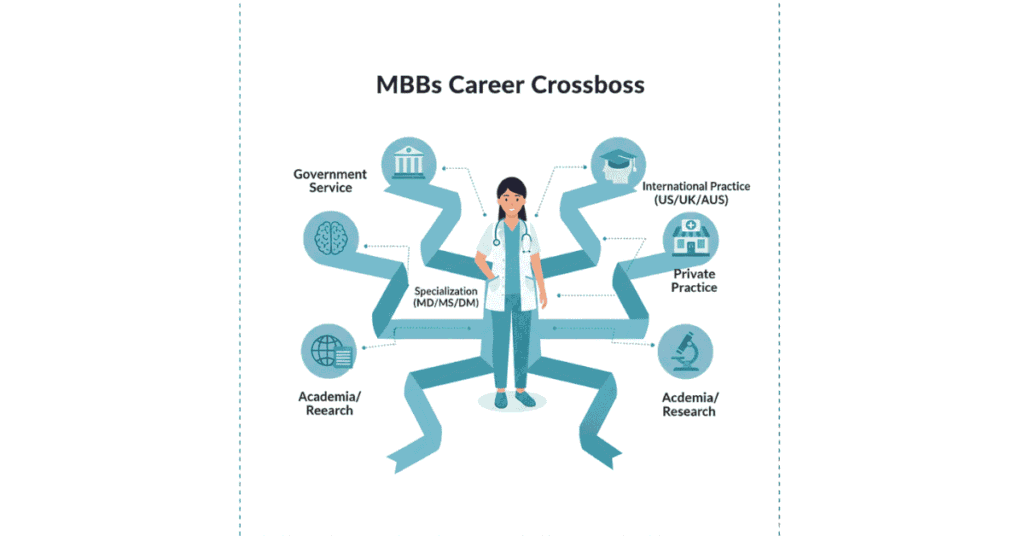
Table of Contents
Introduction: Your MBBS Degree is Just the Beginning
You’ve done it. Five and a half years of grueling medical education. Board exams. Clinical rotations. Nights on call. And finally—that MBBS degree. Congratulations. You’re a doctor.
But here’s the reality that nobody warns you about: Getting your MBBS degree is finishing the race’s first lap, not the finish line.
Your real career decision comes now. You have choices—and they’ll determine whether you earn ₹6 LPA or ₹50+ LPA, whether you work in a small clinic or run a hospital system, whether you stay in India or practice internationally. This guide reveals all your options honestly.
The MBBS Reality: What You Need to Know First
Let’s address the uncomfortable truths about MBBS careers in India:
Truth 1: Initial Salary is Lower Than Perceived
Fresh MBBS graduates earn ₹6-12 LPA in government hospitals, ₹8-15 LPA in private hospitals. This shocks many students who expected ₹20+ LPA immediately. Why? You’re newly qualified, not yet specialized. Salary jumps dramatically after specialization.
Truth 2: You Have Multiple Paths
- General practice (₹6-20 LPA)
- Specialization path (₹15-50+ LPA)
- Private practice (₹10-100+ LPA depending on success)
- International practice (₹30-80+ LPA)
- Academia/research (₹10-25 LPA)
Truth 3: Competition is Intense
NEET-PG exam for specialization is extremely competitive. Pass rate around 15-20%. Many attempts required for good colleges. Government seats are limited. Private college seats cost ₹30-100+ lakhs.
Truth 4: Specialization Takes 3 Years Minimum
After MBBS, you spend 3 more years (MD/MS) specializing. No salary growth during this period. Then 1-2 more years for DM/MCh if super-specializing.
Understanding these realities helps you make informed decisions.

Immediate Post-MBBS Options: What to Do After Graduation
Option 1: Government Service (Most Stable)
Join government as Medical Officer in government hospitals, PHCs, or healthcare services.
Advantages:
- Job security (government job)
- Pension benefits
- Regular hours in many postings
- Incremental salary growth
Disadvantages:
- Lower salary (₹6-12 LPA typically)
- Limited specialization opportunities initially
- Bureaucratic processes
- Rural postings possible (depends on merit)
Salary: ₹6-12 LPA
Path: Work 2-3 years, then pursue specialization while in government service (if seat available)
Best For: Security-seekers, those wanting pension, rural healthcare interest
Option 2: Private Hospital Employment
Join private hospital as Resident Doctor or Medical Officer.
Advantages:
- Better starting salary (₹8-15 LPA)
- Exposure to modern technology
- Faster learning curve
- Specialization scholarships possible
Disadvantages:
- Less job security
- Long working hours
- High patient volumes
- Pressure-heavy environment
Salary: ₹8-15 LPA starting
Path: Work 2-3 years, build expertise, then pursue specialization
Best For: Learning-focused professionals, those wanting private sector experience
Option 3: Rural Health Schemes
Join government rural health schemes (NRHM, NUSRL, etc.).
Advantages:
- Decent salary (₹10-15 LPA often)
- Direct patient care
- Community health focus
- National Health Mission support
Disadvantages:
- Remote location (far from cities)
- Limited resources and infrastructure
- Isolation from peer network
- Limited specialization pathway
Salary: ₹10-15 LPA
Best For: Rural health passionate professionals, those wanting community impact
Option 4: Pursue Specialization Immediately (NEET-PG)
Take NEET-PG exam immediately after internship.
Advantages:
- Start specialization early
- Enter specialization with fresh knowledge
- Better competition timing (recently passed MBBS exam)
Disadvantages:
- Extremely competitive (15-20% pass rate)
- Multiple attempts likely needed
- Expensive coaching (₹2-5 lakhs)
- 3 years without earning during MD/MS
Best For: Academically strong students, those with financial support, specialization-determined individuals
My Recommendation: Work 1-2 years in private hospital first. Earn money, build clinical skills, save for coaching. Then pursue NEET-PG. This strategy is more realistic for most.
Medical Specialization: Your Path to High Income
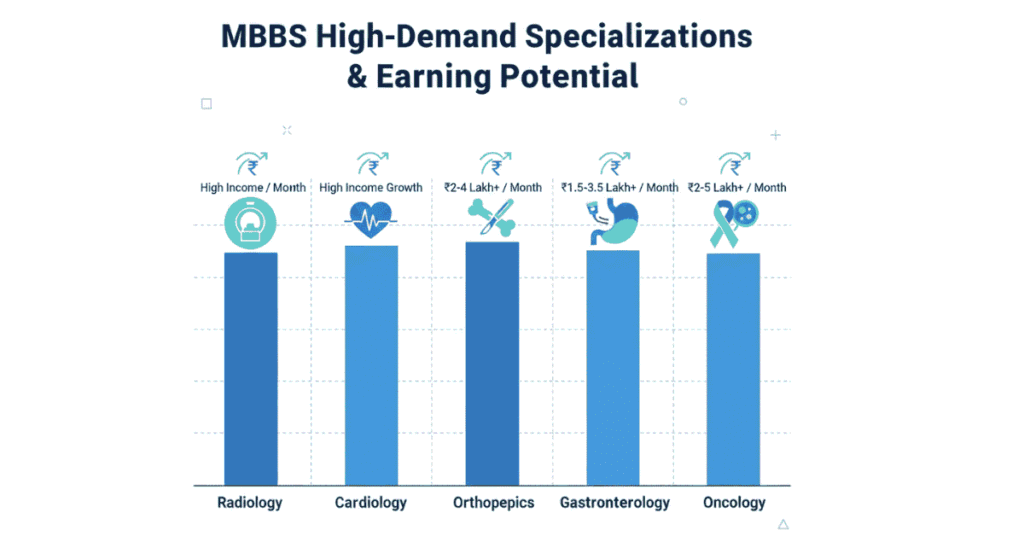
This is where MBBS careers truly differentiate. Specialization determines income trajectory significantly.
High-Demand Specializations (Best Salary Potential)
Radiology/Diagnostic Imaging:
- Why: Every patient needs imaging. Hospitals invest heavily.
- Starting (after MS): ₹15-20 LPA
- 5 years: ₹25-35 LPA
- 10 years: ₹40-60 LPA
- Private practice: ₹50-100+ LPA
Cardiology:
- Why: Cardiac cases are high-revenue. Cardiac care is expensive.
- Starting: ₹15-20 LPA
- 5 years: ₹30-40 LPA
- 10 years: ₹50-80 LPA
- Private practice: ₹60-150+ LPA
Orthopedic Surgery:
- Why: Surgery-based specialization. High procedure volume.
- Starting: ₹15-20 LPA
- 5 years: ₹25-35 LPA
- 10 years: ₹40-60 LPA
- Private practice: ₹50-150+ LPA
Gastroenterology:
- Why: High procedure volume. Endoscopy profitable.
- Starting: ₹12-18 LPA
- 5 years: ₹20-30 LPA
- 10 years: ₹35-55 LPA
- Private practice: ₹40-100+ LPA
Oncology:
- Why: Cancer treatment is expensive. Growing demand.
- Starting: ₹12-18 LPA
- 5 years: ₹20-30 LPA
- 10 years: ₹35-50 LPA
- Private practice: ₹50-100+ LPA
Good Salary Specializations
Pediatrics: ₹10-18 LPA starting, ₹25-45 LPA senior
Psychiatry: ₹10-15 LPA starting, ₹20-35 LPA senior
Anesthesia: ₹12-18 LPA starting, ₹30-50 LPA senior
ENT: ₹10-18 LPA starting, ₹25-50 LPA senior
Lower Salary Specializations (But Valuable Work)
Community Medicine: ₹10-15 LPA, limited private practice
Pathology: ₹10-15 LPA starting
Emergency Medicine: ₹10-15 LPA, shift work compensated
Key Point: Higher-paying specializations typically involve procedures (surgery, imaging, cardiology, gastroenterology). Medicine-based (non-surgical) specializations earn less.

MBBS Doctor Salary & Career Progression: Real Numbers
Year 1-2: Resident Doctor
Salary: ₹6-15 LPA depending on government/privateupes
What You Do:
- Clinical training
- Learning specialties
- Patient care under supervision
Focus: Building clinical foundation, deciding specialization direction
Year 3-5: MD/MS Specialization
Salary During Training: Usually ₹10-15 LPA (salary while studying specialty)
Timeline: 3 years for MD/MS
After Completion: Jump to ₹15-25 LPA (starting specialist salary)
Year 6-8: Specialist Doctor
Salary: ₹20-35 LPAupes
What You Do:
- Independent specialist practice
- More complex cases
- Leadership in own department
- Teaching juniors
Advancement: Move toward DM/MCh if super-specialization desired
Year 9-12: Senior Specialist/Consultant
Salary: ₹35-50 LPAupes
Roles:
- Senior consultant in hospitals
- Department head positions
- Complex case management
- Teaching and research
Year 12+: Expert/Director/Private Practice
Salary: ₹50-100+ LPA (private practice), ₹60-100+ LPA (hospital director)
Private Practice Reality:
- First 2 years: Build patient base (lower earning)
- Year 3-5: Established practice (₹30-50 LPA)
- Year 5+: Successful practice (₹50-150+ LPA depending on specialty)

20-Year Result: ₹6 LPA → ₹80-150+ LPA (13-25x increase!)
This assumes strategic specialization, geographic advantage, and success in private practice.
Private Medical Practice: Building Your Own Clinic
Many doctors establish private practice. Here’s the reality:
Clinic Setup Costs
Small clinic (10 patients/day capacity): ₹10-20 lakhs
- Rent deposit and setup
- Medical equipment
- Furniture and fixtures
- Registration and licensing
Medium clinic (20-30 patients/day): ₹25-50 lakhs
- Better location
- More equipment
- Professional staff
- Modern interior
Revenue Model
Small clinic:
- 15-20 patients daily
- ₹500-1,000 per consultation
- ₹7,500-20,000 daily revenue
- ₹2-5 LPA monthly = ₹24-60 LPA annually
- After expenses (rent, staff, utilities): ₹10-30 LPA net
Established private practice (5-10 years):
- 40-60 patients daily
- Built reputation
- ₹1,000-2,000 per consultation (higher for seniors)
- ₹40,000-1,20,000 daily revenue
- After expenses: ₹30-80 LPA annually
Private Practice Success Factors
Location: High-traffic, accessible, good locality
Reputation: Patient satisfaction, word-of-mouth referrals
Specialization: Specialists earn more than general practitioners
Staff: Good nurses, support staff, administration
Marketing: Professional presence, patient education
Hours: Consistent availability builds trust
Reality Check: Private practice takes 3-5 years to become profitable. Initial earnings lower than hospital salary. Requires business acumen beyond medical knowledge.
International Opportunities for Indian Doctors
Many Indian doctors practice abroad, often earning 3-5x more.
Top Destinations
USA:
- Salary: $150,000-300,000+ annually (₹1.2-2.5 crore)
- Process: USMLE exams, ECFMG, visa sponsorship
- Timeline: 2-3 years typically
UK:
- Salary: £50,000-120,000 (₹50-120 lakhs)
- Process: PLAB exam, GMC registration, visa
- Timeline: 1-2 years typically
Gulf Countries (UAE, Saudi, Qatar):
- Salary: ₹40-100 lakhs annually
- Advantages: Tax-free income, closer to India
- Timeline: 6-12 months typically
Canada/Australia:
- Salary: CAD 150,000-250,000+ (₹90-150 lakhs)
- Process: Medical licensing exams, credentials recognition
- Timeline: 1-2 years
ROI Calculation
Staying in India specialist:
- 20-year earning: ₹1-2 crore net
5 years abroad, then return to India:
- 5 years abroad earning: ₹50-75 lakhs × 5 = ₹2.5-3.75 crore
- Return to India senior role: ₹50-80 LPA for 15 years = ₹75-120 lakhs
- Total: ₹3.25-4.95 crore
- Plus: Advanced training, international experience
International practice can significantly increase lifetime earnings.
Beyond Clinical Practice: Alternative Doctor Careers
Not all MBBS graduates practice clinically. Consider:
Medical Writing & Science Communication
- Document clinical trials for pharmaceutical companies
- Write medical articles and research publications
- Salary: ₹8-20 LPA
- Growing field, good work-life balance
Medical Consulting
- Healthcare consulting for hospitals, clinics
- Healthcare IT companies need medical expertise
- Salary: ₹12-30 LPA
- Strategic thinking role
Medical Education & Academia
- Teach at medical colleges
- Conduct research
- Write textbooks
- Salary: ₹15-30 LPA
- Fulfilling for education-focused doctors
Healthcare Management
- Hospital administration
- Healthcare operations
- Healthcare policy
- Salary: ₹15-40 LPA
- Leadership opportunities
Telemedicine & Digital Health
- Remote consultations
- Health app development
- Telemedicine platform management
- Salary: ₹10-30 LPA
- Flexible, growing sector
Public Health & Government Policy
- Government health department work
- WHO/UN health programs
- Public health research
- Salary: ₹12-30 LPA
- Nation-building work
Common MBBS Career Mistakes: Learn From Others
Mistake 1: Not Specializing
Some doctors practice general medicine forever, earning ₹10-20 LPA. Meanwhile, specialized peers earn ₹40-80+ LPA. If income is priority, specialization is critical.
Mistake 2: Wrong Specialization Choice
Choosing specialization based on peer pressure instead of interest/aptitude leads to burnout and lower satisfaction.
Mistake 3: Not Building Professional Network
Isolated practice limits referrals and growth. Building professional relationships is essential.
Mistake 4: Ignoring Business Skills
Clinical excellence ≠ business success. Private practitioners need business acumen alongside medical knowledge.
Mistake 5: Geographic Mismatch
Setting up practice in wrong location limits patient base. Choose location strategically.
Your Post-MBBS 5-Year Action Plan
Year 1-2: Foundation Building
- Join private hospital or government service
- Decide specialization direction
- Build clinical experience
- Save money for specialization coaching
Year 2-3: Specialization Pursuit
- Begin NEET-PG preparation
- Take NEET-PG exam (multiple attempts if needed)
- Join specialization program (MD/MS)
Year 4-5: Advanced Training
- Complete 1-2 years of specialization
- Build specialization expertise
- Begin developing patient base if planning private practice
- Build professional network
After Year 5: Career Crystallization
- Complete specialization
- Choose: Hospital consultant, private practice, or alternative role
- Build toward financial goals
- Consider DM/MCh if ultra-specialization desired
Closing: Your MBBS Career Trajectory
MBBS careers are complex with multiple paths:
- Fastest earning: Private practice (₹30-80+ LPA after establishment)
- Highest earning: Specialization + private practice (₹80-150+ LPA)
- Most stable: Government service (job security, pension)
- Most flexible: Specialization in hospital (balance earning and stability)
- Most impactful: Public health (nation-building, social impact)
Your MBBS is a privilege and responsibility. Use it strategically—aligning income goals, lifestyle preferences, and societal impact.
Your medical career doesn’t start with the MBBS degree. It starts with strategic planning after you have it.
Good luck, future doctor. Medicine needs your expertise, compassion, and dedication. 🩺✨