
LEGAL RESEARCHER CAREER PATH

Table of Contents
Introduction:
Picture yourself as the detective behind every winning legal argument. While lawyers make the courtroom presentations and negotiate deals, legal researchers are the ones uncovering the critical precedents, statutes, and legal analyses that make those victories possible. You’re not just finding information—you’re uncovering insights that can change case outcomes or business strategies.
Legal research has become a specialized profession in its own right. Modern law firms, corporate legal departments, think tanks, and academic institutions all employ dedicated researchers who master complex legal databases, develop sophisticated research strategies, and deliver actionable insights under tight deadlines. This role combines intellectual curiosity, analytical rigor, and technical proficiency—making it ideal for those who love deep dives into legal problems without courtroom pressure.
In India, legal researchers earn competitive salaries starting at ₹3-6 lakhs annually for entry-level roles, with experienced professionals making ₹8-15 lakhs or more in metro cities. Demand remains strong as legal complexity grows and firms recognize the cost savings of delegating research to specialists rather than billing client time at lawyer rates. If organized thinking, information discovery, and contributing to legal success appeals to you, legal research offers a rewarding career path.
What Legal Researchers Actually Do
The Research Engine of Legal Practice
Legal researchers serve as the intelligence units of legal teams. When lawyers need answers to complex questions—”Has any court ever ruled that way on software licensing disputes?” or “What do recent SEBI circulars say about private placements?”—researchers deliver precise, comprehensive answers with citations and analysis.
Your work directly impacts legal outcomes. A comprehensive research memo identifying overlooked precedents can win cases. Thorough due diligence uncovering hidden contract clauses can prevent disastrous business deals. Quick research responding to breaking regulatory changes can protect clients from penalties. Though rarely acknowledged publicly, your work forms the foundation of legal success.
Core Daily Responsibilities
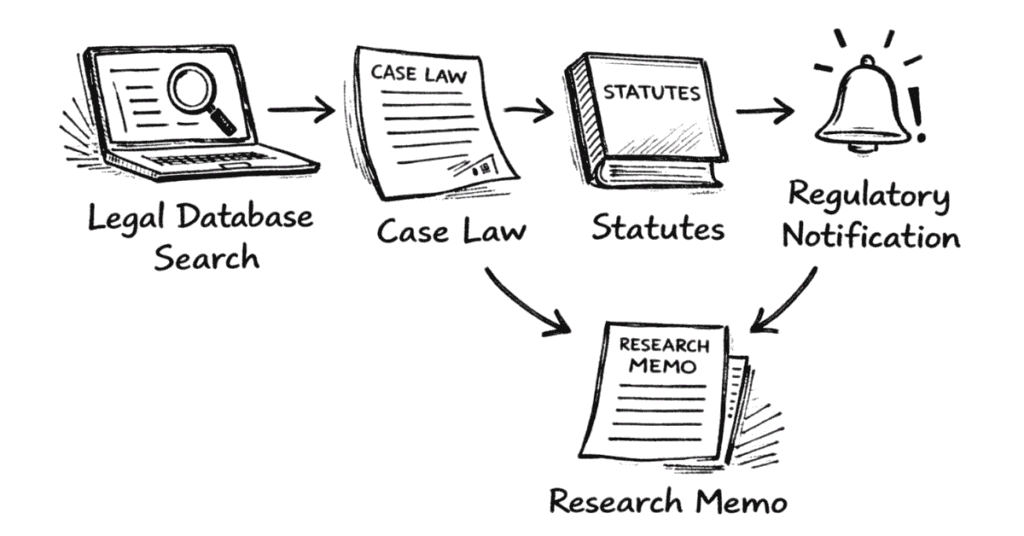
Case Law Research: Diving into databases like Manupatra, SCC Online, and AIR Online to find relevant judicial decisions. You don’t just locate cases—you analyze their facts, reasoning, and applicability to current matters. Understanding distinctions between persuasive and binding precedents, recognizing evolving judicial trends, and identifying dissenting opinions separates excellent researchers from average ones.
Statutory Research: Navigating India’s complex statutory framework across central acts, state laws, rules, regulations, notifications, and circulars. You’ll trace legislative history, understand amendment timelines, and identify interactions between different statutes. For corporate researchers, this means mastering Companies Act 2013 alongside SEBI regulations, FEMA provisions, and sector-specific laws.
Regulatory Tracking: Monitoring regulatory developments across government ministries, sector regulators (RBI, SEBI, IRDAI), and international bodies affecting Indian businesses. You’ll create tracking systems alerting legal teams to upcoming changes requiring client action or contract amendments.
Legislative Analysis: When Parliament amends laws or states enact new legislation, you analyze impacts on existing client relationships, contracts, and business practices. Your memos help lawyers advise clients on compliance requirements and strategic responses.
Comparative Research: For multinational clients or cross-border transactions, you’ll research foreign laws and compare them with Indian provisions. Understanding similarities, differences, and potential conflicts helps lawyers structure international deals effectively.
Due Diligence Support: During M&A transactions, financing deals, or partnership formations, you’ll review target companies’ legal histories—litigation records, regulatory compliance, contract portfolios, and intellectual property status. Your findings identify deal risks and valuation impacts.
Types of Legal Research Careers
Law Firm Research Departments
Large and mid-sized law firms maintain dedicated research teams supporting multiple practice groups. Corporate researchers focus on commercial laws, litigation researchers specialize in case law across jurisdictions, and regulatory researchers track sector-specific developments.
Advantages: Exposure to diverse practice areas, sophisticated research tools, team collaboration, and structured career progression. You’ll work with top lawyers gaining insights into high-stakes legal work.
Challenges: High pressure during transaction deadlines or trial preparations, long hours when multiple matters converge, constant need to learn new areas.
Corporate Legal Research
In-house legal departments employ researchers supporting business operations. You’ll research regulatory compliance for new product launches, analyze contract enforceability across jurisdictions, and monitor litigation risks affecting corporate strategy.
Advantages: Deep industry specialization, regular hours, business impact visibility, strategic involvement beyond pure research.
Typical industries: Banking (RBI/SEBI compliance), technology (data privacy/IP), pharmaceuticals (drug regulations), manufacturing (environmental/labor laws).
Academic and Policy Research
Law schools, think tanks, and policy institutes hire researchers supporting faculty publications, white papers, and legislative reform projects. You’ll conduct comprehensive legal analyses, comparative studies, and empirical research on legal effectiveness.
Advantages: Intellectual freedom, publication opportunities, contribution to legal scholarship, flexible hours, academic environment.
Organizations: NLU research centers, Centre for Policy Research, Vidhi Centre for Legal Policy, PRS Legislative Research.
Litigation Support Research
Dedicated litigation research firms or law firm litigation departments focus exclusively on case law analysis, precedent research, and evidentiary support. You’ll build case theories through comprehensive legal histories and identify winning arguments.
Advantages: Deep litigation expertise development, trial involvement, specialized knowledge across jurisdictions and courts.
Government Legal Research
Legislative departments, law commissions, regulatory bodies, and government law officers employ researchers drafting legislation, analyzing judicial decisions impacting policy, and preparing government positions in litigation.
Advantages: Policy influence, public service contribution, job security, exposure to legislative processes.
Essential Skills for Legal Research Success
Mastering Legal Databases
Primary Indian Platforms:
- Manupatra: Comprehensive coverage of Supreme Court, High Courts, tribunals; excellent statutory materials; legislative tracking
- SCC Online: Strong case law depth, headnotes, citation tracking, legislative updates
- AIR Online: Authoritative reporter series, law journal articles, manual research skills
- Indian Kanoon: Free platform excellent for quick searches, citation verification
- Taxmann: Taxation, corporate, FEMA specialist database
- Express Laws: Regulatory notifications and circulars
International Research: Westlaw India, LexisNexis India, Lexology for foreign law and cross-border matters.
Advanced Techniques: Boolean searching, citation analysis, legislative history reconstruction, parallel citation tracking across databases.
Analytical and Critical Thinking
Beyond Finding Information: Excellent researchers don’t just locate cases—they understand their significance. You’ll identify:
- Distinguishing facts making precedents inapplicable
- Evolving judicial philosophies affecting precedent weight
- Policy rationales behind statutory interpretations
- Gaps in existing law creating litigation risks
- Analogous reasoning from different jurisdictions
Synthesis Skills: Combining multiple sources into coherent analyses. A single research memo might integrate Supreme Court precedents, High Court applications, statutory provisions, regulatory guidance, and academic commentary into unified recommendations.
Writing Excellence
Legal research culminates in written deliverables:
- Research Memos: 3-15 page analyses answering specific legal questions with citations, analysis, and recommendations
- Precedent Digests: Summaries of key cases organized by legal issue
- Legislative Trackers: Regular updates on law changes with impact analysis
- Due Diligence Reports: Comprehensive legal risk assessments
Writing Standards: Precise language, logical structure, Bluebook/Indian citation formats, executive summaries for busy lawyers, balanced analysis of competing positions.
Technical Proficiency
Research Software: Proficiency with legal databases, reference management tools (Zotero, Mendeley), Excel for tracking research projects.
Productivity Tools: Microsoft Word mastery (styles, track changes, table of authorities), Adobe Acrobat for document analysis, presentation software for research briefings.
Data Visualization: Creating charts showing case citation networks, legislative amendment timelines, or regulatory development trends.
Educational Pathways and Entry Requirements
Academic Foundation
Law Degree (LLB): Essential for most research positions. Both 3-year and 5-year integrated programs qualify you. Strong academic performance, particularly in legal research courses, impresses employers.
Research Methodology Training: Law school research courses teach fundamental techniques, but self-study accelerates mastery. Practice complex database searches, analyze lengthy judgments, and write sample research memos.
Subject Specialization: For corporate research, corporate law/commercial law electives prove valuable. Litigation researchers benefit from civil procedure and evidence law courses. Regulatory researchers should study administrative law.
Advanced Qualifications (Optional but Valuable)
LLM: Postgraduate law degrees demonstrate research aptitude and subject specialization. Corporate law, intellectual property, or international law LLMs enhance corporate research prospects.
Legal Research Certifications: Various institutes offer specialized training:
- NUJS Kolkata Legal Research Certificate
- NALSAR Legal Research Methodology Course
- Private institute short courses focusing on database mastery
Language Skills: Proficiency in Hindi, regional languages benefits research involving state laws and local judgments. Foreign language skills aid international research.
Entry-Level Experience Building
Law School Research Assistantships: Working for professors builds skills and credentials. You’ll conduct literature reviews, verify citations, and co-author academic papers.
Internships: Research departments of major law firms, court libraries, or regulatory bodies provide practical training. Even 1-2 month internships teach professional research standards.
Freelance Research: Platforms connect independent researchers with lawyers needing urgent research support. Builds portfolio and testimonials.
Legal Process Outsourcing (LPO): Entry-level research positions in LPO firms expose you to international research standards and high-volume workloads.

Salary Expectations and Career Progression
Compensation Ranges
Entry-Level (0-2 Years): ₹3-6 lakhs annually (₹25,000-50,000 monthly). Starting roles involve basic case law/statutory research under supervision.
Mid-Career (3-7 Years): ₹7-12 lakhs annually. Independent research on complex matters, specialization in practice areas, supervisory responsibilities.
Senior Level (8+ Years): ₹12-20 lakhs annually. Leading research teams, strategic research projects, client-facing research presentations.
Specialist/Principal Researcher: ₹20-30 lakhs+. Subject matter experts managing entire research functions or highly specialized niches.
Location Premiums
Tier-1 Cities (Mumbai, Delhi, Bangalore): 30-50% premium over national averages due to higher living costs and concentration of major firms.
Tier-2 Cities (Pune, Hyderabad, Chennai): Competitive salaries with lower living costs, growing legal hubs.
Work-from-Home Opportunities: Remote research positions increasingly common, particularly post-pandemic.
Career Progression Path
- Junior Legal Researcher → Basic research assignments, database training
- Legal Researcher → Independent research projects, practice area specialization
- Senior Legal Researcher → Complex research, mentoring juniors, quality control
- Lead Researcher/Research Manager → Team leadership, strategic research planning
- Director of Research/Chief Research Officer → Enterprise research strategy, technology implementation
Lateral Moves:
- Knowledge Management: Transitioning research expertise into law firm KM roles
- Compliance Research: Corporate regulatory research specialization
- Academic Research: University research positions or think tanks
- Legal Tech: Research platform development or AI legal research
Technology Transforming Legal Research
AI Legal Research Tools
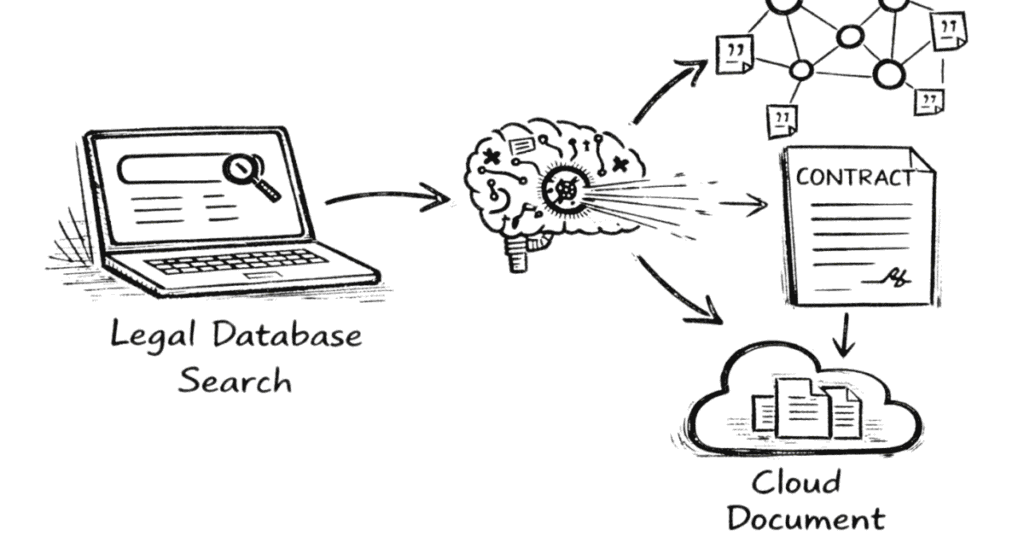
CaseMine, Ravel Law: AI-powered case law analysis identifying relevant precedents, citation networks, judicial analytics.
Lexis+ AI, Westlaw Precision: Natural language search, predictive analytics, brief analysis.
Indian Developments: Manupatra Edge, SCC Online AI features accelerating research workflows.
Research Management Platforms
Everlaw, Relativity: E-discovery platforms combining research with document review.
iManage, NetDocuments: Knowledge management systems organizing research outputs.
Data Analytics
Predictive Justice: Analyzing judge tendencies, case outcomes by issue combinations.
Legislative Analytics: Tracking bill passage probabilities, amendment patterns.
Challenges and Rewards
Primary Challenges
Information Overload: Sifting massive legal databases to find needles in haystacks. Developing sophisticated search strategies prevents wasted time.
Evolving Legal Landscape: Continuous learning required as laws change, new precedents emerge, regulations multiply.
Deadline Pressure: Urgent research requests during court hearings, transaction closings, regulatory responses.
Isolation: Research often solitary work requiring long screen hours, deep concentration.
Key Rewards
Intellectual Challenge: Complex puzzles requiring analytical creativity, pattern recognition.
Direct Impact: Your research often determines case outcomes, business decisions, legal strategies.
Career Flexibility: Skills transfer across practice areas, employers, even internationally.
Excellent Work-Life Balance: Predictable hours compared to practicing lawyers.
Continuous Learning: Every matter teaches new legal areas, industries, jurisdictions.
Getting Started: Practical Action Plan
- Master Free Resources: Practice extensively on Indian Kanoon, Supreme Court website
- Subscribe to Databases: Gain student access to Manupatra/SCC through law school
- Build Writing Portfolio: Create sample research memos on current legal issues
- Network Strategically: Connect with research heads at major firms on LinkedIn
- Intern Intensively: Prioritize research-focused internships over general legal internships
- Specialize Early: Pick 1-2 practice areas for deep expertise development
Is Legal Research Right for You? Perfect for analytical introverts who love information discovery, organized thinkers enjoying complex puzzles, career-focused individuals seeking stable advancement without courtroom pressure. Less suitable for extroverts craving client interaction, those disliking screen-intensive work, or glory-seekers wanting courtroom recognition.
Legal research offers intellectual satisfaction, direct business impact, and excellent compensation without lawyer stresses. As legal complexity grows, skilled researchers become indispensable across law firms, corporations, and government. For organized minds loving legal detective work, few careers offer greater rewards.