
JAM Training Guide
Table of Contents

What is JAM?
Just A Minute (JAM) is an impromptu speaking exercise where candidates must speak continuously on a given topic for exactly 60 seconds without hesitation, repetition, deviation, or grammatical errors. Used extensively in MBA admissions, engineering placements, corporate interviews, and campus recruitments by companies like TCS, Infosys, Accenture, and Wipro, JAM sessions test your spontaneity, communication fluency, and mental agility under pressure.
Unlike prepared speeches where you have time to craft arguments, JAM demands instant topic analysis, rapid idea generation, and coherent articulation—all within seconds. The evaluator announces a topic, gives you 10-30 seconds to think, and then you must speak continuously for one full minute.
Why Companies Conduct JAM Rounds
Organizations use JAM sessions as powerful screening tools because they reveal skills that resumes and written tests cannot capture. Your ability to think quickly demonstrates adaptability—crucial in fast-paced business environments where employees must respond to unexpected client questions, present unplanned updates, or explain complex concepts spontaneously.
JAM evaluates your communication clarity under stress, showing evaluators how you’ll perform in high-pressure meetings, client presentations, or crisis situations. It also assesses your vocabulary range, grammatical accuracy, and ability to organize thoughts coherently without preparation time—skills essential for professional success.

Core Evaluation Parameters
Communication Skills – Evaluators assess your verbal fluency, pronunciation clarity, grammatical accuracy, vocabulary richness, and voice modulation. They observe whether you speak in complete sentences, avoid filler words like “um” or “like,” and maintain appropriate pace without rushing or dragging.
Content Organization – Your ability to structure one minute of speech with clear introduction, main points, and conclusion demonstrates logical thinking. Evaluators note whether you stay focused on the topic or deviate into tangents, and whether your ideas flow coherently from one point to another.
Confidence & Body Language – Your posture, eye contact, hand gestures, facial expressions, and overall demeanor reveal self-assurance. Confident speakers maintain steady eye contact, use purposeful gestures, and project their voice clearly without appearing nervous or apologetic.
Spontaneity & Quick Thinking – The core JAM skill is thinking on your feet. Evaluators notice how quickly you grasp the topic, generate relevant ideas, and adapt your speech mid-flow if needed. This measures your mental agility and problem-solving speed.
Time Management – Speaking for exactly one minute—neither stopping at 45 seconds nor exceeding 70 seconds—shows awareness and control. Candidates who finish too early appear unprepared, while those who ramble beyond time limits demonstrate poor self-regulation.
Creativity & Knowledge – Your ability to present unique perspectives, interesting examples, or creative interpretations distinguishes you from other candidates who deliver predictable speeches. Evaluators value originality and depth of knowledge.
🔍 Explore structured learning resources to strengthen communication clarity →
Types of JAM Topics
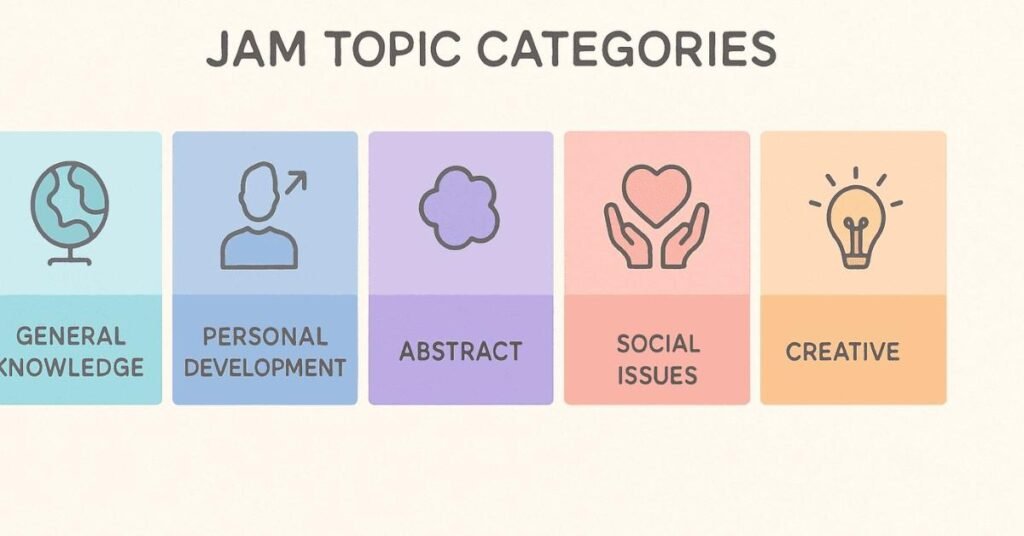
General Knowledge Topics – These require awareness of current affairs, historical events, technological trends, or social issues. Examples include “Artificial Intelligence in Healthcare,” “India’s Digital Payment Revolution,” “Climate Change Solutions,” or “Startup Ecosystem in India”.
Personal Development Topics – These explore self-improvement, character traits, or motivational themes like “Self-Confidence,” “Time Management,” “Leadership Qualities,” “Importance of Failure,” or “Work-Life Balance”.
Abstract & Philosophical Topics – These test your interpretive abilities with metaphorical or conceptual subjects like “Life is a Journey,” “Success is a Journey, Not a Destination,” “Technology: Boon or Bane,” or “Change is the Only Constant”.
Social Issues Topics – These address societal challenges such as “Women Empowerment,” “Digital Divide in India,” “Mental Health Awareness,” “Education System Reform,” or “Youth Unemployment”.
Light & Creative Topics – Some JAM sessions use fun, everyday topics to test creativity like “My Favorite Color,” “If I Were Prime Minister,” “My Dream Vacation,” or “A Day Without Internet”.
Professional Topics – Corporate interviews may include business-focused topics like “Importance of Teamwork,” “Customer Service Excellence,” “Innovation in Business,” or “Corporate Social Responsibility”.
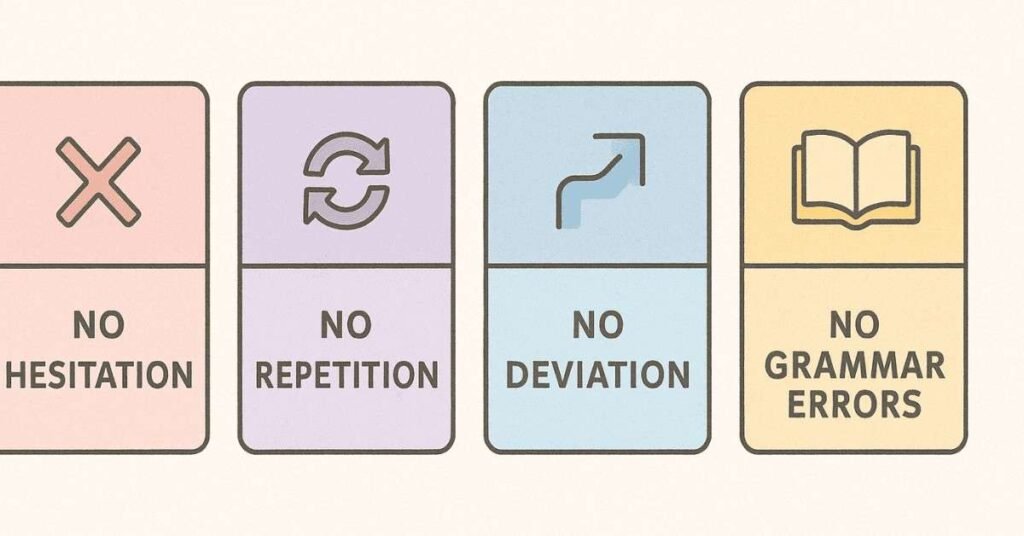
The JAM Rules Framework
Understanding the four cardinal rules helps you avoid disqualification and maximize scores during your 60-second performance.
No Hesitation – You must speak continuously without long pauses, “umm” sounds, or awkward silences. Brief pauses to breathe or think for a split second are acceptable, but hesitating for 3-4 seconds signals you’ve lost your train of thought and results in point deductions.
No Repetition – Avoid repeating the same words, phrases, or ideas. While using common words like “and,” “the,” or “is” multiple times is acceptable, repeating key content words or restating the same point differently constitutes repetition. For example, saying “education is important” and later “education holds significance” would be flagged.
No Deviation – Stay strictly on topic. If the subject is “Social Media Impact,” don’t drift into discussing traditional media, television history, or unrelated technology topics. Every sentence should directly relate to the given topic.
No Grammatical Errors – Maintain proper grammar throughout. Subject-verb agreement mistakes, incorrect tenses, wrong prepositions, or sentence fragments reduce your score. Speaking in grammatically correct, complete sentences demonstrates language proficiency.
The Psychology of JAM Performance
JAM sessions create intentional pressure to simulate workplace stress. Evaluators understand that candidates feel nervous—they’re not expecting perfection but rather assessing how you handle pressure. Your recovery from minor stumbles matters more than avoiding them entirely.
The 60-second constraint forces you to prioritize ideas rapidly, a skill crucial for professionals who must deliver elevator pitches, respond to unexpected questions in meetings, or provide quick briefings to senior management. By succeeding in JAM, you prove you can organize thoughts coherently even when caught off-guard.
JAM also reveals personality traits. Confident, articulate speakers who maintain composure under time pressure signal they’ll represent the organization well in client interactions, presentations, and team discussions. Conversely, candidates who freeze, stumble repeatedly, or speak incoherently raise concerns about their communication readiness
📘 Discover more preparation-focused content designed to improve performance →
Common Misconceptions About JAM
Many candidates believe memorizing speeches for common topics guarantees success. However, evaluators easily recognize memorized content, which appears robotic and disconnected. Moreover, you might get an unexpected topic where memorization provides no advantage.
Another misconception is that speaking fast demonstrates fluency. In reality, rushing through content makes you appear nervous and difficult to understand. Evaluators prefer steady, clear delivery at conversational pace over rapid-fire speech.
Some think using complex vocabulary impresses evaluators, but unnecessarily complicated words often backfire when mispronounced or used incorrectly. Simple, clear language with correct grammar scores higher than pretentious vocabulary with errors.
Finally, candidates assume only extroverts succeed at JAM. While outgoing personalities may appear comfortable initially, introverted candidates who prepare systematically often outperform because they focus on content quality and structured thinking rather than showy performance.
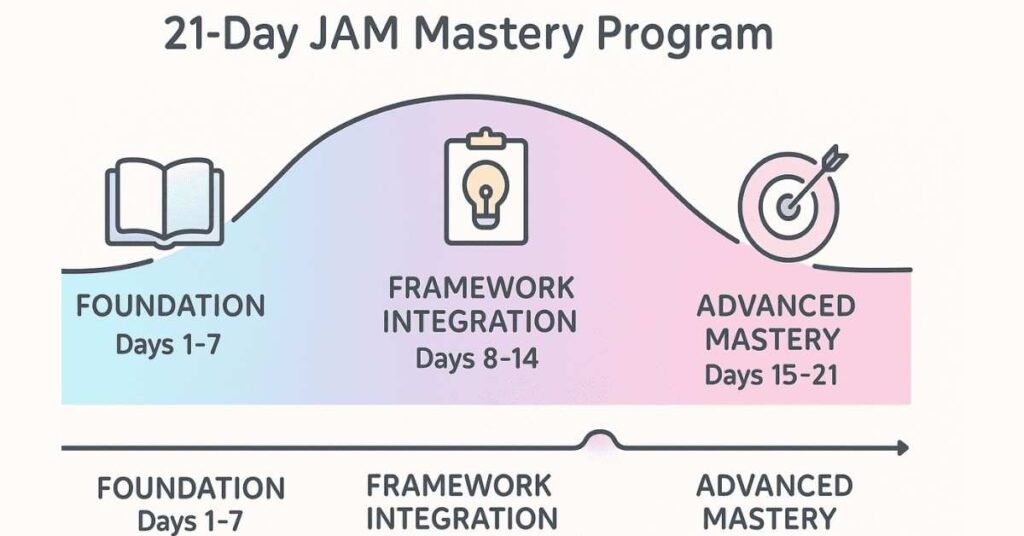
The 21-Day JAM Mastery Program
Days 1-7: Foundation Building – Start with stream-of-consciousness exercises where you speak continuously for 60 seconds on everyday objects around you—a pen, coffee mug, window, or chair. The goal isn’t making sense but eliminating hesitation. Turn off your internal judge and just keep talking, even if sentences feel disconnected. This builds the fundamental skill of continuous speech without pauses.
Practice recording yourself daily. Listen back and count filler words (“um,” “like,” “actually,” “basically”). Each day, challenge yourself to reduce these by 20%. Also note grammatical errors and work on eliminating one error type per day—perhaps subject-verb agreement on Day 2, tense consistency on Day 3.
Read newspapers or online articles aloud for 10 minutes daily. This builds fluency, expands vocabulary, and trains your mouth muscles for clear articulation. Pay attention to pronunciation, especially for technical terms or complex words you might need in professional topics.
Days 8-14: Framework Integration – Learn and practice structured frameworks that organize your one-minute speeches effectively. The most powerful frameworks transform random thoughts into coherent presentations.
PADS Framework (Point-Advantages-Disadvantages-Summary) – This balanced approach works exceptionally well for analytical topics. Start by stating your main point clearly (10 seconds), discuss 1-2 advantages (20 seconds), present 1-2 disadvantages (20 seconds), and conclude with a balanced summary (10 seconds). For example, on “Remote Work,” your point might be “Remote work has transformed modern employment,” followed by advantages like flexibility and cost savings, disadvantages like isolation and communication gaps, ending with “Hybrid models may offer the best of both worlds”.
OREO Framework (Opinion-Reason-Experience-Opinion) – Perfect for opinion-based topics, this structure gives you a clear roadmap. State your opinion (10 seconds), provide logical reasons supporting it (20 seconds), share a personal or observed experience illustrating your point (20 seconds), and restate your opinion with a call to action (10 seconds). For “Importance of Time Management,” open with “Effective time management determines professional success,” explain why prioritization matters, share how you’ve seen colleagues advance through disciplined scheduling, and conclude by reinforcing that everyone should develop time management skills.
PREP Framework (Point-Reason-Example-Point) – A streamlined structure for persuasive speeches. Make your point clearly, give compelling reasons, provide concrete examples, and circle back to reinforce your initial point. This works brilliantly for topics like “Innovation in Business” or “Customer Service Excellence”.
Practice applying each framework to 10 different topics. Write down the topic, choose a framework, and speak for 60 seconds following that structure. Gradually, these frameworks become automatic mental templates.
Days 15-21: Advanced Mastery – Introduce the “no prep” drill where you pull random topics from a bowl and immediately start speaking without any thinking time. This simulates worst-case scenarios where you get an unfamiliar topic and must perform instantly. Initially, you’ll struggle, but this drill dramatically improves your think-on-your-feet abilities.
Practice the “story adaptation” technique. Write three diverse personal stories or examples on a sticky note—perhaps a college experience, a news event, and a business case study. Pick random topics and force yourself to incorporate at least one story into your speech. This teaches you to creatively adapt prepared material to unexpected topics.
Conduct mock JAM sessions with friends or family. Have someone randomly select topics and evaluate you using a scoring sheet covering communication clarity, content relevance, confidence, and time management. Request honest feedback on specific weaknesses—perhaps you speak too fast when nervous, or your conclusions feel abrupt.
📂 Access complete learning materials to enhance confidence and delivery →
The 10-Second Topic Analysis Technique
When you receive a topic, you have roughly 10-30 seconds before speaking begins. Use this precious time strategically with the BREAK Method:
B – Breathe – Take one deep breath to calm nerves and oxygenate your brain. This prevents panic and activates clear thinking.
R – Recognize Topic Type – Quickly identify whether it’s factual (requires knowledge), abstract (requires interpretation), personal (requires opinion), or creative (requires imagination). This determines your approach.
E – Extract Key Words – Identify 2-3 keywords in the topic that become your speech anchors. For “Digital India Initiative,” your keywords might be “technology,” “accessibility,” and “governance”.
A – Apply Framework – Mentally select which framework (PADS, OREO, or PREP) best suits this topic and quickly outline your 4 segments.
K – Kickstart Confidently – Choose your opening line—either a definition, question, statistic, or bold statement—and commit to starting strong.
Content Generation Strategies for Common Topic Categories
For Technical/Knowledge Topics – When faced with subjects like “Blockchain Technology” or “Green Energy,” structure your response as: Definition → Applications → Benefits → Future Outlook. Even if your knowledge is limited, this structure lets you speak intelligently. Define blockchain as “a decentralized digital ledger,” mention applications in finance and supply chain, discuss transparency benefits, and conclude with “As adoption grows, blockchain may revolutionize multiple industries”.
For Abstract Topics – Topics like “Success is a Journey” require interpretation. Use the approach: Interpret → Personal Connection → Universal Truth → Motivational Close. Start by explaining what “journey” means in this context (process vs. destination), connect to personal or observed experiences of learning through failures, broaden to universal human experience, and end with an inspiring thought.
For Social Issues – Topics like “Gender Equality” need balanced perspectives. Apply: Current Situation → Challenges → Progress Made → Path Forward. Acknowledge existing disparities, identify systemic barriers, highlight positive changes (legislation, awareness), and end with collective responsibility for continued progress.
For Personal Development Topics – Subjects like “Leadership Qualities” benefit from the Example-Based approach: Definition → Real-Life Example → Core Attributes → Application. Define leadership as influencing positive change, cite an admired leader (perhaps mentioning specific actions), extract transferable qualities, and encourage listeners to develop these traits.
Advanced Speaking Techniques
The Strategic Pause – While hesitation damages scores, strategic pauses enhance delivery. Brief 1-2 second pauses after making important points give listeners time to absorb information and create dramatic effect. Practice pausing after your opening statement, before transitioning between framework sections, and before your conclusion.
Voice Modulation Mastery – Monotone delivery bores evaluators. Vary your pitch, pace, and volume to maintain engagement. Raise your pitch slightly when asking rhetorical questions, slow down when emphasizing critical points, increase volume for passionate statements, and soften tone for reflective observations.
The Power of Rhetorical Questions – Incorporating 1-2 rhetorical questions engages evaluators mentally. “What does true innovation mean?” or “Have we considered the long-term implications?” These questions don’t require answers but make your speech conversational and thoughtful.
Transitional Phrases – Smooth transitions between framework sections prevent disjointed speeches. Master phrases like “Building on this point…”, “However, we must also consider…”, “This brings us to…”, “Looking at the broader picture…”, and “To conclude…” These connectors create flow and professionalism.
The Personal Touch – When appropriate, briefly referencing personal observations or experiences makes speeches authentic and memorable. “In my experience…” or “I’ve observed that…” followed by a quick example humanizes your content without making it entirely autobiographical.
Body Language Optimization
Posture and Stance – Stand or sit upright with shoulders relaxed, projecting confidence without appearing rigid. Distribute weight evenly on both feet if standing, and avoid swaying or shifting. If seated, sit forward slightly showing engagement rather than leaning back passively.
Eye Contact Distribution – If presenting to multiple evaluators, distribute eye contact evenly, spending 3-4 seconds with each person throughout your minute. This creates connection and shows confidence. Avoid staring at the ceiling, floor, or fixating on one person.
Purposeful Gestures – Use hand gestures sparingly but meaningfully to emphasize points. When listing items (“firstly,” “secondly”), count on fingers. When describing growth or expansion, move hands outward. When emphasizing importance, use a single pointed gesture. Keep gestures within your body frame and avoid repetitive movements.
Facial Expressions – Maintain a pleasant, engaged expression throughout. Smile slightly when appropriate (especially during lighter topics), show thoughtfulness during serious subjects, and display enthusiasm when discussing opportunities or solutions. Avoid blank, nervous, or overly serious expressions.
Handling Common Challenges
Mind Blanking Mid-Speech – If you suddenly forget what to say, don’t panic or admit you’ve blanked. Use recovery phrases: “Let me elaborate on this further…” or “Another dimension worth exploring…” while your brain catches up. Alternatively, quickly summarize what you’ve already said, which buys thinking time and demonstrates consolidation skills.
Running Out of Content – If you’ve covered your points with 15-20 seconds remaining, expand on your strongest point with additional examples or perspectives. Alternatively, transition to conclusion earlier than planned: “To summarize the key insights…” A strong, early conclusion beats rambling filler content.
Speaking Too Fast – Nervous candidates often rush, finishing in 35-40 seconds. Practice with metronome apps that beep every 15 seconds, reminding you to pace yourself. Consciously slow down, enunciate clearly, and use strategic pauses. Remember: clarity and comprehension matter more than cramming information.
Difficult or Unfamiliar Topics – When you receive a topic you know nothing about, speak in broader terms and generalities. For “Quantum Computing,” you might say “Emerging technologies like quantum computing represent humanity’s quest to solve increasingly complex problems. While specifics require expertise, the broader principle holds—investment in cutting-edge research drives innovation cycles. As these technologies mature, they’ll likely impact industries from healthcare to finance, requiring workforce adaptation and regulatory frameworks. The challenge lies in balancing rapid advancement with ethical considerations.” This approach demonstrates thinking abilities without pretending false expertise.
The JAM (Just A Minute) Complete Training Guide
Evaluation Criteria, Sample Topics & Performance Day Strategies
Understanding the JAM Scoring Rubric
Most organizations use standardized evaluation sheets rating candidates on 5-7 key dimensions, typically on a 1-5 or 1-10 scale. Understanding these scoring criteria helps you optimize performance strategically.
Preparation & Introduction (15-20%) – Evaluators assess how effectively you begin your speech. Strong openings include attention-grabbing statements, clear thesis establishment, or engaging questions that orient listeners to your topic immediately. Weak introductions that fail to capture attention or don’t clearly establish the theme receive lower scores. Your opening 10 seconds significantly influence overall impression.
Content Quality & Presence of Mind (30-35%) – This carries maximum weightage, measuring your depth of understanding, accuracy of information, originality of thought, and logical progression of ideas. Evaluators reward candidates who demonstrate complete grasp of topics through relevant examples, diverse perspectives, and creative interpretations. Inaccurate information, superficial treatment, or generic statements score poorly.
Organization & Structure (20-25%) – Your ability to arrange thoughts coherently with clear introduction, body, and conclusion demonstrates logical thinking. Effective transitions between points, smooth idea flow from opening to conclusion, and purposeful structure receive high marks. Disjointed speeches lacking clear progression or awkward transitions score lower.
Delivery & Communication Skills (15-20%) – Verbal fluency, pronunciation clarity, grammatical accuracy, voice modulation, pace control, and vocabulary richness fall under this category. Evaluators note filler word frequency, hesitation patterns, grammatical errors, and monotone delivery. Clear, confident, varied delivery with minimal errors scores highest.youtube
Confidence & Body Language (10-15%) – Your posture, eye contact, facial expressions, hand gestures, and overall demeanor reveal self-assurance. Confident speakers maintain steady eye contact, use purposeful gestures, project voices clearly, and display relaxed yet engaged body language. Nervous behaviors like excessive fidgeting, avoiding eye contact, or apologetic postures reduce scores.
Time Management (5-10%) – Speaking for the full 60 seconds without significantly overshooting or falling short demonstrates control and awareness. Finishing at 45-50 seconds suggests insufficient content preparation, while exceeding 70 seconds indicates poor self-regulation. Evaluators penalize both extremes.youtube
100+ High-Probability JAM Topics by Category
Technology & Innovation Topics – Artificial Intelligence in Daily Life, 5G Technology Impact, Cryptocurrency Future, Cybersecurity Importance, Internet of Things, Digital Privacy Concerns, Blockchain Technology, Cloud Computing Benefits, Social Media Influence, E-Learning Advantages, Automation and Jobs, Virtual Reality Applications, Robotics in Healthcare, Smart Cities Concept, Digital India Initiative.
Social Issues & Current Affairs – Women Empowerment, Gender Equality, Climate Change Solutions, Mental Health Awareness, Youth Unemployment, Education System Reform, Rural Development, Healthcare Accessibility, Poverty Alleviation, Child Labor Prevention, LGBTQ+ Rights, Elder Care Challenges, Work-Life Balance, Digital Divide, Sustainable Development.
Business & Professional Topics – Entrepreneurship Spirit, Startup Ecosystem, Leadership Qualities, Teamwork Importance, Corporate Social Responsibility, Customer Service Excellence, Innovation in Business, Work from Home Culture, Government vs Private Jobs, Financial Literacy, Globalization Impact, Indian Economy Growth, Digital Marketing Trends, Brand Building, Ethical Business Practices.
Personal Development Topics – Time Management Skills, Self-Confidence Building, Importance of Reading, Communication Skills, Emotional Intelligence, Critical Thinking, Goal Setting, Continuous Learning, Handling Failure, Decision Making, Public Speaking, Stress Management, Positive Attitude, Adaptability, Growth Mindset.
Abstract & Philosophical Topics – Success is a Journey, Change is Constant, Life is a Teacher, Failure is a Stepping Stone, Time Management, First Impression Matters, Knowledge vs Wisdom, Happiness is a Choice, Power of Silence, Actions Speak Louder Than Words, Quality over Quantity, Practice Makes Perfect, Honesty is the Best Policy, Experience is the Best Teacher, Today is a Gift.
Environment & Sustainability Topics – Global Warming Solutions, Renewable Energy Future, Plastic Pollution Control, Water Conservation, Forest Conservation, Sustainable Agriculture, Green Technology, Carbon Footprint Reduction, Wildlife Protection, Electric Vehicles, Urban Pollution, Organic Farming, Waste Management, Clean Energy Transition, Environmental Awareness.
Education & Career Topics – Online vs Offline Learning, Skill-Based Education, Vocational Training Importance, Higher Education Value, Student Stress Management, Internship Benefits, Career Planning, Lifelong Learning, Practical vs Theoretical Knowledge, Education Technology, Teacher’s Role in Society, Competitive Exams Pressure, Study Abroad Benefits, Professional Certifications, Industry-Academia Gap.
Culture & Society Topics – Indian Cultural Heritage, Festival Celebrations, Unity in Diversity, Traditional vs Modern Values, Social Media Impact on Culture, Language Preservation, Art and Society, Music Therapy, Sports and Nation Building, Cinema Influence on Youth, Food and Culture, Tourism Development, Heritage Conservation, Cultural Exchange, Regional Identity.
Health & Lifestyle Topics – Fitness Importance, Yoga Benefits, Healthy Eating Habits, Sleep Hygiene, Screen Time Management, Meditation Practice, Preventive Healthcare, Lifestyle Diseases, Mental Wellness, Stress Management Techniques, Work-Life Integration, Mindfulness Practice, Addiction Prevention, Holistic Health, Active Lifestyle.
Fun & Creative Topics – My Favorite Color, Dream Vacation Destination, If I Were a Superhero, My Role Model, Best Advice I Received, Favorite Book/Movie, College Life Memories, Hobbies and Interests, Weekend Plans, Favorite Season, My Ideal Job, If I Won a Lottery, Time Travel Fantasy, Perfect Day Description, My Childhood Memory.
Performance Day Strategic Preparation
24 Hours Before JAM – Stop intensive practice and instead review your framework templates mentally. Over-practicing the day before increases anxiety without adding value. Focus on relaxation—watch light entertainment, engage in physical exercise, or pursue hobbies that calm your mind. Avoid late-night cramming or topic memorization.
Review 10-15 diverse topics you’ve practiced, reading your framework notes briefly. This refreshes memory without creating pressure. Trust your preparation—you’ve built muscle memory through practice that will activate when needed
Morning of JAM Session – Eat a balanced breakfast with complex carbohydrates and protein for sustained energy. Avoid excessive caffeine which can increase nervousness and make you speak too rapidly. Stay hydrated but don’t overdrink immediately before to avoid restroom urgency.
Arrive at the venue 20-30 minutes early. This allows you to acclimate to the environment, observe the setup, and calm pre-performance nerves. Rushing creates unnecessary stress that affects performance quality.youtube
Practice deep breathing exercises—inhale for 4 counts, hold for 4, exhale for 6. This activates your parasympathetic nervous system, reducing anxiety and increasing focus. Do three rounds of breathing just before your turn.
Dress Professionally – Wear formal business attire that makes you feel confident and professional. For men, shirts with trousers or formal suits work well. For women, formal suits, sarees, kurtas, or business dresses are appropriate. Ensure clothes are clean, pressed, and comfortable. Avoid excessive perfume, cologne, flashy jewelry, or distracting accessories.
Professional appearance influences both evaluator perception and your own confidence levels. When you look professional, you feel professional, which translates into better performance.
Waiting Room Strategy
While waiting for your turn, avoid discussing performance with anxious candidates who might increase your stress. Instead, practice positive visualization—imagine yourself speaking confidently, receiving approving nods from evaluators, and finishing strong. Mental rehearsal activates neural pathways used during actual performance.
If permitted, review your framework templates one final time on paper or mentally. The PADS, OREO, and PREP structures should be crystal clear in your mind. When your topic is announced, you’ll automatically slot content into one of these frameworks.
Observe other candidates if possible, noting what works and what doesn’t. Learn from their strengths (strong openings, good examples, confident delivery) and weaknesses (hesitation, poor time management, deviation). This real-time learning calibrates your approach.
The Critical First 10 Seconds
When your topic is announced, your immediate response sets the tone for the entire minute. Use the BREAK method systematically:youtube
Take a deep breath to oxygenate your brain and calm nerves. This prevents panic-driven blank minds. While breathing, quickly identify topic type—factual, abstract, social issue, or creative. Extract 2-3 keywords that become your speech anchors. For “Digital India Initiative,” keywords are “technology,” “governance,” “accessibility”.youtube
Select your framework based on topic type. Factual topics work well with PADS, opinion topics with OREO, persuasive topics with PREP. Mentally outline your four segments in 2-3 seconds. Finally, choose your opening line—preferably a strong statement or question.
Begin confidently even if you’re nervous. Evaluators expect some nervousness but assess how you manage it. Speaking your first sentence strongly activates momentum that carries through the remaining 50 seconds.youtube
Real-Time Performance Tactics
Vocal Variety – Modulate your voice throughout the minute. Start with moderate volume and pace, increase energy when discussing exciting aspects, slow down for emphasis on important points, and soften tone for reflective observations. Monotone delivery bores evaluators regardless of content quality.
Strategic Pausing – Use 1-2 second pauses after your opening statement, before transitioning between framework sections, and before your conclusion. These micro-pauses give evaluators absorption time, add dramatic effect, and don’t count as hesitation when used purposefully.
Keywords Expansion – If content runs thin, return to your anchor keywords and explore them from different angles. For “Climate Change,” you might discuss causes, effects, solutions, global cooperation, individual responsibility, and future outlook—all radiating from that central keyword.
The Conclusion Signal – When you reach approximately 50 seconds, use transitional phrases signaling conclusion: “To conclude…”, “In summary…”, “The key takeaway is…” This prepares evaluators for your ending and demonstrates time awareness.
Confident Closure – End with a strong statement, call to action, or thought-provoking question. Never trail off uncertainly or apologize for performance. Even if you struggled mid-speech, a powerful conclusion leaves positive final impressions.
Post-Performance Recovery
After completing your JAM, maintain professional composure regardless of how you felt about your performance. Thank evaluators with brief eye contact and a slight nod, then exit calmly. Avoid showing disappointment, frustration, or excessive celebration.
Don’t immediately discuss your performance with other candidates. This creates unnecessary anxiety and you cannot change what’s done. Instead, mentally note what went well and what you’d improve for future sessions—this reflection aids long-term skill development.
If there are multiple rounds, use learnings from the first JAM to refine your approach for subsequent attempts. Perhaps you spoke too fast, or your conclusion felt rushed, or you forgot to use examples. Adjust accordingly.
Final Success Principles
Authenticity Over Perfection – Evaluators prefer genuine, authentic speakers with minor flaws over robotic, perfect performances that feel scripted. Let your personality shine through your content and delivery style.
Practice Consistency – JAM mastery requires daily practice for 2-3 weeks minimum. Sporadic practice doesn’t build the automatic reflexes needed for spontaneous speaking. Dedicate 15-20 minutes daily to topic practice.
Feedback Integration – After mock JAMs, actively seek specific feedback on what worked and what needs improvement. Generic feedback like “good job” doesn’t help. Ask: “Did I hesitate? Were my transitions smooth? Did I manage time well?” Use this feedback to target weak areas.
Confidence Building – Remember that JAM evaluates your thinking and communication under pressure, not your encyclopedic knowledge. Even with limited topic knowledge, strong framework application and confident delivery score well.