
Job Market & Opportunities

Table of Contents
The IT job market in India is firing on all cylinders. Fresh graduate hiring is 40% higher in 2025 than previous years, with companies desperate for talent in specific areas. But here’s what many job seekers don’t understand: not all jobs are created equal, and not all companies offer the same growth.
Let’s explore where the opportunities actually are.

The Top IT Companies Hiring
Tier-1 IT Services Companies:
Companies like TCS, Infosys, Wipro, HCL Technologies, and Cognizant are traditional mega-recruiters. They hire thousands of freshers annually through campus recruitment.
Why Work Here:
- Structured training programs for freshers
- Job security and global exposure
- Clear career progression
- Established HR and benefits structures
- International project assignments
Why Some Avoid:
- Large bureaucratic structures
- Can feel like a factory initially
- Slower innovation compared to startups
- Limited autonomy in early career
Fresher Hiring in 2025:
These companies are hiring heavily but increasingly demanding specialization. Generic engineering graduates face tougher competition.
Growth-Stage Tech Companies:
Companies like Flipkart, Amazon, OYO, Unacademy, and Vedantu offer different flavors.
Why Work Here:
- Entrepreneurial environment
- Faster career progression
- Direct impact on business
- Learning from experienced founders
- Equity/stock options (potential wealth creation)
Why Some Hesitate:
- Less structured mentorship than large companies
- Demanding environment with high expectations
- Smaller safety nets if company struggles
- Benefits sometimes less comprehensive than tier-
Startup Ecosystem:
India’s startup ecosystem is thriving, particularly in Bangalore, Hyderabad, and Mumbai. Companies like Swiggy, Byju’s, Razorpay, and thousands of smaller startups offer exciting opportunities.
Why Work Here:
- Extreme ownership and autonomy
- Rapid skill development (you wear multiple hats)
- Potential for massive learning
- Early-stage equity could be valuable
- Direct founder/investor interactions
Why Some Struggle:
- High risk—startups fail
- Irregular work hours and demanding culture
- Benefits often less generous
- Job security isn’t guaranteed
- Growth depends heavily on company survival
Government & Public Sector IT:
Organizations like ISRO, CDAC, TCS (part of government projects), and various government IT departments also hire.
Why Work Here:
- Exceptional job security
- Defined pension benefits
- Work-life balance often better
- Serving nation-building projects
- Stable, predictable career
Why Some Don’t Consider:
- Slower salary growth than private sector
- Less cutting-edge technology
- Bureaucratic decision-making
- Limited corporate flexibility

The Sector-Wise Hiring Landscape
Not all sectors hire equally. Understanding hot sectors helps you target right companies.
Finance & FinTech (Booming)
Banks, payment gateways, and fintech startups are aggressively hiring developers, data scientists, and cybersecurity experts. Why? Digital banking transformation. Companies like Razorpay, Pine Labs, HDFC Bank, and ICICI Bank are hunting talent.
E-commerce & Consumer Tech (High Growth)
Flipkart, Amazon, Meesho, and similar companies need product engineers, data analysts, and platform builders. The consumer tech wave continues.
AI/ML & Data Analytics (Explosive Demand)
Every industry is integrating AI. Healthcare tech, fintech, and enterprise software companies are desperately seeking AI/ML engineers and data scientists.
Cybersecurity (Critical)
As breaches increase, every organization needs cybersecurity talent. From startups to enterprises, this is universally in-demand
Cloud & Infrastructure (Essential)
AWS partners, Azure specialists, and cloud-native companies are hiring rapidly. Digital transformation isn’t optional anymore.
Startup vs. Corporate: Which Path for You?
This is a real decision point. Let’s break it down honestly.
Choose Corporate (TCS, Infosys, Amazon, etc.) If:
- You value stability and want a structured career path
- You’re risk-averse and want predictable growth
- You prefer established systems and clear rules
- You want international exposure through company programs
- You’re still unsure about your specific interests (corporate offers variety)
Choose Startup If:
- You’re comfortable with ambiguity and high-pace environments
- You want rapid skill development and autonomy
- You’re willing to accept job insecurity for potential equity upside
- You enjoy wearing multiple hats and taking ownership
- You’re passionate about the specific problem the startup solves
Hybrid Approach:
Start in a startup for 2-3 years to gain aggressive skill development, then move to a larger company for stability and higher salaries. Many successful professionals follow this path. Alternatively, start in a large company to build structured fundamentals, then move to a startup where you can contribute more meaningfully.
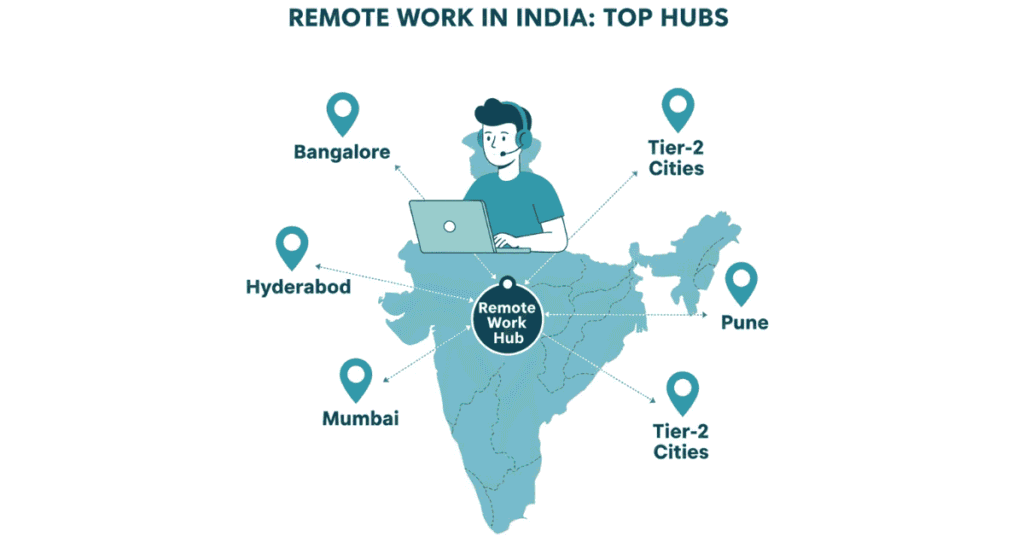
Remote Work Trends: Redefining Opportunities
Remote work has fundamentally changed IT hiring. You’re no longer limited to companies in your city.
Remote Work Reality:
- Most IT companies offer hybrid (2-3 days office) or fully remote options
- Remote roles sometimes pay slightly less (10-15% premium for office work is disappearing)
- Time zone differences are less of a barrier for Indian companies
- Remote work is now standard, not exceptional
What This Means:
You can live in Hyderabad and work for a Bangalore startup. You can be in a tier-2 city and earn metro-level salaries. This geographic freedom is unprecedented.
Strategic Advantage:
Apply to companies across India without relocation constraints. Your geographic location is no longer your ceiling.
Internship & Placement Pathways: The Fastest Route
Campus Recruitment (Traditional):
Companies visit colleges, conduct tests, interviews, and hire en masse. It’s competitive but structured.
Reality Check:
Campus recruitment favors students from recognized colleges. If you’re from a less-known institution or are self-taught, other routes are more viable.
Internship → Job Conversion (Underrated Path):
Many companies hire interns full-time if performance is good. Internships are essentially 3-6 month job interviews.
How to Use This:
Intern seriously. Demonstrate value, learn the codebase, and show cultural fit. A good internship often leads directly to employment offers at 20-30% higher salary than applying externally.
Online Platforms (LinkedIn, Naukri, AngelList):
Platforms like LinkedIn are increasingly where companies post jobs. Build a strong profile, highlight projects, and apply directly.
Advantage:
You control the narrative. Your profile showcases your actual work and skills, not just degrees.
Networking & Referrals (Most Effective):
Many jobs aren’t advertised. Companies prefer referrals because referred candidates have higher retention. Someone already working at the company vouches for you.
How to Leverage:
Attend tech meetups, join communities, connect on LinkedIn with professionals in target companies. Referrals lead to interviews 80% faster than cold applications.
Freelancing & Portfolio Building (Alternative Path):
Build real projects on platforms like GitHub. Companies increasingly hire based on portfolio rather than degrees.
Advantage:
You prove skills through actual work, not credentials.
Geographic Hotspots for IT Jobs in India
Bangalore: India’s Silicon Valley. Highest concentration of IT companies, startups, and opportunities. Salaries are highest but cost of living is significant.
Hyderabad: Emerging as the new tech hub. Lower cost of living than Bangalore, excellent companies, and government support for tech. Your target region is strategically positioned here.
Pune: Growing IT hub with strong IT company presence and emerging startups. More affordable than Bangalore.
Mumbai: Financial hub with fintech boom. Strong for finance-focused IT roles.
Delhi-NCR: Government sector and corporate headquarters. Mix of opportunities.
Telangana & Andhra Pradesh (Your Focus Regions): Government initiatives are creating IT infrastructure. Hyderabad is the epicenter with companies like TCS, Microsoft, Amazon, and numerous startups. Growth potential is excellent.
The Hiring Timeline: When to Apply
Peak Hiring Seasons:
- January-March: Post-New Year hiring surge
- July-September: Mid-year recruitment push
- October-November: Pre-year-end hiring
Campus Recruitment:
Typically August-December for graduation in May-June.
Freelancing & Contract Work:
Year-round, but peak during project phases.
Strategic Timing:
If you’re graduating in May, campus recruitment happens August-November (before graduation). For immediate hiring, apply during peak seasons. Don’t wait for perfect conditions; apply year-round but focus efforts during peak seasons.
Red Flags in Job Offers
Not all opportunities are good opportunities. Watch for:
- Unrealistic salary promises (3x market rate should raise concerns)
- Pressure to join immediately without proper documentation
- No clear job description or role defi
- Companies with high attrition (check Glassdoor reviews)
- Vague compensation structure (legitimate companies are clear)
No benefits or unclear terms (professional companies document everything)

Evaluating Job Offers: Beyond Salary
Total Compensation Analysis:
- Base salary
- Bonuses and incentives
- Health insurance (for you and family)
- Vacation days
- Remote work flexibility
- Professional development budget
- Stock options/equity (if applicable)
- Career growth opportunity
Culture & Learning:
- Company growth trajectory
- Team quality and mentorship availability
- Learning opportunities and training budget
- Work-life balance (check Glassdoor)
- Diversity and inclusion initiatives
Career Trajectory:
- Promotion timeline and clarity
- Specialization opportunities
- Skill development alignment with your goals
- International exposure possibilities
Red Line Factors:
Some things are dealbreakers:
- Toxic work environment (verified through current/ex-employees)
- No career growth possibilities
- Misalignment with your values
- Unreasonable work hours without compensation