
IT INDUSTRY COMPLETE CAREER GUIDE
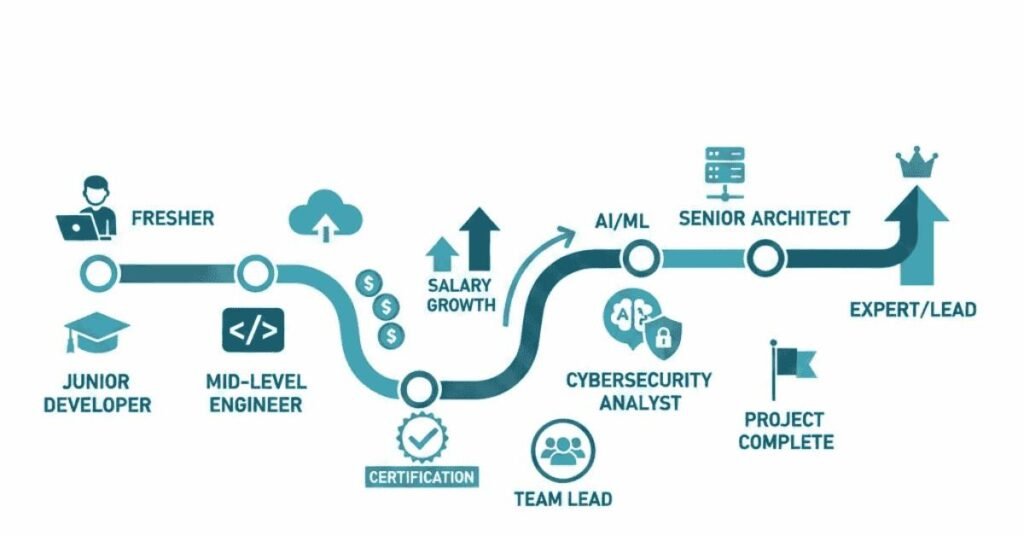
Table of Contents
MASTER INTRODUCTION
India’s Information Technology sector stands at an inflection point. With over 5 million professionals already working in IT and a projected 8-10% annual growth rate, the sector continues to be one of the most recession-resistant, dynamic, and rewarding career fields globally.
But here’s what many aspiring professionals don’t understand: IT isn’t one career—it’s dozens of specializations, each with distinct salary trajectories, skill requirements, and growth potential. A full-stack developer’s career path differs vastly from a cybersecurity specialist’s. A fresher’s salary in AI/ML can be 3x higher than a fresher in QA. Strategic choices made early compound dramatically over years.
This comprehensive guide is designed for:
- Freshers exploring IT careers after graduation or during college
- Career changers transitioning into technology
- Working professionals seeking advancement or specialization
- Students planning their path toward high-paying, future-proof careers
- Anyone in Telangana & Andhra Pradesh leveraging the booming tech hub ecosystem
Whether you’re in Hyderabad, Bengaluru, or anywhere globally, this guide provides the exact roadmap successful IT professionals follow.

SECTION 1: INTRODUCTION TO IT INDUSTRY
The Growth Story You Need to Know
When Rahul finished his engineering degree in 2023, he wasn’t sure which career direction to take. His friends were pursuing similar paths, but the IT sector seemed overwhelming with endless possibilities. Today, he’s a junior software developer earning ₹5.5 LPA and watching his industry grow at an unprecedented pace. His story isn’t unique—thousands of graduates like Rahul are discovering that the IT industry offers more than just jobs; it offers future-proof, dynamic careers
Why the IT Sector is Booming
India’s IT sector isn’t just thriving—it’s transforming. With a projected 8-10% annual growth rate, the sector continues to be one of the most recession-resistant career fields. But what makes IT so special?
The answer lies in digital transformation. Every business today—whether a startup in Hyderabad or an established company in Bangalore—needs technology to survive. Banks need cybersecurity experts. E-commerce platforms need full-stack developers. Healthcare companies need data scientists. This universal demand means opportunities are everywhere.
Think of IT as the backbone of modern India. From the apps you use daily to the systems powering government services, IT professionals are the architects behind these innovations.
What Exactly is an IT Career?
Here’s where many beginners get confused. “IT career” isn’t just one job—it’s an umbrella covering dozens of specializations. Whether you’re interested in building applications, protecting against cyber threats, analyzing massive datasets, or managing cloud infrastructure, there’s an IT role waiting for you.
An IT professional can be:
- A software developer creating the next mobile app
- A cybersecurity specialist protecting company data
- A data scientist uncovering business insights
- A cloud architect designing scalable systems
- A network engineer managing IT infrastructure
- A DevOps engineer ensuring smooth deployments
- An AI/ML researcher building intelligent systems
Each role is distinct, pays differently, requires different skills, and offers unique career progression paths.
Opportunity Window
Here’s the exciting part: the IT sector isn’t slowing down. In 2025, demand for fresh graduates is expected to rise by 40%, with companies investing heavily in training early-career professionals. This means fresher hiring is booming.
Entry-level professionals can expect packages ranging from ₹4-7 LPA for roles like full-stack development, while specialized areas like AI/ML and cloud computing offer fresher packages of ₹8-12 LPA. Even more compelling? These numbers are growing. Companies are now offering 25-30% higher packages than standard benchmarks for high-demand roles.
Why Now is the Perfect Time to Start
Five years ago, someone might have questioned your IT career choice. Today, that conversation has shifted completely. The IT sector offers:
- High-paying opportunities across multiple specializations
- Remote work flexibility with jobs available globally
- Rapid skill development through certifications and practical projects
- International exposure without leaving India
Job security driven by continuous digital transformation

SECTION 2: IT CAREER PATHS & SPECIALIZATIONS
Understanding Your Options
If you’ve ever walked into a tech office, you’d notice something fascinating: everyone’s doing vastly different work. The person at the desk next to you might be writing code while the person across is analyzing data, and someone else is ensuring the company’s systems stay secure. This diversity is what makes IT so powerful—and sometimes confusing for newcomers.
Let’s break down the major IT career paths so you can understand where your interests might fit best
1. Software Development: Building Digital Solutions
Software developers are the architects of the digital world. They write code that powers applications, websites, and systems millions of people use daily.
What You’ll Do:
Software development splits into specializations. Frontend developers build what users see—the interface of apps and websites. Backend developers create the invisible infrastructure that makes everything work. Full-stack developers do both.
Why It’s Popular:
It’s creative, technical, and immediately impactful. You solve real problems through code.
Salary Range:
- Entry-Level: ₹4-7 LPA
- Mid-Level (3-6 years): ₹10-15 LPA
- Senior-Level (6-10 years): ₹15-25 LP
Skills You’ll Need:
Programming languages like Java, Python, JavaScript, and frameworks like React, Angular, and Flutter. Problem-solving abilities matter as much as coding knowledge.
2. Data Science & Analytics: Turning Data into Gold
If you enjoy solving puzzles and uncovering hidden patterns, data science might be your calling. Data scientists transform raw data into actionable business insights.
What You’ll Do:
You’ll work with massive datasets, build predictive models, create visualizations, and help companies make data-driven decisions. One day you might predict customer behavior; the next, you’re optimizing supply chains.
Why Companies Can’t Get Enough:
Every business today drowns in data. Companies desperately need professionals who can extract meaningful insights.
Salary Range:
- Entry-Level: ₹9.6-13.6 LPA
- Mid-Level: ₹12-18 LPA
- Senior-Level: ₹20-25 LPA
Skills You’ll Need:
Python, SQL, machine learning frameworks like TensorFlow and PyTorch, statistical knowledge, and tools like Tableau for data visualization
3. Cybersecurity: Protecting Digital Assets
cybersecurity isn’t optional—it’s essential. Every data breach makes headlines. Every company loses sleep over security threats. Cybersecurity professionals are the gatekeepers protecting sensitive information.
What You’ll Do:
You’ll identify vulnerabilities, design security systems, respond to threats, and ensure compliance with security standards. It’s detective work meets engineering.
Why It’s Critical:
Cyber threats grow more sophisticated daily. Hackers cost companies billions. Demand for cybersecurity experts far exceeds supply.
Salary Range:
- Entry-Level: ₹5-8 LPA
- Mid-Level: ₹10-15 LPA
- Senior-Level: ₹18-22 LPA
Skills You’ll Need:
Understanding network security, encryption, penetration testing, and security tools. Certifications like CEH (Certified Ethical Hacker) are valuable.
4. Cloud Computing & DevOps: Building Scalable Systems
Cloud architects and DevOps engineers are among the highest-paid IT professionals. Why? Because they solve one of technology’s biggest challenges: how to build systems that scale efficiently.
What You’ll Do:
Cloud architects design and manage cloud infrastructure for organizations. DevOps engineers ensure smooth deployment and operation of applications. You’re essentially building the highways on which applications run.
Salary Range:
- Entry-Level (DevOps): ₹5-9 LPA; (Cloud Architect): ₹10-15 LPA
- Mid-Level (DevOps): ₹12-18 LPA; (Cloud Architect): ₹18-25 LPA
- Senior-Level (DevOps): ₹18-20 LPA; (Cloud Architect): ₹25-30+ LPA
Why Companies Pay Premium:
Cloud computing is the lifeblood of modern businesses. Every major company is migrating to cloud platforms. The demand is massive; the supply is limited.
Skills You’ll Need:
Expertise with AWS, Azure, or Google Cloud platforms. Understanding of containerization (Docker), orchestration (Kubernetes), infrastructure-as-code, and DevOps tools.

5. Artificial Intelligence & Machine Learning: The Future is Here
AI/ML professionals are reshaping industries. They build systems that learn, adapt, and make intelligent decisions.
What You’ll Do:
You’ll develop algorithms, train models, and deploy AI solutions for real-world problems. From recommendation systems to autonomous vehicles, you’re working on tomorrow’s technology today.
Salary Range:
- Entry-Level: ₹8-12 LPA
- Mid-Level: ₹15-22 LPA
- Senior-Level: ₹25-45 LPA
Why This Field is Exploding:
AI is no longer science fiction—it’s mainstream business. Every company is investing in AI. The demand for skilled AI/ML professionals is insatiable.
Skills You’ll Need:
Python, machine learning frameworks (TensorFlow, PyTorch), deep learning knowledge, and mathematics (linear algebra, calculus, statistics).
6. Quality Assurance & Testing: The Quality Guardians
Every software release needs rigorous testing before reaching users. QA professionals ensure quality and catch bugs before customers do.
What You’ll Do:
You’ll create test cases, execute tests, identify bugs, and ensure software meets quality standards. It’s detail-oriented, methodical work.
Why It Matters:
A single bug can cost companies thousands or destroy their reputation. QA professionals are essential gatekeepers.
Salary Range:
- Entry-Level: ₹3.5-5.5 LPA
- Mid-Level: ₹7-10 LPA
- Senior-Level: ₹12-15 LPA
Skills You’ll Need:
Testing methodologies, automation tools, SQL knowledge, and keen attention to detail.
7. IT Infrastructure & Network Management
Behind every smooth digital experience are network and infrastructure professionals managing the physical and digital backbone of organizations.
What You’ll Do:
You’ll maintain servers, manage networks, ensure uptime, solve connectivity issues, and manage IT systems. You’re the troubleshooter who keeps everything running smoothly.
Salary Range:
- Entry-Level: ₹3.5-5 LPA
- Mid-Level: ₹7-10 LPA
- Senior-Level: ₹12-15 LPA
Why It’s Steady:
Every organization needs infrastructure support. This role has consistent demand and job security.
Skills You’ll Need:
Linux and Windows administration, networking protocols, server management, and troubleshooting expertise.

SECTION 3: IN-DEMAND TECH SKILLS
Mastering the Right Skills
Priya spent six months learning Java in 2023, and while it helped her land a junior developer role, she realized by 2024 that specialization mattered more than breadth. The companies she interviewed with weren’t just looking for someone who could code—they wanted developers skilled in cloud platforms and AI integration. Within a year of upskilling, her salary jumped from ₹5 LPA to ₹8.5 LPA.
Her experience reflects a crucial truth: in IT, the right skills open doors. The wrong skills close them. Here are the skills every IT professional should master
1. Programming Languages: The Foundation
Programming languages are your toolkit. Knowing multiple languages makes you adaptable and valuable.
Python: The Versatile Choice
Python dominates 2025. It’s not just for data science anymore—it’s everywhere. From web development to AI, Python’s simplicity and power make it indispensable. If you’re starting fresh, Python should be your first language.
Java: The Reliable Workhorse
Java remains essential for building large-scale enterprise applications. Companies with massive codebases rely on Java developers.
JavaScript: The Web Essential
If web development interests you, JavaScript is non-negotiable. Every website you use runs on JavaScript.
Practical Tip:
Don’t try to learn every language. Pick one as your primary language based on your career interest (Python for data science, Java for enterprise apps, JavaScript for web development). Once you’re comfortable, pick a second language to expand flexibility.
2. Cloud Computing Expertise: Non-Negotiable
Cloud computing isn’t a specialization anymore—it’s a basic expectation. Whether you’re a developer, data scientist, or infrastructure professional, cloud skills matter.
AWS (Amazon Web Services)
The market leader. Most companies use AWS. Learning AWS opens maximum opportunities.
Microsoft Azure
Azure is preferred by enterprises using Microsoft products. Strong demand in large organizations.
Google Cloud Platform (GCP)
GCP excels in data analytics and machine learning. Growing adoption in tech companies.
What You Should Learn:
Start with one platform (AWS is statistically the safest choice), understand core services like EC2, S3, databases, and networking. Then expand to others. The principles transfer across platforms.
Real Impact:
Cloud skills can justify a ₹2-3 LPA salary increase. A developer with cloud expertise beats a developer without it every single time.
3. AI and Machine Learning: The Future Today
AI is no longer cutting-edge—it’s becoming mainstream. Companies integrating AI see competitive advantages. They’re aggressively hiring AI/ML talent.
Essential AI/ML Skills:
- Machine Learning Frameworks: TensorFlow and PyTorch are the industry standards
- Deep Learning: Understanding neural networks, CNNs, RNNs, and transformers
Data Processing: Understanding data preprocessing, cleaning, and transformation is crucial
4. Data Tools: Making Data Actionable
Data is everywhere. Knowing how to work with data is valuable across any IT specialization.
SQL
Almost every IT role requires SQL for database queries. Mastering SQL opens doors.mvjce
Data Visualization Tools
Tableau and Power BI turn raw data into understandable visualizations. These skills are in high demand for data analysts and business analysts.talentsprint
5. Cybersecurity Fundamentals: Protecting Everything
Even if cybersecurity isn’t your main career path, basic security knowledge is essential. Cyber threats are evolving, and every professional should understand security basics.
Critical Skills:
- Network Security
- Encryption
- Penetration Testing
- Security Certifications (CEH, CompTIA Security+)
6. DevOps & Containerization: Scaling Applications
DevOps bridges development and operations. It’s about deploying applications efficiently and reliably.
Key DevOps Skills:
- Docker: Containerization makes applications portable
- Kubernetes: Container orchestration at scale
- Infrastructure-as-Code: Managing infrastructure through code
CI/CD: Automating testing and deployment
7. Soft Skills: The Hidden Differentiators
Technical skills get you interviews. Soft skills get you promotions.
Critical Soft Skills:
- Communication: Explaining technical concepts to non-technical people
- Teamwork: Most IT projects involve teams
- Continuous Learning: Technology evolves rapidly
Leadership: Essential for career advancement
SECTION 4: IT SALARY TRENDS & COMPENSATION

Understanding Your Financial Trajectory
Arjun graduated in 2024 and received an offer letter with “₹6.5 LPA” written across the top. He felt proud until his senior from the batch told him: “You should’ve negotiated harder. Companies are offering ₹8-10 LPA for similar roles this year.” That conversation changed everything. Today, Arjun understands that knowing market rates isn’t just helpful—it’s essential for career decisions.
Understanding IT salaries in 2025 isn’t about greed. It’s about making informed career choices, knowing your worth, and planning your financial future. Let’s break down what the numbers actually tell us.
The Big Picture: Overall IT Salary Growth
India’s IT sector is experiencing 9.6% average salary growth in 2025, with significant variation based on specialization and experience level.
Here’s what matters: Not everyone gets 9.6% hikes. Freshers might see 2-4% adjustments. Mid-level specialists might get 10-12%. Senior leaders could see 12-15%. The variance is enormous.
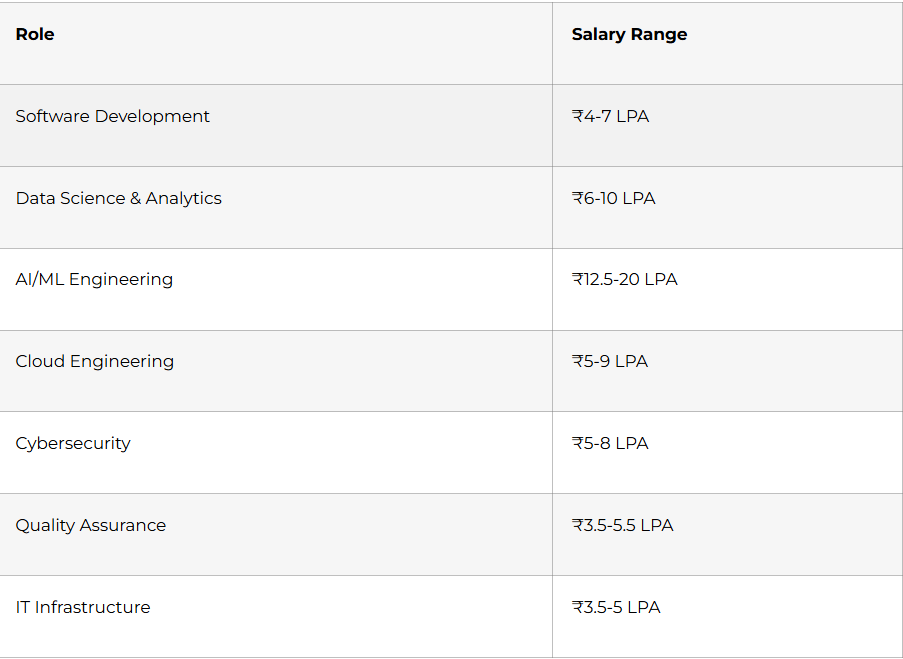
Fresher Packages: What Recent Graduates Can Expect
The exciting news? Fresh graduate hiring is expected to jump by 40% in 2025, with companies offering packages up to 30% above industry norms for high-demand skills.
Standard Fresher Packages (2025):
What This Means:
If you’re a fresher with AI/ML skills, you’re commanding a premium. If you’re a generalist developer without specialization, expect the lower end of the range. This is why specialization early in your career matters significantly.
Mid-Level Professionals: The Sweet Spot
Mid-level professionals (3-6 years experience) are in the most valuable position. They have experience but aren’t expensive like seniors.

The Specialization Premium:
Professionals with specialized skills in AI, cybersecurity, cloud computing, and DevOps see 10-12% salary hikes, while generalists might see only 4-6%. A mid-level DevOps engineer with AWS expertise earns significantly more than a mid-level generic developer.
Senior-Level Compensation: The Expert Premium
Senior professionals (6-10 years) command substantial compensation, especially in specialized areas.

The Leadership Leap:
Senior salaries don’t just reflect technical expertise—they reflect leadership, mentorship, and strategic value. A senior cloud architect earning ₹40 LPA isn’t just deploying applications; they’re architecting organizational strategies.
Highest-Paying Specializations
AI/ML Engineering
- Freshers: ₹12.5-20 LPA
- Mid-level: ₹18-25 LPA
- Senior: ₹25-45 LPA
Why? Demand far exceeds supply. Every company wants AI integration.
Cloud Architecture
- Freshers: ₹10-15 LPA
- Mid-level: ₹18-25 LPA
- Senior: ₹25-65 LPA
Why? Cloud is infrastructure for modern business. Expertise is rare and highly valued.
DevOps & Infrastructure
- Freshers: ₹5-9 LPA
- Mid-level: ₹12-18 LPA
- Senior: ₹18-20 LPA
Why? DevOps engineers are in short supply. They ensure reliability and scalability.
Cybersecurity
- Freshers: ₹5-8 LPA
- Mid-level: ₹10-15 LPA
- Senior: ₹18-22 LPA
Why? Every breach makes headlines. Companies invest heavily in security talent
Data Science
- Freshers: ₹9-14 LPA
- Mid-level: ₹12.5-20 LPA
- Senior: ₹18-35 LPA
Why? Companies extract enormous value from data insights. Data scientists are business assets
Regional Salary Variations: Where You Work Matters
IT salaries vary significantly by location. Telangana and Andhra Pradesh (your target regions) offer competitive packages.
Metropolitan Hubs (Bangalore, Mumbai, Delhi):
Highest salaries due to company headquarters and high costs of living. Freshers might get ₹1-2 LPA more than tier-2 cities.
Tier-2 Cities (Hyderabad, Pune, Chennai):
Slightly lower salaries but excellent opportunities. Hyderabad has become India’s IT hub with aggressive hiring. Fresh packages are competitive—often only ₹0.5-1 LPA less than Bangalore
Emerging Tech Hubs (Telangana, Andhra Pradesh):
Government initiatives and tech parks are creating opportunities. Salaries are marginally lower than metros but competitive with tier-2 cities. Remote work has also equalized salaries significantly
Salary Growth Strategy: How to Maximize Earnings
- Specialize Early
Don’t stay a generalist. Pick a high-demand specialization (AI, cloud, cybersecurity) within 2 years. Specialists earn 50% more than generalists at mid-level.
- Gain Certifications
AWS, Azure, or Kubernetes certifications justify ₹1-3 LPA salary increases. They demonstrate marketable expertise
- Strategic Job Switches
Internal promotions offer 8-10% raises. Job switches offer 20-35% raises for the same role. Strategic job changes accelerate salary growth.
- Develop Leadership Skills
Transitioning to team lead or manager roles adds ₹2-4 LPA to compensation as you gain experience.

SECTION 5: JOB MARKET & OPPORTUNITIES
Where the Real Jobs Are
The IT job market in India is firing on all cylinders. Fresh graduate hiring is 40% higher in 2025 than previous years, with companies desperate for talent in specific areas. But here’s what many job seekers don’t understand: not all jobs are created equal, and not all companies offer the same growth.
Top IT Companies Hiring
Tier-1 IT Services Companies:
Companies like TCS, Infosys, Wipro, HCL Technologies, and Cognizant are traditional mega-recruiters. They hire thousands of freshers annually through campus recruitment.
Advantages:
- Structured training programs for freshers
- Job security and global exposure
- Clear career progression
- Established HR and benefits structures
- International project assignments
Growth-Stage Tech Companies:
Companies like Flipkart, Amazon, OYO, Unacademy, and Vedantu offer different flavors.
Advantages:
- Entrepreneurial environment
- Faster career progression
- Direct impact on business
- Equity/stock options (potential wealth creation)
Startup Ecosystem:
India’s startup ecosystem is thriving, particularly in Bangalore, Hyderabad, and Mumbai. Companies like Swiggy, Razorpay, and thousands of smaller startups offer exciting opportunities.
Advantages:
- Extreme ownership and autonomy
- Rapid skill development
- Potential for massive learning
- Early-stage equity could be valuable
Sector-Wise Hiring Landscape
Finance & FinTech (Booming)
Banks, payment gateways, and fintech startups are aggressively hiring developers, data scientists, and cybersecurity experts. Companies like Razorpay, Pine Labs, HDFC Bank, and ICICI Bank are hunting talent
E-commerce & Consumer Tech (High Growth)
Flipkart, Amazon, Meesho, and similar companies need product engineers, data analysts, and platform builders. The consumer tech wave continues.
AI/ML & Data Analytics (Explosive Demand)
Every industry is integrating AI. Healthcare tech, fintech, and enterprise software companies are desperately seeking AI/ML engineers and data scientists.
Cybersecurity (Critical)
As breaches increase, every organization needs cybersecurity talent. From startups to enterprises, this is universally in-demand.
Cloud & Infrastructure (Essential)
AWS partners, Azure specialists, and cloud-native companies are hiring rapidly. Digital transformation isn’t optional anymore.
Startup vs. Corporate: Which Path for You?
Choose Corporate If:
- You value stability and want a structured career path
- You’re risk-averse and want predictable growth
- You prefer established systems and clear rules
- You want international exposure
- You’re still unsure about your specific interests
Choose Startup If:
- You’re comfortable with ambiguity and high-pace environments
- You want rapid skill development and autonomy
- You’re willing to accept job insecurity for potential equity upside
- You enjoy wearing multiple hats
You’re passionate about the specific problem the startup solves
Remote Work Trends: Redefining Opportunities
Remote work has fundamentally changed IT hiring. You’re no longer limited to companies in your city.
2025 Remote Work Reality:
- Most IT companies offer hybrid (2-3 days office) or fully remote options
- Remote roles sometimes pay slightly less (10-15% premium for office work is disappearing)
- Time zone differences are less of a barrier for Indian companies
- Remote work is now standard, not exceptional
Strategic Advantage:
Apply to companies across India without relocation constraints. Your geographic location is no longer your ceiling.
Internship & Placement Pathways: The Fastest Route
Internship → Job Conversion (Underrated Path):
Many companies hire interns full-time if performance is good. Internships are essentially 3-6 month job interviews.
Advantage:
A good internship often leads directly to employment offers at 20-30% higher salary than applying externally.nucamp
Online Platforms (LinkedIn, Naukri, AngelList):
Build a strong profile, highlight projects, and apply directly.
Networking & Referrals (Most Effective):
Many jobs aren’t advertised. Companies prefer referrals because referred candidates have higher retention. Someone already working at the company vouches for you.
Advantage:
Referrals lead to interviews 80% faster than cold applications.
Geographic Hotspots for IT Jobs in India
Hyderabad: Emerging as the new tech hub. Lower cost of living than Bangalore, excellent companies, and government support for tech. Your target region is strategically positioned here.
Bangalore: India’s Silicon Valley. Highest concentration of IT companies, startups, and opportunities.
Pune: Growing IT hub with strong IT company presence and emerging startups.
Mumbai: Financial hub with fintech boom. Strong for finance-focused IT roles.
Telangana & Andhra Pradesh (Your Focus): Government initiatives are creating IT infrastructure. Hyderabad is the epicenter with companies like TCS, Microsoft, Amazon, and numerous startups. Growth potential is excellent

SECTION 6: GETTING STARTED: EDUCATION & CERTIFICATIONS
Your Learning Pathways
Meera faced a choice that many aspiring IT professionals encounter. After 12th grade, she wondered: “Do I need a 4-year engineering degree? Or can bootcamps work? What about online certifications?” Her mother wanted a “safe” degree. Her friend was already learning coding through a bootcamp. The truth? Both paths work, but understanding them is crucial.
Traditional University Degree (B.Tech / B.Sc Computer Science)
uration: 4 years
Cost: ₹3-10 LPA (government colleges) to ₹15-30 LPA (private universities)
Advantages:
- Comprehensive computer science foundation
- Campus placements with major companies
- Internship opportunities built into curriculum
- Graduate degree opens advanced opportunities
- Time to explore specializations
- Networking with batch mates
Disadvantages:
- 4-year time investment
- High cost for private institutions
- Outdated curriculum in some colleges
- Classroom learning might feel slow for self-motivated learners
- Not all colleges offer industry-relevant training
Reality Check:
A degree is still valuable, especially from recognized institutions. However, the degree alone isn’t enough. Students graduating from even good colleges struggle if they haven’t built projects or learned practically.
Bootcamps & Intensive Programs (3-12 Months)
Duration: 3-12 months (varies by program)
Cost: ₹1-5 LPA depending on bootcamp quality
Advantages:
- Fast, job-focused training
- Significantly cheaper than 4-year degree
- Hands-on project-based learning
- Direct industry mentorship
- Placement assistance upon completion
Disadvantages:
- No degree credential (though certificates help)
- Intense pressure and fast pace
- Limited depth in computer science fundamentals
- Quality varies dramatically by bootcamp
- Some employers still prefer degrees
Reality Check:
Bootcamps work excellently for motivated individuals. However, bootcamp graduates often face a barrier with traditional companies preferring degree holders. Startups and smaller companies increasingly hire bootcamp graduates based on skills
Online Certifications (Self-Paced)
Duration: 1-12 months (depends on commitment)
Cost: ₹500-50,000 depending on certification
Advantages:
- Extremely affordable
- Learn at your own pace
- Flexible around work/studies
- Get recognized credentials
- Focus on specific, high-demand skills
Disadvantages:
- Requires self-discipline (high dropout rates)
- No structured career guidance
- Limited networking opportunities
- Employers value certifications less than degrees
- No dedicated placement support
Reality Check:
Certifications are complementary, not replacements for education. A graduate with a degree + AWS certification beats both a degree holder without certifications and a bootcamp graduate without formal credentials.
The Hybrid Approach: The Smart Path
Most successful IT professionals don’t choose one path—they blend them.
Example Path 1 (The Student):
- Year 1: Start B.Tech, complete first-year fundamentals
- Year 2-3: During college, take online specialization courses (Python, Cloud, etc.)
- Year 4: Complete bootcamp-style intensive project work, build portfolio
- Result: Graduate with degree + specialized skills + portfolio
Example Path 2 (The Career Changer):
- Enroll in 3-month bootcamp for full-stack development
- Simultaneously pursue AWS certification online (part-time)
- Build portfolio projects using bootcamp learning
Result: Ready for job market within 6 months with bootcamp training + certification
Essential IT Certifications by Specialization
For Software Developers:
- AWS Certified Developer Associate
- Kubernetes Application Developer
- Java/Python professional certifications
For Data Scientists:
- AWS Certified Machine Learning Specialty
- Google Cloud Professional Data Engineer
- Tableau or Power BI certifications
For Cybersecurity Professionals:
- CompTIA Security+
- Certified Ethical Hacker (CEH)
- AWS Certified Security Specialty
For Cloud Professionals:
- AWS Certified Solutions Architect
- Microsoft Azure Administrator
- Google Cloud Associate Cloud Engineer
For DevOps Engineers:
- AWS Certified DevOps Engineer
- Kubernetes Application Developer
- Docker Certified Associate
Certification ROI in 2025:
A relevant certification can justify ₹1-3 LPA salary increase. They demonstrate current knowledge and commitment to the field.
Building a Portfolio: Your Best Credential
In 2025, portfolio projects are increasingly important. Here’s why: portfolio demonstrates actual capability.
What to Build:
- Project Complexity: Simple to intermediate projects that showcase your learning
Examples:
- For Web Developers: Build a full-stack application (frontend + backend + database)
- For Data Scientists: Complete a data analysis project with predictions
- For Mobile Developers: Build a useful mobile app
- For DevOps: Deploy an application infrastructure using Kubernetes
- Relevance: Build projects using in-demand technologies
- Documentation: Document your projects well
Include README files, explain your approach, discuss challenges and solutions.
- Open Source Contributions: Contribute to popular open-source projects
This demonstrates ability to work with production code, follow conventions, and collaborate.
GitHub Profile:
Push projects to GitHub with clear documentation. Your GitHub profile becomes your resume for many employers, especially startups.nucamp
Realistic Timeline:
Building 3-5 solid portfolio projects takes 3-6 months if you’re dedicated.
Online Learning Platforms: Where to Learn
Free Resources:
- YouTube (FreeCodeCamp, Traversy Media, Academind)
- GitHub learning resources
- Codecademy free tier
- Udemy free courses
Paid Quality Platforms:
- Coursera: University-backed courses, good for structured learning (₹1,000-5,000 per course)
- Udemy: Affordable courses, huge variety (₹300-1,500 per course during sales)
- LinkedIn Learning: Professional development
- Pluralsight: Technology-focused, high quality
- DataCamp: Specializes in data science and analytics
- Official Certification Programs: AWS, Azure, Google Cloud official training
For Indian Learners:
- Unacademy (Indian platform with quality educators)
- Scaler Academy – focused on career transitions
- NASSCOM courses – Indian IT association offerings
SECTION 7: INTERVIEW PREPARATION FOR IT ROLES
Mastering the Interview Game
Vikram sat nervously outside the interview room, palms sweating. He’d been a solid coder during practice, but something about technical interviews terrified him. When the interviewer asked “Design a system to handle 1 million users,” his mind froze. He stumbled through an answer, got rejected, and spent the next two weeks wondering what went wrong.
The truth? Technical interviews aren’t about knowing everything. They’re about thinking systematically, communicating clearly, and demonstrating problem-solving skills. Let’s break down exactly what to expect and how to ace it.
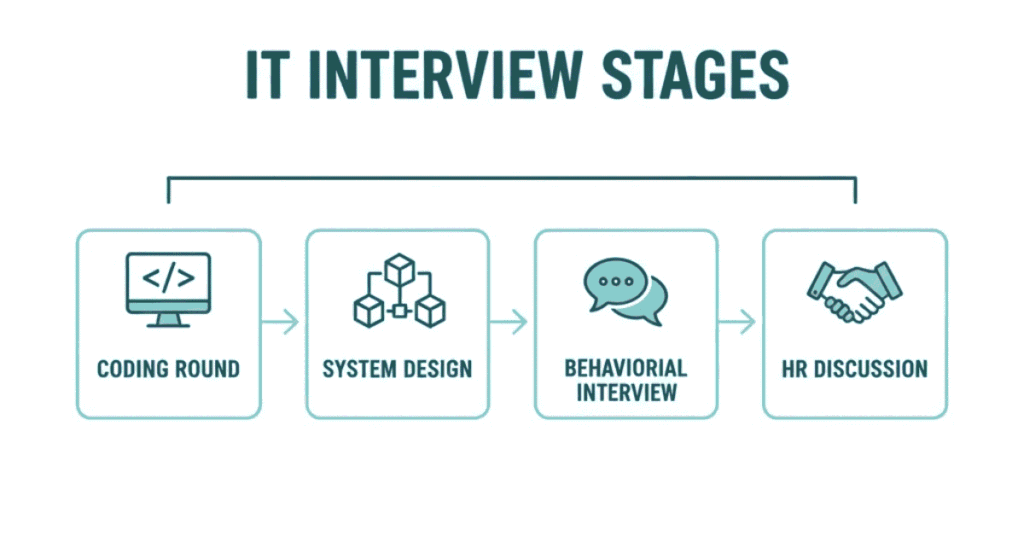
Understanding IT Interview Structure
Most IT interviews follow a predictable pattern:
Phone Screen (30 minutes): Initial conversation about background, motivation, and basic technical questions. This filters for cultural fit and baseline competency.
Technical Round 1 (60 minutes): Coding problems or technical questions specific to the role.
Technical Round 2 (60 minutes): Deeper problem-solving, system design, or architecture questions.
Behavioral Round (45 minutes): Questions about your experience, teamwork, conflict resolution.
HR/Final Round (30 minutes): Compensation discussion, company culture fit, final questions.
Coding Interviews: The Technical Gauntlet
What to Expect:
Interviewers present coding problems. You have 30-45 minutes to solve them while explaining your approach. You write code, test it, optimize it.
Common Problem Types:
- Array & String Manipulation
- Linked Lists
- Trees & Graphs
- Dynamic Programming
- Hash Tables & Sets
- Stacks & Queues
Preparation Strategy:
Solve 50-100 problems on platforms like LeetCode or HackerRank, focusing on medium difficulty. Understand the logic, then solve variants.
During the Interview:
- Clarify the problem before coding (ask edge cases, constraints)
- Think aloud (interviewers want to see your thought process)
- Write pseudocode first before actual code
- Handle edge cases (empty arrays, null values, large inputs)
- Test your code with sample inputs
- Optimize iteratively (get a working solution first, then optimize)
Common Mistakes to Avoid:
- Jumping to code without thinking
- Ignoring edge cases
- Not testing your code
- Over-complicating solutions
Not communicating your approach
System Design Interviews: Thinking at Scale
Senior positions often include system design rounds.
Typical Question:
“Design Instagram” or “Design an e-commerce platform” or “Design a URL shortener”
Structured Approach:
- Requirements Clarification (5 minutes)
- Functional: What features must the system have?
- Non-functional: Scale, latency, availability requirements?
- High-Level Design (10 minutes)
- Draw architecture boxes: Client → Load Balancer → Servers → Database → Cache
- Database Design (10 minutes)
- Schema design (tables, relationships)
- SQL vs. NoSQL decision
- Scalability Concerns (10 minutes)
- Caching strategy (Redis, Memcached)
- Database sharding/replication
- CDN for static content
- Message queues for async work
- Trade-offs & Justification (5 minutes)
- Why these choices?
- What would you change with different requirements?
Behavioral & HR Interview Mastery
Common Questions:
“Tell me about a time you faced a difficult problem and how you solved it”
“Describe a situation where you disagreed with a team member”
“How do you handle tight deadlines?”
STAR Framework (Situation, Task, Action, Result):
Structure your answers clearly:
- Situation: Context and background
- Task: What was your responsibility?
- Action: What did you do specifically?
- Result: What happened? Quantify if possible
Key Behavioral Answers to Prepare:
- Leadership experience
- Handling failure
- Working with difficult people
- Continuous learning
- Taking initiative
- Collaborative achievement
Preparation Timeline
4 Weeks Before Interview:
- Research the company thoroughly
- Study coding problems (30 problems/week)
- Prepare 5-7 behavioral stories
2 Weeks Before:
- Do mock interviews
- Practice system design (2-3 sessions)
- Review core data structures
1 Week Before:
- Polish your portfolio/projects
- Prepare questions to ask interviewers
Get good sleep
SECTION 8: CAREER GROWTH & DEVELOPMENT
From Fresher to Expert
Priya started as a junior developer earning ₹5.5 LPA in 2021. Fast-forward to 2025: she’s a tech lead managing a team of 8, earning ₹18 LPA with stock options. What changed? It wasn’t luck. It was strategic career decisions, continuous learning, and moving at the right times.
Most IT professionals don’t have a career map. They follow the flow, take promotions that come, and wonder why they’re not progressing faster. Understanding IT career progression changes everything.
The Career Progression Timeline: From Fresher to Senior
Year 0-1: Fresher/Junior (₹4-7 LPA)
What You’re Doing:
Learning the ropes, getting assigned simple tasks, building fundamentals, understanding company culture.
Expectations:
- Complete assigned tasks on time
- Learn from mentors
- Ask questions when stuck
- Show initiative for learning
- Deliver quality code/work
Career Move:
Stay 1-1.5 years minimum. Build competence and establish credibility.
Years 1-2: Junior to Mid-Level (₹7-10 LPA)
What You’re Doing:
Taking ownership of features, mentoring juniors, participating in architecture discussions, specializing in a particular area.
What Matters Most:
Ownership and communication. Companies value people who don’t just execute but think about impact.
Career Move:
This is where you make strategic choices. If your company isn’t appreciating your growth, consider switching companies. A job switch here can increase salary by 25-35%.
Years 3-5: Mid-Level to Senior (₹10-18 LPA)
What You’re Doing:
Leading projects, making architectural decisions, mentoring multiple people, contributing to hiring, representing your team in cross-functional discussions.
What Matters Most:
Leadership and business acumen. Technical skill matters, but your ability to lead, communicate, and deliver business value matters more.
Specialization Options:
- Individual Contributor (IC) Track: Go deeper technically (Staff Engineer, Principal Engineer roles)
- Management Track: Lead people (Engineering Manager, Director)
- Hybrid: Both technical depth and some team responsibility
Years 6-10: Senior to Lead (₹18-30 LPA)
What You’re Doing:
Setting technical direction, leading multiple teams, influencing organizational strategy, interviewing and hiring, mentoring senior people.
Years 10+: Principal/Director Level (₹30-50+ LPA)
You’re setting direction, influencing across the company, making strategic hires, representing the company externally.
The Specialization Decision: IC vs. Manager Track
One of IT’s biggest decisions happens around year 3-5: Do you want to go deep (Individual Contributor) or broad (Management)?
Individual Contributor (IC) Track:
Progression: Senior Engineer → Staff Engineer → Principal Engineer → Distinguished Engineer
Compensation: Senior: ₹18-25 LPA; Staff: ₹25-40 LPA; Principal: ₹40-60+ LPA
Best For:
- People who love technology deeply
- Problem-solvers energized by complex technical challenges
- Those who dislike administrative overhead
- People preferring stability over rapid growth
Management Track:
Progression: Team Lead → Engineering Manager → Senior Manager → Director → VP
Compensation: Team Lead: ₹15-20 LPA; Manager: ₹18-28 LPA; Senior Manager: ₹28-45 LPA
Best For:
- People who enjoy developing others
- Those who like organizational impact
- People comfortable with conflict resolution
Those seeking faster salary growth
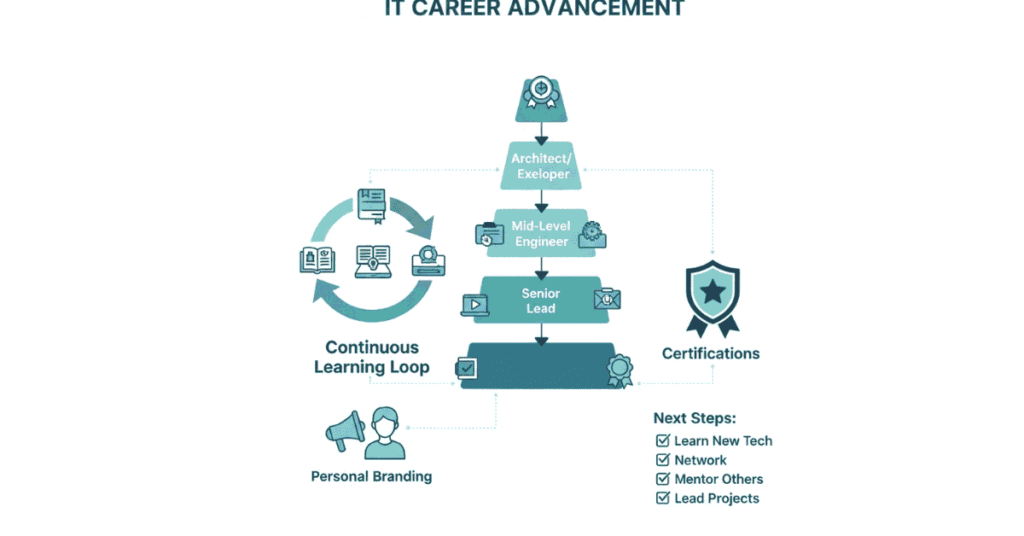
Continuous Learning: Non-Negotiable for Growth
Technology changes rapidly. Professionals who stop learning plateau quickly.
Learning Strategies:
Official Training (20% of learning):
- Online certifications
- Company-sponsored courses
- Conferences and workshops
Learning by Doing (50% of learning):
- Taking on challenging projects
- Side projects
- Open-source contributions
- Mentoring others
Informal Learning (30% of learning):
- Reading articles and blogs
- Podcasts and videos
- Discussions with peers
- Online communities
Allocation:
Spend 20% of work time on learning. Most companies support this through “20% projects” or dedicated training time.
Internal vs. External Growth: Making the Move
Should You Seek Internal Promotion or Switch Companies?
Stay Internally If:
- You’re genuinely learning and contributing meaningfully
- The company is growing
- Your manager supports your growth
- Internal promotions are happening regularly
- Compensation is competitive
Switch Companies If:
- You’re not growing; just executing
- Internal promotions are stalled
- Your manager isn’t invested in your development
- You’ve maxed out roles in your company
- Compensation is below market rate
Data Point:
Professionals who switch companies every 2-3 years in early-to-mid career (years 1-7) typically earn 30-50% more by year 7 than those who stay in one company
Building Your Personal Brand
Career growth accelerates with visibility.
How to Build Personal Brand:
- Write: Blog about technical topics, share insights on LinkedIn
- Speak: Give talks at meetups, conferences, or company events
- Contribute: Opensource contributions get noticed
Network: Build genuine relationships with peers and mentors
Mentorship: Both Getting and Giving
Finding Mentors:
Early in your career, having 1-2 mentors accelerates growth significantly.
How to Find:
- Ask senior people you respect
- Participate in company mentorship programs
- Seek mentors at conferences or online communities
Becoming a Mentor:
Around year 3-4, start mentoring juniors. Teaching forces you to clarify your own knowledge and develops leadership skills.
SECTION 9: COMMON CHALLENGES & SOLUTIONS
Navigating IT Career Obstacles
Six months into his job, Arjun faced a problem every IT professional encounters: his skills felt outdated. The codebase used frameworks he’d never heard of. His colleagues discussed concepts that went over his head. He felt like a fraud. Meanwhile, he was working 60-hour weeks and couldn’t remember the last time he had a weekend free.
These challenges aren’t unique to Arjun. They’re systematic in IT. Let’s address them directly with practical solutions.
Challenge 1: Skill Gaps and Imposter Syndrome
The Problem:
Technology moves faster than any individual can learn. You’re always behind on something.
Solutions:
Prioritize Over Perfection:
You can’t learn everything. Focus on skills directly relevant to your role and career goals.
The 70% Rule:
When you’re 70% comfortable with a technology, you’re ready to use it professionally.
Learn While Doing:
You don’t learn coding by watching tutorials. You learn by building.
Normalize Not Knowing:
Ask questions. Every professional doesn’t know some things.
Challenge 2: Work-Life Balance and Burnout
The Problem:
IT is demanding. Deadlines are tight, problems are complex, and companies often expect 24/7 availability.
Solutions:
Set Boundaries:
- Define work hours and stick to them
- Don’t respond to messages outside these hours
- Take actual vacations
Real Talk:
Some companies have poor work culture. If you’re consistently working 60+ hours, that’s a company problem. Consider moving.
Mental Health:
Burnout is real. If you’re exhausted, frustrated, and cynical about work:
- Talk to manager about workload
- Consider therapy
- Take breaks
If nothing improves, change jobs
Challenge 3: Keeping Up With Technology The Problem:
The Problem:
By the time you master one framework, three new ones emerge.
Solutions:
Focus on Fundamentals:
Programming languages, data structures, algorithms, and design patterns are 80% of what you need. New frameworks are just applications of these fundamentals.
Follow a Learning Path:
Don’t randomly learn. Decide: “In 6 months, I want to master X.”
Stay Connected:
- Follow relevant blogs and newsletters
- Join communities (Reddit, Discord, local meetups)
- Listen to tech podcasts
- Follow influential people on Twitter/LinkedIn
Accept You Can’t Learn Everything:
You literally cannot master all of technology. Accept it. Focus on your domain and strategic adjacent skills.
Challenge 4: Career Stagnation
The Problem:
You’ve been doing the same job for 3 years. You’re competent but not growing.
Solutions:
Request Growth Conversations:
Talk to your manager: “I want to grow. What should I focus on?”
Create Growth Opportunities:
- Take on new projects
- Mentor junior developers
- Lead initiatives
- Contribute to company-wide improvements
Change Jobs:
Growth comes from new challenges. If your current company isn’t offering them, another one will.
Challenge 5: Work Visibility and Recognition
The Problem:
You’re doing solid work, but nobody notices. Louder colleagues get promotions.
Solutions:
Communicate Your Work:
- Share progress in team meetings
- Write status updates
- Showcase completed projects
- Document impact with metrics
Say It Out Loud:
In 1-on-1s, tell your manager about your achievements.
Help Others Succeed:
Managers promote people who make their lives easier.
Network Internally:
Build relationships across teams.
Challenge 6: Salary and Compensation Gaps
The Problem:
You discover a colleague earning 30% more for similar work.
Solutions:
Know Your Market Value:
Use Levels.fyi, Glassdoor, and Payscale to understand what you should earn.
Negotiate Aggressively:
- When hired: Counter offers increase starting salary
- At promotions: Negotiate 20-30% increases
- At job switches: Never tell your current salary; ask for what you deserve
Specialize:
Specialized skills command 20-40% premiums
Job Switch Strategy:
External job switches typically give 20-35% raises. Every 2-3 years, a strategic switch accelerates salary growth significantly.
SECTION 10: RESOURCES & NEXT STEPS
Your Toolkit for Success
You now understand IT careers comprehensively. The specializations, salary trends, interview processes, and growth paths. But where do you actually start? What tools do you use? How do you find jobs? These practical resources bridge knowledge and action.
Job Portals and Recruitment Platforms
Primary Job Portals (India):
- LinkedIn Jobs: The dominant platform. Most companies post here first.
- Naukri.com: India’s largest traditional job portal.
- AngelList: Startup-focused.
- Indeed India: Growing platform with good company coverage.
- Internshala: Internships and entry-level roles. Essential for freshers.
- Upwork & Toptal: Freelancing platforms.
- Company Websites: Apply directly on company websites.
How to Use Portals Effectively:
- Complete profiles 100% (higher visibility)
- Use keywords from job descriptions in your profile
- Set job alerts for your specialization
- Apply within 24 hours of posting
- Customize cover letters for each role
Coding Practice Platforms
- LeetCode: Coding interview prep
- HackerRank: Similar to LeetCode
- Codeforces: Competitive programming
- GitHub: Build projects, contribute to open-source
System Design Resources:
- “System Design Interview” by Alex Xu (book)
- Gaurav Sen’s YouTube channel (free system design education)
- Educative courses on system design
Learning Communities
Reddit:
- r/learnprogramming
- r/cscareerquestions
- r/india_jobs
Discord Communities:
- Pepcoding Discord
- DevTown Discord
- Dev.to Discord
LinkedIn Groups:
- Join groups specific to your specialization
- Engage in discussions
- Network with community members
Local Meetups:
- Search Meetup.com for tech meetups in your city
- Attend regularly, network, learn
Tech Conferences:
- Bangalore International Conference
- Google Cloud Summit
- AWS Summit
LinkedIn Profile Optimization
Your LinkedIn profile is your digital resume. Optimize it strategically.
Profile Structure:
Headline: Don’t just say “Junior Developer.” Be specific: “Python Developer | Django | Open to Startups”
Profile Picture: Professional photo. First impressions matter.
About Section:
Write in first person. Tell your story with specific accomplishments.
Experience Section:
For each job, include:
- Specific accomplishments with metrics
- Technologies used
- Impact you created
Skills Section:
List top 10 skills in order of proficiency.
Endorsements & Recommendations:
Get recommendations from colleagues and managers.
Activity:
Post or share content occasionally to keep your profile active.
Content You Should Consume
Blogs & Newsletters:
- CSS Tricks (web development)
- Dev.to (diverse tech topics)
- Hacker News (cutting-edge tech)
- Martin Fowler’s blog (architecture)
Podcasts:
- “The Changelog” (software development)
- “CodeNewbie Podcast” (beginner-friendly)
- “Syntax” (web development)
YouTube Channels:
- Traversy Media (web development)
- FreeCodeCamp (comprehensive tutorials)
- Kannan Karthick (system design, Indian context)
Books:
- “Clean Code” by Robert C. Martin
- “Design Patterns” by Gang of Four
“The Pragmatic Programmer” (updated edition)

Building Your Personal Learning Plan
Create a 6-month plan:
Month 1: Identify specialization, choose primary learning resource
Months 2-3: Deep dive into fundamentals of your specialization
Months 3-4: Build first portfolio project
Months 4-5: Build second project, start interview prep
Month 6: Interview prep intensifies, apply for jobs
The Frontlines Edutech Advantage
As you embark on your IT career journey, structured learning accelerates progress significantly.
Why Frontlines Edutech Matters:
Frontlines Edutech specializes in career-ready IT training with specific focus on Indian job market realities. Our programs are designed with one goal: getting you employed at a good company earning market-rate compensation.
What Frontlines Offers:
- Specialized Roadmaps: Don’t waste time on irrelevant content. Follow structured paths in your chosen specialization
- Interview Preparation Guides: Comprehensive interview prep materials covering technical questions, system design, behavioral patterns, and communication strategies specific to Indian companies
- Project-Based Learning: Build real projects during training. Your portfolio becomes your ticket to jobs
- Career Guidance: Learn career strategy—how to navigate promotions, negotiate salaries, and make career moves strategically
- Industry-Aligned Content: Curriculum reflects what companies actually need
- Placement Support: Direct connections with hiring companies, referral assistance, and career placement support
Courses Relevant to Your IT Career:
- Full-Stack Web Development: Launch your career in one of the most in-demand areas
- Data Analytics & Visualization: Start your data career with strong fundamentals
- Data Science: Advanced track for AI/ML aspirants
Cloud Computing: AWS and Azure specialization
The Frontlines Edutech Advantage
Week 1:
- Identify your IT specialization
- Build/optimize your LinkedIn profile
- Subscribe to 3 relevant newsletters
Week 2:
- Enroll in your first learning resource
- Join 2 online communities relevant to your specialization
- Start solving coding problems (if pursuing development)
Week 3:
- Complete first third of your chosen course
- Build first small project
- Attend one tech meetup or webinar
Week 4:
- Evaluate your learning
- Connect with 10 professionals on LinkedIn in your target role
- Schedule consultation with Frontlines Edutech about structured programs
Realistic Expectations
Timeline to First IT Job:
- With structured learning: 3-6 months
- With degree + learning: Parallel (4 years degree + continuous upskilling)
- With bootcamp: 3-4 months
Salary Reality:
- First job: ₹4-7 LPA (without specialization), ₹8-12 LPA (with specialization)
- Career progression requires strategy, not just time
- Specialization and job switches drive salary growth
Success Formula:
30% luck, 70% strategy and hard work. You control the 70%. Focus on that.
CONCLUSION: YOUR IT CAREER STARTS NOW
The IT industry in India is booming with unprecedented opportunities. Whether you’re a fresher exploring careers, a student planning your path, or a professional considering a transition, the time to act is now.
The Complete Journey:
- Start by identifying your specialization
- Learn through structured courses and hands-on projects
- Build a portfolio that proves your capabilities
- Network genuinely with professionals in your field
- Negotiate aggressively at critical moments
- Grow strategically through career moves and continuous learning
- Lead by helping others succeed
This guide covers the technical landscape. The human element—your dedication, curiosity, and resilience—determines your actual success.
Key Takeaways:
- Specialization matters more than generalization – Choose your path early and go deep
- Salary growth comes from strategy, not loyalty – Job switches and certifications drive compensation
- Soft skills are non-negotiable – Technical excellence alone won’t take you to senior levels
- Portfolio projects are your insurance policy – Build real projects that prove your capabilities
- Continuous learning is mandatory – The technology that makes you valuable today will be obsolete in 5 years
- Your geographic location is no longer your ceiling – Remote work has equalized opportunities
- Community matters – Build genuine relationships and networks; they create opportunities
Ready to Transform Your IT Career?
Your journey from exploration to employment to expertise is real. Take the first step today. Whether through self-learning, bootcamps, or structured programs like Frontlines Edutech, begin now.
The IT career you envision is entirely achievable with the right strategy and commitment.
Enroll in Frontlines Edutech courses and join thousands of professionals who transformed their careers through industry-aligned, practical learning. Your IT career starts now.