
IT Career Paths & Specializations

Table of Contents
If you’ve ever walked into a tech office, you’d notice something fascinating: everyone’s doing vastly different work. The person at the desk next to you might be writing code while the person across is analyzing data, and someone else is ensuring the company’s systems stay secure. This diversity is what makes IT so powerful—and sometimes confusing for newcomers.
Let’s break down the major IT career paths so you can understand where your interests might fit best
1. Software Development: Building Digital Solutions
Software developers are the architects of the digital world. They write code that powers applications, websites, and systems millions of people use daily.
What You’ll Do:
Software development splits into specializations. Frontend developers build what users see—the interface of apps and websites. Backend developers create the invisible infrastructure that makes everything work. Full-stack developers do both.
Why It’s Popular:
It’s creative, technical, and immediately impactful. You solve real problems through code.
Entry-Level Salary: ₹4-7 LPA
Mid-Level Salary: ₹10-15 LPA
Senior-Level Salary: ₹15-18 LPA
Skills You’ll Need:
Programming languages like Java, Python, JavaScript, and frameworks like React, Angular, and Flutter. Problem-solving abilities matter as much as coding knowledge.
2. Data Science & Analytics: Turning Data into Gold
If you enjoy solving puzzles and uncovering hidden patterns, data science might be your calling. Data scientists transform raw data into actionable business insights.
What You’ll Do:
You’ll work with massive datasets, build predictive models, create visualizations, and help companies make data-driven decisions. One day you might predict customer behavior; the next, you’re optimizing supply chains.
Why Companies Can’t Get Enough:
Every business today drowns in data. Companies desperately need professionals who can extract meaningful insights
Entry-Level Salary: ₹6-10 LPA
Mid-Level Salary: ₹12-18 LPA
Senior-Level Salary: ₹20-25 LPA
Skills You’ll Need:
Python, SQL, machine learning frameworks like TensorFlow and PyTorch, statistical knowledge, and tools like Tableau for data visualization.
3. Cybersecurity: Protecting Digital Assets
cybersecurity isn’t optional—it’s essential. Every data breach makes headlines. Every company loses sleep over security threats. Cybersecurity professionals are the gatekeepers protecting sensitive information.
What You’ll Do:
You’ll identify vulnerabilities, design security systems, respond to threats, and ensure compliance with security standards. It’s detective work meets engineering.
Why It’s Critical:
Cyber threats grow more sophisticated daily. Hackers cost companies billions. Demand for cybersecurity experts far exceeds supply.
Entry-Level Salary: ₹5-8 LPA
Mid-Level Salary: ₹10-15 LPA
Senior-Level Salary: ₹18-22 LPA
Skills You’ll Need:
Understanding network security, encryption, penetration testing, and security tools. Certifications like CEH (Certified Ethical Hacker) are valuable.
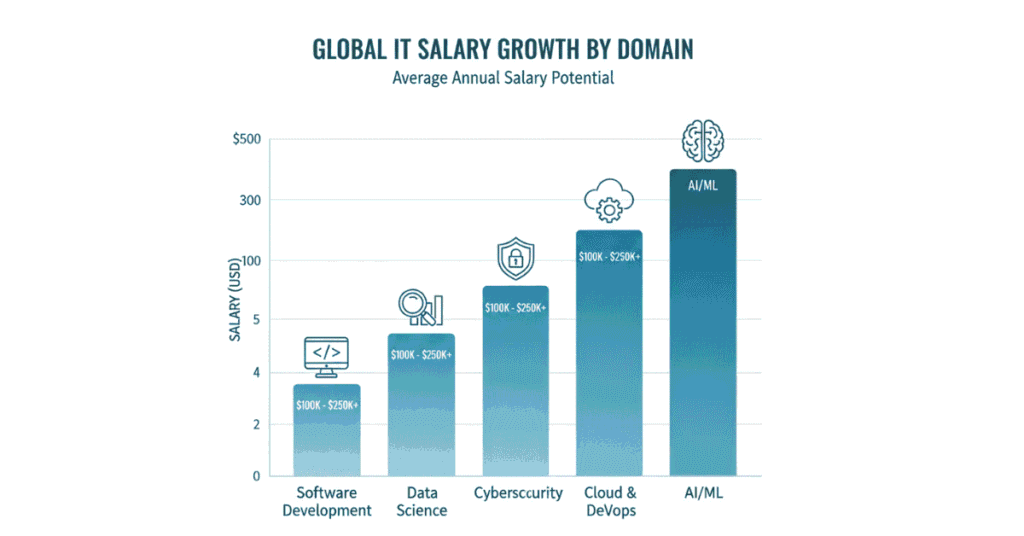
4. Cloud Computing & DevOps: Building Scalable Systems
Cloud architects and DevOps engineers are among the highest-paid IT professionals. Why? Because they solve one of technology’s biggest challenges: how to build systems that scale efficiently.
What You’ll Do:
Cloud architects design and manage cloud infrastructure for organizations. DevOps engineers ensure smooth deployment and operation of applications. You’re essentially building the highways on which applications run.
Why Companies Pay Premium:
Cloud computing is the lifeblood of modern businesses. Every major company is migrating to cloud platforms. The demand is massive; the supply is limited.
Entry-Level Salary: ₹5-9 LPA (DevOps); ₹10-15 LPA (Cloud Architect)
Mid-Level Salary: ₹12-18 LPA (DevOps); ₹18-25 LPA (Cloud Architect)
Senior-Level Salary: ₹18-20 LPA (DevOps); ₹25-30 LPA (Cloud Architect)
Skills You’ll Need:
Expertise with AWS, Azure, or Google Cloud platforms. Understanding of containerization (Docker), orchestration (Kubernetes), infrastructure-as-code, and DevOps tools.
5. Artificial Intelligence & Machine Learning: The Future is Here
AI/ML professionals are reshaping industries. They build systems that learn, adapt, and make intelligent decisions.
What You’ll Do:
You’ll develop algorithms, train models, and deploy AI solutions for real-world problems. From recommendation systems to autonomous vehicles, you’re working on tomorrow’s technology today.
Why This Field is Exploding:
AI is no longer science fiction—it’s mainstream business. Every company is investing in AI. The demand for skilled AI/ML professionals is insatiable.
Entry-Level Salary: ₹8-12 LPA
Mid-Level Salary: ₹15-22 LPA
Senior-Level Salary: ₹25-30 LPA
Skills You’ll Need:
Python, machine learning frameworks (TensorFlow, PyTorch), deep learning knowledge, and mathematics (linear algebra, calculus, statistics).
6. Quality Assurance & Testing: The Quality Guardians
Every software release needs rigorous testing before reaching users. QA professionals ensure quality and catch bugs before customers do.
What You’ll Do:
You’ll create test cases, execute tests, identify bugs, and ensure software meets quality standards. It’s detail-oriented, methodical work.
Why It Matters:
A single bug can cost companies thousands or destroy their reputation. QA professionals are essential gatekeepers.
Entry-Level Salary: ₹3.5-5.5 LPA
Mid-Level Salary: ₹7-10 LPA
Senior-Level Salary: ₹12-15 LPA

7. IT Infrastructure & Network Management
Behind every smooth digital experience are network and infrastructure professionals managing the physical and digital backbone of organizations.
What You’ll Do:
You’ll maintain servers, manage networks, ensure uptime, solve connectivity issues, and manage IT systems. You’re the troubleshooter who keeps everything running smoothly.
Why It’s Steady:
Every organization needs infrastructure support. This role has consistent demand and job security.
Entry-Level Salary: ₹3.5-5 LPA
Mid-Level Salary: ₹7-10 LPA
Senior-Level Salary: ₹12-15 LPA
Skills You’ll Need:
Linux and Windows administration, networking protocols, server management, and troubleshooting expertise.