
IoT in Agriculture: Career Opportunities for Tech Graduates in India
Table of Contents
Introduction
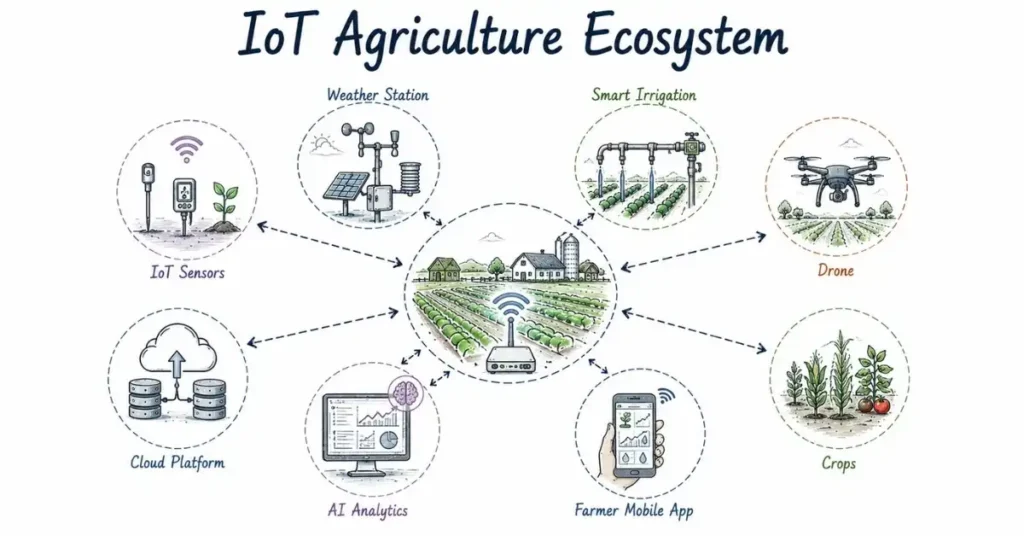
A soil moisture sensor costs roughly ₹800. A microcontroller to read its data costs another ₹400. A SIM card to transmit that data to the cloud costs ₹200 a month. For under ₹1,500, a farmer can know from his phone, at any hour whether his field needs water right now.
That sensor sitting in the ground is not the product. The career is in everything around it.
Someone designed the sensor housing to survive monsoon flooding and summer heat. Someone wrote the firmware that reads the sensor every 15 minutes and transmits it without draining the battery. Someone built the cloud pipeline that receives that data from 10,000 sensors across 500 farms simultaneously. Someone trained the machine learning model that converts raw moisture readings into a plain-language recommendation in Marathi. Someone built the app that displays it on a ₹6,000 Android phone with a 2G connection.
That is five careers. All of them are in IoT in agriculture. All of them are currently understaffed in India.
This guide is specifically for tech graduates Computer Science, Electronics, Instrumentation, IT who want to work in a sector that combines technical challenge with genuine real-world impact.
What IoT in Agriculture Actually Means
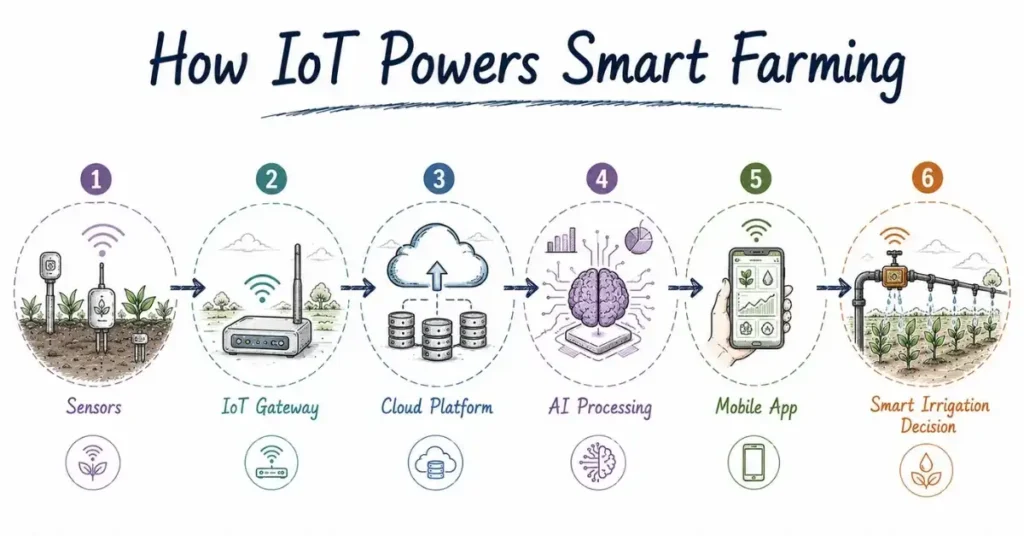
IoT stands for Internet of Things a network of physical devices embedded with sensors, software, and connectivity that collect and exchange data. In agriculture, IoT means deploying these connected devices across farms to monitor, automate, and optimise farming decisions in real time.
The simplest way to understand it: every time a farmer used to walk a field to check on crops, that was a manual data collection exercise. IoT replaces or supplements that walk with continuous, automated, remotely accessible data soil conditions, weather, plant health indicators, water flow rates, livestock vitals transmitted from the field to a platform where it can be analysed and acted upon.
In India specifically, agricultural IoT has three primary application areas driving the most investment and hiring right now:
Precision irrigation: Sensors that monitor soil moisture, weather, and crop water demand to automate irrigation decisions. Companies like Fasal and Mitra are leading this in Maharashtra and Karnataka.
Crop advisory and monitoring: Sensor networks combined with AI models that detect early-stage pest pressure, disease risk, and nutrient deficiency. BharatAgri and Cropin are the most prominent players.
Dairy and livestock monitoring: IoT devices that track animal health, milk yield patterns, and estrus cycles in real time. Stellapps is India’s most advanced player in this space, operating across major dairy cooperatives.
Why Tech Graduates Are in High Demand in Indian AgriTech IoT
Here is the honest supply-demand picture.
India has roughly 1.5 million engineering graduates per year. The overwhelming majority target IT services, product companies, and the startup ecosystem in Bengaluru, Hyderabad, and Pune. A very small fraction consider AgriTech.
Meanwhile, Indian AgriTech IoT companies are scaling fast with venture funding and government contracts and they need the same technical skills as consumer tech companies. But because most tech graduates do not consider AgriTech, these companies consistently struggle to hire.
The result: AgriTech IoT companies often pay comparable salaries to mid-size tech startups, offer faster growth because the team is smaller and your contribution is more visible, and give you technical problems that are genuinely harder than building another e-commerce feature because you are building for intermittent rural connectivity, extreme weather conditions, power-constrained hardware, and users who have never touched a smartphone app before.
If you want technical depth, real-world impact, and a less crowded career path, this is one of the most underrated options available to an Indian tech graduate right now.
IoT Agriculture Career Roles: The Full Breakdown
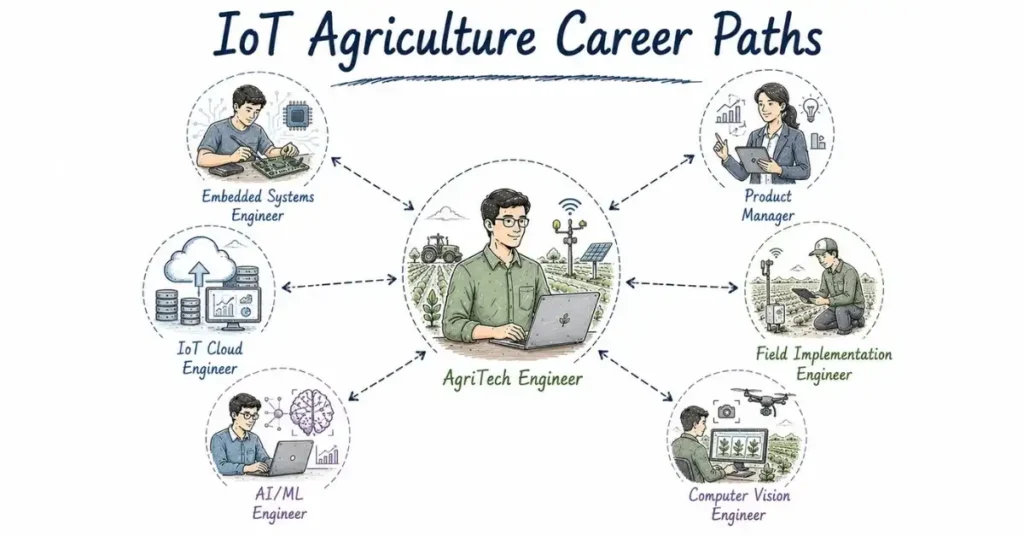
1. Embedded Systems / Firmware Engineer
What you do: You write the software that runs directly on IoT hardware microcontrollers, sensors, communication modules. Your code runs in constrained environments with limited memory, limited power, and no reliable internet connection. You make the hardware work reliably in conditions ranging from 45°C summer heat in Vidarbha to monsoon flooding in Assam.
Day in the life: Debug a firmware issue causing intermittent sensor dropout on a deployed soil monitoring node, write optimised low-power sleep mode logic for a new sensor variant, test data transmission reliability across different cellular network conditions, collaborate with hardware team on a new PCB revision.
Who fits: B.Tech Electronics, Electrical, or CS graduates with C/C++ programming skills and interest in hardware-software interaction. Prior exposure to Arduino, Raspberry Pi, or similar platforms is a strong starting point.
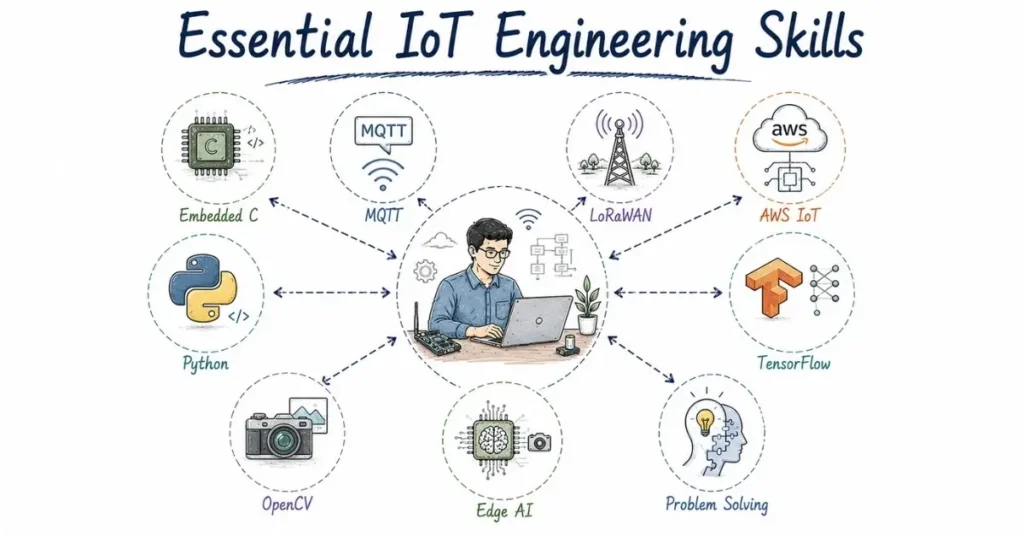
Key skills: C/C++ for embedded systems, RTOS basics, communication protocols (MQTT, LoRaWAN, NB-IoT, GPRS), low-power design principles, basic electronics troubleshooting.
Employers: Fasal (Pune), Stellapps (Bengaluru), Intello Labs (Gurugram), Robert Bosch India (precision agriculture division), Sensegrass, Mitra.
Salary range: ₹4.5 – ₹8 LPA (junior) | ₹10 – ₹18 LPA (senior embedded engineer)
2. IoT Cloud / Backend Engineer
What you do: You build and maintain the cloud infrastructure that receives, stores, and processes data from thousands of field sensors simultaneously. You work on data ingestion pipelines, time-series databases, API development, and real-time processing systems. The scale of this problem is non-trivial a network of 50,000 sensors sending data every 15 minutes generates enormous data volumes that need to be reliably captured and made queryable.
Day in the life: Optimise a slow database query causing latency in the farmer-facing dashboard, implement a new data ingestion endpoint for a new sensor hardware variant, set up automated alerting for sensor nodes that have gone offline, review cloud infrastructure costs and implement storage optimisation.
Who fits: B.Tech CS or IT graduates with backend development experience. Comfort with cloud platforms and database systems is more important than agricultural knowledge at hiring.
Key skills: Python or Node.js backend development, AWS IoT Core or Azure IoT Hub, time-series databases (InfluxDB, TimescaleDB), REST API design, Docker/Kubernetes basics, SQL and NoSQL databases.
Employers: Cropin (Bengaluru), SatSure (Bengaluru), BharatAgri (Pune), Fasal (Pune), Jiva.ag, Dehaat (Patna).
Salary range: ₹5 – ₹9 LPA (junior backend engineer) | ₹12 – ₹22 LPA (senior / lead engineer)
3. AI / ML Engineer Agricultural Applications
What you do: You build the intelligence layer on top of IoT data. Your models answer questions like: Will this field develop a fungal infection in the next five days? What is the optimal irrigation schedule for the next week given forecast rainfall? Which of these 10,000 farms is showing early signs of pest outbreak? The combination of sensor data, satellite imagery, weather data, and historical crop records gives you rich, complex datasets to work with.
Day in the life: Train a binary classification model to detect powdery mildew risk from temperature and humidity sensor readings, evaluate precision-recall tradeoffs to minimise false alarms that frustrate farmers, work with agronomy team to validate model predictions against ground truth observations, deploy updated model to production, monitor prediction accuracy dashboard.
Who fits: B.Tech or M.Tech CS/Data Science graduates with strong Python, machine learning fundamentals, and statistical thinking. Agricultural domain knowledge is genuinely valuable but not a hard requirement at hiring companies provide domain training.
Key skills: Python (scikit-learn, TensorFlow, PyTorch), time-series forecasting, geospatial data processing, model deployment (MLflow, FastAPI), familiarity with agricultural data types (NDVI, weather parameters, soil indices).
Employers: Cropin (most data science-intensive AgriTech company in India), SatSure, Intello Labs, BharatAgri, Microsoft Research India (FarmBeats project), IBM (Agri AI), Jiva.ag.
Salary range: ₹7 – ₹12 LPA (junior ML engineer) | ₹14 – ₹25 LPA (senior / lead ML engineer at funded startups)
4. AgriTech Product Manager
What you do: You own the roadmap for a digital agricultural product a farmer-facing app, a B2B analytics dashboard, an IoT sensor management platform. You are the bridge between what farmers need, what the business requires, and what the engineering team can build. In AgriTech, this role carries additional complexity because your end users farmers have very different digital literacy levels, connectivity constraints, and trust thresholds compared to urban app users.
Day in the life: Analyse in-app behaviour data showing farmers drop off before completing an irrigation schedule setup, conduct phone interviews with 5 farmers to understand where they get confused, write a product requirements document for a simplified onboarding flow, prioritise it against three other features in the sprint backlog, present the quarterly product roadmap to investors.
Who fits: B.Tech graduates with 2–4 years of software development or business analyst experience who want to move into product management. Strong empathy for non-urban users is specifically valuable in this context.
Key skills: User research methods, product roadmap tools (Jira, Notion, Productboard), data analysis (SQL, Mixpanel, Amplitude), wireframing (Figma), agronomy basics enough to evaluate feature feasibility.
Employers: BharatAgri, AgroStar, Cropin, Ninjacart, DeHaat all have dedicated product teams. This is a Bengaluru and Pune-heavy hiring market.
Salary range: ₹10 – ₹16 LPA (associate/junior PM) | ₹18 – ₹30 LPA (senior PM / Group PM)
5. IoT Field Implementation Engineer
What you do: You are the person who actually goes to the farm and makes the technology work. You install sensor networks, configure devices, train farmers to use the app, troubleshoot connectivity issues in areas with weak cellular signals, and serve as the ground-level link between the technology and the people it is meant to serve. This role is often underestimated but it is where the most critical learning in the entire AgriTech sector happens.
Day in the life: Travel to a cluster of 15 farms in Nashik for a drip irrigation IoT system commissioning, install and configure 60 sensor nodes, test data transmission for each node, demonstrate the farmer dashboard app to each farmer in Marathi, document installation details and flag two sites with connectivity issues for the engineering team.
Who fits: B.Tech Electronics, Instrumentation, or CS graduates who are comfortable with field work and rural travel. Regional language fluency is a significant advantage. This role is a fast learning environment that leads to senior technical or product roles within 2–3 years.
Key skills: Basic electronics troubleshooting, mobile app configuration, customer-facing communication, regional language ability, field data collection.
Employers: Fasal, Stellapps, Mitra, Sensegrass, BharatAgri all have dedicated field implementation teams. This is a pan-India hiring track, not concentrated in metros.
Salary range: ₹3.5 – ₹6 LPA (field engineer) | ₹7 – ₹12 LPA (senior field engineer / regional implementation manager)
6. Computer Vision Engineer Agri Applications
What you do: You build systems that analyse images from drones, smartphone cameras, or fixed field cameras to detect plant diseases, assess produce quality, count crop population, or identify pest damage. This is one of the most technically specialised roles in AgriTech IoT and is also one of the highest paying.
Day in the life: Label a new dataset of mango leaf images for disease classification, fine-tune a pre-trained ResNet model on the dataset, evaluate model accuracy on held-out test images, collaborate with drone team on image capture protocol to maximise model performance, test the model on edge hardware for on-device inference.
Who fits: B.Tech / M.Tech CS graduates with strong computer vision and deep learning skills. Portfolio projects involving image classification or object detection are practically mandatory for this role.
Key skills: Python, PyTorch or TensorFlow, OpenCV, image segmentation and classification, edge AI deployment (ONNX, TensorRT), dataset annotation tools.
Employers: Intello Labs (the most focused computer vision AgriTech company in India), Cropin, SatSure, Jain Irrigation (exploring computer vision for irrigation management), and several early-stage startups.
Salary range: ₹8 – ₹14 LPA (junior CV engineer) | ₹16 – ₹28 LPA (senior / lead CV engineer)
The Technical Stack You Need to Know
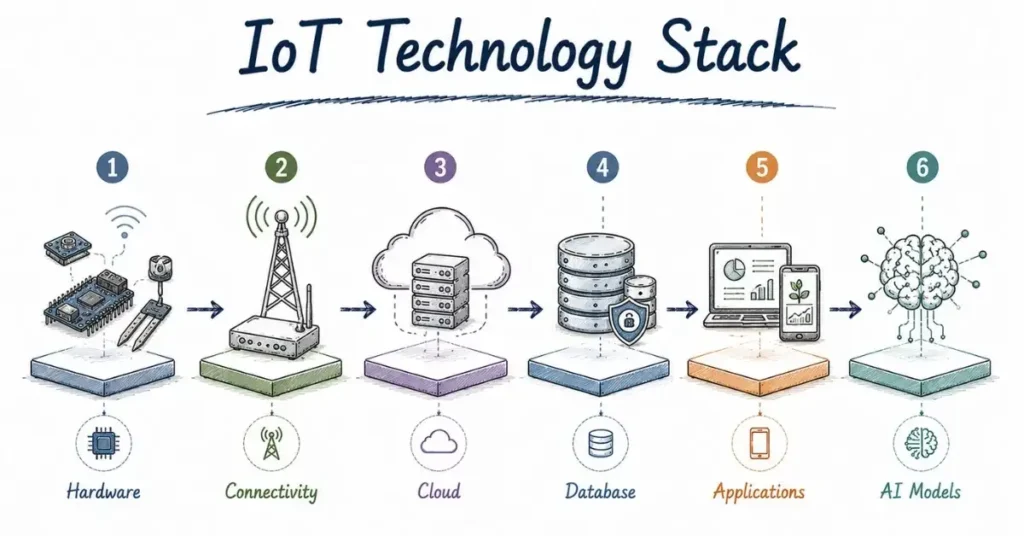
This is the actual technology stack used across Indian AgriTech IoT companies. Use this as a study map:
Hardware layer: Arduino, ESP32, STM32 microcontrollers; soil moisture sensors, temperature/humidity sensors (DHT22, SHT series); LoRa modules, GPRS/NB-IoT modems.
Connectivity layer: LoRaWAN networks (The Things Network in urban/peri-urban areas), GPRS/4G cellular (most deployed rural networks), Wi-Fi (greenhouse and controlled environment applications).
Cloud layer: AWS IoT Core, Azure IoT Hub, Google Cloud IoT (being deprecated most companies migrating to AWS or Azure), MQTT protocol for device-cloud messaging.
Data layer: InfluxDB or TimescaleDB for time-series sensor data, PostgreSQL for relational data, Redis for caching, Apache Kafka for high-throughput data streams at scale.
Application layer: React or Flutter for farmer-facing apps, FastAPI or Django for backend APIs, Grafana for internal sensor monitoring dashboards.
AI/ML layer: Python (scikit-learn, TensorFlow, PyTorch), MLflow for model management, Google Earth Engine for satellite data processing.
You do not need to know all of this. Pick one layer and go deep. The embedded systems engineer and the ML engineer use entirely different stacks specialise before you broaden.
How to Build a Portfolio That Gets You Hired
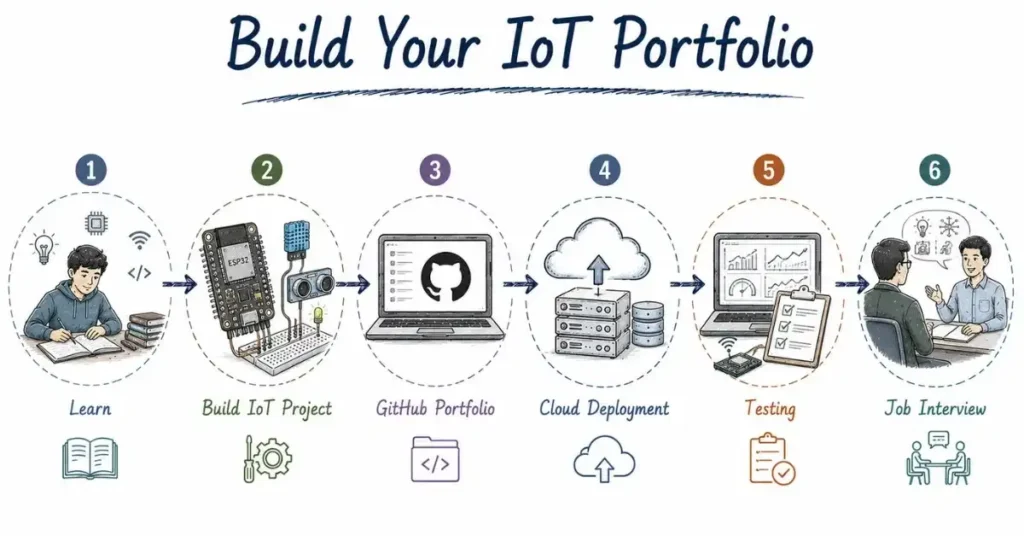
AgriTech IoT companies are practical. They want to see evidence that you can build things, not just that you passed exams. Here is what a strong entry-level portfolio looks like:
For Embedded / IoT Hardware roles:
Build a soil moisture monitoring system using an ESP32, a capacitive soil moisture sensor, and a free MQTT broker. Display readings on a simple web dashboard. Document it on GitHub with a clear README. This project costs under ₹2,000 to build and demonstrates the entire IoT stack in miniature.
For Backend / Cloud roles:
Build a data ingestion API that receives simulated sensor data, stores it in a time-series database, and serves it through a REST endpoint with basic aggregation queries. Deploy it on a free AWS or Azure tier. Document it clearly.
For ML / AI roles:
Find a publicly available plant disease image dataset (PlantVillage on Kaggle is the most used) and build a classification model. Go beyond basic accuracy analyse where the model fails, discuss class imbalance, evaluate it on images from Indian crop conditions if possible. Write it up as a structured project on GitHub or a personal blog.
For Product Management roles:
Do a detailed teardown of an existing AgriTech app BharatAgri, AgroStar, or the eNAM app. Write a 1,000-word product critique covering what works, what does not, and what you would change with one specific proposed feature backed by user reasoning. Publish it on LinkedIn or Medium.
Skills That Make You Stand Out in AgriTech IoT Interviews
Understanding of rural connectivity constraints: Most tech graduates think about building for 4G. AgriTech IoT requires building for 2G, intermittent connectivity, and complete offline scenarios. Candidates who understand this immediately demonstrate sector readiness.
Low-power design awareness: Battery life on a field sensor is not a luxury consideration it is the difference between a product that works and one that requires a farm visit every two weeks to replace batteries. Understanding duty cycling, sleep modes, and energy harvesting signals genuine embedded systems maturity.
Appreciation for the last-mile user: The end beneficiary of your code is a farmer with a class 8 education using a ₹5,000 phone on a 2G connection. Building for this user not for a Bengaluru tech professional requires a genuine mental shift. Demonstrating this awareness in interviews separates you from the majority of applicants.
Salary Growth Path in AgriTech IoT
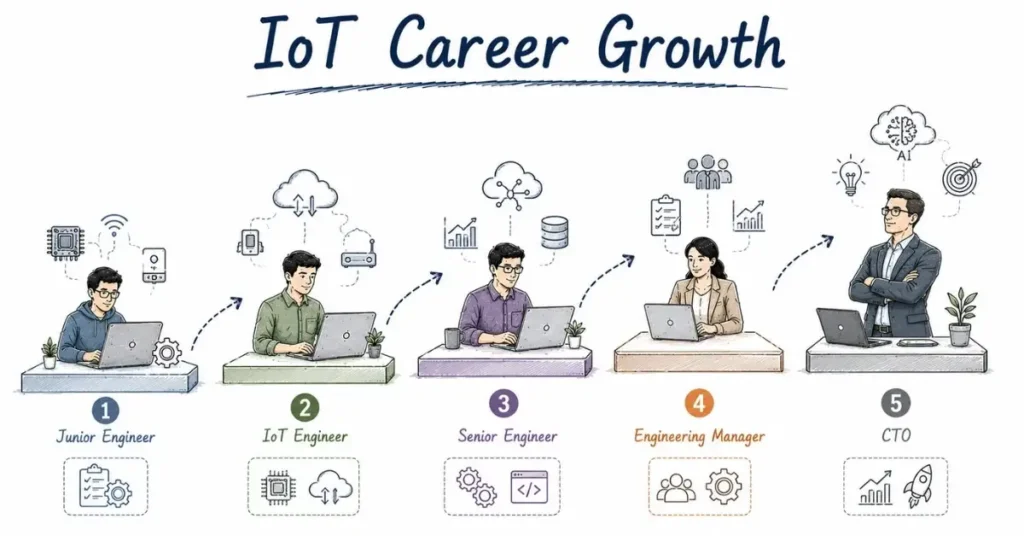
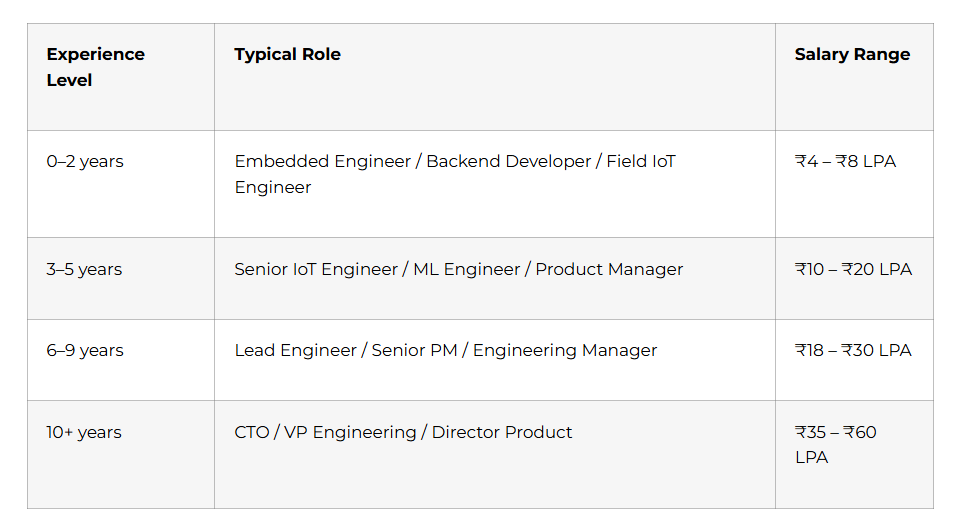
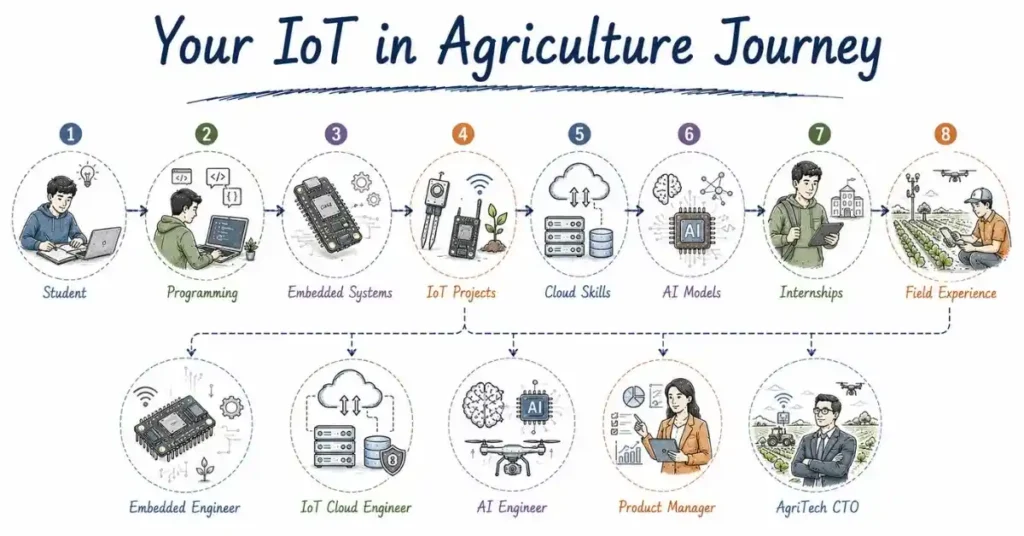
The ceiling in AgriTech IoT is high particularly for people who combine technical depth with genuine sector expertise. CTOs of funded AgriTech companies in India currently command compensation packages comparable to equivalent roles in consumer tech.
One Honest Reality About AgriTech IoT Careers
Building technology for Indian agriculture is harder than building for urban consumers. The failure modes are more severe a bug in an irrigation automation system can destroy a crop. The users have less tolerance for confusing interfaces. The connectivity is less reliable. The hardware operates in harsher conditions.
This difficulty is precisely what makes the work interesting and what makes experienced AgriTech IoT engineers valuable. Every constraint you solve in this sector teaches you something that a career in e-commerce or fintech simply would not.
The sector is also at an early enough stage that people joining now will be the senior engineers and product leaders when it reaches full scale in the next decade. The people who build their AgriTech IoT expertise between 2025 and 2030 will be genuinely difficult to replace.