
Advertising is the way forward in making your business stand out in today’s competitive online market. The most effective way to get customers is via Google Ads. Google Ads is a super powerful medium that enables any business to display its product and service on Google Search and beyond its search engine reach. Whether you are a small startup or an established company, Google Ads can help you get the right audience and drive the right traffic to your site.
This post takes you through a step-by-step procedure in utilizing Google Ads for your business and strategies that would lead to the most successful ad campaign ever. This may be your first time going about online advertising or you may want to improve your already existing campaigns.
1. What is Google Ads and Why Is It Important?
So before digging deeper into how to use Google Ads for your business, let us know what Google Ads is first. Google Ads is the online advertisement space where a business pays its ad to appear in search results from Google or its partner websites and costs it a fee every time that click happened on your ad. The final aim is to attract a visitor who would likely convert to buy something, sign up for a service, fill out a contact form.
Google Ads is important to any business because:
You get real-time visibility within search results.
Pinpoint targeting is available on keyword, location, and demographic.
You can control and measure your budget in real-time.
2. First Steps in Your Google Ads Account
Open your Account. The first step to enjoying Google Ads for your business. Here’s a step-by-step guide to help get you started:
Sign-up in Google Ads: One goes to the Google Ads website. Upon getting there, sign-up on it using your Google Account.
Set your Goal: Google Ads offers a wide range of options in setting specific goals from driving traffic to boosting sales.
Campaign Type: Google Ads has the following types of campaigns; Search, Display, Video, Shopping, and App. For most businesses, a search campaign is an excellent place to start.
Target Audience: Determine whom you want to reach. Click through geographic locations, languages, and audience demographics.
Set a budget: You will define the amount of money you are able to afford per day. Google Ads will not cost you any more than that so you are always in control.
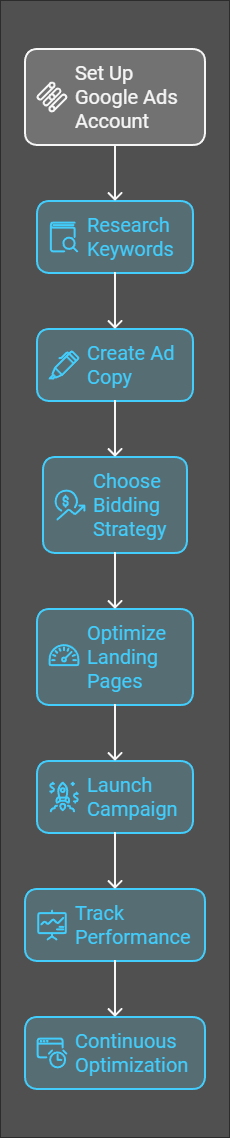
3. Keyword Research: This is the Core of any Campaign
Keyword discovery is one of the most vital components of Google Ads. Keywords are phrases that prospects enter Google to search for a product or a service similar to yours. The idea behind a bid on relevant keywords is making sure your ad is there to show up once the people start searching on those terms.

Keyword Search Strategy
Use keyword planner on Google: with the help of that, you find some relevant keywords and also information about the search volume and competition
Long-tail Keywords: These are phrases very specific to the word such as “buy leather shoes online” which is low in competition but leads to a higher intention, thus prone to converting more than short-tail words
Group Relevant Keywords: It helps you in your ad grouping so that targeting specific keywords will be easily achieved depending on the targeted users.
Determine the right keywords which ensure that your advertisements meet the right people with interests in what you offer
4. Relevant Ad Copy
Next on your road to maximizing Google Ads is writing a compelling ad copy. This is the area that will show what the user is likely to see when the ad will show on the search results page; thus, it should be clear, concise, and interesting.
Key Elements of a Good Ad:
Headline: This is the most visible part of your ad. Thus, it has to grab attention, featuring a primary keyword with clear value proposition.
Description: This section would be on the benefits and features of your product along with a strong call to action. Phrases such as “Buy now,” “Get a free trial,” or “Contact us today” give an impulse for clicks.
Display URL: The display URL should also be the one that the end-users are likely to land up with. Now, if you are running an ad for the sale, then the URL may come to look like something like “www.yoursite.com/sale.”
5. Bidding Strategies: Best ROI
Now that you have your ad copy selected, it’s now the time to set up a bidding strategy. That is basically how much to pay for a click in relation to any click done on any of your business’s ads on your online presence. There are various bidding strategies.
Manual CPC: You let Google know how much you would pay for every click. So, you have more control over what you spend but it does require monitoring.
Enhanced CPC : The search engine automatically adjusts your manual bids according to your conversion potential.
Target CPA (Cost Per Acquisition): Set a target cost for every conversion, and Google will automatically optimize your bids to get the most conversions at or below that cost.
Maximize Clicks: Google will want to get the most clicks within your set budget.
Choose a strategy that achieves the objectives of your campaign whether it’s driving traffic, leads, or maximizing conversions.
6. Landing Pages: Driving Conversions
It has nothing to do with keywords and the strategy one used in their bids. It is where people land when they click your ad. An optimized landing page will ensure that clicks translate into customers.
Best Practices of Landing Pages
Relevance: the landing page should be relevant to the purpose of the ad. That is, if one is advertising a certain product, then users should be sent straight to that product page
Speed: The page loading speed will affect how the users will view it and how it will work in converting. A slow page may make the users lose interest before acting on it.
Clear CTA’s: Your landing page will surely need to have an over-whelming call-to-action for the potential customers. Make them something really active like “Buy Now, sign up or “Quote it”.
7. Success Tractability
Some of the major business benefits through the channel that come from Google ads through a real-time way track and measurability. As much Google reports exactly concerning advertisements, thus bringing them proper insights about advertisements.

Things to Measure.
CTR: It is the number of people who have clicked the ad after seeing it. So, the more the percentage of CTR, it is obvious that your ads are relevant and engaging enough.
Conversion Rate: This translates the percentage of clicks into desired actions, for example, purchase, sign-up.
Quality Score: Google measures every ad based on Quality Score due to and relevance of the landing page with respect to the keywords applied in your ad as well as the actual ad and landing page itself. This means that you will get high-quality which in turn means achieving a low cost-per-click rate, hence also helping your placements
8. Continual Optimization for Maximum Efficiency
After all things are done, launching a campaign is just the tip of the iceberg. Real work now begins. To be able to squeeze every last bit of value out of Google Ads for your business, you’ll have to keep constantly optimizing your campaigns
Testing New Ad Copy: Running A/B tests on headlines, descriptions, and CTAs to see what works best in that particular combination leading toward conversion.
Bid Management: Continue monitoring the strategy so that neither will spend more money or less.
Keywords Optimization: Continue monitoring the keywords; remove the worst from them and replace with an ideal mix of what best contributes toward the best result.
Conclusion:
Using Google Ads for your business is one of the most effective ways to reach your target audience, boost visibility, and drive conversions. By following the steps outlined in this guide from keyword research to ad creation and campaign optimization you’ll be well on your way for creating successful ad campaigns. With continuous monitoring and refinement, Google Ads can be a powerful tool in growing your business and achieving your marketing goals.