
How to Become a School Teacher in India: Complete Guide
Table of Contents
Have you ever imagined yourself standing in front of a classroom, watching students’ eyes light up when they finally understand a difficult concept? That’s the magic of teaching—and it’s a career path that millions of Indians aspire to follow. With India home to over 1.5 million schools and requiring approximately 1.2 million new teachers every year, there’s never been a better time to explore teaching as a profession. But here’s the question everyone asks: how exactly do you become a school teacher in India?
Whether you’ve just finished your graduation, are contemplating a career change, or are a student planning your future, this guide walks you through every single step—from choosing the right degree to landing your first teaching job and eventually becoming a school principal. Let’s break down this rewarding journey into simple, actionable steps that anyone can follow.
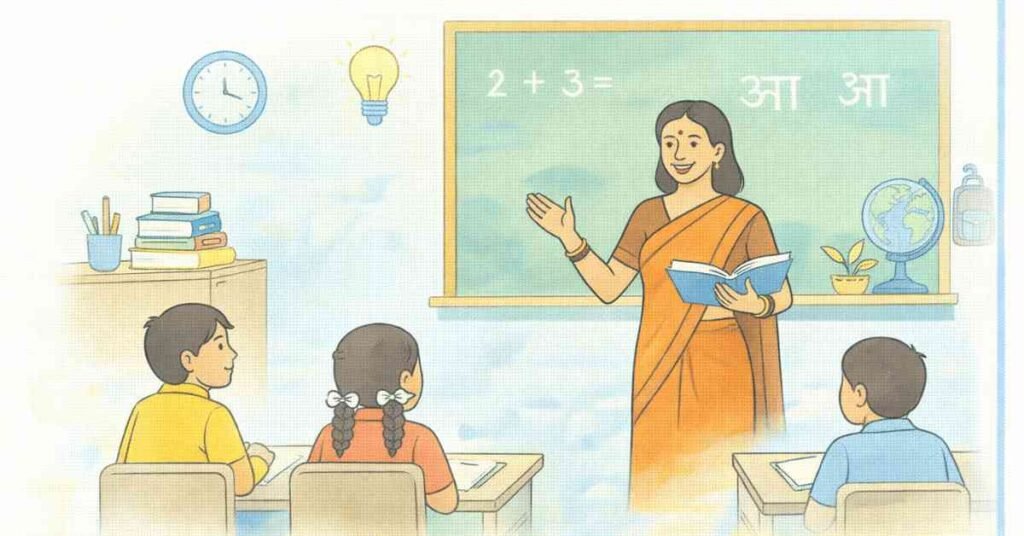
Understanding the Teaching Hierarchy in Schools
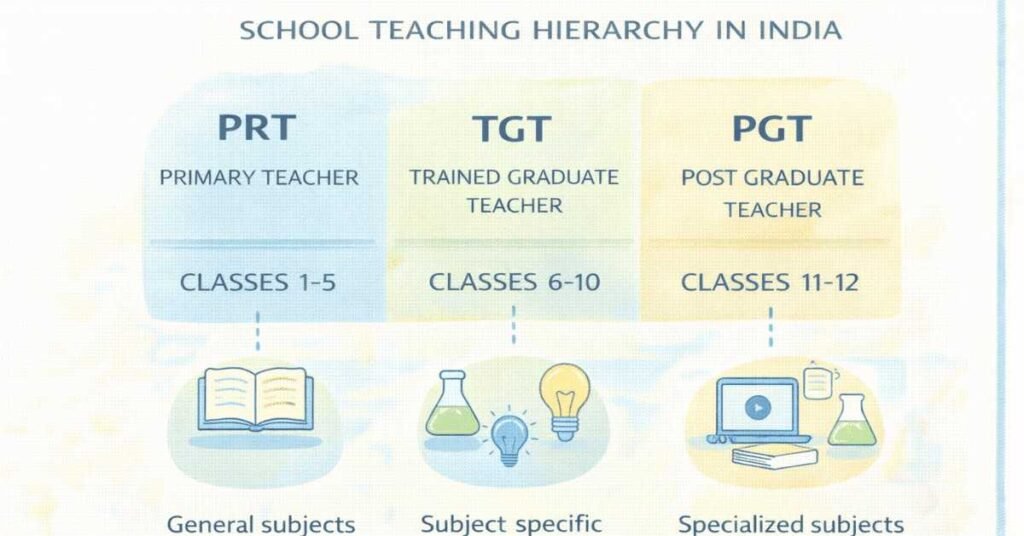
Before diving into qualifications and exams, you need to understand where you want to fit in the school teaching structure. Schools in India have three main teaching levels, each with different requirements and responsibilities:
Primary Teachers (PRT) teach classes 1 to 5, working with young children during their most formative years. You’ll teach all basic subjects—English, Hindi, Mathematics, Environmental Studies—and focus on building foundational skills. These teachers need a Diploma in Elementary Education (D.El.Ed) along with clearing CTET Paper I. Monthly salaries typically range from ₹25,000 to ₹40,000, depending on whether you work in government or private schools.
Trained Graduate Teachers (TGT) handle classes 6 to 10, teaching specific subjects like Mathematics, Science, Social Studies, or Languages. This is where students start developing deeper subject understanding, and you’ll specialize in one or two areas. TGTs need a Bachelor’s degree in their subject, B.Ed certification, and CTET Paper II qualification. The salary range is ₹30,000 to ₹50,000 monthly.
Post Graduate Teachers (PGT) teach senior classes 11 and 12, preparing students for board examinations and competitive entrance tests. You need a Master’s degree in your specialized subject along with B.Ed. Since PGT positions require advanced subject expertise, they command higher salaries of ₹40,000 to ₹60,000 per month. PGTs often guide students toward higher education choices and career planning.
Understanding these distinctions helps you plan your education accordingly. If you want to teach young children, focus on primary education qualifications. If you’re passionate about a specific subject and enjoy teaching teenagers, aim for TGT or PGT positions.
Step 1: Complete Your Graduation (Any Stream)
The teaching profession welcomes graduates from all academic backgrounds—Arts, Science, Commerce, or even Engineering. This diversity actually strengthens education because different perspectives enrich classroom discussions.
Minimum requirements include completing your 10+2 education and then pursuing any Bachelor’s degree with at least 50% marks (45% for SC/ST/OBC categories). For TGT positions, your undergraduate subject matters because you’ll likely teach related subjects. A B.Sc. in Physics graduate typically becomes a science teacher, while a B.A. in English graduate teaches language and literature.
For PGT aspirants, you’ll need to complete post-graduation in your specialized subject. For instance, if you want to teach Economics to Class 11 and 12, pursue M.A. in Economics. Engineering graduates with B.Tech degrees and 55% marks can also enter teaching after B.Ed.
Here’s something many people don’t realize: your graduation subject opens specific teaching doors. Commerce graduates become excellent teachers for Accountancy, Business Studies, and Economics. Arts graduates teach History, Political Science, Geography, and Languages. Science graduates handle Physics, Chemistry, Biology, and Mathematics. Choose your undergraduate degree keeping your teaching interests in mind.
Step 2: Pursue Bachelor of Education (B.Ed) – The Core Requirement
The B.Ed degree is your passport to the teaching profession in India. Think of it as the bridge between knowing your subject and knowing how to teach it effectively. The National Council for Teacher Education (NCTE) mandates B.Ed for teaching positions in all recognized schools.
What is B.Ed? It’s a two-year undergraduate professional degree that trains you in teaching methodologies, educational psychology, classroom management, curriculum development, and assessment techniques. You won’t just learn what to teach, but how to teach in ways that help diverse learners grasp concepts.
B.Ed curriculum covers pedagogical subjects like principles of education and teaching methods, child psychology and development stages, classroom management and discipline strategies, educational technology and digital tools, lesson planning and curriculum design, assessment and evaluation methods, and practical teaching experience through internships. The hands-on teaching practice you get during B.Ed is invaluable—you’ll actually teach real students under supervision, receive feedback, and improve your skills before entering the profession.
Admission process varies by state and institution. Some universities conduct entrance exams like MAH B.Ed CET, APEdCET, TSEdCET, while others offer admission based on graduation marks. India has approximately 8,600+ B.Ed colleges, including 6,400+ private institutions and 400+ government colleges. Top universities offering B.Ed include Delhi University, IGNOU, Amity University, Jamia Millia Islamia, Banaras Hindu University, and Osmania University.
B.Ed fees differ significantly between government and private colleges. Government institutions charge ₹10,000 to ₹50,000 for the entire two-year program, while private colleges range from ₹50,000 to ₹2 lakhs. In cities like Hyderabad, reputable institutions like Osmania University, MANUU, and EFLU offer quality B.Ed programs.
Alternative integrated programs like B.A. B.Ed, B.Sc. B.Ed, or B.Com B.Ed combine undergraduate and teaching degrees into four-year programs. These are excellent options if you decide on teaching early in your academic journey, saving you a year compared to separate degrees.
Step 3: Clear the Teacher Eligibility Test (TET)
Completing B.Ed alone doesn’t qualify you for teaching jobs—you must clear the Teacher Eligibility Test. This exam ensures only competent candidates enter the teaching profession.
Two types of TET exist: CTET (Central Teacher Eligibility Test) conducted by CBSE for central government schools like Kendriya Vidyalayas, Navodaya Vidyalayas, and Tibetan schools across India. State TETs conducted by individual states for government schools within that specific state. Many private schools also prefer TET-qualified teachers.
Which should you take? If you’re open to teaching anywhere in India in central schools, take CTET. If you want government teaching jobs in a specific state, take that state’s TET. You can take both exams—there’s no restriction. CTET qualification is now valid for a lifetime (previously it was seven years), making it an excellent investment.
CTET has two papers: Paper I for candidates wanting to teach Classes 1-5 (primary level), covering Child Development & Pedagogy, Language I & II, Mathematics, and Environmental Studies—150 questions for 150 marks. Paper II for those teaching Classes 6-8 (upper primary level), covering Child Development & Pedagogy, Language I & II, and either Mathematics & Science or Social Studies—150 questions for 150 marks.
You can appear for both papers in the same exam session. Each paper is 2.5 hours long with multiple-choice questions. The passing marks are 60% (90 out of 150) for general category candidates, and 55% for reserved categories.
Key preparation tips include understanding the exam pattern thoroughly, focusing on child psychology and pedagogy sections (common to both papers), practicing previous years’ question papers, strengthening your chosen subject area, and improving time management since you have just 1 minute per question. Several online platforms and coaching institutes offer CTET preparation courses, but self-study with good reference books is equally effective.
Understanding the Complete Qualification Journey
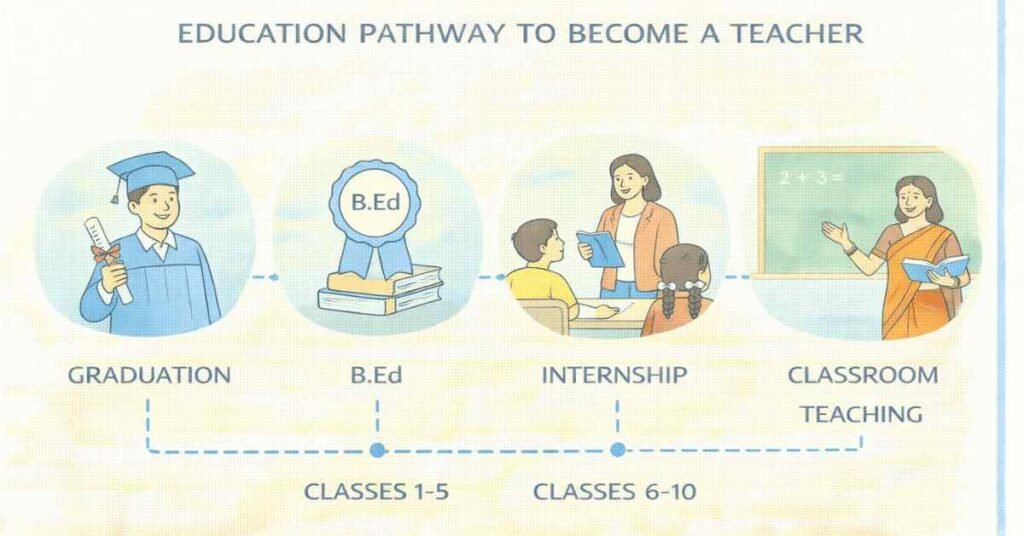
Let me consolidate the timeline so you can plan your career path:
Years 1-3: Complete your Bachelor’s degree in any subject (Arts/Science/Commerce/Engineering) with at least 50% marks.
Years 4-5: Pursue 2-year B.Ed program from an NCTE-recognized institution, including practical teaching internships.
During or after B.Ed: Clear CTET or State TET examination—you can attempt this exam multiple times until you pass.
Year 6 onwards: Apply for teaching positions in government or private schools based on your qualifications.
For PGT positions, add 2 years for Master’s degree, which you can complete either before or after B.Ed. The entire journey from 10+2 to becoming a fully qualified teacher takes approximately 7-9 years.
Government Teacher vs Private School Teacher: Which Path to Choose?
Once you’re qualified with B.Ed and TET, you face an important decision: government schools or private schools ? Both have distinct advantages and challenges.
Government School Teaching offers remarkable job security with permanent positions after probation period, structured salary under 7th Pay Commission with regular increments, pension benefits after retirement, and additional allowances like HRA, DA, and TA. The average government teacher salary is ₹4.5 lakhs per annum, with experienced teachers earning ₹12-15 lakhs annually. During the probationary period, you receive ₹7,300 per month initially.
For primary teachers, basic pay ranges from ₹9,500 to ₹38,800 with grade pay of ₹5,200, plus 12% Dearness Allowance and ₹3,500 HRA. Upper primary teachers get basic pay between ₹10,300 and ₹44,200 with grade pay of ₹5,600. High school teachers earn approximately ₹3.10 lakhs annually, while secondary teachers get ₹3.08 lakhs.
Getting government teaching jobs requires clearing competitive exams beyond TET, waiting for vacancy notifications (which can take months or years), going through multiple selection rounds including interviews and document verification, and sometimes political or regional factors influencing recruitment. Once you’re in, however, the job stability is unmatched.
Private School Teaching provides better starting salaries in many cases (₹2.80 lakhs average, but premium schools pay much more), faster hiring processes with multiple opportunities throughout the year, modern infrastructure with smart boards and digital tools, and exposure to innovative teaching methods. Private schools often have better student discipline and parental involvement.
The challenges include less job security (contracts can be terminated), no pension benefits, and higher performance pressure linked to student results. However, top private schools, especially CBSE and international boards, offer excellent career growth and professional development opportunities.
Which should you choose? If long-term security, pension, and work-life balance matter most, target government positions. If you prefer dynamic environments, better infrastructure, and don’t mind performance pressure, private schools are excellent. Many teachers start in private schools to gain experience and then transition to government jobs when opportunities arise.
Career Progression: From Teacher to Principal
Teaching isn’t a dead-end career—multiple growth paths exist. Understanding progression options helps you plan long-term.
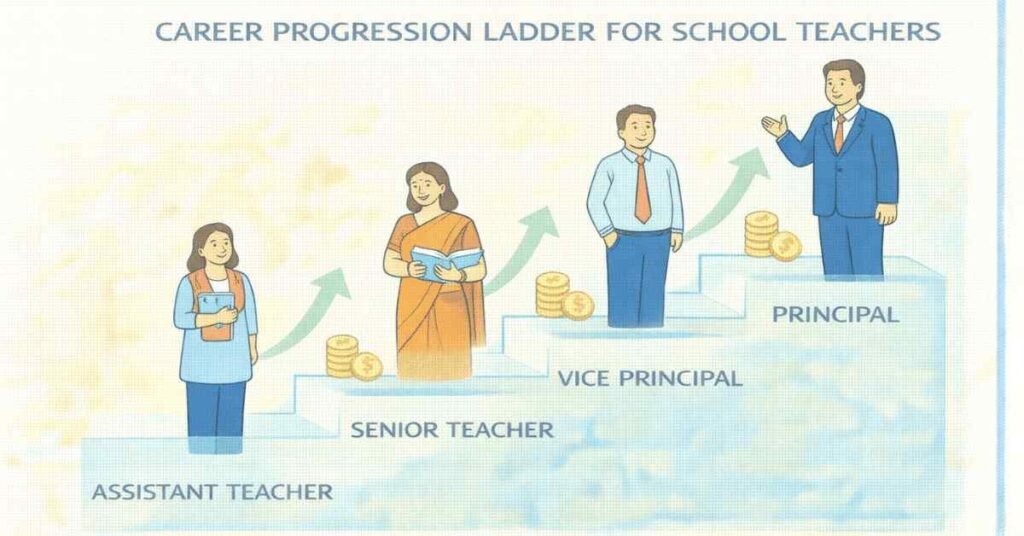
The typical journey: Start as Assistant Teacher or TGT handling regular classes and building teaching skills (Years 1-5). Progress to Senior Teacher with additional responsibilities like mentoring new teachers and leading subject departments (Years 6-10). Move to Department Head or Coordinator roles managing entire subject departments and coordinating curriculum (Years 10-15). Then become Vice Principal or Academic Coordinator assisting in school administration and policy implementation (Years 15-20). Finally reach Principal position leading the entire school, managing staff, budgets, and strategic planning (Years 20+).
Becoming a principal requires 10-15 years of teaching experience demonstrating leadership capabilities, an M.Ed degree or educational leadership certification, proven track record in improving student outcomes, and strong administrative and management skills. Some institutions now prefer principals with MBA in Educational Management alongside teaching qualifications.
Principal salaries are significantly higher: government school principals earn ₹6-10 lakhs annually, private CBSE school principals get ₹8-14 lakhs annually, and international school principals (IB/IGCSE) command ₹15-24 lakhs annually. In metropolitan cities, top institution principals earn even more.
The journey from teacher to principal typically takes 10-15 years of dedicated work, continuous learning, and demonstrating leadership. Some schools offer fast-track leadership programs where exceptional teachers can accelerate this timeline to 8-10 years.
Salary Expectations: What Can You Realistically Earn?
Let’s talk numbers because financial viability matters when choosing careers.
Starting salaries for freshers: PRT (Primary Teachers) earn ₹25,000-₹40,000 monthly. TGT (Trained Graduate Teachers) get ₹30,000-₹50,000 monthly. PGT (Post Graduate Teachers) command ₹40,000-₹60,000 monthly.
Government vs private sector: Government institutions pay an average of ₹3.15 lakhs annually, while private institutions pay ₹2.80 lakhs on average. However, this gap narrows in premium private schools, which often pay more than government scales initially.
Subject-wise differences: Science and Mathematics teachers typically earn 10-15% more than humanities teachers due to higher demand and subject complexity. English language teachers are also in high demand with competitive salaries.
Experience-based growth: With 5 years of experience, your salary increases by approximately 40-50%. With 10 years, you’re earning 80-100% more than starting salary. Senior teachers with 15+ years earn ₹50,000-₹80,000 monthly in good institutions.
Additional income sources: Many teachers supplement their primary income through private tuitions (₹10,000-₹40,000 monthly extra), online teaching platforms, content creation for EdTech companies, and exam paper setting. These side activities can potentially double your take-home income.
While teaching may not match corporate starting salaries initially, the steady growth, job security, pension benefits (in government jobs), and additional income opportunities make it financially viable. More importantly, the non-monetary rewards—student gratitude, social respect, and work-life balance—add tremendous value to this profession.
Skills That Make Successful Teachers
Having the right qualifications gets you the job, but possessing these skills makes you excel:
Communication mastery means explaining complex concepts in simple language, adapting your communication style to different learners, and listening actively to student questions and concerns. Great teachers can explain the same concept five different ways until every student understands.
Patience and empathy help you handle students with different learning speeds, manage classroom disruptions calmly, and understand students’ personal challenges affecting their performance. Remember, you’re teaching children, not machines.
Classroom management involves maintaining discipline without being authoritarian, creating inclusive environments where all students feel safe to participate, and handling conflicts between students diplomatically. This skill develops with experience but consciously working on it accelerates growth.
Subject expertise goes beyond textbook knowledge to include real-world applications of concepts, staying updated with latest developments in your field, and answering unexpected student questions confidently. Deep subject knowledge builds student respect and trust.
Technology proficiency is increasingly essential with using educational apps and online platforms, creating engaging digital presentations, managing online classes effectively, and incorporating educational videos and interactive content. The COVID-19 pandemic proved that tech-savvy teachers adapted better to changing education scenarios.
Adaptability and continuous learning mean embracing new teaching methods and curricula, learning from feedback without taking it personally, and pursuing professional development opportunities regularly. Education evolves constantly, and teachers must evolve with it.
Common Challenges and How to Handle Them
Being realistic about challenges helps you prepare mentally:
Lower starting salaries compared to corporate jobs can be discouraging initially. Remember that teaching offers steady progression, job security, and multiple income streams through tuitions. View the first 3-5 years as skill-building phase rather than peak earning phase.
Workload beyond classroom includes lesson planning, assignment corrections, parent meetings, and extra-curricular activities. Developing efficient systems for routine tasks and learning to say no to excessive additional responsibilities helps maintain work-life balance.
Dealing with difficult students or parents tests your patience and professionalism. Developing emotional intelligence, seeking mentor guidance, and maintaining professional boundaries helps navigate these situations.
Keeping students engaged in an age of smartphones and short attention spans requires creativity. Incorporating storytelling, real-world examples, interactive activities, and technology makes learning more engaging.
Staying motivated through repetitive academic years can be challenging. Connecting with other passionate teachers, celebrating small student victories, and remembering why you chose teaching keeps your enthusiasm alive.
Taking the First Step: Your Action Plan
Ready to begin your teaching journey? Here’s your immediate action plan:
If you’re still in graduation: Focus on scoring at least 50% marks, start researching B.Ed colleges in your preferred locations, consider integrated B.A. B.Ed or B.Sc. B.Ed programs if you have 2-3 years of graduation remaining, and gain informal teaching experience through tutoring to confirm your interest.
If you’ve completed graduation: Identify NCTE-approved B.Ed colleges using the official NCTE website, prepare for B.Ed entrance exams if required in your state, apply to 5-6 colleges to maximize admission chances, and arrange finances (₹10,000-₹2 lakhs depending on college type).
If you’re pursuing or completed B.Ed: Register for the next CTET examination through the official CBSE website, download previous years’ question papers and start preparation, join online study groups or coaching if needed, and start applying for teaching positions even before results (many schools hire provisionally).
If you’re TET-qualified: Create a professional teaching resume highlighting your qualifications, practical teaching experience, and skills, register on job portals like Naukri, Indeed, and teaching-specific sites, directly approach schools with your resume during their hiring seasons (typically March-June), and network with teachers in your target schools for referrals.

Why Teaching Remains a Noble and Viable Career
Despite challenges, teaching remains one of the most fulfilling professions. India needs 1.2 million new teachers annually to meet its growing educational demands—that’s your opportunity. Over 70% of existing teachers are approaching retirement age in the next decade, creating massive vacancies.
The respect teachers command in Indian society is unmatched. Parents trust you with their children’s futures. Students remember great teachers decades after leaving school. The impact you create lasts for generations.
With structured qualifications (B.Ed + TET), dedication to continuous improvement, and genuine passion for helping students learn, you can build a secure, respectable, and deeply satisfying teaching career. The journey from standing nervously in your first classroom to becoming a confident educator shaping hundreds of lives is challenging but extraordinarily rewarding.
Your teaching journey begins with a single decision: to pursue B.Ed and commit to this noble profession. India’s students are waiting for teachers like you.