
How to Become a College Professor in India: Step-by-Step Career Roadmap
Table of Contents

Standing in front of university students, conducting cutting-edge research, publishing discoveries in prestigious journals, leading a department, and shaping the intellectual future of an entire nation—this is the college professor’s reality. If this vision resonates with you, you’re asking the right question: what’s the actual path from where you are now to becoming a tenured professor in an Indian university ?
Unlike school teaching, where B.Ed and a state exam suffice, becoming a college professor requires a specific, structured journey spanning typically 10-15 years. This roadmap walks you through every single step—from your current qualifications through doctorate, postdoctoral research, assistant professorship, and eventual promotion to full professor. The path is clear, demanding, but absolutely achievable for anyone willing to invest the time and effort.
Part 1: Understanding the Indian Academic Hierarchy
Before planning your journey, you must understand where you’re headed.
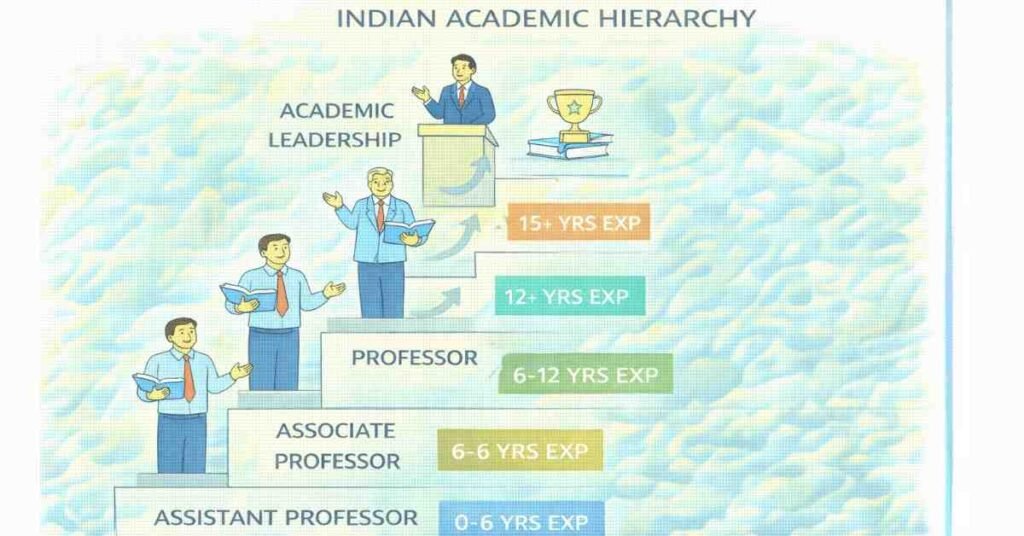
The Academic Ranks Explained
Assistant Professor (Entry Level): This is where virtually every academic career begins. After qualifying through UGC NET or PhD exemption, you enter as Assistant Professor with responsibility for teaching, research, and institutional service. Your salary starts at ₹57,700 basic pay, growing to approximately ₹75,000-₹80,000 with allowances. This position typically lasts 4-6 years before promotion eligibility.
Associate Professor (Mid-Career Leadership): Achieved after approximately 8-10 years of service with demonstrated research excellence, this rank marks transition from junior to senior academia. Your teaching load decreases, research expectations increase, and you begin mentoring junior faculty. Salary rises to ₹77,000-₹85,000 basic pay, grossing ₹1,00,000-₹1,15,000 monthly.
Professor (Senior Leadership): Typically reached after 15-20+ years with extensive publications, multiple PhD supervisions, and recognized scholarly contributions, the Professor rank positions you as an institutional leader. You chair departments, lead research initiatives, and shape university policies. Basic pay reaches ₹90,000-₹1,10,000, with gross salary ₹1,20,000-₹1,50,000+ monthly.
Distinguished Positions: Senior Professors, Emeritus Professors, Department Heads, Deans, and eventually Vice-Chancellor represent the institutional leadership tier. These positions bring prestige, significant salary increases to ₹1,50,000-₹3,00,000+, and influence over educational policy across institutions or states.
Understanding this hierarchy helps you set realistic milestones. You’re not aiming for immediate Professor status; you’re planning a decades-long career with clear progression steps.
Government vs Private Universities: A Critical Choice
Your career destination matters as much as your qualifications. Government universities offer
- Permanent tenure and job security after probation
- Fixed salary scales with guaranteed increments
- Pension and retirement benefits
- Research funding through government schemes
- More rigorous hiring standards
Private universities typically provide:
- Competitive starting salaries (often higher than government)
- Modern infrastructure and resources
- Flexible work environment and rapid career progression
- Performance-based incentives
- Less job security and no pension
Most aspiring professors target government universities for long-term stability, though prestigious private institutions (BITS Pilani, ISB, Ashoka University) offer equally compelling careers. Your choice depends on whether you prioritize security or dynamism.
Part 2: Educational Foundation—Building Your Credentials
Your college professor journey begins with education choices made today.
Bachelor's Degree: The Starting Point
in this area throughout your career. A B.Sc. graduate becomes a science professor, B.A. graduate becomes a humanities professor, B.Com. graduate becomes a commerce professor.
Key considerations:
- Score at least 55-60% in your Bachelor’s degree
- Choose a subject genuinely fascinating to you—you’ll spend 30+ years with it
- Engage in research projects even as an undergraduate
- Publish small papers or present at college seminars
- Develop strong foundational concepts rather than surface-level knowledge
Undergraduate excellence matters because it directly influences Master’s admissions and scholarship opportunities.

Master's Degree: Deepening Expertise
This is where serious academic training begins. Master’s programs prepare you for research-level thinking required in academia.
What to focus on:
- Secure admission to reputed universities known for research
- Score 60%+ marks to qualify for UGC NET later
- Select your Master’s thesis topic based on genuine research interest
- Publish your Master’s thesis work (many universities encourage this)
- Build relationships with professors—they become mentors, collaborators, and recommendation writers
- Attend national seminars and conferences in your field
Your Master’s performance directly determines PhD admission prospects at top universities. Universities prioritize candidates with proven research aptitude demonstrated through strong grades and early publications.
Part 3: The Critical Gateway—UGC NET or PhD
This is the turning point where your professor aspirations become concrete.
Understanding Your Two Paths
Path A: UGC NET First, Then PhD
Many successful academics follow this route: qualify for Assistant Professor through UGC NET, work 3-4 years in academic environment, then pursue PhD part-time or on sabbatical. This approach provides financial security while building academic experience.
Steps:
- Clear UGC NET exam (discussed extensively in Blog Post #3)
- Secure Assistant Professor appointment
- Teach, establish research programs, publish initial papers
- After 3-4 years, pursue PhD part-time or apply for study leave
Advantages: Financial security, teaching experience before PhD, clearer research direction informed by classroom experience
Disadvantages: Balancing PhD with full-time teaching is demanding, may delay professor-level positions
Path B: PhD First, Then UGC NET for Assistant Professor
This is the accelerated track: pursue PhD immediately after Master’s, then secure Assistant Professor position with doctoral credentials.
Steps:
- Apply to PhD programs at top universities (IIT, DU, JNU, IISER, etc.)
- Pursue 3-5 year PhD with focused research
- Publish dissertation research in peer-reviewed journals
- Qualify for Assistant Professor through UGC NET (or exempt due to PhD)
- Secure senior-level academic position due to PhD credentials
Advantages: Faster career progression, senior-level positions as Assistant Professor, established research record
Disadvantages: Financial strain during PhD (unless fellowship funded), no teaching experience before academics, 5+ years without income
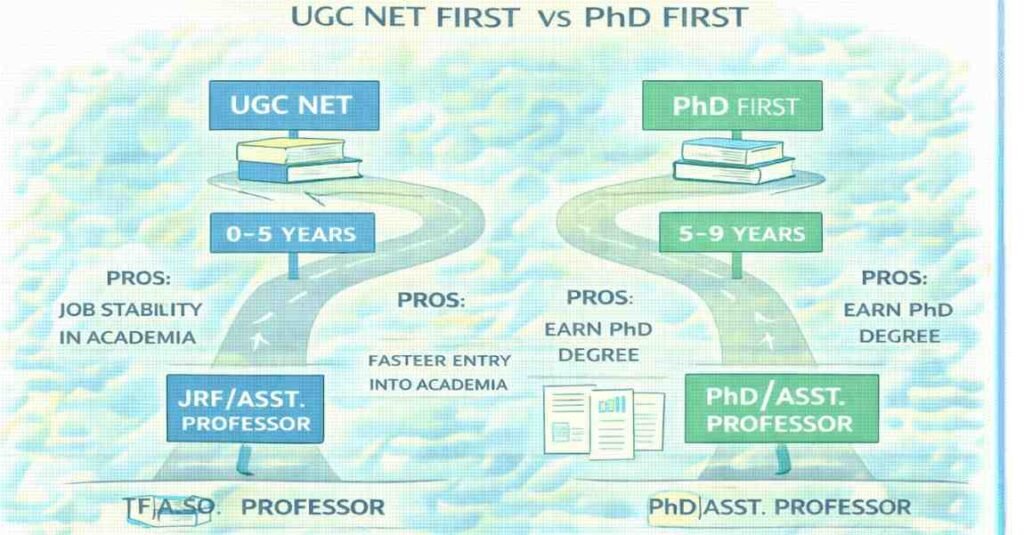
Making the Choice
If you’re under 30 with research passion and financial ability, pursue PhD first—you’ll reach senior positions faster. If you’re older, have financial responsibilities, or want teaching experience first, do UGC NET then PhD part-time.
Research shows that professors with both early teaching experience and research credentials often become better educators and mentors than those with pure research backgrounds.
Part 4: The PhD Journey—Building Your Research Identity
Whether pursuing PhD immediately or after UGC NET, this degree is non-negotiable for professor positions.
Choosing Your PhD University and Guide
University selection matters enormously:
Tier 1 institutions (IIT, Delhi University, JNU, IISc, IISER) have established research programs, better funding, publication visibility, and faculty with national/international recognition. PhD from these institutions opens higher-level career opportunities.
Tier 2 universities (state universities, reputable private institutions) offer decent research environments, though with less funding and visibility.
Tier 3 universities may lack research infrastructure, limited publication support, and weaker faculty networks.
Guide selection is equally crucial:
Your PhD guide (advisor) fundamentally shapes your academic career. A guide who publishes actively, secures research funding, collaborates nationally/internationally, and genuinely mentors students accelerates your development. Conversely, a guide who doesn’t publish or has minimal research activity can stall your progress.
How to choose: Research potential guides’ publication records, talk to their current/former PhD students, assess their research funding history, understand their mentoring philosophy.
The PhD Research Process
Years 1-2: Foundation Phase
- Complete coursework—typically 4-6 semester-long courses on research methods, advanced topics, and seminars
- Conduct literature review identifying research gaps
- Finalize research topic with your guide
- Present research proposal to department committee
- Begin preliminary experiments or data collection
Years 2-3: Main Research Phase
- Execute primary research—conduct experiments, collect data, or gather material depending on your discipline
- Present research findings at internal seminars and department colloquia
- Submit draft chapters to your guide for feedback
- Begin writing first research paper for journal submission
- If possible, present findings at national/international conferences
Years 3-4: Publication and Completion Phase
- Publish 2-3 research papers in peer-reviewed journals
- Complete full dissertation write-up
- Submit dissertation for examination by internal and external examiners
- Defend dissertation in viva voce examination
- Incorporate examiner feedback and finalize thesis
Year 5 (if applicable): Advanced Research
- Conduct follow-up research or replicate findings
- Publish additional papers from dissertation work
- Establish yourself as emerging researcher in your field
Publications: Your Academic Currency
Here’s what nobody explicitly states during PhD: your career trajectory post-doctorate depends almost entirely on your publication record.
For becoming Associate Professor, universities expect:
- Minimum 10 peer-reviewed journal publications
- At least 5 of these should be in reputed journals
- Successfully supervised 1-2 PhD students
- Completed 1-2 externally funded research projects
- Presented papers at national/international conferences
Types of publications that matter:
Research papers in peer-reviewed journals carry the highest weight. Book chapters are valuable but secondary. Conference proceedings help but don’t substitute for journal publications. Textbooks are appreciated but cannot be your only publication type
The challenge: Getting published takes time. Your first paper submission typically gets rejected—this is absolutely normal. After revisions (often 6-12 months later), it might be accepted. A reasonable timeline is publishing 1-2 papers yearly, meaning 10 publications require 5-10 years.
This is why many professors combine teaching (UGC NET track) with research—it provides employment while building publication record.
Part 5: Postdoctoral Research—The Stepping Stone
Many academics spend 1-3 years as Postdoctoral Researchers before securing permanent positions
What is a Postdoc?
A postdoctoral position is a temporary appointment (typically 2-3 years) where you conduct research, mentor junior researchers, and usually teach one course. Postdocs work in university departments, research institutes (like IISER, IIT, or national labs), or sometimes industry research centers.
Why do postdocs?
- Build additional publications strengthening your CV
- Gain experience in different research environments
- Expand your research network across institutions
- Develop teaching experience (many postdocs teach one course)
- Allow time for permanent position applications
Finding postdocs: Check university websites, research institute announcements, funding agency listings, and faculty recommendations. Some postdocs are advertised; many arise through networking with established professors.
Postdoc salaries: Typically range from ₹30,000 to ₹60,000 monthly depending on funding source. Government-funded postdocs through SERB, DST, or DBT offer better compensation. Private institution postdocs vary widely.
Part 6: Securing Your First Permanent Position
After PhD (or PhD + postdoc), you’re ready for Assistant Professor positions.
How Universities Hire Assistant Professors
Government universities:
Typically follow these steps:
- Department identifies need for faculty position
- University advertises in employment news and official websites
- Candidates apply with detailed CV including publications
- Department shortlists candidates (usually 5-10 from 50-100 applicants)
- Shortlisted candidates present research seminar to faculty
- Research committee rates candidates based on seminar and publications
- Top 3-4 candidates face interviews
- Selection committee makes final choice
- Selected candidate gets appointment letter
Timeline: Usually 4-8 months from advertisement to appointment
Private universities:
Process is typically faster but less standardized:
- Department directly recruits or uses consultants
- Interviews and negotiation happen relatively quickly
- Offer made within 2-4 weeks
Joining can happen within 1-2 months
Competitive Advantages When Applying
Universities prefer candidates with:
- Strong publication record (10+ peer-reviewed papers minimum)
- Interdisciplinary research that brings funding potential
- Teaching experience even if limited
- Research collaboration with recognized faculty (shows networking)
- Funded project experience even if as junior researcher
- Conference presentations at national/international forums
- Grant writing experience seeking research funding
The most competitive candidates have all these elements.
Part 7: Your First Years as Assistant Professor
Now you’re officially an academic.
Probation Period
Most government universities have 2-year probation. During this period:
- You must perform teaching duties excellently
- Continuing research is expected, not optional
- You should publish at least one paper yearly
- Departmental committee reviews your performance annually
- Poor performance can theoretically lead to termination (rare but possible)
Private universities often have less formal probation but performance pressure is higher
Typical Assistant Professor Responsibilities
Teaching: 12-18 hours weekly classroom teaching across 2-3 courses. You prepare lectures, assignments, exams, and grade student work.
Research: Establish your independent research program, secure research funding, supervise project students. This typically occupies 10-15 hours weekly initially.
Mentoring: Guide project students, thesis students, and junior colleagues. This becomes major responsibility as you progress.
Administration: Committee work, curriculum design, departmental meetings, student counseling. Budget 5-10 hours weekly.
Many Assistant Professors work 50-60 hours weekly, especially in early years.
Building Your Research Program
our research trajectory post-appointment matters tremendously for promotion:
Year 1-2: Establish research lab (even if just desk space), recruit first project students, finalize research projects.
Year 2-3: Secure first external research grant from agencies like SERB, DST, or ICMR. Start publishing from your independent research.
Year 3-5: Expand research team, achieve 4-5 publications from your independent work, guide your first PhD student.
Research funding is crucial—universities judge you by funding secured, students supervised, and publications achieved.

Part 8: Promotion to Associate Professor and Beyond
After approximately 8-10 years as Assistant Professor with strong performance, you become eligible for promotion to Associate Professor.
Promotion Requirements
Government universities typically require:
- Minimum 10 peer-reviewed journal publications
- At least 2 successfully completed PhD supervisions
- Research funding of ₹5-10 lakhs (varies by university and field)
- Excellent teaching evaluations
- Departmental committee recommendation
- External reviewer assessment of research
Private universities have similar expectations but more flexibility
Associate Professor to Professor
This jump typically requires 15-20+ years of service with:
- 20+ peer-reviewed publications with citations
- 4-5 successfully supervised PhDs
- Major research grants (₹15-50 lakhs+)
- Editorship or significant service in academic organizations
- National/international recognition in your field
Full Professorship is no longer automatic—it requires documented excellence.