
Group Discussion Self-Introduction: Make Your Mark in GDs

Table of Contents
Why Group Discussion Introductions Are Completely Different
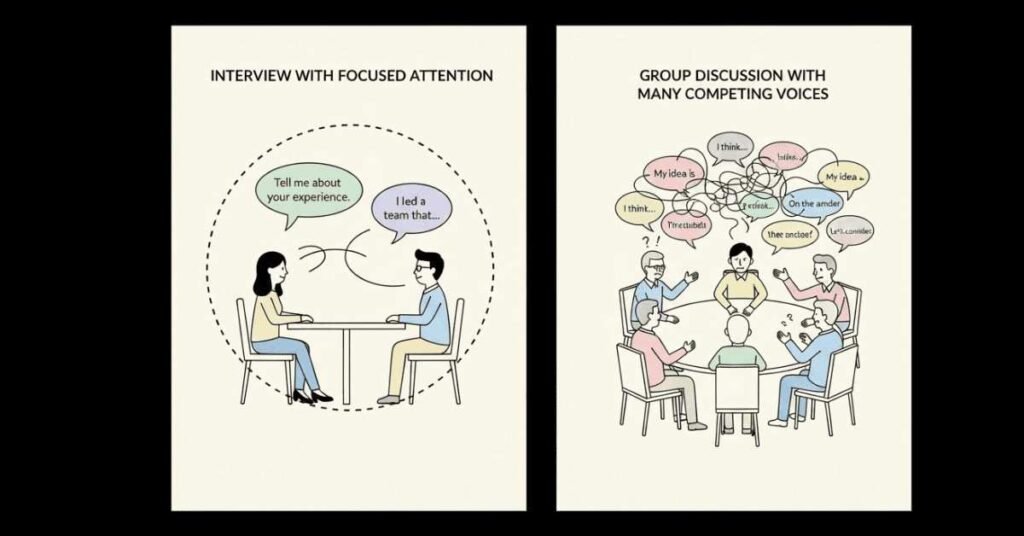
Picture this: You’re sitting in a room with 8-10 other candidates, all equally nervous, all equally qualified. The evaluator says, “Let’s start with quick introductions. Keep it to 30 seconds each.
Suddenly, your carefully prepared 90-second interview introduction is useless. You have 30 seconds—not to tell your life story, but to make yourself memorable enough that when you speak during the discussion, people remember who you are.
Here’s what most candidates don’t understand: a group discussion introduction isn’t about comprehensiveness—it’s about memorability and establishing your presence in a competitive setting.
In a one-on-one interview, you have the interviewer’s full attention. In a GD, you’re competing for mental space with 7-10 other voices. Your introduction needs to be sharp, distinctive, and confident enough to cut through the noise without appearing aggressive or dominating.
According to recruitment professionals, evaluators in group discussions form their initial impressions within the first 20 seconds of your introduction. Those who fumble, speak too softly, or blend into the crowd start at a disadvantage that’s hard to overcome, even with excellent discussion contributions later.
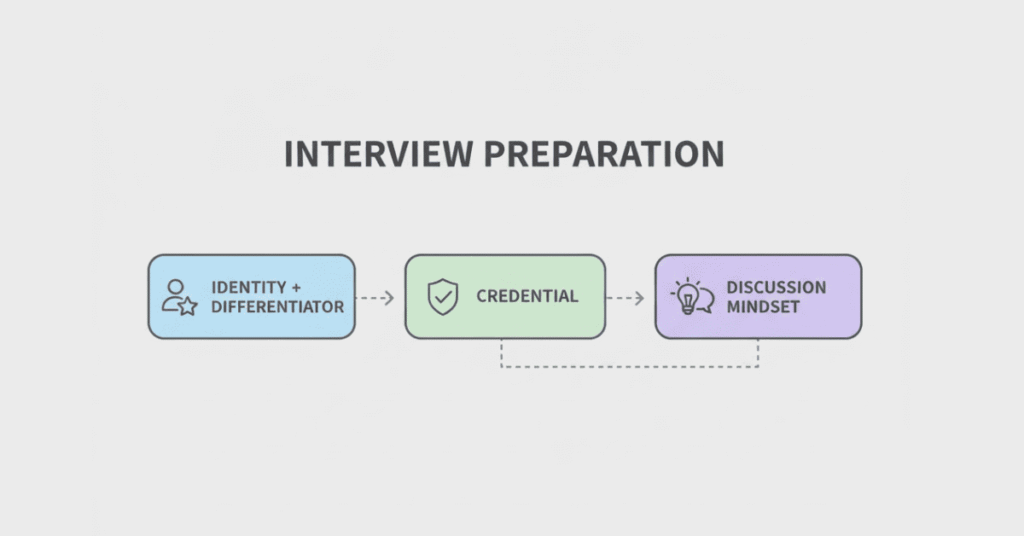
The 3-Part Ultra-Brief GD Introduction Formula

Group discussion introductions follow a completely different structure than interview introductions. You need maximum impact in minimum time.
Part 1: Identity + Differentiator (10 seconds)
Open with your name and one distinctive element that makes you memorable.
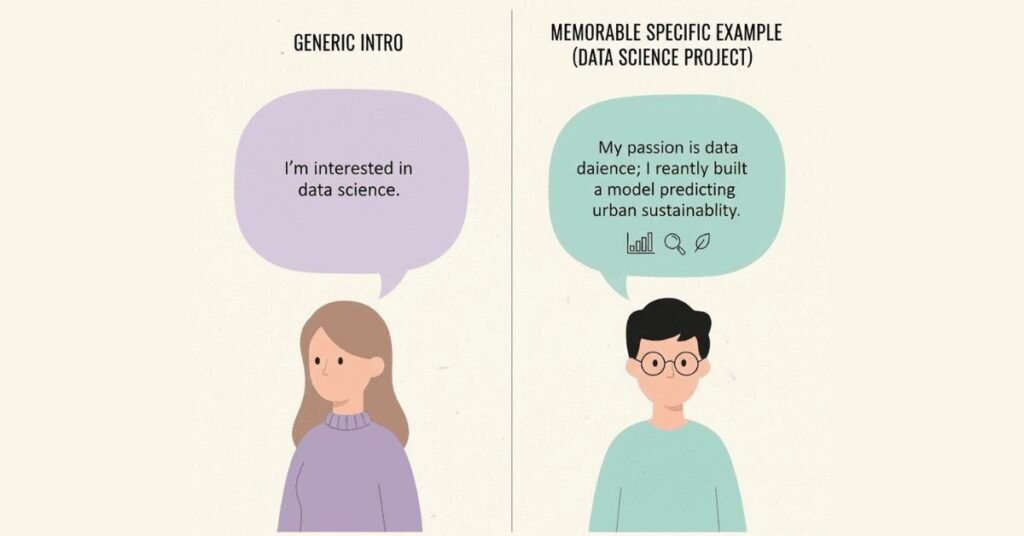
Weak opening:
“Hi, I’m Rahul. I’m from Hyderabad.”
Strong opening:
“Hello everyone, I’m Rahul, a data science enthusiast who’s analyzed over 50 public datasets to understand consumer behavior patterns.
OR
“Hi, I’m Priya, a mechanical engineer who’s passionate about sustainable energy solutions.
Notice the difference? The strong versions give people a hook to remember you by. When you speak later in the discussion, they’ll think, “Oh, that’s the data science person” or “That’s the sustainable energy engineer.
Part 2: Credential That Builds Credibility (15 seconds)
Quickly establish why your perspective matters for the upcoming discussion.
“I recently completed my MBA from Osmania University, specializing in digital marketing. During my final semester, I worked with 3 startups to develop their social media strategies, which taught me practical approaches to modern consumer engagement.
This accomplishes two things: it establishes your educational background and shows real-world application—both matter for GD credibility.
Part 3: Discussion Mindset Signal (5 seconds)
End with a brief statement that shows you’re ready to contribute constructively.
“I’m looking forward to hearing diverse perspectives on today’s topic.”
OR
“Excited to learn from everyone’s unique viewpoints today.
This subtle closing positions you as collaborative rather than competitive—a key trait evaluators look for in GDs.
Total time: 25-30 seconds maximum.
Making Yourself Memorable Without Being Obnoxious
The challenge in GD introductions is standing out without appearing arrogant or domineering. Here’s how to walk that fine line:
Use Specific, Unusual Details
Generic statements make you forgettable. Specific details create mental hooks.
Forgettable: “I like reading books.”
Memorable: “I’ve read 40 books on behavioral economics in the past year.
Forgettable: “I’m interested in technology.”
Memorable: “I built a Chrome extension that 500 people now use daily.
Own Your Unique Angle
If everyone in the room is an engineer, what makes you different? Find your differentiator.
“I’m Karthik, a computer science graduate who’s also a trained classical musician—which taught me pattern recognition skills I now apply to coding.
This combination is unexpected and memorable
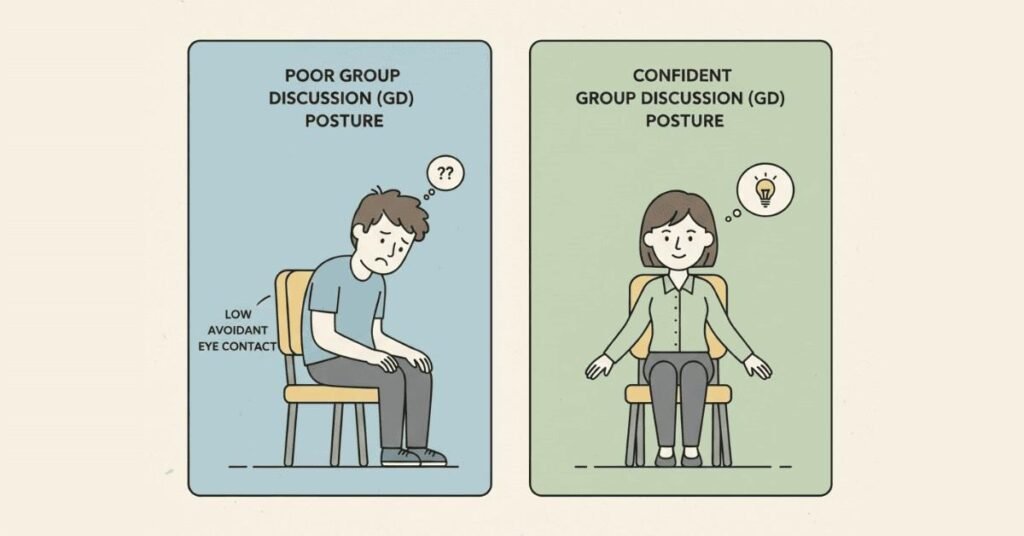
Use Confident Body Language
In a GD setting, your non-verbal communication starts before you speak. When your turn comes:
- Sit up straight
- Make brief eye contact with multiple people in the room (not just the evaluator)
- Speak at a clear, moderate volume—loud enough to be heard, not so loud you’re shouting
- Use a friendly, open facial expression
- Avoid nervous fidgeting
Speak to Everyone, Not Just the Evaluator
This is crucial. When introducing yourself in a GD, address the entire group.
Start with “Hello everyone” not “Hello sir/ma’am.” Make eye contact with other candidates as you speak. This shows you see them as peers you’ll engage with, not just competition to beat.
Real GD Introduction Examples for Different Scenarios
Example 1: Engineering Fresher in IT Company GD
“Hello everyone, I’m Sneha, a recent computer science graduate from JNTU Hyderabad. I’m particularly passionate about solving user experience problems through code—my final year project was a voice-based navigation app for visually impaired users that’s now used by 200+ people. I’m excited to contribute to today’s discussion and learn from your diverse perspectives.
Why this works:
- Clear identity (recent CS grad)
- Specific, memorable project (voice navigation app)
- Quantified impact (200+ users)
- Shows social awareness (accessibility focus)
- Collaborative closing
Time: 28 seconds
Example 2: MBA Student in Marketing Role GD
“Hi everyone, I’m Arjun, an MBA student specializing in brand management. Last summer, I interned with a local startup where I rebranded their social media presence, resulting in a 150% increase in engagement over 3 months. I believe marketing is equal parts creativity and data, and I’m looking forward to exploring that balance in our discussion today.
Why this works:
- Professional identity (MBA, brand management)
- Real achievement with numbers (150% engagement)
- Shows nuanced thinking (creativity + data)
- Forward-looking, collaborative tone.
Time: 26 seconds
Example 3: Experienced Professional in Leadership GD
“Good morning everyone, I’m Kavitha, and I’ve spent 5 years in project management at Tech Solutions, where I currently lead cross-functional teams. One of my proudest achievements was turning around a failing project that was 4 months behind—we delivered it successfully within 2 months. I’m eager to share insights and learn from the varied experiences in this room.
Why this works:
- Establishes seniority (5 years, team leadership)
- Dramatic achievement (turnaround story)
- Respects others’ contributions
- Confident but not dominatinghirist
Time: 27 seconds
Example 4: Career Changer in Diverse Group
“Hello everyone, I’m Ravi, transitioning from 4 years in banking to pursue my passion for HR. Managing a branch team taught me that people are any organization’s greatest asset, which is why I’ve now completed my HR certification and worked with 3 companies on recruitment strategy. I’m excited to bring my unique perspective to our discussion.
Why this works:
- Addresses career change upfront
- Connects previous experience to new field
- Shows preparation (certification + consulting)
- Frames difference as value-add
Time: 26 seconds
Common Group Discussion Introduction Mistakes
Mistake #1: Speaking Too Softly
In a room full of people, a timid voice gets lost. Evaluators literally can’t assess you if they can’t hear you.
The fix: Practice projecting your voice. You don’t need to shout, but speak at a volume where the person farthest from you can hear clearly without straining.
Mistake #2: Taking Too Long
When you’re told 30 seconds and you take 2 minutes, you’ve already shown you can’t follow instructions or respect others’ time.
The fix: Time yourself. Write your introduction, say it out loud with a timer, and ruthlessly cut anything that goes beyond 30 seconds.
Mistake #3: Being Too Generic
“I’m hardworking, dedicated, and a team player“ could describe literally anyone in the room.
The fix: Replace adjectives with specific examples. Don’t say you’re hardworking—mention the project where you worked 12-hour days. Don’t say you’re a team player—describe the team achievement you contributed to.
Mistake #4: Mentioning Irrelevant Information
Your family background, childhood hobbies, or hometown history doesn’t help in a 30-second GD introduction.
The fix: Include only information relevant to professional capability or the discussion topic.
Mistake #5: Comparing Yourself to Others
“I’m probably the most experienced person here” or “Unlike most engineers, I also understand business“ sounds arrogant and alienates the group.
The fix: State your strengths without putting others down. Your achievements speak for themselves.
Mistake #6: Memorizing Word-for-Word
When you recite a memorized script robotically, it shows. You sound inauthentic and can’t adapt if something unexpected happens.
The fix: Memorize the structure and key points, but let the exact words flow naturally each time you practice.
Mistake #7: Poor Posture and Body Language
Slouching, avoiding eye contact, or fidgeting undermines even a great introduction.
The fix: Practice your introduction while sitting upright, making eye contact with imagined audience members around the room.
Mistake #8: Ending Abruptly
Finishing your introduction and then looking down or going silent creates awkward energy.
The fix: End with a smile and maintain eye contact for 1-2 seconds before settling back. This signals confidence and completion.
Adapting Your Introduction to Different GD Topics
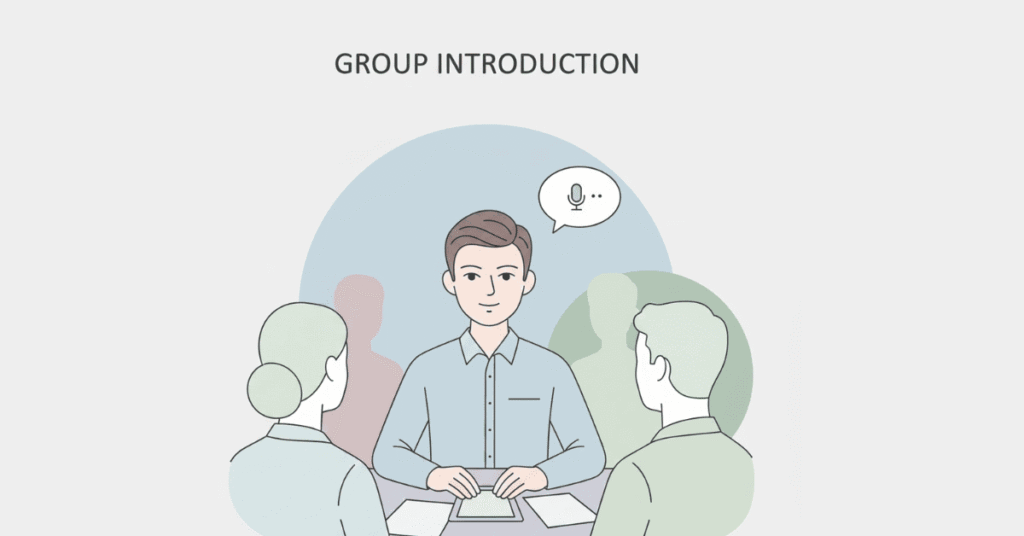
Smart candidates adjust their introduction slightly based on the GD topic announced.
For Technical Topics (AI, Technology, Innovation)
Emphasize your technical background and analytical thinking
“Hi everyone, I’m Karthik, a software engineer who’s spent the last 3 years working on machine learning applications. I’ve built recommendation systems that process millions of data points, so I’m excited to discuss AI’s practical implications today.”
For Social Topics (Education, Healthcare, Policy)
Highlight relevant experience or genuine passion:
“Hello everyone, I’m Neha, an MBA graduate who volunteers teaching underprivileged children every weekend. Having seen educational challenges firsthand, I’m eager to explore practical solutions in today’s discussion.”
For Business Topics (Marketing, Strategy, Economy)
Show business acumen or relevant achievements:
“Good morning, I’m Aditya, currently working in digital marketing where I manage campaigns with ₹10 lakh monthly budgets. I’m looking forward to discussing marketing strategy evolution with this group.
For Abstract Topics (Leadership, Ethics, Success)
Draw from real experiences that demonstrate understanding:
“Hi everyone, I’m Priya, who learned about leadership the hard way—leading a college fest team of 30 volunteers through multiple crises. Excited to share and learn about different leadership philosophies today.
The Strategic Advantage of Going First vs. Last
If You Go First:
Advantage: You set the tone and don’t have to worry about repeating what others said.
Strategy: Be confident and warm. Set a collaborative, respectful tone that others will follow. Your introduction becomes the standard.
If You Go in the Middle:
Advantage: You can observe patterns and differentiate yourself.
Strategy: If everyone’s being too formal, add a touch of personality. If everyone’s listing similar achievements, emphasize your unique angle.
If You Go Last:
Advantage: You’ve heard everyone and can position yourself uniquely.
Challenge: Everything obvious has been said.
Strategy: Acknowledge the group: “It’s great hearing such diverse backgrounds. I’m [name], and what makes my perspective different is…” Then share your unique angle.
Practice Exercises for GD Introduction Mastery
Exercise 1: The 20-Second Challenge
Write your introduction for 30 seconds. Now cut it to 20 seconds without losing impact. This forces you to identify what’s truly essential.
Exercise 2: Five Different Versions
Create five versions of your introduction, each emphasizing a different strength:
- Version 1: Technical skills
- Version 2: Leadership experience
- Version 3: Creative problem-solving
- Version 4: Academic excellence
- Version 5: Real-world impact
Practice switching between them based on context.
Exercise 3: The Group Practice
Gather 5-6 friends. Have everyone introduce themselves in 30 seconds. Record it. Then watch and note:
- Who was most memorable? Why?
- Whose body language was strongest?
- Who spoke too long or too briefly?
- What specific details stuck with you?
Exercise 4: The Interruption Test
Practice your introduction while a friend occasionally interrupts or creates distractions. Learn to maintain composure and continue smoothly—this simulates real GD chaos.
Exercise 5: Volume and Projection
Practice in a large room or outdoors. Speak your introduction as if addressing someone 15 feet away. Record and check if you sound confident or shouty.
The Week Before Your GD: Preparation Checklist
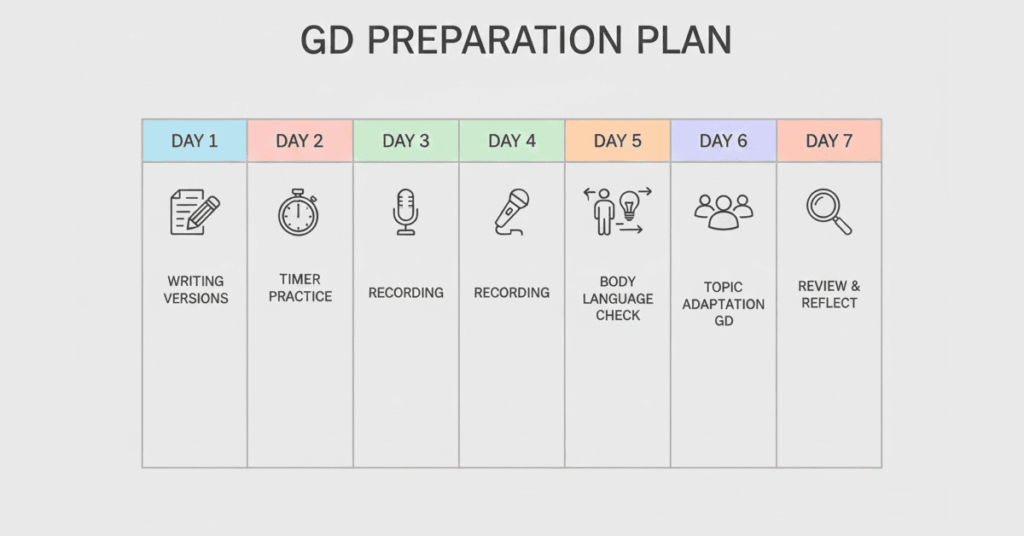
Day 1: Write three versions of your introduction (formal, conversational, topic-adapted).
Day 2: Practice each version with a timer. Cut anything beyond 30 seconds.
Day 3: Record yourself. Watch without sound—is your body language confident? Listen without watching—is your voice clear and energetic?
Day 4: Practice introducing yourself while sitting (GDs are usually seated). Check your posture.
Day 5: Have a friend give you random GD topics. Adapt your introduction’s ending to each topic in 5 seconds.
Day 6: Do a mock GD with friends. Practice being first, middle, and last to introduce yourself.
Day 7: Rest. Review your three best versions. Visualize success. Trust your preparation.
What Evaluators Actually Look For in GD Introductions
Understanding the evaluation criteria helps you optimize your introduction:
Communication Clarity (30%): Can you express yourself clearly and concisely?
Confidence (25%): Do you appear comfortable and self-assured?
Listening Skills (20%): Are you paying attention to others’ introductions?
Professionalism (15%): Is your language and demeanor appropriate?
Memorability (10%): Will they remember who you are during the discussion?
Notice that comprehensiveness isn’t on the list. Nobody expects your complete life story. They want to see you can introduce yourself effectively under time pressure while respecting group dynamics.
Your Introduction Sets the Stage
Here’s what many candidates miss: your GD introduction isn’t just about telling people who you are—it’s about establishing the credibility that makes people listen when you speak during the discussion.
When you introduce yourself with clarity, confidence, and a memorable detail, something subtle happens. Later, when you make a point during the discussion, people are more likely to listen and engage because you’ve already established yourself as someone worth paying attention to.
The candidates who fumble their introduction spend the rest of the GD fighting to be taken seriously. The candidates who nail it start with built-in credibility.
Practice your 30-second introduction until it feels natural. Make it specific enough to be memorable. Deliver it with confidence and warmth. Then watch how differently people respond when you contribute to the discussion.
Your GD success starts with those crucial 30 seconds. Make every word count.