
FAMILY LAW CAREER PATH

Table of Contents
Introduction:
Few legal fields carry the emotional weight of family law. You’re not arguing corporate mergers or patent disputes—you’re helping people rebuild lives after divorce, protecting children during custody battles, and resolving inheritance conflicts tearing families apart. Every case involves raw human drama: betrayal, financial ruin, child welfare, generational wealth disputes.
Family law offers rewards beyond courtroom victories. Clients remember you forever. Successfully reuniting parents with children, securing fair divorce settlements, or mediating contentious inheritance disputes creates profound gratitude. Unlike transactional lawyers, your work changes lives directly.
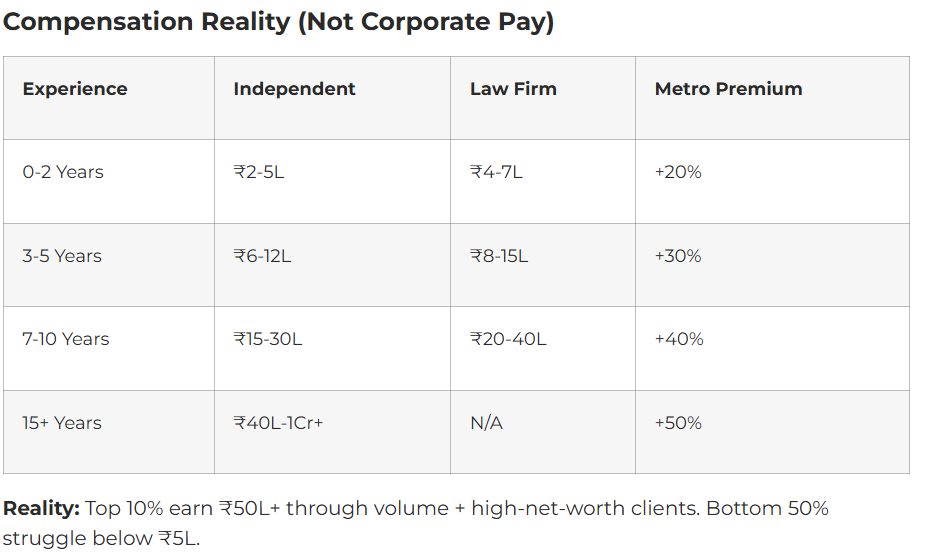
India’s family law market grows steadily as urbanization, nuclear families, and women’s financial independence drive divorce rates up 30% in metros over the last decade. Family lawyers earn ₹8-25 lakhs annually depending on experience and location, with senior practitioners in Delhi/Mumbai commanding ₹40 lakhs+. If you possess empathy combined with legal steel, can separate personal emotions from professional duty, and want meaningful work impacting families directly, family law offers deeply satisfying careers.
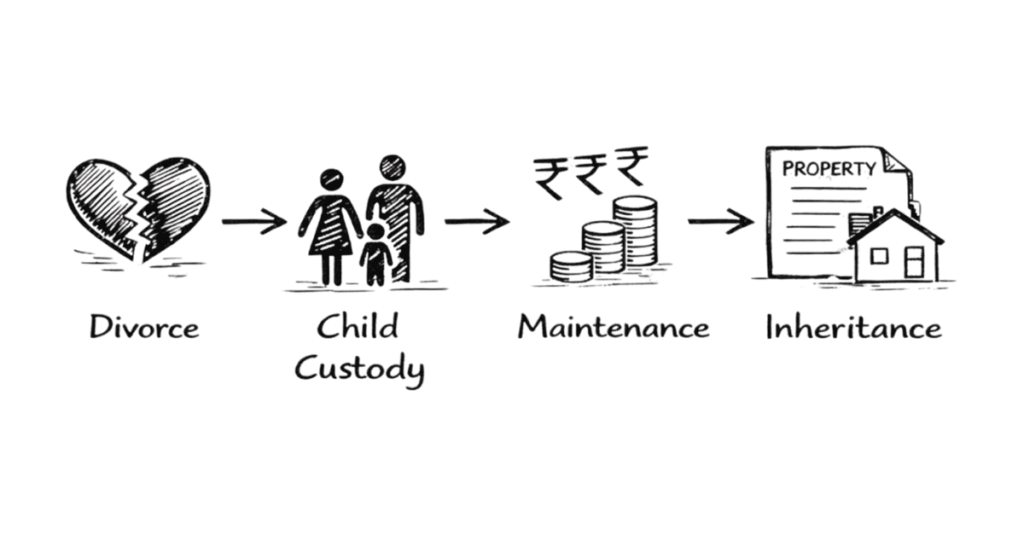
Core Areas of Family Law Practice
Matrimonial Disputes (60% of Practice)
Divorce Proceedings: India’s secular divorce laws create complex jurisdictional battles. Hindu marriages fall under Hindu Marriage Act 1955 (irretrievable breakdown gaining acceptance), Muslim divorces follow personal law (talaq, khula, mubarat), Christians under Indian Divorce Act 1869. You’ll navigate maintenance claims under CrPC 125, stridhan recovery, and jurisdictional conflicts between personal laws.
Judicial Separation vs. Divorce: Clients often prefer separation preserving marriage validity for inheritance/social reasons. You’ll advise on practical differences affecting alimony, child custody, property rights.
Restitution of Conjugal Rights: Rare but persistent—spouses seeking court-ordered cohabitation. Modern courts increasingly skeptical, but cases persist across communities.
Child Custody & Guardianship (25% of Practice)
Welfare Paramount Principle: Courts prioritize child’s best interests above parental rights. You’ll build welfare arguments through school reports, psychological evaluations, stability assessments. Joint custody gaining traction in metros despite statutory bias toward mothers.
Relocation Disputes: Increasingly common as working parents seek better opportunities. Courts balance child’s stability against parental career needs.
Guardianship Petitions: For orphaned children, disabled dependents, or elderly parents. Hindu Minority and Guardianship Act 1956 vs. Guardian and Wards Act 1890 jurisdictional complexities.
Maintenance & Alimony (10% of Practice)
Section 125 CrPC: Secular maintenance for wives, children, parents regardless of religion. ₹3-15 lakhs annual income ceiling creates strategic planning around earnings disclosure.
Hindu Adoption & Maintenance Act: Separate wife maintenance rights with lifetime obligations absent cruelty/desertion.
Domestic Violence Act 2005: Protection orders, residence rights, monetary relief. Fast-track but heavily abused—your skill separates genuine cases from strategic filings.
Inheritance & Succession (5% of Practice)
Hindu Succession Act 1956 (amended 2005): Daughters equal coparceners creates generational wealth disputes. Partition suits explode post-father’s death.
Muslim Personal Law: Complex sharer calculations, wasiyyat (will) limits, gifts during marz-ul-maut (death illness).
Indian Succession Act 1925: Christians/Parsis wills, intestate succession.
Daily Workflow: Managing Emotional Chaos
Client Intake (Emotional Minefield)
text
9 AM: Wife tearfully describes husband’s affair
10 AM: Husband angrily denies, blames her spending
11 AM: Review marriage certificate, income proofs
12 PM: Strategy session—mediation vs. litigation
Reality Check: 70% initial stories incomplete/biased. Your job extracts truth without alienating either party.
Case Preparation (Document Archaeology)
- Bank statements (last 3-5 years)
- Property documents (stridhan proof)
- Communication records (Whatsapp cruelty evidence)
- Children’s school/medical records
- Income proofs (salary slips, ITRs)
Pro Tip: Digital forensics increasingly critical—Whatsapp chat analysis, GPS location data proving cohabitation claims.
Court Strategy (Balancing Aggression/Empathy)
Divorce: Mutual consent fastest (6 months), but 80% contested requiring 3-7 years. Prove cruelty/desertion/desertion.
Custody: Welfare evidence trumps parental rights. Mother preference under 5 years, but fathers winning 30% metro cases.
Maintenance: Lifestyle evidence key. Luxury vacations prove capacity to pay despite declared ₹50K salary.
Essential Skills for Family Law Success
Emotional Intelligence (Mission Critical)
Client Management: Distinguish genuine distress from manipulation. Betrayed spouses seek revenge through endless litigation—you guide toward settlement preserving long-term welfare.
Judge Psychology: Family court judges balance law with human realities. Empathy wins over aggression; practical solutions impress over theoretical arguments.
Mediation Mastery: 60% cases settle through counseling. Your settlement skills determine fees and client satisfaction.
Financial Investigation Skills
Lifestyle Analysis: Instagram vacations contradict ₹30K declared salary. Cross-reference expenses proving true capacity.
Asset Tracing: Hidden properties, benami transactions, cash hoards. RTI applications, society records, electricity bills expose undeclared wealth.
Alimony Calculations: 25% net income benchmark, but luxury lifestyles justify 35-50%. Future earning capacity vs. current dependency.
Legal Drafting Precision
Petition Framing: Single wrong fact kills credibility. “Cruelty” requires specific incidents with dates/witnesses.
Affidavit Strategy: Short, factual, non-emotional. Judges ignore “he destroyed my life” rants.
Settlement Agreements: Ironclad alimony/child support enforcement mechanisms. Lump sum vs. monthly debates.
Technology Proficiency
Digital Evidence: Whatsapp backups, GPS data, social media screenshots. Forensic certification increasingly valuable.
Case Management: Spreadsheets tracking 50+ dates/documents per case across multiple courts.
Virtual Hearings: Zoom proficiency critical post-pandemic.
Educational Pathways & Entry Strategy
Academic Foundation
text
Tier-1 NLUs: NLSIU, NALSAR (family law electives)
Tier-2 NLUs: GNLU, RMLNLU
Private: Symbiosis, OP Jindal
CA/CS + Law: Tax/family wealth planning advantage
Key Subjects:
- Family Law I & II (Hindu/Muslim/Christian)
- Alternative Dispute Resolution (mediation)
- Property Law (inheritance)
- Evidence Law (document authentication)
Practical Training
Internships: Senior family lawyers (not firms), mediation centers, women’s cells. Observe 20+ hearings minimum.
Legal Aid Clinics: Free representation builds courtroom confidence, client management skills.
Mediation Certification: 40-hour course mandated for court referrals.
Entry-Level Positions
- Junior Associate (₹3-6L): Drafting, client meetings, court appearances
- Independent Practice (₹2-8L): Riskier but faster independence
- NGO/Legal Aid (₹2-4L): Experience building, network development

Salary Progression & Business Model
Revenue Model
text
Volume Practice: 30-40 cases @ ₹25-50K fees = ₹10-15L
Premium Practice: 8-12 HNIs @ ₹2-5L fees = ₹20-40L
Hybrid: Best of both worlds
Key Ratios:
- 60% contested divorce/maintenance
- 25% custody/guardianship
- 15% inheritance/property
Top Family Law Markets
Tier-1 Cities
Delhi: HNWI concentration, NRI divorces, property disputes
Mumbai: Bollywood celebrity cases, business family partitions
Bangalore: IT professional divorces, live-in relationship cases
Emerging Hubs
Pune: Similar to Bangalore, lower costs
Gurugram: NRI/HNWI divorces
Hyderabad: IT + film industry mix
Small Town Advantage: Lower competition, trusted community position, volume matrimonial work.
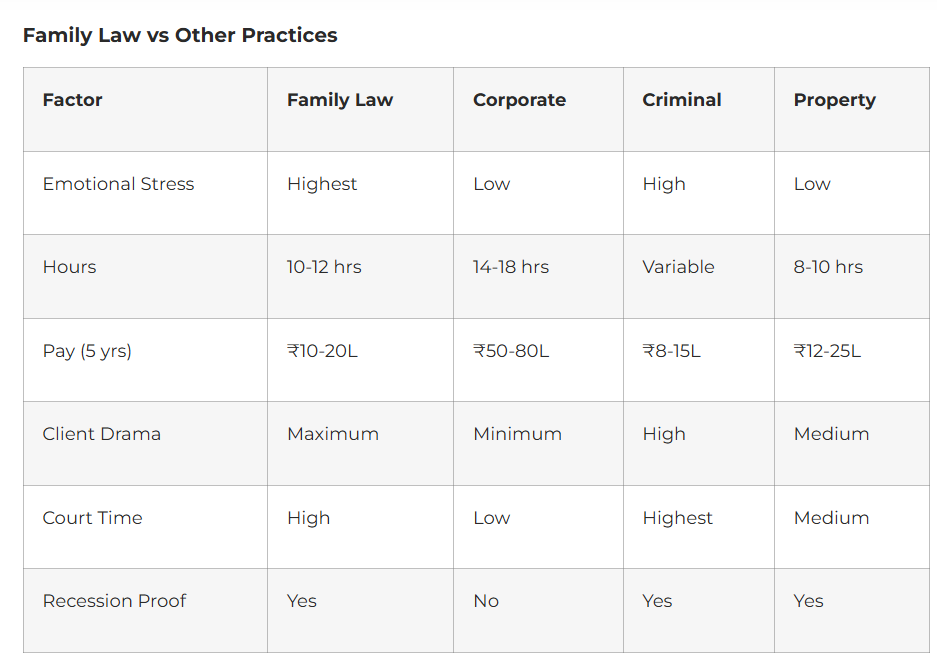
Why Family Law?
- Recession-proof: Marriages break regardless of economy
- High volume: Unlimited local demand
- Fast independence: No corporate ladder
- Deep impact: Life-changing client results
- Flexible hours: Control your schedule
The Reality Check:
- Emotional exhaustion from constant trauma
- Unpredictable cash flow
- Late-night client crises
- Social stigma in conservative communities
- 70% cases involve domestic abuse claims
Success Blueprint: First 5 Years
Year 1: Foundation Building
text
50 hearings observed
20 petitions drafted
5 full cases handled
Local lawyer network established
Year 2-3: Volume Practice
text
30 active cases
₹8-12L revenue target
Mediation certification
HNI client acquisition begins
Year 4-5: Premium Practice
text
15 premium cases @ ₹2L+
₹20-30L revenue
Junior lawyer hiring
Reputation as go-to specialist
Daily Survival Kit
text
7 AM: Case file review
9 AM-5 PM: Courts/client meetings
6-9 PM: Drafting/strategy
9 PM+: Emergency calls
Client Acquisition Channels:
- Referrals (70% business)
- Local networks (matrimonial bureaus)
- Online (JustDial, Google, Instagram)
- NGO partnerships (genuine cases)
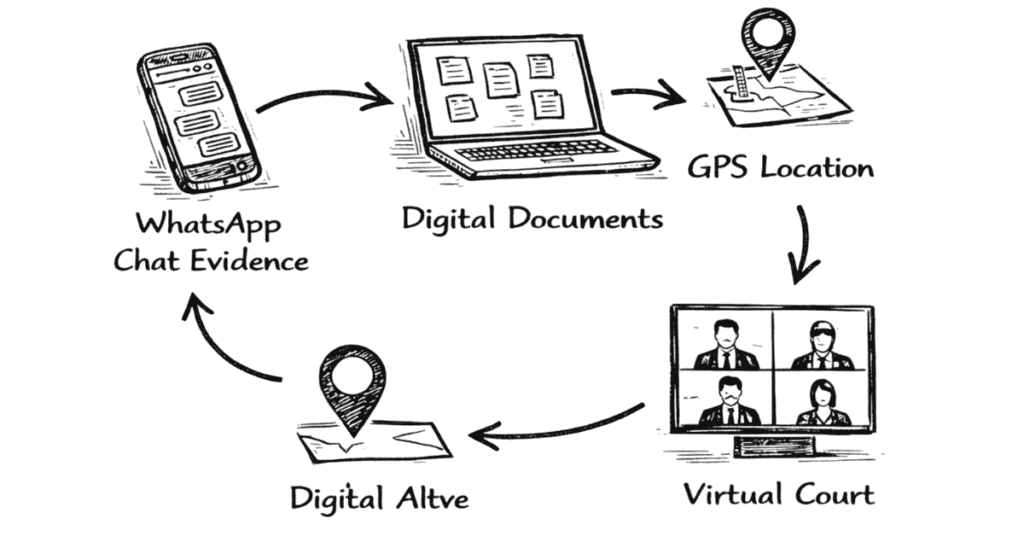
Technology Transforming Family Law
Digital Evidence: Whatsapp analytics, GPS tracking, financial forensics
Virtual Mediation: Zoom counseling sessions
Case Management: Clio, PracticePanther
Client Portals: Secure document sharing
AI Judgment Prediction: 75% accuracy on maintenance awards
Is Family Law Right For You?
You’ll Excel If:
text
✓ Strong emotional boundaries
✓ Enjoy human psychology/drama
✓ Comfortable with messy finances
✓ Litigation confident
✓ Service-oriented personality
✓ Networker comfortable in social circles
Consider Alternatives If:
text
✗ Easily emotionally drained
✗ Hate financial detective work
✗ Dislike courtroom unpredictability
✗ Seek corporate salaries
✗ Prefer clean transactional work
The Ultimate Reward: At age 45, when corporate associates burn out at ₹1 crore packages, you’ll run independent practice earning ₹50 lakhs+ with schedule control, profound client gratitude, and societal respect as “the lawyer who helped my family.” Few careers match this combination of impact, independence, and income potential.