
Facility Management Career India : Salary & Skills Guide
Table of Contents
Introduction
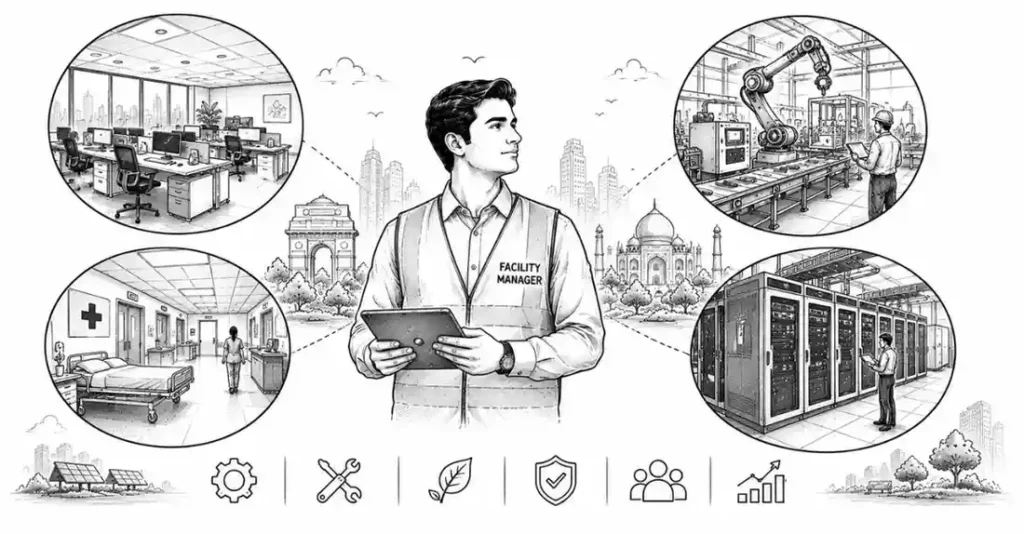
Facility management represents a specialized and increasingly vital profession ensuring the functionality, comfort, safety, efficiency, and sustainability of built environments. Unlike property management which focuses on rental properties and tenant relationships, facility management coordinates physical workplaces with people and operations for organizations that own and occupy their spaces. From corporate offices and manufacturing plants to hospitals, educational institutions, data centers, and retail complexes, facility managers ensure buildings operate smoothly while supporting organizational objectives and occupant wellbeing.
The career offers exceptional compensation and job security in India’s expanding economy. Facility management professionals earn an average of ₹19.5 lakh annually, with most salaries ranging from ₹15 lakh to ₹45.5 lakh based on experience and portfolio complexity. The top 10% of facility managers earn more than ₹30 lakh per year, and the highest earners reach ₹50 lakh annually. Facilities managers average ₹17.8 lakh, with ranges from ₹13 lakh to ₹49.4 lakh depending on credentials, expertise, and organizational scope.
India’s rapid infrastructure development, corporate expansion, GCC (Global Capability Centre) boom, manufacturing growth, and increasing emphasis on workplace experience and sustainability drive strong demand for qualified facility management professionals. Organizations recognize that well-managed facilities directly impact employee productivity, operational efficiency, energy costs, safety compliance, and asset value preservation, making facility managers strategic contributors rather than mere operational support.
The Certified Facility Manager (CFM) credential from the International Facility Management Association (IFMA) stands as the profession’s gold standard, internationally recognized for ensuring knowledge and competence. CFM holders earn 25% more than non-certified counterparts and tend to occupy higher management positions, making certification a powerful career accelerator.
This comprehensive guide explores everything needed to build a successful facility management career in India, from understanding core responsibilities and required skills through CFM certification pathways, realistic salary expectations, specialization opportunities, and proven strategies for career advancement in this dynamic, technically sophisticated profession.
Understanding the Facility Manager Role
Core Responsibilities
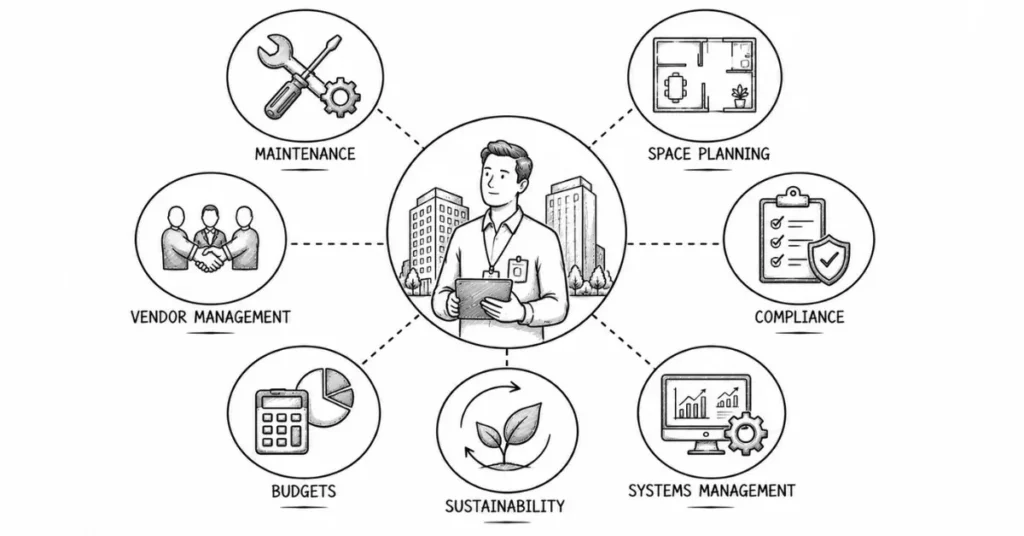
Facility managers oversee comprehensive building operations ensuring physical environments support organizational goals while providing safe, comfortable, efficient spaces for occupants.
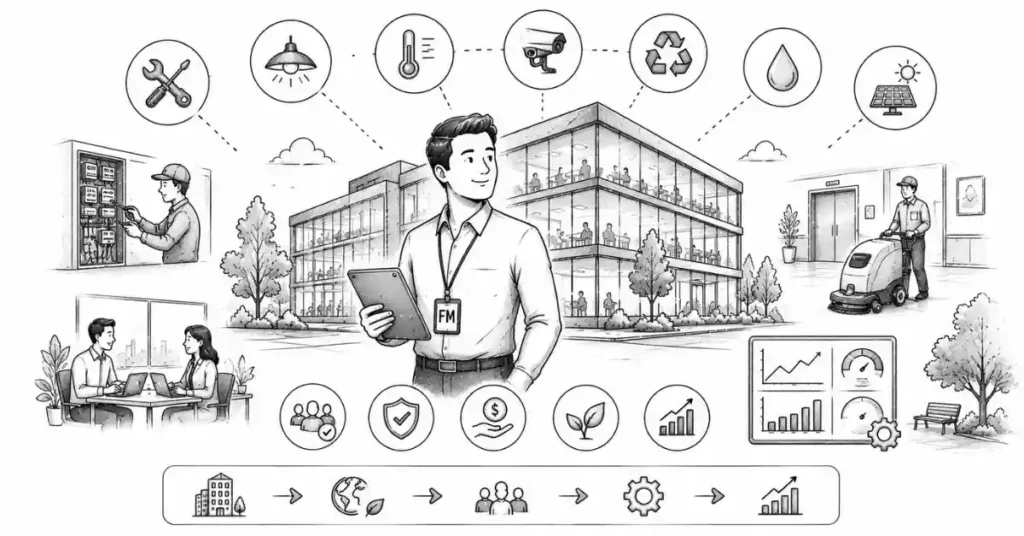
Building maintenance and operations form the foundation of facility management. You coordinate preventive maintenance for HVAC systems, electrical systems, plumbing, elevators, fire safety equipment, and security systems. You schedule routine servicing reducing equipment failures and extending asset life. When issues arise, you coordinate emergency repairs minimizing downtime and disruption. You oversee cleaning and janitorial services maintaining cleanliness, hygiene, and professional appearance throughout facilities. You manage landscaping and exterior maintenance preserving property aesthetics and functionality.
Space planning and management optimizes facility utilization. You analyze space usage patterns identifying underutilized or overcrowded areas. You coordinate office moves, reconfigurations, and expansions supporting organizational changes. You implement workplace strategies including hot-desking, collaborative spaces, and hybrid work models. You track space allocation ensuring efficient use of valuable real estate assets.
Vendor and contractor management requires negotiation skills and quality oversight. You solicit competitive bids for maintenance, cleaning, security, and specialized services. You negotiate contracts balancing cost, quality, and service levels. You monitor vendor performance ensuring contractual compliance and quality standards. You maintain relationships with reliable service providers for emergency response and ongoing needs.
Safety and regulatory compliance protects occupants and organizations from risks. You ensure buildings comply with local building codes, fire safety regulations, health and safety standards, environmental regulations, and accessibility requirements. You coordinate fire drills and emergency preparedness training. You maintain safety equipment and signage. You investigate incidents and implement corrective actions. You document compliance activities protecting organizations from liability.
Budget management and financial oversight directly impacts organizational profitability. You develop annual facility budgets forecasting operational expenses, maintenance costs, utilities, vendor contracts, and capital improvements. You track spending against budgets identifying variances and cost-saving opportunities. You analyze utility consumption patterns implementing energy efficiency measures reducing costs. You prepare financial reports communicating facility costs and performance to senior management.
Sustainability and energy management addresses growing environmental and cost pressures. You monitor energy consumption identifying reduction opportunities. You implement sustainability initiatives including LED lighting upgrades, HVAC optimization, waste reduction programs, water conservation measures, and renewable energy adoption. You pursue green building certifications (LEED, IGBC) demonstrating environmental commitment. You track and report sustainability metrics supporting corporate ESG (Environmental, Social, Governance) goals.
Technology and systems management increasingly distinguishes modern facility management. You oversee building management systems (BMS) monitoring and controlling HVAC, lighting, security, and other systems. You implement computer-aided facility management (CAFM) software tracking assets, work orders, and maintenance schedules. You leverage Internet of Things (IoT) sensors providing real-time data on space utilization, environmental conditions, and equipment performance. You evaluate and adopt PropTech innovations improving efficiency and occupant experience.
Work Environment and Schedule
Facility managers split time between office work managing administrative tasks, reviewing reports, coordinating vendors, planning projects, and attending meetings, and site inspections walking facilities, identifying issues, overseeing repairs, meeting with occupants, and ensuring quality standards.
Most facility managers work standard business hours, though emergencies occasionally require evening or weekend responses for critical systems failures, security incidents, or weather-related damage. The role provides more predictability than sales careers while still offering variety through diverse challenges, multiple stakeholders, and continuous problem-solving opportunities.
Work settings vary dramatically. Corporate offices focus on workplace experience, technology infrastructure, collaboration spaces, and white-collar employee needs. Manufacturing facilities emphasize production floor safety, heavy equipment maintenance, environmental compliance, and operational uptime. Healthcare facilities require infection control, medical equipment coordination, patient safety, and 24/7 critical operations. Educational institutions manage classrooms, laboratories, residential housing, athletics facilities, and seasonal occupancy variations. Retail and hospitality prioritize customer experience, aesthetic maintenance, rapid response to issues, and revenue-supporting environments. Data centers demand specialized knowledge of power infrastructure, cooling systems, network connectivity, and business continuity.
Essential Skills for Facility Management Success
Technical Proficiency
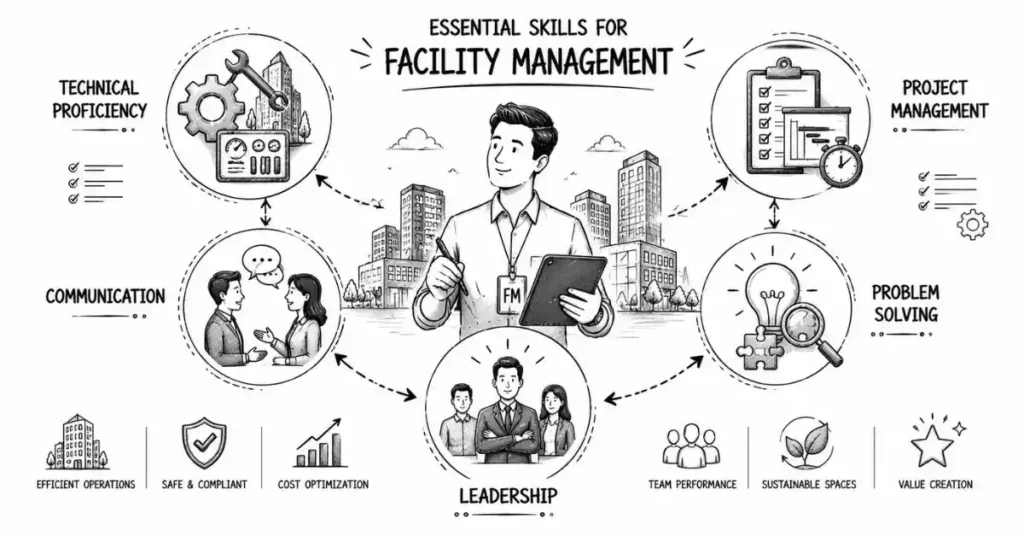
Facility management requires understanding diverse building systems and technologies.
Building systems knowledge includes HVAC systems understanding heating, ventilation, air conditioning principles, equipment types, maintenance requirements, and energy optimization. Electrical systems knowledge covers power distribution, emergency backup systems, lighting systems, and electrical safety. Plumbing systems understanding encompasses water supply, drainage, hot water systems, and leak detection. Fire safety systems familiarity includes sprinklers, alarms, suppression systems, and emergency lighting. Security systems knowledge covers access control, surveillance cameras, intrusion detection, and visitor management.
While you’re not expected to be an engineer or technician, understanding these systems helps you make informed decisions, communicate effectively with technical vendors, identify problems early, and ensure appropriate maintenance and repairs.
Facility management software proficiency improves efficiency through computerized maintenance management systems (CMMS) tracking work orders, preventive maintenance, and asset histories. Building management systems (BMS) provide centralized monitoring and control of building systems. Computer-aided facility management (CAFM) platforms integrate space management, asset tracking, and operations. Project management tools help coordinate complex initiatives, renovations, and capital projects.
Regulatory knowledge ensures compliance with building codes and safety regulations, environmental laws and sustainability requirements, occupational health and safety standards (OSHA equivalent in India), fire safety codes and inspection requirements, and accessibility standards ensuring barrier-free environments.
Project Management Abilities
Facility managers coordinate complex projects from HVAC replacements to complete office renovations. Planning and organizing involves defining project scope, objectives, and deliverables, developing realistic timelines and budgets, identifying resource requirements and constraints, and coordinating multiple stakeholders including occupants, vendors, and leadership.[knowledgehut]
Execution and monitoring requires tracking progress against plans, managing contractor performance and quality, addressing issues and changes promptly, communicating status to stakeholders, and ensuring projects complete on time and within budget.
Communication and Interpersonal Skills
Facility managers interact with diverse audiences requiring adaptable communication.
Verbal communication enables you to explain technical issues in accessible language to non-technical audiences, coordinate with vendors and contractors providing clear expectations, address occupant concerns with professionalism and empathy, present recommendations to senior leadership confidently, and facilitate meetings with cross-functional teams.
Written communication produces clear work orders and maintenance requests, professional reports and status updates, vendor contracts and service agreements, policy and procedure documentation, and incident reports and compliance documentation.
Relationship management builds positive working relationships with occupants and employees, vendor and contractor partnerships based on trust and performance, executive relationships demonstrating strategic value, and cross-functional collaboration with HR, IT, finance, and operations teams.
Problem-Solving and Analytical Thinking
Facilities present continuous challenges requiring systematic problem-solving.
Root cause analysis helps you identify underlying problems rather than treating symptoms, analyze patterns in recurring issues, evaluate alternative solutions considering cost, time, and effectiveness, and implement corrective actions preventing future occurrences.
Data analysis enables you to track key performance indicators (KPIs) including work order response times, maintenance costs per square foot, energy consumption trends, occupant satisfaction scores, and space utilization rates. You interpret data identifying improvement opportunities, benchmark performance against industry standards, and make data-driven decisions supporting recommendations with analysis.
Leadership and Management Capabilities
Facility managers lead teams and influence organizations.
Team leadership involves managing maintenance staff and contractors, delegating tasks appropriately matching skills to requirements, providing coaching and development opportunities, conducting performance evaluations, and fostering collaborative, productive team cultures.
Change management guides organizations through workplace transformations including return-to-office strategies, space reconfigurations, technology implementations, and sustainability initiatives. You address resistance through communication, demonstrate value through results, and engage stakeholders building support.
Educational Backgrounds and Qualifications
Relevant Degrees and Educational Paths
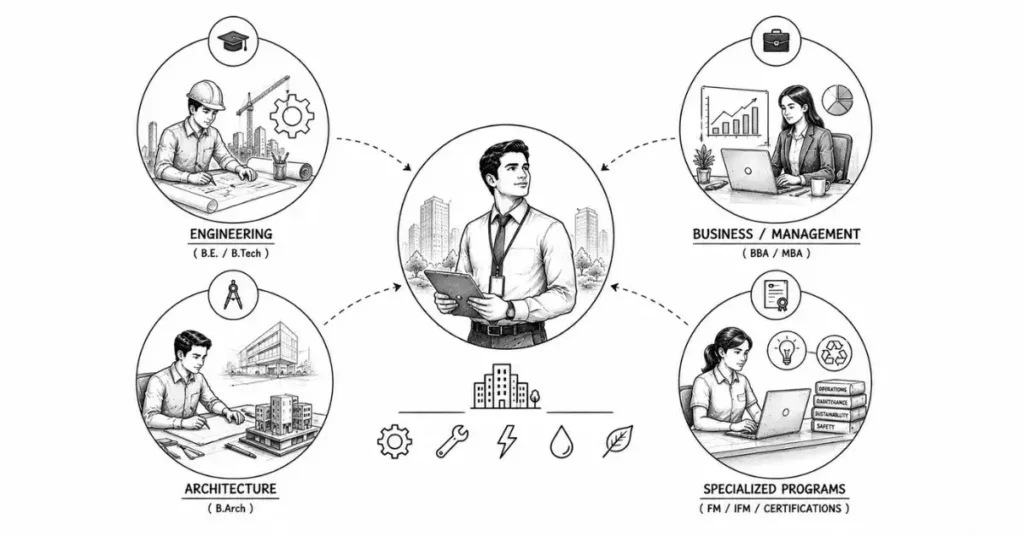
While facility management doesn’t require specific mandatory degrees, certain educational backgrounds provide strong foundations.
Engineering degrees including mechanical, electrical, civil, or industrial engineering provide technical knowledge of building systems, construction processes, and analytical problem-solving approaches valued in facility management.
Business and management degrees such as BBA, MBA, or bachelor’s degrees in business administration offer organizational management skills, financial acumen, project management foundations, and strategic thinking abilities essential for senior facility roles.
Specialized facility management programs through dedicated facility management degrees or diplomas, real estate management programs with facility focus, and technical certifications in HVAC, electrical systems, or building automation provide targeted industry knowledge.
Architecture and construction management degrees give understanding of building design, construction processes, space planning, and material specifications beneficial for facility planning and renovation projects.
However, many successful facility managers come from diverse educational backgrounds, succeeding through professional certifications, on-the-job learning, technical training, and demonstrated competency. Continuous learning matters more than initial degree in this rapidly evolving field.
The CFM Certification: Professional Gold Standard
Understanding the Certified Facility Manager (CFM) Credential
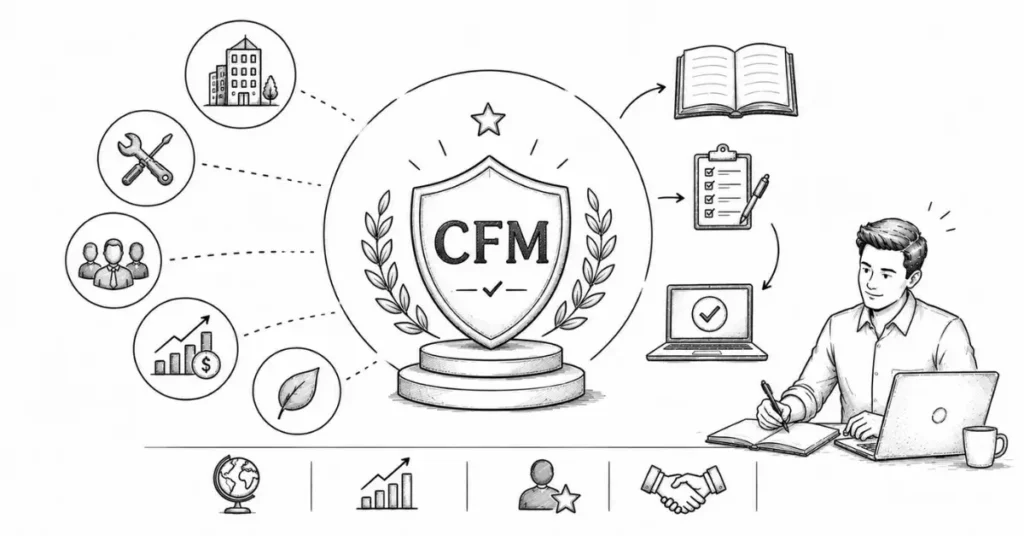
The Certified Facility Manager (CFM) from the International Facility Management Association (IFMA) is an internationally recognized credential setting the standard for ensuring knowledge and competence of practicing facility managers. It is a competency-based certification requiring ongoing professional development and periodic renewal, distinguishing it from one-time examinations.
IFMA’s CFM is the most distinguished credential in the facility industry. The credential establishes the benchmark within the industry, recognized globally as proof of professional expertise. A recent IFMA study found that CFMs earn 25% more than their non-CFM counterparts and tend to occupy higher management positions, demonstrating the credential’s substantial career impact.
The CFM covers eleven core competency areas: communication, emergency preparedness and business continuity, environmental stewardship and sustainability, finance and business, human factors, leadership and strategy, operations and maintenance, project management, quality, real estate and property management, and technology. This comprehensive scope ensures CFMs possess well-rounded expertise across all facility management dimensions.
CFM Eligibility Requirements
IFMA structures CFM eligibility around professional experience rather than specific educational requirements, recognizing that facility management competency develops primarily through practice.
Option 1: With bachelor’s or master’s degree in facility management – At least three years of facility management experience required.
Option 2: Without degree requirement – Five years of facility management experience required.
These pathways make CFM accessible to both formally educated professionals and those who’ve built expertise through practical experience. The experience requirement ensures candidates possess substantive real-world knowledge before pursuing certification, making the credential meaningful rather than merely academic.
CFM Certification Process
Step 1: Verify eligibility by documenting your facility management experience through employment records, job descriptions, and responsibilities confirmation. Ensure you meet either the 3-year (with FM degree) or 5-year (without degree) experience threshold.
Step 2: Prepare for the CFM exam through self-study or preparation courses. There is no required online or in-person training needed to take the CFM exam—candidates only need to meet eligibility requirements. However, IFMA provides optional online and classroom courses to help candidates prepare, though they’re not mandatory.
IFMA India offers CFM preparation programs, typically delivered as intensive 3-4 day workshops covering all eleven competency areas. For example, virtual programs have been offered at ₹1,00,000 (plus GST), and in-person programs in cities like Bangalore at ₹1,20,000 (plus GST). These preparation courses accelerate your readiness but aren’t required if you prefer independent study.
Step 3: Register and schedule your CFM exam through IFMA. To obtain CFM certification, candidates must schedule their exam at an approved Prometric testing center (available globally). IFMA also offers proctored exams virtually after candidates have met requirements, providing flexible testing options.
The CFM exam tests knowledge across all eleven competency areas through multiple-choice questions covering both theoretical knowledge and practical application scenarios. Exam duration is typically 4 hours, requiring sustained focus and comprehensive preparation.
Step 4: Pass the CFM examination demonstrating competency across all facility management domains. Upon successful completion, you receive your CFM credential and can use the CFM designation professionally.
Step 5: Maintain your CFM through continuing education. The CFM is a competency-based certification requiring ongoing professional development and periodic renewal. CFMs must complete continuing education units (CEUs) annually, typically 10 CEUs per year or 30 per three-year renewal cycle, through approved courses, conferences, webinars, and workshops. This ensures CFMs maintain current knowledge as facility management practices, technologies, and standards evolve.
FMP: Alternative or Stepping Stone
IFMA also offers the Facility Management Professional (FMP) credential as an alternative or stepping stone to CFM. FMP requires less experience and serves as an entry-level credential for facility management professionals. Many pursue FMP earlier in their careers (2-3 years experience), then advance to CFM once they meet the higher experience requirements, demonstrating progressive professional development and deepening expertise.
Facility Management Salary and Career Progression
Compensation by Experience Level
Facility management offers attractive compensation with clear experience-based progression.
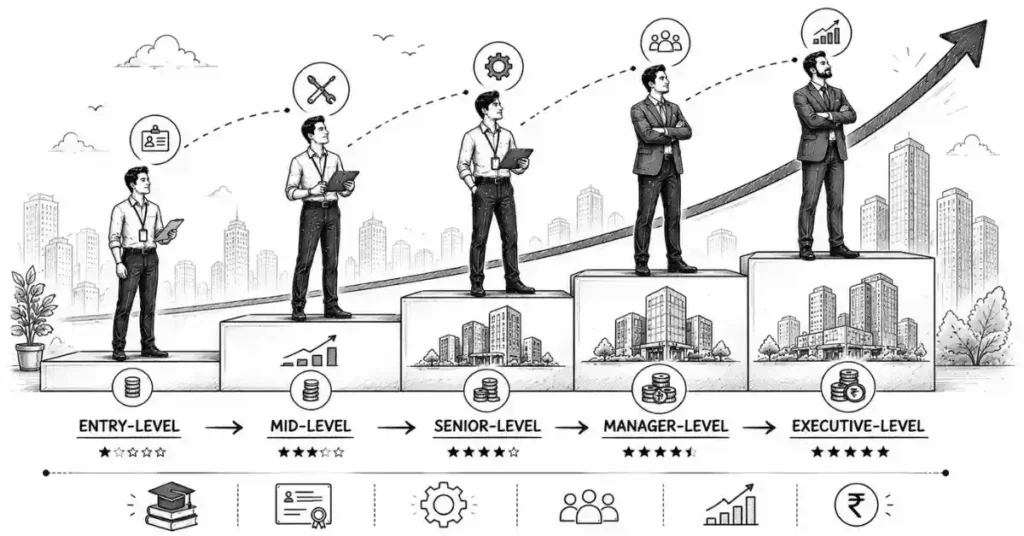
Entry-Level (0-1 year): Facility managers with less than 1 year experience earn an average of ₹3.6 lakh annually. These entry positions include assistant facility manager, facility coordinator, or facilities specialist roles supporting senior managers while building foundational knowledge.
Early Career (1-4 years): Facility managers with 1-4 years of experience earn an average of ₹3.9 lakh. At this stage, you manage specific facility functions independently or support larger portfolios, demonstrating competency in operations, vendor management, and problem-solving.
Mid-Career (5-10 years): Experienced facility managers with 5-10 years command significantly higher compensation. The average salary for facility managers is ₹5.7 lakh according to PayScale data, though 6figr reports facilities managers earning ₹17.8 lakh on average, mostly ranging from ₹13 lakh to ₹49.4 lakh. This wide range reflects variations in portfolio size, organizational type, geographic location, and credential status.
Senior Level (10-15 years): Senior facility managers with 10-15 years and CFM credentials typically earn ₹20-30 lakh annually, managing large portfolios, leading facility teams, and participating in strategic planning. These professionals often hold titles like Senior Facility Manager, Regional Facility Manager, or Facility Operations Manager.
Executive Level (15+ years): The most experienced facility professionals holding titles like Director of Facilities, VP of Facilities, or Chief Facilities Officer earn ₹30-50 lakh or more. The highest reported salary in facility management is ₹50 lakh, earned by top 1% professionals. Female facility management professionals average ₹25 lakh compared to ₹18 lakh for males, suggesting women in the field may hold more senior positions or specialized roles.
ipsum dolor sit amet, consectetur adipiscing elit. Ut elit tellus, luctus nec ullamcorper mattis, pulvinar dapibus leo.
Industry and Organizational Variations
Facility management compensation varies by employer type and industry. Corporate offices of large multinational companies, technology firms, consulting companies, and financial services offer higher salaries reflecting larger facilities, sophisticated operations, and strategic importance. Manufacturing facilities provide competitive compensation for facility managers understanding industrial operations, safety requirements, and production support. Healthcare institutions offer specialized facility management roles with premium compensation for managing complex medical environments. Government agencies provide stable employment with pension benefits, though typically lower cash compensation than private sector. Facility management service providers like CBRE, JLL, ISS, Sodexo, and specialized FM companies offer diverse exposure across client portfolios with competitive compensation structures.
CFM Certification Impact
The CFM credential creates substantial earning premiums. CFM holders earn 25% more than non-certified counterparts on average, representing approximately ₹4.5-6 lakh additional annual compensation for mid-career professionals. Beyond direct salary impact, CFM opens doors to senior positions, strategic roles, international opportunities, and consulting engagements unavailable to non-certified professionals, amplifying long-term earning potential significantly.
Building Your Facility Management Career
Entry Pathways
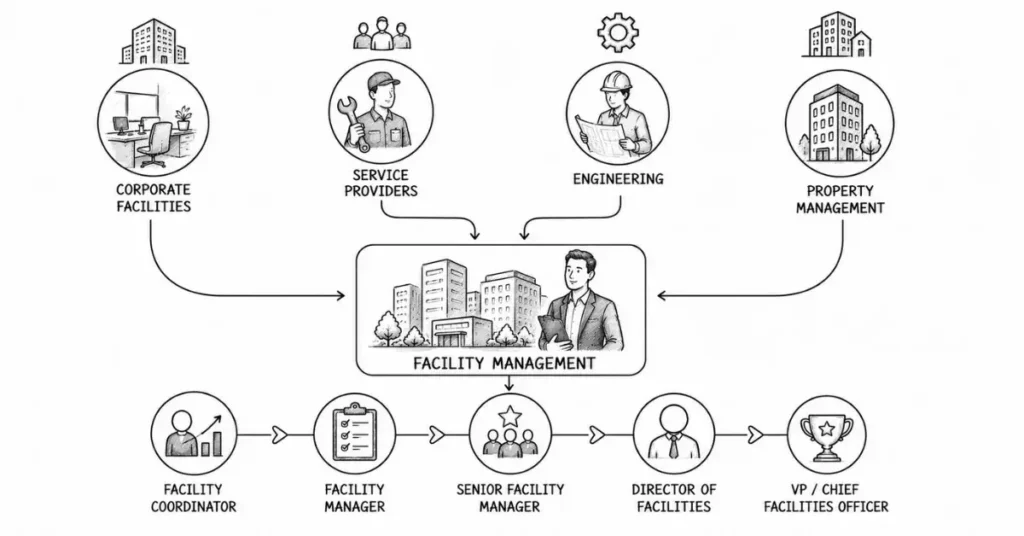
Corporate facilities departments: Apply for assistant facility manager, facilities coordinator, or operations specialist roles at large companies managing their own properties. These positions provide exposure to comprehensive facility operations while earning stable salaries and benefits.
Facility management service providers: Join firms like CBRE, JLL, Cushman & Wakefield, ISS, or Sodexo providing outsourced facility management services. These companies offer structured training programs, exposure to diverse facilities and industries, clear career progression paths, and opportunities to pursue certifications.
Engineering or operations backgrounds: Leverage mechanical, electrical, or civil engineering backgrounds into facilities roles, transitioning technical expertise into management responsibilities overseeing building systems and maintenance operations.
Property management transition: Move from property management focusing on tenant relationships into facility management emphasizing building operations, space planning, and technical systems management.
Career Advancement Strategies
Pursue CFM certification after gaining 3-5 years of experience to differentiate yourself, demonstrate commitment to the profession, expand your knowledge across all competency areas, and unlock senior positions requiring or strongly preferring CFM credentials.
Develop specialized expertise in sustainability and energy management, building automation and smart buildings, project management for capital improvements, space planning and workplace strategy, or specific industries (healthcare, data centers, manufacturing) where specialized knowledge commands premiums.
Build technical capabilities through continuous learning in building systems, PropTech innovations, data analytics platforms, regulatory changes, and industry best practices. Attend IFMA conferences, workshops, and webinars maintaining current knowledge.
Expand leadership skills by managing larger teams, taking responsibility for broader portfolios, participating in strategic planning, and developing business acumen understanding how facility management impacts organizational performance and profitability.
Consider geographic mobility as senior facility management roles often require willingness to relocate for regional or national positions overseeing multiple locations.
Frequently Asked Questions
Is facility management a good career in India? Yes, facility management offers strong compensation (₹17.8-50 lakh), growing demand driven by corporate expansion and infrastructure development, clear career progression, technical challenge and variety, and strategic importance to organizations making it a stable, rewarding profession.
What’s the difference between facility management and property management? Facility management focuses on operating buildings that organizations own and occupy, emphasizing building systems, space planning, and workplace services. Property management focuses on rental properties for third-party owners, emphasizing tenant relationships, leasing, and rent collection. Facility managers are more technical; property managers more relationship-focused.
Is the CFM certification worth the investment? Yes, CFM holders earn 25% more than non-certified peers and tend to occupy higher management positions. The credential costs approximately ₹1,00,000-₹1,20,000 for preparation plus exam fees, but typically pays for itself within 1-2 years through salary increases and career advancement.
Can I transition from engineering to facility management? Yes, engineering backgrounds (mechanical, electrical, civil) provide excellent foundations for facility management careers. Many successful facility managers started as engineers, transitioning technical expertise into broader management roles overseeing comprehensive facility operations.
What industries offer the best facility management opportunities? Technology companies, corporate offices, healthcare facilities, manufacturing plants, data centers, and facility management service providers offer excellent opportunities with competitive compensation, sophisticated operations, and career growth potential.
Do I need an engineering degree for facility management? No, while engineering degrees help, they’re not mandatory. Many successful facility managers come from business, management, or diverse backgrounds, succeeding through CFM certification, technical training, practical experience, and continuous learning.
Conclusion
Facility management careers offer technical challenge, strategic importance, solid compensation, job security, and professional satisfaction through ensuring built environments support organizational success and occupant wellbeing. The profession rewards technical knowledge, project management abilities, problem-solving skills, leadership capabilities, and commitment to continuous learning in a rapidly evolving field.
Your journey begins with entry-level positions building operational foundations, continues through developing specialized expertise and pursuing CFM certification demonstrating professional commitment, and advances through increasingly responsible roles managing larger portfolios and leading facility teams. Facility managers who build lasting success combine technical proficiency with business acumen, operational excellence with strategic thinking, and proven results with genuine service orientation.
Take your first step today—research facility management positions in your target industries, connect with practicing facility managers for informational interviews, investigate CFM eligibility and preparation resources, or apply for assistant facility manager roles building the foundations for this rewarding, technically sophisticated career in India’s expanding built environment sector.