
Entry Points for Freshers

Table of Contents
The Fresher's Question: "Can I Even Get a Manufacturing Job Without Experience?"
Here’s the good news that might surprise you: Manufacturing actively hires freshers. In fact, it’s one of the few industries where being a fresher is almost an advantage.
Why? Because manufacturing companies run structured trainee programs. They know they need to build talent from the ground up. Unlike some industries where “entry-level” really means “we expect 2-3 years of experience,” manufacturing genuinely welcomes college graduates with zero factory experience.
The manufacturing sector is experiencing a 15% increase in job opportunities, with extensive fresher hiring happening across companies. Freshers are actively recruited for training programs, graduate trainee positions, and entry-level operational roles.
Let’s walk through exactly how freshers like you enter manufacturing.
Three Main Entry Points for Freshers
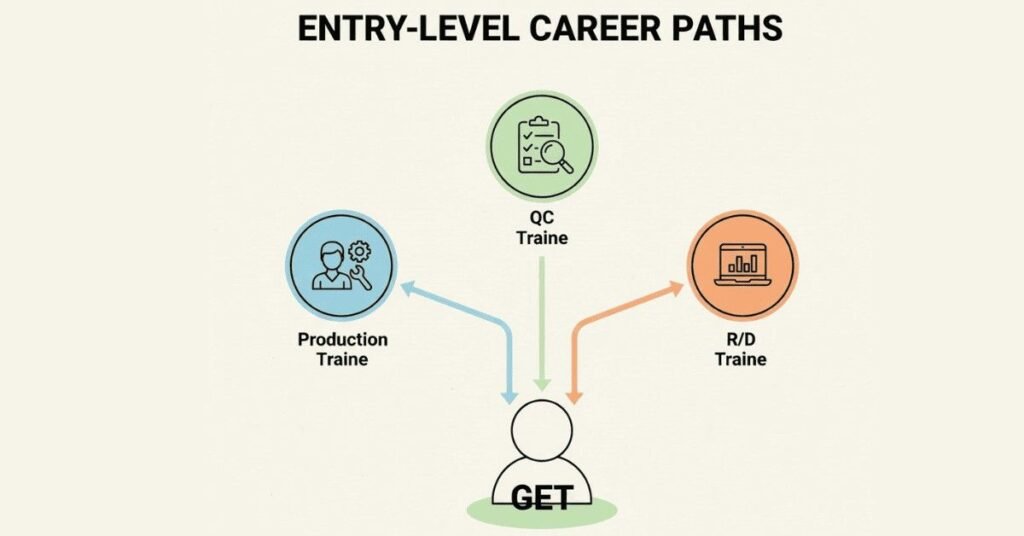
Entry Point 1: Graduate Engineer Trainee (GET) Programs
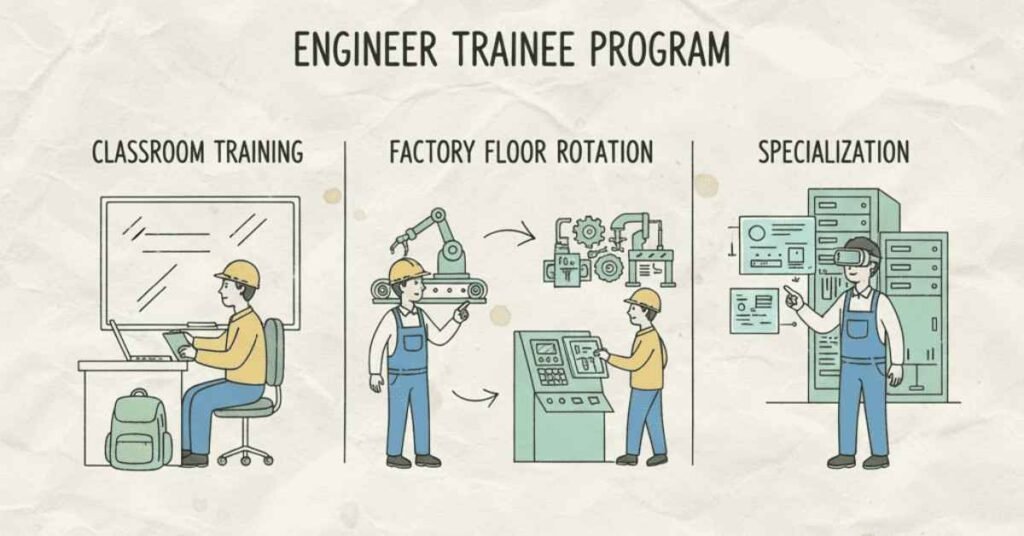
What It Is:
A structured, typically 6-12 month program designed specifically for engineering graduates (B.Tech, BE, or diploma holders). You join as a trainee, learn manufacturing processes, and then move to permanent roles.
Why Companies Run These Programs:
- They need fresh talent who understand modern technology
- They can train you in their specific processes
- You’re typically less expensive than experienced hires
- They’re building future leadership talent
Typical Structure:
- Month 1-2: Classroom training (safety, company policies, manufacturing basics)
- Month 2-4: Floor training (rotating through different departments)
- Month 4-8: Focused learning on your specialization (production, quality, maintenance)
- Month 8-12: Taking on small projects and responsibilities
Salary:
₹18,000-28,000/month during training period
₹22,000-35,000/month after completion when you move to permanent role
Entry Requirements:
- Bachelor’s degree in Engineering (any discipline—Mechanical, Electrical, Electronics, Chemical, Civil)
- Polytechnic diploma in Engineering
- Some companies also accept B.Sc. graduates
Companies Running GET Programs:
- L&T (Larsen & Toubro)
- Bosch
- Siemens
- Mahindra & Mahindra
- Bajaj Auto
- Vedanta
- Various mid-size manufacturers
Why GET is Great for Freshers:
- Highest starting salary among entry-level roles
- Structured learning (not just thrown into work)
- Fast-track to supervisory roles
- Clear pathway to engineering positions
Challenge:
Competition is fierce. These programs have 100+ applicants for each position. You need strong academics and interview skills.
Entry Point 2: Production Trainee / Associate Programs
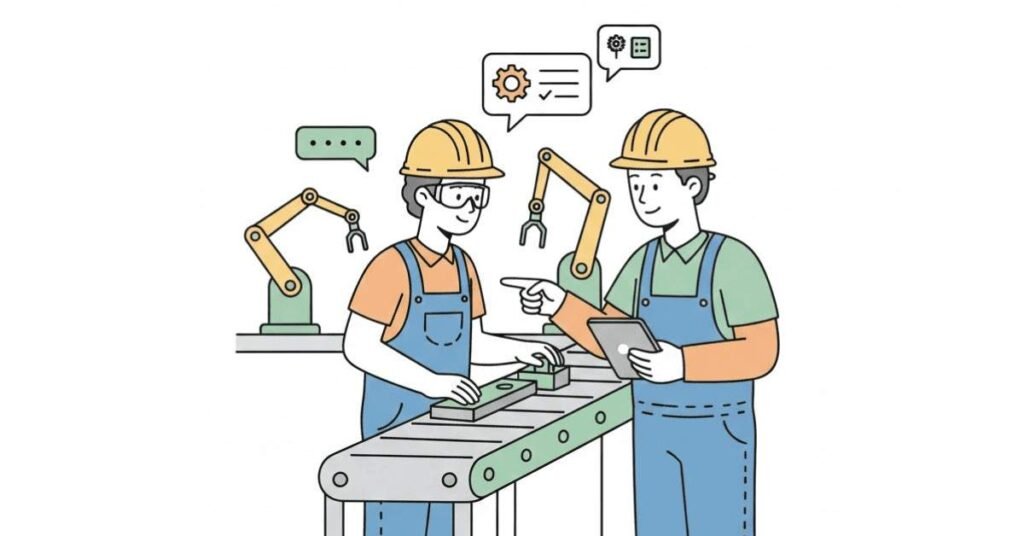
What It Is:
Entry-level positions for diploma or even 12th-pass holders. You work directly on production floors, learning hands-on manufacturing processes.
Why Companies Hire This Way:
- Produces skilled workers for production lines
- Identifies talent for advancement
- Builds efficient, trained workforce
- Creates future supervisors and technicians
Typical Structure:
- First 2-3 months: Learning production procedures, safety compliance, equipment familiarity
- Month 4-6: Working independently on assigned production line
- Month 6+: Taking on responsibility, mentoring newer trainees, considering advancement
Salary:
₹10,000-16,000/month
With performance bonuses and shift allowances: ₹12,000-20,000/month
Entry Requirements:
- 12th pass (higher secondary)
- Industrial Training Institute (ITI) certification (preferred but not required)
- Age typically 18-28 years
- Physical fitness for factory floor work
Advancement Timeline:
- Year 1: Production Trainee (₹10,000-16,000)
- Year 2: Senior Production Associate (₹16,000-24,000)
- Year 3: Shift Supervisor or Lead (₹24,000-35,000)
Why Production Trainee is Great for Freshers:
- Easiest entry (minimal qualifications required)
- Immediate earning (you’re paid while learning)
- Clear advancement path (can reach supervisory roles within 3-4 years)
- Practical skills (you learn by doing)
Challenge:
Involves shift work (may include night shifts), physical demands, and requires adjustment to factory environment.
Entry Point 3: Quality Control / Quality Assurance Trainee
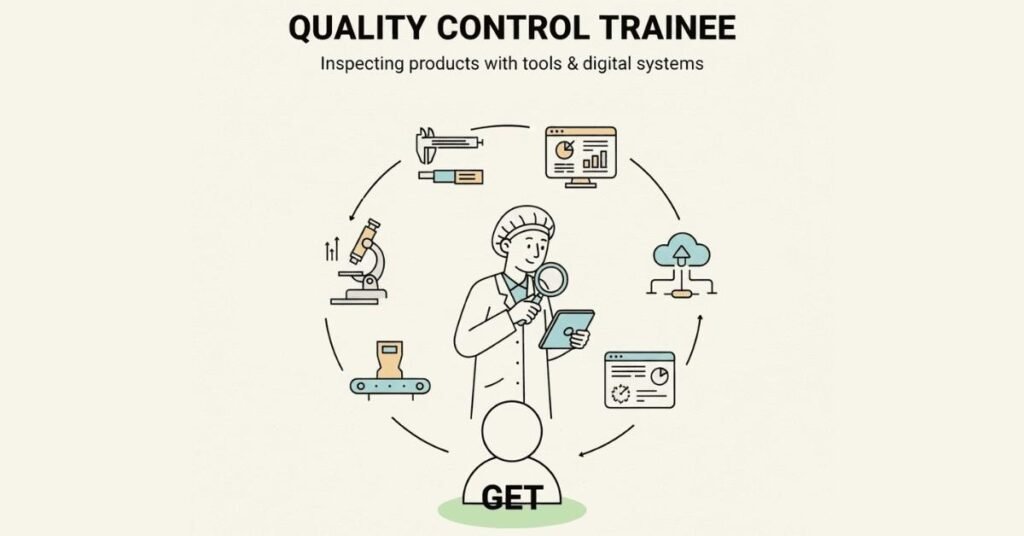
What It Is:
Specialized entry role focused on quality and inspection. You learn to identify defects, maintain quality standards, and use quality systems.
Why Companies Hire This Way:
- Quality is critical; they need trained QC personnel
- Offers clear career path into quality management
- Requires attention to detail and can be learned on-the-job
- Combines technical and analytical skills
Typical Structure:
- Month 1-2: Quality standards, inspection techniques, documentation
- Month 2-4: Shadowing experienced inspectors
- Month 4+: Independent inspection with supervisor oversight
- Parallel: Learning quality management systems (ISO 9001, SPC, etc.)
Salary:
₹10,000-20,000/month as trainee
₹18,000-28,000/month after 1 year as QC Executive
Entry Requirements:
- 12th pass or diploma in any field
- Some roles prefer Science background (but not mandatory)
- Good English for documentation
- Attention to detail and analytical thinking
Advancement Timeline:
- Year 1: QC Trainee (₹10,000-20,000)
- Year 2: QC Executive (₹18,000-28,000)
- Year 3: Quality Supervisor (₹25,000-35,000)
- Year 4-5: Quality Manager (₹35,000-50,000)
Why QC Trainee is Great for Freshers:
- Fastest path to management (QA roles lead to manager positions relatively quickly)
- Lower physical demand than production roles
- Combines technical + thinking work
- High career ceiling (can reach senior management)
- Specialized expertise (makes you valuable)
Challenge:
Can be monotonous (repetitive checking). Requires maintaining high concentration throughout shifts.
Which Entry Point Should YOU Choose?
Use this decision framework:
Choose GET Program If:
- You have an engineering degree (B.Tech, BE, or diploma)
- You want the highest starting salary
- You’re comfortable with competition and rigorous interviews
- You want to move into engineering/planning roles faster
- You prefer structured classroom training initially
Choose Production Trainee If:
- You don’t have an engineering degree
- You want to learn manufacturing from the ground up
- You’re comfortable with hands-on, physical work
- You prefer immediate earning over extended classroom training
- You want practical, real-world learning
Choose QC Trainee If:
- You’re analytically inclined (like solving problems, analyzing data)
- You want to avoid heavy physical work
- You prefer specialization (quality is a distinct expertise)
- You aspire to management roles
- You’re detail-oriented and comfortable with inspection work
The Fresher Hiring Timeline: When to Apply
Manufacturing has seasonal hiring patterns. Know when to apply:
Peak Hiring Seasons:
- January-March: Campus hiring, companies recruiting for April start dates
- June-August: Mid-year hiring, filling vacancies and expanding
- September-October: Preparing for year-end busy period
- December: Sometimes hiring for January starts
Best Strategy:
Apply during these periods. Applications submitted outside these windows might sit in queues or face rejection.
For Campus Placements:
Register with your college placement cell. Most campus hiring happens in your final year (final semester or immediately after graduation).
For Off-Campus:
Apply directly on company websites or job portals once you graduate. Fresher roles are advertised on:
- LinkedIn Jobs
- Indeed India
- Company careers pages
- Naukri.com
- Monster.com
What Companies Actually Look for in Fresher Candidates
Based on how companies evaluate freshers:
Technical Factors (40% importance):
- GPA/Academic score (minimum usually 6.5-7.0 out of 10)
- Relevant engineering background (mechanical, production, industrial preferred, but not required)
- Projects or internships (shows initiative and understanding)
- Certifications (Lean, CAD, safety training—shows extra learning)
Soft Factors (40% importance):
- Communication ability (can you explain technical concepts clearly?)
- Problem-solving approach (how do you think through challenges?)
- Attitude toward learning (willingness to learn, curiosity, humility)
- Team collaboration (can you work with others?)
Practical Factors (20% importance):
- Attendance reliability (critical in manufacturing)
- Physical capability (can you work in industrial environments?)
- Shift flexibility (willing to work varying shifts?)
- Location flexibility (willing to relocate within Telangana/AP?)
What Companies DON’T Care About (for freshers):
- Previous work experience (you don’t have it; that’s fine)
- Specific manufacturing experience (they’ll teach you)
- Perfect English (basic communication is enough)
Specific certifications (they can be learned on-job
The Realistic First Job Picture
Be honest with yourself about your first manufacturing job:
It Will Be:
- Repetitive initially (you’re learning fundamentals)
- Structured and rules-based (safety and compliance matter)
- Involving shift work (potentially night or weekend shifts)
- Physically or mentally demanding (factory floors are not relaxing)
- Involving detailed procedures (everything follows protocols)
It Will NOT Be:
- Glamorous (you’re not in a corporate office)
- Highly creative initially (you follow existing processes)
- Completely comfortable (factories are hot, noisy, and industrial)
- Independent immediately (you’ll have supervisors and training)
But Here’s the Reality: Most freshers who stay past year 1 find it genuinely interesting. Manufacturing is problem-solving. Every day presents challenges and learning opportunities. The work feels concrete and meaningful (you see products being made).
The First-Year Milestone: Beyond Trainee Status
Your goal in year 1 isn’t just to survive—it’s to transition from trainee to permanent contributor:
Month 1-3: Learning Phase
- Complete all training
- Demonstrate reliability
- Ask questions actively
- Build relationships with supervisors
Month 4-6: Contribution Phase
- Work independently on core tasks
- Contribute ideas (even small ones)
- Mentor newer trainees
- Show problem-solving ability
Month 7-12: Advancement Phase
- Propose improvements
- Take on leadership in small tasks
- Plan next specialization
- Discuss career development with supervisor
At 12 Months: You should no longer be considered a “trainee.” You’re a valued team member with clear next steps.
The Bottom Line: Your Entry is Guaranteed
Manufacturing genuinely welcomes freshers. You’re not competing against experienced professionals for entry-level roles. You’re competing against other freshers. The bar is reasonable: show up reliably, learn eagerly, and contribute positively.
With 500,000 new job openings projected and 15% increase in fresher opportunities, your entry into manufacturing is not just possible—it’s actively encouraged.
Your job now: Pick the right entry point for your qualifications and interests. Then execute the application strategy during hiring seasons. Your manufacturing career starts there.