
Education Sector Career Guide
Table of Contents
Part 1:Introduction & Understanding the Education Landscape
Think education careers are just about teaching? Think again. The education sector in India has transformed into a multi-billion dollar industry with opportunities you probably never knew existed. Whether you’re a fresh graduate wondering what’s next or someone looking to switch careers, this guide will walk you through every possibility the education world has to offer.
Why Choose Education as a Career?
Picture this: India has over 600 million people under 25 years old—that’s the world’s largest youth population. Every single one of them needs education, guidance, and skill development. The EdTech market alone is expected to hit $10.4 billion by the end of 2025, growing at nearly 40% each year. What does this mean for you? Simple—job security, growth opportunities, and the chance to make real impact.
The best part? You don’t need to stand in front of a classroom to work in education anymore. From designing online courses to managing educational technology platforms, the sector has evolved dramatically. People with diverse backgrounds—whether you’re from engineering, arts, commerce, or science—can find their perfect fit here.
The Education Sector Today: Breaking It Down
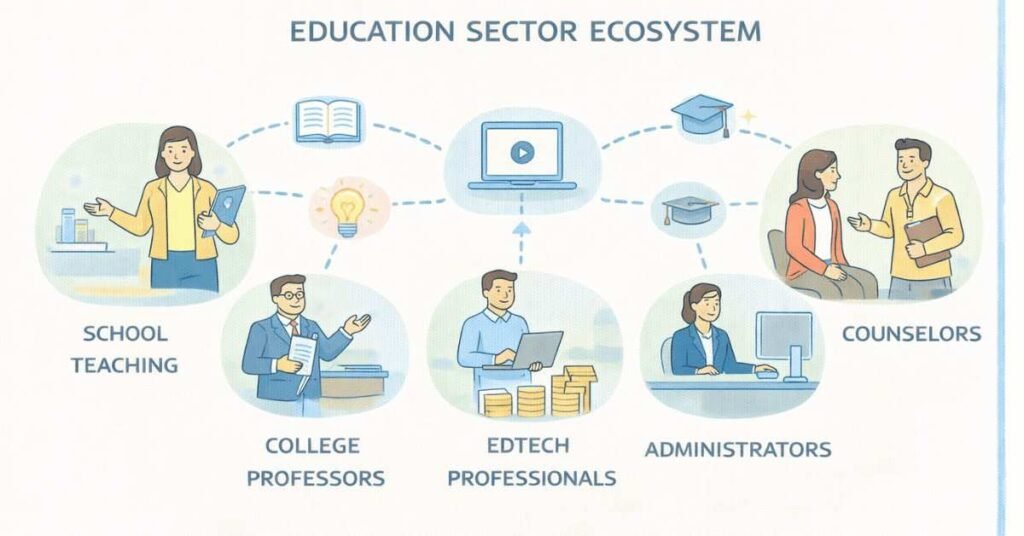
Let me break down the education sector into digestible pieces so you understand where you can fit in:
Traditional Teaching Roles — These include positions in schools and colleges where you directly teach students. You’ll need specific qualifications like B.Ed or M.Ed, but the satisfaction of shaping young minds is unmatched.
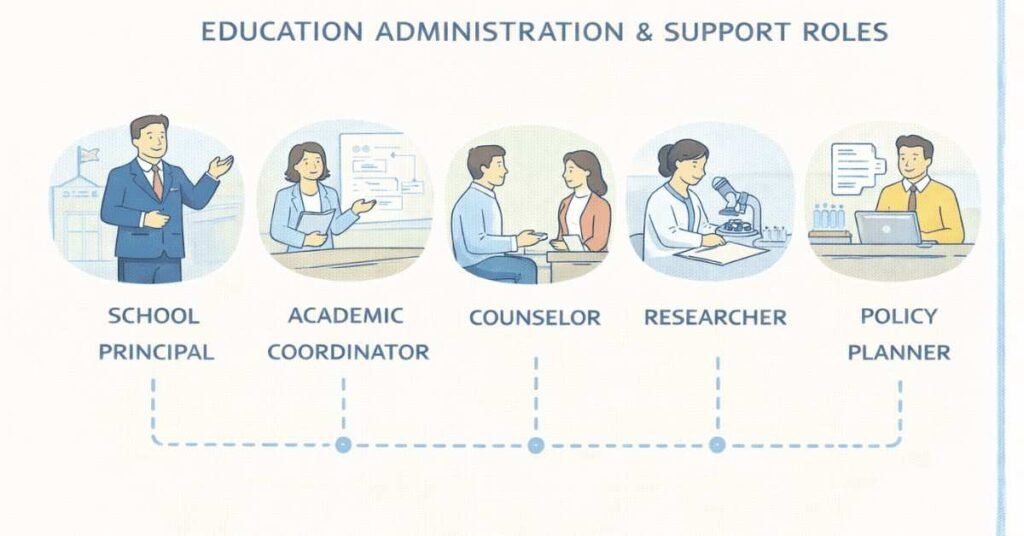
Educational Administration — Think principals, academic coordinators, and education managers. These professionals run educational institutions, making strategic decisions that affect hundreds of students. Average salaries here range from ₹17.2 lakhs annually, with top performers earning over ₹40 lakhs.
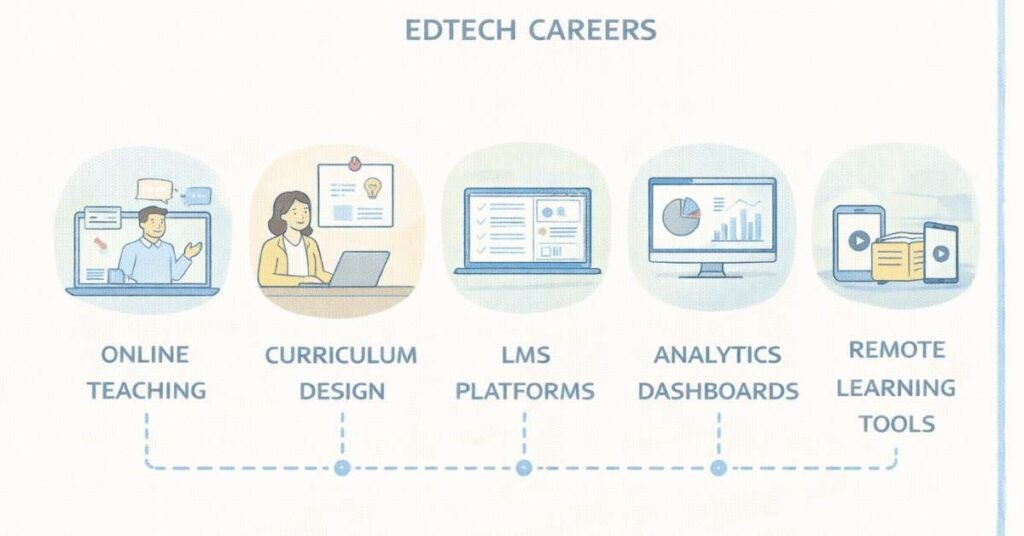
EdTech Sector — This is where technology meets education. Content developers, instructional designers, learning consultants, and platform managers work together to create digital learning experiences. With remote work options and competitive pay, this sector is attracting talent from across the country.
Support Services — Educational counselors, curriculum developers, academic writers, and researchers play crucial behind-the-scenes roles that keep the education system running smoothly.
What Makes Education Careers Attractive
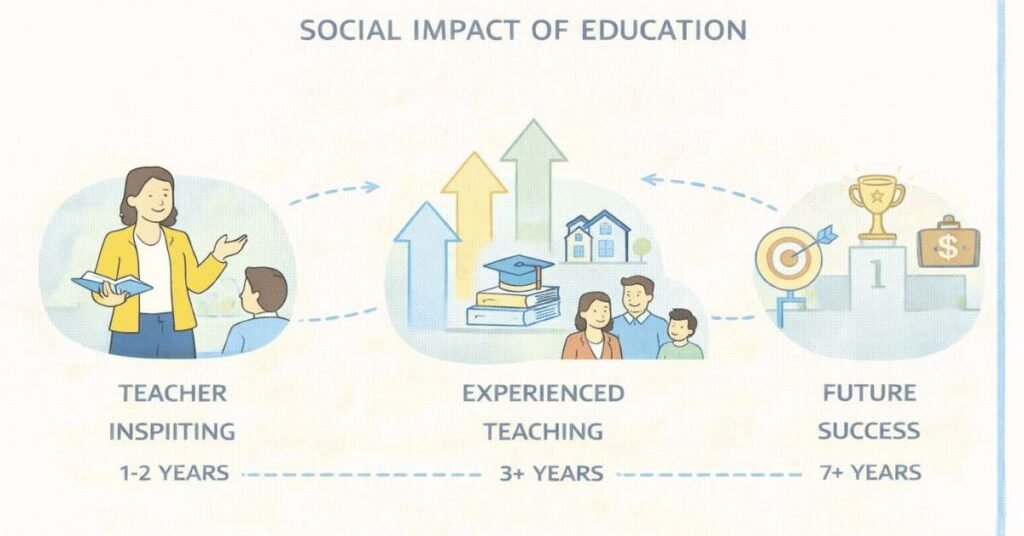
Research shows that B.Ed graduates with EdTech skills have 30% higher placement rates compared to those without digital competencies. The government’s focus on education reforms through NITI Aayog has created policy-level opportunities that didn’t exist five years ago. Plus, with the rise of hybrid learning models, professionals can now work from anywhere while contributing to education.
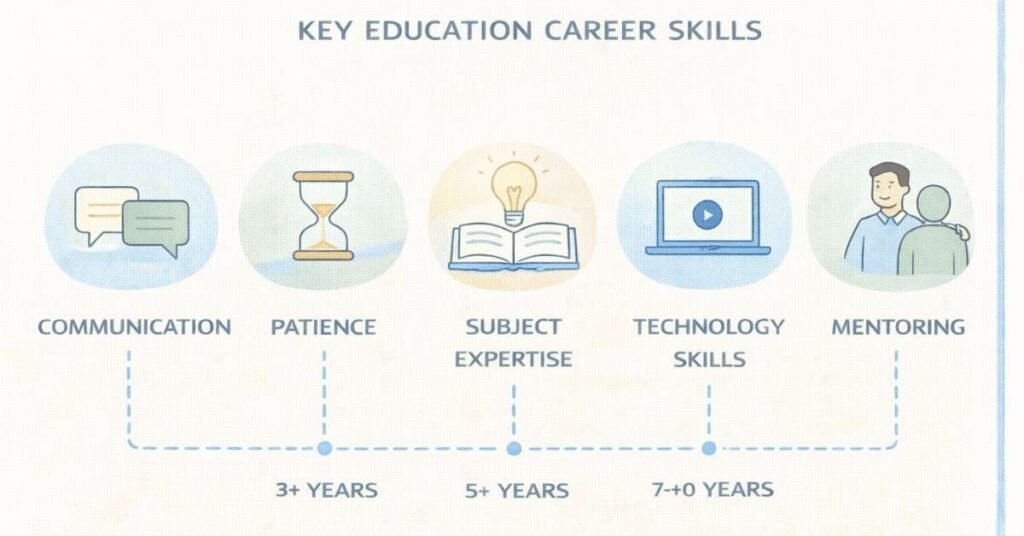
But here’s what nobody tells you: success in education careers isn’t just about degrees anymore. It’s about understanding how students learn, staying updated with technology, and having genuine passion for helping others grow. If you can communicate well, solve problems creatively, and adapt to changing learning environments, you’re already halfway there.
Part 2: Traditional Teaching Careers — The Foundation
School Teaching: Where It All Begins
School teaching remains the heart of education careers, and it’s far more diverse than you might think. When you become a teacher, you’re not just covering textbook chapters—you’re building character, inspiring curiosity, and helping children discover their strengths.
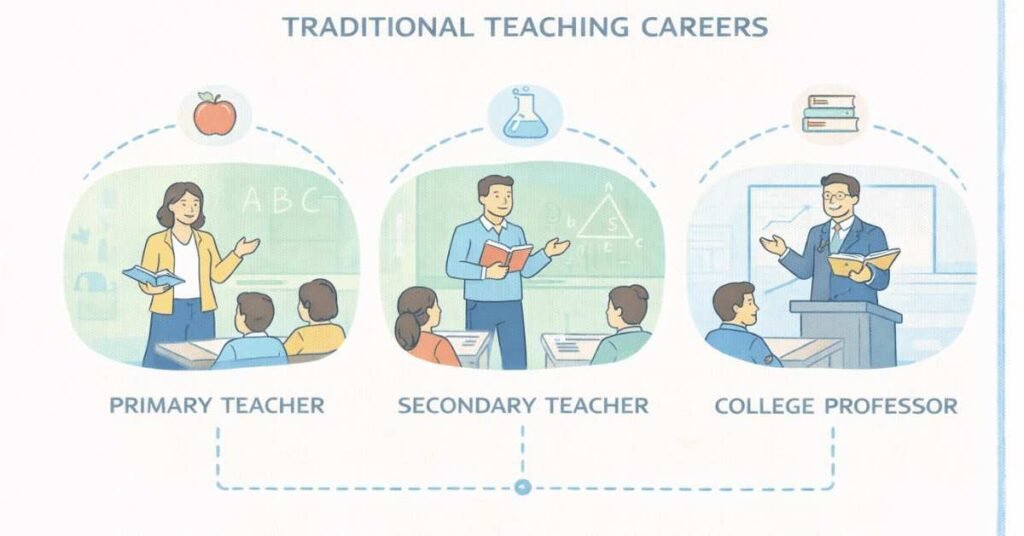
Primary Level Teachers (Classes 1-5) work with young children during their formative years. You’ll teach multiple subjects, manage classrooms full of energy, and develop creative ways to make learning fun. The key qualification here is D.El.Ed (Diploma in Elementary Education) or B.El.Ed (Bachelor in Elementary Education).
Secondary Teachers (Classes 6-10) typically specialize in specific subjects like Mathematics, Science, English, or Social Studies. You need a bachelor’s degree in your subject along with B.Ed certification. This is where you help students build strong conceptual foundations that prepare them for higher education.
Senior Secondary Teachers (Classes 11-12) are called Post Graduate Teachers (PGTs) and need a master’s degree in their subject plus B.Ed. Salaries range from ₹30,000 to ₹50,000 per month in most schools, but specialized subject teachers often command higher packages.
Qualifications You'll Need
Let me simplify the educational pathway for you:
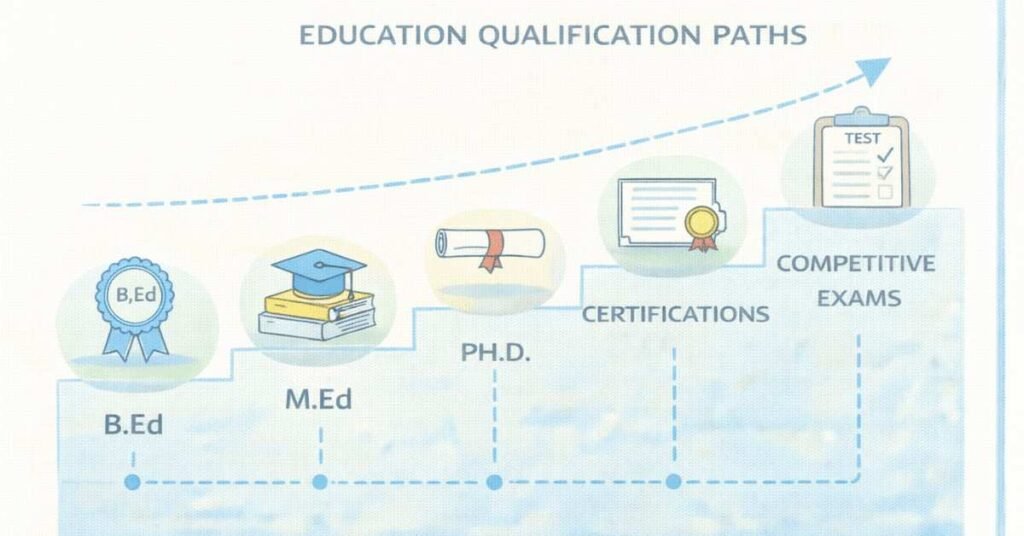
After completing your 10+2 education, pursue a bachelor’s degree in any discipline. Then enroll in B.Ed (Bachelor of Education), which is a two-year program that teaches you teaching methodologies, educational psychology, and classroom management. Some students also opt for integrated B.A. B.Ed or B.Sc. B.Ed programs that combine undergraduate and teaching degrees.
Next comes the Teacher Eligibility Test (TET)—either CTET for central government schools or state-level TET for state schools. This exam tests your understanding of child development, teaching methods, and subject knowledge. Without clearing TET, you cannot teach in government or recognized private schools.
Government vs Private School Teaching
Government Teaching Jobs offer job security, pension benefits, and fixed pay scales. However, getting in requires clearing competitive exams and sometimes waiting for positions to open up. Once you’re in, your career progression follows a structured path with regular increments.
Private School Teaching provides flexibility, better infrastructure, and often higher starting salaries. Many private schools use smart boards, digital learning tools, and innovative teaching methods that make your job more engaging. You also get more opportunities for professional development through workshops and training programs.
The choice between government and private depends on what you value more—long-term security or dynamic work environments. Many teachers start in private schools to gain experience and then transition to government positions later.
Beyond Classroom Teaching
Schools need more than just subject teachers. Consider these specializations:
Class Mentors guide students through academic and personal challenges, helping them develop holistically. Co-curricular Coordinators organize sports, arts, and cultural activities that build students’ confidence and teamwork skills. School Counselors require additional counseling certification but address students’ emotional and psychological needs.
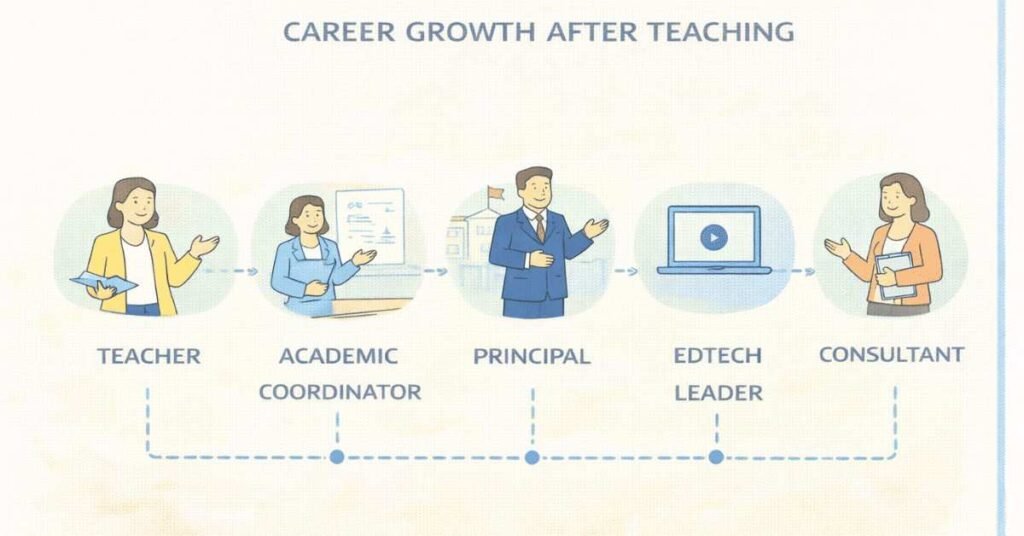
Career growth in school teaching typically progresses from teacher to senior teacher, then department head, vice principal, and finally principal. Principals earn between ₹40,000 to ₹80,000 monthly depending on the school’s size and reputation.
Part 3: Higher Education & College Teaching — The Academic Path
Understanding College-Level Teaching Positions
College teaching represents a significant step up from school education, where you’ll engage with young adults who’ve chosen to study your subject. Unlike school teachers who follow prescribed syllabi, college professors have more academic freedom to shape course content, conduct research, and contribute to their field’s knowledge base.
The hierarchy in higher education follows a clear progression:
Assistant Professor (Entry Level) — This is where most teaching careers in higher education begin. You’ll teach undergraduate and postgraduate students, supervise projects, and start building your research portfolio. The starting basic pay under the 7th Pay Commission is ₹57,700 per month, which increases to ₹90,000-₹1.1 lakhs with allowances like Dearness Allowance (55%), House Rent Allowance (10-30%), and Transport Allowance.
Associate Professor (Mid-Level) — After gaining 6 years of post-PhD experience, including at least 3 years as an Assistant Professor, you can be promoted to this level. You’re expected to have published at least 10 research papers, guided one PhD student, and completed sponsored research projects worth ₹5 lakhs or more. The pay scale ranges from ₹57,700 to ₹1,82,400.
Professor (Senior Level) — This position requires 10 years of post-PhD experience, with at least 4 years as an Associate Professor. Senior professors have published 20+ papers in reputed journals, independently guided PhD students, and completed multiple research projects. They often lead departments, make policy decisions, and represent their institutions at national and international forums.
The UGC NET: Your Gateway to College Teaching
The National Eligibility Test (NET) conducted by the University Grants Commission (UGC) is the standard qualifying exam for Assistant Professor positions across India. Let me break down what you need to know:
Eligibility Requirements — You must have a Master’s degree in your chosen subject with at least 55% marks (50% for SC/ST/OBC/PwD categories) from a UGC-recognized university. There’s no upper age limit for Assistant Professor eligibility, making this accessible even if you’re switching careers later in life.
Exam Pattern — UGC NET tests your subject knowledge, teaching aptitude, research methodology, and comprehension skills. The National Testing Agency (NTA) conducts this exam twice a year, giving you multiple opportunities to qualify.
Alternative Routes — If you hold a PhD degree awarded through proper research methodology (with external examiners and viva voce), you’re exempted from NET. You can also qualify through GATE (for engineering subjects), CSIR-NET (for science subjects), or State-level SET exams.
The important thing to understand is this: UGC NET opens doors not just to teaching, but also to Junior Research Fellowships (JRF) that provide ₹37,000 monthly stipend for pursuing PhD. Many candidates use NET qualification as a stepping stone to build academic careers combining teaching and research.
The PhD Journey: Building Your Academic Credentials
While not mandatory for Assistant Professor positions if you’ve cleared NET, a PhD significantly enhances your career prospects and is becoming increasingly important under the National Education Policy 2020.
Why Pursue a PhD? — Doctoral research deepens your expertise, opens research opportunities, exempts you from NET, and positions you for faster career progression. Universities value PhD holders for their ability to guide research students and bring funding through sponsored projects.
The Process — After your Master’s degree, you’ll enroll in a PhD program (typically 3-5 years), select a research supervisor, conduct original research, publish papers in peer-reviewed journals, and defend your thesis before expert examiners. The journey demands dedication, but PhD holders command respect in academic circles and often secure better positions.
PhD Requirements for Career Growth — To become an Associate Professor, you need a PhD plus 10 publications. For Professor-level positions, institutions expect 20+ publications, multiple PhD students guided, and substantial research funding secured. Your doctoral work essentially becomes the foundation for your entire academic career.
Getting Your First Break: Entry-Level Opportunities
Starting your college teaching career doesn’t always require waiting for permanent positions. Several entry points exist:
Guest Lecturer Positions — Government colleges pay ₹1,500 per lecture with a maximum of ₹50,000 monthly based on the number of classes you teach. Private colleges offer varying rates, with average monthly earnings around ₹42,083. While contractual and without full benefits, guest lecturing lets you gain teaching experience, build connections with faculty, understand academic culture, and strengthen your resume for permanent positions.
Visiting Faculty Roles — These positions offer more stability than guest lecturing, with average annual compensation of ₹28.1 lakhs. Visiting faculty typically work on semester or annual contracts, teach regular courses, and participate in department activities. Top performers in prestigious institutions earn ₹48-54 lakhs annually.
Research Associate Positions — After completing your PhD (or during the final stages), you can work as a Research Associate or Postdoctoral Fellow. Institutions like IISER Pune, IIT Madras, and ISB offer 2-3 year positions where you conduct research, publish papers, and gain teaching experience. These roles are excellent preparation for permanent faculty positions and help you build publication records.
Government vs Private College Teaching: Making the Choice
Both sectors offer distinct advantages, and understanding these helps you make informed career decisions.
Government College/University Positions — These provide unmatched job security with permanent tenure after probation, structured pay according to 7th Pay Commission (ensuring fair compensation), pension benefits and retirement security, and opportunities for funded research through government schemes. Government institutions often have established reputations, and faculty enjoy significant academic freedom. However, bureaucratic processes can be slow, infrastructure may lag behind modern standards, and promotions follow rigid timelines.
Private College/University Positions — Private institutions typically offer modern infrastructure with smart classrooms and advanced labs, better placement support for students (which reflects well on faculty), flexibility in teaching methods and curriculum innovation, and often higher starting salaries in prestigious institutions. You’ll also find more industry collaboration opportunities and exposure to contemporary educational technologies. The trade-offs include less job security (especially in smaller colleges), performance pressure linked to student outcomes, and varying quality of work environment depending on the institution’s management.
Many academics start in private colleges to gain experience and build credentials, then transition to government positions for long-term stability. Others prefer staying in top-tier private universities like BITS Pilani, ISB, or leading private institutions that offer competitive packages and excellent work environments.
Part 4: EdTech Careers & Modern Opportunities — The Digital Revolution
The EdTech Boom: Understanding the Landscape
India’s EdTech sector has exploded into a ₹10.4 billion industry by the end of 2025, growing at an impressive 39.77% annually. Between 2020 and 2023 alone, Indian EdTech startups raised over $16 billion in funding. What does this mean for your career? Thousands of new jobs that didn’t exist a decade ago, combining education expertise with technology skills.
The beauty of EdTech careers is their flexibility—you can work from home, set your own schedule in many roles, and reach students across the globe without ever entering a physical classroom. Companies like BYJU’S, Unacademy, Vedantu, WhiteHat Jr, and Toppr are constantly hiring educators who understand both teaching and technology.
Content Developer & Curriculum Designer: Creating Learning Experiences
Content developers are the architects of online learning. You’ll design course materials, create video scripts, develop interactive exercises, and ensure content aligns with learning objectives. Unlike traditional teaching where you explain concepts to one class, your work reaches thousands of students simultaneously.
What the role involves — You’ll research subject matter thoroughly, break down complex topics into digestible chunks, write engaging explanations that hold attention, create assessments that test understanding effectively, and collaborate with graphic designers and video producers. The work requires strong subject knowledge combined with creativity in presentation.
Skills that matter — Beyond your subject expertise, you need excellent written communication, understanding of different learning styles, ability to simplify without dumbing down, and familiarity with Learning Management Systems (LMS). Basic knowledge of instructional design principles helps you structure content that actually helps students learn, not just read.
Compensation and growth — Curriculum developers in India earn between ₹4-8 lakhs annually at entry level, scaling up to ₹12-20 lakhs for experienced professionals. Senior instructional designers in companies like Sanofi or major EdTech firms command even higher packages. The role also offers freelance opportunities where you can work with multiple organizations simultaneously.
Online Teaching & Tutoring: Education Without Boundaries
Online tutoring has become one of the most accessible entry points into EdTech careers. You don’t need to relocate to metro cities or invest in physical infrastructure—just solid subject knowledge, good internet connection, and teaching skills.
Platform-based teaching — Major EdTech platforms hire subject matter experts to conduct live classes, create recorded lessons, solve student doubts, and provide personalized guidance. You’ll use interactive whiteboards, screen sharing, and engaging teaching methods adapted for digital delivery. The advantage? You teach once, but your recorded sessions reach thousands of students over time.
Independent online tutoring — Many educators build their own student base through platforms or personal marketing. You set your own rates (typically ₹500-₹2,000 per hour depending on subject and level), choose your schedule, and work with students who specifically want your teaching style. Successful online tutors report earning ₹50,000-₹1.5 lakhs monthly once they establish reputation.
What makes online teachers successful — Technical comfort with video conferencing tools, ability to engage students through screens (which is harder than face-to-face), patience with technology glitches, strong communication that compensates for lack of physical presence, and adaptability to different student learning paces.
Educational Technology Specialist: The Bridge Between Teaching and Tech
Educational technology specialists help schools and institutions implement digital learning solutions. Think of yourself as the translator between educators who know teaching and tech teams who know software.
Your responsibilities — You’ll evaluate educational software and tools, train teachers on using technology effectively, troubleshoot technical issues that arise during classes, design blended learning strategies combining offline and online methods, and analyze data to improve learning outcomes. This role requires understanding both pedagogy and technology deeply.
Career path and salary — Entry-level EdTech specialists earn ₹5-7 lakhs annually, mid-level professionals with 3-5 years experience earn ₹10-15 lakhs, and senior specialists or managers command ₹18-30 lakhs. With India’s education institutions rapidly digitizing, demand for these professionals continues growing.
Academic Counselor & Career Advisor: Guiding Student Futures
Academic counseling has evolved beyond simply helping students choose subjects. Modern counselors guide career decisions, mental health support, college applications, entrance exam preparation, and skill development planning.
Government institution counselors — Schools and colleges employ counselors to support students’ academic planning and career guidance. You’ll conduct one-on-one sessions, organize career fairs, coordinate with parents, and maintain student progress records. Government positions offer ₹4-7 lakhs annually with regular benefits.
Private sector counseling — EdTech companies, study-abroad consultancies, and private schools hire counselors who understand diverse career pathways. You’ll stay updated on emerging careers, admission processes, scholarship opportunities, and industry trends. Experienced counselors in premium institutions earn ₹8-15 lakhs annually.
Essential counselor skills — Active listening without judgment, knowledge of various career paths and educational opportunities, empathy and patience with confused students, excellent interpersonal communication, and understanding of psychological principles (though not requiring full psychology degrees).
Part 5: Educational Administration & Leadership Roles
School Principal & Administrative Leadership
Moving into educational administration means transitioning from teaching individuals to leading entire institutions. Principals and administrators shape school culture, implement educational policies, manage budgets, and ensure quality education delivery.
The principal’s role — Beyond administrative paperwork, modern principals lead curriculum innovation, teacher professional development, parent engagement initiatives, and strategic planning for institutional growth. You’re responsible for everything from academic results to infrastructure development.
Qualification pathway — Most principals start as teachers, progress to senior teacher positions, then become department heads or vice principals before taking principal roles. The journey typically requires 10-15 years of teaching experience, M.Ed degree, and demonstrated leadership capabilities. Many institutions now prefer principals with management qualifications (MBA in Education Management or similar) alongside teaching degrees.
Compensation varies significantly — Government school principals earn ₹50,000-₹80,000 monthly under structured pay scales. Private school principals’ salaries depend on the institution’s reputation and size—ranging from ₹60,000 in smaller schools to ₹2-3 lakhs monthly in elite institutions. International schools and prestigious private institutions offer even higher packages with additional perks.
Education Administration Specialists
Educational administrators work at district, state, or national levels managing educational programs and policies. These are desk jobs focusing on planning, coordination, and implementation rather than direct student interaction.
Typical roles include — Academic coordinators who oversee curriculum implementation across multiple schools, training coordinators who design and deliver teacher professional development, education officers in government departments managing various schemes, and policy analysts who research and recommend educational reforms. The average salary for school administration professionals is ₹17.2 lakhs annually, with top performers earning ₹40+ lakhs.
Skills for administration success — Project management abilities to handle multiple initiatives simultaneously, analytical skills to interpret educational data and trends, leadership qualities to motivate teams, communication skills for liaising with stakeholders at all levels, and understanding of educational policies and regulations.
Part 6: Alternative & Specialized Career Paths
Special Education Teachers: Making Education Inclusive
Special education focuses on students with learning disabilities, physical disabilities, autism spectrum disorders, or other special needs. This specialized field requires additional training but offers immensely rewarding experiences.
Why specialize in special education — India has millions of children with special needs requiring trained educators who understand differentiated instruction methods. The field faces severe shortage of qualified professionals, making it easier to find positions with better compensation. Special education teachers earn ₹8-30 lakhs annually depending on expertise and institution.
Additional qualifications needed — After your B.Ed, pursue specialized diplomas or certificates in Special Education, which typically last 6-12 months. You’ll learn about various disabilities, inclusive teaching strategies, assistive technologies, individualized education plans (IEPs), and behavioral management techniques.
Educational Researcher & Policy Analyst
Educational research involves studying teaching methods, learning patterns, policy effectiveness, and educational trends to improve systems. Researchers work with institutions like NCERT, SCERT, UGC, state education boards, or private research organizations.
What researchers do — Design research studies on educational issues, collect and analyze data from schools and students, publish findings in academic journals, present at conferences, and advise policymakers on evidence-based reforms. PhD holders are particularly sought after for research positions.
Career prospects — Research associate positions start at ₹4-6 lakhs annually, while senior researchers and fellows earn ₹8-15 lakhs. The work offers intellectual satisfaction, contributes to systemic improvements, and provides opportunities for international collaboration.
Content Writing & Educational Publishing
Educational writers create textbooks, reference materials, test preparation guides, online articles, and educational blogs. If you love your subject but prefer writing over teaching, this path offers creative fulfillment.
Types of educational writing — Textbook authors work with publishers like NCERT, private publishers, or international companies, academic writers create research papers and journal articles, content writers for EdTech produce blog posts and marketing content, and examination question paper setters design assessments for boards and competitive exams.
Building a writing career — Start by freelancing for smaller publications or educational websites to build your portfolio. Gradually approach larger publishers with samples of your work. Successful educational writers earn ₹30,000-₹1 lakh monthly through a combination of projects
Corporate Training & Development
Corporations need trainers for employee skill development, onboarding programs, leadership development, and compliance training. Your teaching background translates perfectly to corporate training roles.
What corporate trainers do — Assess organizational training needs, design training modules and workshops, deliver engaging sessions to adult learners, evaluate training effectiveness, and continuously update programs based on business requirements. IT, banking, healthcare, consulting firms, and MNCs actively hire corporate trainers.
Earning potential — Corporate trainers earn significantly more than school teachers—₹8-30 lakhs annually depending on specialization and experience. Technical trainers (for software, data analytics, etc.) command the highest salaries, while soft skills trainers also enjoy strong demand.
Part 7: Skills for Success & Career Advancement
Core Skills Every Education Professional Needs
Regardless of which education career you choose, certain skills remain universally valuable:
Communication excellence — Whether explaining concepts, writing content, or leading teams, clear communication forms the foundation of all education roles. Practice both verbal and written communication consistently.
Technological proficiency — Modern educators must be comfortable with digital tools. Learn Learning Management Systems (Moodle, Google Classroom), video conferencing platforms (Zoom, Microsoft Teams), content creation tools (Canva, PowerPoint), and basic data analysis (Excel, Google Sheets). EdTech skills increase your placement chances by 30%.
Adaptability and continuous learning — Education evolves constantly with new research, technologies, and methodologies. Professionals who embrace change and continuously upskill remain relevant throughout their careers.
Empathy and emotional intelligence — Understanding students’ perspectives, managing classroom dynamics, handling parent concerns, and collaborating with colleagues all require strong emotional intelligence. These soft skills often matter as much as subject expertise.
Building Your Education Career: Practical Steps
Step 1: Get qualified properly — Complete appropriate degrees (B.Ed, M.Ed, subject specializations) and clear necessary exams (TET, NET, SET). Don’t skip these foundational requirements even if they seem time-consuming.
Step 2: Gain diverse experience — Start with guest lecturing, tutoring, or internships to understand different educational settings. This helps you discover which environment suits you best before committing long-term.
Step 3: Specialize strategically — After gaining basic experience, develop expertise in high-demand areas like special education, EdTech, or specific subject niches. Specialists always earn more than generalists.
Step 4: Build your professional network — Join teacher associations, attend educational conferences, connect with professionals on LinkedIn, and participate in workshops. Many opportunities come through professional networks rather than job postings.
Step 5: Document your achievements — Maintain records of student results, innovative teaching methods, research publications, training certifications, and awards received. These become crucial when applying for promotions or new positions.
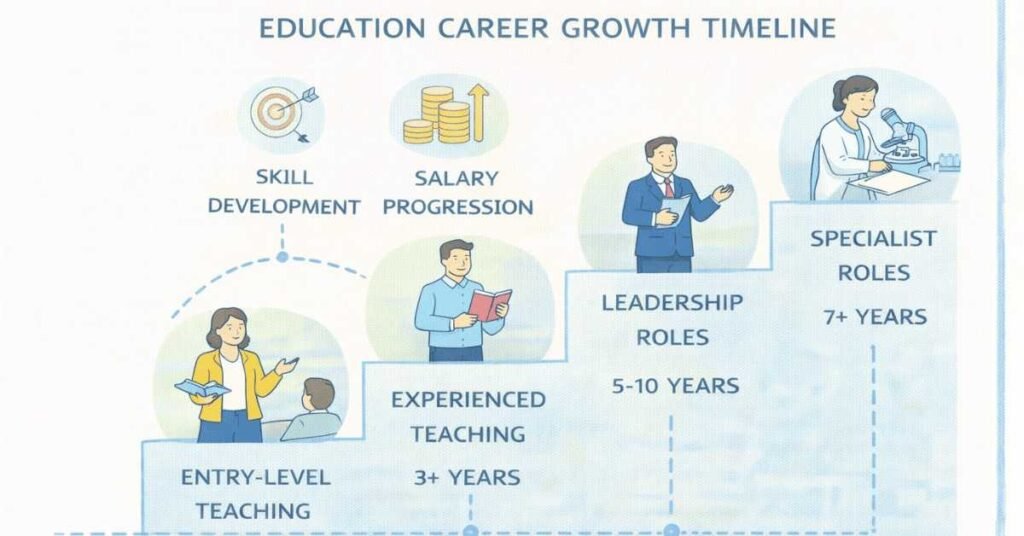
Career Growth Timeline: What to Expect
Understanding typical career progression helps you plan realistically:
Years 0-3 (Foundation Phase) — Focus on building teaching skills, understanding educational systems, clearing qualifying exams, and gaining diverse experience across different student groups. Expected salary: ₹3-5 lakhs annually.
Years 4-7 (Specialization Phase) — Develop expertise in specific subjects or educational areas, pursue higher qualifications (M.Ed, NET), take on additional responsibilities, and start building professional reputation. Expected salary: ₹6-10 lakhs annually.
Years 8-12 (Leadership Phase) — Move into senior positions (department head, coordinator, senior lecturer), mentor junior teachers, lead initiatives, and consider administrative roles. Expected salary: ₹10-18 lakhs annually.
Years 13+ (Expert Phase) — Become principal, professor, educational consultant, or policy advisor with institutional influence, industry recognition, and opportunity to shape education broadly. Expected salary: ₹18-40+ lakhs annually.
Final Thoughts: Making Your Decision
The education sector offers something rare in today’s job market—purpose combined with stability. While you’re building your career, you’re simultaneously shaping thousands of young minds and contributing to national development. The Indian education market is expected to reach $30 billion by 2031, ensuring long-term career security.
Your specific path depends on your strengths and preferences. If you love direct interaction, traditional teaching suits you perfectly. If technology excites you, explore EdTech opportunities. If you’re drawn to systems and strategy, consider administration. If research and analysis appeal to you, pursue academic research paths.
The most successful education professionals share one characteristic: genuine passion for helping others learn and grow. If you have that passion combined with willingness to continuously improve your skills, the education sector offers unlimited opportunities for meaningful, stable, and rewarding careers.
Start where you are, use what you have, and keep growing—your education career journey begins today.
Yes, I have additional sections to complete this comprehensive guide! Here’s the continuation:
Part 8: Job Search Strategies & Landing Your First Position
Where to Find Education Jobs
Finding the right position requires knowing where to look. High-demand states like Maharashtra, Uttar Pradesh, Bihar, Karnataka, Tamil Nadu, Madhya Pradesh, and Orissa are urgently hiring teachers across all levels, with salaries ranging from ₹18,000 to ₹60,000 monthly depending on subject and experience.
Online Job Portals — Register on specialized platforms like FacultyPlus, Naukri.com’s education section, LinkedIn Jobs, Indeed India, and TeachingJobs.co.in. Set up job alerts for your preferred locations and subjects so opportunities reach you immediately. Education-specific recruitment agencies like Eras Teachers provide free placement assistance for CBSE, ICSE, IGCSE, and State Board schools.
Government Recruitment Websites — Check employment news portals regularly for government teaching vacancies. The UGC recruitment portal (CUREC) lists university positions. State education department websites announce TET-qualified teacher recruitment. These official channels ensure you don’t miss important application deadlines.
Direct School Applications — Many premium private schools accept direct applications through their websites. International schools, CBSE schools, and established chains like Delhi Public School, Bharati Vidyapeeth, or Ryan International often have dedicated career portals. Don’t hesitate to walk into schools with your resume, especially during their hiring seasons (March-June for new academic year).
EdTech Company Careers Pages — Companies like BYJU’S, Unacademy, Vedantu, WhiteHat Jr, Toppr, and Next Education regularly hire content creators, tutors, and curriculum developers. Their career sections list specific requirements and application processes. Many offer work-from-home options with flexible schedules.
Crafting Your Education Resume
Your resume needs to showcase both subject expertise and teaching capabilities:
Structure it effectively — Start with a clear summary statement highlighting your specialization, years of experience, and key qualifications. List your education credentials prominently (B.Ed, M.Ed, NET/TET scores) since these are mandatory requirements. Include any additional certifications in special education, EdTech tools, or educational psychology.
Highlight measurable achievements — Instead of saying “taught mathematics,” write “improved Class 10 board results by 15% through innovative problem-solving techniques”. Quantify wherever possible: number of students taught, improvement in test scores, projects completed, workshops conducted. These concrete metrics demonstrate your impact.
Showcase technology skills — Modern schools value digital literacy. List your proficiency with Learning Management Systems, Google Classroom, Zoom, educational apps, content creation tools, and Microsoft Office. If you’ve created online content, designed digital assessments, or managed virtual classrooms, highlight these prominently.
Include relevant projects — Mention curriculum development work, research papers published, educational workshops attended, competitions your students won under your guidance, and any innovation you introduced in teaching methods. These differentiate you from other candidates with similar qualifications.
Acing the Teaching Interview
Education interviews typically assess three dimensions: subject knowledge, teaching methodology, and personality fit:
Prepare for demo teaching — Most schools require demonstration classes where you teach a topic to the interview panel or actual students. Select a topic you’re confident about, prepare engaging visual aids, plan interactive elements, practice time management (usually 15-20 minutes), and anticipate student questions. Your demo reveals your actual teaching style better than any verbal description.
Common interview questions to prepare — Why did you choose teaching as a career? How do you handle difficult students or classroom discipline issues? Describe an innovative teaching method you’ve used. How would you explain [specific complex concept] to struggling students? What’s your approach to parent communication? How do you stay updated with your subject?. Frame answers using specific examples from your experience rather than theoretical responses.
Ask intelligent questions — When given the opportunity, ask about the school’s teaching philosophy, professional development opportunities, support systems for new teachers, student-teacher ratio, resources available, and expectations for the role. This demonstrates genuine interest and helps you assess if the institution aligns with your career goals.
Part 9: Professional Development & Certifications
Essential Certifications That Boost Your Career
Beyond basic degrees, additional certifications significantly enhance employability and earning potential:
Google Certified Educator — This certification demonstrates proficiency in using Google tools for education. Levels 1 and 2 cover Google Classroom, Drive, Docs, Sheets, Forms, and other education-specific applications. Many schools prefer candidates with this certification as they transition to digital learning.
Microsoft Certified Educator (MCE) — Similar to Google certification, this validates your ability to use Microsoft tools effectively in teaching. It’s particularly valuable in institutions using Microsoft Teams and Office 365.
TESOL/TEFL Certification — If you’re interested in teaching English, especially to international students or in language learning platforms, TESOL (Teaching English to Speakers of Other Languages) or TEFL (Teaching English as a Foreign Language) certifications are highly valued. Online and offline opportunities abroad become accessible with these credentials.mcsgoc
Special Education Certifications — Short-term diplomas or certificates in inclusive education, learning disabilities, autism spectrum support, or assistive technology open specialized teaching opportunities with better compensation. The shortage of special education teachers makes these certifications particularly valuable.
Educational Technology Certifications — Certifications in instructional design, e-learning development, Learning Management Systems (Moodle, Canvas), or educational content creation tools enhance your profile for EdTech roles. Platforms like Coursera, edX, and LinkedIn Learning offer affordable options.
Continuous Learning Resources
Successful educators never stop learning:
Online Learning Platforms — Coursera offers courses from global universities on pedagogy, educational technology, and subject-specific teaching methods. edX provides free access to content from Harvard, MIT, and other institutions. SWAYAM (Study Webs of Active Learning for Young Aspiring Minds) is the government’s free online education platform offering courses for professional development.
Professional Teacher Networks — Join associations like the All India Association for Educational Research (AIAER), State teacher unions, or subject-specific forums. These networks share best practices, policy updates, and job opportunities while providing professional support.
Educational Journals and Publications — Subscribe to journals like Journal of Education and Practice, Indian Journal of Education, or international publications to stay current with educational research and innovative teaching methods. Reading research keeps you informed about evidence-based practices.
Workshops and Conferences — Attend annual education conferences, subject teacher meetings, or technology integration workshops. These provide networking opportunities, exposure to new methodologies, and credential-building for career advancement.
Part 10: Challenges & How to Overcome Them
Common Challenges in Education Careers
Being realistic about challenges helps you prepare mentally and strategically:
Initial Low Salaries — Fresh B.Ed graduates often start at ₹20,000-₹30,000 monthly in private schools, which seems modest compared to corporate sectors. However, remember that education careers offer steady growth, multiple income streams through tuitions, and non-monetary benefits like job satisfaction. Focus on building skills and reputation in initial years rather than just salary.
Workload Beyond Classroom — Teachers handle lesson planning, assessment corrections, parent meetings, administrative duties, and extra-curricular coordination beyond actual teaching hours. Time management and boundary-setting become crucial skills. Learn to work efficiently during school hours and protect personal time to avoid burnout.
Dealing with Difficult Stakeholders — You’ll encounter challenging students, demanding parents, and occasionally unsupportive management. Developing emotional intelligence, communication skills, and conflict resolution abilities helps navigate these situations professionally. Remember that challenges are temporary, but the positive impact you create lasts forever.
Keeping Up with Changes — Educational policies, curricula, technology tools, and teaching methodologies constantly evolve. This requires continuous learning and adaptation. View change as opportunity rather than burden—those who adapt quickly advance faster in their careers.
Solutions and Coping Strategies
Build Multiple Income Streams — Supplement your teaching salary through online tutoring, creating educational content, writing textbooks, conducting weekend workshops, or consulting with EdTech companies. Many successful educators earn 50-100% additional income through such activities.
Invest in Technology Skills — EdTech proficiency increases placement rates by 30% and opens higher-paying opportunities. Dedicate time to learning digital tools—this investment pays off throughout your career.
Create Support Networks — Connect with fellow educators who understand your challenges. Join online communities, WhatsApp groups, or local teacher circles where you can share experiences, resources, and emotional support.
Practice Self-Care — Teaching is emotionally demanding work. Maintain hobbies outside education, exercise regularly, set boundaries between work and personal life, and seek help when feeling overwhelmed. Sustainable careers require sustainable habits.
Part 11: Frequently Asked Questions
Q: Can I become a teacher without a B.Ed degree?
For government and recognized private schools teaching Classes 1-12, B.Ed is mandatory after clearing TET. However, you can teach in preschools, coaching centers, or unrecognized institutions without B.Ed, though career growth remains limited. Integrated programs like B.A. B.Ed or B.Sc. B.Ed combine undergraduate and teaching degrees.
Q: Is NET necessary for college teaching?
UGC NET is required for Assistant Professor positions in universities and colleges unless you have a PhD awarded through proper research methodology with external examiners. State-level SET exams are alternatives for state universities. Government institutions strictly enforce this requirement.
Q: What’s the difference between TET and CTET?
CTET (Central Teacher Eligibility Test) qualifies you for central government schools like KVS, NVS, and Tibetan schools across India. State TETs qualify you for government schools within specific states. Many private schools accept either qualification. You can appear for both to maximize opportunities.
Q: Can commerce/arts graduates become teachers?
Absolutely! You can teach your specialized subjects after completing B.Ed. Commerce graduates teach Accountancy, Business Studies, and Economics, while arts graduates teach languages, history, political science, sociology, and other humanities subjects. The demand for good humanities teachers is substantial.
Q: Is teaching a good career in 2025 and beyond?
Yes, for multiple reasons: India’s education market is projected to reach $30 billion by 2031, the EdTech sector alone will hit $10.4 billion by end of 2025, over 70% of Indian schools require trained teachers, and the sector offers job security, meaningful work, and diverse career paths. With continuous upskilling, teaching remains a solid long-term career choice.
Q: How can I switch from corporate to teaching?
Many professionals transition to education careers. Start by obtaining B.Ed (available through distance learning), clear TET/NET based on your target level, gain experience through part-time tutoring or guest lecturing, leverage your industry expertise for corporate training or business studies teaching, and consider EdTech roles that value both education and corporate backgrounds.
Q: What’s the future of teaching jobs with AI and automation?
While AI will transform education, it cannot replace human teachers. Teachers who adapt technology and focus on skills AI cannot replicate—emotional intelligence, mentorship, creativity, critical thinking development, and personalized guidance—will thrive. In fact, EdTech growth creates more education jobs, not fewer. The key is embracing technology rather than fearing it.
Quick Reference: Career Pathways at a Glance
For Fresh Graduates (0-2 years experience):
- School teaching (TGT) after B.Ed + TET: ₹3-5 lakhs annually
- Online tutoring part-time: ₹30,000-₹50,000 monthly
- Content writing for EdTech: ₹20,000-₹40,000 monthly
- Guest lecturer: ₹1,500 per lecture
For Mid-Career Professionals (3-7 years experience):
- Senior Teacher/PGT: ₹6-10 lakhs annually
- Curriculum Developer: ₹8-15 lakhs annually
- Academic Coordinator: ₹8-12 lakhs annually
- Assistant Professor (NET/PhD): ₹9-11 lakhs annually
For Experienced Professionals (8+ years experience):
- School Principal: ₹15-40 lakhs annually
- Associate/Full Professor: ₹15-25 lakhs annually
- EdTech Senior Roles: ₹20-35 lakhs annually
- Educational Consultant: ₹25-50 lakhs annually
Conclusion: Your Education Career Starts Now
You’ve just explored one of the most comprehensive guides to education careers in India covering traditional teaching, higher education, EdTech opportunities, administration, specialized paths, and everything in between. The education sector offers something rare—purpose, stability, growth, and the chance to create lasting impact.
The beauty of education careers lies in their diversity. Whether you’re drawn to working with young children, mentoring college students, designing digital learning experiences, conducting educational research, or leading institutions, there’s a path perfectly suited to your strengths and interests.
India’s education sector is projected to reach $30 billion by 2031, ensuring long-term career security. With over 70% of schools requiring trained teachers and the EdTech market growing at nearly 40% annually, opportunities have never been more abundant. The country’s 600 million youth population guarantees sustained demand for quality educators across all levels.
Success in education careers requires three elements: proper qualifications (B.Ed, M.Ed, NET), continuous skill development (especially in technology), and genuine passion for helping others learn. Start where you are with what you have, stay committed to improvement, and build your career step by step.
educator, every respected principal, every influential education leader started exactly where you are now—at the beginning. What distinguished them was not just qualifications, but persistence, adaptability, and unwavering commitment to their chosen path.
The next generation of students is waiting for teachers like you—educators who combine subject mastery with empathy, traditional values with technological proficiency, and academic rigor with creative teaching methods. Your education career journey begins today, and the impact you’ll create will last for generations.
Take the first step. Choose your path. Shape the future.
Cluster 1: Teaching Career Foundations
Blog Post 1: "How to Become a School Teacher in India: Complete Guide
Focus: Primary, secondary, and senior secondary teaching paths, B.Ed requirements, TET/CTET preparation, government vs private schools, salary expectations, career progression from teacher to principal.
Target Audience: Fresh graduates, career switchers interested in school teaching
Keywords: school teacher career, B.Ed after graduation, TET exam preparation, teaching jobs India
Blog Post 2: "Government Teacher vs Private School Teacher: Which Career Path is Right for You?"
Focus: Detailed comparison of job security, salary structures, work culture, benefits, application processes, and long-term career growth in both sectors.
Target Audience: B.Ed graduates deciding between government and private sectors
Keywords: government teacher salary, private school jobs, TET qualified jobs, teaching career comparison
Blog Post 3: "UGC NET Complete Guide: Your Pathway to College Teaching & Research"
Focus: NET eligibility, exam pattern, preparation strategies, Assistant Professor career, JRF benefits, PhD exemptions, salary scales, career progression to Professor.
Target Audience: Post-graduates planning higher education teaching careers
Keywords: UGC NET preparation, assistant professor career, college lecturer jobs, NET exam.
Cluster 2: Higher Education & Academic Careers
Blog Post 4: "How to Become a College Professor in India: Step-by-Step Career Roadmap"
Focus: Educational qualifications, PhD journey, publication requirements, Assistant Professor to Professor progression, research expectations, academic leadership roles.
Target Audience: Master’s degree holders, PhD scholars, aspiring academicians
Keywords: college professor career India, PhD after NET, academic career path, professor salary India
Blog Post 5: "Guest Lecturer to Permanent Faculty: Building Your College Teaching Career"
Focus: Starting as guest lecturer, visiting faculty opportunities, networking strategies, building publication record, transitioning to permanent positions, salary growth.
Target Audience: Fresh PhD holders, part-time educators seeking full-time positions
Keywords: guest lecturer jobs, visiting faculty salary, how to become permanent teacher, college teaching jobs
Blog Post 6: "PhD in Education: Is It Worth It? Complete Career Benefits Analysis"
Focus: PhD benefits, research process, duration, NET exemption, career advantages, Associate Professor requirements, earning potential, academic credibility.
Target Audience: NET qualified candidates, teachers considering doctoral studies
Keywords: PhD after NET, education PhD India, doctoral research benefits, academic career growth
Cluster 3: EdTech & Digital Education Careers
Blog Post 7: "Top 10 EdTech Careers in India: Skills, Salary & How to Get Started"
Focus: Content developer, curriculum designer, instructional designer, online tutor, educational technology specialist, learning consultant roles, required skills, salary ranges.
Target Audience: Teachers interested in EdTech, tech-savvy educators, career switchers
Keywords: EdTech careers India, content developer jobs, online teaching opportunities, education technology jobs
Blog Post 8: "How to Start Online Teaching: Complete Guide to Earning ₹50,000+ Monthly"
Focus: Platform selection, building student base, pricing strategies, teaching tools, marketing yourself, creating recorded content, scaling income, tax considerations.
Target Audience: Teachers wanting additional income, full-time online educators
Keywords: online tutoring jobs, work from home teaching, online teacher salary, teaching platforms India
Blog Post 9: "Curriculum Developer Career Guide: Skills, Qualifications & Salary
Focus: Role responsibilities, instructional design principles, required qualifications, software tools, portfolio building, freelancing vs full-time, career growth to senior designer.
Target Audience: Teachers interested in content creation, creative educators
Keywords: curriculum developer jobs, instructional designer salary, educational content writing, LMS careers
Cluster 4: Specialized Education Careers
Blog Post 10: "Special Education Teaching: High-Demand Career with ₹8-30 Lakhs Salary"
Focus: Why special education, types of disabilities, required certifications, teaching strategies, job opportunities, emotional rewards, salary expectations, career growth.
Target Audience: Empathetic educators, those passionate about inclusive education
Keywords: special education teacher India, inclusive education career, special needs teaching, SPED certification
Blog Post 11: "Academic Counselor Career: Guide Students & Earn ₹8-15 Lakhs Annually"
Focus: Role responsibilities, qualifications needed, counseling skills, working with students/parents, career guidance expertise, salary in government vs private sectors.
Target Audience: Teachers interested in counseling, psychology graduates with education interest
Keywords: educational counselor jobs, career advisor salary, school counselor career, student guidance jobs
Blog Post 12: "Corporate Training Career for Teachers: Earn ₹8-30 Lakhs in L&D Roles"
Focus: Transitioning from teaching to corporate training, adult learning principles, training needs analysis, industries hiring trainers, technical vs soft skills training.
Target Audience: Experienced teachers seeking career change, higher salary opportunities
Keywords: corporate trainer jobs, L&D career, employee training roles, teaching to corporate transition
Cluster 5: Educational Leadership & Administration
Blog Post 13: "How to Become a School Principal: Qualifications, Experience & Salary Guide"
Focus: Career progression from teacher to principal, required experience, leadership skills, management qualifications, salary ranges, responsibilities, day-in-the-life.
Target Audience: Senior teachers planning administrative careers
Keywords: school principal career, headmaster salary India, education leadership, principal qualifications
Blog Post 14: "Education Administration Careers: Beyond Teaching to Management Roles"
Focus: Academic coordinator, training coordinator, education officer, policy analyst roles, required skills, salary (₹17-40 lakhs), government vs private opportunities.
Target Audience: Teachers interested in policy/management, education graduates
Keywords: education administrator jobs, academic coordinator salary, education management career, school administration roles
Cluster 6: Alternative & Creative Education Paths
Blog Post 15: "Educational Content Writing: Earn ₹30,000-₹1 Lakh Monthly as a Freelance Writer"
Focus: Textbook writing, test preparation materials, blog content, examination papers, building portfolio, finding clients, pricing your work, balancing with teaching.
Target Audience: Teachers with strong writing skills, subject matter experts
Keywords: educational content writer jobs, textbook writing career, academic writing freelance, education blogger income
Blog Post 16: "Educational Research Careers: PhD to Policy Advisor Pathway"
Focus: Research associate roles, working with NCERT/SCERT/UGC, designing studies, publishing papers, influencing policy, PhD advantages, salary ranges.
Target Audience: PhD scholars, academically inclined educators
Keywords: education research jobs, research associate salary, educational policy careers, academic researcher India
Blog Post 17: "Teaching Jobs Abroad: How to Take Your Education Career International"
Focus: TESOL/TEFL certifications, countries hiring Indian teachers, international school opportunities, salary comparisons, cultural adaptation, application process.
Target Audience: Adventurous teachers, those seeking international experience
Keywords: teaching jobs abroad for Indians, TEFL certification India, international teacher salary, teach English overseas
Cluster 7: Practical Career Development
Blog Post 18: "Top 10 Certifications That Boost Teaching Careers & Salary in 2025"
Focus: Google Certified Educator, Microsoft Educator, TESOL/TEFL, special education certificates, EdTech tools, cost-benefit analysis, where to get certified.
Target Audience: Teachers at all levels seeking career advancement
Keywords: teaching certifications India, Google Educator certification, professional development teachers, education credentials
Blog Post 19: "Teacher Resume That Gets Interviews: Format, Examples & Expert Tips"
Focus: Structure, highlighting achievements, quantifying impact, technology skills, demo teaching preparation, interview questions, portfolio creation.
Target Audience: Job-seeking teachers, fresh B.Ed graduates
Keywords: teacher resume format, teaching job interview tips, education CV examples, demo class preparation
Blog Post 20: "Teaching Career Salary Guide 2025: From ₹3 Lakhs to ₹40 Lakhs+"
Focus: Salary ranges by position, experience-based progression, location differences, government pay scales, private sector packages, additional income sources.
Target Audience: Anyone researching education career viability
Keywords: teacher salary India 2025, professor salary scale, education sector income, teaching job packages
Cluster 8: Entry Strategies & Career Transitions
Blog Post 21: "B.Ed After Graduation: Complete Guide to Eligibility, Admission & Career"
Focus: Why pursue B.Ed, eligibility criteria, entrance exams, top colleges, fees, integrated programs, career options after B.Ed, placement statistics.
Target Audience: Undergraduate students, recent graduates
Keywords: B.Ed after graduation, B.Ed admission 2025, teaching degree India, B.Ed career options
Blog Post 22: "TET vs CTET: Which Exam Should You Take for Teaching Jobs?"
Focus: Differences, eligibility, exam patterns, which qualifies for what jobs, preparation strategies, passing percentages, validity, can you take both?
Target Audience: B.Ed graduates preparing for eligibility tests
Keywords: TET vs CTET difference, CTET exam preparation, state TET eligibility, teacher eligibility test
Blog Post 23: "Career Change to Teaching: Step-by-Step Guide for Working Professionals"
Focus: Why switch to teaching, distance B.Ed options, maintaining current job while studying, leveraging industry experience, corporate to classroom transition stories.
Target Audience: Corporate professionals considering teaching careers
Keywords: career change to teaching, distance B.Ed for working professionals, corporate to teacher transition, second career teaching
Cluster 9: State-Specific & Regional Content
Blog Post 24: "Teaching Jobs in Telangana & Andhra Pradesh: Opportunities, Salary & How to Apply"
Focus: State-specific vacancies, TS-TET/AP-TET details, salary scales, top schools/colleges hiring, regional education boards, local opportunities.
Target Audience: Teachers/students in Telangana and Andhra Pradesh (your target geography)
Keywords: teaching jobs Telangana, Andhra Pradesh teacher vacancy, TS-TET preparation, Hyderabad teaching jobs
Blog Post 25: "Top EdTech Companies Hiring in Hyderabad: Remote & Office Teaching Jobs"
Focus: Major EdTech presence in Hyderabad, work-from-home opportunities, skill requirements, application tips, salary ranges, company culture.
Target Audience: Urban educators in Telangana seeking modern opportunities
Keywords: EdTech jobs Hyderabad, online teaching jobs Telangana, remote education jobs, BYJU’S Unacademy careers
Cluster 10: Future & Trends
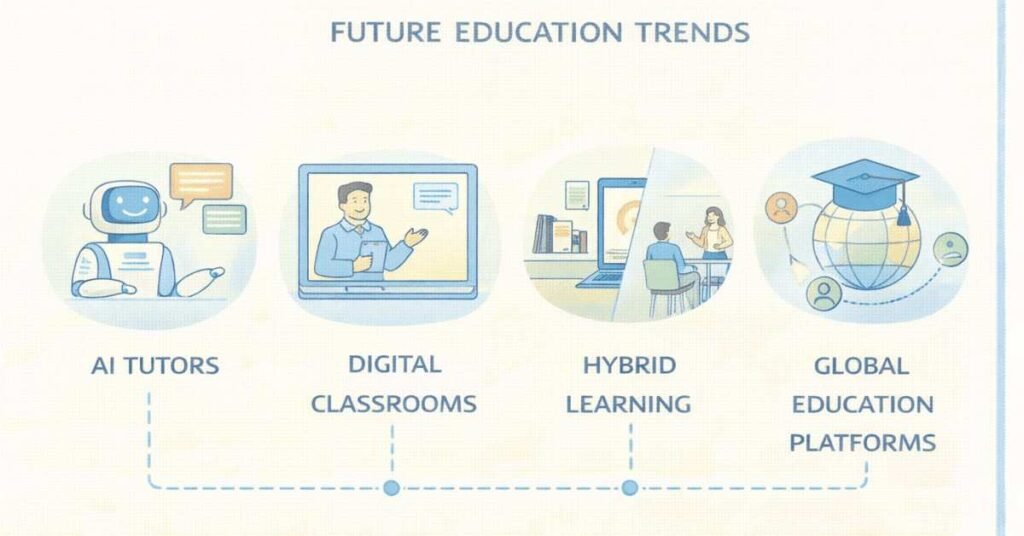
Blog Post 26: "Future of Teaching Careers: AI, EdTech & What It Means for Teachers in 2025"
Focus: Technology impact, skills that remain relevant, AI as teaching assistant, jobs being created vs eliminated, how to future-proof your career.
Target Audience: Forward-thinking educators, those anxious about automation
Keywords: future of teaching jobs, AI in education, teacher skills 2025, EdTech trends India
Blog Post 27: "Education Sector Career FAQs: 27 Questions Answered by Experts"
Focus: Compilation of most-asked questions about teaching careers, qualifications, salaries, career changes, with detailed answers.
Target Audience: Anyone researching education careers
Keywords: teaching career questions, education sector FAQs, teacher salary questions, B.Ed doubts clarified