
Corporate Training Career for Teachers: Earn ₹8-30 Lakhs in L&D Roles
Table of Contents
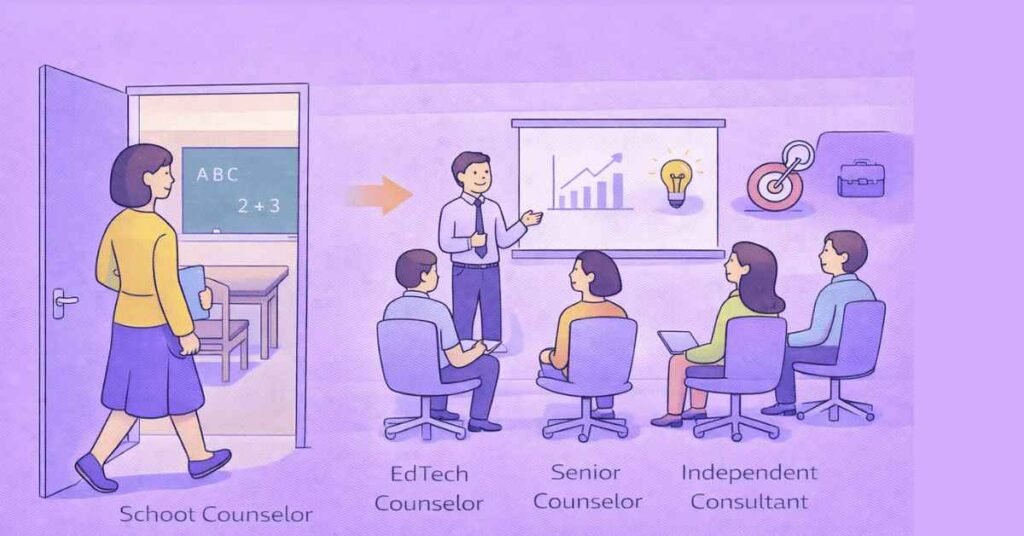
Are you an experienced teacher who loves the art of instruction but feels limited by the traditional school system? Do you have a passion for helping people learn and grow, but wish for a more dynamic environment and significantly higher earning potential?
If so, it’s time to consider a career transition that leverages all your hard-earned teaching skills in a new, exciting context: Corporate Training.
Companies across India are investing billions in upskilling their workforce, creating a massive demand for professionals who know how to design and deliver effective learning experiences. And who is better equipped for this than a teacher? This guide will show you how your teaching expertise is your golden ticket to a high-paying career in the corporate Learning & Development (L&D) world, with salaries ranging from ₹8 lakhs to ₹30 lakhs or more per year.
Part 1: Why Teachers Make Great Corporate Trainers
You might think that the corporate world is completely different from a school classroom, but the fundamental skills required for effective training are exactly the same. Your experience as a teacher gives you a massive head start.
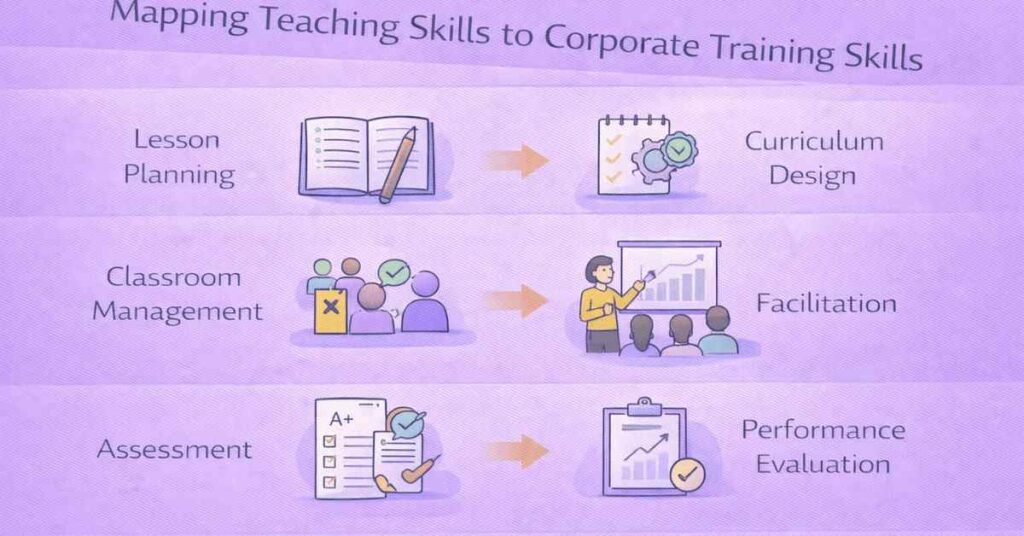
- You are an expert in pedagogy: You already know how to structure a lesson, explain complex ideas simply, manage a group, and assess learning. This is the core of what a corporate trainer does.
- You understand different learning styles: You know that some people learn by listening, some by seeing, and others by doing. You are already skilled at differentiating your instruction to cater to a diverse audience.
- You have excellent classroom management skills: If you can manage a class of 30 restless teenagers, you can certainly manage a room of 15 motivated adults. Your ability to command attention, facilitate discussions, and keep a session on track is a highly valued corporate skill.
- You are a master of communication: Years of explaining abstract concepts and answering endless questions have honed your communication skills to a fine point.
- You are patient and empathetic: You know how to encourage a struggling learner and build their confidence, a crucial skill when training employees on new and difficult topics.
Your teaching experience is not something you leave behind; it’s your most valuable asset in this transition.
Part 2: Understanding the World of Corporate L&D
Learning & Development (L&D) is the function within a company responsible for enhancing the skills, knowledge, and performance of its employees. It’s a strategic department that directly contributes to the company’s growth and success.
The two main types of training you might deliver are:
- Soft Skills Training: This is a natural fit for many teachers. It focuses on interpersonal skills that are crucial for success in any role.
- Examples: Communication Skills, Leadership Development, Teamwork & Collaboration, Time Management, Presentation Skills, Emotional Intelligence.
- Technical or Functional Training: This focuses on specific, job-related hard skills. If you have a background in a particular subject, you can specialize in that area.
- Examples: A former computer science teacher could become a trainer for programming languages like Python. A former commerce teacher could train employees in financial modeling or accounting software. A tech-savvy teacher could become a trainer for new internal software being rolled out in the company.
Part 3: The Key Roles in a Corporate L&D Team
The L&D field offers a variety of roles that map well to a teacher’s skill set.
1. Corporate Trainer / Facilitator
This is the most direct equivalent of a teacher. You are the one who stands in front of the “classroom” (which could be a physical training room or a virtual one on Zoom) and delivers the training sessions.
- What you’ll do: Conduct workshops, facilitate group discussions, run activities, and deliver presentations.
- Who it’s for: Teachers who love the energy of live instruction and interacting with learners.
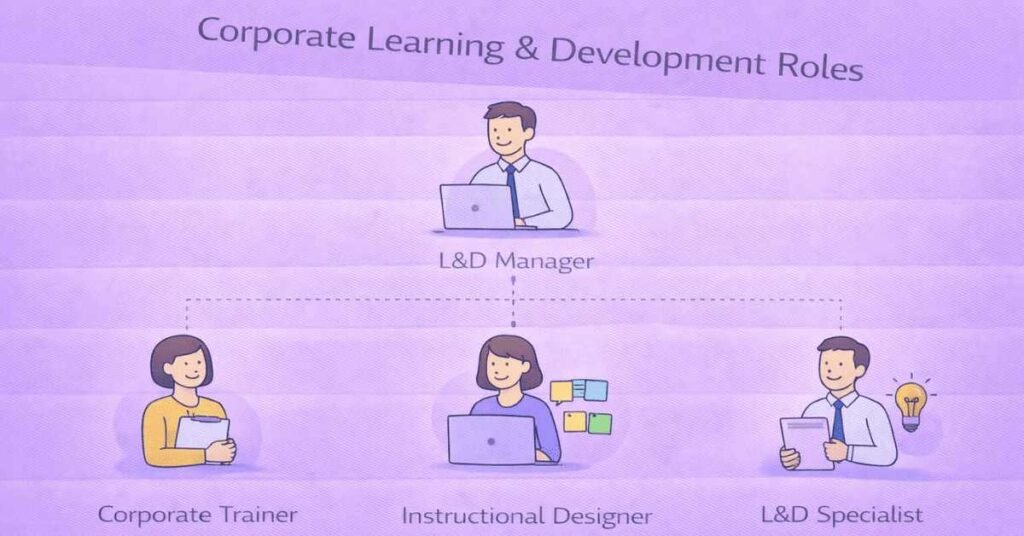
2. Instructional Designer (Corporate)
Just like in EdTech, the Instructional Designer in a corporate setting designs the learning materials. You would take a business need (e.g., “Our new managers need to be better at giving feedback”) and design a complete learning program to address it.
- What you’ll do: Create e-learning modules, design workshop activities, write facilitator guides, and develop training videos.
- Who it’s for: Teachers who excel at lesson planning and creating engaging content but may prefer a more behind-the-scenes role.
3. L&D Specialist / Generalist
This role is a mix of both. In a smaller company, you might be responsible for everything—from identifying training needs to designing the content and delivering the sessions.
- What you’ll do: A little bit of everything—needs analysis, design, delivery, and evaluation of training programs.
- Who it’s for: Teachers who are adaptable, love variety, and want a broad overview of the entire L&D function.
4. L&D Manager / Leader
After gaining experience, you can move into a leadership role. You would manage a team of trainers and designers, set the overall L&D strategy for the company, manage the training budget, and report on the business impact of your programs to senior leadership.
- What you’ll do: Strategy, team management, budget allocation, and stakeholder management.
- Who it’s for: Experienced teachers with strong leadership and strategic thinking skills.
Part 4: The Salary Leap – What You Can Expect to Earn
This is often the most compelling reason for the transition. Corporate L&D roles are well-compensated because they are seen as directly contributing to the company’s bottom line.
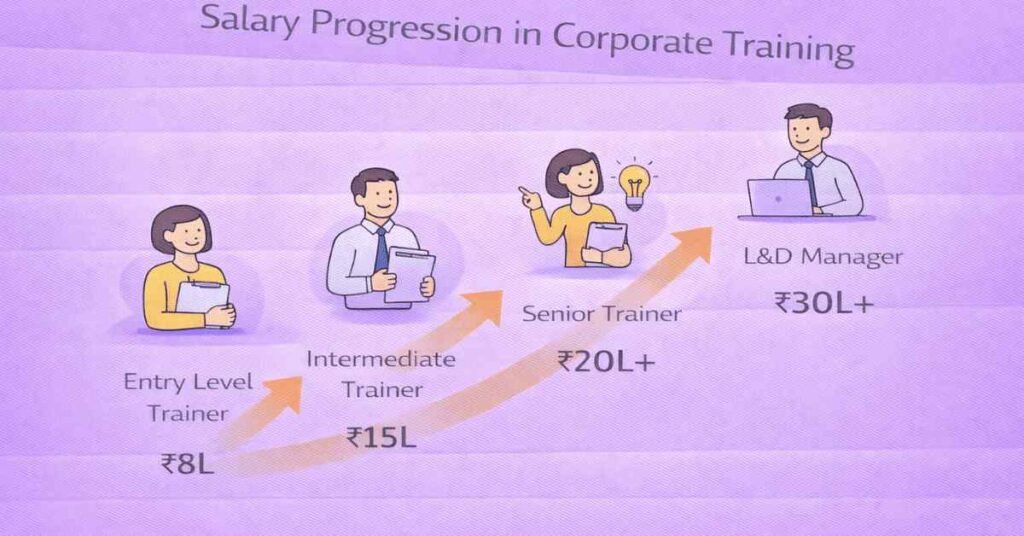
Salary Ranges in India (2025):
- Corporate Trainer / L&D Specialist (Entry to Mid-Level): ₹8 lakhs – ₹15 lakhs per annum
- Senior Trainer / Instructional Designer: ₹15 lakhs – ₹22 lakhs per annum
- L&D Manager: ₹18 lakhs – ₹30 lakhs per annum
- Head of L&D / Director (in large MNCs): ₹35 lakhs – ₹60+ lakhs per annum
Source: Based on data from major recruitment firms like Michael Page and user-reported data on platforms like Glassdoor for L&D roles.
Even an entry-level corporate training role often pays double or triple the salary of an experienced school teacher. This significant financial uplift can be life-changing.
Part 5: Your Step-by-Step Transition Plan
Making the switch from education to corporate requires a strategic approach.
Step 1: Reframe Your Resume and LinkedIn Profile
You need to translate your teaching experience into corporate language.
- Instead of “Classroom Management,” use “Group Facilitation and Audience Engagement.”
- Instead of “Lesson Planning,” use “Curriculum Design and Content Development.”
- Instead of “Grading Assignments,” use “Performance Assessment and Feedback Delivery.”
- Instead of “Parent-Teacher Meetings,” use “Stakeholder Communication and Management.”
Quantify your achievements. For example, “Designed and delivered a new remedial math program that improved average student test scores by 15% in one academic year.”

Step 2: Get a Relevant Certification (Optional but Recommended)
While your teaching experience is valuable, a corporate certification signals to employers that you are serious about the transition.
- Certified Professional in Training Management (CPTM): A globally recognized certification.
- Instructional Design Certifications: Look for programs that teach you how to use Articulate Storyline.
- Facilitation Skills Certifications: Many institutes offer “Train the Trainer” programs.
These certifications not only add weight to your resume but also teach you the specific models and language used in the corporate L&D world.
Step 3: Start with Freelance or Part-Time Gigs
The easiest way to get your foot in the door is to start small.
- Offer to conduct a free workshop: Reach out to a small local company or a startup and offer to conduct a free 2-hour workshop on a topic like “Effective Communication” or “Presentation Skills.” This gives you your first piece of corporate experience and a valuable testimonial.
- Look for freelance training projects: Many companies hire trainers on a project basis. Platforms like Upwork or LinkedIn can have such opportunities.
Step 4: Network Strategically
- Connect with L&D professionals on LinkedIn. Don’t just send a connection request; send a personalized note explaining that you are a teacher looking to transition and would appreciate their advice.
Attend HR and L&D conferences and webinars. This is a great way to learn about industry trends and meet people in the field.
Step 5: Target the Right Companies and Roles
When you start applying for full-time jobs, be strategic.
- EdTech Companies: These companies are a natural fit as they value both education and business skills.
- Companies with Large Sales Teams: These organizations (like those in insurance, pharma, or real estate) have a constant need for sales trainers.
- IT and BPO Companies: These are some of the largest employers of L&D professionals in India, with huge teams dedicated to employee training.
Conclusion
Your years in the classroom have equipped you with a powerful and transferable skill set. In the corporate world, these skills are not just valued; they are in high demand and come with significant financial rewards.
The transition from a teacher to a corporate trainer is not just a career change; it’s a career upgrade. It allows you to continue your passion for teaching while working in a dynamic environment, solving real business problems, and achieving a level of professional and financial growth that is often difficult to attain in traditional education. If you are ready for a new challenge, the world of Learning & Development is waiting for you.