
CONTRACT MANAGEMENT SPECIALIST
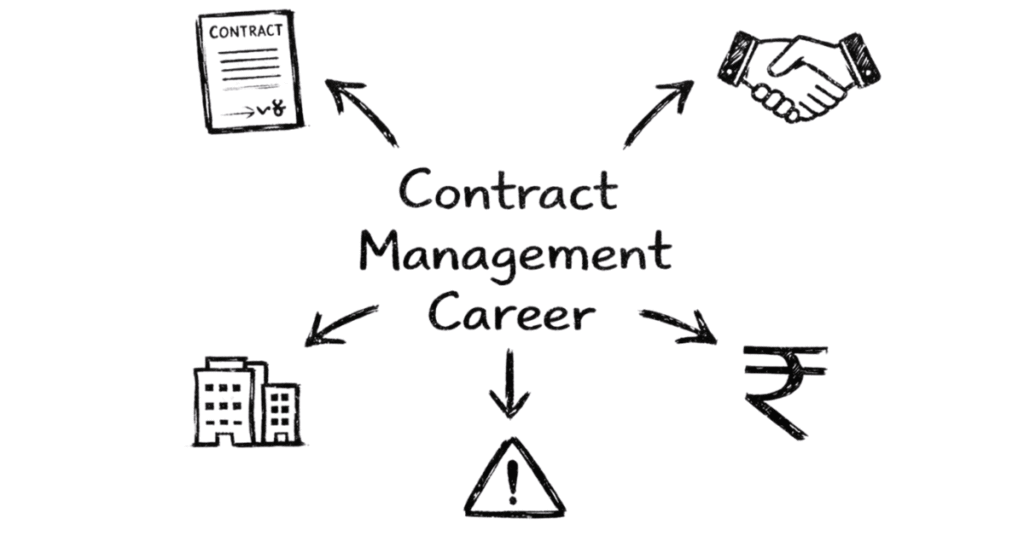
Table of Contents
Introduction:
Imagine being the person who ensures that every business agreement—from simple vendor contracts to multi-million-rupee partnerships—actually works in your company’s favor. That’s the role of a contract management specialist. You don’t just draft contracts; you make sure they deliver the expected value over their entire lifecycle.
Contract management has evolved from a paperwork exercise into a strategic business function. Modern organizations recognize that poor contract management costs companies 9.2% of their annual revenue on average. Effective contract managers protect that revenue while enabling business growth through better vendor relationships and risk mitigation.
In India, contract management professionals earn strong salaries—₹6-12 lakhs annually on average, with experienced specialists making ₹15-25 lakhs in metro cities. Demand continues growing as companies adopt digital contract lifecycle management (CLM) systems and face increasing regulatory complexity. If you enjoy analyzing business relationships, managing risk, and working at the intersection of law and operations, this career offers excellent opportunities.
What Contract Management Specialists Actually Do
Beyond Just Paperwork
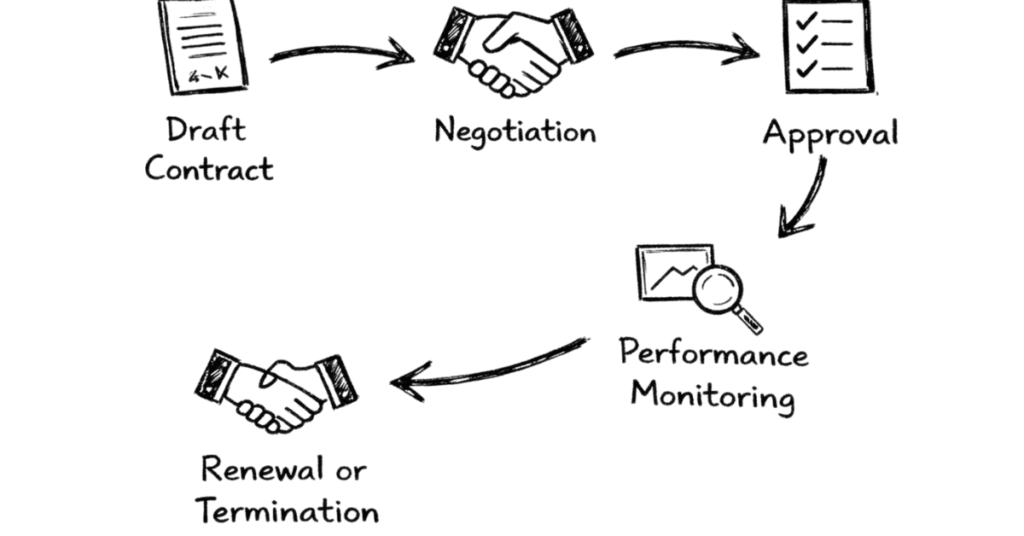
Contract management specialists oversee the entire contract lifecycle—from initial negotiation through execution, monitoring, and eventual renewal or termination. Your role combines legal knowledge, business acumen, and project management skills to ensure contracts deliver promised value.
Consider a software company signing a ₹50 crore outsourcing agreement with an overseas vendor. You ensure the contract clearly defines deliverables, payment schedules, service levels, and penalties for non-performance. During the contract term, you monitor vendor performance against KPIs, manage change requests when business needs evolve, and resolve disputes before they escalate to litigation.
Core Responsibilities
Contract Drafting and Negotiation: You collaborate with legal teams and business stakeholders to draft clear, enforceable contracts protecting your organization’s interests. This requires understanding business objectives, identifying legal risks, and negotiating terms that balance protection with relationship-building.
Risk Identification and Mitigation: Every contract contains risks—payment delays, quality failures, scope creep, or regulatory violations. You systematically identify these risks and build protections into contracts, such as performance guarantees, indemnification clauses, and termination rights.
Compliance Monitoring: You ensure contracts comply with applicable laws, industry regulations, and internal policies. This might involve verifying vendor certifications, monitoring regulatory changes affecting contract terms, or ensuring data privacy compliance in service agreements.
Performance Tracking: Using contract management software, you monitor vendor performance against agreed KPIs. Did the vendor meet service level targets? Are deliverables arriving on schedule? Are costs staying within budget? Your dashboards and reports help stakeholders make informed decisions about vendor relationships.
Vendor Relationship Management: Strong contract managers build collaborative relationships with vendors while maintaining professional boundaries. Regular business reviews, performance feedback, and relationship-building initiatives help maximize vendor performance and identify opportunities for mutual growth.
Renewal and Termination Management: As contracts approach expiration, you evaluate vendor performance, negotiate renewal terms if appropriate, or manage orderly terminations. Poorly handled renewals or terminations can create business disruptions and legal liabilities.
Types of Contracts You'll Manage
Commercial Agreements
Vendor and Supplier Contracts: These govern purchases of goods and services—from office supplies to complex IT implementations. You ensure pricing, quality standards, delivery schedules, and warranty terms protect your organization while maintaining supplier relationships.
Service Level Agreements (SLAs): Critical for outsourcing and managed services, SLAs define measurable performance standards with financial penalties for non-compliance. You negotiate realistic targets, establish monitoring mechanisms, and enforce remedies when vendors underperform.
Master Service Agreements (MSAs): Framework agreements governing multiple projects or statements of work (SOWs) between the same parties. MSAs provide efficiency while maintaining consistency across diverse engagements.
Technology Contracts
Software Licensing Agreements: Governing SaaS subscriptions, perpetual licenses, and software maintenance. You negotiate usage rights, support levels, data ownership, and termination provisions while understanding technical implementation requirements.
Cloud Services Agreements: Complex contracts governing IaaS, PaaS, and SaaS cloud services. These involve data sovereignty issues, security requirements, service credits, and exit strategies ensuring business continuity during provider changes.
IT Outsourcing Contracts: Multi-year, high-value agreements for application development, infrastructure management, and business process outsourcing. These require sophisticated risk allocation, performance measurement, and change management provisions.
Real Estate and Facilities
Lease Agreements: Commercial property leases involve rent escalation clauses, maintenance responsibilities, tenant improvements, and termination rights. You negotiate terms balancing cost control with operational flexibility.
Construction Contracts: Governing building projects, renovations, and infrastructure development. These involve payment milestones, performance bonds, change order processes, and dispute resolution mechanisms.
Facilities Management Agreements: Long-term contracts for building maintenance, security, cleaning, and other facility services. You establish KPIs, pricing mechanisms, and quality standards ensuring cost-effective facility operations.
Human Capital Contracts
Staffing and Recruitment Agreements: Governing temporary staffing, executive search, and RPO (Recruitment Process Outsourcing) arrangements. You negotiate placement fees, guarantee periods, compliance requirements, and performance standards.
Training and Development Contracts: Agreements for corporate training programs, leadership development, and skill-building initiatives. You ensure clear deliverables, pricing structures, and measurable learning outcomes.
Essential Skills for Contract Management Success
Legal and Contract Knowledge
Contract Law Fundamentals: Deep understanding of Indian Contract Act 1872, Specific Relief Act 1963, and relevant commercial laws. You must recognize enforceable vs. unenforceable terms, understand implied warranties, and identify clauses creating unintended legal liabilities.
Commercial Awareness: Understanding business drivers behind contracts enables you to negotiate terms supporting commercial objectives rather than just minimizing legal risk. You learn to balance protection with practicality.
Risk Assessment: Systematic ability to identify, prioritize, and mitigate contract risks. This involves scenario analysis—what happens if vendors fail, prices escalate, regulations change, or business needs evolve?
Technical and Analytical Skills
Contract Lifecycle Management (CLM) Software: Proficiency with platforms like DocuSign CLM, Icertis, SAP Ariba, or Coupa. These systems automate workflows, track obligations, generate reports, and ensure compliance across contract portfolios.
Data Analysis: Using contract data to identify trends, risks, and opportunities. Which vendors consistently underperform? Which contract types generate highest value? Which clauses most frequently cause disputes? Analytical skills turn contract data into actionable business insights.
Financial Analysis: Understanding Total Cost of Ownership (TCO), Net Present Value (NPV) calculations, cost escalation formulas, and financial modeling. Contracts involve substantial financial commitments requiring sophisticated cost analysis.
Soft Skills and Business Acumen
Negotiation Excellence: Balancing assertiveness with relationship-building. You negotiate favorable terms without burning vendor bridges needed for future collaboration. Win-win negotiation creates long-term value rather than short-term victories.
Stakeholder Management: Aligning diverse interests—legal wants maximum protection, procurement seeks lowest prices, business units need operational flexibility, executives demand strategic alignment. You become the trusted advisor synthesizing these perspectives.
Communication Clarity: Explaining complex contract terms to non-legal stakeholders. Business managers need to understand practical implications of legal language. You translate legalese into business language without losing precision.
Project Management: Contracts represent multi-phase projects spanning months or years. You coordinate cross-functional teams, manage timelines, track deliverables, and resolve issues preventing contract success.
Educational Pathways and Certifications
Academic Foundation
Law Degrees: LLB graduates excel in contract management due to deep legal knowledge. Corporate law or commercial law specializations provide particular advantages.
Business Degrees: MBA, BBA, or commerce graduates understand business drivers behind contracts. Supply chain management, finance, or operations specializations prove particularly valuable.
Engineering/Technical Degrees: Professionals from technical backgrounds excel managing complex technology contracts requiring both business and technical understanding.
Professional Certifications
Certified Commercial Contracts Manager (CCCM): Offered by the National Contract Management Association (NCMA), this certification covers contract lifecycle management, negotiation, risk management, and compliance. Highly regarded internationally.
Certified Professional Contracts Manager (CPCM): Advanced certification requiring significant experience plus CCCM. Demonstrates mastery across all contract management competencies.
IACCM Contract Management Certification: International Association for Contract & Commercial Management offers practitioner-level and advanced certifications recognized globally. Focuses on strategic contract management.
PMI Certifications: Project Management Professional (PMP) or Certified Associate in Project Management (CAPM) complement contract management skills, particularly for complex, multi-year engagements.
SAP/Oracle Procurement Certifications: Technical certifications for enterprise contract management systems demonstrate hands-on platform expertise.
Salary Expectations and Career Progression
Compensation Ranges
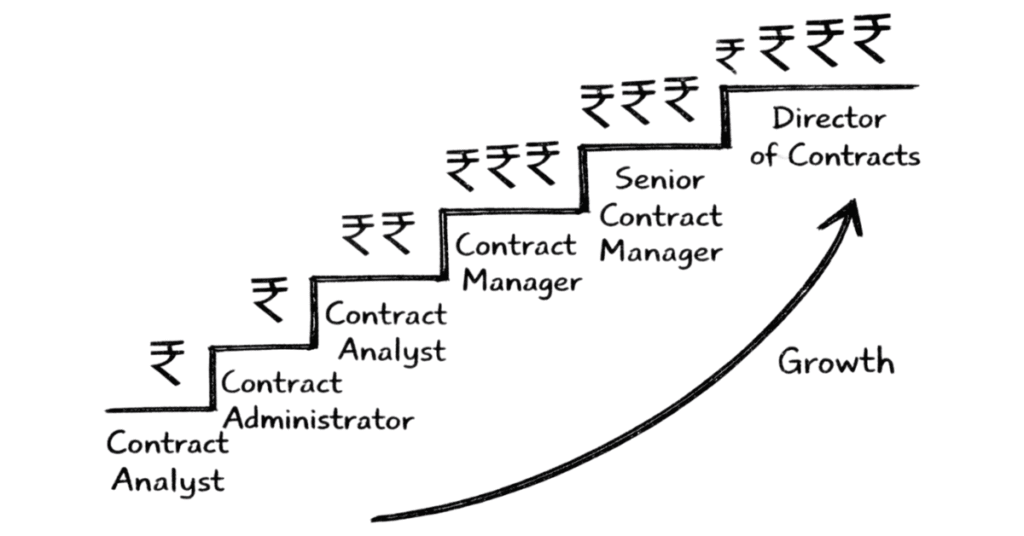
Entry-Level (0-3 Years): ₹4-7 lakhs annually. Starting roles focus on contract administration, data entry, basic compliance monitoring, and supporting senior managers.
Mid-Career (4-8 Years): ₹8-15 lakhs annually. Independent responsibility for contract negotiation, vendor management, performance monitoring, and portfolio oversight.
Senior Level (9+ Years): ₹16-25 lakhs annually. Strategic leadership of contract management functions, team supervision, system implementation leadership, and executive reporting.
Enterprise Leadership: Directors and VPs of Contract Management earn ₹30-50 lakhs in large organizations, overseeing enterprise-wide contract strategies and multimillion-rupee portfolios.
Career Progression Path
- Contract Administrator → Basic contract processing, compliance checks, reporting
- Contract Analyst → Performance monitoring, basic negotiation support, risk analysis
- Contract Manager → Full lifecycle ownership, negotiation leadership, vendor management
- Senior Contract Manager → Portfolio management, team coordination, process improvement
- Contract Management Lead/Director → Strategic leadership, system implementation, cross-functional collaboration
Technology Transforming Contract Management
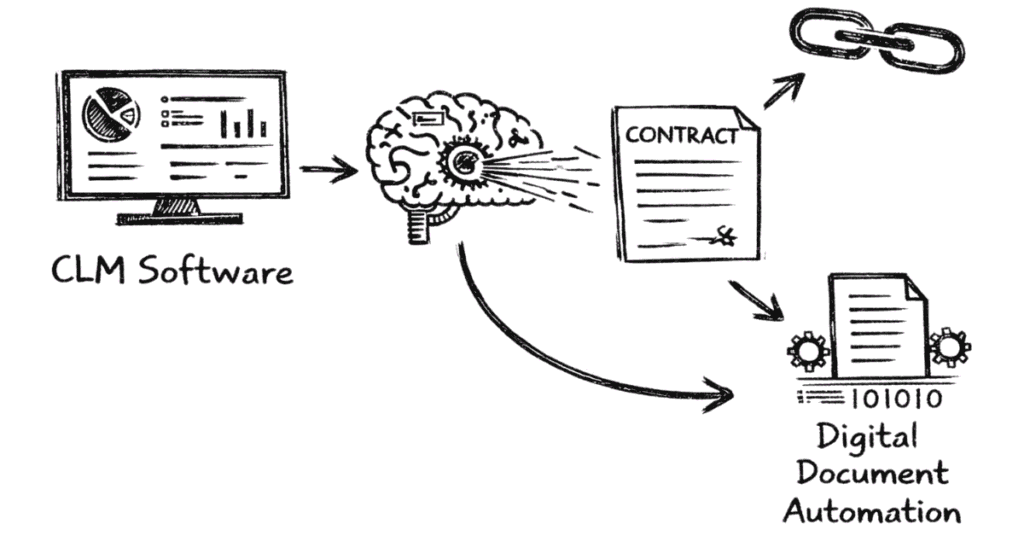
Contract Lifecycle Management (CLM) Platforms
Modern CLM systems automate 70-80% of routine contract tasks:
- AI-powered clause extraction and risk identification
- Automated workflows and approval routing
- Obligation tracking and compliance alerts
- Vendor performance dashboards
- Renewal and expiration management
Leading platforms include Icertis, SAP Ariba, Coupa, and DocuSign CLM. Proficiency with these systems separates average contract managers from high-value specialists.
Blockchain and Smart Contracts
Emerging technologies enable self-executing contracts where terms automatically trigger payments, obligations, or terminations based on predefined conditions. While still early-stage, blockchain contract solutions promise to revolutionize high-volume, low-value contracting.
AI Contract Analytics
Artificial intelligence analyzes entire contract portfolios identifying:
- Risky clauses appearing across multiple agreements
- Underperforming vendors based on contract performance data
- Opportunities for standardization and cost savings
Compliance gaps requiring remediation
Salary Expectations Across Legal Careers
Understanding compensation helps you negotiate fairly and plan your career progression. Here’s a realistic picture of what legal professionals earn in India:
Entry-Level Salaries (0-3 Years Experience)
- Litigation Lawyers: ₹2.16-4.8 lakhs annually (self-employed advocates’ income varies widely based on clientele)upgrad
- Corporate Lawyers: ₹6-8 lakhs in mid-sized companiesvmls
- Compliance Officers: ₹4-7 lakhs depending on industrymysarkarinaukri
- Paralegals/Legal Assistants: ₹3-4.2 lakhs (₹25,000-35,000 monthly)thelegalschool
- IP Lawyers: ₹8-10 lakhs due to specialized skillsvmls
- Legal Researchers: ₹3-5 lakhs annually
Mid-Level Salaries (4-10 Years Experience)
- Litigation Lawyers: ₹5-16.6 lakhsupgrad
- Corporate Lawyers: ₹10-20 lakhsupgrad+1
- Compliance Managers: ₹8-15 lakhsmysarkarinaukri
- Senior Paralegals: ₹6-10 lakhsthelegalschool
- IP Lawyers: ₹15-25 lakhsshiksha
- Data Privacy Officers: ₹12-18 lakhsvmls
Senior-Level Salaries (10+ Years Experience)
- Senior Advocates: ₹17-30+ lakhs (top lawyers charge significantly more per case)upgrad
- General Counsel: ₹25-50 lakhs depending on company size
- Chief Compliance Officers: ₹20-40 lakhsmysarkarinaukri
- Senior IP Counsel: ₹20-35 lakhsshiksha
Factors Affecting Salary:
- Location: Metropolitan cities like Mumbai, Delhi, and Bangalore typically pay 20-40% more than tier-2 citiesupgrad
- Industry: Financial services, technology, and pharmaceuticals often pay premium salaries due to complex regulations
- Specialization: Niche areas like IP law, privacy law, and legal tech command higher compensationvmls
Type of Employer: Large law firms and multinational corporations typically pay more than small firms or NGOs
Industry Opportunities
Technology Sector: Highest demand due to complex SaaS, cloud, and software licensing agreements. Bangalore offers premium compensation.
Pharmaceuticals: Clinical trial agreements, manufacturing contracts, distribution deals. Hyderabad and Mumbai hubs.
Financial Services: Vendor management programs, outsourcing agreements, regulatory compliance contracts. Mumbai leadership.
Manufacturing: Supply chain contracts, construction projects, facilities management. Diverse opportunities across India.
Government: Public procurement contracts, PPP (Public-Private Partnership) agreements. Delhi-NCR concentration.
Getting Started in Contract Management
- Build Foundational Knowledge: Study contract law, commercial law, basic accounting principles
- Gain Relevant Experience: Procurement, vendor management, legal administration, project coordination
- Pursue Certifications: Start with CCCM or IACCM practitioner certification
- Master Technology: Learn leading CLM platforms through free trials or employer training
- Network Strategically: Join NCMA, IACCM, local contract management associations
- Develop Business Acumen: Understand your target industries deeply
Is This Career Right for You? Contract management suits analytical thinkers who enjoy systematic problem-solving, risk mitigation, and business strategy. You’ll rarely appear in court but significantly impact your organization’s bottom line. The work combines law, finance, operations, and technology—perfect for versatile professionals seeking strategic influence without courtroom drama.