
Conservation Careers in India: Wildlife, Forest & Biodiversity Jobs
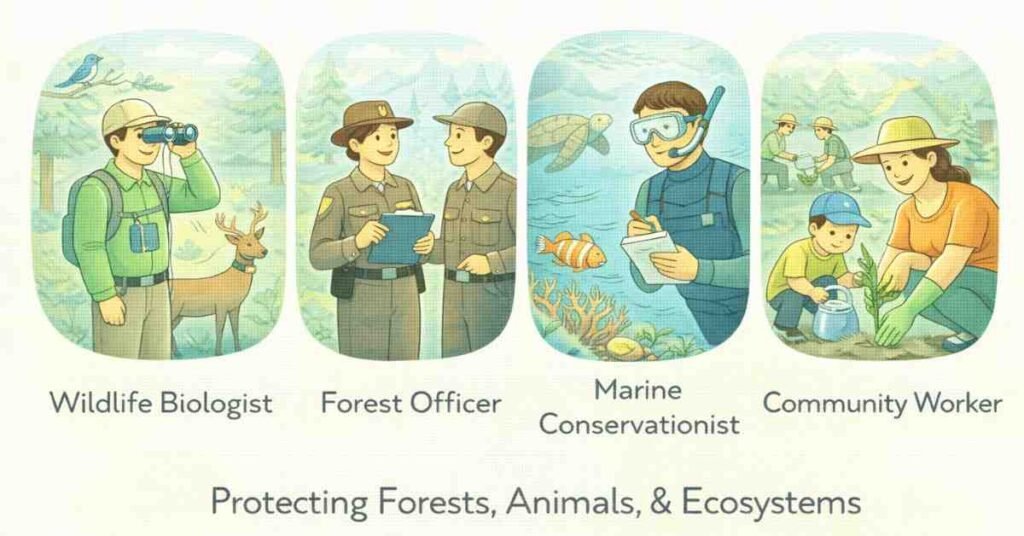
Table of Contents
If you feel excited when you visit forests, see animals in the wild, or watch nature documentaries, a conservation career might be a good fit. Conservation is about protecting forests, animals, birds, rivers, coasts, and entire ecosystems so that they survive for future generations. It is serious, professional work, not just a hobby or volunteering activity.
Conservation jobs combine fieldwork, science, community engagement, and sometimes policy, giving you a chance to work close to nature while still building a stable career.
What Is Conservation Work?
Conservation work focuses on protecting biodiversity (plants, animals, and ecosystems), managing natural resources responsibly, and reducing the negative impact of human activities on nature. Professionals in this field try to balance development needs like roads, cities, and industries with the survival of wildlife and natural habitats.
In simple terms, conservation jobs aim to:
- Protect endangered species and their habitats.
- Restore damaged ecosystems like degraded forests or polluted wetlands.
- Work with local communities so both people and wildlife can coexist.
Conservation is not only about forests and tigers. It includes wetlands, grasslands, coral reefs, urban biodiversity, and even working on laws and policies that protect nature.
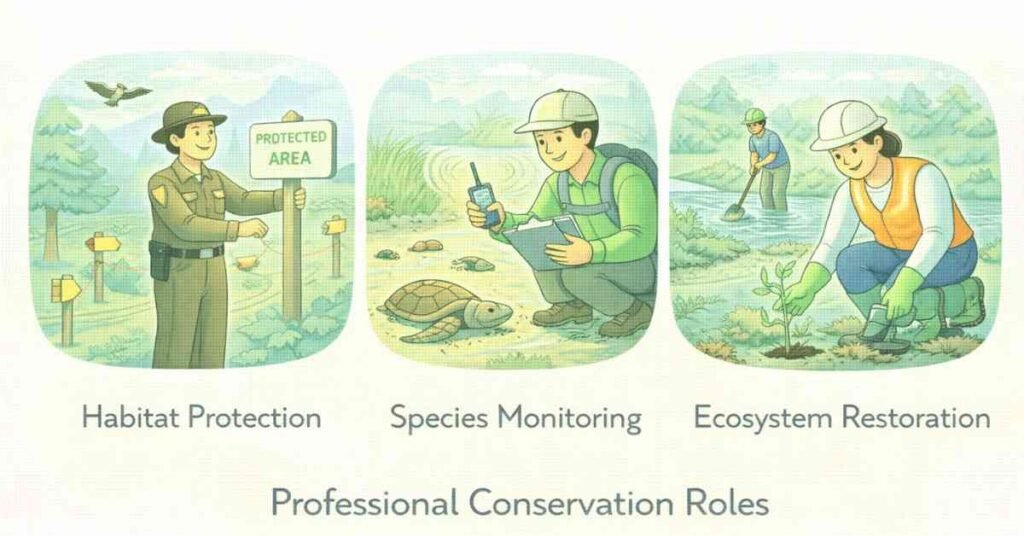
Top Conservation Career Roles
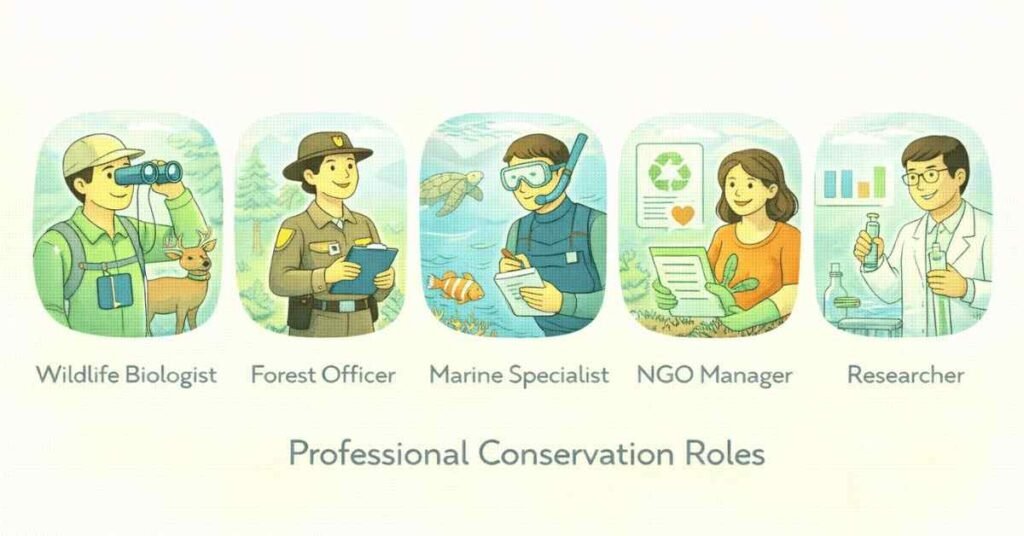
1. Wildlife Biologist / Conservation Biologist
What they do:
Wildlife and conservation biologists study animals, plants, and their habitats to understand how they live, what threats they face, and how to protect them. They may track tigers with camera traps, survey bird populations, or study how roads affect animal movement.
Typical responsibilities:
- Conduct field surveys to count animals or study their behaviour.
- Use tools like camera traps, GPS collars, and binoculars.
- Analyze data and write scientific or project reports.
- Help design conservation plans for specific species or landscapes.
Where they work:
- Wildlife and forest departments.
- Research institutes and universities.
- National and international conservation NGOs.
Education path:
- BSc in Wildlife Science, Zoology, Life Sciences, Environmental Science.
- MSc in Wildlife Science, Conservation Biology, Ecology or related field.
Soft skill fit: good for people who enjoy outdoor work, are patient, and don’t mind basic field conditions.
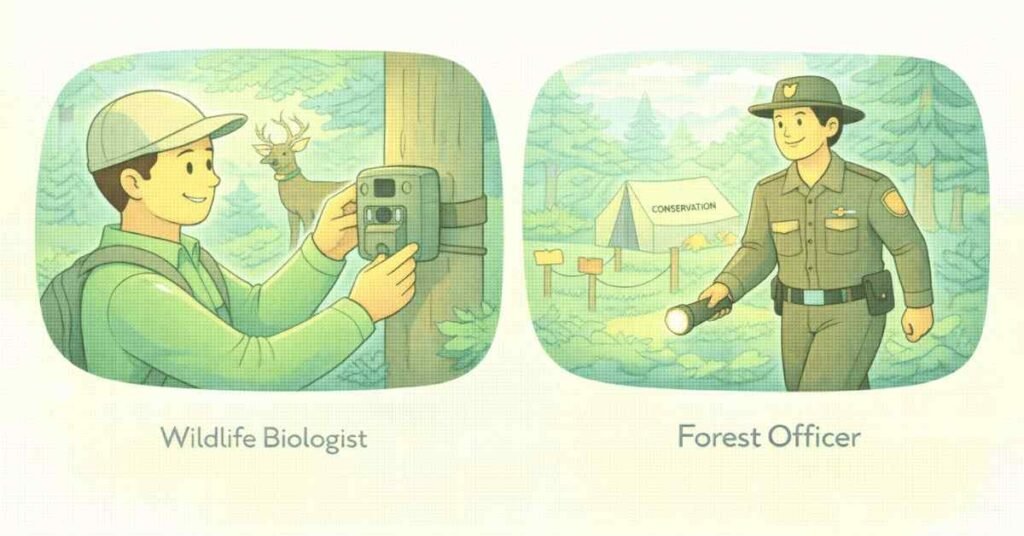
2. Forest Officer (Government – Indian Forest Service/State Forest Service)
What they do:
Forest officers manage large forest areas, protect wildlife, and implement government schemes related to forests and environment. They act like “guardians” of forest land and wildlife.
Typical responsibilities:
- Oversee protection of forests against illegal logging and poaching.
- Manage staff like forest guards and watchers.
- Implement plantation programs, eco-tourism projects, and community-based forestry.
- Work on forest fire prevention and control.
Where they work:
- Central and state forest departments.
Education & entry:
- Indian Forest Service (IFS): through UPSC exam with a science/engineering background.
- State forest services: through state-level public service commission exams.
This path suits those who want a respected government job, don’t mind tough postings, and are comfortable working in remote areas.
3. Marine Conservation Specialist
What they do:
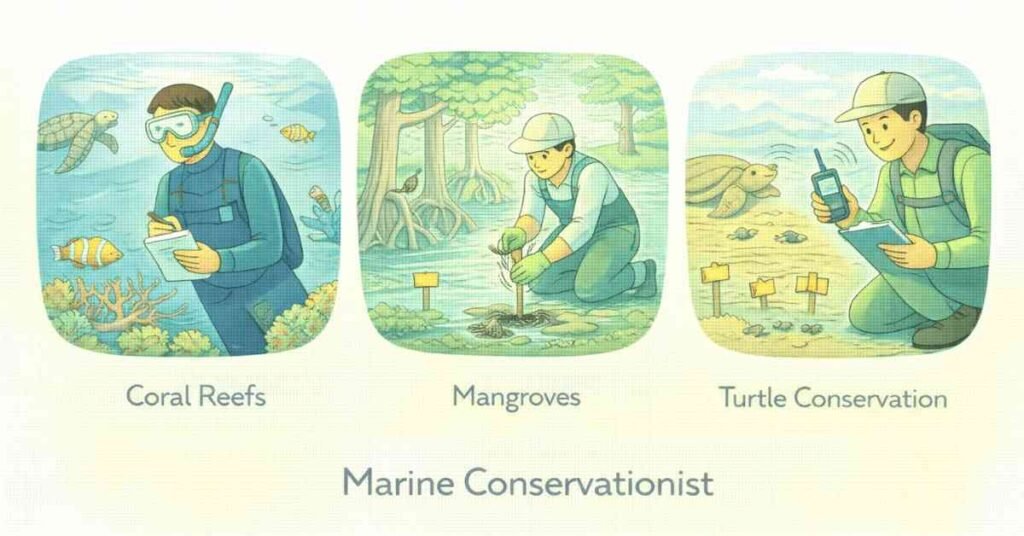
Marine conservation professionals protect oceans, coasts, coral reefs, mangroves, and marine animals like turtles, dolphins, and fish. Their work aims to tackle issues like plastic pollution, coral bleaching, and overfishing.
Typical responsibilities:
- Conduct underwater or coastal surveys to monitor coral reefs, fish, or turtle nesting sites.
- Study impacts of tourism, fishing, or climate change on marine ecosystems.
- Work with fishing communities on sustainable fishing practices.
- Support marine protected area planning and management.
Where they work:
- Coastal research institutes and universities.
- Marine-focused NGOs and conservation organizations.
- Government coastal and environment departments.
Education path:
- BSc in Marine Science, Zoology, Environmental Science, or Fisheries.
- MSc in Marine Biology, Oceanography, Coastal and Marine Studies, or related areas.This role is ideal if you love the sea, don’t mind travel, and are okay with fieldwork that can involve boats, diving (with training), and irregular schedules.
4. Conservation Project Manager / NGO Program Manager
What they do:
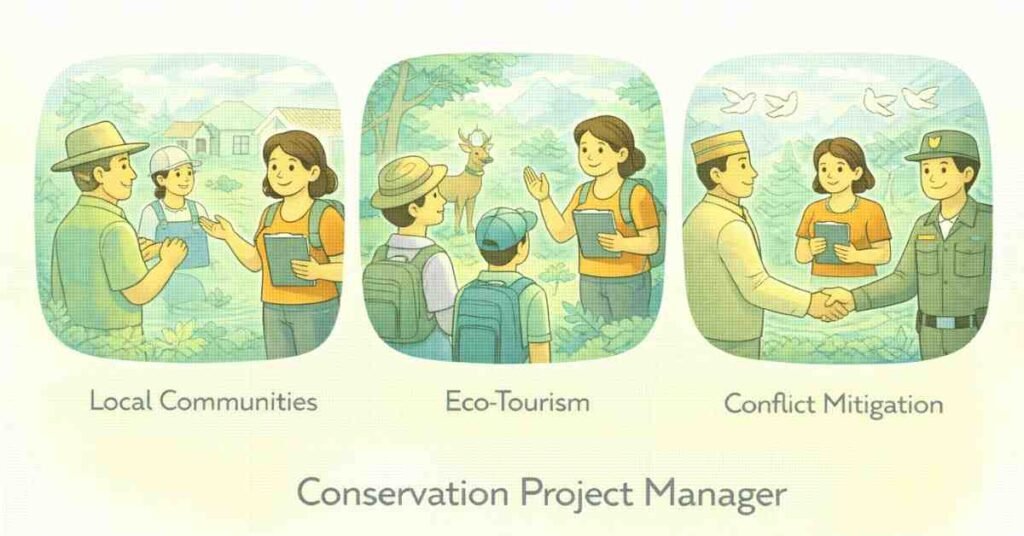
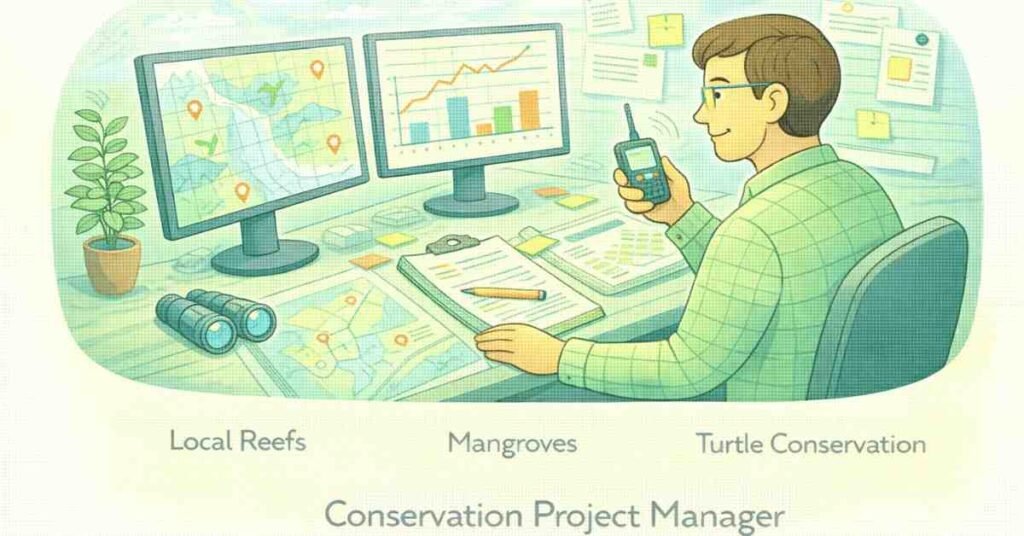
Conservation project managers run on-ground conservation projects, combining science, people management, and planning. They may lead projects on tiger conservation, community forestry, human–wildlife conflict mitigation, or habitat restoration.
Typical responsibilities:
- Plan project activities, timelines, and budgets.
- Coordinate field teams, volunteers, and local partners.
- Interact with local communities and government officials.
- Monitor project progress and prepare reports or donor updates.
Where they work:
- National and international conservation NGOs.
- Foundations and CSR (Corporate Social Responsibility) projects.
Education & skills:
- Degree in Environmental Science, Forestry, Wildlife, Rural Development, or Social Sciences.
- Strong project management, communication, and people skills.
This suits people who like leadership, coordination, and seeing direct impact on the ground.
5. Community-Based Conservation Specialist
What they do:
These professionals focus on working with local communities living near forests, national parks, and other natural areas. The aim is to reduce conflict (for example, crop damage by wildlife) and create alternative livelihoods that support conservation.
Typical responsibilities:
- Conduct community meetings and awareness sessions.
- Help set up eco-friendly livelihood options like eco-tourism, handicrafts, or sustainable agriculture.
- Work on human–wildlife conflict solutions such as fencing, crop protection, or early warning systems.
- Act as a bridge between local people, NGOs, and government departments.
Where they work:
- Grassroots NGOs.
- CSR projects of large companies.
- Government and international development agencies.
Education & skills:
- Degree in Environmental Studies, Social Work, Rural Development, or related fields.
- Strong communication in local languages, empathy, patience, and problem-solving skills.
6. Protected Area Manager / Park Warden (National Parks & Sanctuaries)
What they do:
Protected area managers are responsible for managing national parks, wildlife sanctuaries, and conservation reserves. They ensure the safety of wildlife and visitors, maintain facilities, and support research and tourism.
Typical responsibilities:
- Oversee anti-poaching patrols and habitat protection.
- Coordinate with forest guards and local staff.
- Manage tourist facilities and enforce park rules.
- Support scientific research and monitoring activities in the park.
Where they work:
- Forest and wildlife departments.
Education & entry:
- Typically via forest service or related government recruitment (varies by state and role seniority).
Good for those who want structured government roles with high responsibility and a direct link to on-ground conservation.
7. Conservation Researcher / Ecologist
What they do:
Research-focused conservation professionals work mostly in universities and research institutes, studying ecosystems and publishing scientific work that guides conservation policies.
Typical responsibilities:
- Design and conduct long-term ecological studies.
- Collect and analyze data on forests, wetlands, grasslands, or species.
- Publish research papers and policy recommendations.
- Teach or guide students and interns in some roles.
Where they work:
- Universities and research institutes.
- Think tanks and conservation-focused research organizations.
Education path:
- BSc, MSc, and often PhD in Wildlife Science, Ecology, Environmental Science, Zoology, or Botany.
Ideal for those who enjoy deep study, data analysis, and writing rather than only field logistics.
8. Urban Biodiversity & Green Space Planner
What they do:
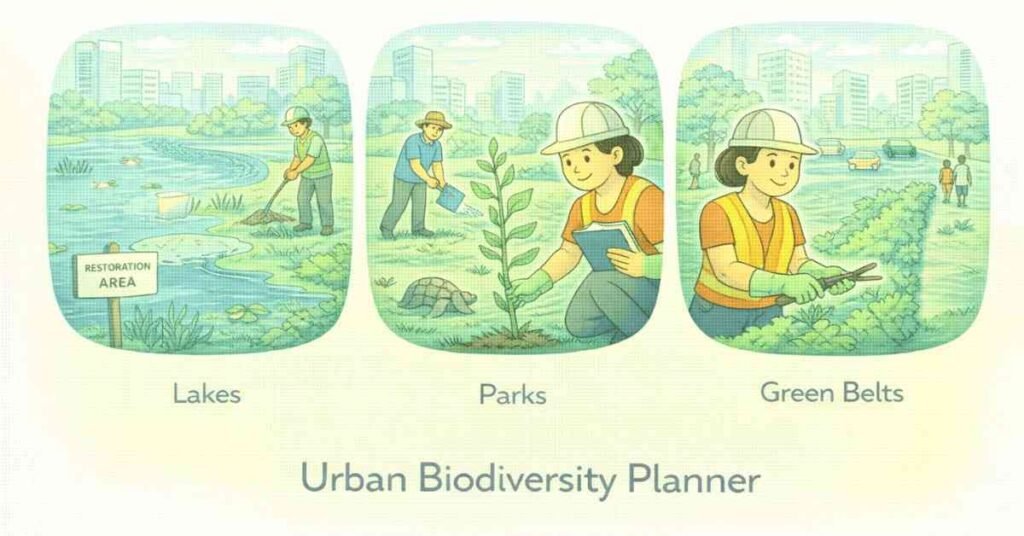
These professionals bring conservation thinking into cities by protecting urban lakes, parks, tree cover, and biodiversity. They help make cities greener and more livable.
Typical responsibilities:
- Plan and design urban green spaces like parks, green belts, and biodiversity parks.
- Work on restoration of lakes, wetlands, or urban forests.
- Advise on city planning with ecological sensitivity.
- Conduct biodiversity surveys in cities (birds, butterflies, trees, etc.).
Where they work:
- City planning bodies and municipal corporations.
- Environmental consultancies and urban design firms.
- NGOs and citizen groups focused on urban ecology.
Education & skills:
- Environmental Science, Urban Planning, Landscape Architecture, or related disciplines.
- GIS, mapping, basic understanding of town planning laws, and interest in both nature and cities.
Education Pathways for Conservation Careers
Your education path depends on how “scientific” or “social” you want your conservation work to be. Here is a simple breakdown:
After Class 10
- Choose Science (PCB/PCMB) in 11th–12th if you want options like wildlife biology, ecology, or environmental science.
- If you choose Arts/Commerce, you can still enter community-based conservation, policy, or NGO management later through environmental or development studies at graduation level.
After Class 12
Option 1: Science-Focused Path
- BSc in:
- Wildlife Science
- Zoology
- Botany
- Environmental Science
- Forestry
- Followed by MSc in:
- Wildlife Science
- Conservation Biology
- Ecology
- Environmental Science
This path suits wildlife biologists, conservation researchers, and ecological roles.
Option 2: Social & Community Path
- BA/BSc in:
- Environmental Studies
- Rural Development
- Social Work
- Sociology
- Followed by Masters in:
- Environmental Management
- Sustainable Development
- Rural Development
- Social Work with environment focus
This path suits community-based conservation, NGO projects, and development-linked conservation.
Option 3: Mixed / Planning Path
- Degrees in Environment + Planning/Architecture/Geography for urban conservation and green space planning.
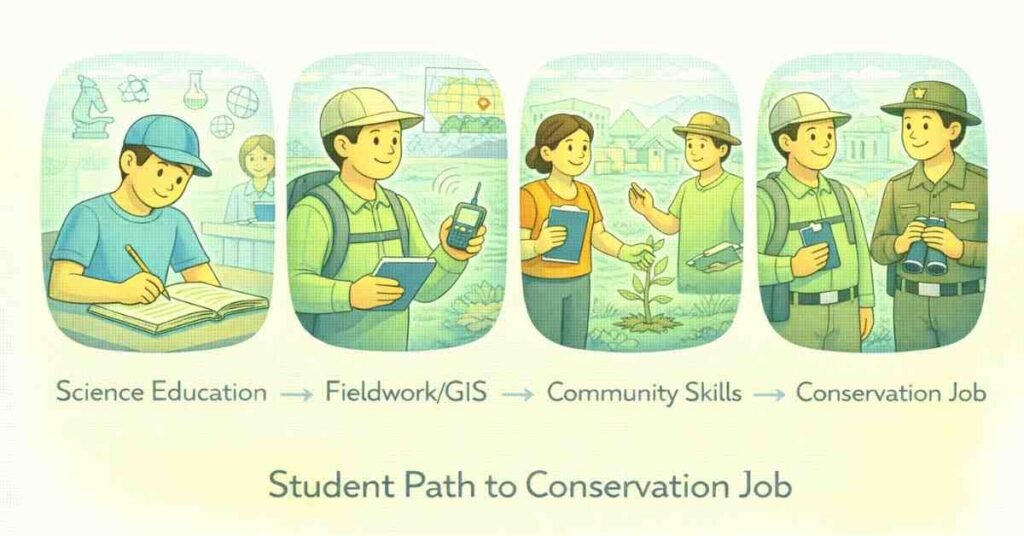
Key Skills You Need for Conservation
Technical & Field Skills
- Field survey methods: line transects, point counts, camera trapping, vegetation sampling.
- Basic data analysis and use of spreadsheets or simple statistics.
- GIS and mapping basics for habitat and landscape analysis.
- Species identification (birds, mammals, plants, etc., depending on your focus).
Soft Skills
- Patience and emotional resilience: fieldwork can be physically tiring and emotionally challenging.
- Communication skills: you often work with local communities, forest staff, and donors.
- Teamwork: conservation projects are usually collaborative.
Problem-solving: especially with conflict situations between people and wildlife.
Salary Reality in Conservation Careers
Conservation is usually driven by passion, but that does not mean there is no money. Still, you must be realistic.
- Entry-level NGO or project roles:
- Roughly ₹3–6 LPA, depending on the organization size and location.
- Roughly ₹3–6 LPA, depending on the organization size and location.
- Government forest/wildlife roles:
- Generally higher starting package than NGOs plus strong benefits and job security.
- Generally higher starting package than NGOs plus strong benefits and job security.
- Mid-career NGO/project management:
- Around ₹6–12 LPA, with higher pay in large international NGOs or funded projects.
- Around ₹6–12 LPA, with higher pay in large international NGOs or funded projects.
- Research/academic roles:
- Variable, but can be stable with funded positions and promotions.
- Variable, but can be stable with funded positions and promotions.
International conservation jobs and consulting assignments can pay more, particularly if you build strong expertise in a niche area like marine conservation, human–wildlife conflict, or landscape-level planning.
How to Break into Conservation (Step-by-Step)
- During School/College:
- Join nature clubs, bird watching groups, or citizen science initiatives.
- Visit national parks, sanctuaries, and attend nature camps if possible.
- Join nature clubs, bird watching groups, or citizen science initiatives.
- During Graduation:
- Choose projects related to wildlife, forests, or ecosystems.
- Volunteer or intern with conservation NGOs during vacations.
- Choose projects related to wildlife, forests, or ecosystems.
- After Graduation:
- Do internships or junior roles even if the pay is modest initially—experience in conservation is extremely valuable.
- Consider a relevant master’s degree if you want long-term growth or research positions.
- Do internships or junior roles even if the pay is modest initially—experience in conservation is extremely valuable.
- Build a Portfolio:
- Document your field experiences, projects, and skills.
- Create a simple portfolio with photos (where allowed), survey reports, or small write-ups.
- Document your field experiences, projects, and skills.
- Network:
- Follow conservation organizations and researchers on LinkedIn and other platforms.
- Follow conservation organizations and researchers on LinkedIn and other platforms.
Attend webinars, workshops, and conferences in conservation and wildlife.
Challenges vs Rewards in Conservation Careers

Challenges:
- Salaries at the start may be lower than some corporate roles.
- Field conditions can be tough: heat, rain, basic facilities, long hours.
- Job security in some project-based roles can depend on funding cycles.
Rewards:
- Direct impact: you see the result of your work on species and habitats over time.
- Purpose-driven career: you work for more than just money.
- Rich experiences: close connection with nature, travel to remote and beautiful places, interactions with diverse communities.