
COMMUNICATION & SOFT SKILLS FOR HOSPITALITY
Table of Contents
Mastering Communication in Hospitality: Your Career Superpower
Why Communication Matters More Than You Think
Communication is foundational to every hospitality role. Whether you’re a front desk executive handling guest inquiries, a chef coordinating kitchen staff, a sales manager presenting to corporate clients, or an events coordinator managing vendors—communication skill determines your effectiveness and career trajectory.
In hospitality, miscommunication doesn’t just create awkward moments; it impacts guest experiences, operational efficiency, and business outcomes. Mastering communication isn’t just about advancing your career—it’s about delivering exceptional service, managing teams effectively, and building relationships that support your entire hospitality journey.
The Communication Hierarchy in Hospitality
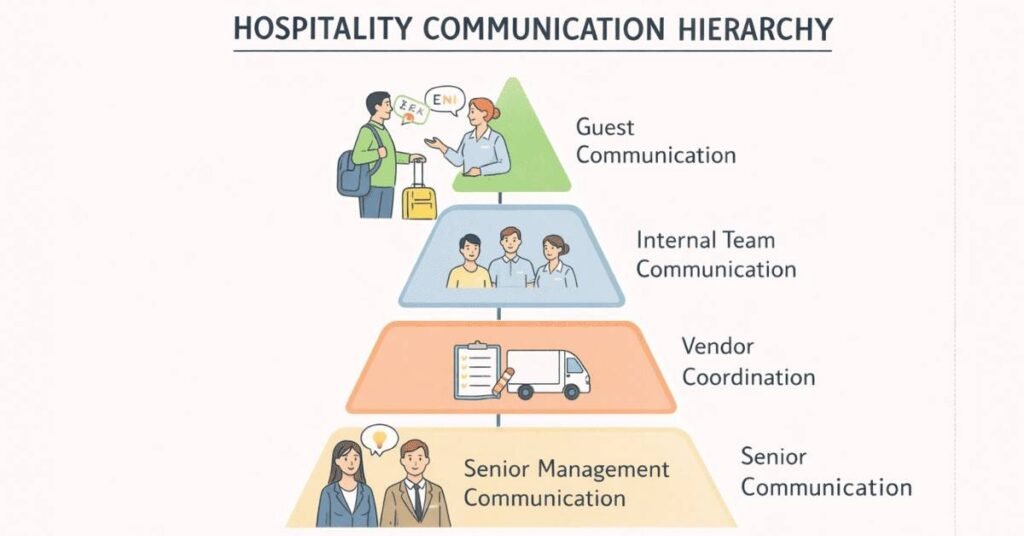
Communication occurs at multiple levels, each requiring different approaches:
Guest Communication
Direct interaction with guests—face-to-face, phone, email, messaging apps.
Characteristics:
- Professional yet warm tone
- Clear, easy-to-understand language
- Responsive (prompt replies expected)
- Solution-focused
Internal Team Communication
Communication with colleagues, supervisors, other departments.
Characteristics:
- Collaborative approach
- Specific, actionable information
- Regular updates and feedback
- Respectful consideration of others’ time
External Vendor/Supplier Communication
Interaction with vendors, partners, contractors.
Characteristics:
- Professional, business-focused
- Clear expectations and deadlines
- Documentation and confirmation
- Relationship-building focus
Senior Management Communication
Communicating with directors, general managers, ownership.
Characteristics:
- Strategic perspective
- Data-driven information
- Executive summary format
- Respectful of their time
Each level requires adjusted communication approach.
Core Communication Skills in Hospitality
1. Verbal Communication Excellence
In-Person Communication:
Hospitality heavily involves face-to-face interaction. Mastering in-person communication is critical.
Voice Quality Matters:
- Tone – Your voice communicates emotion and attitude. Practice warmth: “Welcome! How can I help you today?” sounds different from “What do you need?” (same words, different tone)
- Speed – Speaking too fast creates confusion and seems nervous. Speaking too slow seems condescending. Find natural rhythm.
- Volume – Loud voices seem aggressive; very soft voices seem uncertain. Moderate volume with confidence.
- Clarity – Enunciate clearly, especially important for international guests and phone communication.
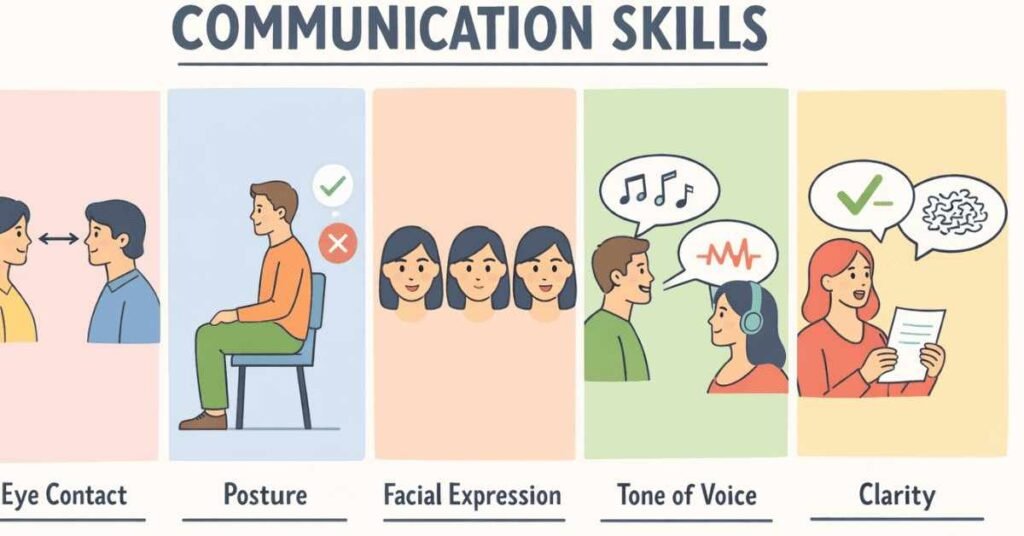
Body Language Communication:
Over 65% of communication is non-verbal. Your body language communicates more than words.
- Posture – Stand upright, shoulders back. This communicates confidence and professionalism.
- Eye Contact – Direct (but not intense) eye contact communicates honesty and respect. Avoiding eye contact suggests nervousness or dishonesty.
- Facial Expression – Smile appropriately (authentic, not forced). Facial expressions should match your words—don’t say “I’d be happy to help!” while frowning.
- Gestures – Use hand gestures naturally to emphasize points. Avoid excessive gesturing (seems nervous) or no gestures (seems disengaged).
- Distance – Maintain appropriate personal space (roughly 1-2 feet in professional settings). Too close feels intrusive; too far seems unfriendly.
Real Example:
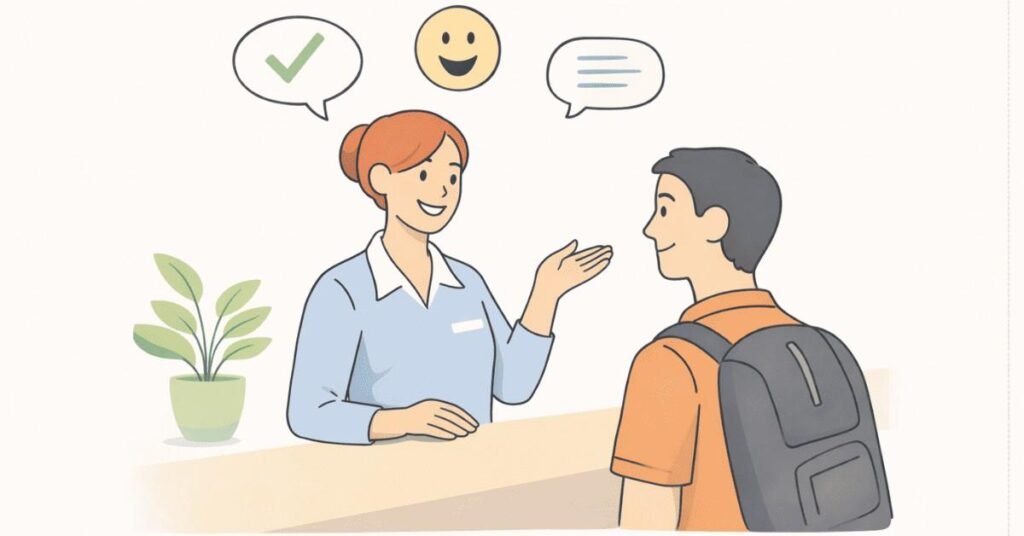
Scenario: Guest checks in after delayed flight, clearly exhausted.
Poor Communication: Front desk sits back in chair, minimal smile, says “Welcome” without eye contact while focused on computer.
Excellent Communication: Front desk stands, makes eye contact, offers genuine smile, leans slightly forward showing interest, says “Welcome! You must be exhausted after your delay. Let me get you checked in quickly so you can rest.” Body language communicates empathy and genuine care.
2. Phone Communication Skills
Phone communication removes visual cues, making voice quality and clarity paramount.
Phone Etiquette Fundamentals:
- Answer Promptly – Answer within 3 rings. Quick response shows professionalism.
- Identify Yourself – “Good morning, this is Rajesh at the Riverside Hotel. How can I help you?”
- Listen Actively – Without visual cues, listening is everything. Focus completely on what’s being said.
- Speak Clearly – Enunciate carefully since they can’t see your face.
- Avoid Background Noise – Find quiet spaces for calls. Background noise seems unprofessional.
- Confirm Details – Repeat back information, especially for bookings or complex requests.
- Offer Written Follow-Up – “I’ll send you a confirmation email with all details.”
- End Professionally – “Thank you for calling. We look forward to welcoming you!”
Handling Difficult Phone Calls:
- Stay Calm – Difficult callers sense frustration. Maintain composure.
- Empathize First – “I understand this is frustrating…” before offering solutions.
- Never Say “You’ll have to…” – This sounds dismissive. Instead: “What I can do is…”
Offer Choices – Empower them: “Would you prefer A, B, or C?”
3. Written Communication
Written communication through emails, messages, and documentation is increasingly important.
Email Communication Standards:
- Subject Line Clarity – “Room 405 Wi-Fi Issue – Urgent Resolution Needed” (specific) vs. “Help” (vague)
- Professional Greeting – “Dear Mr. Sharma,” or “Hello Priya,” (depending on relationship and formality)
- Clear Opening – State purpose immediately: “I’m writing to confirm your event details for March 15th.”
- Body Organization – Use short paragraphs, bullet points for clarity. Avoid wall-of-text emails.
- Specific Details – Include dates, times, amounts, confirmation numbers.
- Tone Appropriateness – Match formality to recipient. More casual with colleagues, formal with corporate clients.
- Professional Closing – “Best regards,” or “Warm regards,” (not “Bye!” or “Thanks a bunch!”)
- Proofread – Spelling and grammar mistakes undermine credibility.
Real Example:
Poor Email:
“Hi, I wanted to let u know that ur reservation is confirmed. The room is nice and the breakfast is good. Let me no if u need anything.”
Professional Email:
“Dear Mr. Patel,
I’m delighted to confirm your reservation with us from March 15-17, 2025.
Booking Details:
- Room: Deluxe Double Room (Garden View)
- Check-in: 3:00 PM / Check-out: 11:00 AM
- Rate: INR 5,500/night (including breakfast)
- Confirmation #: HT-2025-87654
Special Amenities:
- Complimentary late checkout until 1:00 PM
- Airport transfer assistance available upon request
- Concierge services 24/7
Please don’t hesitate to contact me with any questions. I look forward to welcoming you.
Best regards,
Priya Sharma
Guest Relations
Riverside Hotel”
4. Active Listening Skills
We covered this partly in customer service, but it’s worth deeper exploration in communication context.
Advanced Active Listening:
- Minimize Internal Dialogue – Stop planning your response while they’re speaking.
- Notice Emotion – Listen for feelings beneath words. “The room is too noisy” might mean “I can’t sleep and I’m frustrated.”
- Clarify With Questions – “When you say the room is too noisy, is the issue from outside or other guests?”
- Reflect Back – Show understanding: “So you’re looking for a quiet room away from the street.”
- Avoid Interrupting – Even if you know the solution, let them finish. Interrupting seems dismissive.
- Remember Details – Note important information. This shows respect: “You mentioned you’re here for your anniversary—congratulations!”
5. Cross-Cultural Communication
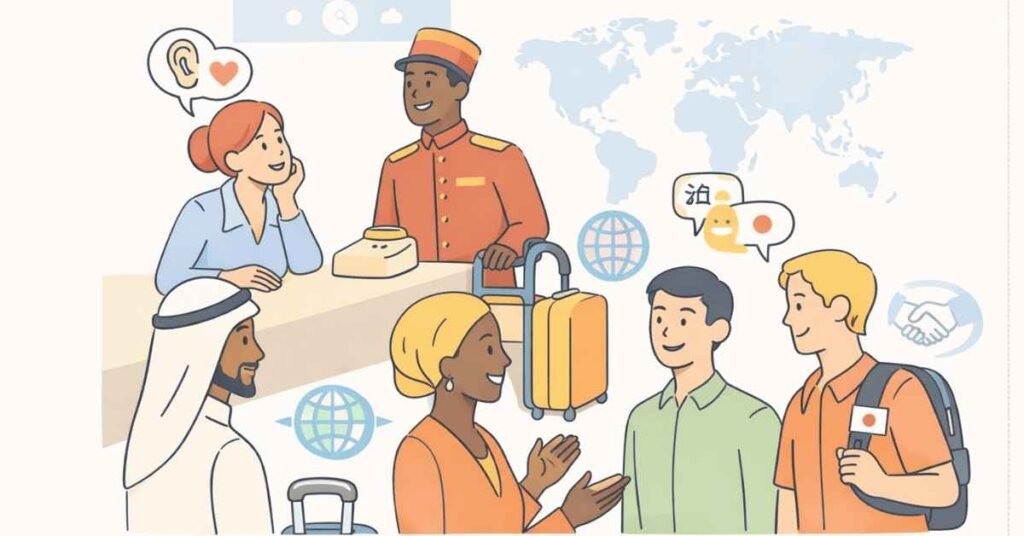
Hospitality involves interacting with diverse guests and colleagues from different cultural backgrounds.
Cultural Sensitivity Principles:
- Avoid Stereotyping – Don’t assume preferences based on appearance or accent.
- Respect Communication Styles – Some cultures prefer direct communication; others prefer indirect. Adapt accordingly.
- Language Patience – If someone speaks English as second language, speak clearly and patiently, never condescendingly.
- Respect Personal Space & Gestures – What’s appropriate in India might be inappropriate in another culture.
- Learn Basic Greetings – Guests appreciate effort to greet them in their language.
- Ask When Uncertain – “I want to ensure I’m respecting your preferences—please let me know how I can best serve you.”
Real Example:
Situation: International guest from Japan seems unhappy despite excellent service metrics.
Poor Response: Assume they’re just not satisfied-type.
Better Response: Research Japanese communication styles. In Japanese culture, directness can seem rude. The guest might be happy but expressing it subtly. Ask gently: “We want to ensure your stay is perfect. Is there anything that would make it more comfortable?”
6. Difficult Conversation Skills
Sometimes communication involves delivering bad news or having uncomfortable conversations.
Framework for Difficult Conversations:
- Choose Right Setting – Private, calm environment
- Be Timely – Don’t delay difficult conversations
- Be Direct But Respectful – “I need to discuss your recent absences. This is impacting our team.”
- Listen to Their Perspective – “What’s happening that’s caused these absences?”
- Focus on Behavior, Not Character – “Being late impacts our service” (not “You’re an irresponsible person”)
- Offer Solutions – “How can I help you manage this? What support do you need?”
Document – For performance conversations, keep records
Communication in Different Hospitality Roles
Front Office Staff Communication:
- Guest check-in/out: Clear, efficient, friendly
- Phone calls: Professional, solution-focused
- Email inquiries: Prompt, detailed responses
- Colleague coordination: Clear handoffs, critical information
F&B Staff Communication:
- Menu recommendations: Enthusiastic, knowledgeable
- Special request handling: Accurate note-taking, confirmation
- Complaint handling: Empathetic, solution-focused
- Kitchen communication: Clear, specific orders
Sales & Marketing Communication:
- Client proposals: Professional, tailored to client needs
- Presentations: Confident, data-driven, compelling
- Relationship building: Personal touch, follow-up
- Negotiation: Confident, solution-focused
Management Communication:
- Team briefings: Clear objectives, actionable information
- One-on-ones: Supportive, developmental focus
- Upper management: Strategic, data-focused, concise
- Crisis communication: Calm, clear, action-oriented
Communication Tools & Platforms
Modern hospitality uses various communication platforms:
- Guest-Facing: WhatsApp, Telegram, email, phone, in-app messaging
- Internal: Slack, Microsoft Teams, walkie-talkies, in-person briefings
- Vendor: Email, dedicated vendor portals, phone
- Documentation: CRM systems, property management systems
Proficiency with these platforms is increasingly important.
Developing Your Communication Skills
Practice Deliberately:
- Record yourself speaking (awkward but valuable)
- Practice phone calls with colleagues
- Role-play difficult scenarios
- Ask for feedback: “How did I handle that communication?”
Seek Feedback:
- Ask supervisors for communication feedback
- Get guest feedback through surveys
- Ask colleagues what communication could improve
Continuous Learning:
- Take communication workshops
- Read books on communication (books like “Crucial Conversations”)
- Watch TED talks on communication
- Study excellent communicators—what makes them effective?

Why Communication Excellence Accelerates Hospitality Careers
Communication is the primary differentiator between good hospitality professionals and great ones. Here’s why it matters for advancement:
- Guest Loyalty – Excellent communication creates emotional connections
- Team Efficiency – Clear communication prevents misunderstandings and mistakes
- Problem Prevention – Clear communication prevents issues from escalating
- Leadership Readiness – Management roles require exceptional communication
- Client Relationships – In sales and events, communication determines success
Professionals who master communication skills are consistently promoted faster, earn higher salaries, and enjoy more career satisfaction.