
How to Get PE License & Professional Certifications for Civil Engineers
Table of Contents
Introduction
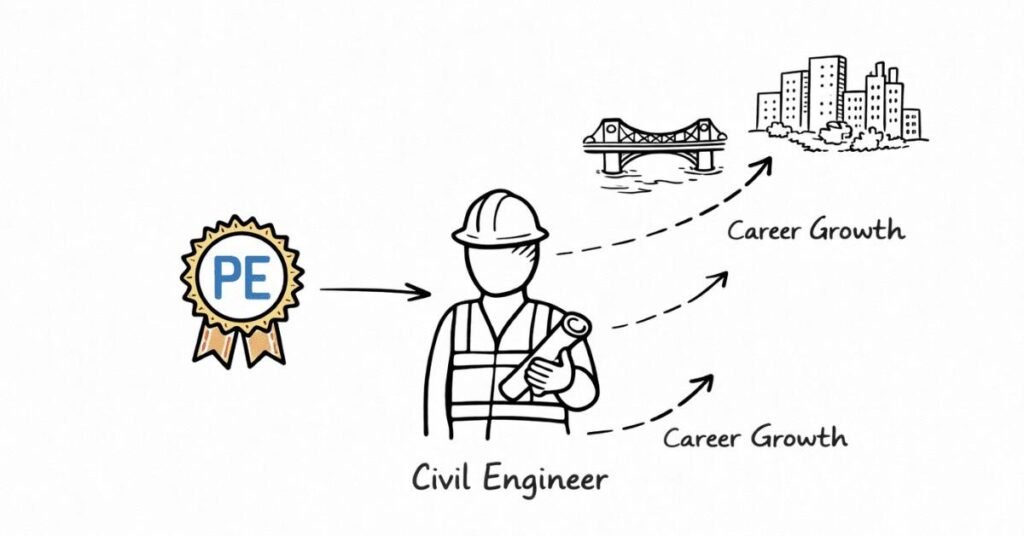
When students hear the word “license” in engineering, most think of driving. In the professional world, though, a “licensed” or “certified” engineer is someone who has proven their expertise to an official body. That stamp next to your name can open doors that stay closed for other engineers.
In India, there is growing importance given to civil engineering certifications like PE (Professional Engineer) by professional bodies, along with global credentials like PMP, LEED, and software-specific certifications. These do not replace your BTech degree, but they add a powerful layer of credibility and employability.
This guide explains, in simple language, how Indian civil engineers can build their profile using licenses and certifications, and when it actually makes sense to go for them.
Why Licenses & Certifications Matter for Civil Engineers
Think of certifications as “trust badges”. A degree says you completed a course. A license or certification says you meet a professional standard tested by an independent body.
They matter because:
- They prove your competence to clients, employers, and government bodies.
- They help when you want to sign designs, run your own consultancy, or bid on projects.
- They can increase your salary and promotion chances, especially for senior roles.
- Some international projects and organizations prefer or require certified/ licensed engineers.
For a fresher, a certification is not a magic ticket to a big package. But as you gain experience, these credentials can push you ahead of others with similar years of work.
What Is PE (Professional Engineer) Certification?
In simple terms, a Professional Engineer (PE) is an engineer who has:
- A recognized engineering degree
- Significant work experience
- Cleared a structured evaluation by a professional body
- Agreed to follow a code of ethics
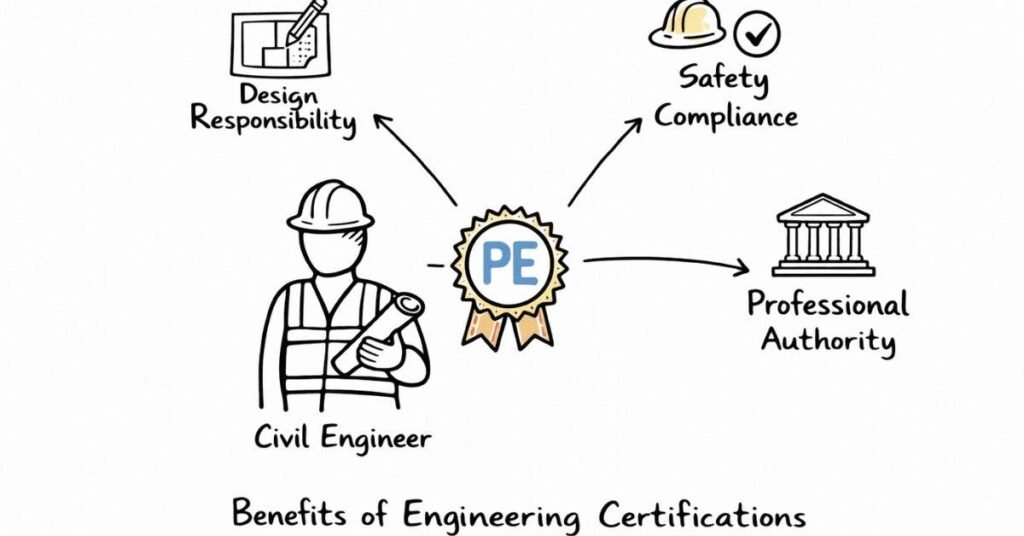
In India, PE-type certification is typically offered by professional engineering institutions. The goal is to recognize engineers who are competent to take professional responsibility for design, safety, and public welfare.
What this usually means for you:
- You can be officially recognized as a competent professional in your field.
- Your profile improves for consulting, senior roles, and international work.
- It signals that you are serious about continuous learning and professional conduct.
Eligibility: When Can You Think About PE?
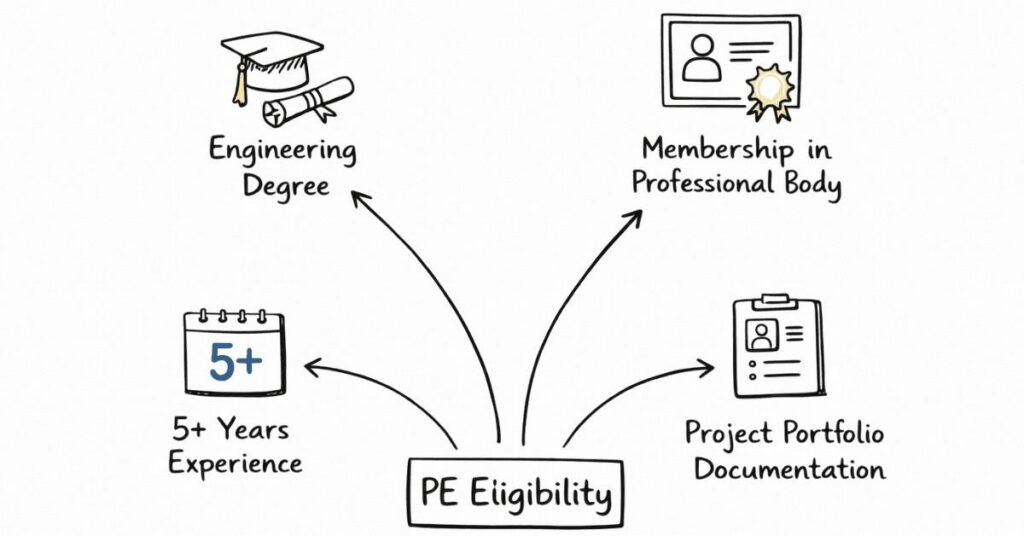
PE is not for freshers just out of BTech. It is usually meant for engineers with a few years of real experience.
Typical expectations (varies by body):
- Degree: BTech/BE in Civil Engineering (from a recognized university).
- Membership: Often, you must be a member of the relevant professional institution.
- Experience: Around 5+ years of post-degree professional experience in civil/infrastructure work.
- Professional record: Some proof of projects handled, responsibilities taken, and roles played.
So, if you are a student or a fresher, your first focus should be learning, internships, and site/design exposure, not PE immediately. Consider PE from around Year 5 of your career onward.
Typical PE Certification Process (Step-by-Step)
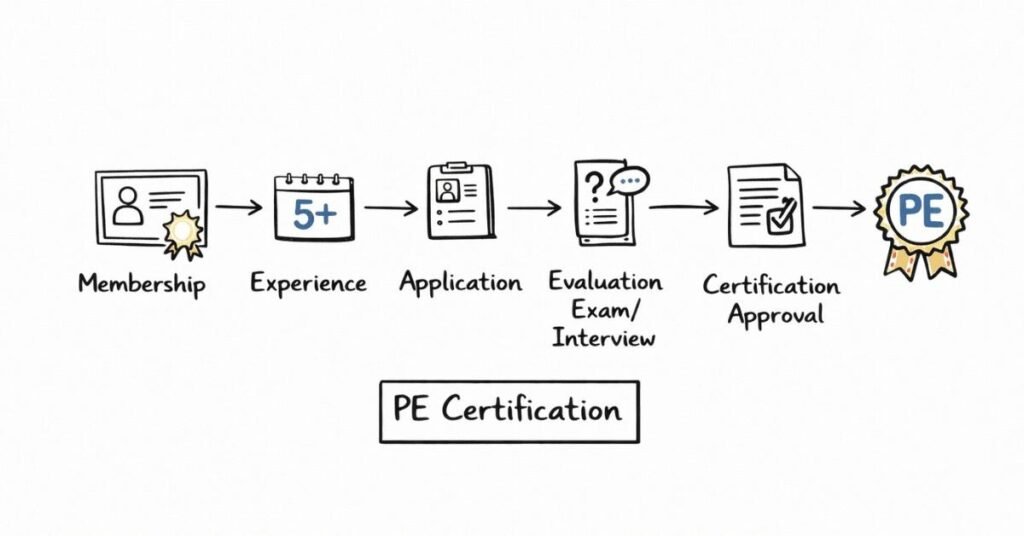
Different institutions have slightly different processes, but the flow is broadly similar:
- Become a Member
- Apply for membership in a recognized engineering institution (like a national professional body).
- Submit your degree certificate, marksheets, and basic details.
- Apply for membership in a recognized engineering institution (like a national professional body).
- Gain Relevant Experience
- Work in civil engineering roles: design office, construction site, infrastructure projects, water, transportation, etc.
- Keep records of: projects, responsibilities, design calculations, drawings, reports, site responsibilities.
- Work in civil engineering roles: design office, construction site, infrastructure projects, water, transportation, etc.
- Apply for PE Assessment
- Fill an application form specifically for PE certification.
- Attach documents:
- Degree certificates
- Experience certificates
- Project summaries / portfolio
- Recommendation letters (often from seniors or existing members)
- Degree certificates
- Fill an application form specifically for PE certification.
- Appear for Evaluation
- This may include:
- Written examination (technical + ethics/ professional practice).
- Viva/interview before a panel.
- Assessment of your project work and contributions.
- Written examination (technical + ethics/ professional practice).
- This may include:
- Get Certified
- Once you clear the process, you receive a PE certificate / credential.
- You may also get the right to write “PE” or similar suffix after your name.
- Once you clear the process, you receive a PE certificate / credential.
- Maintain Your Status
- Some bodies require continuous professional development (CPD).
- Some bodies require continuous professional development (CPD).
That means attending workshops, conferences, courses regularly to keep your knowledge up-to-date.
Benefits of PE for Indian Civil Engineers
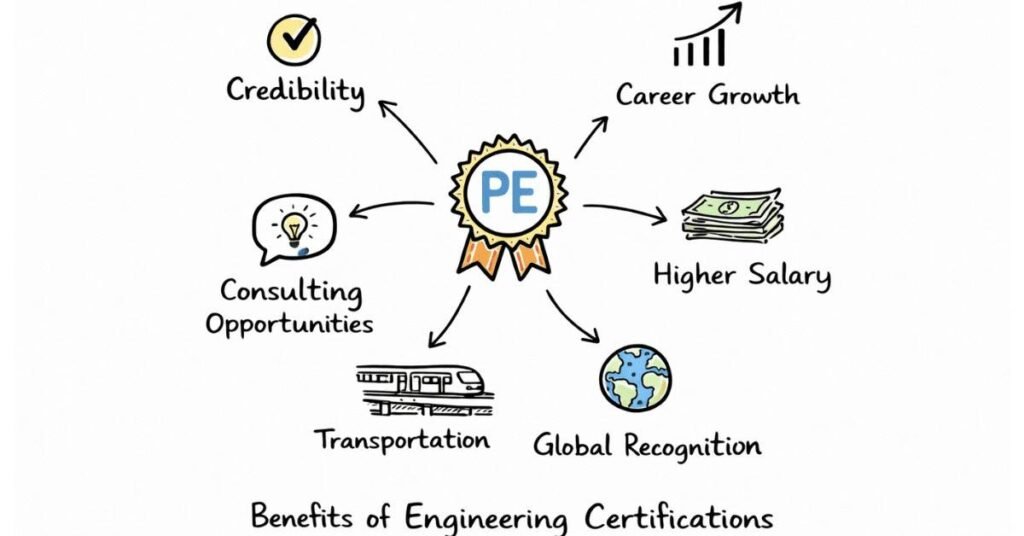
Is it worth the effort? For many mid-career engineers, yes. Key benefits:
- Higher credibility: Useful in consulting, design, and sanction-related roles.
- Better opportunities: Certain tenders, government projects, or clients may prefer certified professionals.
- Edge in promotions: Especially in large organizations where multiple engineers compete for senior roles.
- International mobility: If you plan to work abroad or with international firms, a recognized professional certification is a big plus.
- Stronger personal brand: You are no longer just “Engineer X”; you are “Engineer X, PE”, which carries weight.
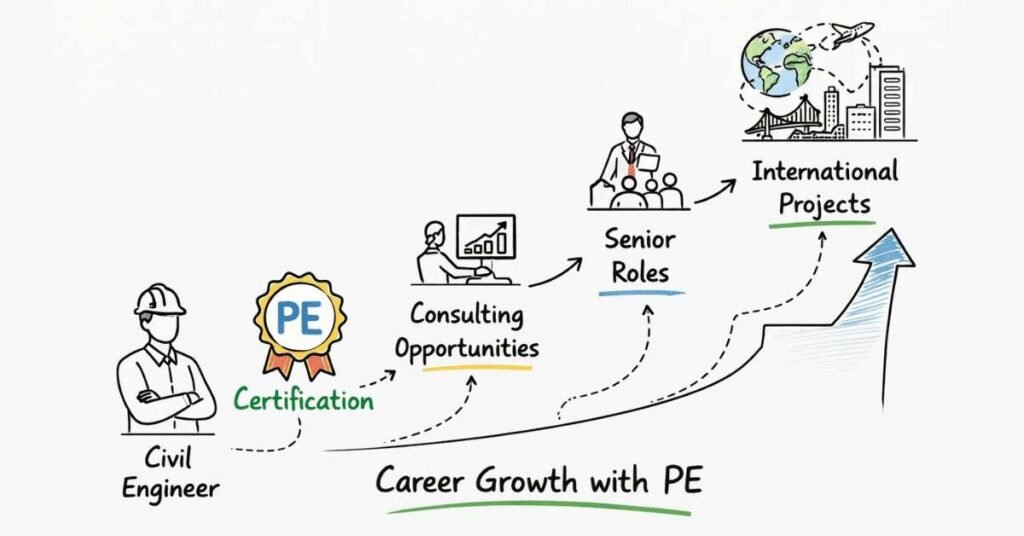
When PE Is Practical vs. When It’s Optional
PE is most useful if you want to:
- Run your own design or consulting practice.
- Work as a signing authority for structural design or other critical design work (depending on local rules).
- Take senior technical roles in consulting or infrastructure firms.
- Work on international or high-stakes projects where professional recognition matters.
It is less urgent if you:
- Want to stay purely on the execution/ site side and not do high-level design or independent consultancy.
- Are in early years of your career (0–3 years).
- Are planning a complete switch to non-technical roles (sales, pure management, etc.).
Other Valuable Professional Certifications for Civil Engineers
PE is not the only way to stand out. Several other certifications can help at different stages.
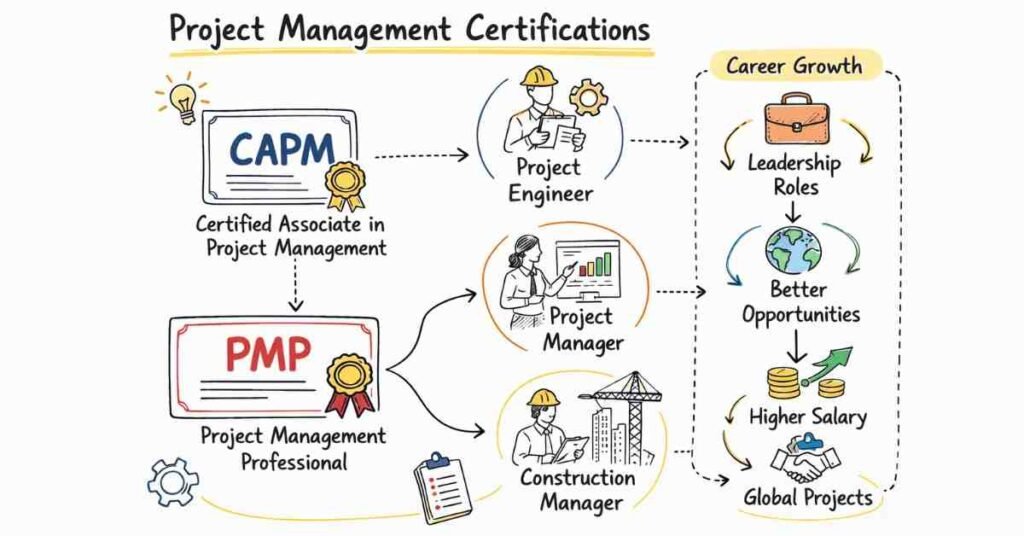
1. Project Management Certifications (PMP / CAPM)
If you see yourself as a future Project Manager or Construction Manager, project management certifications are powerful.
- CAPM (entry-level) – good for early-stage professionals who want a formal foundation in project management.
- PMP (Project Management Professional) – one of the most respected PM certifications globally.
Benefits:
- Teaches you planning, scheduling, risk management, cost control, stakeholder management.
- Highly valued in construction and infrastructure companies.
- Boosts your profile for roles like Project Engineer, Project Manager, Construction Manager.
Best time to aim: 3–8 years experience, especially when you start handling entire projects or large work segments.
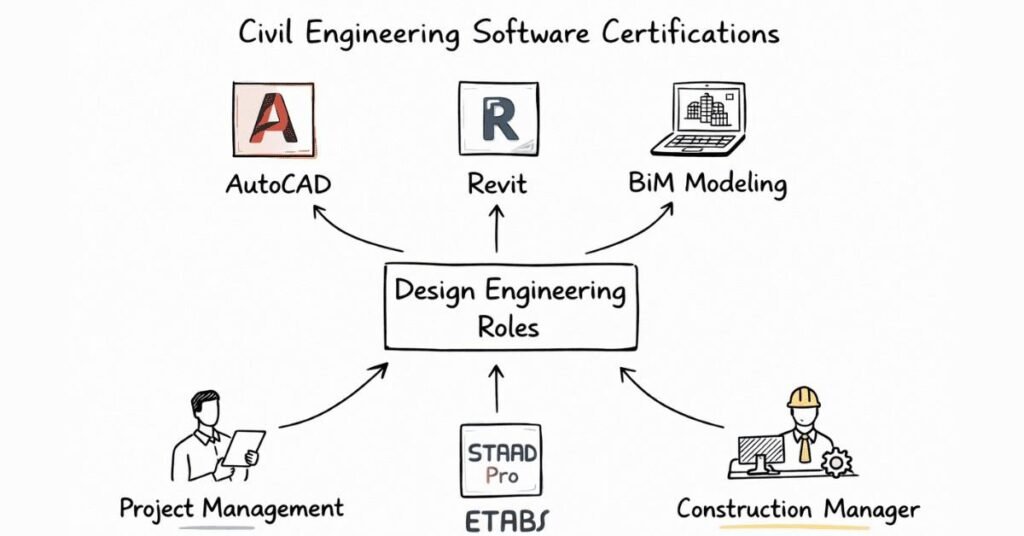
2. Software Certifications (CAD, BIM, Analysis Tools)
Software skills are your bread and butter as a modern civil engineer.
- AutoCAD Certification
- Validates your drawing and drafting skills.
- Useful for almost every civil role—site, design, planning, quantity surveying.
- Validates your drawing and drafting skills.
- Revit / BIM Certifications
- Critical for BIM Specialist, BIM Coordinator, BIM Manager roles.
- BIM is rapidly becoming standard in big infrastructure and real estate projects.
- Critical for BIM Specialist, BIM Coordinator, BIM Manager roles.
- STAAD Pro / ETABS / SAP2000 Certifications
- Essential for those targeting structural design roles.
- Shows that you are not just a beginner user but have deep understanding.
- Essential for those targeting structural design roles.
These certifications can be done relatively early:
- Ideal window: BTech 3rd–4th year or 0–3 years experience, so you can use them to land better roles.
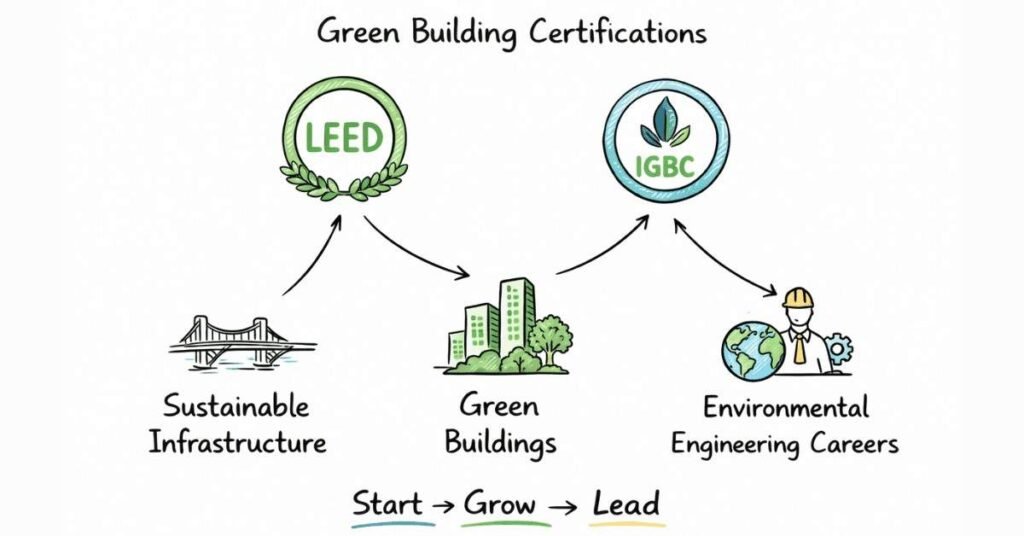
3. Green Building & Sustainability Certifications (LEED, IGBC)
If you’re passionate about sustainability and environmental impact, this area is growing fast.
- LEED Green Associate / LEED AP
- Focus on sustainable design, energy efficiency, water conservation, waste reduction.
- Focus on sustainable design, energy efficiency, water conservation, waste reduction.
- IGBC Certifications (Indian Green Building Council)
- Focused on Indian context and rating systems for green buildings.
Why it matters:
- Green buildings are not a “trend” anymore; they are becoming standard.
- Many clients specifically request green-certified buildings.
- Gives you an edge for roles in environmental engineering, sustainable design, green infrastructure, and smart city projects.
Best time: 2–6 years experience or when you join a firm that actively works on green building projects.
4. Safety & Site Management Certifications
Construction sites are high-risk environments. Safety-related certifications help you stand out for site and management roles.
- NEBOSH / IOSH (international safety certifications)
- Construction safety diplomas or certifications
Benefits:
- Useful for site engineers, safety officers, construction managers.
- Increases trust from employers for roles requiring strict safety compliance.
- Important for large infrastructure and industrial projects.
5. Quantity Surveying & Contracts Certifications
If you’re interested in the commercial side of projects—costs, contracts, claims—this is your domain.
- Certifications in Quantity Surveying (QS)
- Training in contracts & claims management
Useful for:
- Roles like Quantity Surveyor, Contracts Engineer, Cost Engineer.
Those who enjoy numbers, negotiation, and documentation more than pure technical design.
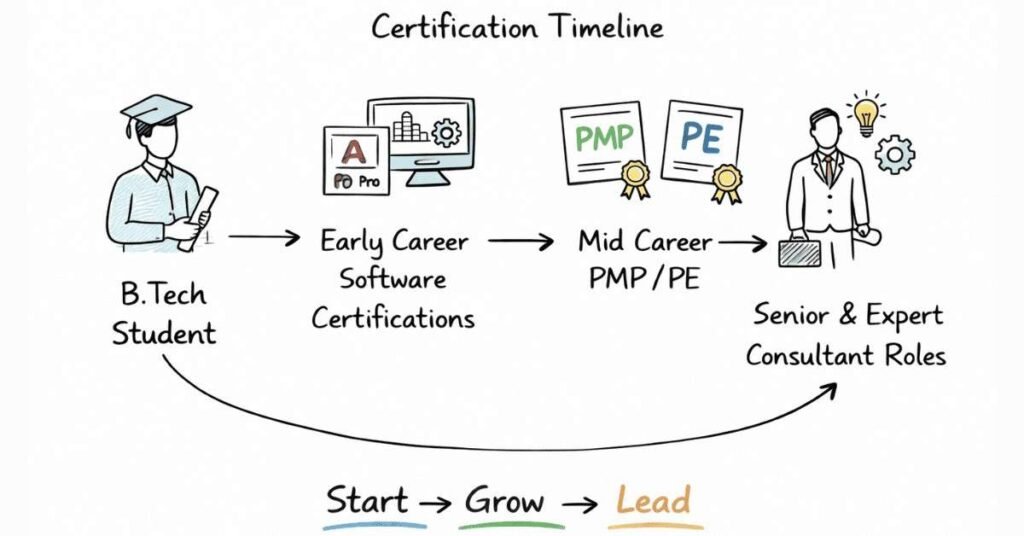
Which Certifications to Do at What Stage (Practical Roadmap)
To keep it simple, here’s a suggested timeline:
During BTech (3rd–4th Year)
- Learn and (if possible) certify in:
- AutoCAD
- One structural / BIM tool (Revit or STAAD basic level)
- AutoCAD
- Attend short workshops on:
- Project management basics
- Green building basics
- Project management basics
Focus: Build employable software skills so you stand out as a fresher.
Early Career (0–3 Years)
- Strengthen hands-on skills on site or in design office.
- Add:
- Revit / BIM certification (if interested in design/ digital roles).
- STAAD / ETABS (if interested in structural design).
- Revit / BIM certification (if interested in design/ digital roles).
- Consider small certifications in:
- Construction safety
- Quantity surveying (if inclined towards cost side).
- Construction safety
Focus: Become technically strong + software-competent.
Mid Career (3–8 Years)
- Now think serious professional recognition:
- Prepare your profile and logbook for PE-type certification.
- Go for PMP or equivalent project management credential if you’re managing projects.
- LEED / IGBC if you’re in green or urban projects.
- Prepare your profile and logbook for PE-type certification.
Focus: Move from “doer” to “leader / specialist”.
Senior Career (8+ Years)
- Maintain your credentials with continuous learning.
- Upgrade to advanced credentials, speak at conferences, publish case studies.
- Use your certifications to:
- Win high-level roles.
- Start your own consultancy/firm.
- Position yourself as an expert in a niche (e.g., “Senior Structural Consultant, PE, PMP”).
- Win high-level roles.
Focus: Leverage your credentials for leadership and consulting.
How to Prepare for Certification Exams (Without Burning Out)
Most civil engineers work long hours. Preparing for exams on top of that can be tough. A few realistic tips:
- Start early, go slow: 1–2 hours a day is enough if you are consistent over a few months.
- Use official study guides: For PMP, LEED, etc., official materials are worth the investment.
- Practice real problems: For software, practice real drawings and models, not just theory.
- Leverage your daily work: Use your current projects as study material—relate theory to what you see on site or in design.
- Study groups: If possible, prepare with friends/colleagues. Accountability helps.
Common Myths About Certifications
- “If I get one big certification, my salary will double.”
Reality: Certifications improve your profile, but salary growth comes from experience + performance + negotiation. - “I need to collect as many certificates as possible.”
Reality: Two or three relevant, respected certifications are better than ten random ones. - “Certifications are only for people going abroad.”
Reality: Indian employers increasingly value structured certifications, especially in large firms and major projects. - “If I don’t have certifications, my career is over.”
Reality: Many excellent engineers never pursued formal certifications. They grew through strong work, networking, and results. Certifications are boosters, not life-or-death
How to Decide Which Certification Is Right for You
Ask yourself:
- What kind of role do I want in 5–10 years?
- Project Manager? → PMP
- Structural expert? → STAAD/ETABS + PE-type credential
- BIM leader? → Revit/BIM certifications
- Green building expert? → LEED/IGBC
- Project Manager? → PMP
- Do I want to start a consultancy later?
- Yes → PE-type certification becomes more valuable.
- Yes → PE-type certification becomes more valuable.
- Am I ready to invest time and money now?
- If not, plan a realistic timeline instead of rushing.
- If not, plan a realistic timeline instead of rushing.
Write down your dream role, then pick certifications that directly support that role—nothing more, nothing less.
In Simple Words
- As a student or fresher: focus on software + basics.
- As a mid-level engineer: focus on specialization + reputation (PE, PMP, etc.).
- As a senior engineer: use credentials to lead, consult, and grow your influence.
Licenses and certifications are like high-quality tools in a construction project: they don’t build the structure on their own, but in the hands of a skilled engineer, they multiply the impact.