
What is Civil Engineering? Career Overview & Industry Impact
Table of Contents
Introduction
When you look at the Bandra-Worli Sea Link stretching across Mumbai’s coastline, or walk through a metro station in Delhi, or drive on the smooth Chennai-Bangalore highway, you’re witnessing civil engineering in action. But what exactly do civil engineers do? And why should you consider this as a career?
Let’s break it down in simple terms, without the technical jargon that makes most engineering explanations confusing.
What is Civil Engineering? The Simple Explanation
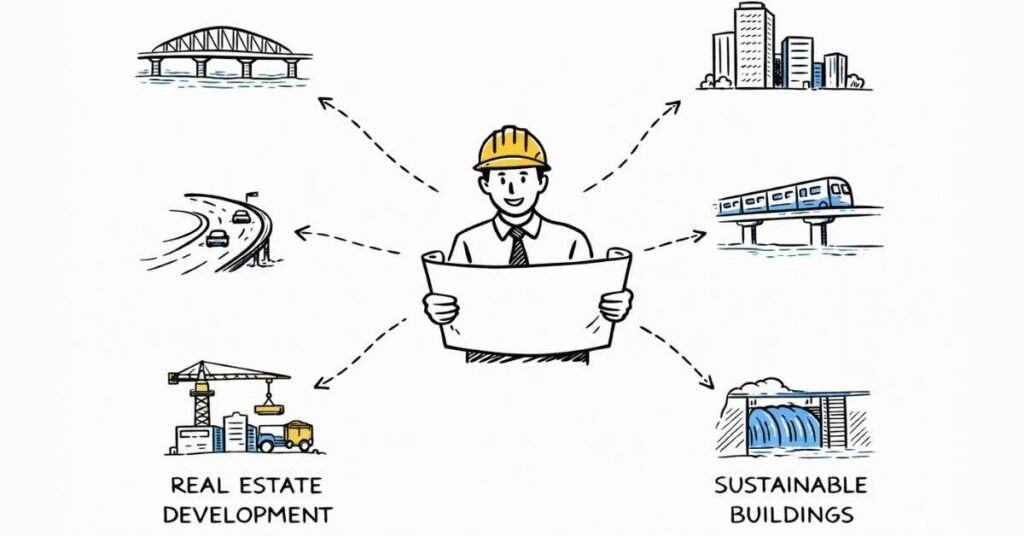
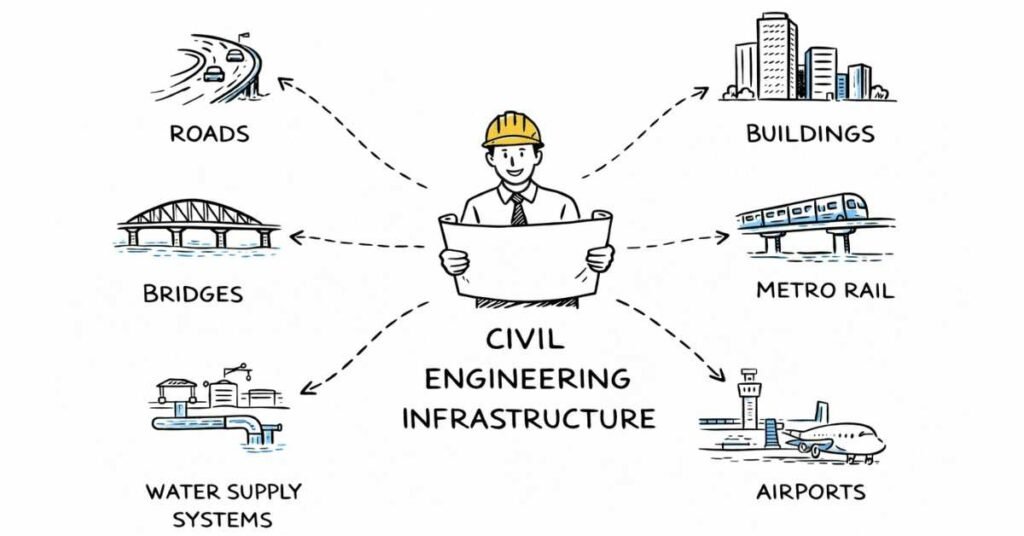
Civil engineering is the branch of engineering that deals with designing, building, and maintaining the physical infrastructure we use every day. When we say infrastructure, we mean roads, bridges, buildings, dams, airports, metro systems, water supply networks, sewage treatment plants—basically everything that makes modern life possible.
people who turn ideas into reality. An architect might design a beautiful building, but it’s the civil engineer who figures out how to actually build it so it doesn’t fall down. A government might plan a new metro line, but civil engineers are the ones who make it happen—from surveying the land to designing the tunnels to overseeing construction.
Here’s an interesting way to understand it: if you removed all the work done by civil engineers from any city, you’d be left with just the land. No buildings, no roads, no water supply, no electricity poles—nothing. That’s how fundamental civil engineering is to modern civilization.
What Do Civil Engineers Actually Do Every Day?
The daily work of a civil engineer varies hugely depending on their role and specialization, but let me give you a realistic picture:
If you’re a site engineer, your day starts early. You reach the construction site, check the previous day’s work, meet with contractors and supervisors, review construction drawings, ensure materials are delivered on time, solve problems that come up (and trust me, problems always come up), document the day’s progress, and coordinate between the design team and the actual workers building the structure.
You’re not sitting in an air-conditioned office. You’re wearing a hard hat, walking around the site, climbing scaffolding to inspect work, checking if the concrete quality is right, ensuring safety measures are followed. It’s hands-on, it’s challenging, and it’s how most civil engineers start their careers.
If you’re a design engineer, you’re working in an office (usually air-conditioned, thankfully), using software like AutoCAD, STAAD Pro, or Revit to create structural designs. You’re calculating loads, analyzing how structures will behave under different conditions, creating detailed drawings, coordinating with architects and other engineers, and ensuring your designs meet safety codes and building regulations.
If you’re a project manager, your role is more strategic. You’re managing budgets (making sure the project doesn’t run out of money), coordinating teams (design engineers, site engineers, contractors, suppliers), communicating with clients and stakeholders, solving conflicts, making decisions about materials and methods, and ensuring the project stays on schedule.
The common thread? Problem-solving. Civil engineering is all about solving real-world problems with practical solutions.

Why Civil Engineering Exists: The Big Picture
Let’s talk about why this profession matters, especially in India’s context.
India is undergoing massive urbanization. By 2030, over 600 million Indians will live in cities. These people need homes to live in, offices to work in, roads to travel on, metro systems for daily commute, clean water to drink, and systems to manage waste. Who creates all this? Civil engineers.
The Indian government has launched ambitious infrastructure programs:
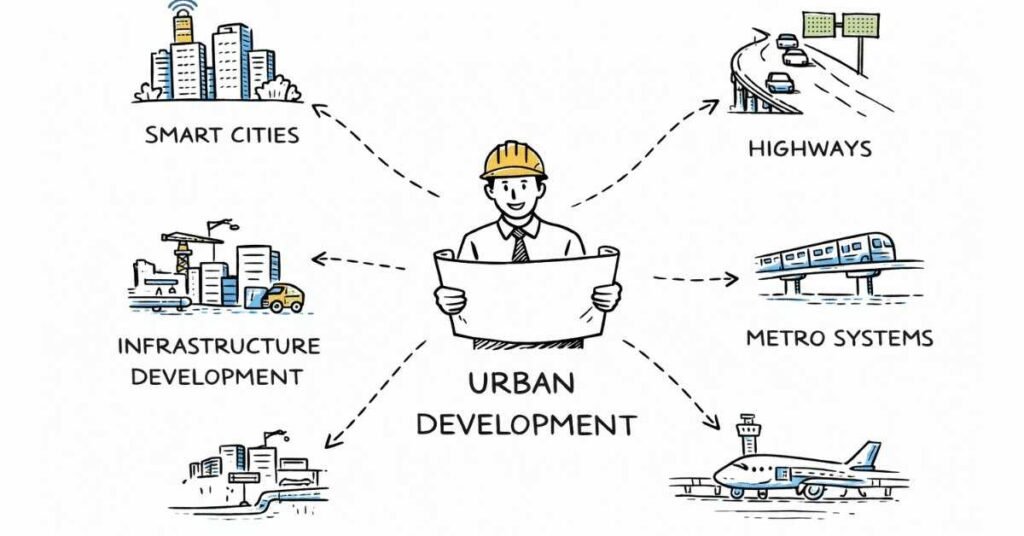
The Smart Cities Mission aims to develop 100 cities with modern infrastructure, sustainable environment, and decent quality of life. This involves designing smart transportation systems, energy-efficient buildings, water conservation systems, and IT-enabled governance. Total investment: over ₹2 lakh crores. Every rupee of this creates opportunities for civil engineers.
The Delhi-Mumbai Industrial Corridor is a $90 billion project creating industrial smart cities between Delhi and Mumbai. This requires civil engineers to plan cities from scratch, design industrial zones, build logistics hubs, create housing for millions of workers, and develop supporting infrastructure.
Metro rail systems are being built or expanded in cities like Bangalore, Pune, Ahmedabad, Nagpur, Kochi, and many others. Each metro project requires thousands of civil engineers—from planning routes to designing stations to building underground tunnels to installing tracks.
Without civil engineers, these projects remain PowerPoint presentations. Civil engineers are the ones who make development happen on the ground.
The Different Faces of Civil Engineering
Here’s something many students don’t realize: “civil engineer” isn’t one job—it’s many different jobs under one umbrella.
Structural engineers focus on making sure buildings and bridges don’t collapse. They calculate loads, design load-bearing elements like beams and columns, select appropriate materials, and ensure structures can withstand earthquakes, wind, and other forces. If you’ve ever wondered how buildings in earthquake-prone areas like Delhi or shimla stay standing during tremors, thank a structural engineer.
Geotechnical engineers are the soil experts. Before any construction begins, someone needs to study the soil—is it strong enough to support a building? How deep should the foundation go? Will the ground settle over time? Geotechnical engineers answer these questions. They’re especially important for big projects like high-rise buildings, bridges, and dams.
Transportation engineers design roads, highways, railways, and airports. They figure out optimal routes, design traffic systems, plan public transportation networks, and work on making travel safer and more efficient. With India’s focus on highway development and metro expansion, transportation engineers are in high demand.
Water resources engineers work on dams, canals, irrigation systems, flood control, and water treatment. In a country where water scarcity is a growing concern, these engineers play a critical role in water conservation and distribution.
focus on sustainability—waste management, pollution control, environmental impact assessments, and green building design. As India commits to reducing carbon emissions and sustainable development, environmental engineers are becoming increasingly important.
Construction managers are the orchestrators. They don’t necessarily do the technical design work, but they manage entire projects—coordinating teams, managing budgets, dealing with contractors, ensuring quality, and making sure everything finishes on time.
Public Sector vs. Private Sector: Where Do Civil Engineers Work?
Civil engineers work in both government and private organizations, and the experience is quite different in each.
Government jobs (PWD, NHAI, Railways, CPWD, state engineering departments) offer job security, pension benefits, work-life balance, and the satisfaction of working on public welfare projects. However, salaries are generally lower than private sector, bureaucratic processes can be frustrating, and career progression might be slower.
Private construction companies (L&T, Tata Projects, Shapoorji Pallonji, GMR) offer higher salaries, faster career growth, performance-based bonuses, and exposure to diverse projects. But you might face more work pressure, longer hours, frequent travel to project sites, and less job security than government positions.
Real estate developers (DLF, Godrej Properties, Prestige Group) focus on residential and commercial construction. The pay can be good, and projects are usually in urban areas, but the work can be high-pressure with tight deadlines.
Consulting firms (AECOM, Jacobs, Arup) provide design and advisory services. These offer good work-life balance, intellectually stimulating work, and exposure to international projects, though salaries might be moderate.
Many civil engineers also start their own consultancies or contracting firms after gaining experience. Entrepreneurship opportunities are significant in this field.
The Impact: Why Your Work Matters
Let me tell you something that makes civil engineering unique: your work outlives you.
Software engineers write code that might become obsolete in five years. Marketing campaigns are forgotten in months. But bridges you help build stand for decades, sometimes centuries. Buildings you design become part of people’s daily lives for generations.
There’s a famous story about the Howrah Bridge in Kolkata, built in 1943. The engineers who designed it are long gone, but millions of people still cross that bridge every day. That’s the kind of lasting impact civil engineers have.
Your work directly affects people’s lives. The metro system you help build reduces commute times for millions. The water treatment plant you design ensures clean drinking water. The earthquake-resistant building you construct saves lives during disasters. The affordable housing project you execute gives families their first home.
This sense of purpose and tangible impact is what attracts many people to civil engineering. It’s not just a job—it’s about building the infrastructure that helps society function.
Challenges in Civil Engineering: The Reality Check
Let’s be honest about the challenges, because you should know what you’re getting into.
Site work can be tough. You might be posted to remote locations where a highway or dam is being built. Living away from family, working in extreme weather (scorching heat or freezing cold), dealing with basic facilities—it’s not glamorous.
The pay gap. When your batchmate who joined an IT company is earning ₹8-10 LPA as a fresher, you might be starting at ₹3.5-4 LPA. That can sting. However, remember that experienced civil engineers with proven expertise earn very well—₹15-20 LPA and above.
Responsibility and pressure. Mistakes in civil engineering can have serious consequences. A structural failure can cost lives. Project delays can cost millions. This responsibility weighs on you, especially as you take on bigger roles.
Physical demands. Unlike desk jobs, civil engineering often involves site visits, walking, climbing, being on your feet for hours. If you have health issues or physical limitations, this can be challenging.
Gender barriers. Let’s acknowledge this: construction sites in India are still male-dominated spaces. Women civil engineers often face additional challenges in gaining respect and managing site teams. Things are improving, but slowly.
Why Choose Civil Engineering in 2026 ?
Despite the challenges, here’s why civil engineering remains a solid career choice:
India’s infrastructure needs are enormous. We need to build housing for millions, create transportation networks for growing cities, develop water supply systems, manage waste in sustainable ways, and build industrial infrastructure. This creates massive, long-term demand for civil engineers.
Job security is high. Unlike some sectors that face boom-and-bust cycles, construction and infrastructure are steady. Buildings will always need to be built, roads will always need maintenance, cities will always need to expand.
Diverse career options. You can work in design, construction, management, consulting, government, private sector, or start your own business. Few fields offer this much variety.
Global opportunities. Civil engineering skills are transferable across countries. If you gain PE certification and experience, opportunities exist in the Middle East, Southeast Asia, Africa, and developed countries.
Continuous learning. The field is evolving with BIM technology, sustainable practices, smart infrastructure, and AI applications. If you enjoy learning new things, you’ll never be bored.
Tangible satisfaction. There’s something deeply satisfying about pointing to a structure and saying “I built that.” That sense of accomplishment is hard to match.

Who Should Consider Civil Engineering?
Civil engineering is a good fit if you:
- Enjoy practical, hands-on work rather than purely theoretical or desk-based jobs
- Are interested in how things are built and work
- Don’t mind working in challenging environments
- Want to see direct, visible results of your work
- Are good at problem-solving and thinking on your feet
- Enjoy coordinating with different types of people
- Care about contributing to national development and infrastructure
It might not be ideal if you:
- Strongly prefer office-based work only
- Are not comfortable with physical work or site environments
- Want the highest starting salaries right out of college
- Prefer individual work over team coordination
- Want to work only in metro cities with all comforts
Getting Started: First Steps
If you’re convinced that civil engineering is for you, here’s how to start:
During your BTech, focus on:
- Building strong fundamentals in core subjects like structural analysis, geotechnical engineering, and concrete technology
- Learning essential software (AutoCAD is a must; also explore STAAD Pro, Revit)
- Doing quality internships at construction sites and design firms
- Understanding practical aspects through site visits and lab work
- Joining professional organizations like IEI (Institution of Engineers India)
For freshers, your priorities should be:
- Don’t be too picky about your first job. The goal is to gain experience
- Site experience is invaluable, even if it’s tough initially
- Learn from senior engineers—their practical knowledge is gold
- Network within the industry
- Keep updating your technical skills
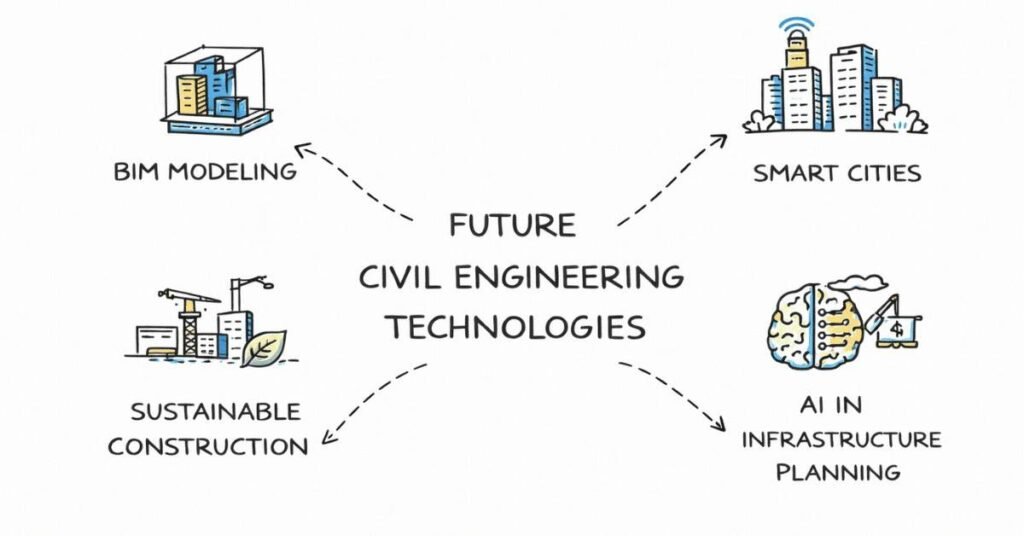
The Future is Being Built Today
Civil engineering is entering an exciting phase. Traditional practices are being transformed by digital technologies like Building Information Modeling (BIM), which is creating 3D digital representations of projects. Sustainable construction is moving from a niche concept to mainstream practice. Smart cities are integrating IoT sensors, AI-based traffic management, and data-driven urban planning.
The India of 2047—the developed nation envisioned under Viksit Bharat—will be built by civil engineers working today. The metro systems, smart cities, industrial corridors, sustainable buildings, and resilient infrastructure will all bear the mark of this generation of civil engineers.
The question is: do you want to be part of building that future?
Wrapping Up: More Than Just a Career
Civil engineering isn’t just about calculations and construction—it’s about shaping the physical world we live in. It’s about problem-solving, teamwork, and making a tangible difference. It’s challenging, demanding, and sometimes frustrating, but it’s also rewarding, stable, and full of opportunities.
Unlike careers that exist in the abstract—lines of code, marketing strategies, financial models—civil engineering creates something you can touch, see, and experience. It’s real, it’s permanent, and it matters.
If you’re the kind of person who wants their work to have visible, lasting impact on society, civil engineering might just be the perfect career for you.