
Civil Engineering Career Guide: Infrastructure & Construction Jobs
Table of Contents
Why Civil Engineering Matters in India's Future ?
Introduction
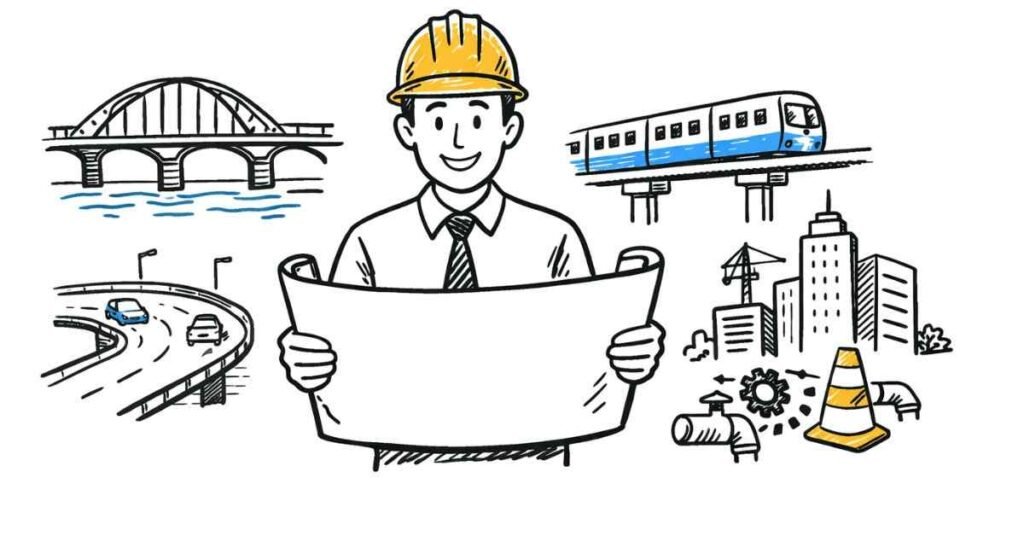
Picture this: you’re standing at a metro station in Hyderabad, watching trains glide smoothly on elevated tracks. Or you’re driving on the Yamuna Expressway, marveling at how smooth the road feels. Behind every bridge, building, metro rail, and highway you see, there’s a civil engineer who made it happen.
Civil engineering isn’t just about concrete and steel—it’s about building the backbone of our nation. With India aiming to become a developed country by 2047 under the Viksit Bharat initiative, the construction and infrastructure sectors are witnessing unprecedented growth. The government’s massive push toward smart cities, industrial corridors, and sustainable infrastructure means one thing: civil engineers are in huge demand.
If you’re a student wondering whether civil engineering is the right career choice, or a fresh graduate trying to figure out where to start, this comprehensive guide is for you. We’ll walk through everything—from what civil engineers actually do daily, to how much they earn, what skills you need, and how to grow in this field.
This isn’t going to be your typical textbook explanation filled with technical jargon. Think of this as a conversation with a senior who’s been there and knows the ropes. By the end of this guide, you’ll have a clear roadmap to launch and grow your civil engineering career in India.
What Does a Civil Engineer Actually Do?
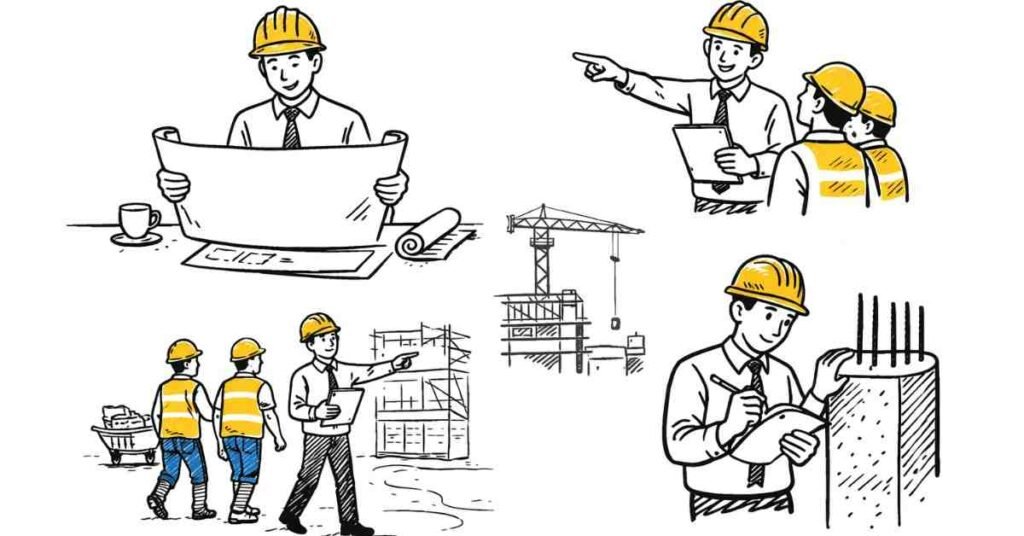
Let’s start with the basics. Civil engineers design, plan, build, and maintain the physical infrastructure around us. This includes roads, bridges, dams, airports, metro rails, water supply systems, sewage treatment plants, residential buildings, commercial complexes, and industrial facilities.
But here’s the thing many students don’t realize: civil engineering isn’t just one job. It’s a collection of different specializations, each with its own focus area. Some civil engineers work on designing earthquake-resistant buildings (structural engineers), while others focus on soil testing before construction begins (geotechnical engineers). Some manage entire construction projects from start to finish (construction managers), and others plan city-wide transportation networks (transportation engineers).
What makes civil engineering unique is its real-world impact. Unlike software that exists in the digital realm, the work you do as a civil engineer is visible. You can point to a building or bridge and say, “I helped build that.” That sense of tangible achievement is something many engineers find deeply satisfying.
The Indian Civil Engineering Landscape in 2026
India is currently experiencing a construction boom. Here’s why this matters for your career:
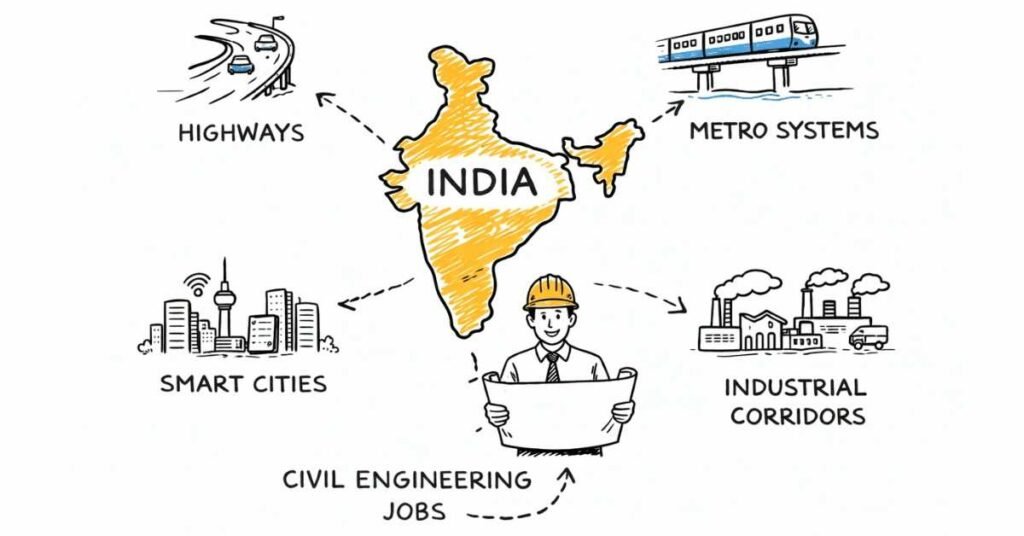
Infrastructure Modernization: The government has invested over ₹2 lakh crores in smart city projects across 100 cities, creating massive job opportunities for civil engineers. These aren’t just construction jobs—they require expertise in sustainable design, smart infrastructure, IoT integration, and urban planning.
Industrial Corridors: Projects like the Delhi-Mumbai Industrial Corridor (DMIC), estimated at $90 billion, are creating millions of jobs in construction, planning, and project management. These mega-projects need civil engineers at every stage—from initial planning to final execution.
Urban Population Growth: By 2030, India’s urban population is expected to exceed 600 million people. This means more residential buildings, commercial spaces, public transportation systems, water supply networks, and waste management facilities—all requiring civil engineers.
Metro Rail Expansion: Cities like Bangalore, Pune, Ahmedabad, Nagpur, and Kochi are building or expanding metro systems, creating specialized opportunities in transportation engineering and underground construction.
Sustainable Infrastructure: With increasing focus on environmental sustainability, there’s growing demand for civil engineers who understand green building practices, renewable energy infrastructure, and eco-friendly construction methods.
Civil Engineering Specializations: Finding Your Path
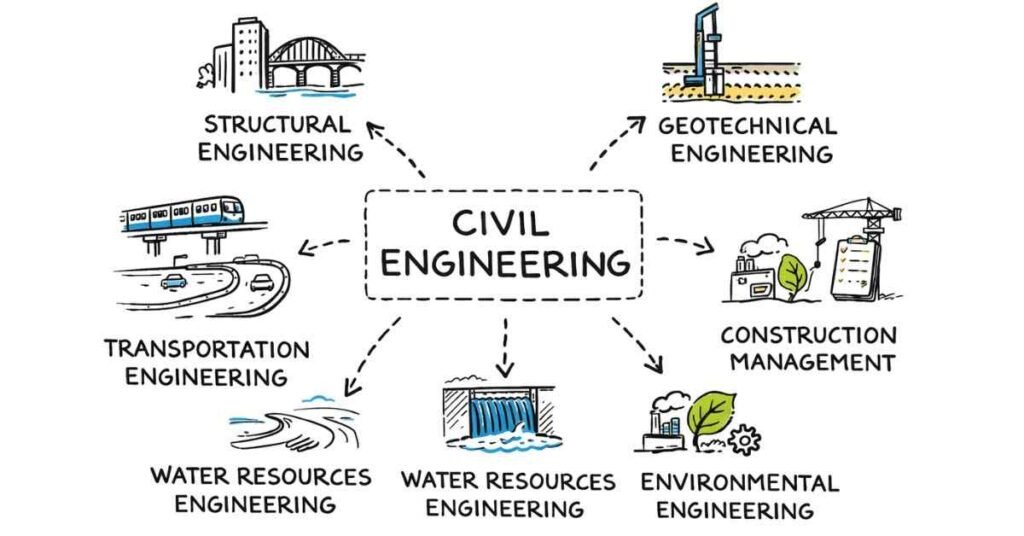
One of the first decisions you’ll make in your civil engineering career is choosing a specialization. While you’ll learn the basics of all areas during your BTech, most engineers eventually specialize in one or two fields. Here’s a quick overview:
Structural Engineering focuses on designing safe, stable structures like buildings, bridges, and stadiums. Structural engineers ensure buildings can withstand earthquakes, wind loads, and other forces. Average salary ranges from ₹4-9 LPA depending on experience.
Geotechnical Engineering deals with soil mechanics, foundation design, and ground stability. Before any building goes up, geotechnical engineers analyze the soil to determine what kind of foundation is needed. This specialization pays well, with salaries ranging from ₹5-10 LPA.
Transportation Engineering involves planning and designing roads, highways, railways, airports, and mass transit systems. With India’s infrastructure push, transportation engineers are in high demand, especially in government projects.
Water Resources Engineering focuses on dams, canals, irrigation systems, flood control, and water treatment plants. This field is particularly important in water-scarce regions and growing urban areas.
Environmental Engineering addresses sustainability challenges—waste management, pollution control, green building design, and environmental impact assessments. As India moves toward sustainable development, this specialization is gaining importance.
Construction Management is where engineering meets business. Construction managers oversee projects, manage budgets and timelines, coordinate teams, and ensure quality control. This career path can lead to senior management roles with salaries reaching ₹10-20 LPA for experienced professionals.
BIM Specialists (Building Information Modeling) are the new-age civil engineers who work with 3D modeling software, digital construction workflows, and clash detection. BIM engineers earn between ₹6-12 LPA, with salaries rising rapidly as more firms adopt digital-first strategies.
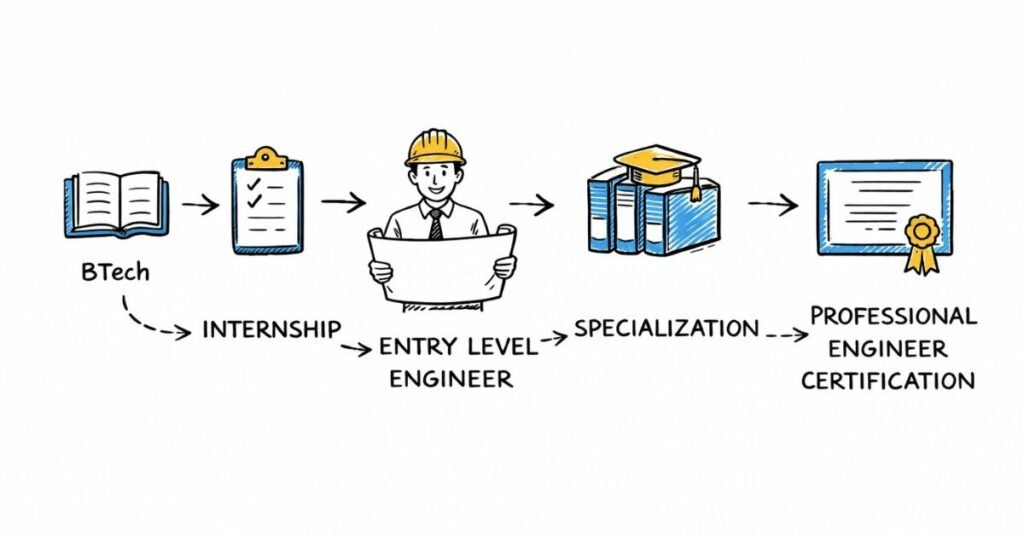
Education Pathway: From BTech to Professional Certification
Undergraduate Education
Your journey starts with a BTech or BE in Civil Engineering, which is a four-year program offered by engineering colleges across India. The curriculum covers fundamental subjects in the first two years—mathematics, physics, engineering mechanics, and basic civil engineering concepts.
In years three and four, you dive into core civil engineering subjects like:
- Strength of Materials (understanding how different materials behave under stress)
- Structural Analysis (calculating forces and moments in structures)
- Geotechnical Engineering (soil mechanics and foundation design)
- Concrete Technology (properties and applications of concrete)
- Transportation Engineering (highway and traffic engineering)
- Environmental Engineering (water supply, waste management)
- Surveying and Geomatics (land measurement, GPS, GIS technology)
Practical Training Matters
Here’s something professors won’t emphasize enough: practical training is just as important as theoretical knowledge. Companies don’t just want students who can solve equations—they want engineers who understand how things work on construction sites.
Make sure you do proper internships during summer breaks. Visit construction sites, talk to site engineers, understand how drawings become actual structures. Many colleges also include lab work in surveying, concrete testing, soil mechanics, and computer-aided design (CAD).
Higher Education Options
After BTech, you have several options:
- MTech in Civil Engineering (2 years): Specialization in structural, geotechnical, transportation, or environmental engineering
- MS abroad: If you’re considering international opportunities
- MBA: If you want to move into construction management or project management roles
- PhD: If you’re interested in research and teaching
Professional Engineer (PE) Certification
In India, the Institution of Engineers India (IEI) offers Professional Engineer (PE) certification. To be eligible, you need a BE/BTech degree recognized by statutory authorities, 5 years of work experience, membership in a recognized professional society, and continuous professional development.
While PE certification isn’t mandatory like it is in the US, it adds credibility to your profile, especially if you’re planning to work on international projects or start your own consulting practice.
Essential Skills Every Civil Engineer Needs
Technical Skills
Let’s be honest: civil engineering is technical, and you’ll need to master certain software and tools to stay competitive:
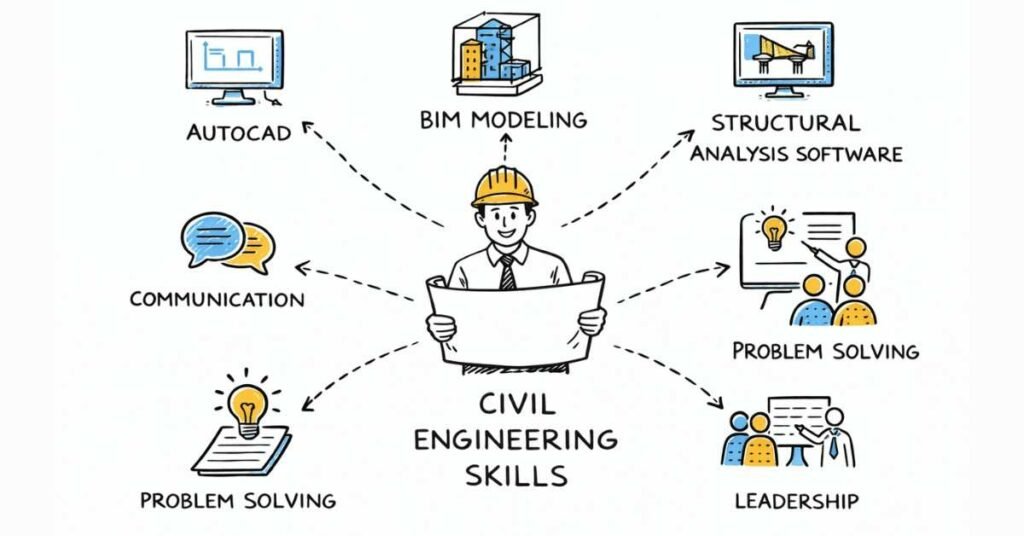
AutoCAD: This is non-negotiable. AutoCAD is used for creating 2D and 3D drawings of structures. Every civil engineer should know how to read and create AutoCAD drawings.
Building Information Modeling (BIM): Software like Revit, Tekla, and Navisworks are becoming industry standards. BIM specialists are highly paid because this skill is in short supply.
Structural Analysis Software: Tools like STAAD Pro, SAP2000, and ETABS help analyze how structures will behave under different loads.
Project Management Software: MS Project, Primavera P6 for planning and scheduling
GIS and Remote Sensing: Especially important for transportation and urban planning
Soft Skills That Make a Difference
Technical knowledge gets you in the door, but soft skills help you grow:
Communication: You’ll work with architects, contractors, clients, government officials, and laborers. Explaining technical concepts in simple language is crucial.
Problem-Solving: Construction sites are full of unexpected challenges—material shortages, weather delays, design conflicts. The ability to think on your feet and find practical solutions is invaluable.
Team Leadership: As you grow, you’ll manage teams of junior engineers, technicians, and contractors. Leadership isn’t about bossing people around—it’s about coordination, motivation, and conflict resolution.
Time Management: Construction projects have strict deadlines. Delays cost money. Managing your time and your team’s time effectively is a skill that separates average engineers from great ones.
Attention to Detail: A small error in calculation or oversight in design can have serious consequences. Developing a habit of double-checking your work saves lives and reputations.
Career Opportunities and Job Roles
Entry-Level Positions (0-2 Years)
When you graduate, you’ll typically start as a:
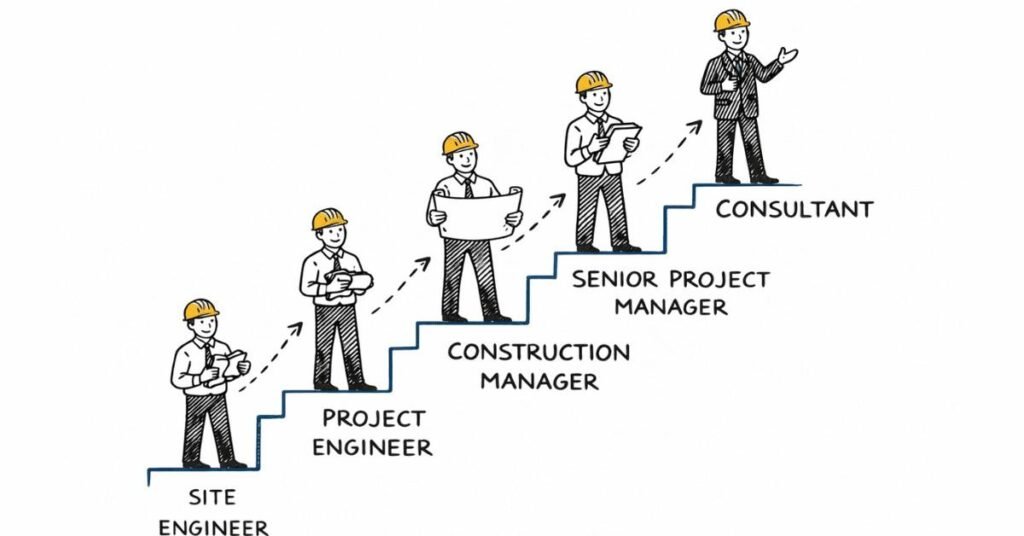
Site Engineer: Your primary role is supervising construction activities on-site, ensuring work matches design drawings, maintaining quality standards, and coordinating with contractors. Entry-level salaries range from ₹3.5-6.6 LPA depending on the company and location.
Junior Design Engineer: If you join a design consultancy, you’ll assist senior engineers in creating structural designs, preparing drawings, and performing calculations.
Quality Control Engineer: Ensuring materials and workmanship meet specified standards through testing and inspection.
Mid-Level Positions (3-7 Years)
With experience, you’ll move into roles with more responsibility:
Project Engineer: Managing specific aspects of larger projects, coordinating between design and execution teams.
Structural Engineer: Designing load-bearing elements of buildings and bridges. Salaries range from ₹4-9 LPA.
Construction Manager: Overseeing entire projects, managing budgets, timelines, and teams. Salaries in this range go from ₹4-10 LPA.
BIM Coordinator: Managing 3D models, coordinating between different disciplines, clash detection. BIM specialists earn ₹6-12 LPA.
Senior-Level Positions (7+ Years)
As you gain expertise and proven track record:
Senior Project Manager: Leading multiple projects, strategic planning, client relationship management. Salaries range from ₹10-20 LPA.
Principal Engineer/Consultant: Providing expert technical guidance, representing the firm in external forums.
Design Head: Leading design teams in consultancy firms, reviewing and approving designs
Construction Director: Overall responsibility for construction operations across multiple projects. Top performers earn ₹1.1-2.2 lakhs per month.
Salary Expectations: What Can You Really Earn?
Let’s talk numbers. Civil engineering salaries in India vary significantly based on experience, specialization, location, and company type.
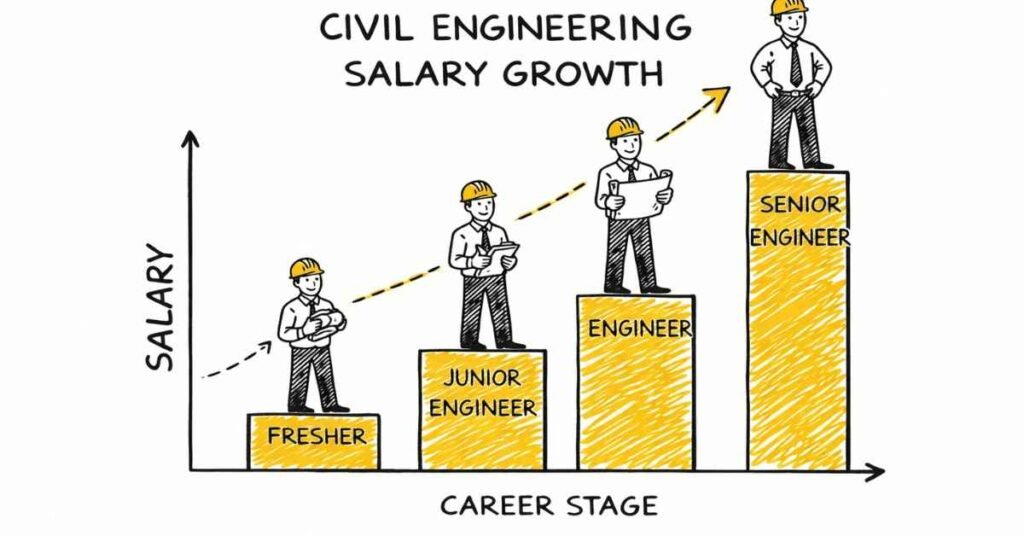
Freshers (0-2 Years): ₹3.5-6.6 LPA
- Government sectors and PSUs often pay at the lower end but offer better job security
- Top construction firms and MNCs pay at the higher end.
Mid-Level (3-7 Years): ₹4-10 LPA
- Specializations like BIM and geotechnical engineering command premium salaries
- Project managers earn toward the higher end of this range.
Senior Level (7+ Years): ₹10-20+ LPA
- Senior project managers in large infrastructure projects
- Consultants with established reputations
- BIM specialists in top firms earn ₹90,000 to ₹2.3 lakhs monthly.
Location Impact:
- Metro cities (Mumbai, Delhi, Bangalore, Hyderabad, Pune): Higher salaries but also higher cost of living
- Tier-2 cities: Lower salaries but better quality of life and cost advantages
- Project sites: Often in remote locations but may include accommodation and food
Sector-wise Variation:
- Private Construction Firms: Variable pay, performance bonuses, faster growth
- Government/PSU: Lower starting salaries but job security, pension benefits
- Consulting Firms: Good work-life balance, project-based work
- Real Estate Developers: High pressure but potentially high earnings
According to recent data, 70% of civil engineer salaries in India range between ₹17-50 lakhs for experienced professionals in senior positions.
Industry Sectors and Where to Work
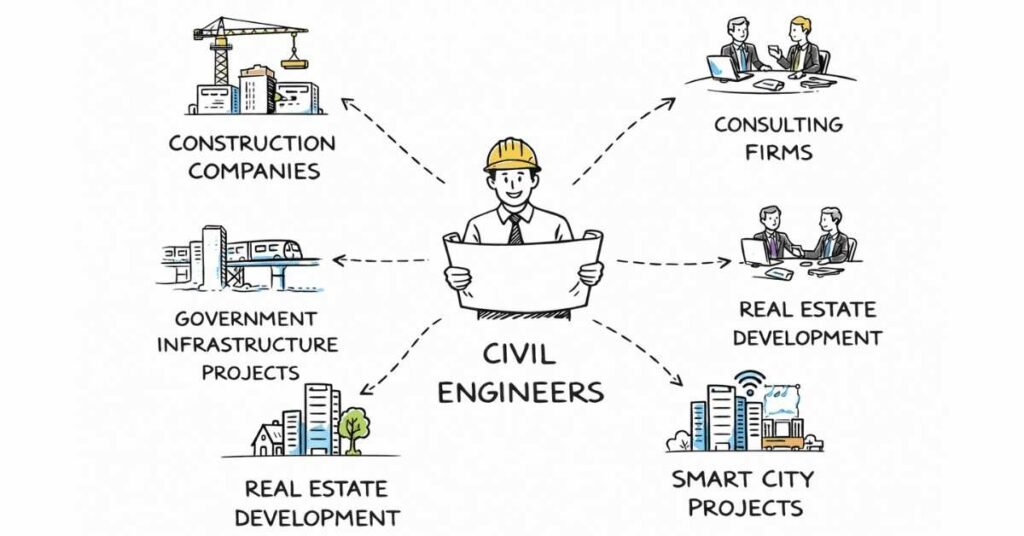
Construction and Infrastructure
This is the largest employer of civil engineers. Companies like L&T, Shapoorji Pallonji, Tata Projects, GMR, and Afcons Infrastructure are constantly hiring for residential, commercial, and infrastructure projects.
Government and Public Sector
Organizations like:
- NHAI (National Highways Authority of India): Highway construction and maintenance
- DMRC (Delhi Metro Rail Corporation): Metro projects nationwide
- PWD (Public Works Department): State-level infrastructure
- Railways: Station development, track maintenance, bridge construction
- CPWD: Central government construction projects.
Real Estate Development
Companies like DLF, Godrej Properties, Prestige Group, and Lodha Group employ civil engineers for residential and commercial project development.
Consulting Firms
Engineering consultancies like AECOM, Jacobs, Arup, and Indian firms like STUP Consultants provide design and supervision services. These firms offer good work-life balance and exposure to diverse projects.
Smart Cities and Urban Development
The Smart Cities Mission across 100 Indian cities has created specialized opportunities in sustainable infrastructure, IoT integration, and urban planning.
Industrial Corridors
Projects like the Delhi-Mumbai Industrial Corridor (DMIC) require civil engineers for industrial zone development, logistics hubs, and smart infrastructure.
Future Trends: Where is Civil Engineering Headed?
Digital Transformation
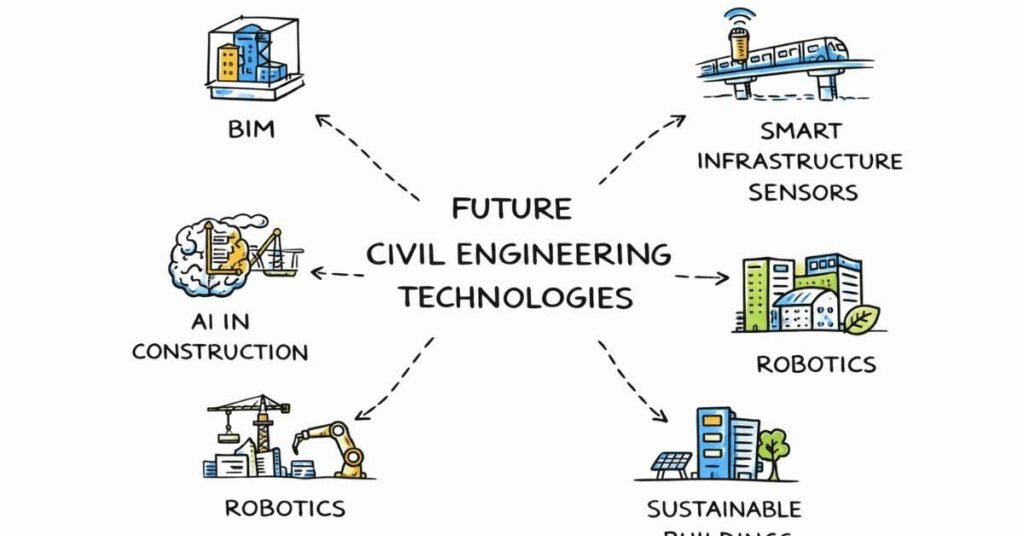
The construction industry is going digital. BIM, prefabrication, modular construction, and IoT-enabled infrastructure monitoring are becoming standard practices. Engineers who adapt to these technologies will have significant advantages.
Sustainable and Green Construction
India is committed to sustainable development. Green buildings, solar-powered infrastructure, rainwater harvesting, waste-to-energy plants, and eco-friendly materials are the future. LEED certification and knowledge of sustainable practices are increasingly valuable.
Smart Infrastructure
Smart roads with sensors, intelligent traffic management systems, automated metro operations, and app-based parking systems are part of India’s smart city vision.
Prefabrication and Modular Construction
Building components are increasingly manufactured in factories and assembled on-site, reducing construction time and improving quality.
AI and Robotics
While still emerging in India, AI is being used for design optimization, predictive maintenance, and safety monitoring. Robotics is entering construction for repetitive tasks.
Career Growth: Your Roadmap from Graduate to Leader
Years 0-3: Learning Phase
Focus on building strong fundamentals. Work on-site, get your hands dirty (sometimes literally), understand how structures are actually built, not just how they’re designed. This is when you develop practical judgment that textbooks can’t teach.
Years 3-7: Specialization Phase
Choose your specialization based on your interests and market demand. Develop expertise, take on more responsibility, perhaps pursue an MTech or professional certifications. This is when your earning potential starts increasing significantly.
Years 7-15: Leadership Phase
Move into project management, lead teams, handle client relationships, make strategic decisions. Your technical skills are now complemented by business acumen and people management.
Years 15+: Expert/Consultant Phase
You’re now an industry expert. Options include senior management in large firms, starting your own consultancy, or even teaching and research. Your experience and network are your biggest assets.
Challenges You Should Know About
Let’s be realistic. Civil engineering isn’t all glamorous:
Site Conditions: Many projects are in remote locations. You might spend months at project sites away from cities and family.
Work Pressure: Deadlines are strict, budgets are tight, and delays are costly. The pressure can be intense, especially during project peak phases.
Physical Demands: Site work involves walking, climbing, working in heat or cold. It’s not a typical 9-to-5 desk job.
Initial Salaries: Compared to software engineers, civil engineering freshers earn less. However, experienced civil engineers with proven expertise earn very well.
Responsibility: Errors in civil engineering can have serious consequences. The responsibility of ensuring structural safety is significant.
Making the Right Choice: Is Civil Engineering for You?
Civil engineering is ideal if you:
- Enjoy seeing tangible results of your work
- Are interested in how things are built
- Don’t mind working in challenging environments
- Want to contribute to national infrastructure development
- Prefer a mix of technical work and people management
- Are willing to continuously learn new technologies
It might not be the best fit if you:
- Prefer purely desk-based work
- Want to avoid physical work environments
- Are looking for the highest starting salaries
- Dislike working with diverse teams
- Want to work only in metro cities
Detailed Topic Guides
This master guide gives you the big picture. For deeper dives into specific topics, explore these comprehensive guides:
Getting Started:
- What is Civil Engineering? Career Overview & Industry Impact
- Civil Engineering Education Guide: Degrees, Courses & Certifications
- How to Get PE License & Professional Certifications
- How to Become a Civil Engineer: Complete Career Launch Guide
Specializations & Skills:
- 8 Civil Engineering Specializations: Find Your Career Path
- 15 Essential Civil Engineering Skills: Technical & Soft Skills Guide
- Top Civil Engineering Jobs: Roles, Responsibilities & Career Tracks
Industry & Opportunities:
- Civil Engineering Industry Sectors: Construction, Transportation & Urban Development
- Civil Engineering Salary Guide 2026: Expected Pay by Role & Experience
- Green Infrastructure & Smart Cities: Future of Civil Engineering Careers
- Government Civil Engineering Jobs: Public Sector Infrastructure Opportunities
- Urban Planning & City Infrastructure: Civil Engineering Career Guide
Growth & Future:
- Civil Engineering Technology Trends 2026: BIM, AI, Robotics & Innovation
- Civil Engineering Career Progression: From Graduate to Senior Leader
- Construction Management Careers: Project Leadership in Civil Engineering
Final Thoughts: Building Your Future
Civil engineering is more than a career—it’s a profession that shapes the physical world around us. Every time you cross a bridge, ride the metro, or walk into a building, you’re experiencing the work of civil engineers.
India’s infrastructure needs are enormous, and the opportunities for civil engineers are equally vast. With the right education, practical skills, and determination, you can build not just structures, but a fulfilling and rewarding career.
The field is evolving. Technology like BIM, sustainable practices, and smart infrastructure are transforming how civil engineers work. Those who embrace these changes and continuously update their skills will thrive.
Whether you dream of designing iconic structures, managing mega infrastructure projects, or contributing to India’s sustainable development, civil engineering offers a path to make that happen. The foundation starts now—with your education, your first internship, your first job. Each step builds upon the previous one, just like constructing a building.
Your career in civil engineering is your project. Plan it well, execute it diligently, and build it to last.